Captain Samuel Woodfill’s Medal of Honor Portrait


The Congressional Medal of Honor was awarded to 119 members of the U.S. Army, Navy, and Marine Corps during World War I, 33 of them posthumously. Portrait photographs of these heroes are remarkably scarce, but I was fortunate to recently acquire one. The subject of tonight’s post is Captain Samuel Woodfill of Indiana, one of America’s most celebrated soldiers of the Great War.

Captain Samuel Woodfill, U.S. Army
Often described by General John J. Pershing as “the outstanding soldier of the American Expeditionary Forces,” Captain Samuel Woodfill earned the Medal of Honor for extraordinary heroism during the Meuse-Argonne Offensive on October 12, 1918. Leading his company through heavy fog and enemy fire near Cunel, France, Woodfill singlehandedly attacked multiple German machine gun nests, killing or capturing their crews despite being gassed and exhausted. A career soldier from Indiana, Woodfill had already served in the Philippines and on the Mexican border before World War I, and his calm, precise marksmanship in France became legendary among his peers. After the war, he was personally honored by Pershing and later chosen to represent the U.S. Army’s enlisted men at the dedication of the Tomb of the Unknown Soldier in 1921.

Arlington National Cemetery Video: Major Samuel Woodfill

Reverse Side of Woodfill’s Portrait

His Medal of Honor citation reads:

“While he was leading his company against the enemy, First Lieutenant Woodfill’s line came under heavy machine gun fire, which threatened to hold up the advance. Followed by two soldiers at 25 yards, this officer went out ahead of his first line toward a machine gun nest and worked his way around its flank, leaving the two soldiers in front. When he got within ten yards of the gun it ceased firing, and four of the enemy appeared, three of whom were shot by First Lieutenant Woodfill. The fourth, an officer, rushed at First Lieutenant Woodfill, who attempted to club the officer with his rifle. After a hand-to-hand struggle, First Lieutenant Woodfill killed the officer with his pistol. His company there upon continued to advance, until shortly afterwards another machine gun nest was encountered. Calling on his men to follow, First Lieutenant Woodfill rushed ahead of his line in the face of heavy fire from the nest, and when several of the enemy appeared above the nest he shot them, capturing three other members of the crew and silencing the gun. A few minutes later this officer for the third time demonstrated conspicuous daring by charging another machine gun position, killing five men in one machine gun pit with his rifle. He then drew his revolver and started to jump into the pit, when two other gunners only a few yards away turned their gun on him. Failing to kill them with his revolver, he grabbed a pick lying nearby and killed both of them. Inspired by the exceptional courage displayed by this officer, his men pressed on to their objective under severe shell and machine gun fire.”


Southbridge, MA Native Charles Edwin Hellner’s WWI Journey


Southbridge’s First Soldier

Writeup by: Andrew Locke

(All photographs and narrative were provided by Locke)

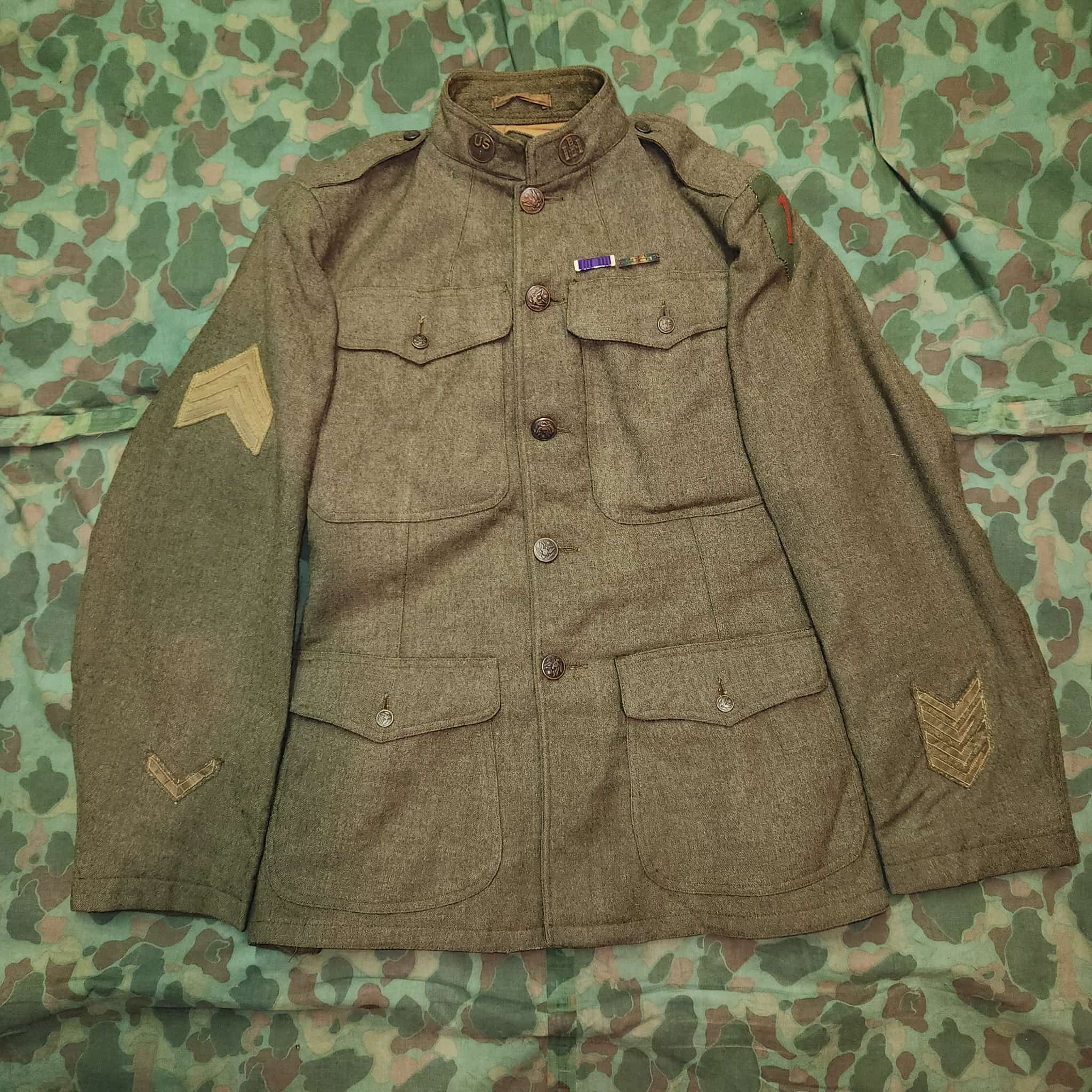
The first man from Southbridge, Massachusetts to enlist during World War 1 was Charles Edwin Hellner. He was born on April 11th, 1897 and was at the age of 20 when he enlisted for the US Army on May 7th, 1917. He was placed into B company of the 1st Engineer Regiment (part of the 1st Infantry Division) with about 30 other Southbridge men. After exactly three months of training he departed for France. 

Sgt. Hellner’s WWI Uniform

     Following their arrival, the soldiers of B company then spent more time training. This time it was in the tactics of trench warfare with the French as their experienced instructors. In later parts of the training, American units would serve alongside French ones in relatively idle sections of the frontline so that the doughboys could get some experience. While serving with elements of the 16th infantry on the morning of November 3rd, 1917, Hellner would be present for the first raid on American troops by the German army. The first three American deaths of the war occurred there.

Hellner’s Diary, Cigarette Case, Pocket Watch and War Medals

     Training and engineer work continued for Hellner’s unit until the 1st Division was called into action again. On May 28th, 1918 the 28th infantry regiment had attacked and successfully captured the French town of Cantigny. The 1st Engineers moved into the sector and began work fortifying the area and digging trenches. Hellner memorialized his service there with a large pennant that bears “Cantigny 1918” and his portrait which speaks to the fame of the battle at the time. While in these trenches at and around Cantigny, B company experienced shelling and fought off diversionary attacks from the German’s Montdidier-Noyon offensive that was aimed at nearby French positions.

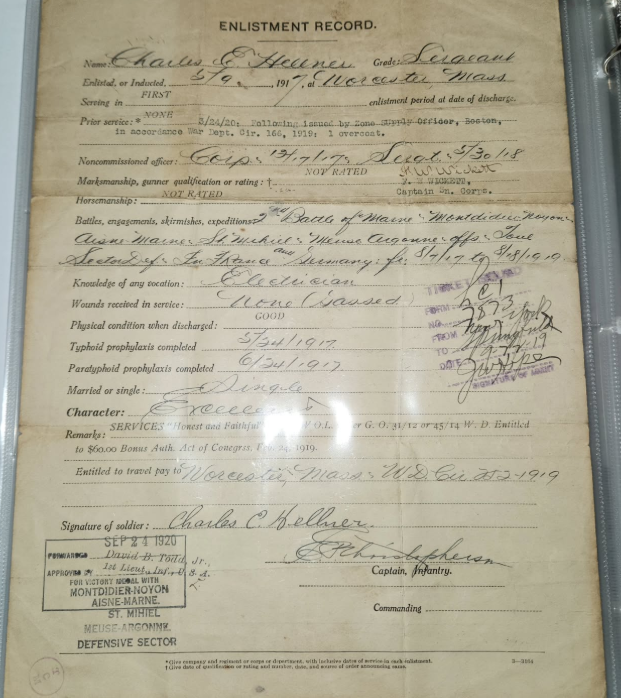
Hellner’s Discharge Paperwork

     On July 18th the 1st Engineers began its involvement in the Second Battle of the Marne. A German attack had recently pushed back allied lines before it faltered and it was realized that this was an opportunity for a counterattack. Hellner had recently been given command of his own squad and would now be leading them into battle. B company spent three days attacking the Germans near the town of Soissons. During the first day of attack on July 18th, a member of Hellner’s squad named William Broughton was hit in the stomach by a piece of shrapnel. Unfortunately, he eventually died from his wounds. Broughton had also come from Southbridge and Hellner wrote a letter home that informed his family that he had passed. July 19th saw B company’s advance slowed by machine gun fire that wounded several men and an officer. On July 20th, Hellner led his squad over the top at 4 AM with the rest of B company in the first wave. With heavy losses they were able to fight until they reached a railroad where they remained the rest of the day.  While taking cover behind an embankment near this railroad, Hellner experienced his first wound of the war. He later wrote a letter about the incident: “I was lying on a railroad embankment when a high explosive German shell burst near me, digging up the dirt and stones all around, and a heavy stone fell upon my foot, breaking one of the bones.” This artillery shell had actually caused much more damage than he’d thought. It dislocated his shoulder, broke a bone in his foot, and gave him a severe rupture. He never reported these wounds and continued to fight at Soissons for two more days. By the end of the battle he was the only man from his squad to report to an officer, the rest had either been killed or wounded. B company in total sustained 74 casualties at Soissons from July 18th to the 22nd.

     After the chaos of their first large scale offensive, they now had a few moments of relief. For the next few months they went back to being engineers and did manual labor including building roads during the St. Mihiel campaign in early September. It is during this time I believe Hellner attended gas school. One of his journals has a section with the same heading that includes details about each type of gas and various mortars including the Livens projector.

Silk Portrait Photo and Cantigny 1918 Pennant

     For the last and largest battle of the war the 1st Engineers was once again called up to act as infantry. The Meuse-Argonne offensive began on September 26th but B company didn’t attack until October 9th. Hill 269 in the Argonne Forest needed to be captured and B company was part of the force chosen for the job. The fight for the hill was intense with the attackers engaging in hand to hand combat. After capturing the hill the engineers immediately braced for a counterattack. One didn’t come until the following day when the Germans stormed the hill with the support of heavy artillery. The enemy never reached the top of the hill and were successfully repelled. At some point during this engagement Hellner was gassed and evacuated to a hospital. 

     Unfortunately I don’t know when he left the hospital but I do know that by November 11th he had returned to B company and was marching towards the frontline near the town of Sedan with the rest of the regiment. Suddenly, a courier on horseback rushed down the column of men telling them to stop marching because the war had ended. In Hellner’s own words: “When we realized it was all over, we whistled, screamed, cheered and raised the devil, and I was so hoarse I couldn’t speak next day above a whisper.” That night the frontline was almost as bright as day with bonfires, flares, and rockets from the celebrating soldiers. 

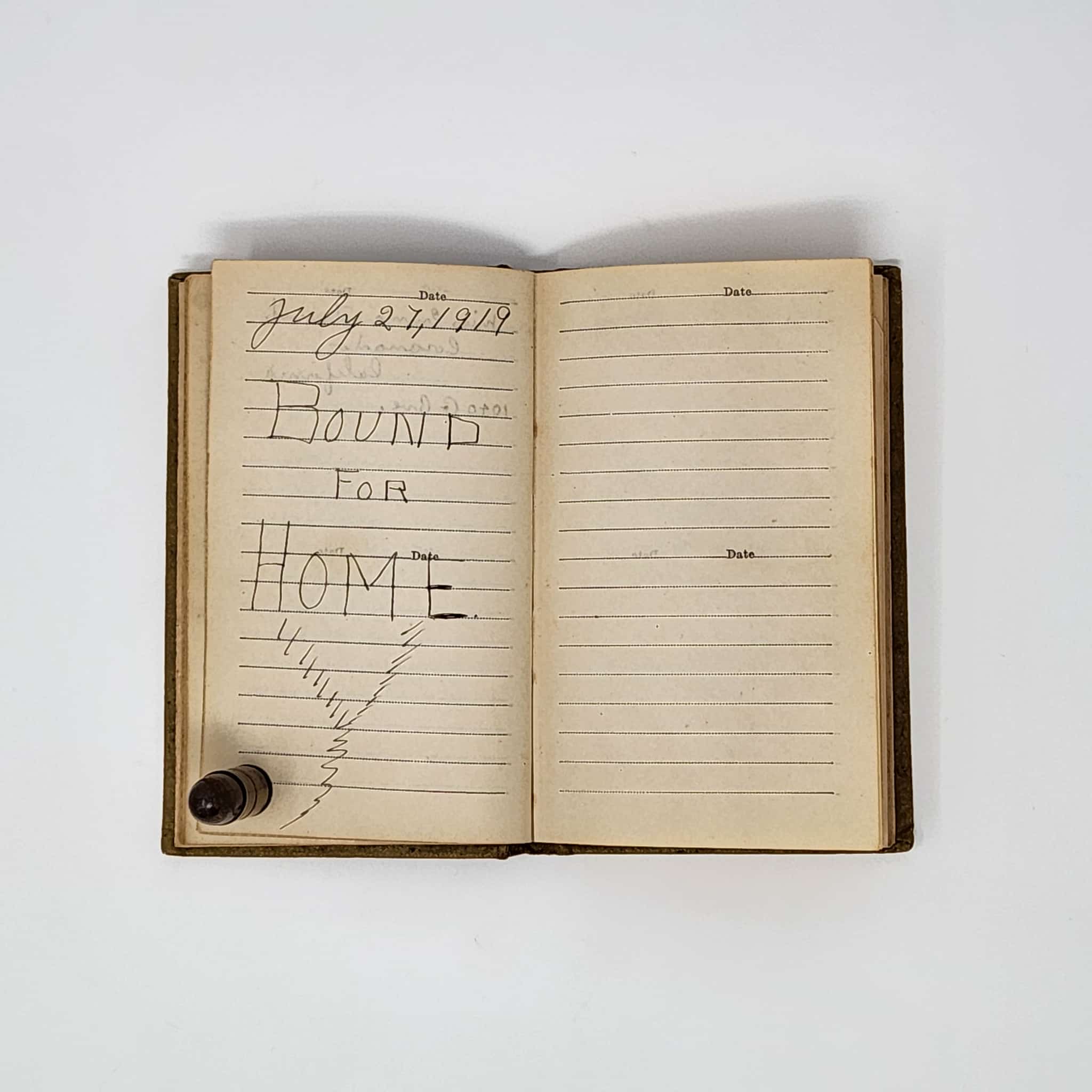
“Bound for Home” – Last Diary Entry

    In December the 1st division was sent into Germany to be a part of the army of occupation. The 1st Engineers remained on this post until July 21st, 1919 when they were detailed to finally return home. He returned to the United States in August and was supposed to receive a discharge but a medical officer advised him to re-enlist so that his wounds from Soissons could finally be tended to by army doctors. This was when the true extent of his injury was truly discovered. It was necessary to fracture his dislocated arm to get it back into its socket. After this though, he could finally return to Southbridge. Funnily enough, even after his wounds from Soissons were corrected, he wasn’t given credit for a wound in action. So his only wound according to his enlistment record was being gassed on Hill 269. Hellner got married in June of 1921 and went on to have two daughters. In later life he moved to Florida and passed away there on June 26th, 1975 at the age of 78.

Collecting WWI Portrait Photos – More Than What Meets the Eye


The title idiom of this post is an apt description when it comes to the wild world of collecting World War One photography, and especially portrait/studio shots.

More than meets the eye: A hidden significance, greater than is first apparent, as in This agreement involves more than meets the eye. [Mid-1800s]

The hidden significance, as stated in McGraw Hill’s Diction of American Idioms is what makes pursuing,collecting and  sharing “lost” photos from the world wars so interesting and important to researchers. The individual men and women who lived and breathed the history of our past are often presented as watered-down versions of the average Joe or Jill of their time period. By finding, researching and publishing these photos, I hope to help the public realize that every story is worth telling, irregardless of perceived heroism involved.  In the case of this blog post, I’ve decided to pick a current (May 31st, 2017) eBay auction that will certainly meet the criteria of the Mid-1800s idiom seen above.

marine

May/June 2017 eBay Auction

I will post auction details  at the conclusion of this blog post, but I wanted to start with a breakdown of why this photograph will sell for hundreds of dollars more than a normal, unidentified U.S. soldier/Marine/sailor from WWI. First, lets see some of the auction details (the seller did a great job of pointing all these out and deserves credit for his research!) that make this a 10/10 snag for the lucky bidder.

What makes this a 10/10 photo for the WWI portrait collector?

  1. Photo aesthetics – The young man in the French studio photo (Carte Postale postcards are French)  is striking a casual pose with the intention of showing off multiple pieces of his uniform/accessories. He’s sporting a bold eagle/globe/anchor (EGA) insignia on his cap, a very nice privately purchased trench watch on his left hand (indicating that he’s right handed), an overseas chevron, wound chevron and a nice set of sergeant stripes on his right sleeve.
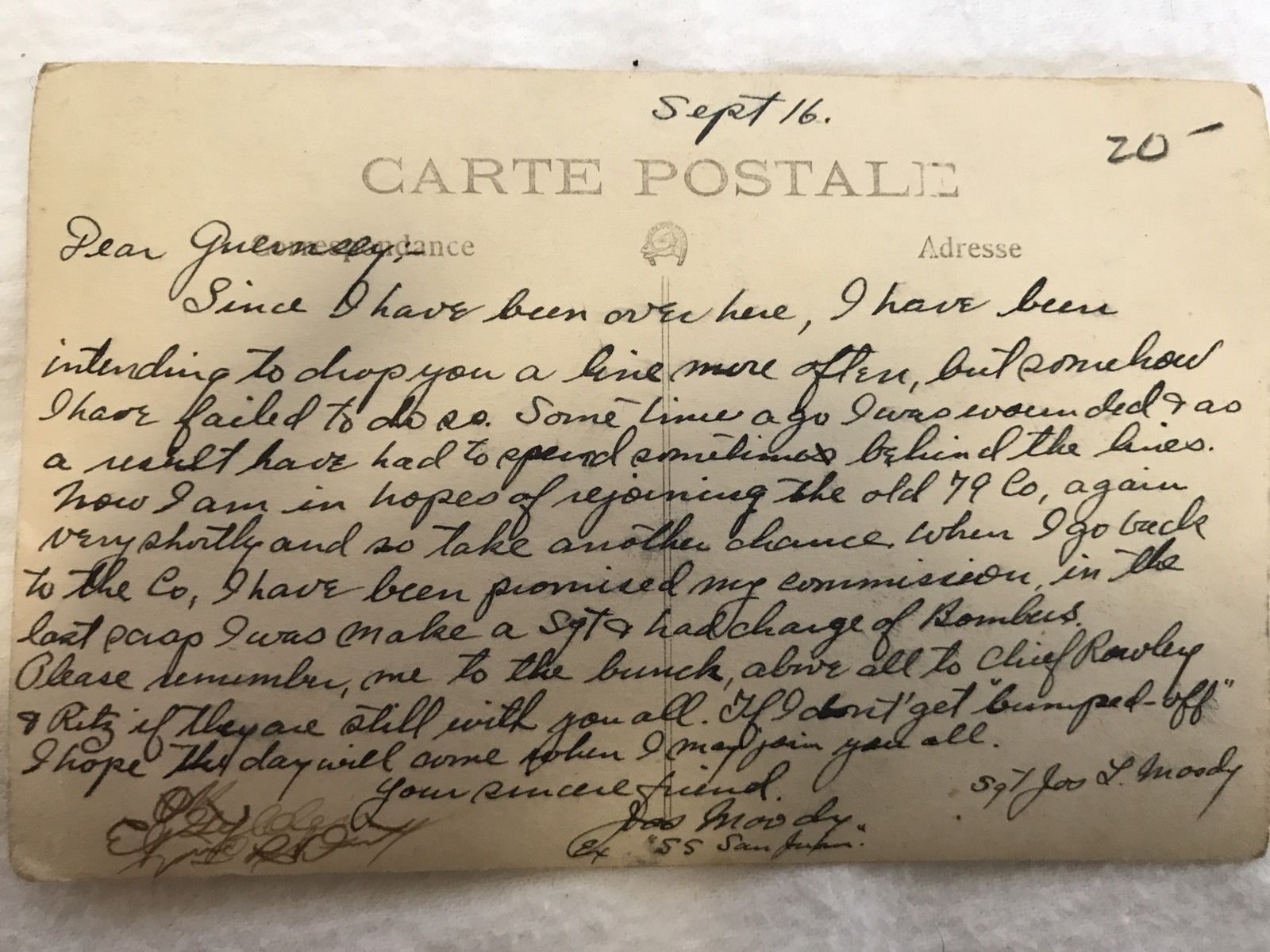
  2. Identification – The period inked identification on the bottom right hand corner gives the intrepid researcher a good place to start searching. I own dozens of shots signed in the same manner. Jos L Moody 6th Marines, ex “SS San Juan” is a good jumping off place…
  3. Written content – The back of the postcard gives a vivid description of his service time to a friend who he appears to have some strong connection to. He mentions the occasion of his wounding, his promotion of sergeant “I was made charge of Bombers” as well as an ominous mention of being “bumped off” as well as his pending commission. Further, the reverse tells us that the photo was taken and sent at least two months before the end of the war, being dated September of 1918, and therefor raises it a few notches in desirability.
  4. Research! – The most vital piece of elevating the significance of a photograph is the story behind the photo. What do all the other key elements tell you? In this case we have, with further research, a photograph of a U.S. Marine who was awarded the Silver Star for his actions at Chateat-Thierry. His Silver Star valor award reads:

    By direction of the President, under the provisions of the act of Congress approved July 9, 1918 (Bul. No. 43, W.D., 1918), Corporal Joseph L. Moody, Jr. (MCSN: 92820), United States Marine Corps, is cited by the Commanding General, SECOND Division, American Expeditionary Forces, for gallantry in action and a silver star may be placed upon the ribbon of the Victory Medals awarded him. Corporal Moody distinguished himself while serving with the 79th Company, Sixth Regiment (Marines), 2d Division, American Expeditionary Forces at Chateau-Thierry, France, 6 June – 10 July 1918

    Additionally, he is further mentioned in the unit history for the 6th Marines and some additional info can be gleaned: “The six men above {Moody included} named delivered messages through intense machine gun fire from the front line to their battalion commanders , going and returning with important messages…”

marine3

Postcard back (officer censured)

So where does this leave us? I’ve pointed out all the salient points that make an interesting photo. But my observations don’t need to be valued in any specific way. I enjoy collecting extraordinarily interesting portraits that don’t need to include identification or a “cool story”. On the flip side, a junky shot of a well-identified soldier/Marine/sailor with a cool history won’t make me open my wallet. It’s really about what you want. Go with your gut!

Ok – so here’s my prediction based on my 10+ years of buying/selling/trading WWI portrait photos. This photograph should sell for anywhere between US $175-$275. It may go for much more if someone has Sgt. Moody’s uniform, medals or has a specific affinity for the 79th Marines. I wouldn’t be surprised if it topped $350 on a good day. Tax returns are coming in?

As of  8:00 PM Eastern Time on 5/31/2017 the bid is at $23.49. I will update the post once the auction ends.

auction

Here’s the address for those of you who have some cash to spend! (Also, $7.75 is a crazy price for shipping!)

http://www.ebay.com/itm/WWI-US-Marine-Silver-Star-Winner-Signed-RPPC-USMC-AEF-79th-CO-2nd-Bn-6th-Mar-/182599306597?hash=item2a83c44d65:g:5LwAAOSwblZZLgWN

Gossip Column

Los Angeles Times, April 16th, 1937

FILM PRODUCER’S EX-WIFE SUES Divorce Action Filed Against Retired Officer Faith Cole MacLean Moody, ;former wife of Douglas Mac- ‘Lean, film producer, yesterday filed suit for divorce from’ Capt Joseph L. Moody, United States Marine Corps, retired, charging , incompatibility. Capt. Moody, a brother-in-law of Helen Wills Moody, tennis star, married Mrs. MacLean in Shanghai in January, 1932, while he was stationed in China as an adjutant in charge of American shore forces during the Sino-Japanese troubles. He now is in theatrical work here. The couple separated March 19, according to the complaint filed by Attorney A. S. Gold- ‘flam. There are no children.


eBay Auction Result

Surprisingly enough, my estimate on the final result of the photo sale came in slightly higher than the exact average of my original estimate of $175-$275. Well, maybe it’s not that surprising given that I’ve bid on over 1,000 WWI portrait photos in the past decade….

Here’s the result! – The photo sold for $239.50 plus shipping.

final

6/6/2017 Final Price


Wounded WWI AEF Chaplain Poses in French Studio – Can We Identify Him?


It is never easy to identify someone from a photograph taken nearly 100 years ago, but it’s even more difficult solely based on obscure details from his/her clothing. In today’s blog post I will focus on a photograph purchased on eBay from a fantastic seller named Colleen ( eBay name: cacdivi) who recently sold me a superb French real photo postcard of an American chaplain posed in a studio during World World I (WWI). Here’s the shot:

wwi026

Wounded American Chaplain in WWI

The scene is fairly typical of what was common of the time period: WWI soldiers/sailors/marine/nurses posed in photo studios in far off places in order to document their experiences to send to relatives and friends. In this case, a currently-unidentified US chaplain (see the crucifix on his shoulder and cap?) strikes a chin-up pose for a French photographer. How do we know that the photo was taken in France?

wwi027

French Postcard Paper

French postcard paper during WWI almost always contains a central vertical dividing mark with CARTE POSTALE emblazoned across the top. I’ve noted a fair number of varieties likely due to differences in production, but the main bulk of French postcard paper of the period look very similar to the above scan.


Dissection of Photographic Context

What are we looking at? I’ve already mentioned that the man posed in the photo is a US chaplain in a French studio during the war. But what details have I been pondering while waiting for the photo to arrive in my mailbox? (Thanks to Colleen – you rock!)

  1. The chaplain has served at least six months in Europe

    botharms

    His Left Sleeve (6th Months Overseas Service) Right Sleeve (Wound Chevron)

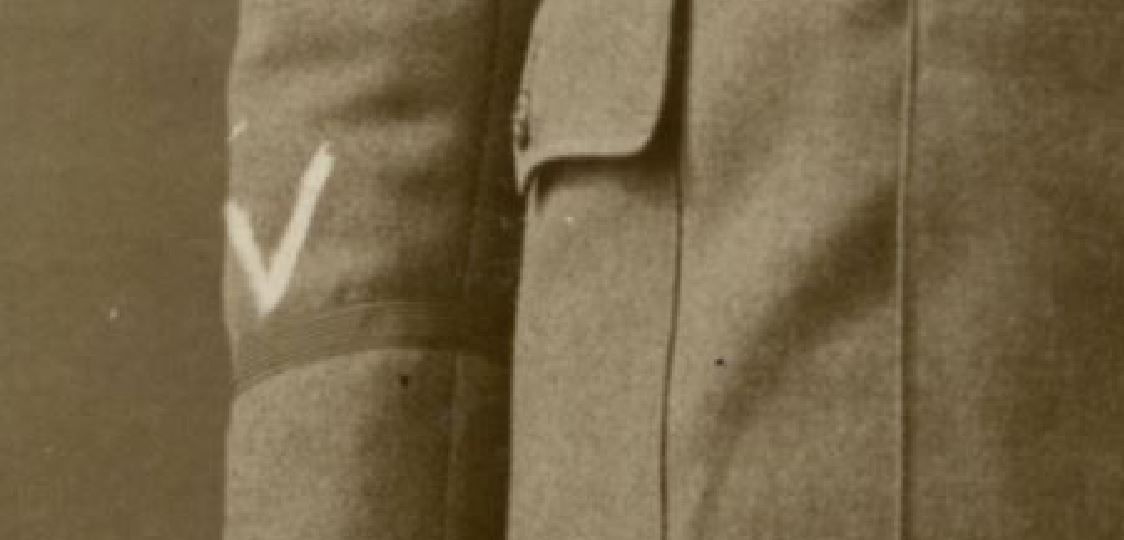
  2. He was wounded or gassed at least once during his service

    woundchev

    His Right Sleeve: Wound Chevron

  3. The photo was likely taken during wartime (before the armistice)
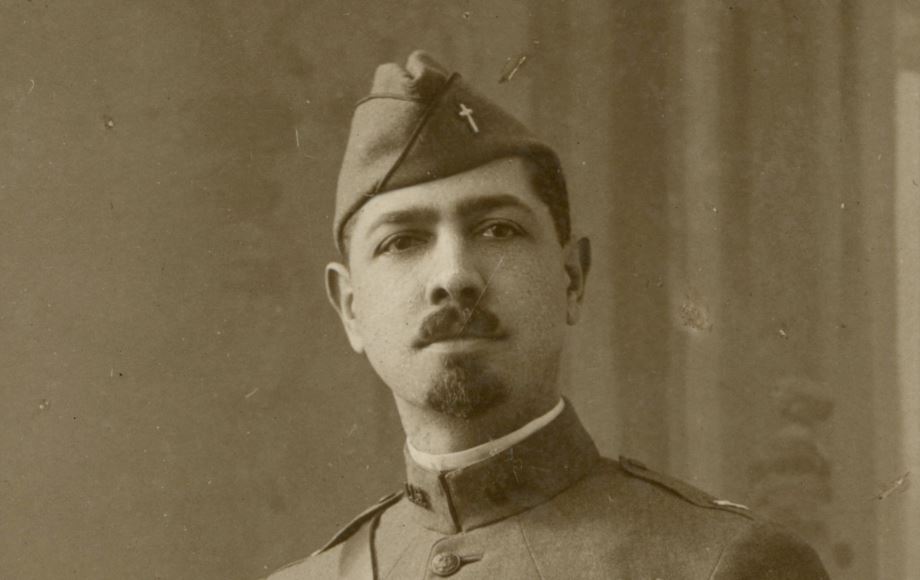
  4. He is oddly sporting a mustache and goatee

    headshot

    Rarely Seen Facial Hair in WWI

  5. He is wearing an identification bracelet made in France

    scan3

    WWI Bracelet Made in France

Why is a photograph of a wounded chaplain posed in a wartime studio worthy of devoting hours of research to? According to a website devoted to military chaplains, the number of wartime chaplains during WWI was incredibly low:

In 1918, Congress passed an act that called for one chaplain for every 1200 officers and enlisted men. Bishop Hayes, in a letter to Cardinal Farley, informs Farley of the current number of chaplains overseas. As of June 1918 there were 301 chaplains in the Army, 30 in the Navy, 7 with the Red Cross, 2 interpreters, and 95 volunteer or Knights of Columbus chaplains.

This photo most likely represents an Army chaplain included in the above June 1918 census: any US chaplain who served at least six months service would’ve been present in France in June of 1918. And to have been wounded or gassed, our unidentified chaplain was likely present during the earlier battles of the US involvement of the war.

Our Chaplain?

Okay, so we know our chaplain was wounded, was photographed at some point in the  spring or summer of 1918 and likely served in an Army division that arrived early (for the Americans). His identity, based on date, is narrowed down to 1 in 301 – a pretty good number when it comes to identifying a photo taken 100 years ago. Also, based on rules, he has to be less than 45 years of age.

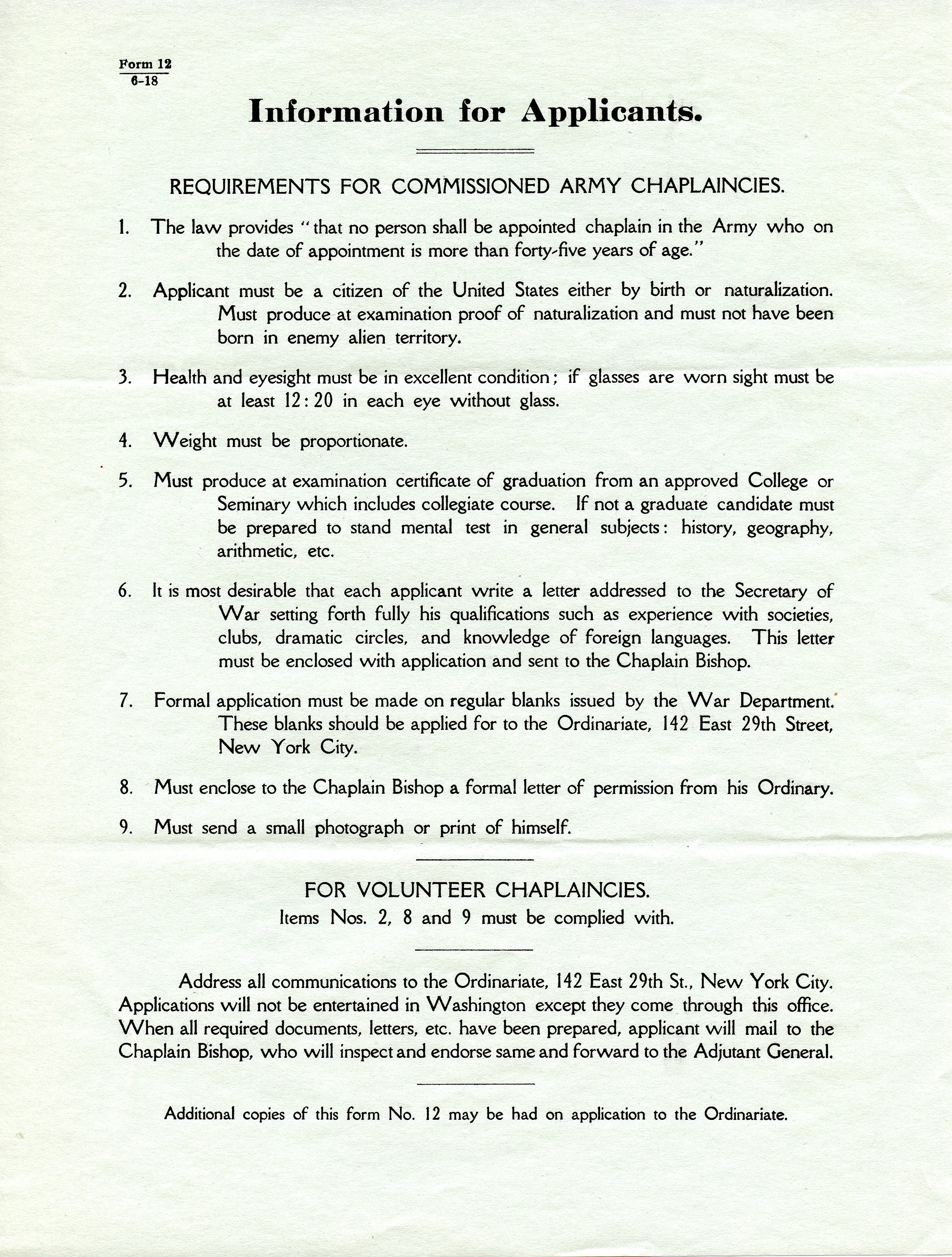
But what was required to be a US chaplain in WWI? Before researching this photo I had no idea of the low number of volunteers or the actual requirements for acceptance. My personal photo collection contains a half dozen photos of chaplains, which is a surprisingly high number based on the scarcity of the subject matter. I was lucky to track down a copy of the rules and regs of chaplainhood here: http://archnyarchives.org/2015/11/10/military-chaplains-in-world-war-i/

Official Chaplain Requirements

Requirements for Commissioned Army Chaplaincies

  1. The law provides that no person shall be appointed chaplain in the Army who on the date of appointment is more than forty-five years of age.
  2. Applicants must be a citizen of the United States either by birth or naturalization. Must produce at examination proof of naturalization and must not have been born in enemy alien territory.
  3. Health and eyesight must be in excellent condition; if glasses are worn sight must be at least 12:20 in each eye without glass.
  4. Weight must be proportionate.
  5. Must produce an examination certificate of graduation from an approved College or Seminary which includes collegiate course. If not a graduate candidate must be prepared to stand mental test in general subjects: history, geography, arithmetic. etc.
  6. It is most desirable that each applicant write a letter addressed to the Secretary of War setting forth fully his qualifications such as experience with societies, clubs, dramatic circles, and knowledge of foreign languages. This letter must be be enclosed with application and sent to the Chaplain Bishop.
  7. Formal application must be made on regular blanks made by the War Department. These Blanks should be applied for to the Ordinariate, 142 East 29th Street, New York City.
  8. Must enclose to the Chaplain Bishop a formal letter of permission from his Ordinary.
  9. Must send a small photographic print of himself.

Chaplain-Application006

1918 Chaplain Application Form


For now I have a good bit of information to extend my research with. Until then, stay tuned!