WWII Press Photo – James “Jack” C. Warren Wounded in Normandy, July 1944


From time to time, I like to browse the pages of eBay in search of portrait photographs of identified U.S. soldiers — small windows into the past that I can casually research to uncover the individual’s story and their role in whichever conflict they served. In today’s post, I was drawn to one particular image: a portrait captured by a British photographer. Unlike the widely circulated press photos that often made their way into American newspapers, this photograph was unlikely to have been distributed stateside and equally unlikely to have fallen into the hands of the soldier’s family.

When soldiers were photographed, it was common for them to provide their names, ranks, and often their hometowns. Yet in most cases, there was little chance for photographers or newspapers to follow up and let those soldiers know that their likeness had appeared in print. That disconnect is part of what makes original press photographs so compelling today. Many remain unpublished, and most have never been thoroughly researched. In fact, I’ve noticed a growing trend in 2025: more and more World War II–era press photos are surfacing on the secondary market, offering new opportunities to rediscover stories that might otherwise have been lost.

PFC James “Jack” C. Warren of Kentucky

The photograph above was discovered in August 2025 during one of my routine eBay searches for intriguing portrait shots of World War II servicemen — images that spark my curiosity to uncover the stories behind the faces. This particular shot is especially striking: crisp, tightly framed, and, based on the other photographs sold by the same seller, likely taken in England at a collection point for wounded or ill soldiers. I cleaned up the scan and cropped the edges to make it more visually appealing for digital presentation.

The next question became the most important one: how do we identify him?

Reverse Side From eBay

What do we know?

The photo was taken on July 13, 1944 at a port in the South of England.

The photographer worked for a British newspaper.

The subject of the photo is a PFC J.C. Warren from Kentucky and was wounded.

The photo was approved for publication by US censors a few days later.

Who was J.C. Warren?

Given the information provided in the brief writeup on the reverse side of the photo, we know that the subject is a young male, likely aged 18-24 from Kentucky named J.C. Warren who was wounded or injured at some point after the D-Day landing a month earlier. His “walking wounded” paper tag (Form 52b-MEDICAL DEPARTMENT, U.S.A. (Revised October 25, 1940), 16-15434) seen poking up at the bottom hints that he wasn’t disabled or infectious. With that information in hand, I began narrowing the search. Since the most common first names beginning with “J” at the time were James and John, I started there, turning to an obscure database that tracks U.S. servicemembers admitted to hospitals during World War II.

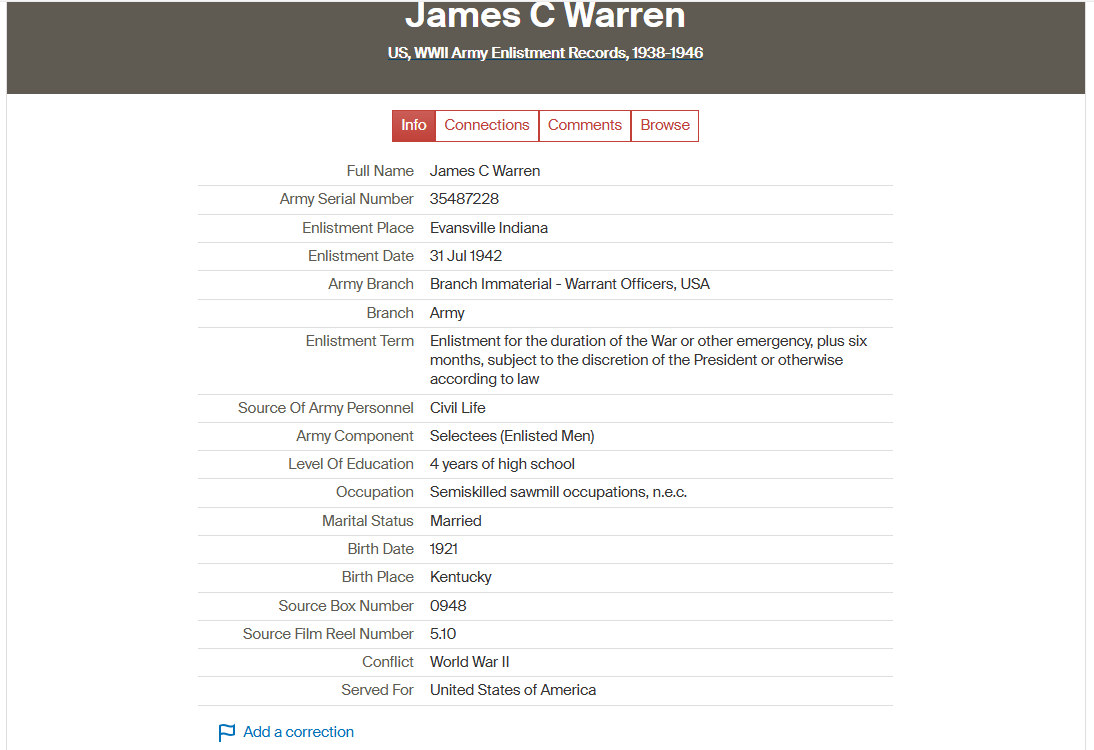
After only a few minutes of typing I found a hit to a James C. Warren with the Army Serial Number(ASN) of 35487228, and the only J C Warren who was from Kentucky that was admitted to a US hospital in July of 1944.
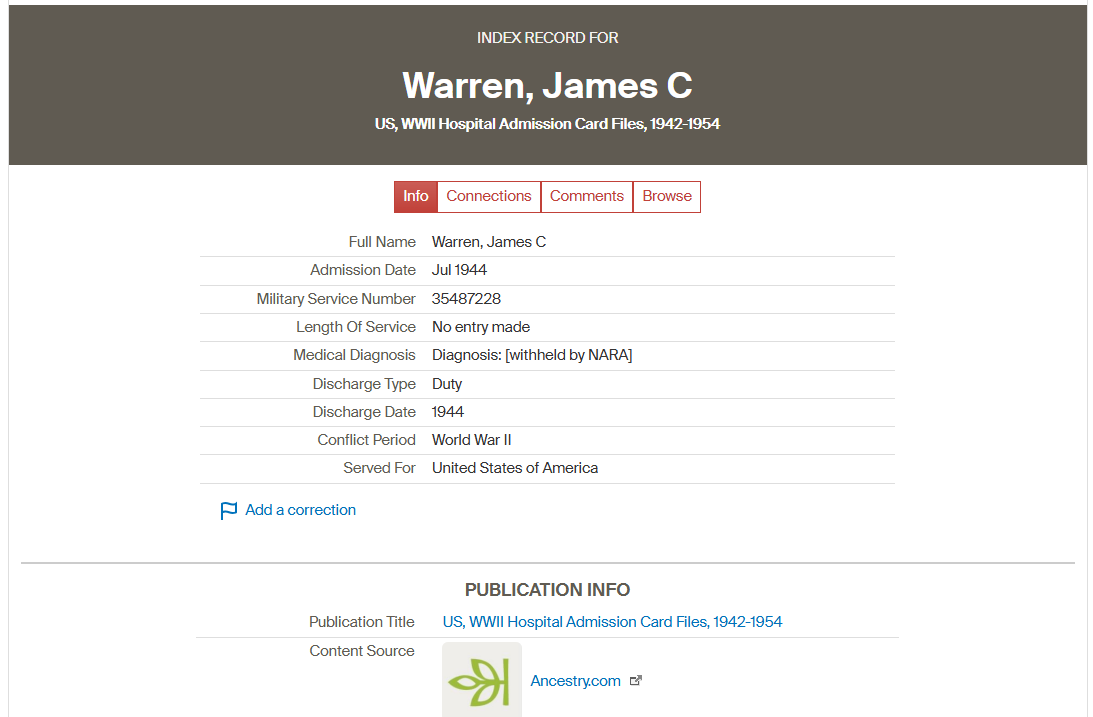
WWII Hospital Admission Card for James Warren

And when looking up his ASN…

WWII Draft Registration Information

With confirmation like this, I decided to dig deeper into PFC Warren’s life story in hopes of pulling out a few more details about his life story. Luckily, Ancestry.com and Fold3.com provide prompts based on confirmed information when researching so I was quickly on my way down the rabbit hole.

Veteran Headstone Application Form

It’s always a bittersweet discovery when I come across one of these documents, which tend to surface most often for veterans who passed away between the 1950s and 1980s. This particular record (which I’ll share below) shows that PFC Warren served with the 816th Ordnance Base Depot Company, a unit stationed in southern England at the time of his hospital admission. Interestingly, there is no mention of a Purple Heart on the form. That leaves me to wonder whether his injury did not meet the criteria for the medal, or whether it simply wasn’t recorded on his discharge papers after the war. Perhaps his family would know the answer.

Veteran Headstone Application

Luckily, the document provides just enough detail to shed light on who James Carmen Warren sadly left behind when he passed away in 1968. Born on April 8, 1921, he died on August 8, 1968, at the age of 47. He was survived by his wife, Mary Emma Green Warren, along with their two sons, Ivan and James C. Warren Jr.

More to come!

Collecting WWI Portrait Photos – More Than What Meets the Eye


The title idiom of this post is an apt description when it comes to the wild world of collecting World War One photography, and especially portrait/studio shots.

More than meets the eye: A hidden significance, greater than is first apparent, as in This agreement involves more than meets the eye. [Mid-1800s]

The hidden significance, as stated in McGraw Hill’s Diction of American Idioms is what makes pursuing,collecting and  sharing “lost” photos from the world wars so interesting and important to researchers. The individual men and women who lived and breathed the history of our past are often presented as watered-down versions of the average Joe or Jill of their time period. By finding, researching and publishing these photos, I hope to help the public realize that every story is worth telling, irregardless of perceived heroism involved.  In the case of this blog post, I’ve decided to pick a current (May 31st, 2017) eBay auction that will certainly meet the criteria of the Mid-1800s idiom seen above.

marine

May/June 2017 eBay Auction

I will post auction details  at the conclusion of this blog post, but I wanted to start with a breakdown of why this photograph will sell for hundreds of dollars more than a normal, unidentified U.S. soldier/Marine/sailor from WWI. First, lets see some of the auction details (the seller did a great job of pointing all these out and deserves credit for his research!) that make this a 10/10 snag for the lucky bidder.

What makes this a 10/10 photo for the WWI portrait collector?

  1. Photo aesthetics – The young man in the French studio photo (Carte Postale postcards are French)  is striking a casual pose with the intention of showing off multiple pieces of his uniform/accessories. He’s sporting a bold eagle/globe/anchor (EGA) insignia on his cap, a very nice privately purchased trench watch on his left hand (indicating that he’s right handed), an overseas chevron, wound chevron and a nice set of sergeant stripes on his right sleeve.
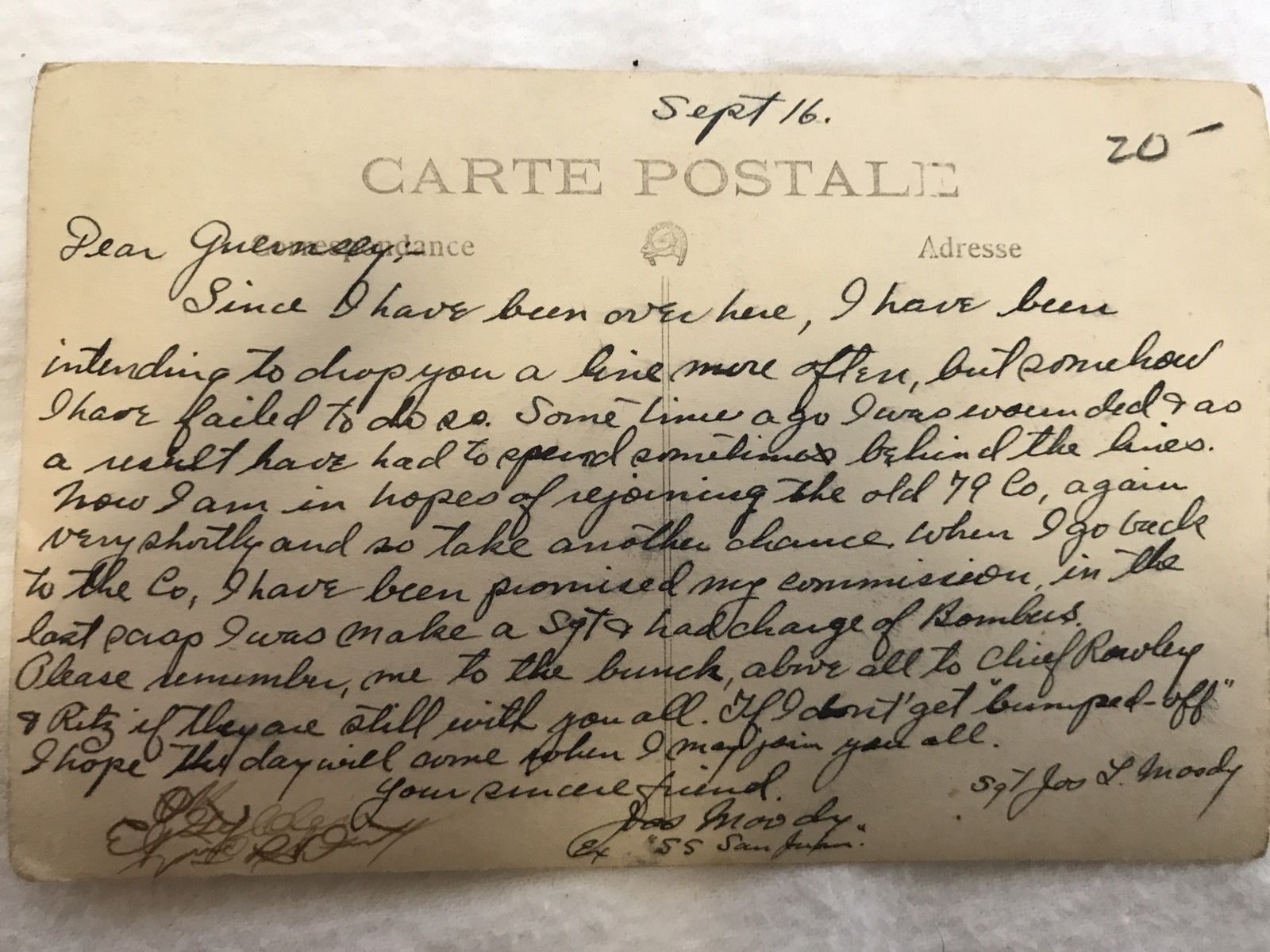
  2. Identification – The period inked identification on the bottom right hand corner gives the intrepid researcher a good place to start searching. I own dozens of shots signed in the same manner. Jos L Moody 6th Marines, ex “SS San Juan” is a good jumping off place…
  3. Written content – The back of the postcard gives a vivid description of his service time to a friend who he appears to have some strong connection to. He mentions the occasion of his wounding, his promotion of sergeant “I was made charge of Bombers” as well as an ominous mention of being “bumped off” as well as his pending commission. Further, the reverse tells us that the photo was taken and sent at least two months before the end of the war, being dated September of 1918, and therefor raises it a few notches in desirability.
  4. Research! – The most vital piece of elevating the significance of a photograph is the story behind the photo. What do all the other key elements tell you? In this case we have, with further research, a photograph of a U.S. Marine who was awarded the Silver Star for his actions at Chateat-Thierry. His Silver Star valor award reads:

    By direction of the President, under the provisions of the act of Congress approved July 9, 1918 (Bul. No. 43, W.D., 1918), Corporal Joseph L. Moody, Jr. (MCSN: 92820), United States Marine Corps, is cited by the Commanding General, SECOND Division, American Expeditionary Forces, for gallantry in action and a silver star may be placed upon the ribbon of the Victory Medals awarded him. Corporal Moody distinguished himself while serving with the 79th Company, Sixth Regiment (Marines), 2d Division, American Expeditionary Forces at Chateau-Thierry, France, 6 June – 10 July 1918

    Additionally, he is further mentioned in the unit history for the 6th Marines and some additional info can be gleaned: “The six men above {Moody included} named delivered messages through intense machine gun fire from the front line to their battalion commanders , going and returning with important messages…”

marine3

Postcard back (officer censured)

So where does this leave us? I’ve pointed out all the salient points that make an interesting photo. But my observations don’t need to be valued in any specific way. I enjoy collecting extraordinarily interesting portraits that don’t need to include identification or a “cool story”. On the flip side, a junky shot of a well-identified soldier/Marine/sailor with a cool history won’t make me open my wallet. It’s really about what you want. Go with your gut!

Ok – so here’s my prediction based on my 10+ years of buying/selling/trading WWI portrait photos. This photograph should sell for anywhere between US $175-$275. It may go for much more if someone has Sgt. Moody’s uniform, medals or has a specific affinity for the 79th Marines. I wouldn’t be surprised if it topped $350 on a good day. Tax returns are coming in?

As of  8:00 PM Eastern Time on 5/31/2017 the bid is at $23.49. I will update the post once the auction ends.

auction

Here’s the address for those of you who have some cash to spend! (Also, $7.75 is a crazy price for shipping!)

http://www.ebay.com/itm/WWI-US-Marine-Silver-Star-Winner-Signed-RPPC-USMC-AEF-79th-CO-2nd-Bn-6th-Mar-/182599306597?hash=item2a83c44d65:g:5LwAAOSwblZZLgWN

Gossip Column

Los Angeles Times, April 16th, 1937

FILM PRODUCER’S EX-WIFE SUES Divorce Action Filed Against Retired Officer Faith Cole MacLean Moody, ;former wife of Douglas Mac- ‘Lean, film producer, yesterday filed suit for divorce from’ Capt Joseph L. Moody, United States Marine Corps, retired, charging , incompatibility. Capt. Moody, a brother-in-law of Helen Wills Moody, tennis star, married Mrs. MacLean in Shanghai in January, 1932, while he was stationed in China as an adjutant in charge of American shore forces during the Sino-Japanese troubles. He now is in theatrical work here. The couple separated March 19, according to the complaint filed by Attorney A. S. Gold- ‘flam. There are no children.


eBay Auction Result

Surprisingly enough, my estimate on the final result of the photo sale came in slightly higher than the exact average of my original estimate of $175-$275. Well, maybe it’s not that surprising given that I’ve bid on over 1,000 WWI portrait photos in the past decade….

Here’s the result! – The photo sold for $239.50 plus shipping.

final

6/6/2017 Final Price


WWI 107th Infantry Regiment, 27th Division NY KIA Portrait Photo – Harold E. Manners – Meuse-Argonne Offensive


I picked up this little gem in a Palmer Massachusetts antique store a few months back and never took the time to look at the photo closely until this past week.  The frame was intricately created; something not often seen in run of the mill WWI photos.  The gold stars on the corners and bottom of the image should have been a dead giveaway.  Once I  decided to look at the photo a little closer, I took the frame apart from the back and began to uncover the identity of the soldier depicted in the image.  I knew he was a member of the 7th Infantry Regiment; this was evidenced in the collar disc.  The 7th New York eventually became the 107th Infantry Regiment of the 27th Division.  Harold was in Company H.

The reverse of the photo was beautifully inscribed with everything I needed to know to track this fellow down.

Harold Edward Manners

Killed in France in the

Great War, Sept. 29th 1918

aged 23 years

After extensive research I’ve learned that Harold was killed during the operations before the Hindeburg Line east of Ronssoy, September 29th, 2918.  His citation for the day reads:

“This soldier, with great gallantry and determination, advanced against unusually difficult enemy positions composed of strongly fortified machine gun nests until killed.”

I found an auction result online that showed his medals which were sold in 2008 at an auction in NY. A beautifully inscribed NY veterans medal for a KIA was included.  I wish I had that grouping!

Harold E. Manners – KIA Meuse-Argonne 1918

WWI 78th Division Portrait Photo – Wounded


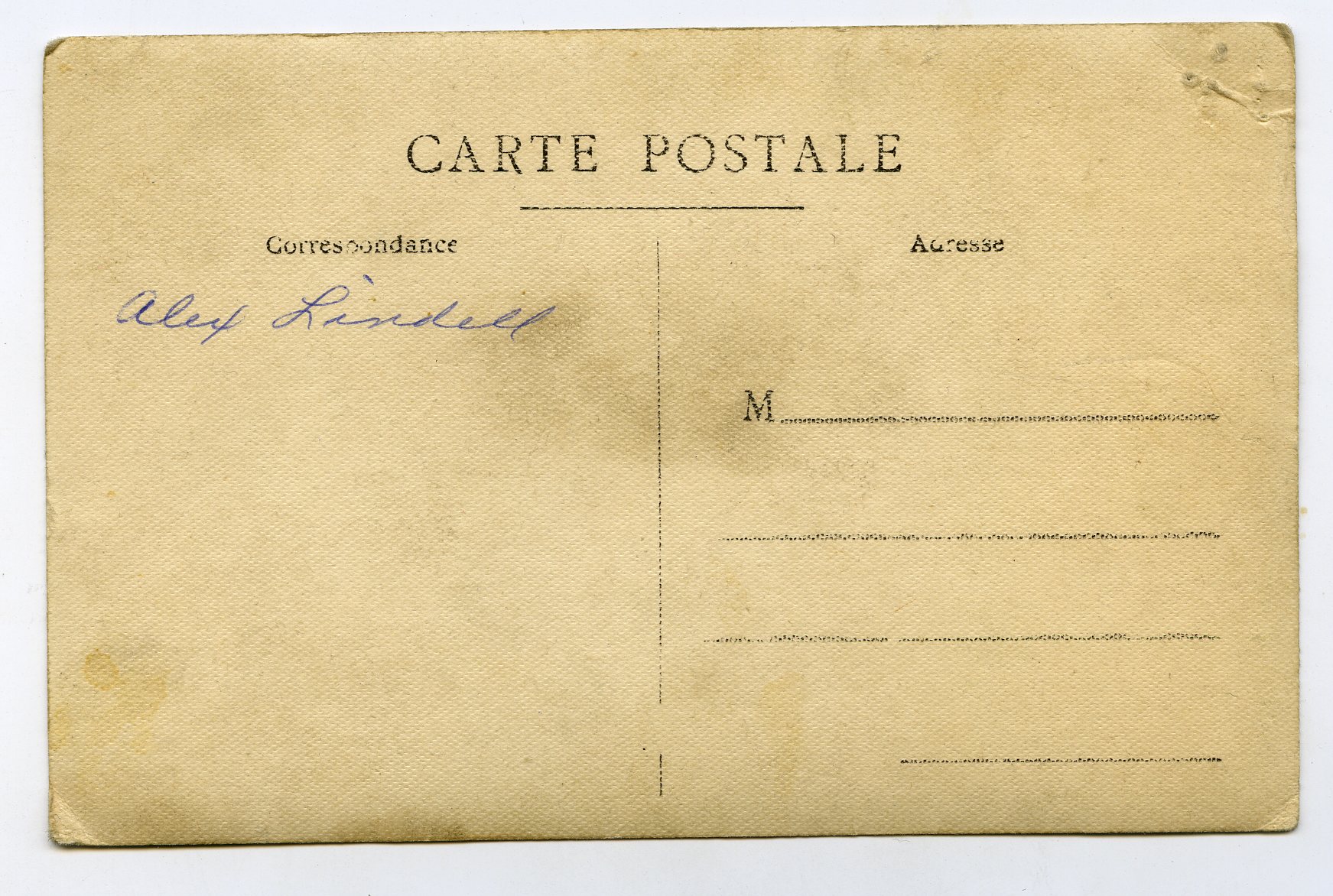
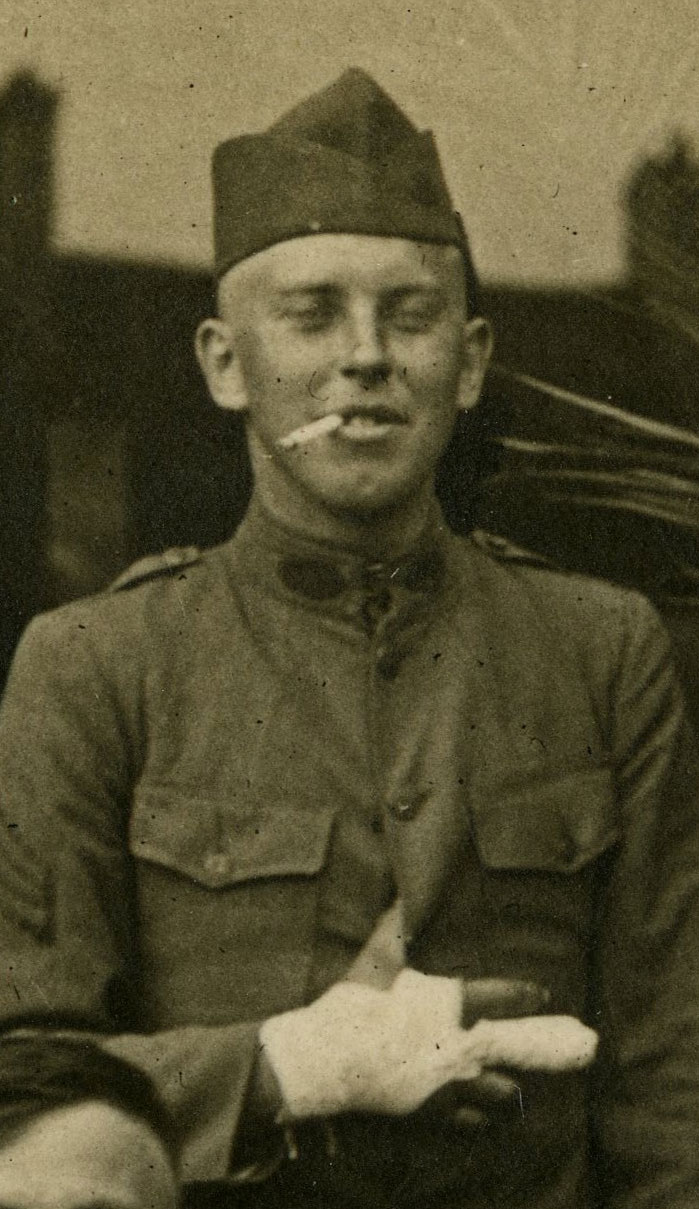
Today’s post comes from my growing collection of 78th Division portrait photos.  Although we don’t know his specific unit designation, we do have his name and company.  Taken in a French studio, Alex Lindell was posed in a manner which allows the viewer to see his maimed hand.  The fact that he was wounded is evidenced by a visible wound chevron on his right hand sleeve.  The stitching is barely visible. 

Alex Lindell of the 78th Division

WWI Photo – Wounded Doughboys Rest w/ Mascot Dog and Pretty French Girl


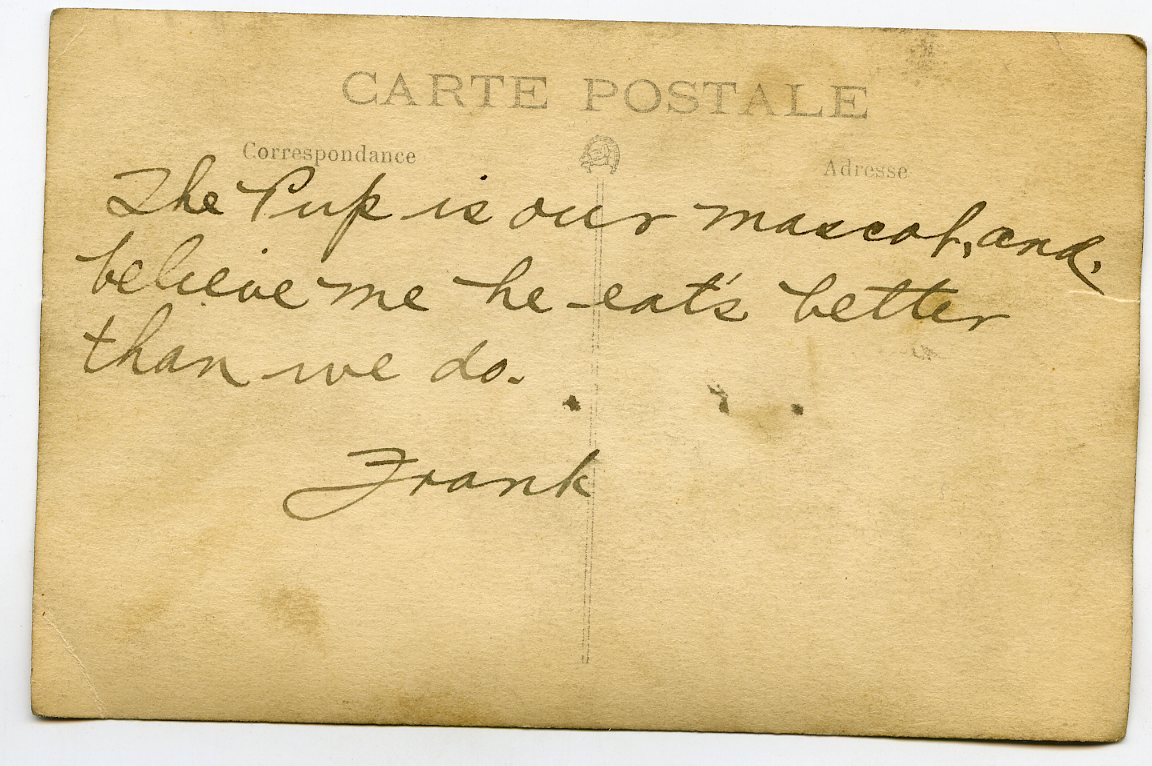
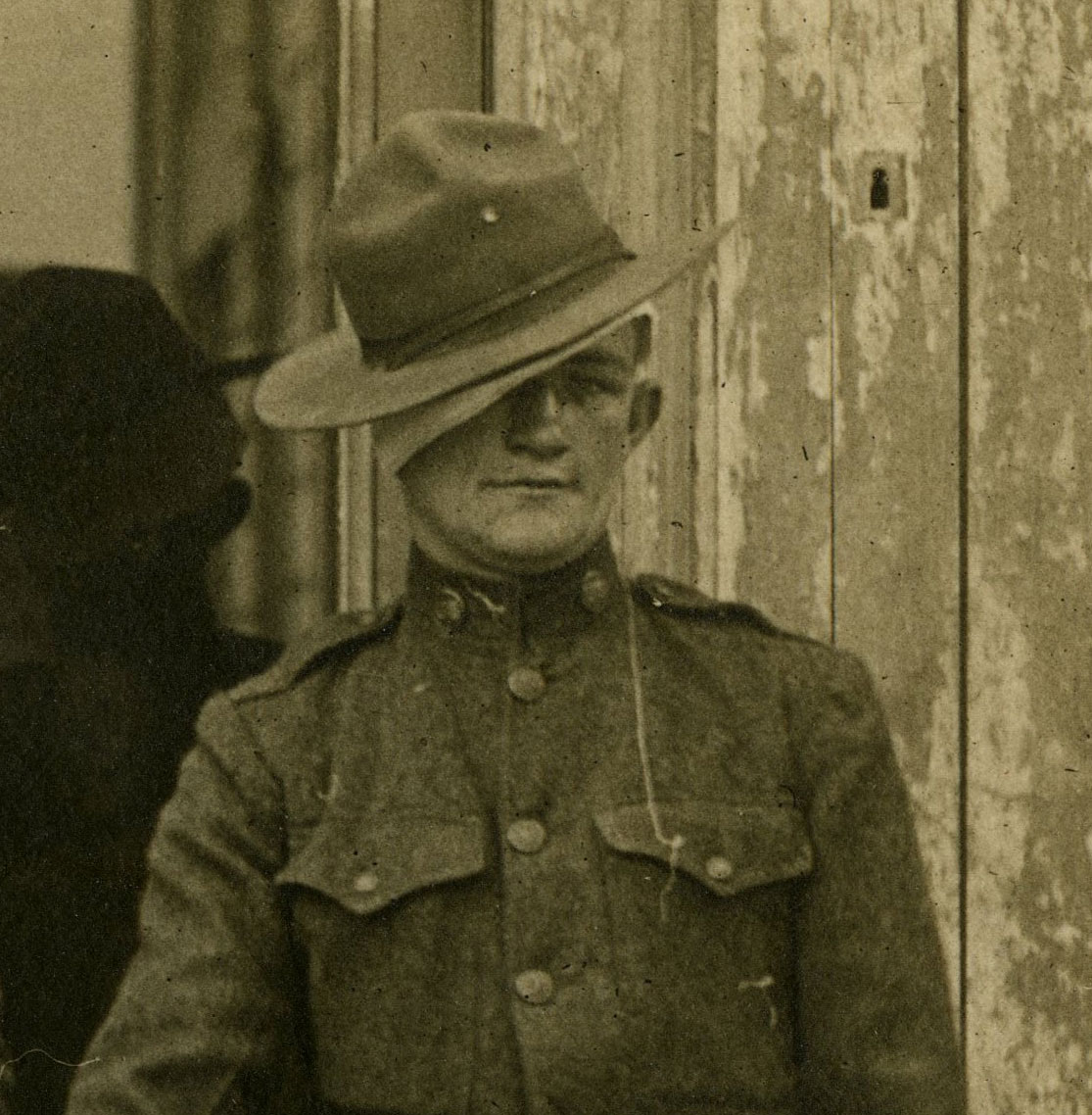
A fabulous shot of a group of doughboys taking some much needed R&R in a French city.  A busty French girl stands in the doorway as the men pose for a photo.  Just read the back!  A superb WWI dog mascot photo with great content.  Note the two wounded soldiers – one with a face wound, the other with a broken hand.

The details of the image pop out once the casual observer steps back from noting the obvious and begins to look for subtle details.  Notice the reflection in the window?  How about the stone gutter along the street?  The hastily buttoned blouse of the facially wounded soldier?  Enjoy!

Welcome to Portraits of War!


Welcome!

After years of collecting WWI and WWII photography, I’ve finally decided to share some of my favorite images with the world.  I’ve searched through flea markets, antique stores, and eBay auctions to obtain photos depicting American soldiers in various world conflicts.

Where to start?

Lets jump into the dissection and interpretation of one of my favorite WWI images and see how history was recorded through the lens of a photographers camera.

Aesthetics

The first thing I always look for when buying a good WWI photo is the general “eye appeal” of the image.  Is the subject well lit?  Did the photographer take time to seat and position the subject?  How good is the contrast and detail?  All these things are sometimes unable to be determined when making internet based purchases, but it never hurts to ask the seller for a better scan.  Condition is also a big factor when I make a “higher end” purchase in eBay.  I consider $50+ the threshold between medium range and higher end purchases.

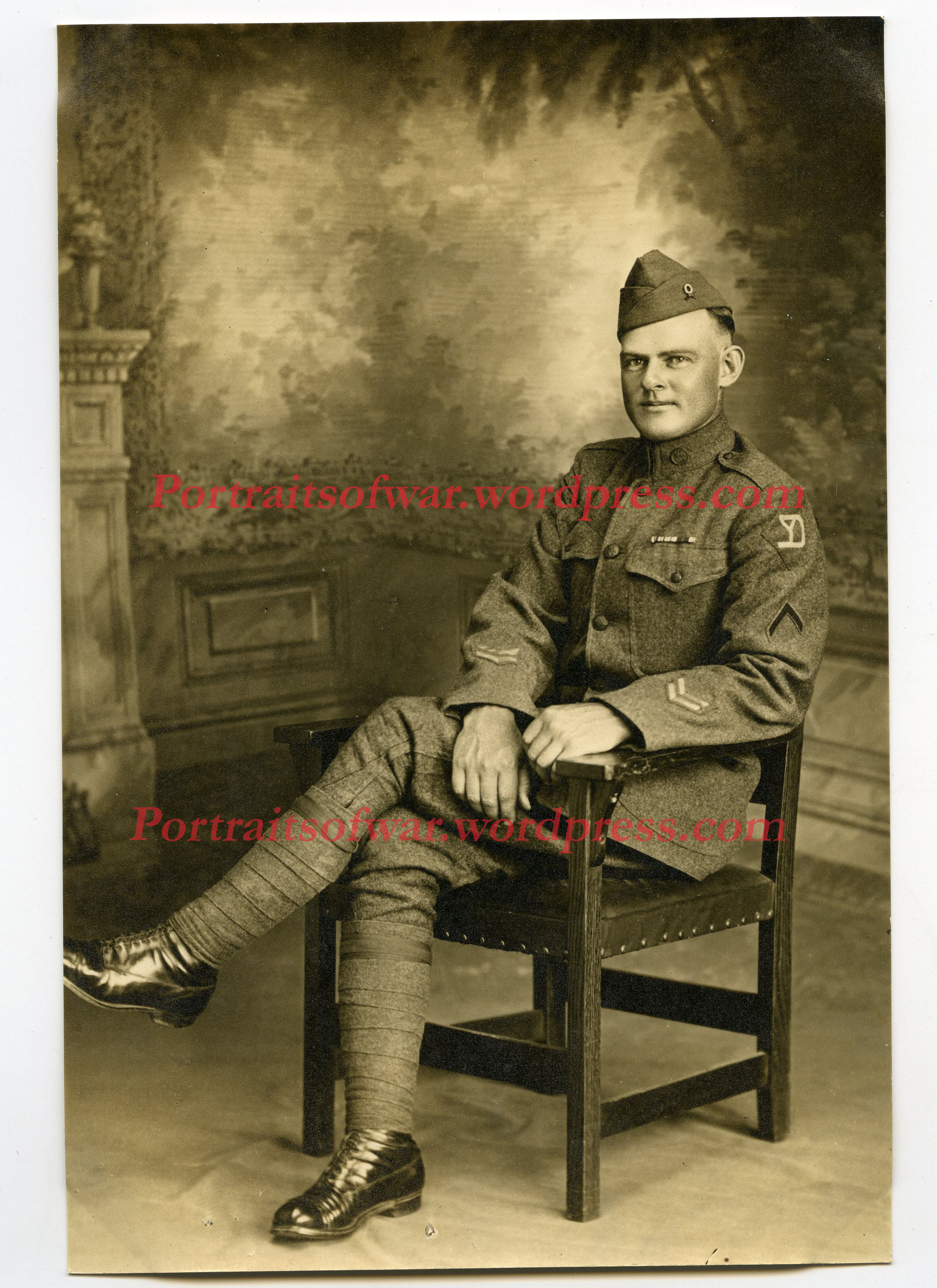
In terms of aesthetics, this photo has it all going on.  The contrast and detail are perfect, the condition of the image is superb, and the price was right at $26.50.  Because the purchase was an eBay auction win, I wasn’t able to ascertain the historical details until I had the photo in-hand.

Historical Detail

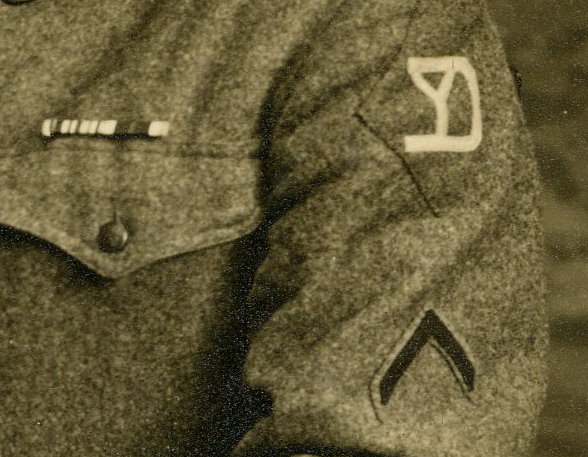
The first and easiest way to identify the unit designation of a WWI soldier portrait is to inspect the shoulder sleeve insignia also known as an SSI, or in layman’s terms, a shoulder patch.  In this case, we see a YD on a diamond on the subjects arm.

My favorite WWI division has to be the 26th “Yankee Division” – made up of primarily New England soldiers who took the call to the National Guard units early on in America’s involvement in WWI.  These New England National Guard units were eventually combined together to form the 26th Division and were later bolstered by fresh recruits from replacement units while stationed in France.


How can we tell when this fellow joined the war?  Although the date of the photo is unknown, we can ascertain that he served at least 12 months overseas.  The two chevrons on his left arm mark him as having served for two 6 month periods.  The photo was likely taken right after his return to the states, which is denoted by the dark colored chevron below his SSI (patch – remember?).

This guy was wounded twice during the war.  The double chevrons on his right arm were earned for being wounded.  He has no obvious battle scars on his face or hands, and he appears to have both his legs, so I am assuming that his wounds didn’t force his discharge.

Most 26th Division doughboys (an endearing term used for WWI American soldiers) served at least 18 months – so this veteran likely came in as a replacement to help fill the slowly depleting ranks of the division.


The 104th Infantry Regiment

With my super-duper high resolution scanner I was able to grab a high quality crop of the collar disc insignia this veteran is wearing.  See that round button below his left cheek?  Under high magnification the button/disc reads – 104 with a US monogram above it.  This means that the wearer is a member of the 104th Infantry Regiment – one of the regiments that made up the 26th Division. The regiment originally started in Springfield Mass in the mid 1700s to help ward off attacks from the bands of King Phillip’s Native American warriors.  This regiment fought with valor in a number of key offensives during WWI.  I wish I had a copy of the unit history to use as a reference 😦