WWII Press Photo – James “Jack” C. Warren Wounded in Normandy, July 1944


From time to time, I like to browse the pages of eBay in search of portrait photographs of identified U.S. soldiers — small windows into the past that I can casually research to uncover the individual’s story and their role in whichever conflict they served. In today’s post, I was drawn to one particular image: a portrait captured by a British photographer. Unlike the widely circulated press photos that often made their way into American newspapers, this photograph was unlikely to have been distributed stateside and equally unlikely to have fallen into the hands of the soldier’s family.

When soldiers were photographed, it was common for them to provide their names, ranks, and often their hometowns. Yet in most cases, there was little chance for photographers or newspapers to follow up and let those soldiers know that their likeness had appeared in print. That disconnect is part of what makes original press photographs so compelling today. Many remain unpublished, and most have never been thoroughly researched. In fact, I’ve noticed a growing trend in 2025: more and more World War II–era press photos are surfacing on the secondary market, offering new opportunities to rediscover stories that might otherwise have been lost.

PFC James “Jack” C. Warren of Kentucky

The photograph above was discovered in August 2025 during one of my routine eBay searches for intriguing portrait shots of World War II servicemen — images that spark my curiosity to uncover the stories behind the faces. This particular shot is especially striking: crisp, tightly framed, and, based on the other photographs sold by the same seller, likely taken in England at a collection point for wounded or ill soldiers. I cleaned up the scan and cropped the edges to make it more visually appealing for digital presentation.

The next question became the most important one: how do we identify him?

Reverse Side From eBay

What do we know?

The photo was taken on July 13, 1944 at a port in the South of England.

The photographer worked for a British newspaper.

The subject of the photo is a PFC J.C. Warren from Kentucky and was wounded.

The photo was approved for publication by US censors a few days later.

Who was J.C. Warren?

Given the information provided in the brief writeup on the reverse side of the photo, we know that the subject is a young male, likely aged 18-24 from Kentucky named J.C. Warren who was wounded or injured at some point after the D-Day landing a month earlier. His “walking wounded” paper tag (Form 52b-MEDICAL DEPARTMENT, U.S.A. (Revised October 25, 1940), 16-15434) seen poking up at the bottom hints that he wasn’t disabled or infectious. With that information in hand, I began narrowing the search. Since the most common first names beginning with “J” at the time were James and John, I started there, turning to an obscure database that tracks U.S. servicemembers admitted to hospitals during World War II.

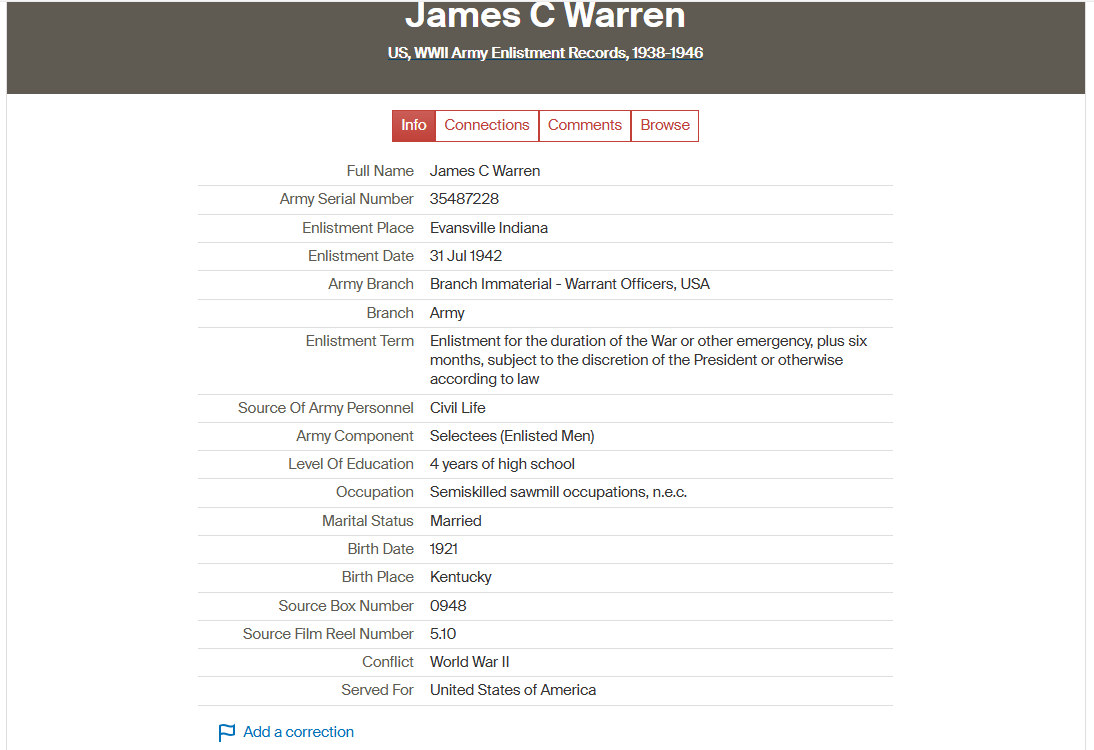
After only a few minutes of typing I found a hit to a James C. Warren with the Army Serial Number(ASN) of 35487228, and the only J C Warren who was from Kentucky that was admitted to a US hospital in July of 1944.
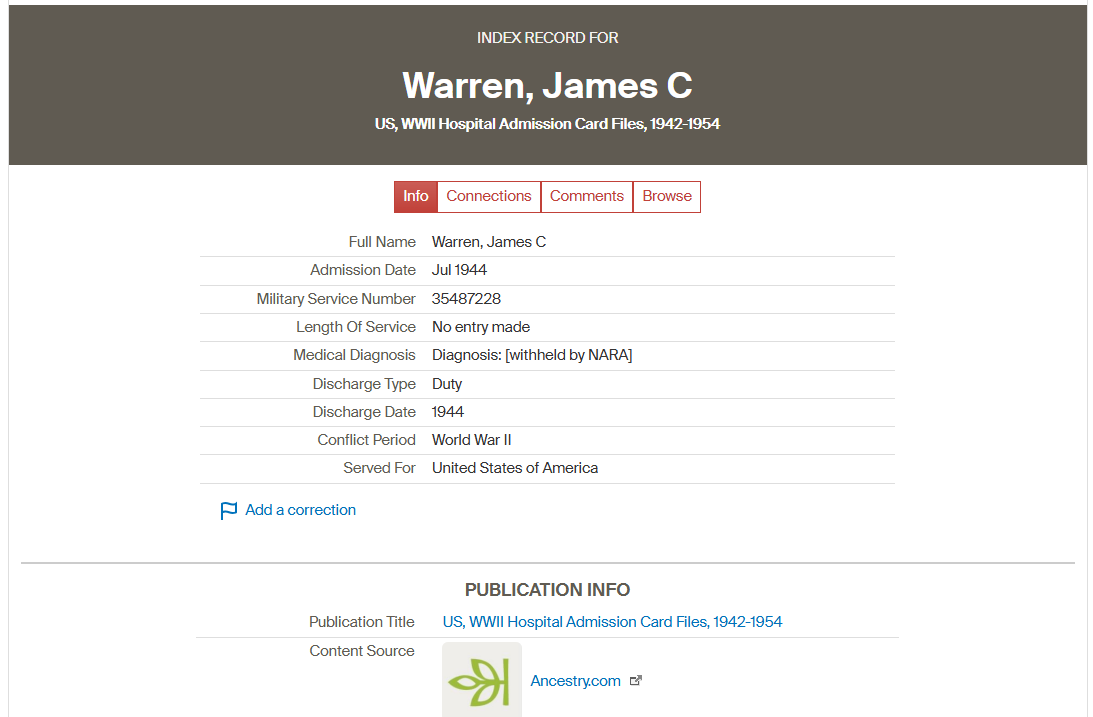
WWII Hospital Admission Card for James Warren

And when looking up his ASN…

WWII Draft Registration Information

With confirmation like this, I decided to dig deeper into PFC Warren’s life story in hopes of pulling out a few more details about his life story. Luckily, Ancestry.com and Fold3.com provide prompts based on confirmed information when researching so I was quickly on my way down the rabbit hole.

Veteran Headstone Application Form

It’s always a bittersweet discovery when I come across one of these documents, which tend to surface most often for veterans who passed away between the 1950s and 1980s. This particular record (which I’ll share below) shows that PFC Warren served with the 816th Ordnance Base Depot Company, a unit stationed in southern England at the time of his hospital admission. Interestingly, there is no mention of a Purple Heart on the form. That leaves me to wonder whether his injury did not meet the criteria for the medal, or whether it simply wasn’t recorded on his discharge papers after the war. Perhaps his family would know the answer.

Veteran Headstone Application

Luckily, the document provides just enough detail to shed light on who James Carmen Warren sadly left behind when he passed away in 1968. Born on April 8, 1921, he died on August 8, 1968, at the age of 47. He was survived by his wife, Mary Emma Green Warren, along with their two sons, Ivan and James C. Warren Jr.

More to come!

A Mormon Missionary in WWI: Battling Influenza in American Samoa


Byron Miller in World War One

Byron Miller in World War One

When searching for new portraiture to add to PortraitsofWar I generally tend to look for material with identifiable soldiers, uniforms, medals and other researchable information to help shed light on life during wartime.   In this post, I will be researching a photograph of a US Navy sailor who caught my eye during a recent eBay search.

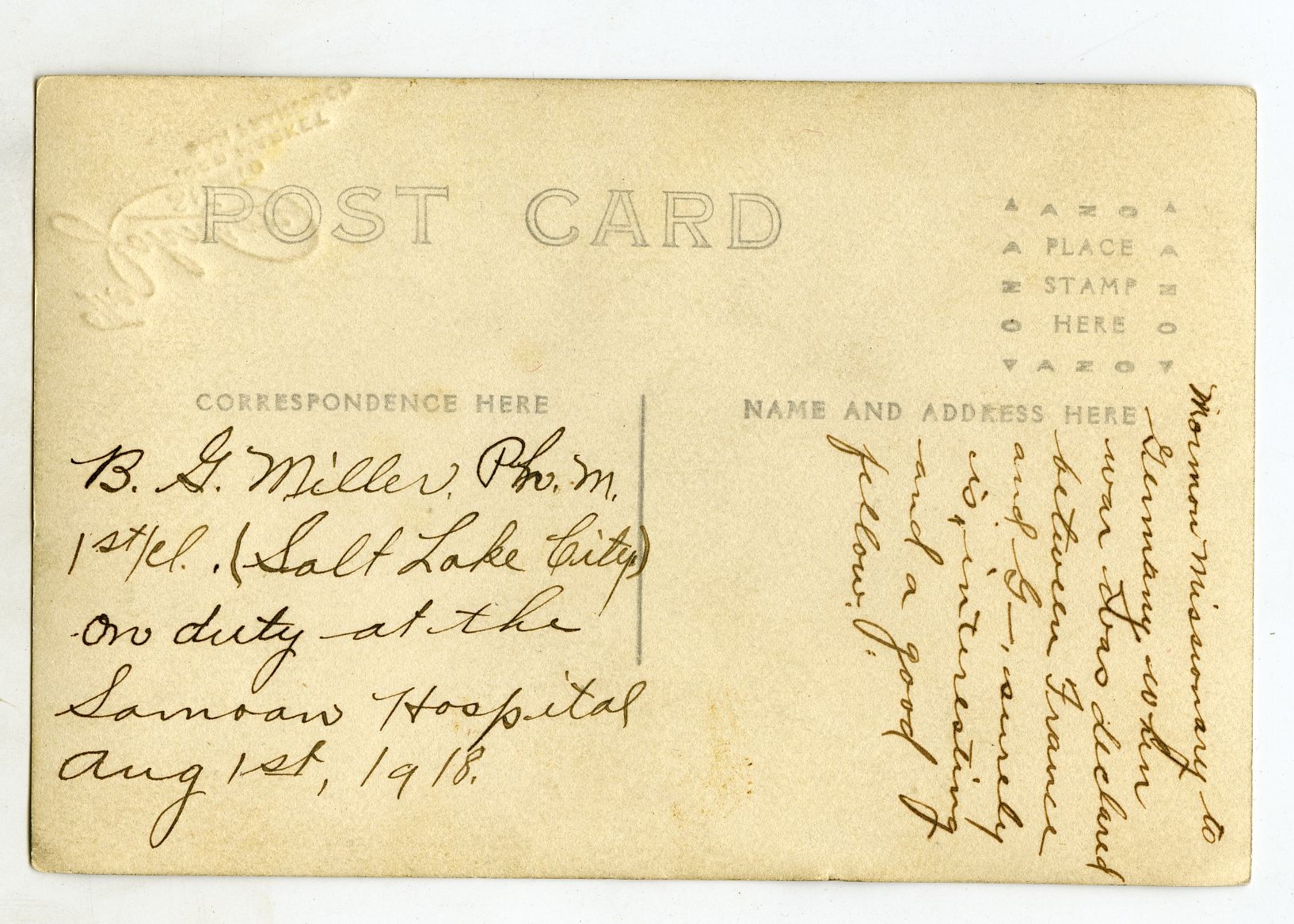
Reverse Side of Postcard

Reverse Side of Postcard

The information written on the back of the postcard shows an identification of the sitter as a B.G. Miller.  He is identified as being a Pharmacist’s Mate 1st Class from Salt Lake City, Utah who was on duty at one point at a hospital in Samoa on August 1st, 1918.  Additional info added to the photo includes an anecdote about his position as a Mormon missionary in Germany during the breakout of the war between Germany and France.

With a little luck and a lot of research I was able to track down our mysterious B.G. Miller.  Byron Gardener Miller was found listed in the Utah World War 1 Military Service Questionnaire on ancestry.com.  Please see his card below:

Byron G. Miller in WWI

Byron G. Miller in WWI

It looks like Byron attended the University of Utah for a year before being shipped off for his overseas missionary work. This is likely the reason for his service as a Pharmacist’s Mate with the US NAVY as can be seen in the details of his uniform.

Navy Pharmacist's Rate Patch

Navy Pharmacist’s Mate Rate Patch

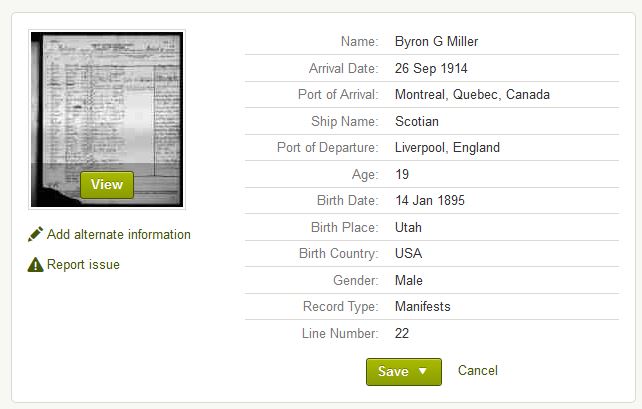
The reference to his missionary service in Germany during the outbreak of war in July of 1914 is partially confirmed through my discovery of his listing aboard a ship ledger arriving in Montreal, PQ in September of 1914.

1914

His service in Samoa has also been confirmed through the same series of records.

sssonomoa

Sadly, his arrival back in the US in 1919 wasn’t likely a time of joy for the Miller family; a Utah death certificate shows that he died of influenza only a few months later on February 7th, 1920.  Interestingly enough, my research into the US Hospital in Samoa shows that a MASSIVE flu outbreak in the Samoan Islands lead to the deaths of nearly 25% of the population.  The US Navy set up an epidemic commission to deal with the issue.  The results of the intervention in American Samoa were incredible.  Apparently the method of using maritime quarantine lowered mortality rates to nearly 1%.  It’s strange that Byron would die of influenza only a few months later while in the United States……

For the 1919 report please CLICK HERE

1920 Death Certificate

1920 Death Certificate

One of the main goals of this website is to help share photos and pertinent military service information with the families of the men and women depicted in the images I collect. In this case, I’m hoping a Miller family representative will discover a rare image of their ancestor who witnessed a formative time in history.

WWII Identified Portrait Photo – Roxbury, MA and Rockland, TX Veteran Ernest Chekoulias 295th Engineer Battalion


Ernest "Chick" Chekoulias

Ernest “Chick” Chekoulias

A recent eBay purchase has landed me with a fantastic group of WWII portrait photos all identified to members of Company A of the 295th Engineer Battalion, a unit that landed on the Normandy beaches only two weeks after the infamous June 6th, 1944 D-Day landings.  Here’s an excerpt from the unit history that described that fateful day:

The Big Moment did come at last; actually there were lots of big moments.  The battalion was divided up into three serials, and each serial was on two or more boats.  The first wave started from Hindon a little after midnight on 13 June.  There was battalion headquarters, parts of each line company, and the medical detachment. They all reached the marshaling area in Winchester at 0830 that morning.  Before dawn two days later, half of them were awakened a few hours later and they too reached another set of docks at that port.  They all sweated out a day and a night, sleeping on the quayside, before they got on the boats.  The first half, after burstmoving into the Channel, had to return to port because their ship’s anti-mine apparatus was not working.  The second half joined their convoy, stayed the night off the Isle of Wight, and then started off for France.  They saw the coast at about noon on 18 June.  They surveyed the coast defenses, and the wreckage, and the boats sunk near the shore.  It all looked very grim.  That night the skyline glowed with glare  of fires and bursting shells, and they were still on the boats in the Channel………”


The photo I’ve selected for this post was initially partially identified as an Ernest Chek…… of 9 Mt. Pleasant Ave, Roxbury, Massachusetts.  I eventually tracked down a unit roster for the 295th Engineers that lists a Sgt. Ernest Chekoulias, serial number 31301800 from Roxbury, MA.  It’s clearly a hit and a cross reference with his obituary confirms that this is indeed the same soldier.  Sgt. Chekoulias is listed in the unit history as having been awarded the Bronze Star for Heroic Achievement.  His obituary page confirms this.


Unit History Bronze Star Info

Unit History Bronze Star Info


chekbronzestar


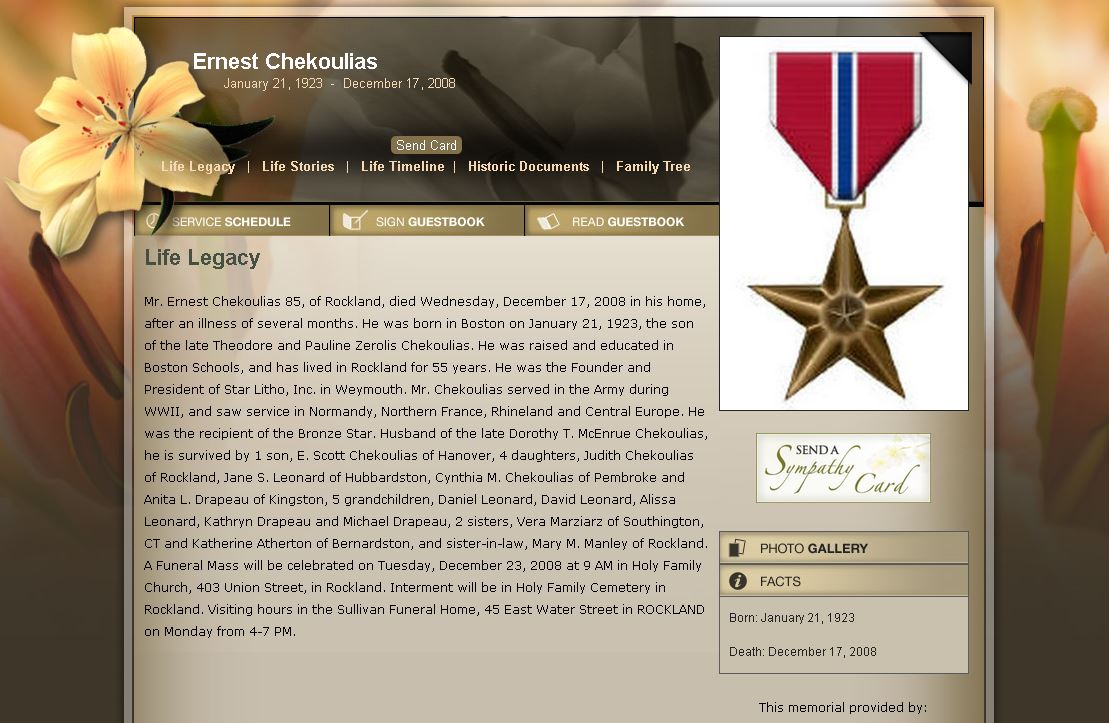
Ernest Chekoulias was born in Boston, MA on  January 21st, 1923 and passed away in Rockland, TX on December 17th, 2008 at the age of 85.   His obituary reads:

Amphib084 copy

Mr. Ernest Chekoulias 85, of Rockland, died Wednesday, December 17, 2008 in his home, after an illness of several months. He was born in Boston on January 21, 1923, the son of the late Theodore and Pauline Zerolis Chekoulias. He was raised and educated in Boston Schools, and has lived in Rockland for 55 years. He was the Founder and President of Star Litho, Inc. in Weymouth. Mr. Chekoulias served in the Army during WWII, and saw service in Normandy, Northern France, Rhineland and Central Europe. He was the recipient of the Bronze Star. Husband of the late Dorothy T. McEnrue Chekoulias, he is survived by 1 son, E. Scott Chekoulias of Hanover, 4 daughters, Judith Chekoulias of Rockland, Jane S. Leonard of Hubbardston, Cynthia M. Chekoulias of Pembroke and Anita L. Drapeau of Kingston, 5 grandchildren, Daniel Leonard, David Leonard, Alissa Leonard, Kathryn Drapeau and Michael Drapeau, 2 sisters, Vera Marziarz of Southington, CT and Katherine Atherton of Bernardston, and sister-in-law, Mary M. Manley of Rockland. A Funeral Mass will be celebrated on Tuesday, December 23, 2008 at 9 AM in Holy Family Church, 403 Union Street, in Rockland. Interment will be in Holy Family Cemetery in Rockland. Visiting hours in the Sullivan Funeral Home, 45 East Water Street in ROCKLAND on Monday from 4-7 PM.


I would like to take the opportunity to thank the late Ernest “Chick” Chekoulis for his service with the 295th Engineers during WWII.  This post is for you!


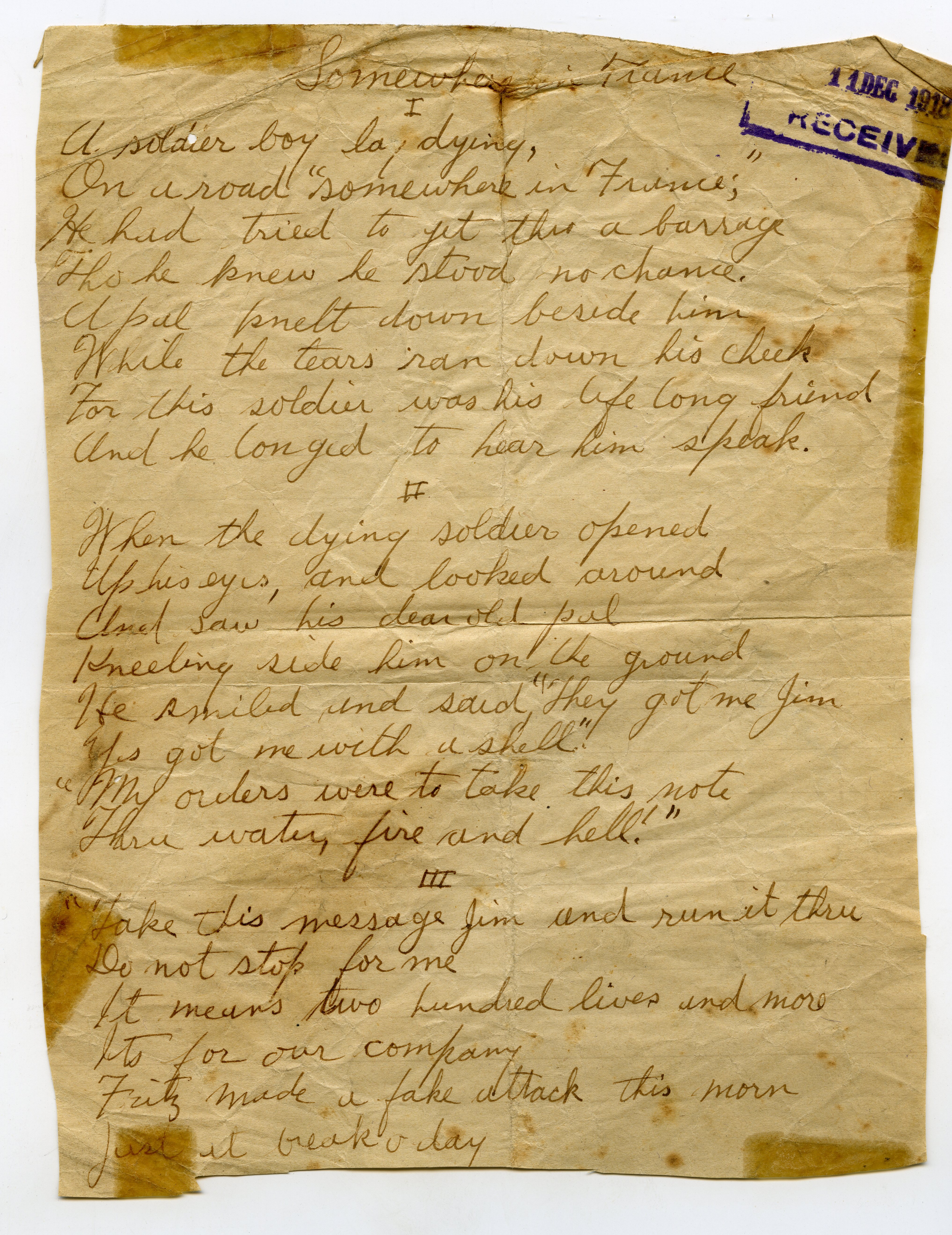
Amazing 103rd Infantry Regiment Field Written Poem – “Somewhere in France” – 26th Division


Sometimes a true gem will turn up among the pages of boring WWI eBay listings.  In this case I was able to purchase a small lot of photos and letters for less than $10, and discovered an amazing field written poem by a battalion runner in the 103rd Infantry Regiment of the 26th “Yankee Division” (my favorite division BTW).  Although the photos that came with the grouping are unrelated to the 103rd, I thought I would post the poem and transcription as a memorial to all those who died in the trenches of France.  Memorial Day is only a few days away and I think it is a fitting tribute to the men and women who served during the First World War.

Please visit Soldier’s Mail for other photos and interpretations of further 103rd Infantry Regiment related material.

Written at Apremont France by Battalion Runner  Blanchard of Company F of the 103rd Infantry Regiment of the 26th Division


Somewhere in France

I

A soldier boy lay dying,

On a road “somewhere in France;”

he had tried to get through a barrage

Tho he knew he stood no chance.

A pal knelt down beside him

While the tears ran down his cheek

For this soldier was his lifelong friend

And he longed to hear him speak.

II

When the dying soldier opened

Up his eyes, and look around

And saw his dear old pal

Kneeling side him on the grounf

He smiled and said “They got me Jim

Yes got me with a shell.”

“My orders were to take this note

Through water, fire and hell.”

III

“Take this message Jim and run it thru

Do not stop for me

It means two hundred lives and more

Its for our company

Fritz made a fake attack this morn

Just it break o’ day

If you can only get it rhu

We’ll make those dam Huns pay”

IV

“And when you get around to it

Just write a line or two,

To my mother and my sweetheart Jim

Old pay so good and true;

Tell them I tried to make it

Thru gas, barrage, and shell

That my resting place is heaven

For I when there thru a hell.”

V

Then the dying soldier closed his eyes

His pal with tender care,

Gently laid him down

And smoothed his bloody ruffled hair,

And with a sob of anguish

He started down the road,

In his hand he held the message

That was written out in code.

VI

Jim got the message there in time

To quell the Germans’ bluff,

He told the story to the boys

How the blood got on his cuff,

The dying words of Bill his pal

A runner dead and gone

And the company paid their last respects

To the brave but silent form.

~Wrote at Apremont by Batt. Runner Blanchard

At the conclusion of a dream – YD Co. F 103. Inf.