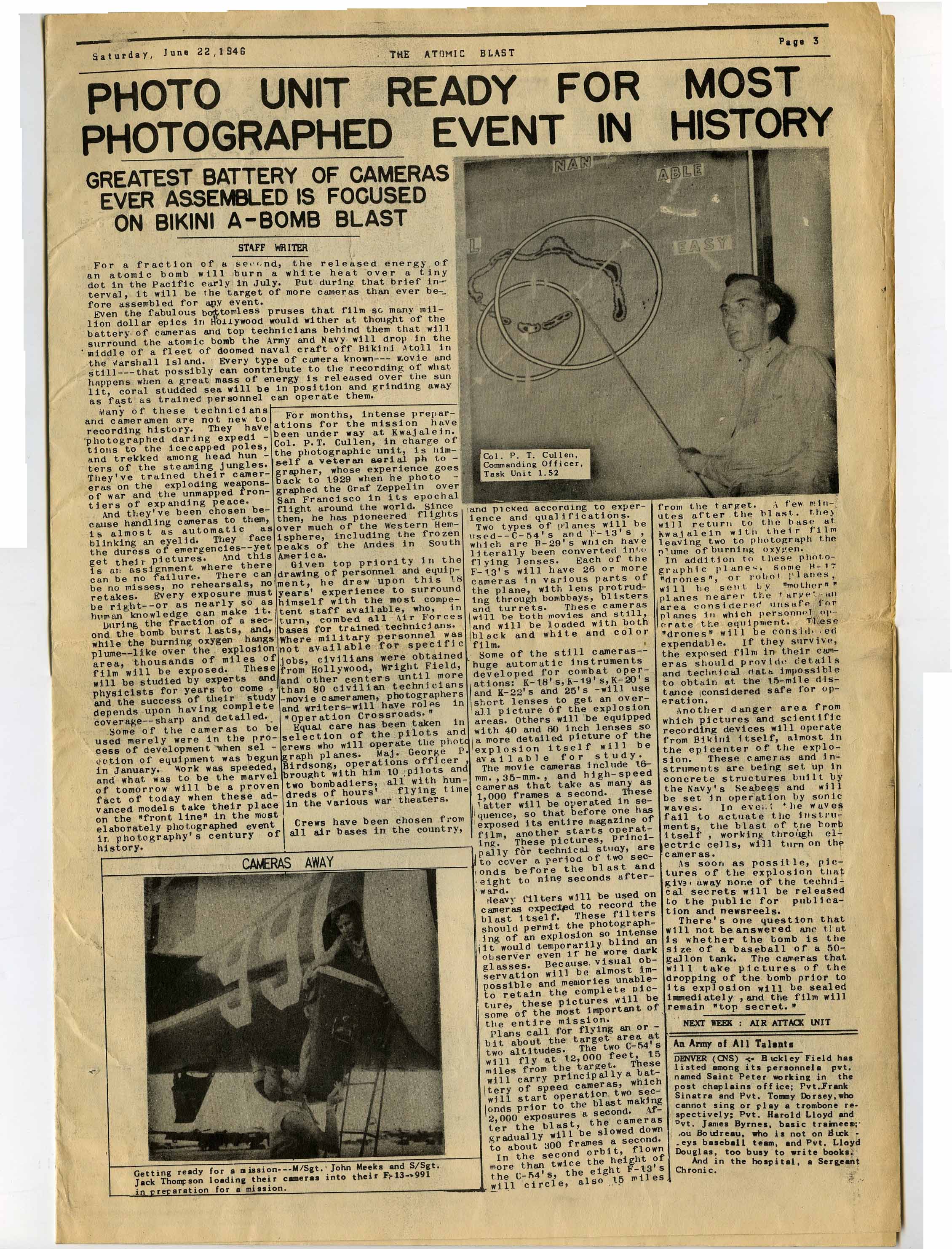
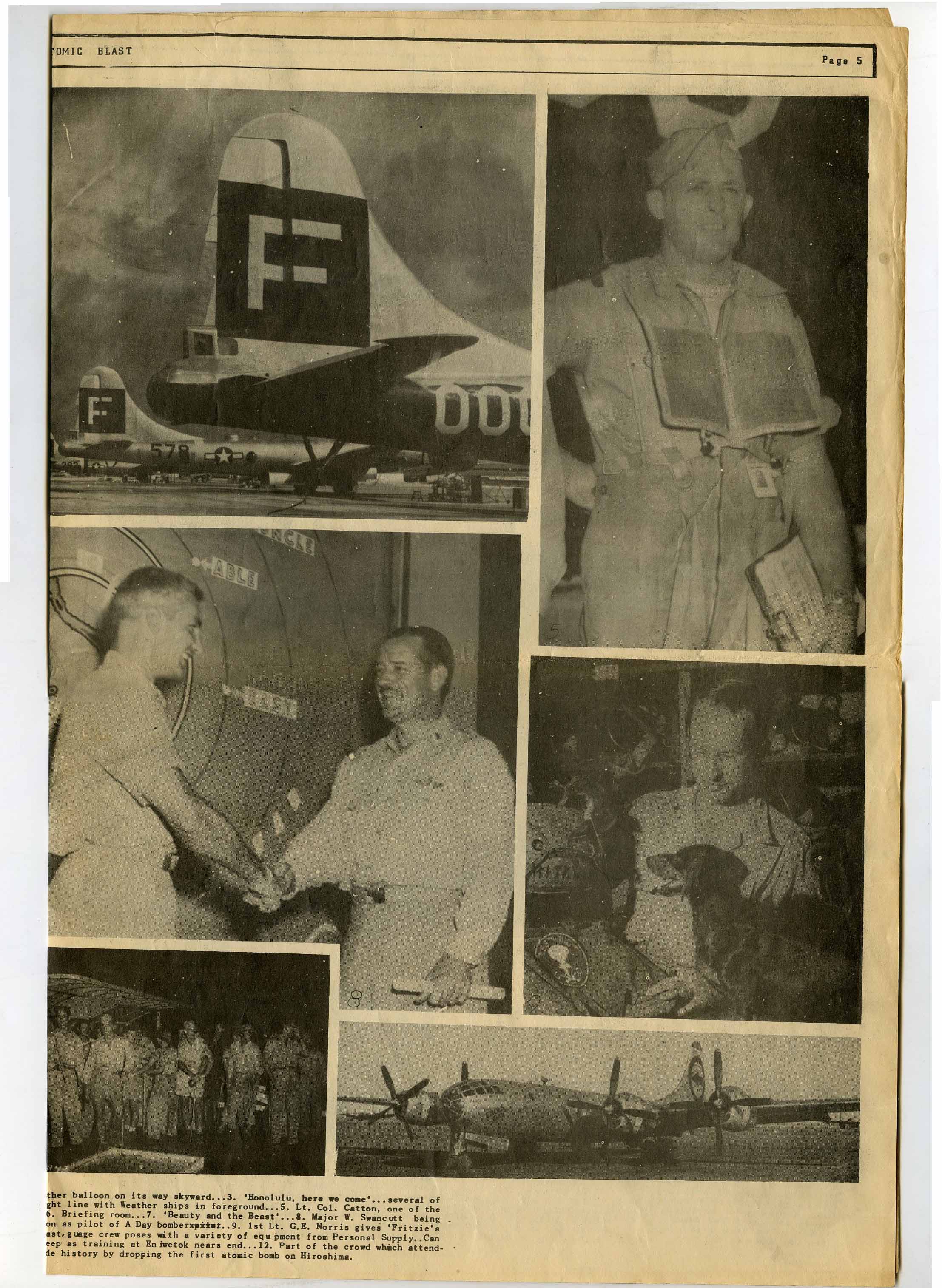
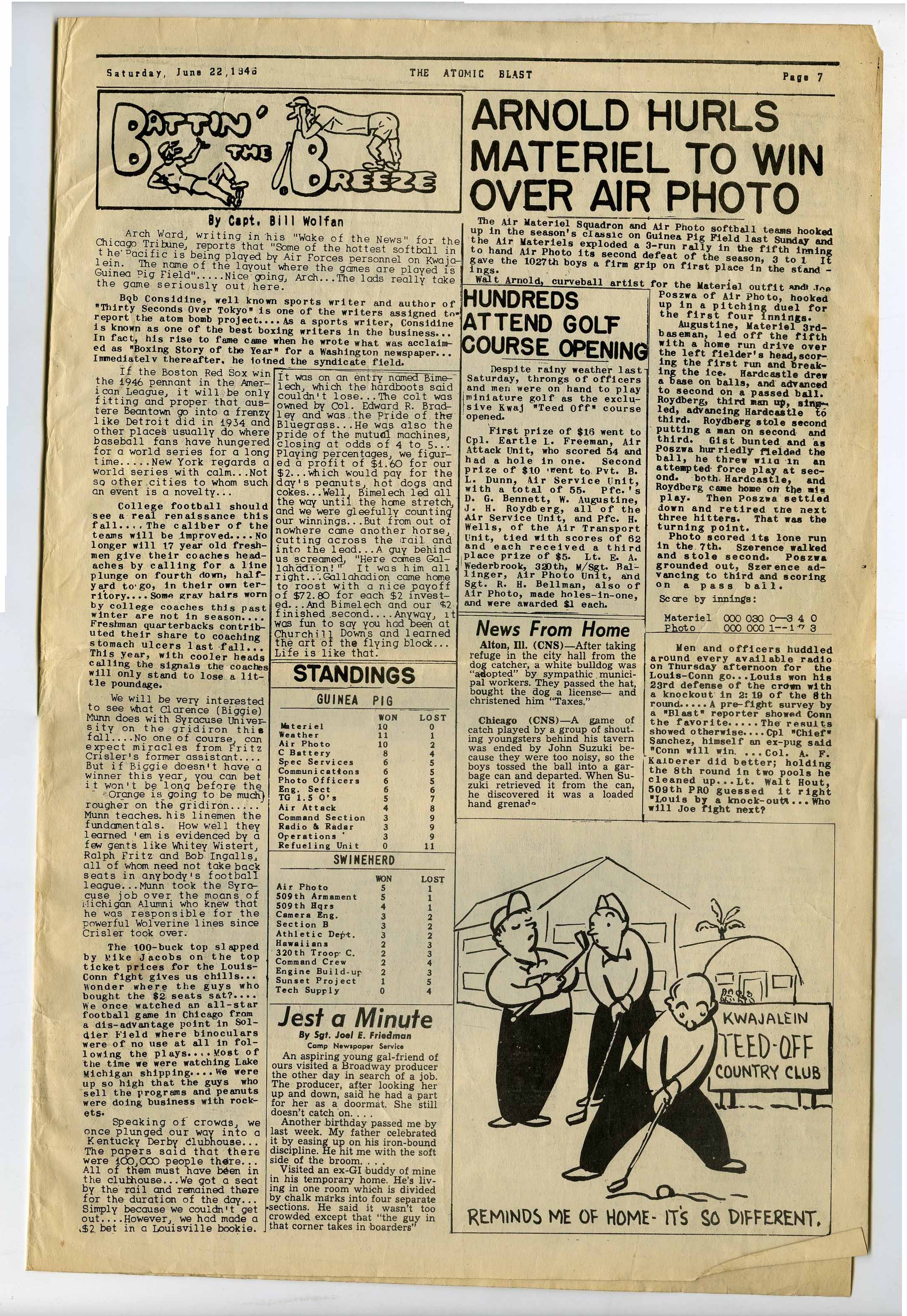
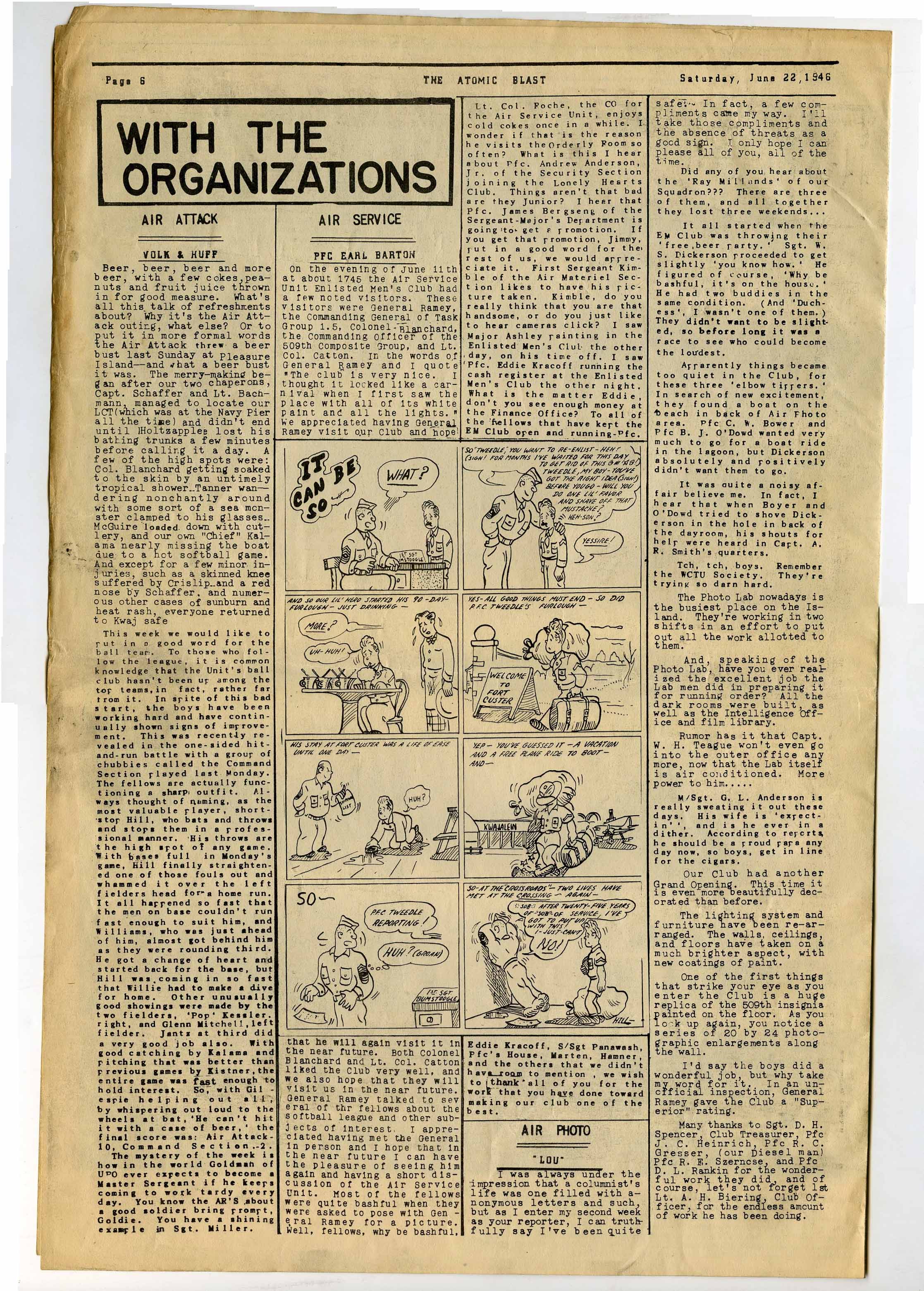
WWII 388th Bomb Group Artist – MAJOR Biographical Update


Image

My quest to discover the mysterious background of a WWII artist started nearly two years ago with the acquisition of a grouping of photographs and negatives from a seemingly nameless soldier.  I soon was able to deduce his name – Alva Alegre, and began the incredibly interesting voyage of tracking down his true identity.  His photography is hauntingly personal, unveiling the often unseen side of war; the everyday life of the 388th Bomb Group.  The journey has introduced me to dozens of people with connections of “Al”, from 94 year old bomber pilots who fondly remember seeing his artwork behind the Officers Bar in England, to military engineers who knew him later in life.  I’ve spent hundreds of hours (really!) scanning his photographs and dozens more hours researching his life.

After contacting the U.S. Army Arsenal where Al worked in the 1960s, I was able to find a museum curator who has access to works created by Al in the late 1960s.  He also was able to track down an article written for the employee newspaper that highlights his life story.  Finally!  Please read and check out some of my related posts.  Just search for 388th in the search menu.  His photographic skills cannot be understated.

“Artist’s Life”

The Arsenal Arsenalite

July-August 1970

By Bob Grybos

If your business should take you to the Benet R&E Labs, make it your business to visit the Reception Area and view the Ilustations of Watervliet – designed weapons of action.  You’ll find they combine meticulous craftsmanship with artistic perception to the degree that makes these paintings far more than straightforward representations, and that the Arsenal is fortunate indeed to have the talent that produced them at its service.

That talent belongs to Al Alegre who has been our technical illustrator since 1963 when he arrived at Watervliet following a varied and colorful career that began when he left his native Phillipines at age of 17.  He came first, via Canada, to Chicago where he abandoned his original intention to enter the electrical engineering field, deciding instead on a career in art.  So, then it was off to Northwestern University where he acquired a bachelor of philosophy, majoring in art, then thence to the Artt Institute of Chicago.

After a year back home in the Phillipines he wended his way to California in 1939 and for the next two years worked as a portrait sketch artist in the Phillipiines Pavillion at the San Francisco Worlds Fair.  Here he produced more than 4,000 charcoal portrait sketches and between seasons attended the Art Center School in Los Angeles – where he also studied photography.

With the closing of the Fair, “the fastest brush in the West” entered the U.S. Army Air Force and assigned as an armament staff sergeant with the 8th Air Force {388th Bomb Group} in England.  During off-duty hours he continued to perfect his skills, burning out portraits of his fellow soldiers – including no less a GI than General Ira Eaker, boss of the 8th.

After the war Al returned to the Windy City for graduate studies at the University of Chicago and then moved on to New York City where he received his masters degree in art from Columia University in 1947.

Following his completion of a course in color photography Al opened his own art and photography establishment “Studio 74” at that number on 57th Street, which happened to be located next door to the voice instruction school of famed composer Gian Carlo-Menotti which, Al says, provided not only a pleasant musical accompaniment but also a wealth of models for the Alegre activity.

Exposure to commercial art led to an interest in air brush techniques and consequently to Alegre’s present career as a technical illustration.  Since embarking in the field he has worked for Polaroid Electronics in Long Island, Fairchild Aircraft in Maryland, EDO COpr, Long Island, and the Missile and Space Division of GE in Philadelphia.

It was while working for GE(on space re-entry vehicles) that Al was contacted by representatives  of our Personnel Office and soon afterward joined us for a relationship that has proved mutually profitable ever since.

Al’s artistic outpost, has not been restricted to his arsenal assignments.  His work in many media employing many techniques is well known to many Arsenalites.  A former charter member of the Artist’s Equity of New YOrk, and professor of a listing in “Who’s Who in American Arts” he’s now a member of the Arsenal Art Guild exhibits.  Another regular extra-curricular activity is the painting of portraits of Aresenal C.O.s which he presents to them upon their leaving Watervliet.

Apresently Al maintains a studio apartment in Troy and also a studio in PHiladelphia where, along with producing a variety of paintings, he is also working on a book on technical illstration.

His ambition for the future is to instruct.  And, by the results achieved by his students in the Art Guild class he recently conducted, future students are in store for a very rewarding experience.

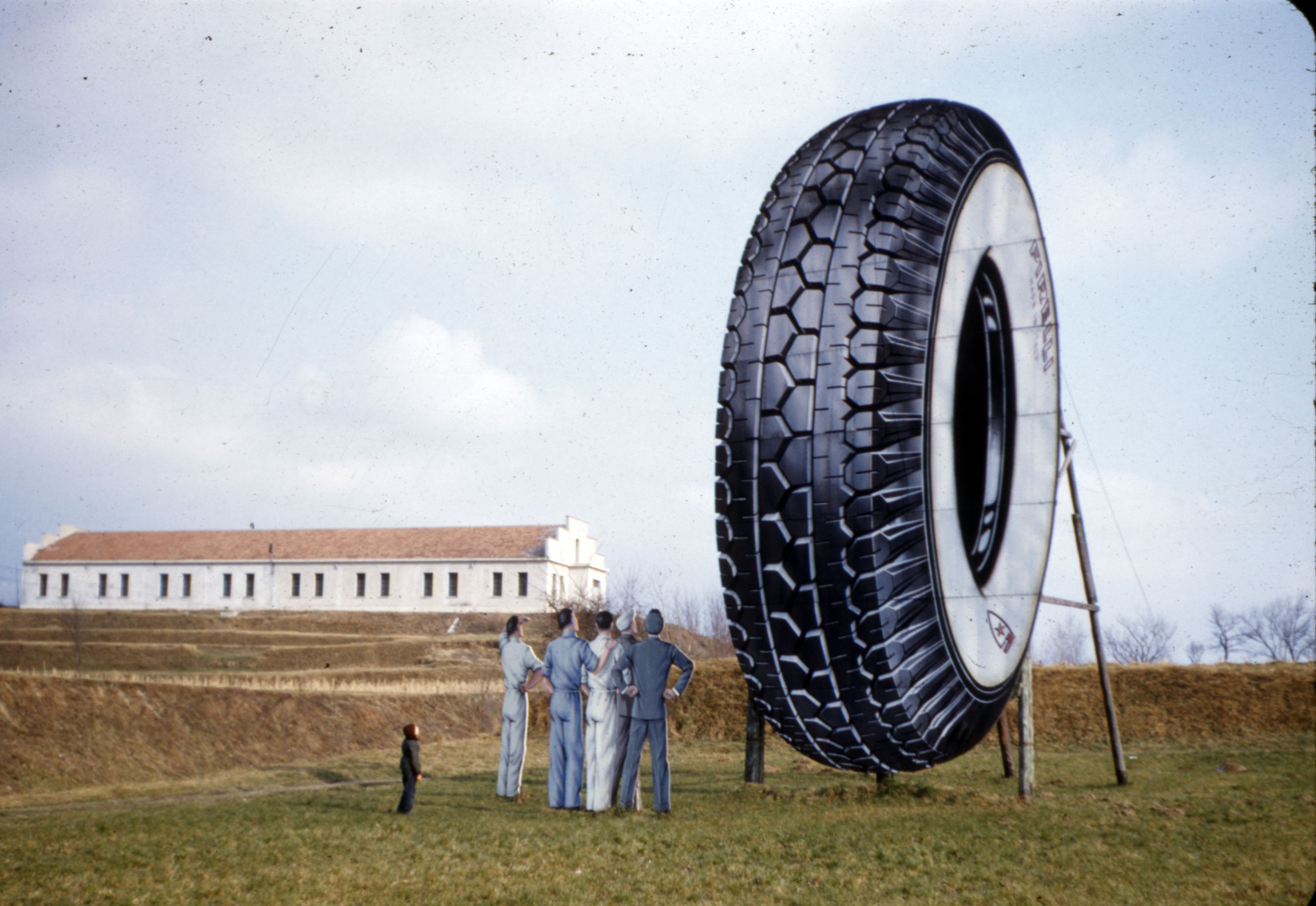
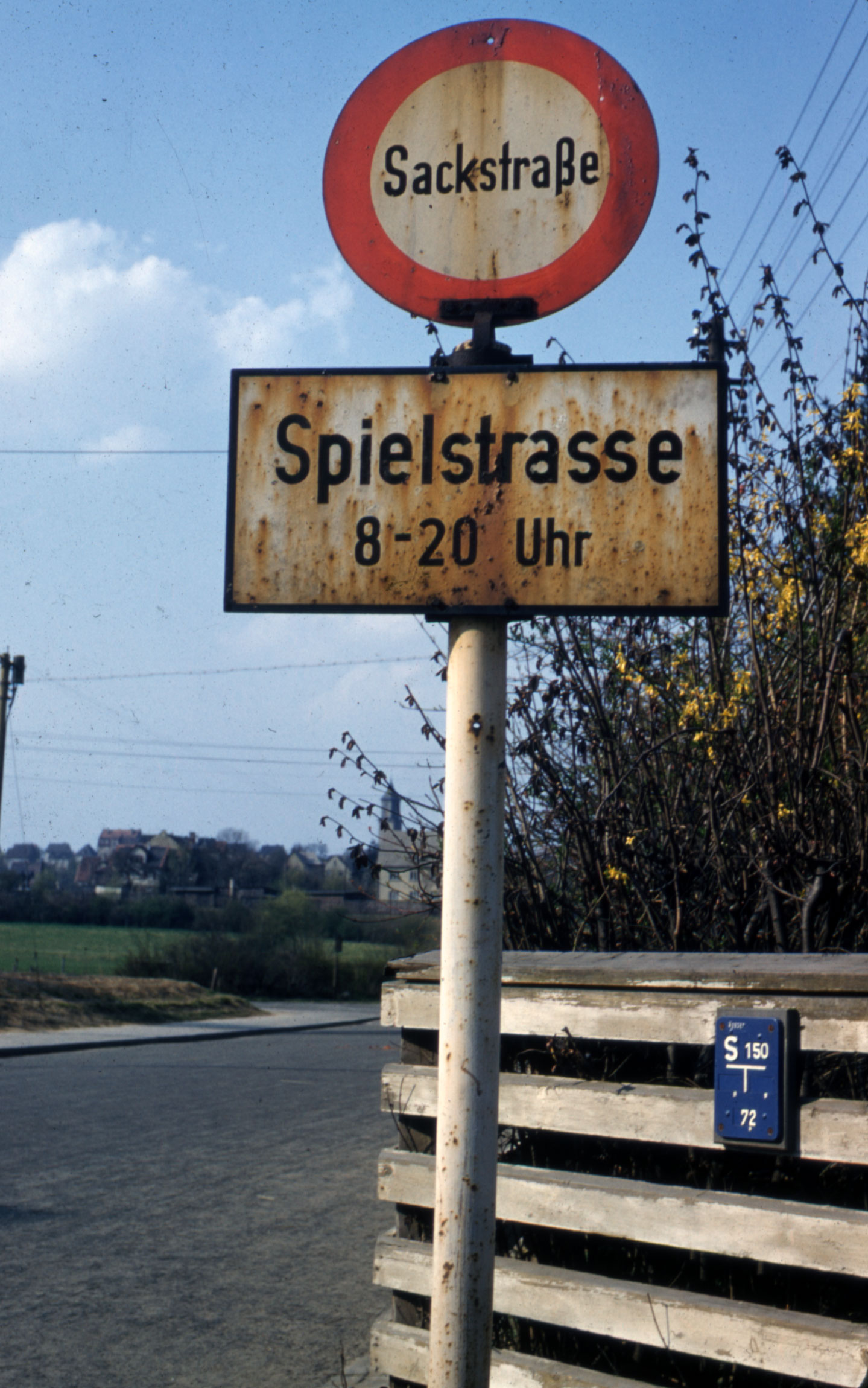
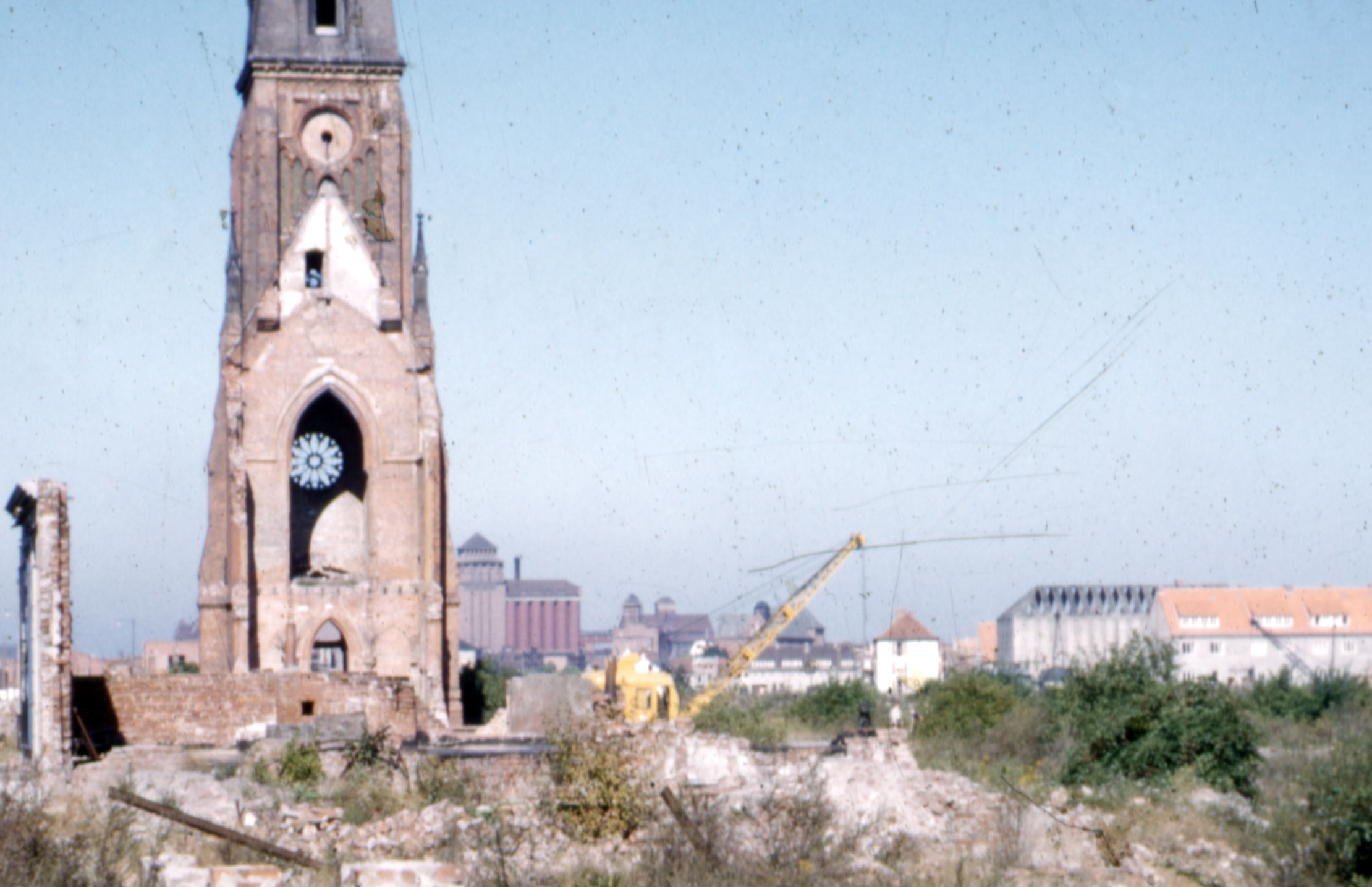
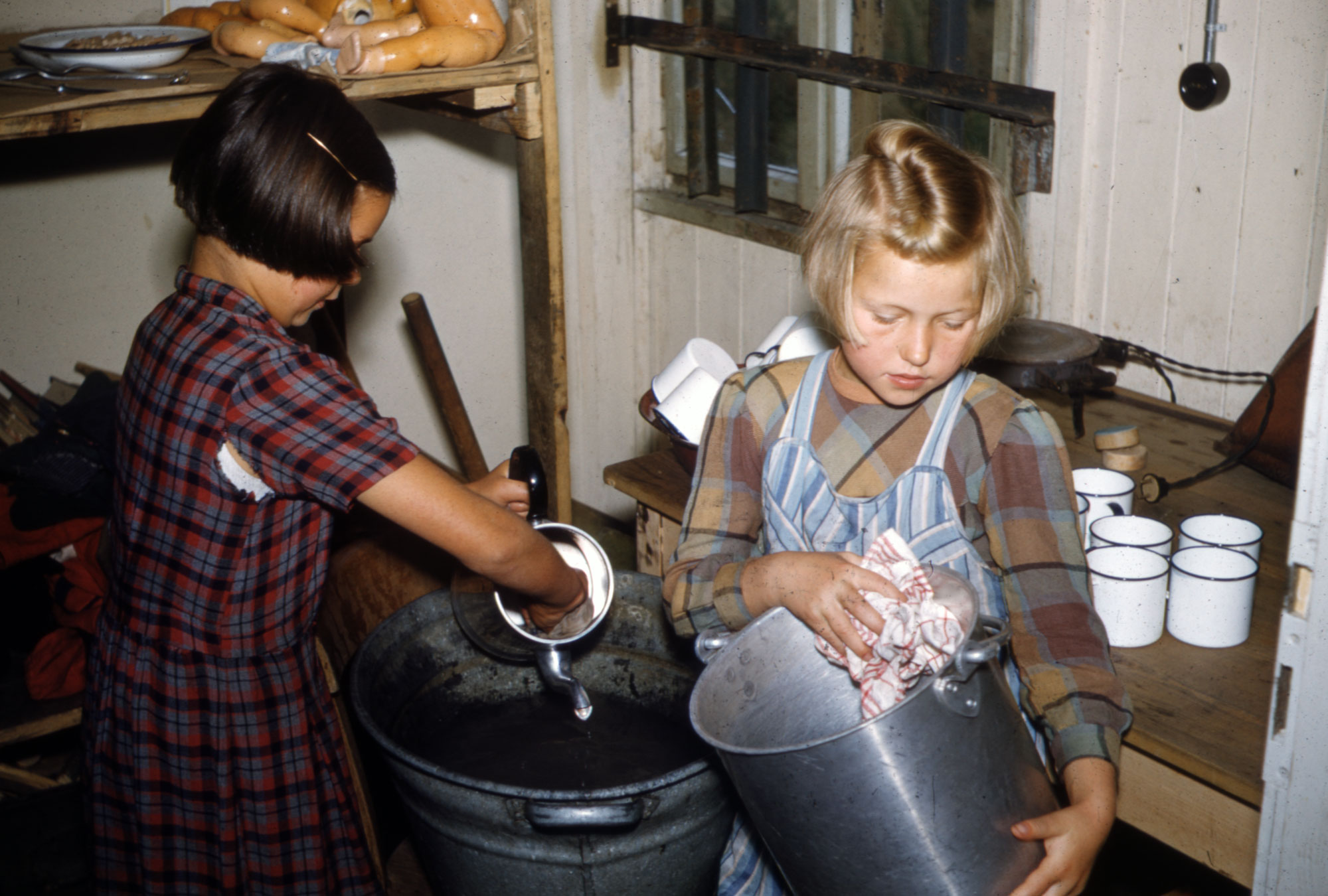
Post WWII Rebuilding of Germany – The Marshall Plan and Kassel, Germany in Vibrant Color in the 1950s


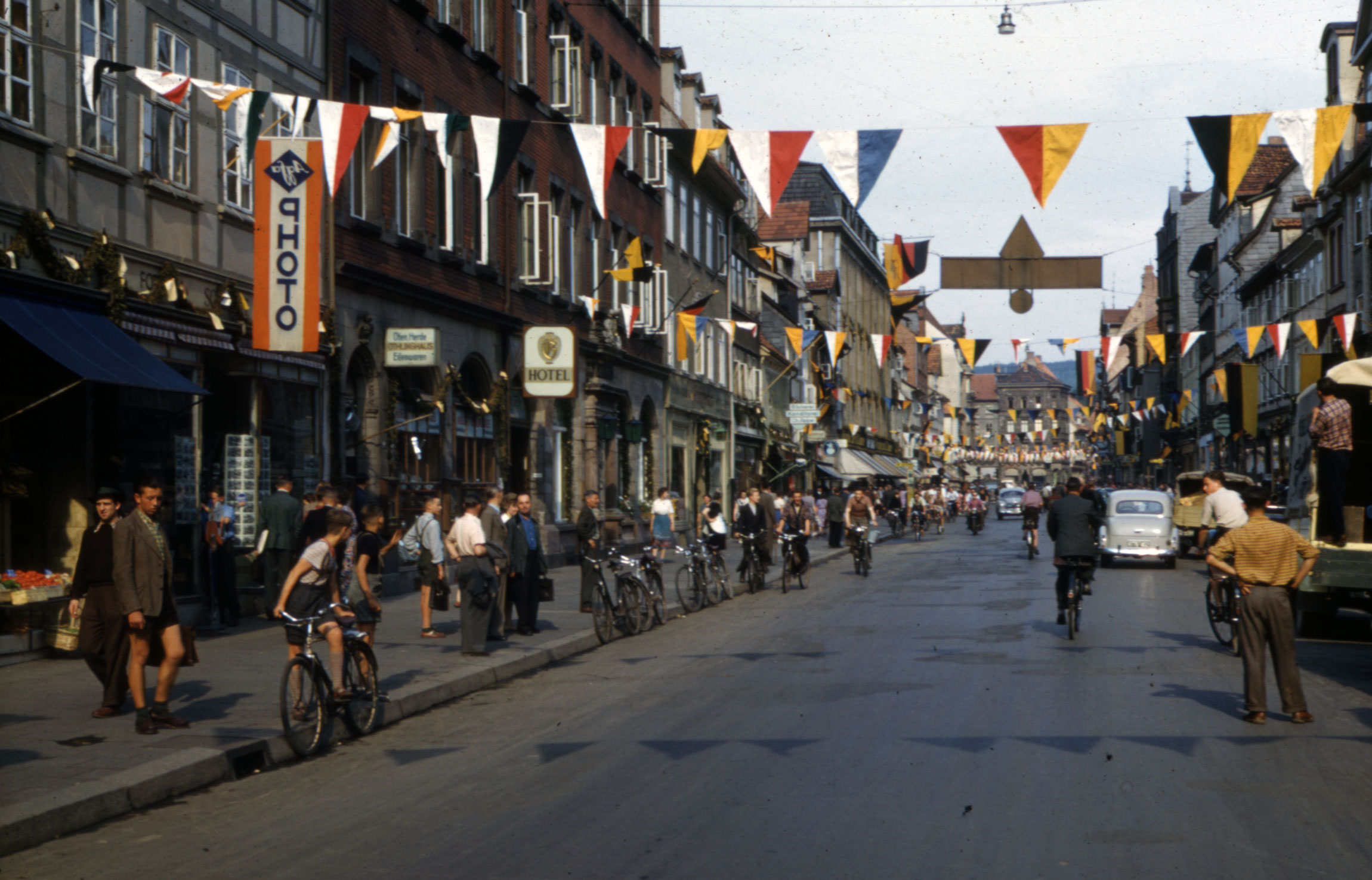
PortraitsofWar recently acquired a collection of over 200 color slides taken in the mid to late 1950s depicting the rebuilding of Postwar Germany in the Kassel area.  The images follow a group of American volunteers who helped rebuild churches in and around the city.  They also were charged with feeding and taking care of refugees who were waiting for new homes to be built.  Although there is no linear progression to the photos, they nonetheless show a side of European history that has been glossed over.  The Marshall Plan brought industry and revitalization to Europe, and also brought American tourists who snapped countless photos of the rebuild process.


WWI Fort Ethan Allen 2nd Vermont Cav. Detailed Letter – Officer Shot in the Head! – Vermont WWI Content


The 2nd Vermont Cavalry trained at Fort Ethan Allen in Colchester Vermont prior to WWI and, after training, shipped off to France to fight with the only US cavalry unit during the war.  I currently live only ten minutes from the fort, and have previously posted a panoramic photo from an infantry regiment that trained there as well.  Collecting WWI Vermont items can be hard; the material seems to never come up to auction.  In this case, I was able to find a little nugget of Vermont history hidden amongst the seemingly endless WWI eBay listing section.

Looks like Clarence “Everett” Hall was originally from Manchester, Connecticut.  In his letter he mentions a number of interesting topics, including the everyday life of a cavalry troop as well as an interesting encounter where he inadvertantly shoots an officer in the head!  A great read, and a must for any fan of WWI cav.


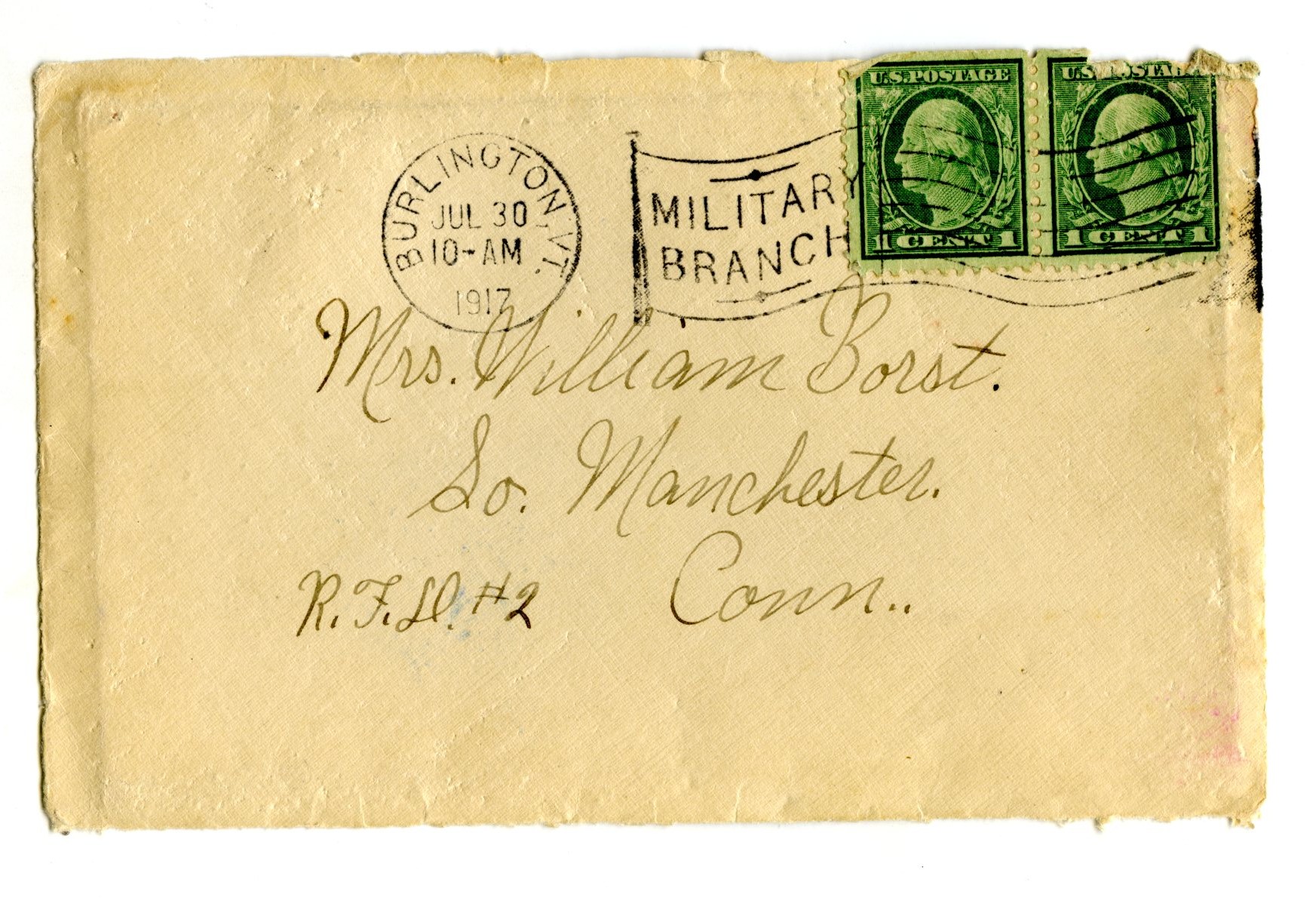
Postmarked Burlington on July 30th, 1917.

Clarence Everett Hall

Fort Ethan Allen

Troop M. 2nd Vermont Cav.

July 28th, 1917

Dear Marion,

Your welcome letter received.  Will write while I have time.

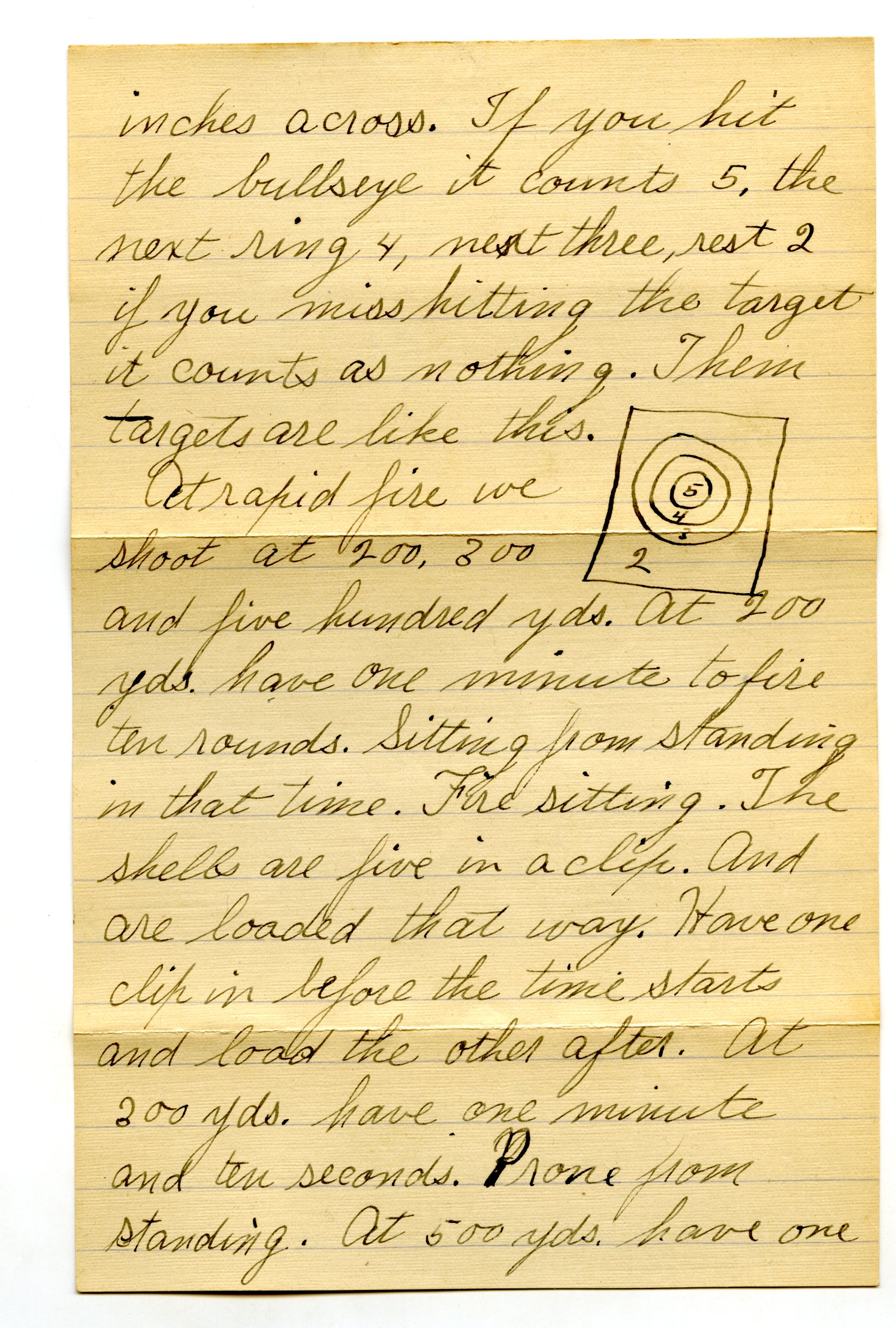
Haveing(sic) a little better weather now.  It was 102 Wednesday on the range.  We was shooting for record shoot slow and rapid fire.  At slow you can take all the time to shoot you want.  Fire at 300, 500 and 600 yards slow fire.  Ten shots or rounds at each.  At 300 yards the bullseye is twelve inches across.  At 500 and 600 yards its twenty inches across.  If you hit the bullseye it counts as 5, the next ring 4, next 3 , rest 2 if you miss hitting the target it counts as nothing.  Then targets are like this.

On rapid fire we shoot 200, 300 and 500 yards.  At 200 yards have one minute to fire ten rounds.  Sitting from standing that time.  Fire sitting.  The shells are five in a clip.  And are loaded that way.  Have one clip in before the time starts and load the others after.  At 300 yards have one minute and ten seconds.  Prone from standing.  At 500 yards have one minute and twenty seconds to fire 10 rounds in.  And fire prone, laying down before the time starts.  The rapid fire target represents a mans head and shoulders.  And count the same.  The bullseye is forty inches across.

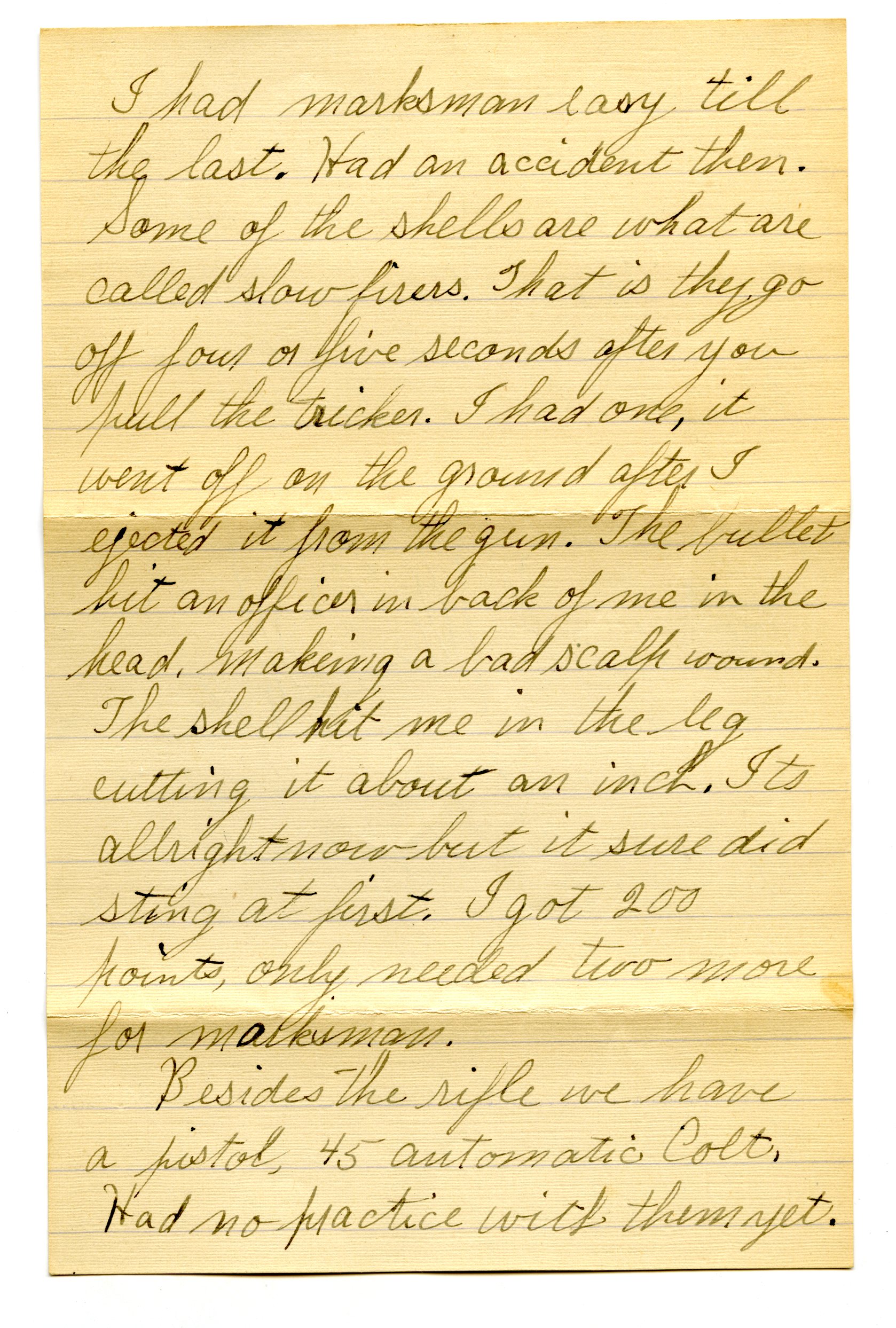
The higher score you get the better it is.  252 points gives you expert rifleman, that pays fire dollars a month extra.  238 gives you sharpshooter, that pays you three dollar a month.  202 pays two dollars a month and is marksman.  Nobody in the troop got expert several got sharpshooter, and several marksman.  I had marksman easy till the last.  Had an accident then.  Some of the shells are what are called slow fires.  That is they go off four or five seconds after you pull the trigger.  I had one, it went off on the ground after I ejected it from the gun.  The bullet hit an officer in back of me in the head, making a bad scalp wound.  The shell hit me in the leg cutting it about an inch.  It’s allright(sic) now but it sure did sting at first.  I got 200 points, only needed two more for marksman.

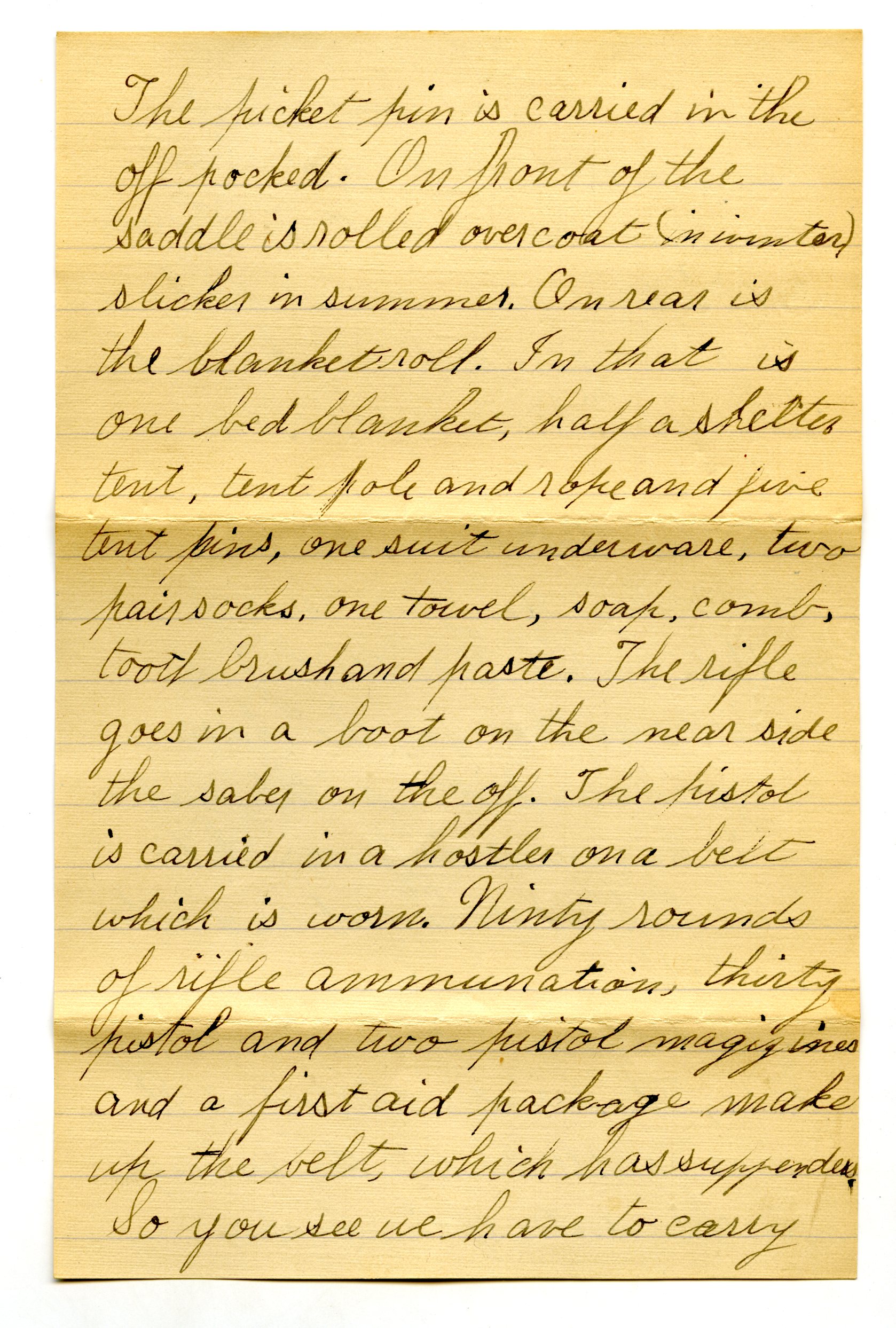
Besides the rifle we have a pistol, 45 automatic Colt.  Had no practice with them yet.  Besides that we have a saber.  Like a sword.  Straight and about three and a half feet long.  At full pack, “thats when we are ready for a long march we have the following.” One saddle, one saddle blanket, that foes on the horse, one surscingle, one pair saddle bags, they go on the read of the saddle.  In the saddle bag is carried everything for the horse.  Curry comb, brush, etc.  In the rear one is the man stuff messkit.  Knife, fork and spoon and any other little thing you want to carry.  The canteen in carried on the rear saddle packet the tin cup in the center of the loops.  The picket pin carried in the off pocket.  On front of the saddle is rolled overcoat (in winter), slicker in summer.  On rear is the blanketroll.  In that is one bed blanket, half a shelter tent, tent pole and rope and five tent pins, one suit underwear, two pair socks, one towel, soap, comb, toothbrush and paste.  The rifle goes in a boot on the near side, the saber on the off.  The pistol is carried in a holster on the belt which is worn.  Ninety rounds of rifle ammunition, thirty pistol and two pistol magazines and a first aid package make up the belt, which has suspenders so you can carry quite a little. The rest of out clothing etc. is put in a bag and carried in the wagons.  We just use the saddle for regular drill.

We have revellie, first call 5:15 roll call 5:30, breakfast at 6, drill at 7 until 10:30 mounted stables, that’s grooming the horses until 10:50.  11 till 11:30 dismounted drill with rifles.  12 dismiss.  In the afternoon if its not to(sic) hot have rifle, pistol, sabre drill.  Semaphore and wigwag practice, that’s sending messages with one and two flags.  Saturdays we have inspections of everything.  No drilling, afternoon off.  Sundays off except stables and water call.  Water call is 4:30.  Water and tie up the horses then.  5:30 retreat and supper.  Tatoo at nine, taps at eleven.  We have to put all lights out in the squad room at nine.

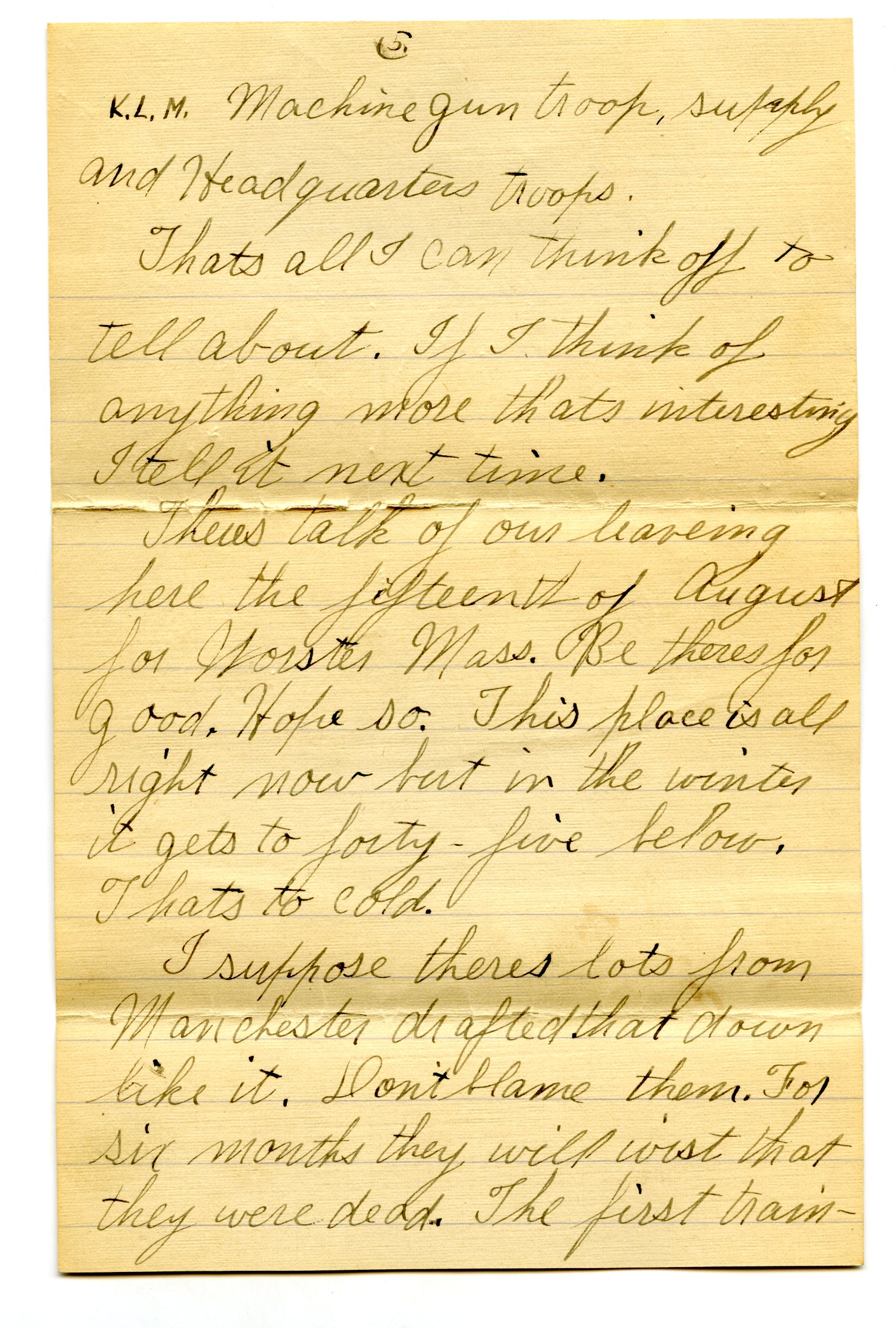
We have a nice building to sleep in .  Have a large day room downstairs, music library etc. there.  Shower, baths, etc. in the basement.  Have regular bunks to sleep in with springs, sheets, pillows etc.  There’s 105 in the troop.  Theres 15 troops in a regiment, four squadrons, three troops to a squadron and three troops over A.B.C, D.E.F, G.H.I, K.L.M, machine gun troop, supply and headquarters troops.

That’s all I can think off(sic) to tell about.  If I think of anything more that’s interesting I will tell it next time.  There’s talk of our leaving here the fifteenth of August for Worcester, Mass.  Be there for good.  Hope so.  This place is all right now but in the winter it gets to 45 below.  That’s too cold. 

I suppose there’s lots from Manchester drafted that don’t like it.  Don’t blame them.  For six months they will wish they were dead.  The first training is very hard.

Guess I will close now its time for retreat and if I write much more I’ll have to send this parcel post.

With Love,

Everett

Clarence E. Hall

WWI Grave Find Tells Story Germans Want To Forget


http://www.spiegel.de/international/europe/0,1518,794103,00.html


Pocket Books and Prayer Beads

WWI Grave Find Tells Story Germans Want To Forget

By David Crossland

Photo Gallery: German WWI Shelter Unearthed in France


Archaeologists in France recently discovered the remains of 21 German soldiers from World War I in an underground shelter that hasn’t been touched since the day it was destroyed by French shells 93 years ago. Pocket books and prayer beads tell stories of life in the trenches — but Germany doesn’t want to hear them.

Archaeologists in northern France have unearthed the bodies of 21 German soldiers from World War One in an elaborate underground shelter that was destroyed in a French attack in March 1918, and hasn’t been opened since.


Individual war casualties are still frequently found during construction work on the former Western front battlefields of France and Belgium, but the discovery of so many soldiers in one location is rare.

The tomb, poignant and grisly, sheds light on the lives of the soldiers who died in explosions from heavy shells that penetrated the tunnel.

“It’s a bit like Pompeii,” Michaël Landolt, the French archaeologist leading the dig, told SPIEGEL ONLINE. “Everything collapsed in seconds and is just the way it was at the time. This is an extraordinary find.”

The men were from the 6th Company of the “Reserve Infanterie Regiment 94.” Their bodies had been left in the dugout because retrieving them was deemed too dangerous. A total of 34 men in the shelter were killed in the attack. Troops managed to haul out 13 of the dead at the time.

The roof of the “Killian Shelter,” a tunnel 125 meters (410 feet) long near the small town of Carspach in the Alsace region, was discovered by chance in October 2010 during excavation work for a nearby road building project. The regional French archaeological authority, PAIR, began a thorough dig last month and expects to complete its work by mid-November.

Pipes, Wallets and a Rosary

The tunnel, six meters underground and 1.80 meters high, was built with German thoroughness, equipped with heating, telephone connections, electricity, beds and a pipe to pump out water. It had 16 exits and was big enough to hold up to 500 men in an emergency.

The archaeologists have uncovered the sides, floors and stairways, all made from heavy timber. The intended permanence of the structure shows how static the fighting was for most of the war, in which both sides built vast trench systems that stretched 440 miles from the Swiss border to the North Sea.

Boots, helmets and weapons, a wine bottle and a mustard jar have been found along with personal items including dog tags, wallets, pipes, cigarette cases, spectacles and pocket books. A rosary was also found, with a French bullet threaded in among the prayer beads, evidently fashioned as a souvenir.

“The items will be taken to a laboratory, cleaned and examined,” said Landolt. It is unclear whether the booklets found are diaries or identity papers.

The skeleton of a goat was also discovered. It may have been held as a source of fresh milk.

Scant Interest From German Public

In Britain, the discovery of such a mass grave would be front-page news. Journalists would track down the descendants of the dead soldiers and tell the stories of the Tommies who made the ultimate sacrifice in the horrific conflict that shaped the 20th century.

That was what happened in 2009, when mass graves containing 250 Australian and British soldiers were unearthed near the village of Fromelles, close to the city of Lille. A program was launched to identify the remains through DNA matching, and 110 have been identified by name after over 2,000 relatives responded to calls for DNA samples.

In Germany, it’s a very different story. The find has only made the inside pages of a handful of newspapers. In the nation’s memory, the war is eclipsed by World War II, the Holocaust and the collective guilt that weighs on Germany to this day. Both conflicts have imbued Germany with a deep streak of pacifism.

“Britain, France and Belgium still refer to it as the Great War, but our memory of it is totally buried by World War II with the Holocaust, the expulsion from the east, the Allied bombardment,” Fritz Kirchmeier, spokesman for the German War Graves Commission, told SPIEGEL ONLINE. “World War I plays only a minor role in the German national memory.”

The Commission is holding out little hope that it will be able to track down the families of the dead.

“We haven’t reached anyone yet and it will be very hard, as you can imagine, given the time that has lapsed,” said Kirchmeier. “It’s a difficult business that involves contacting local registry offices.”

It would not appear to be an insurmountable problem, though, if the public interest was there. The names and dates and places of birth of all the 21 soldiers are known. Their dog tags have been found. The soldiers include Musketeer Martin Heidrich from Schönfeld, aged 20, Private Harry Bierkamp, born Jan. 18, 1896 in Hamburg, and Lieutenant August Hütten from Aachen, aged 37.

A memorial stone bearing their names stands in the nearby German war cemetery of Illfurth. The Commission will rebury the bodies in the cemetery unless it manages to contact descendants and they decide to have the remains repatriated to Germany.

Mustard Gas and Heavy Shells

Jürgen Ehret, a German who is assisting the French authorities in the Killian dig, has researched the history of the front line in this region of Alsace, which was quiet compared with the battlefronts further north, whose names evoke the mechanized slaughter that marked the war — Verdun, the Somme, Artois and Ypres. An estimated 15 million people were killed and 20 million wounded in what was described as “the war to end all wars.”

“The French attacked the shelter with aerial mines with delayed-action fuses that penetrated the ground and blasted in the side wall of the shelter in two points,” said Ehret.

The French bombardment lasted six hours and the special mines, fired up almost vertical in a high arc, proved too much for the supposedly bomb-proof Killian dugout. The French attack followed a three-hour German artillery barrage with shells containing mustard gas.

The remains of around 10 to 20 German soldiers from the war are usually found in France and Belgium each year, said Kirchmeier.

For Commonwealth soldiers, the average is 35, which isn’t surprising given that more than 165,000 of them are still unaccounted for on the Western Front.


“The Fromelles operation was a good example of the level of public interest, which was extraordinary,” Peter Francis, spokesman for the Commonwealth War Graves Commission, told SPIEGEL ONLINE. The identification process couldn’t have been as effective as it was without that public engagement, he added.

Interest in the World War I has always been strong in Britain and has intensified with the deaths of the last veterans in recent years, and with the emergence of the Internet, which has made it easer to trace the location of the graves of fallen ancestors. A further boost is likely to come in the run-up to the centenary of the outbreak in 2014.

It remains to be seen whether that anniversary will fan interest in Germany as well, said Kirchmeier. By that time, the Killian shelter will have vanished again, under a road. But the men who died in it, forgotten or not, will at least have found a worthy resting place.

WWII Combat Photography of the 87th Division in Germany – 347th Infantry Regiment


Casual followers of this blog will know that the majority of my slides and photos are mainly portraits and posed scenes, although a few capture moments of combat, the vast majority of WWII snapshots floating around the web were taken at leisure during down-time after combat.  A recent set of photos to come into my possession show an uncommon view of front line fighting.  This is my third set of photos of this type, the other two being from the 99th and 42nd Divisions.  This set comes from a veteran of the 347th Infantry Regiment of the 87th “Golden Acorn” Division.

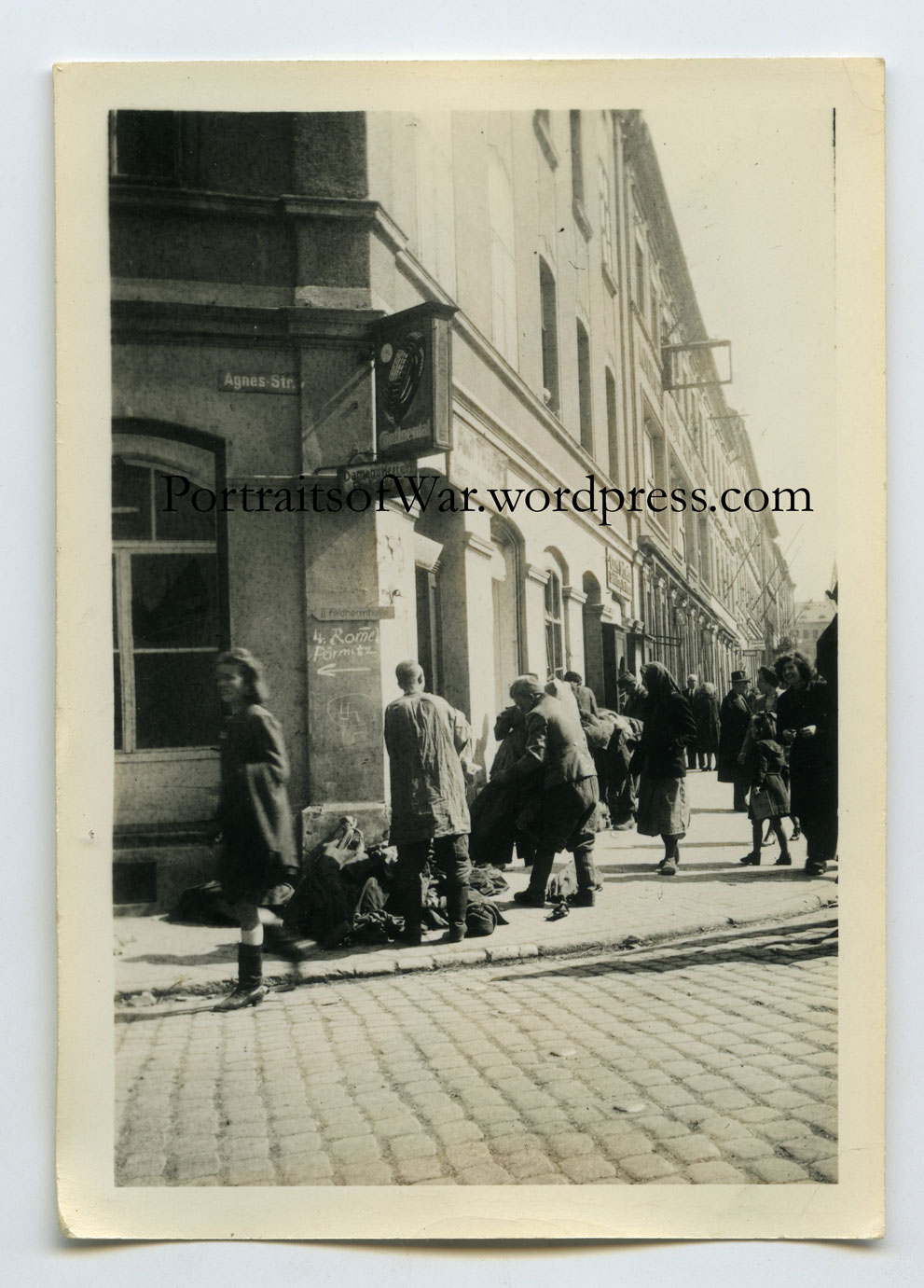
Russian Slave Laborers Looting

Tanks and Infantry Advance in Schietz

Dead German in Street

Sherman Tanks in Plauen Germany


Captured German Police Helmet

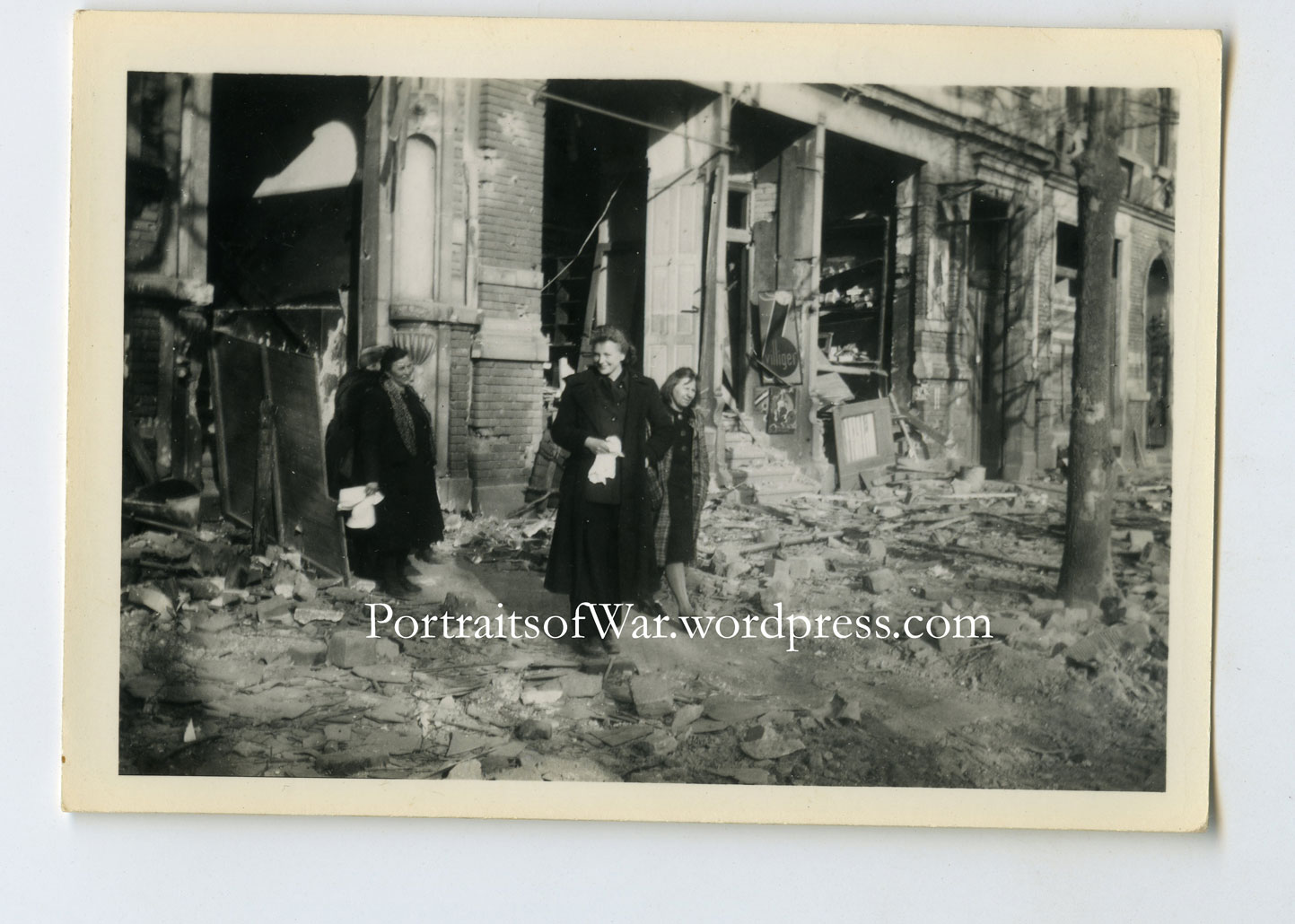
Women in Rubble


Captured German Belt

Unit Crest of the 347th

The Runner up for Unit Crest Design

Many more to come!

WWI Dogtag Collection – 1st Lt. Liva McLain – Evacuation Hospital No.7 in France


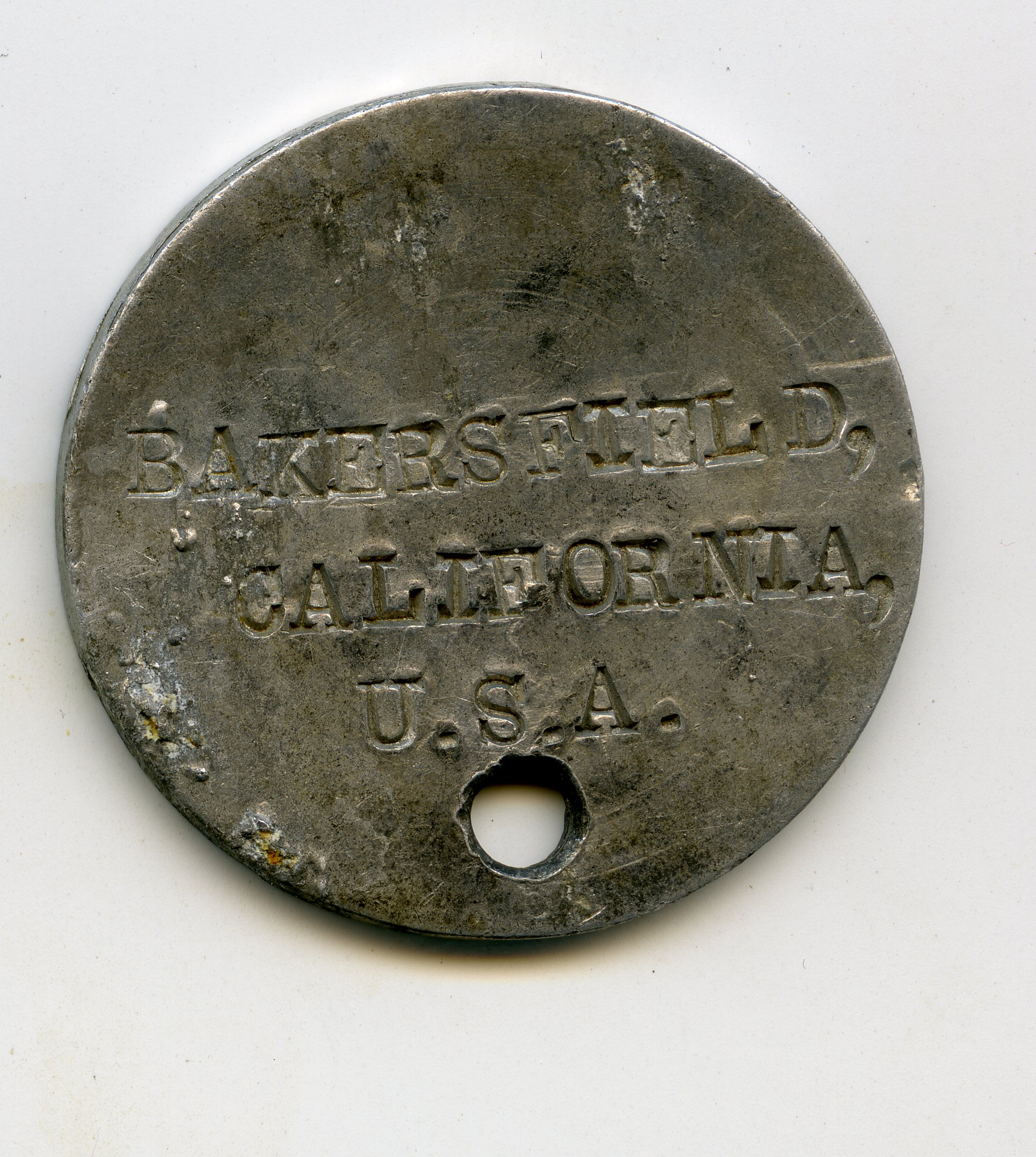
I recently picked a nice WWI dogtag from a medical officer named Liva C. McLain, and found that he likely served as a surgeon with the 7th Evacuation Hospital at Chateau Montanglaust in France, a hospital especially equipped to deal with those wounded with mustard gas.

He is mentioned on page six of the following medical corps pamphlet,

http://jama.ama-assn.org/content/LXIX/25/2121.full.pdf

It looks like Liva served with the hospital during some key battles during the war.  His hospital served the wounded at both Chateau Thierry and Belleau Woods.  Here’s a good JSTOR article about the unit’s participation at Belleau Woods:

http://www.jstor.org/stable/3405593?seq=2&Search=yes&searchText=7&searchText=no.&list=hide&searchUri=%2Faction%2FdoBasicSearch%3Ffilter%3Diid%253A10.2307%252Fi278008%26Query%3Dno.%2B7%26Search.x%3D0%26Search.y%3D0%26wc%3Don&prevSearch=&item=1&ttl=1&returnArticleService=showFullText&resultsServiceName=null

Here is a link to a soldier in the 103rd Infantry Regiment of the 26th Division who spent some time recuperating at the 7th Hospital:

http://worldwar1letters.wordpress.com/2009/08/13/evacuation-hospital-no-7-at-chateau-montanglaust-8131918/

The 7th Evacuation Hospital was organized on 26 November 1917, at Fort Riley, Kansas, as Evacuation Hospital Number 7. The organization participated in WW 1 in the following campaigns: Champagne-Marne, Aisne-Marne, St Mihiel, and Meuse-Argonne. It received a decoration streamer with colors of the French Croix de Guerre with Silver Star, embroidered St Mihiel-Msuse-Argonne. The organization was demobilized on 1 May 1919.


Updates – 12/12/2013

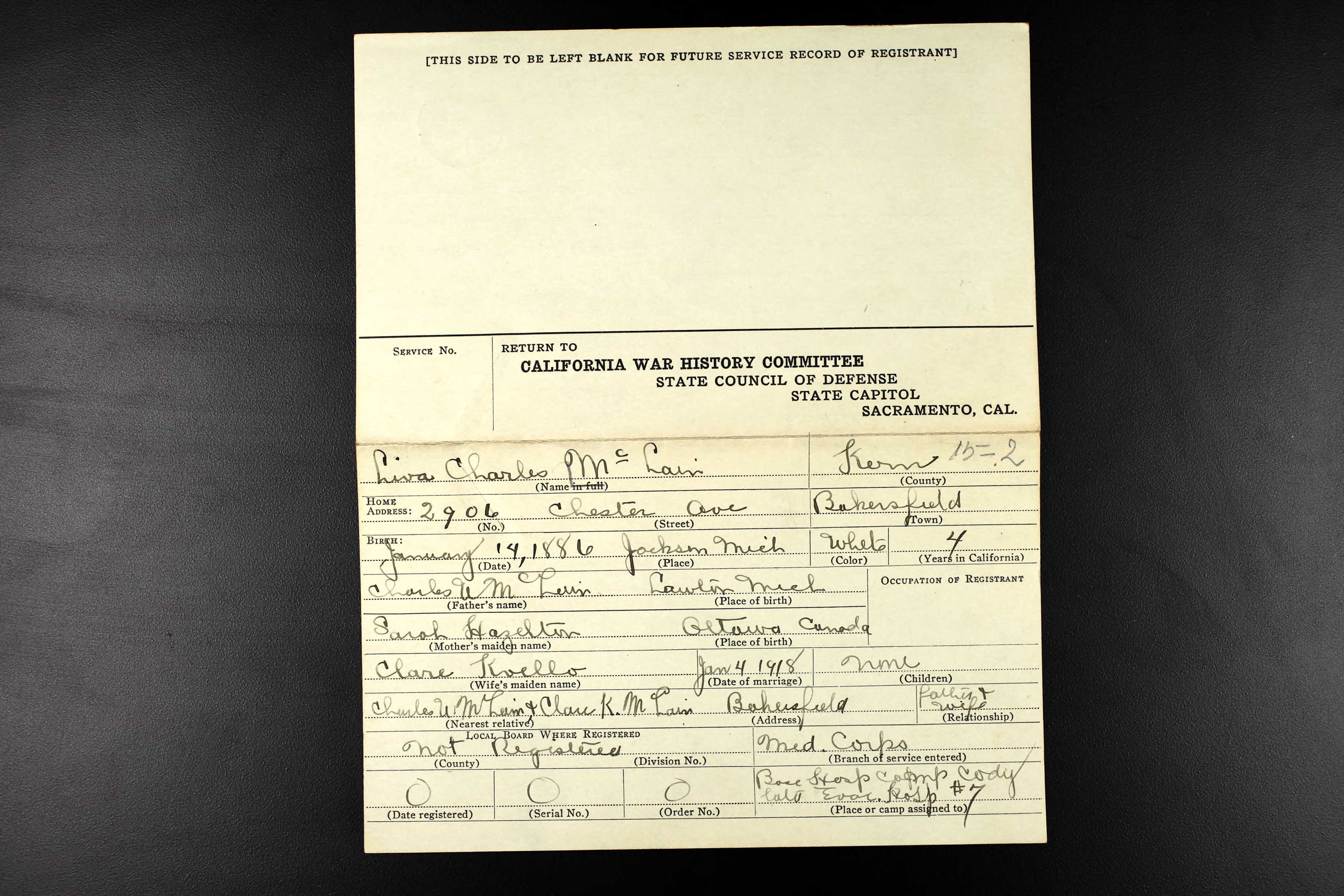
In an effort to reevaluate some of my WWI collection material, I decided to do a new ancestry search on Lt. McLain.  I came up with an interesting document to confirm the above information.  Nothing earth shattering, but it provides a bit of clarity to the presented information.


Lt. McLain's WWI California Veteran Registry Card

Lt. McLain’s WWI California Veteran Registry Card

WWI Doughboy Photo and Grandson Reunited: The Story of PFC Charles R. Nablo


Not every WWI photo in my collection has a name inscribed on the reverse, but this one comes with both a name and a modern day connection.  After buying the image on eBay with only minor excitement, I was pleased to find a name and address inscribed on the back giving me a glimmer of hope in identifying the soldier.  After doing a quick search on findagrave.com (a great site for cemetery information), I was able to find the name of the cemetery where Mr.Nablo is buried.  Without much hope, I submitted a grave photograph request and was astonished when, within a few days, my request was fulfilled with a snapshot of his grave marker.  I added his photo to the findagrave.com site and wiped my hands of the issue.  One week later, the grandson of Charles Nablo emailed me!  I sent him the photo in the mail, and helped reunite a lost photo to it’s rightful owner.

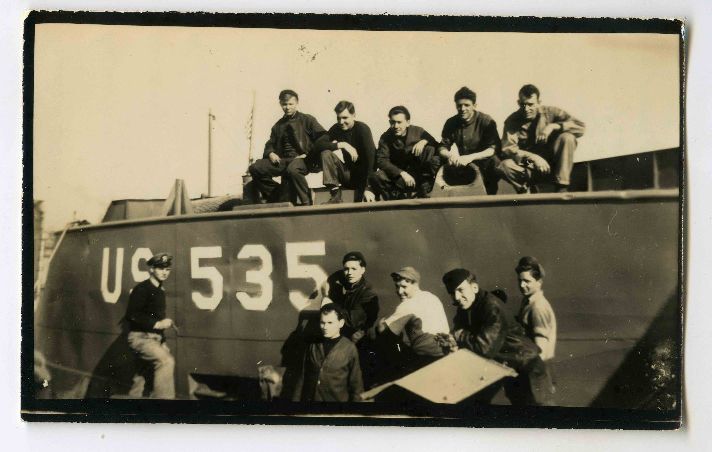
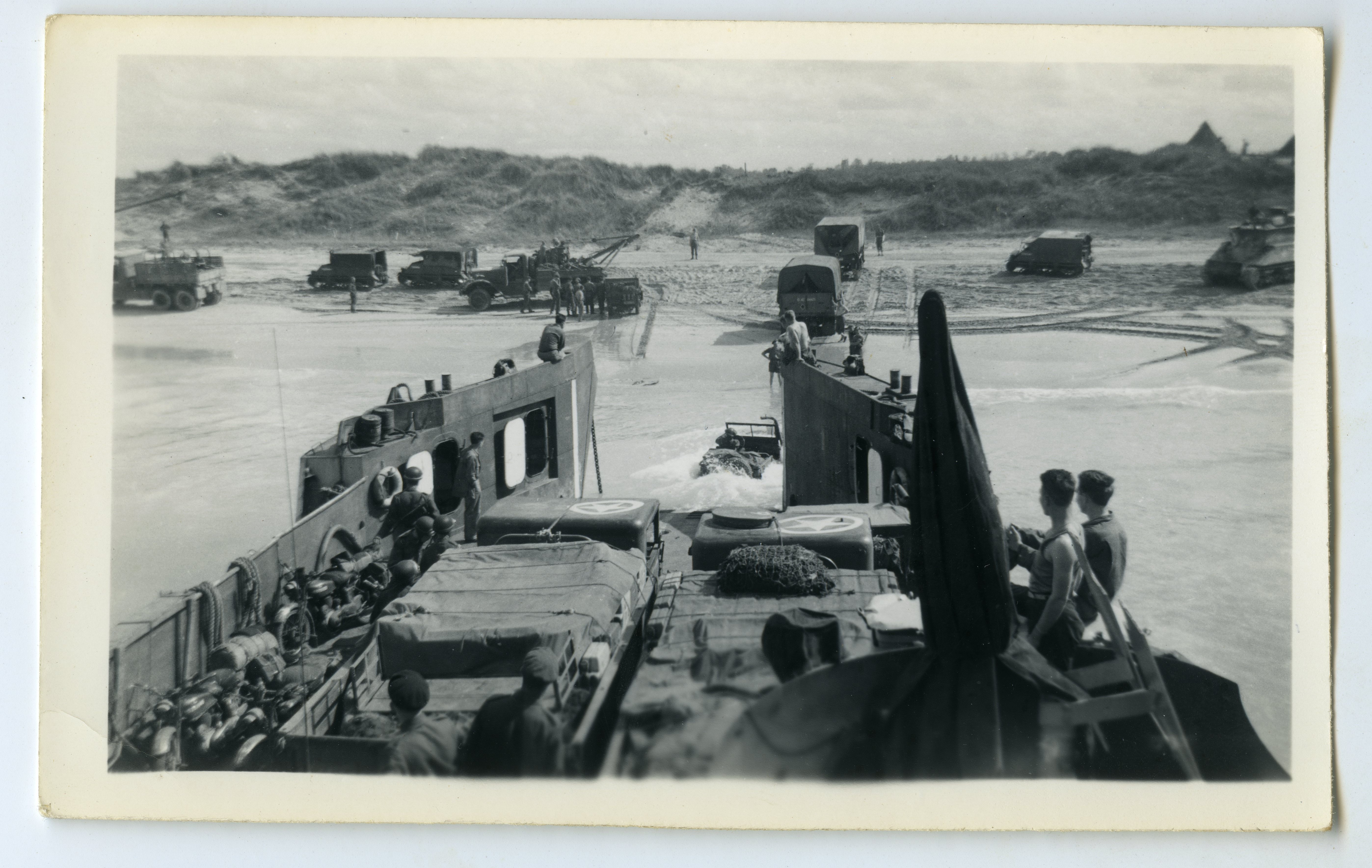
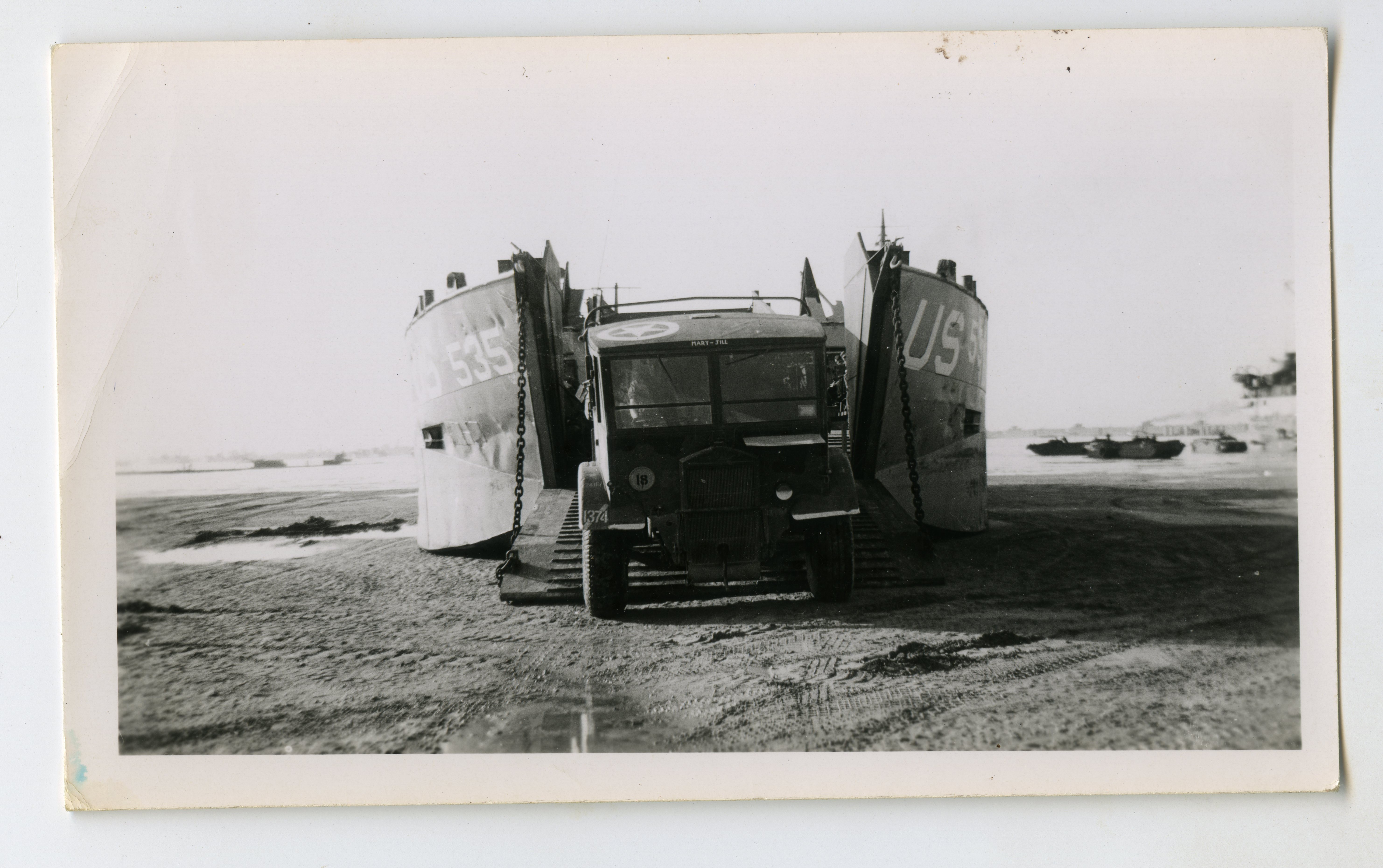
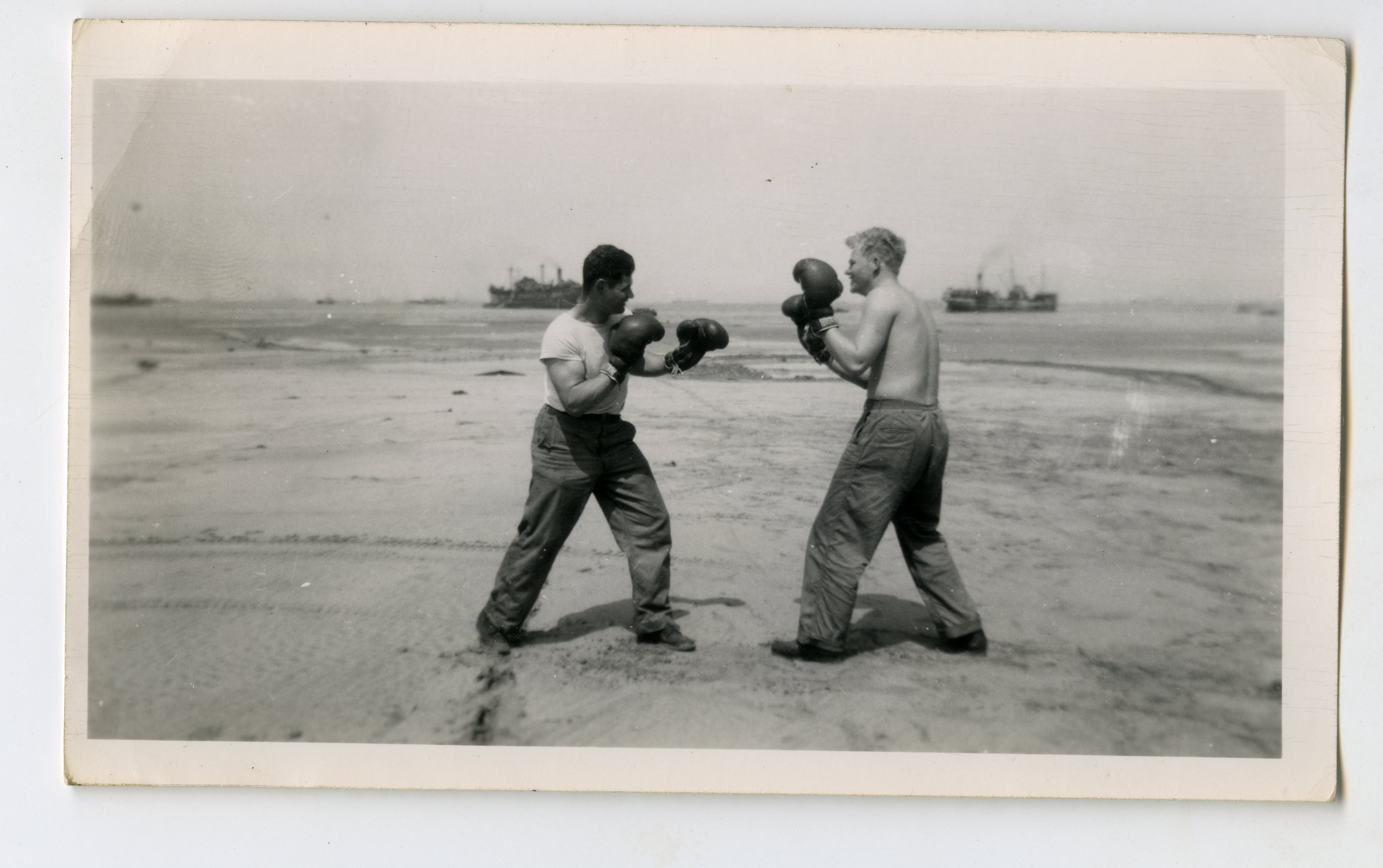
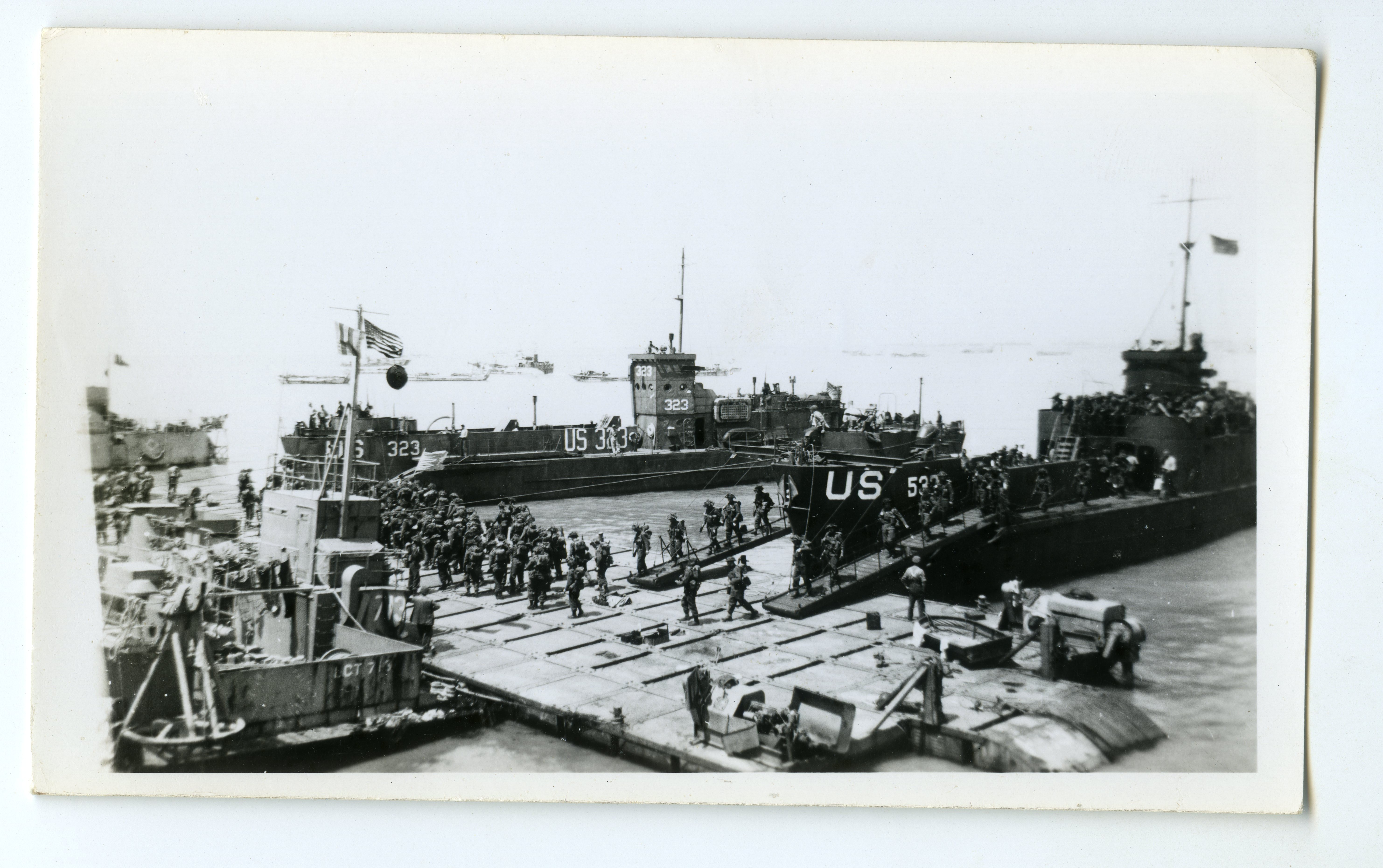
Original Never-Before-Seen WWII D-Day Landing Photos on Omaha Beach – LCT-535


Preparing the 535

Half the fun of winning a new group of WWII photos on eBay lies in the research and presentation of the material.  After recently having placed the winning bid on a set of 50

or so WWII photos of what appeared to be some sort of beach landing, I quickly realized that I had something more important in my possession.

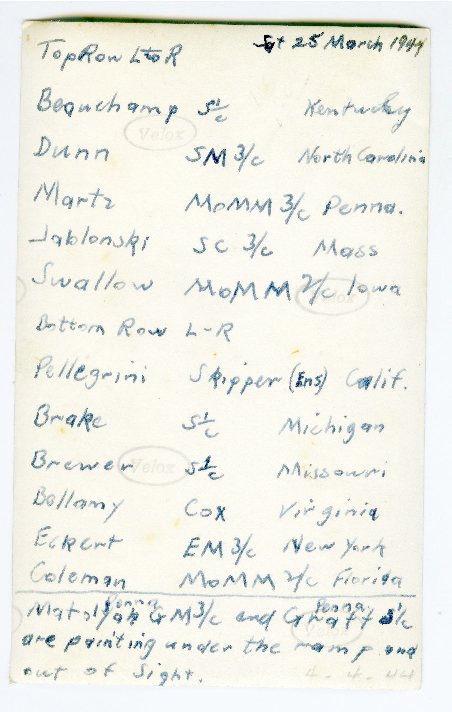
After asking the gracious seller a little bit of info about the provenience of the lot, I soon found out that the photos came from the estate of a deceased WWII veteran from Santa Rosa, CA.  Al Pellegrini was the skipper of the LCT-535 during the D-Day invasion at Omaha Beach, and either snapped, or was given these photos as a memento of his time aboard the 535.

According to a 1994 article by Gaye LeBaron of the Press Democrat,

“Ensign Albert J. Pellegrini of Santa Rosa, California, came early to the invasion of Normandy.  He landed his LCT 535 about 10 minutes ahead of H-Hour on the sands of Omaha Beach, earning the distinction of being the skipper of the first American vessel to land on the French coast on June 6th, 1944.”

Wow!  What did I stumble across with this innocuous looking eBay listing?  I hope to present these photos to show the world the faces of the first men to land on Omaha Beach on that fateful day nearly 70 years ago.

3rd Trip on June 6th - Dropping off Field Hospital

Many more photos to come!