The following article was graciously submitted by Sam Pestle. To see more stories of WWI soldiers with accompanying portrait photography, please check out Sam’s page – The United States in WW1 on Facebook.
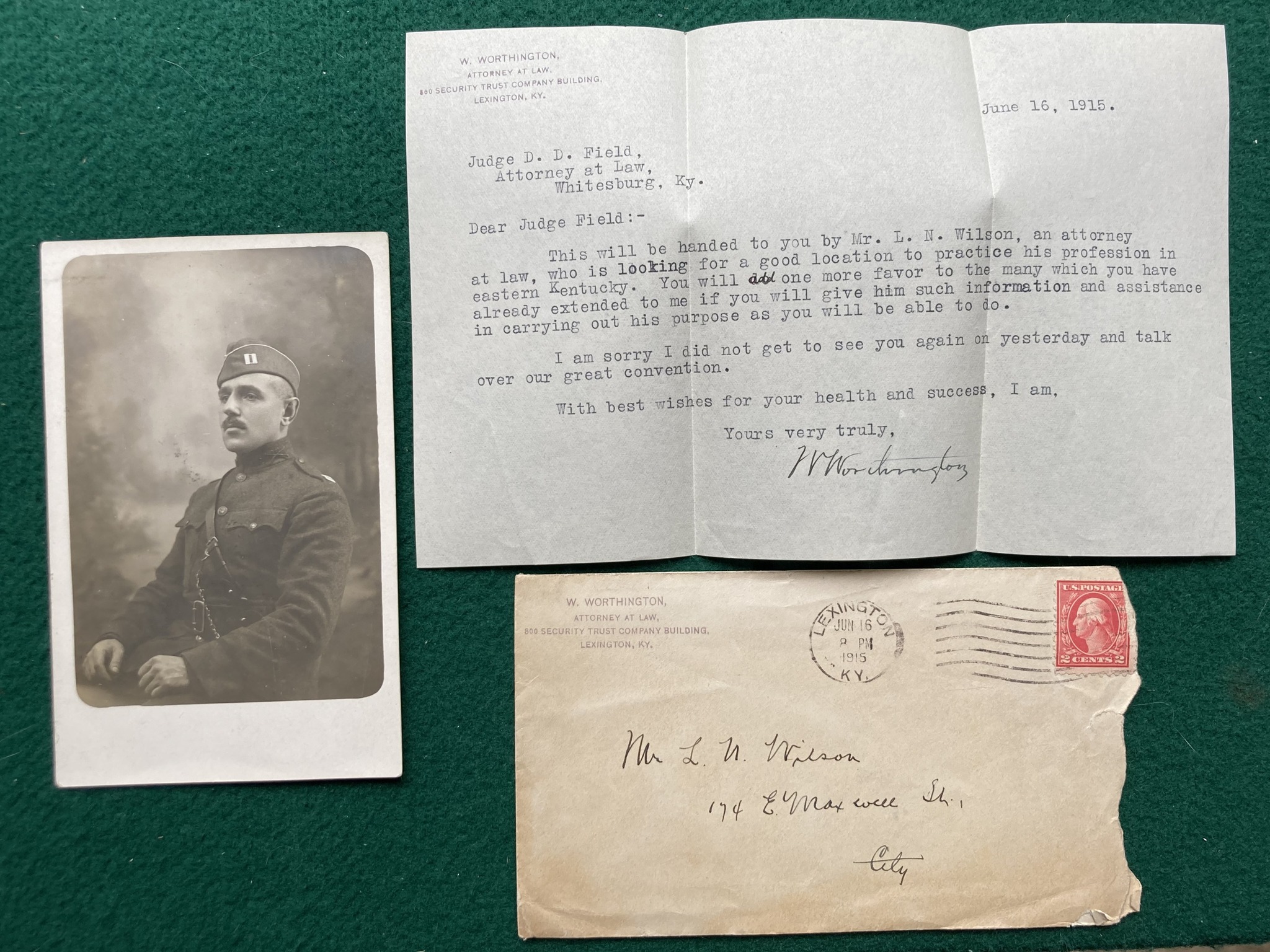
The son of a presbyterian minister, Laurance Newton Wilson was born in Kansas City, Missouri, on January 19th, 1890. His family later relocated to Washington D.C. and Laurance graduated from high school in 1909. Laurance then chose to pursue higher education and was accepted into the Law School at George Washington University. Records indicate that he was an exceptional student at GWU and became a member of the Sigma Phi Epsilon fraternity. Of particular interest, future FBI Director J. Edgar Hoover was also in attendance at the law school during this period, although he graduated a year after Laurance.
Following his graduation in 1915, Laurance passed the bar and began practicing law in Lexington, Kentucky. He had been working for less than two years when America became involved in the First World War, and Laurance applied as a candidate to the US Army Reserve Corps on May 15th, 1917. He was sent to Fort Benjamin Harrison for officer training and received a 2nd Lieutenant’s commission on August 17th.
Laurance was later promoted to 1st Lieutenant and assigned to command Company “C” of the 801st Pioneer Infantry Regiment. It is important to note that this was a segregated unit of the US Army that was composed of enlisted African American doughboys commanded by white officers. The 801st Pioneers sailed to France aboard the USS Manchuria on September 8th, 1918, and arrived along the Western Front in the final weeks of the conflict. The regiment served under the American 1st Army and was assigned to battlefield salvage operations and munition disposal efforts in the Chateau-Thierry Sector (this was a hazardous job which led to several men being killed or wounded in the regiment).
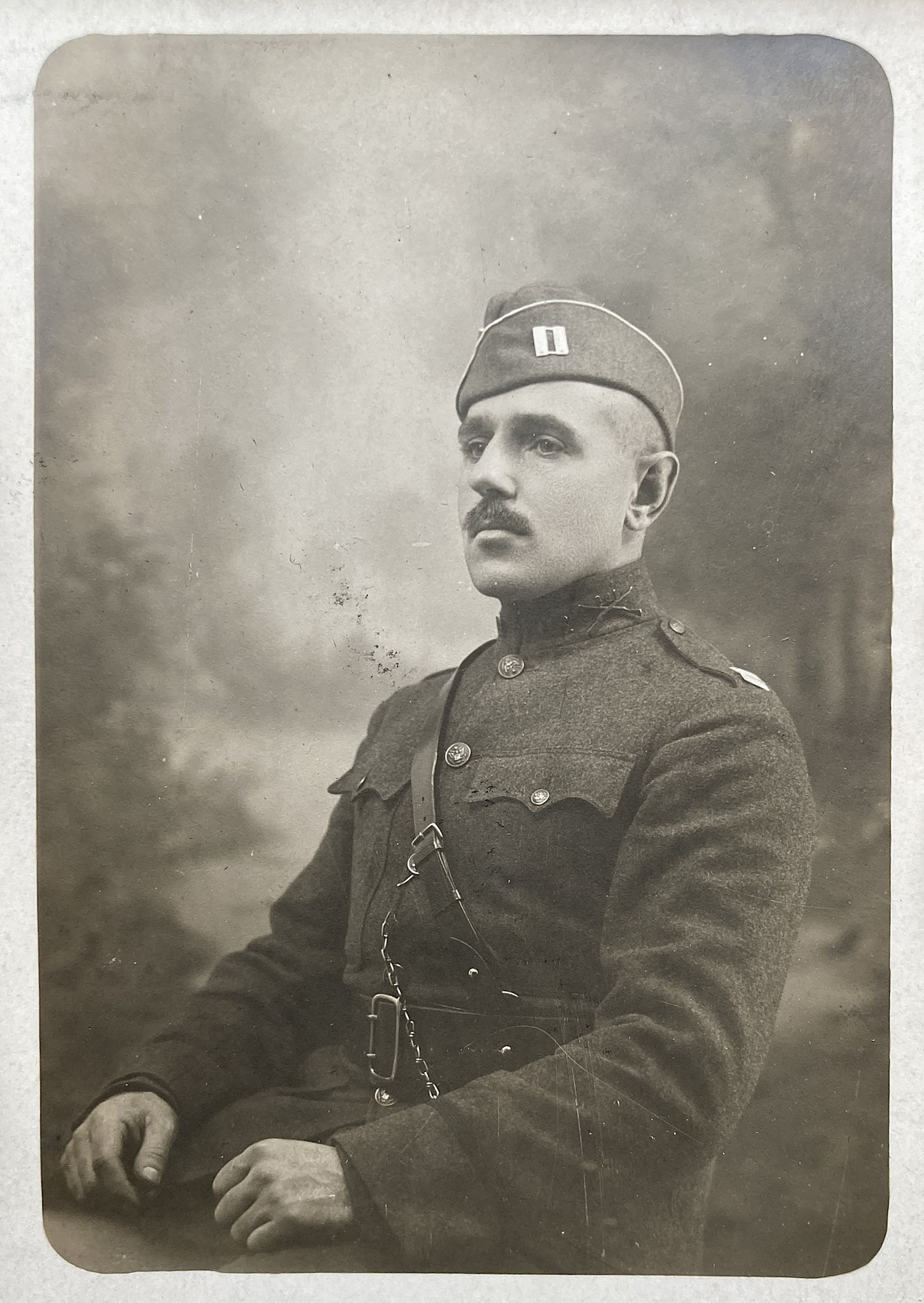
Following the November Armistice, Laurance was promoted to Captain and the French photograph seen below originates from that time period. Cpt. Wilson was then reassigned to command Company “F” of the 305th Infantry Regiment in December of 1918. He later completed his AEF experience while serving as a regimental adjutant and returned to the United States aboard the RMS Aquitania on April 24th, 1919. He received an honorable discharge on May 29th.
Laurance returned to his work as an attorney after the war and was employed by the Royal-Globe Insurance Company for several decades. He married in 1924 and lived much of his subsequent adult life in New Jersey. Laurance does not appear to have had any children and later retired to North Ferrisburgh, Vermont. He suffered a stroke in his final years and died of bronchopneumonia due to aspiration on April 26th, 1970, at the age of 80 years. He now rests beneath a civilian gravestone beside his wife in the North Ferrisburgh Cemetery of North Ferrisburgh, VT.
Captain Lawrence Newton Wilson of the 801st Pioneer Infantry
The Congressional Medal of Honor was awarded to 119 members of the U.S. Army, Navy, and Marine Corps during World War I, 33 of them posthumously. Portrait photographs of these heroes are remarkably scarce, but I was fortunate to recently acquire one. The subject of tonight’s post is Captain Samuel Woodfill of Indiana, one of America’s most celebrated soldiers of the Great War.
Captain Samuel Woodfill, U.S. Army Often described by General John J. Pershing as “the outstanding soldier of the American Expeditionary Forces,” Captain Samuel Woodfill earned the Medal of Honor for extraordinary heroism during the Meuse-Argonne Offensive on October 12, 1918. Leading his company through heavy fog and enemy fire near Cunel, France, Woodfill singlehandedly attacked multiple German machine gun nests, killing or capturing their crews despite being gassed and exhausted. A career soldier from Indiana, Woodfill had already served in the Philippines and on the Mexican border before World War I, and his calm, precise marksmanship in France became legendary among his peers. After the war, he was personally honored by Pershing and later chosen to represent the U.S. Army’s enlisted men at the dedication of the Tomb of the Unknown Soldier in 1921.
Arlington National Cemetery Video: Major Samuel Woodfill
Reverse Side of Woodfill’s Portrait
His Medal of Honor citation reads:
“While he was leading his company against the enemy, First Lieutenant Woodfill’s line came under heavy machine gun fire, which threatened to hold up the advance. Followed by two soldiers at 25 yards, this officer went out ahead of his first line toward a machine gun nest and worked his way around its flank, leaving the two soldiers in front. When he got within ten yards of the gun it ceased firing, and four of the enemy appeared, three of whom were shot by First Lieutenant Woodfill. The fourth, an officer, rushed at First Lieutenant Woodfill, who attempted to club the officer with his rifle. After a hand-to-hand struggle, First Lieutenant Woodfill killed the officer with his pistol. His company there upon continued to advance, until shortly afterwards another machine gun nest was encountered. Calling on his men to follow, First Lieutenant Woodfill rushed ahead of his line in the face of heavy fire from the nest, and when several of the enemy appeared above the nest he shot them, capturing three other members of the crew and silencing the gun. A few minutes later this officer for the third time demonstrated conspicuous daring by charging another machine gun position, killing five men in one machine gun pit with his rifle. He then drew his revolver and started to jump into the pit, when two other gunners only a few yards away turned their gun on him. Failing to kill them with his revolver, he grabbed a pick lying nearby and killed both of them. Inspired by the exceptional courage displayed by this officer, his men pressed on to their objective under severe shell and machine gun fire.”
Eight years ago I posted a series of snapshots taken by a US soldier showing the liberation of an unknown concentration camp during WWII. When I acquired the photos, they had no provenance and no information on the reverse side to start the process of identification. Luckily, a blog follower was able to help with the identification of the camp through the same processes I typically use. By observing the surrounding architecture and general contextual clues, he was able to identify the camp as Kaufering IV, a large subcamp of Dachau. Here is what he provided:
Some thoughts:
i)This is certainly somewhere Upper Bavaria – the house architecture is fairly typical of the region.
ii)The presence of the 2 Luftwaffe officers suggests some sort of air force activity is close by. Lager Lechfeld was used as a fighter base and a shake-down airbase for the nearby Messerschmitt complex in Augsburg. Prisoners were engaged in constructing bomb-proof bunker-factories in appalling conditions.
iii)One of the photographs has a very distinctive semi-sunken barrack type, known as “Erdhütten” (Lit: “Earth huts”) – very primitive constructions, the timbers of which were made from off-cuts and waste from furniture production and which survivors testify, leaked terribly. These barracks were a distinctive feature of the Dachau sub-camps in the Kaufering/Buchlöe area.
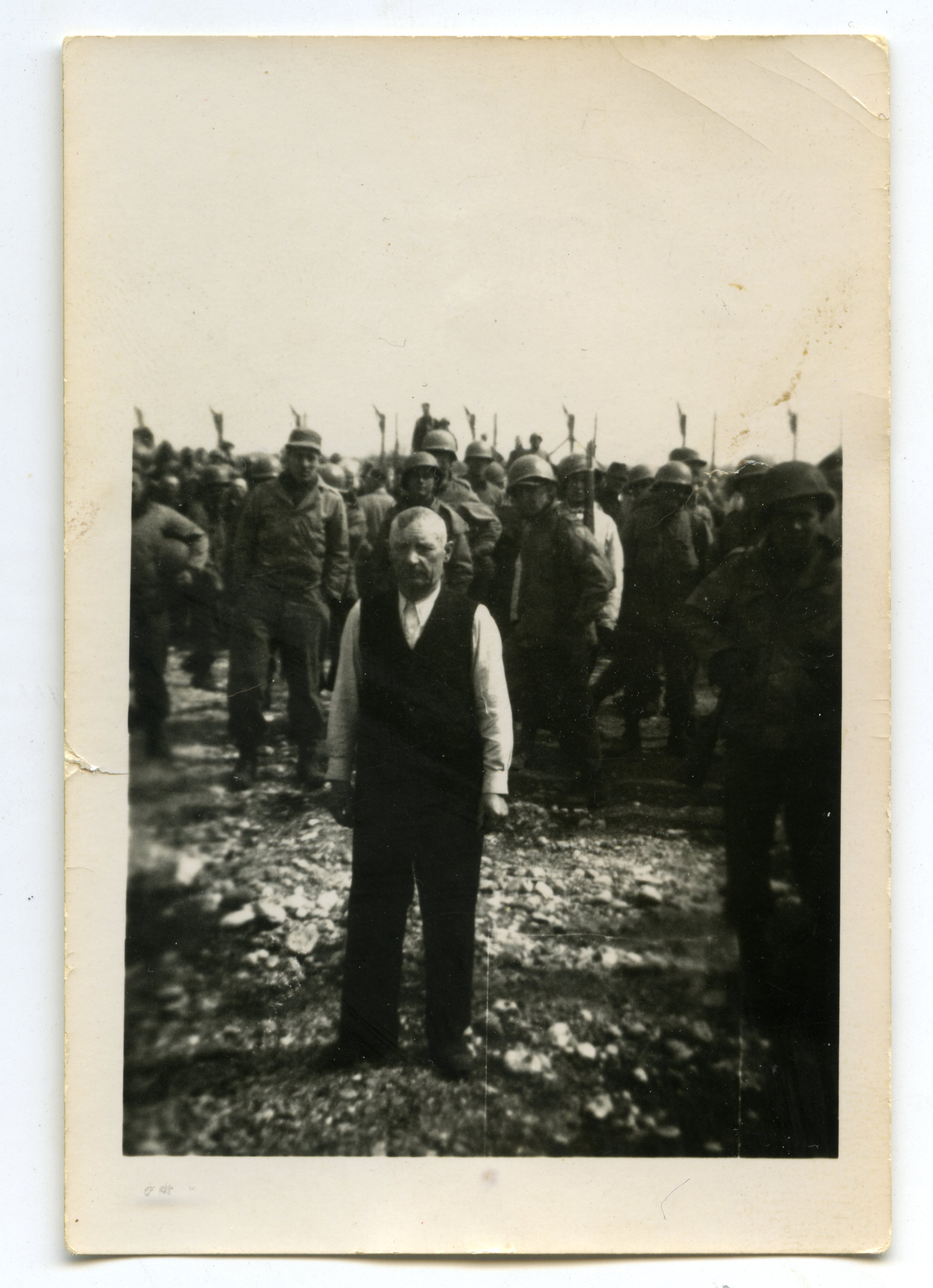
Thanks to the careful research of Taff Simon, we now know that the camp shown in these snapshots is Kaufering IV. A closer look at the details within the images supports his findings. One particular photograph offers the clearest confirmation: it shows an older man in civilian clothing with a closely shaven head, a haunting detail that anchors these scenes to the history of this Dachau subcamp.
Snapshot of SS Commandant Johann Baptist Eichelsdörfer
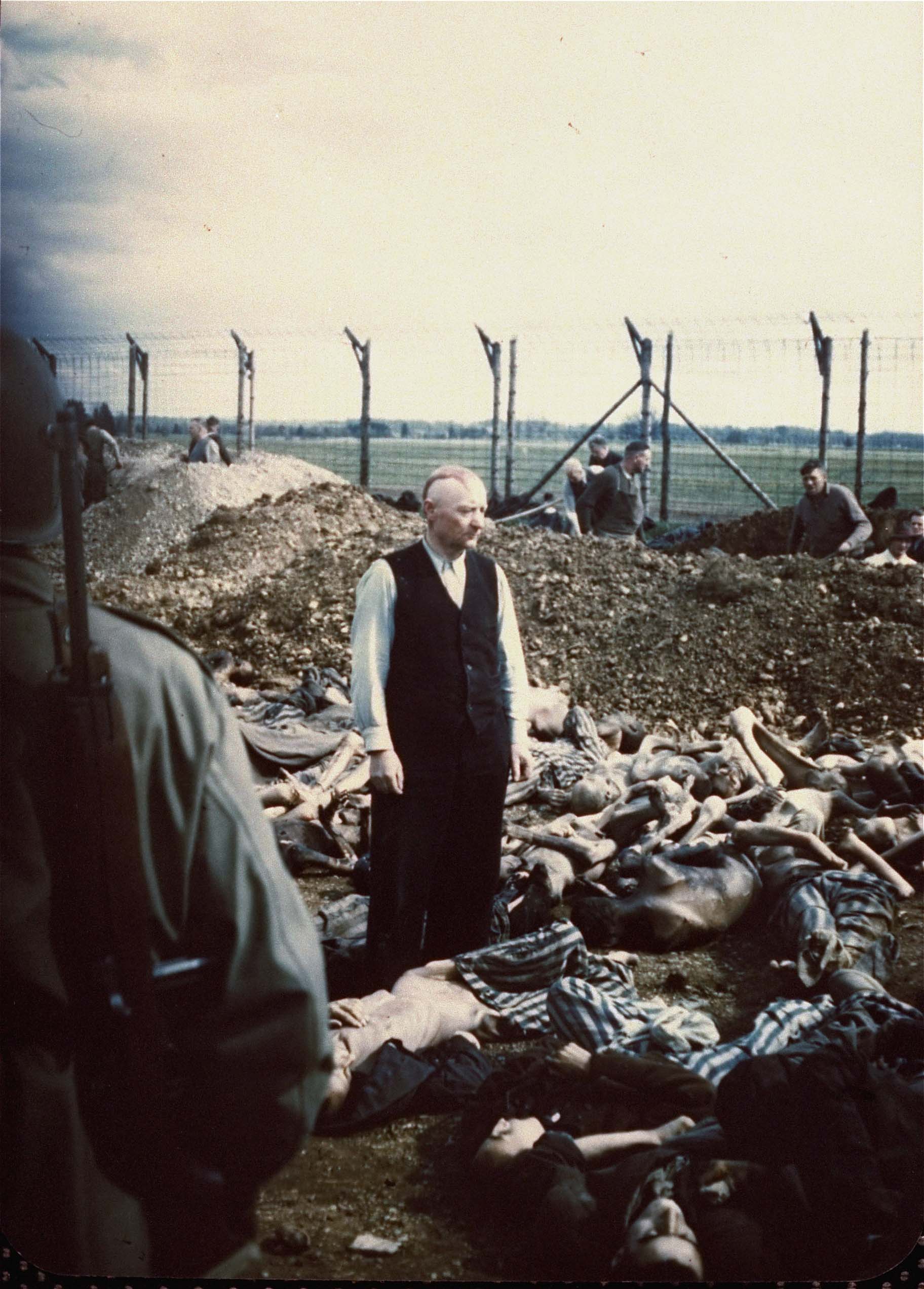
When I first wrote about the snapshot collection in 2017, I was unable to identify the man since he was in civilian garb. Artificial intelligence image searches at the time were unable to attribute the image to any individual, so I was under the assumption that he was a local civilian who was brought in to help with the burial of the camp victims. But now, with the attribution of the snapshots to Kaufering IV, I was able to find more images of Eichelsdörfer. His shaven head with the lopsided squirrel-tail appearance confirms his identity when compared to the images below.
Color Photo of Johann Baptist Eichelsdörfer (US Holocaust Museum image)
(SS officer Johann Baptist Eichelsdoerfer, the commandant of the Kaufering IV concentration camp, stands among the corpses of prisoners killed in his camp. US Holocaust Museum image)
(Wikipedia Commons)
Who was he?
Johann Baptist Eichelsdörfer was a German military officer and concentration camp commandant during World War II. Born on January 20, 1890, in Dachau, Germany, he served as a non-commissioned officer in the Bavarian Army during World War I and remained in the military after the war, retiring in 1924 with the rank of lieutenant. He rejoined the military in 1940 and served in various locations, including France, Poland, and the Soviet Union. In 1944, he was assigned to the Dachau concentration camp system, where he served as the commandant of several subcamps. In January 1945, he took command of Kaufering IV, a subcamp of Dachau located near Hurlach, which was designated as a “hospital camp” but was, in reality, a site where sick and dying prisoners were abandoned without adequate medical care. Under his command, thousands of prisoners died due to starvation, disease, and mistreatment.
Eichelsdörfer’s actions came to light when American forces liberated Kaufering IV on April 27, 1945. U.S. soldiers discovered hundreds of bodies and surviving prisoners who had been subjected to brutal conditions. Eichelsdörfer was captured and photographed standing among the bodies of dead inmates, a stark image used as evidence during his trial. He was tried at the Dachau Trials, a series of military tribunals held by the U.S. Army to prosecute Nazi war criminals. On December 13, 1945, he was convicted of war crimes and crimes against humanity and sentenced to death. Eichelsdörfer was executed by hanging on May 29, 1946, in Landsberg am Lech prison. His trial and execution highlighted the atrocities committed in the Nazi concentration camps and served as a reminder of the need for accountability in the aftermath of war.
The Other Snapshots
Now that we know the snapshots from the 2017 blog post were taken at Kaufering IV, the other images captured by an unknown US GI make more sense. I will post them here with some updated commentary. Feel free to weigh in if you have any comments or suggestions for descriptions.
Kaufering IV Survivor
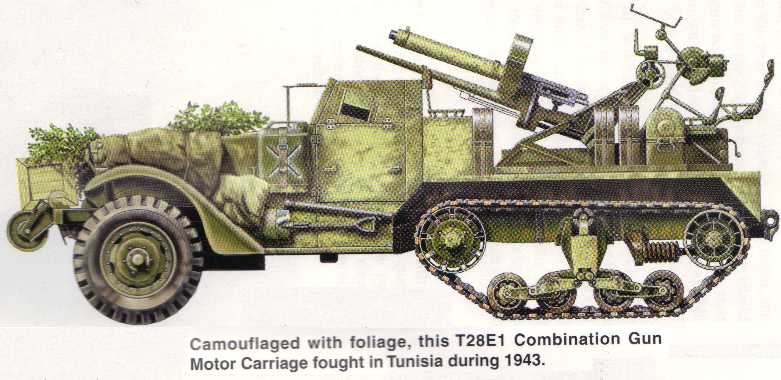
In the above image, we see a recently liberated survivor of his time at Kaufering IV. He’s using his bandaged hands to tie on a pair of shoes, likely a pair provided to him by US soldiers. He also appears to have some soup in a small can as well as a striped blanket wrapped around his head and body. In the back of the image appears a US T28E1 which was likely one of the 12th Armor Division’s anti-aircraft mobile vehicles. The painted sillouettes of 14 German aircraft on the side hint that the operators of the T28E1 shot down lots of German aircraft as the war came to an end.
Generalized View of the T28E1
German Luftwaffe Officers
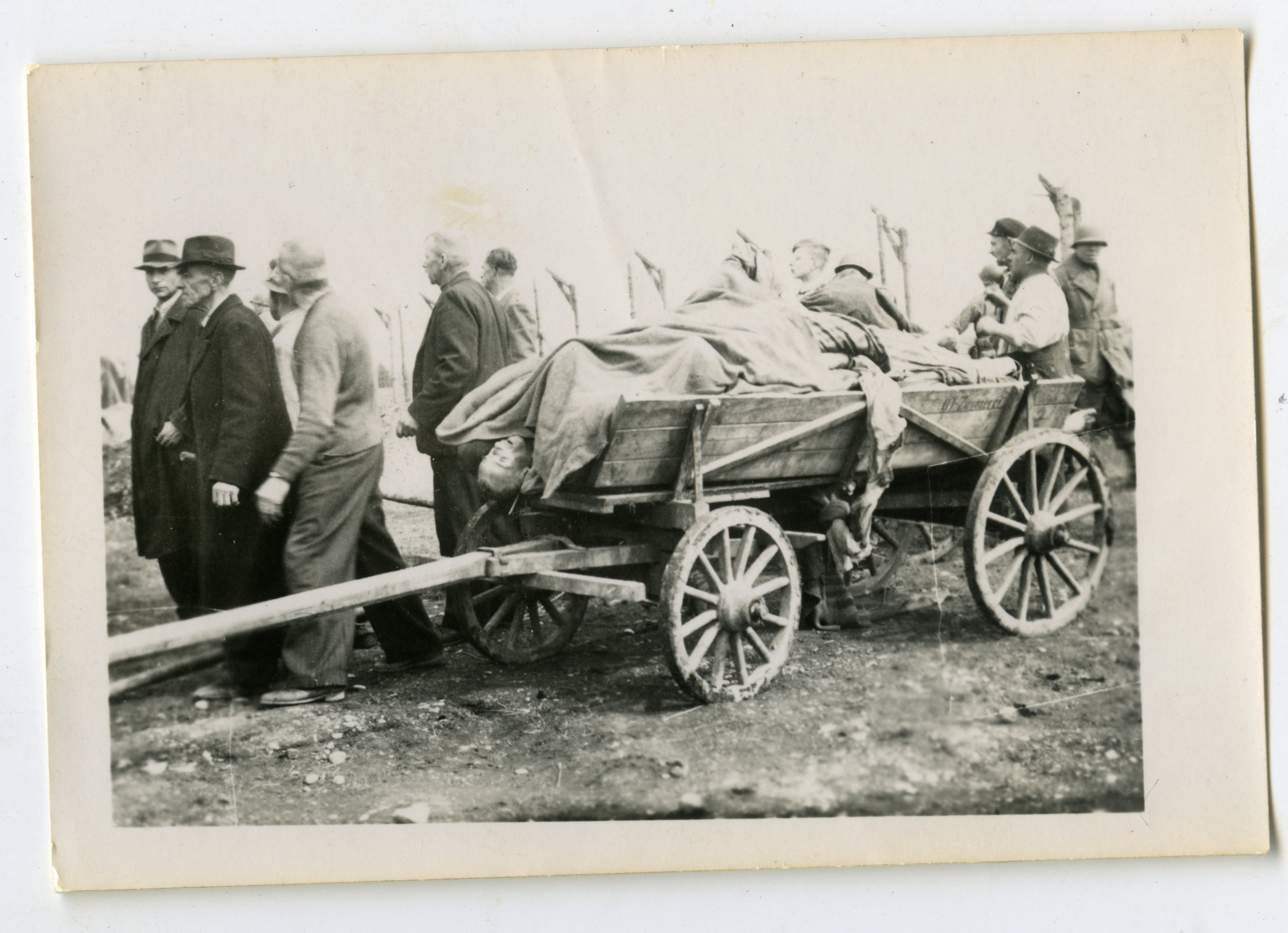
German Civilians Help with Burial
Camp Building and Ditch
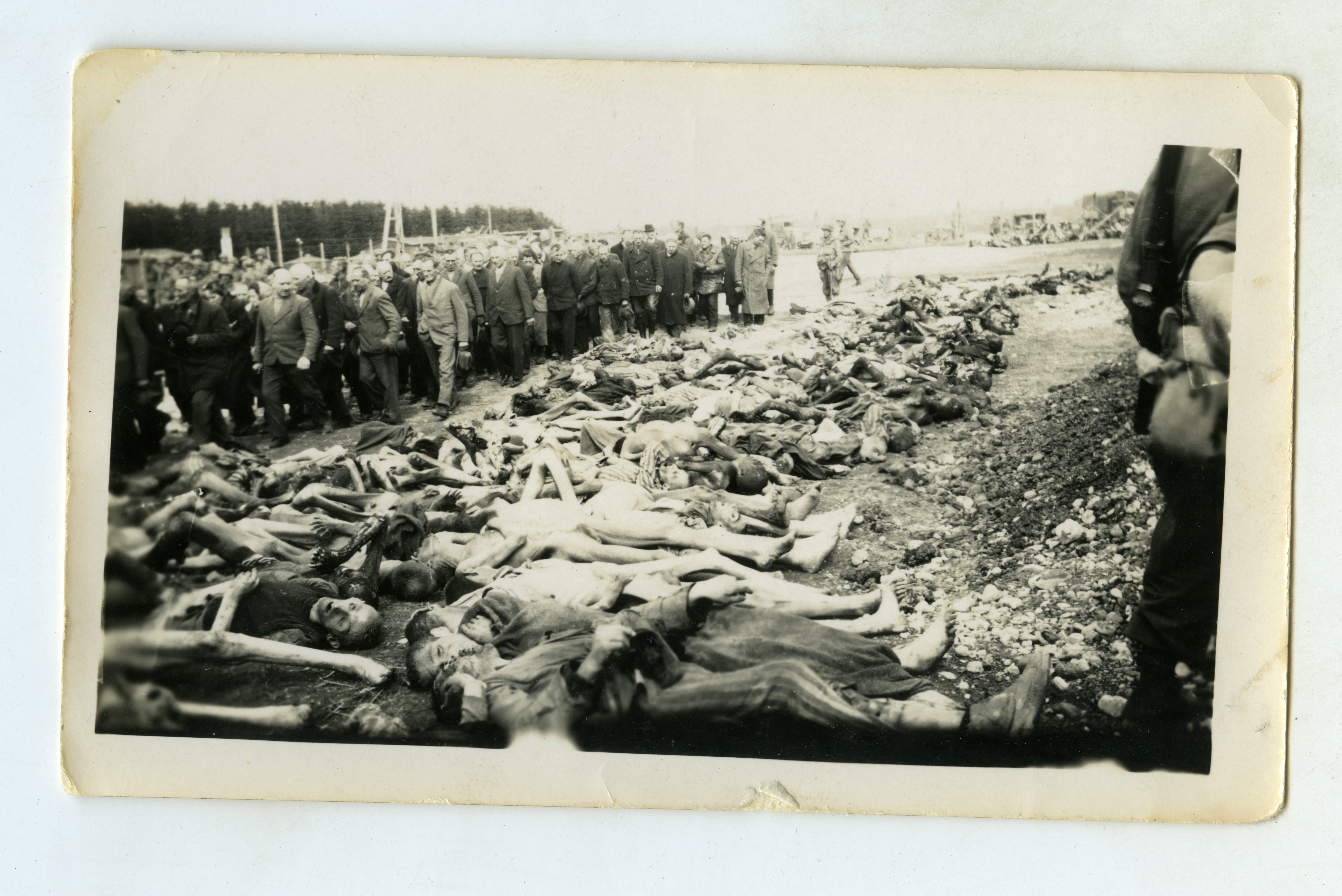
Local Civilians Observe the Dead
Kaufering IV Victims
US Officers Speak to a Crowd
US GI’s View the Dead
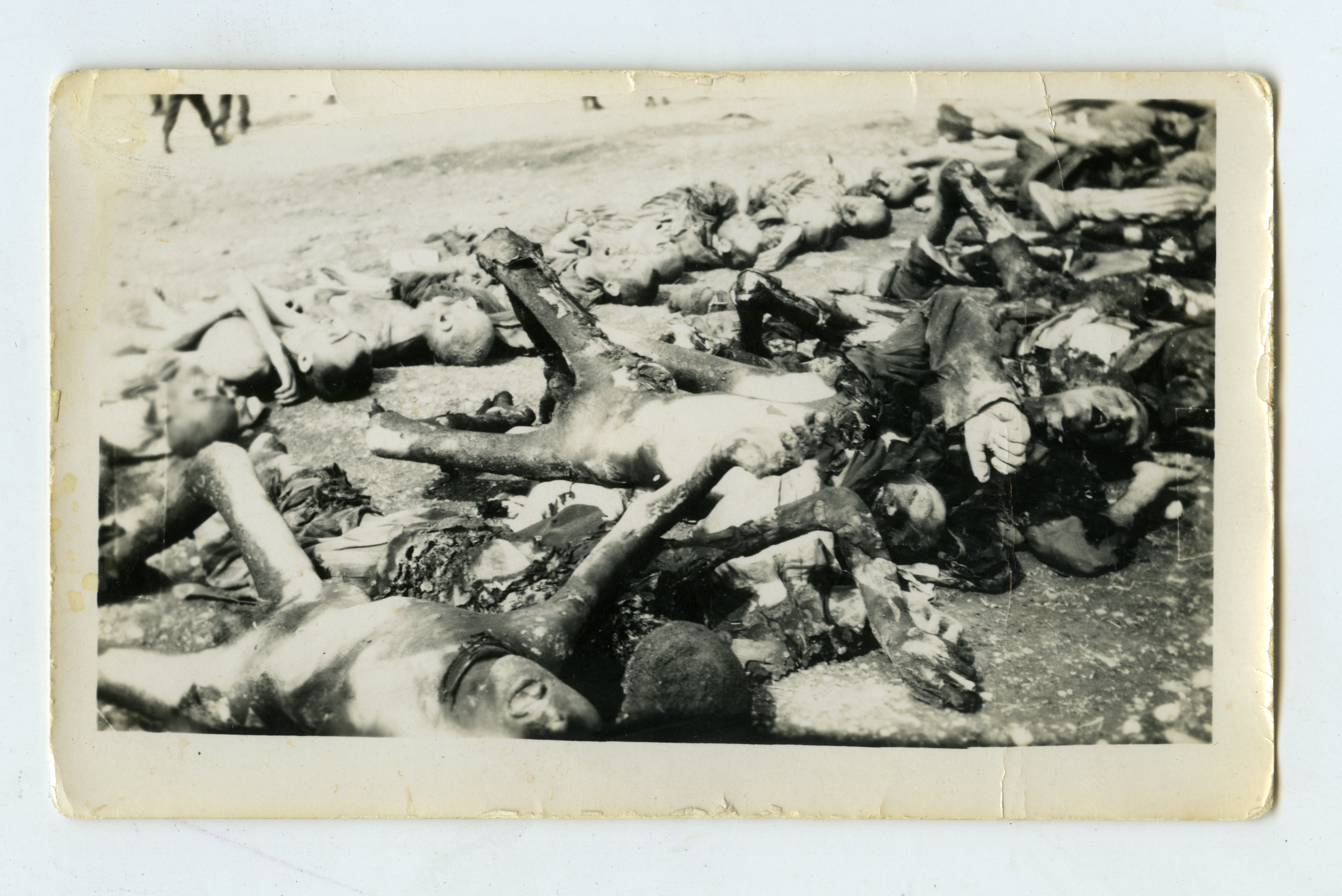
Camp Victims
Camp Victims and Army Officers
Camp Victims
Local German Civilians Listen to US Officers
I really don’t know how to close this sobering post update from 2017. I did pass the snapshots along to a WWII veterans museum based here in the United States, but I’m unsure of what they ended up doing with them. I hope that his post will help educate those researching Kaufering IV and bring some closure to the mystery of when and where these snapshots were taken.
If you want to see some footage from the camp liberation, please check out the video here.
Easy Co. 506th PIR, 101st Airborne, Band of Brothers at Kaufering IV
HBO’s Band of Brothers covered Kaufering IV briefly in one episode. The unit was involved in the liberation of the camp, along with the 12th Armored Division. See below for a dramatized version of the events. The small earthen huts described by Taff can be clearly depicted. The HBO historical accuracy consultants did a great job!
From time to time, I like to browse the pages of eBay in search of portrait photographs of identified U.S. soldiers — small windows into the past that I can casually research to uncover the individual’s story and their role in whichever conflict they served. In today’s post, I was drawn to one particular image: a portrait captured by a British photographer. Unlike the widely circulated press photos that often made their way into American newspapers, this photograph was unlikely to have been distributed stateside and equally unlikely to have fallen into the hands of the soldier’s family.
When soldiers were photographed, it was common for them to provide their names, ranks, and often their hometowns. Yet in most cases, there was little chance for photographers or newspapers to follow up and let those soldiers know that their likeness had appeared in print. That disconnect is part of what makes original press photographs so compelling today. Many remain unpublished, and most have never been thoroughly researched. In fact, I’ve noticed a growing trend in 2025: more and more World War II–era press photos are surfacing on the secondary market, offering new opportunities to rediscover stories that might otherwise have been lost.
PFC James “Jack” C. Warren of Kentucky
The photograph above was discovered in August 2025 during one of my routine eBay searches for intriguing portrait shots of World War II servicemen — images that spark my curiosity to uncover the stories behind the faces. This particular shot is especially striking: crisp, tightly framed, and, based on the other photographs sold by the same seller, likely taken in England at a collection point for wounded or ill soldiers. I cleaned up the scan and cropped the edges to make it more visually appealing for digital presentation.
The next question became the most important one: how do we identify him?
Reverse Side From eBay
What do we know?
The photo was taken on July 13, 1944 at a port in the South of England.
The photographer worked for a British newspaper.
The subject of the photo is a PFC J.C. Warren from Kentucky and was wounded.
The photo was approved for publication by US censors a few days later.
Who was J.C. Warren?
Given the information provided in the brief writeup on the reverse side of the photo, we know that the subject is a young male, likely aged 18-24 from Kentucky named J.C. Warren who was wounded or injured at some point after the D-Day landing a month earlier. His “walking wounded” paper tag (Form 52b-MEDICAL DEPARTMENT, U.S.A. (Revised October 25, 1940), 16-15434) seen poking up at the bottom hints that he wasn’t disabled or infectious. With that information in hand, I began narrowing the search. Since the most common first names beginning with “J” at the time were James and John, I started there, turning to an obscure database that tracks U.S. servicemembers admitted to hospitals during World War II.
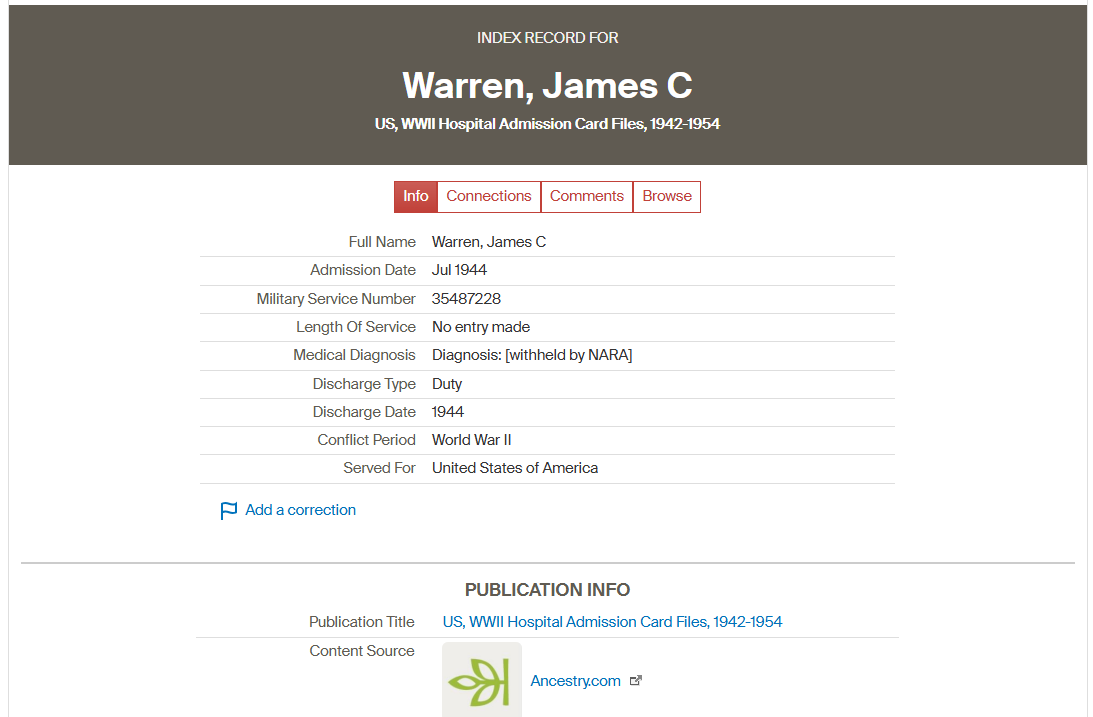
After only a few minutes of typing I found a hit to a James C. Warren with the Army Serial Number(ASN) of 35487228, and the only J C Warren who was from Kentucky that was admitted to a US hospital in July of 1944.
WWII Hospital Admission Card for James Warren
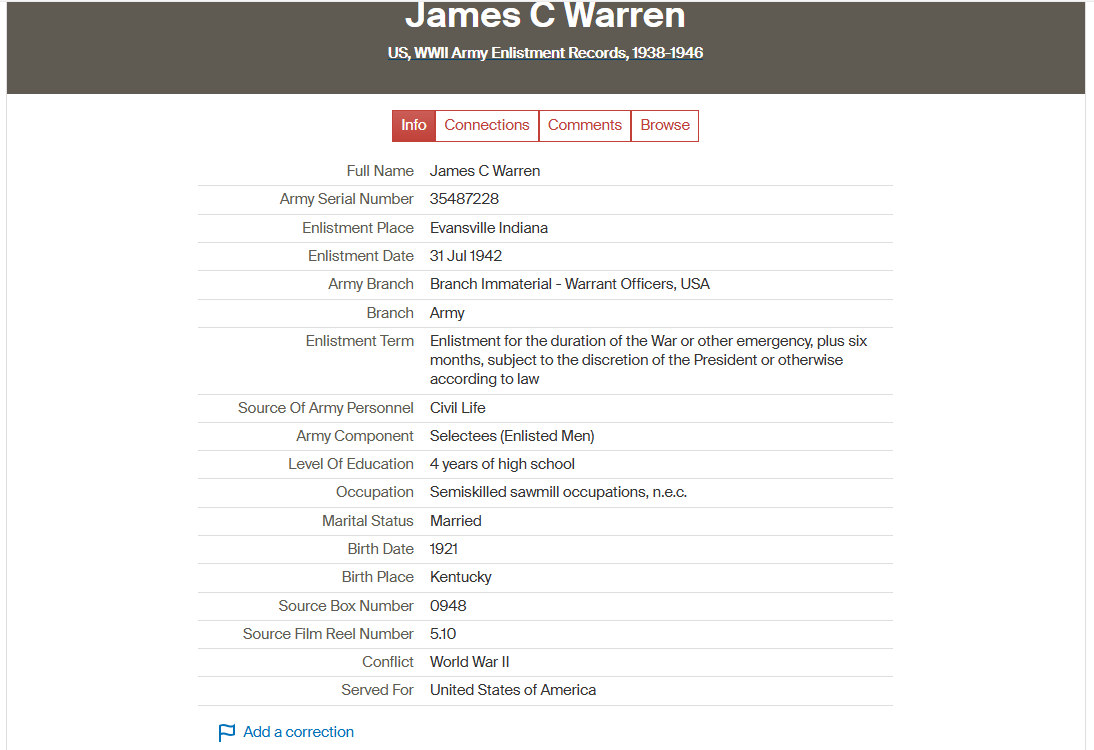
And when looking up his ASN…
WWII Draft Registration Information
With confirmation like this, I decided to dig deeper into PFC Warren’s life story in hopes of pulling out a few more details about his life story. Luckily, Ancestry.com and Fold3.com provide prompts based on confirmed information when researching so I was quickly on my way down the rabbit hole.
Veteran Headstone Application Form
It’s always a bittersweet discovery when I come across one of these documents, which tend to surface most often for veterans who passed away between the 1950s and 1980s. This particular record (which I’ll share below) shows that PFC Warren served with the 816th Ordnance Base Depot Company, a unit stationed in southern England at the time of his hospital admission. Interestingly, there is no mention of a Purple Heart on the form. That leaves me to wonder whether his injury did not meet the criteria for the medal, or whether it simply wasn’t recorded on his discharge papers after the war. Perhaps his family would know the answer.
Veteran Headstone Application
Luckily, the document provides just enough detail to shed light on who James Carmen Warren sadly left behind when he passed away in 1968. Born on April 8, 1921, he died on August 8, 1968, at the age of 47. He was survived by his wife, Mary Emma Green Warren, along with their two sons, Ivan and James C. Warren Jr.
One of my closely held collecting secrets is that I love WWII and WWI photographs of soldiers holding or interacting with their dogs. My recently dearly departed furry companion Violet originally led me to start collecting shots of soldiers with their canine friends nearly eight years ago. Without her I would’ve never thought twice to bid on a dog photograph.
Violet at the Hilton Portland, ME
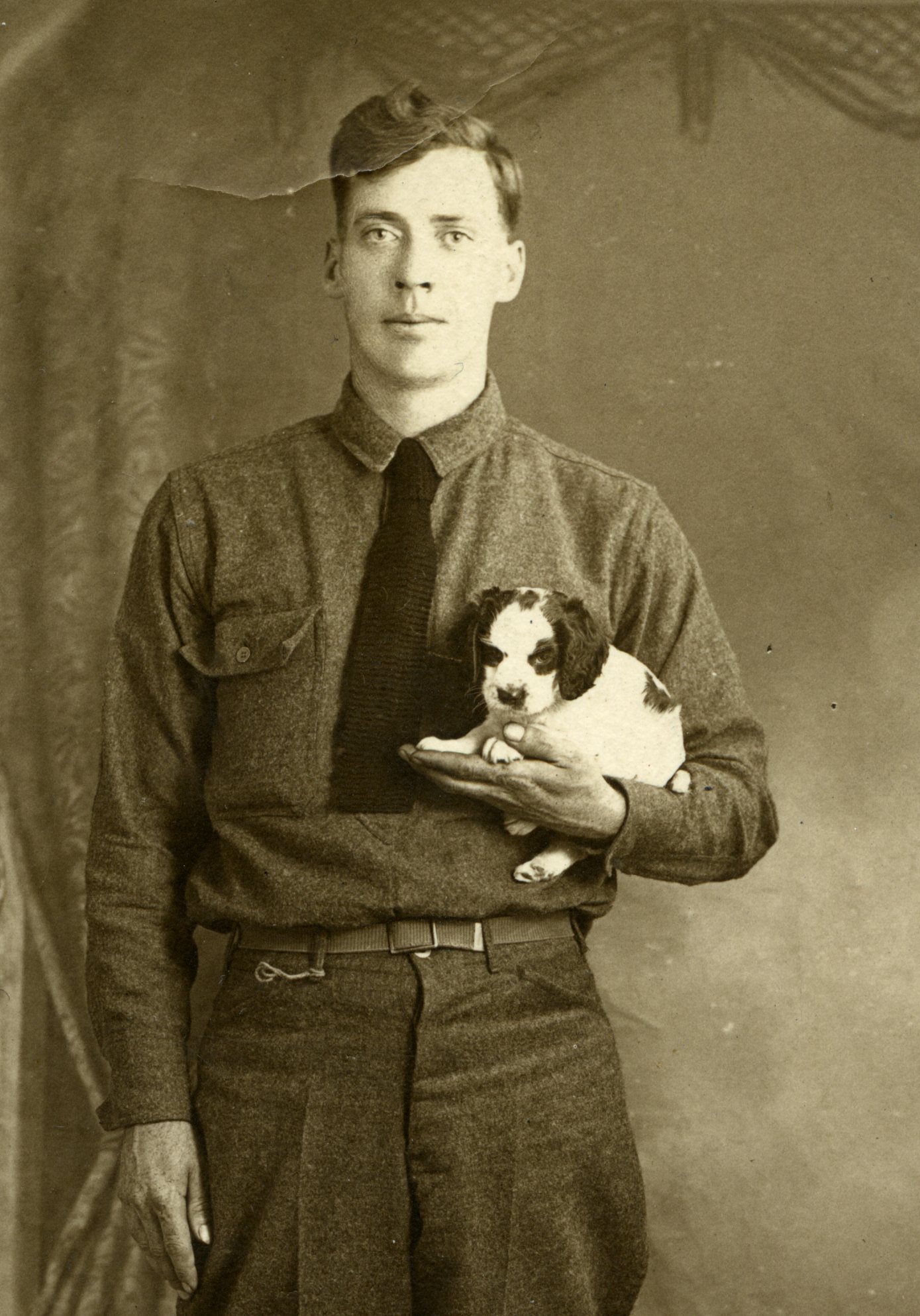
I dedicate this post to her. In this particular case, I bid on and won (eBay) a photograph of a US soldier holding a young puppy during wartime in France. Typically, shots of US soldiers holding dogs or other mascots were taken (at least that I’ve found) in the post-war era following the 11/11/18 Armistice. This studio photograph was taken on September 10th, 1918 and shows Thomas (Tom) Gray Jr. posing in a French studio with a puppy cradled in his left arm while sporting a custom knit necktie.
Thomas Gray Jr. and a cute puppy!
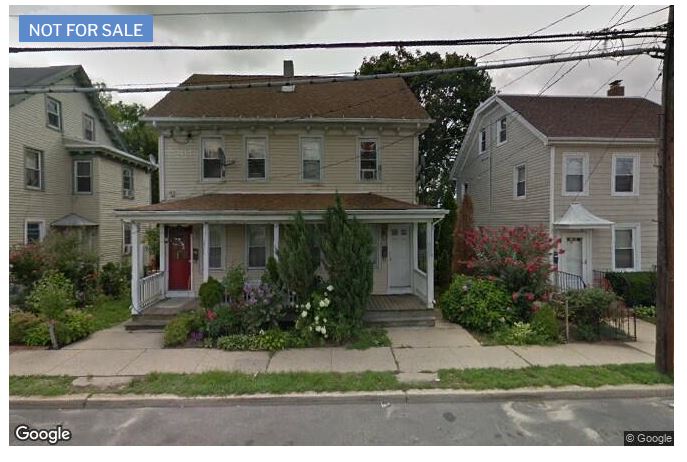
The photo was taken in September of 1918 and the writing on the back (see below) notes that Thomas had been overseas for ten months at this point. Additionally, he addresses the postcard photo to his mother, Mrs. Thomas Gray of 329 North Pearl Street, Bridgeton, NJ. After my normal run of extensive research it appears that his father and brothers worked, at some point, for a local glass factory as glass and bottle blowers. This company was likely the Cumberland Glass Works which was located not far from their duplex home. Additionally, the factory could’ve been the More-Jones factory that appears in a series of Lewis Hine photographs depicting child labor. In fact, Thomas appears in the New Jersey State Census of 1905 and is listed a “Snapper Boy” in the occupation column. So, at age 14 Thomas was working in a glass factory… Could he be one of the young boys captured by Hine?
Lewis Hine Photograph Taken in Bridgeton, NJ Ca. 1909
Reverse side of the postcard
As far as I can tell, Thomas served with Company B, 501st Engineers and shipped out in November of 1917 and served until mid 1919 when he eventually went home to New Jersey with no mention of a companion. I wish I could learn more about the dog in his hand and about his service in this obscure unit, but I can only do so much research before moving on. I hope that a relative finds this post at some point and can help fill in the gaps. Crazier things have happened on this blog.
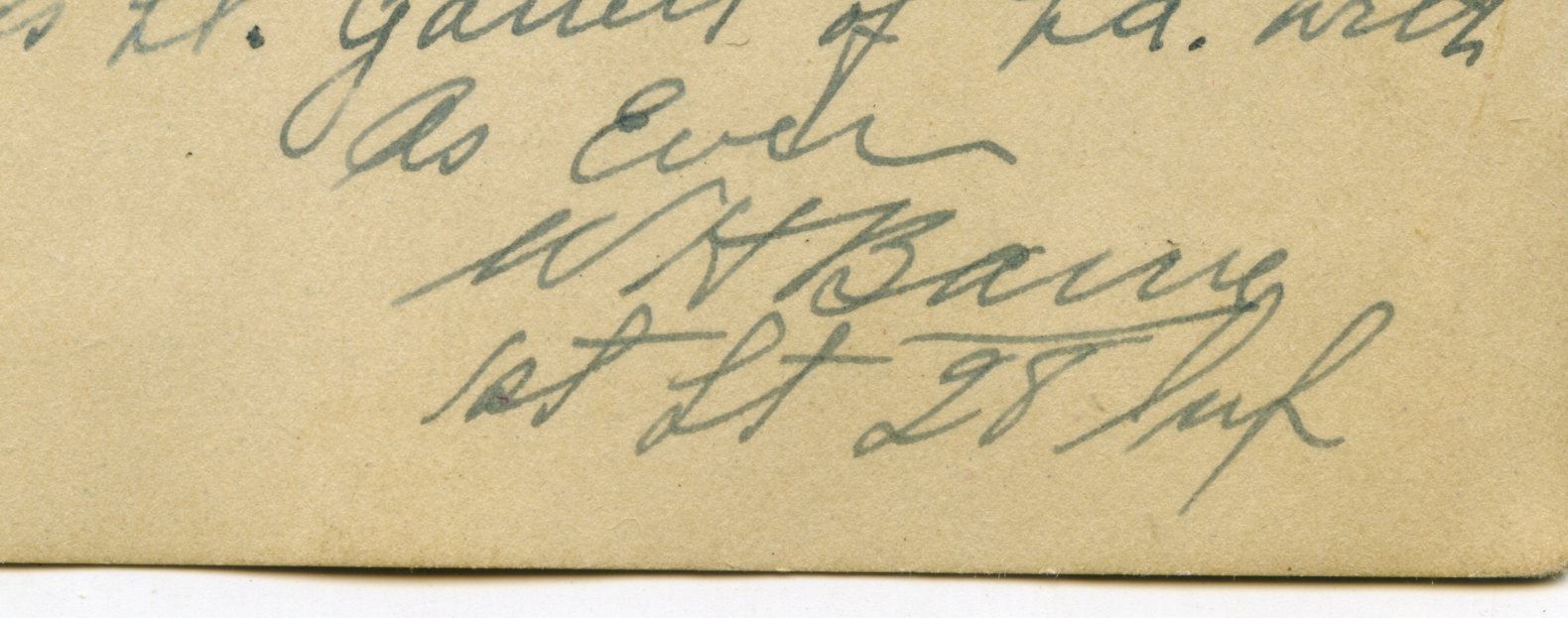
eBay can be a fun way to research WWI soldiers in a way that wouldn’t have been possible ten years ago. With the emerging databases of WWI soldier roster information and the ever-expanding capacity of Ancestry.com for genealogical data, WWI veterans are becoming easier and easier to research. In this case, I purchased a photo of two US officers posing in a French studio in March of 1919. The signature on the front and the inscription on the back give roughly enough information to make a positive identification. The standing officer is 2nd Lt. William H. Barry of Langley, Washington. He served with F. Co of the 28th Infantry Regiment, 1st Division during the American involvement in WWI. He was awarded the Distinguished Service Cross (DSC) for his bravery and extraordinary heroism in the breakthrough of the Hindenburg Line. A large percentage of his company became casualties and he assumed command after the CO was wounded. He reorganized the company and completed their objective under the rain of German machine fun fire.
To think, this photograph was obtained on an internet auction site for less than the price of a tank of gasoline and had been sitting in a pile of postcards for years before it was posted. I’m glad to provide this information – I hope a family member can find this post and learn a little about their ancestor!
Lt. William H. Barry (Standing)
Lt. Barry’s March 1919 Signature
BARRY, WILLIAM H. Second Lieutenant, U.S. Army
28th Infantry Regiment, 1st Division, A.E.F.
Date of Action: October 5, 1918 Citation:
The Distinguished Service Cross is presented to William H. Barry, Second Lieutenant, U.S. Army, for extraordinary heroism in action near Exermont, France, October 5, 1918. Assuming command of his company after his company commander and a major portion of the company became casualties, Second Lieutenant Barry reorganized his company and personally led it forward in the attack, successfully attaining his objective in the face of intense machine-gun and artillery fire. He constantly exposed himself to enemy fire in order to encourage and insure the protection of his men. General Orders No. 103, W.D., 1919
Home Town: Langley, WA
A recent purchase just arrived in my mailbox and I’ve been researching the details in hopes of identifying something interesting to write about. Well, this photo has a few good details that will hopefully help future collectors with identifying their WWI photographs!
57th Field Artillery Brigade
The first details that pop out are the accessories that these doughboys decided to wear into the studio. These small nuances of WWI photos really help researchers, reenactors and collectors understand that uniform and insignia regulations in 1918 were at time blurry, and interesting one-off uniform presentations did exist. In this case we see a handful of elements that are not typically found in photos of the period.
Leg Covering
One soldier (far left) is wearing M1910 canvas gaiters, while the other two are sporting wool puttees.
Cap Insignia
All three doughboys are wearing French lettering on their caps denoting their specific unit affiliation. In this case, they are wearing the number 57 with a letter A. In any other scenario I would assume that this would place them within the 57th Infantry Regiment, Company A, or possibly 57th Pioneer Regiment, Company A. In this case, the next detail down drives the unit ID home. These letters and numbers are often seen on French collars.
French Cap Numbering
Officer’s Field Artillery Insignia
The soldier at the far right is wearing an officer collar insignia for a Field Artillery Regiment. An odd thing on an enlisted man, and especially odd at the center of the chest. Who knows?
Watches
All three are wearing watches! The first on the left has a pocket watch with fob and chain clipped to his shirt. The other two are wearing “trench watches” with kitchener straps. Interestingly, they both do not currently have crystal guards AKA “shrapnel guards” on the watch face to protect from wartime damage. These were popular amongst watch-wearing soldiers of WWI.
Field Artillery Ring
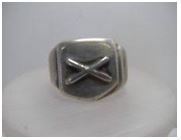
One detail that I always look for is the presence of a ring on WWI soldiers. The soldier at the far left is wearing a sterling silver Field Artillery ring – another clue that supports the 57th Field Artillery ID for this photo.
Oval Sterling Field Artillery Ring
In summary, the tiny details of a photo can actually make an unidentified WWI photo incredibly interesting and fun to dissect. These little nuances of wartime accessory can, at time make the difference between a $5.00 photo and a $50.00 photo to the discerning collector. It also helps expand knowledge into unknown areas of military material culture collecting. Pull out your magnifying glass and look through your collection!
Apologies for not posting any interesting original material in the past few weeks, I’ve been busy dealing with the holidays and the celebrations that inevitably pop up at this time of year. Today’s blog post will be about a topic I’ve become fascinated with over the course of the past two years. Have you ever wondered why stereotypical WWI German media characters from WWI always seem to have a large scar on their face? Ever wonder why they always seem to be on the cheek and always are attributed with men of high status such as generals and higher ranking officers?
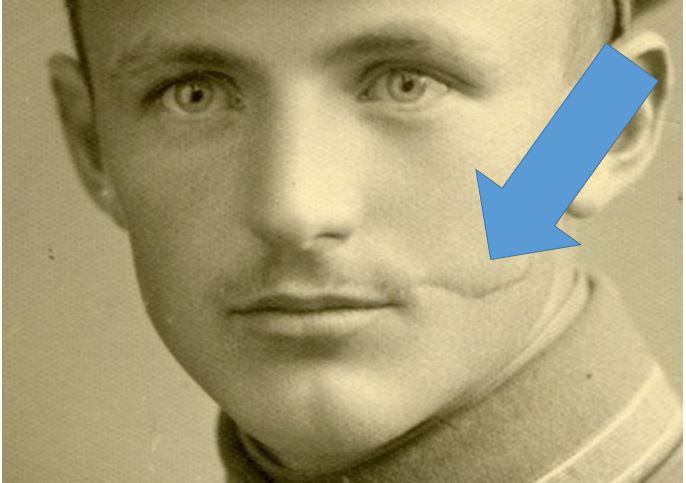
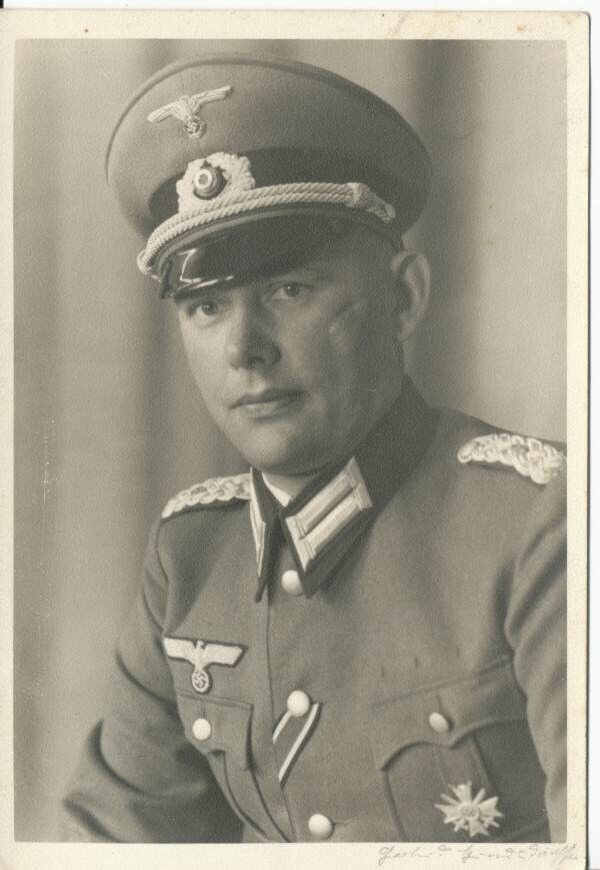
Well, recently I was able to purchase on eBay an inexpensive photo ($4.99) on eBay that perfectly personifies the image of a young WWI German soldier with a prominent facial scar.
Mensur Scar (New photo to collection)
Was this scar the result of a bad shaving accident? In fact, the answer is exactly the opposite; this left cheek scar is the result of a deliberate action.
Ouch!
After a solid night of internet research, I was able to cobble together an answer regarding the odd number of facial scars associated with late 19th and early 20th century German and Austrian soldiers. The Dueling Scar!
Male (upper class) students who were members of fraternities of major German and Austrian universities during this time were often engaged in academic fencing which at times would, at times, become a duel between competing fraternities. These individualized duels between students eventually became a badge of honor among fraternity members – taking a blow to the face showed courage and was a lasting reminder of the fraternal bond.
Since these boys were often from a higher class, it was no surprise that many eventually became officers during WWI. This act was well know during the time and eventually became banned around the time of the outbreak of the war. The ban was lifted when Adolf Hitler came to power in 1933. Many of the German officers of WWII had these scars given the fact that they were in university prior to WWI.
A fun fact – The majority of scars appear on the left side of the face due to the fact that many fencers were trained in a right-handed style!
Skip ahead to 2:50 to see the duel in action!
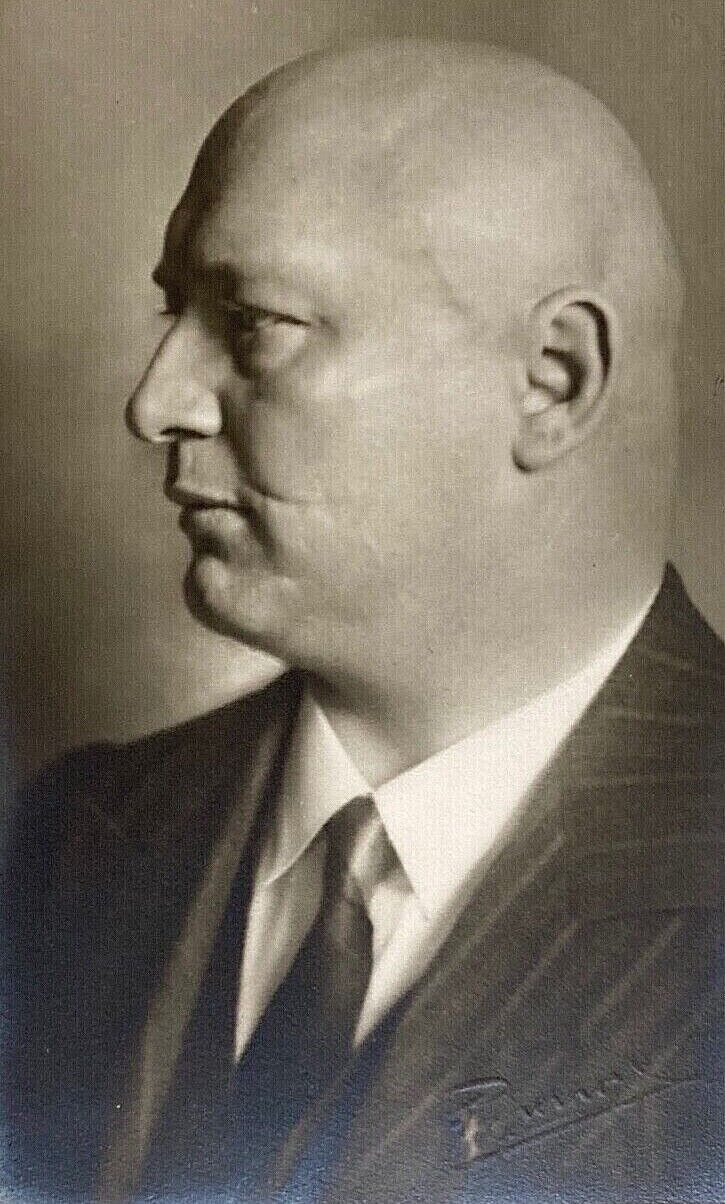
Otto Skorzeny with Mensur Scar
German Pilot Eduard Wolfgang Zorer
Cartoon View ca. 1909 (From eBay listing)
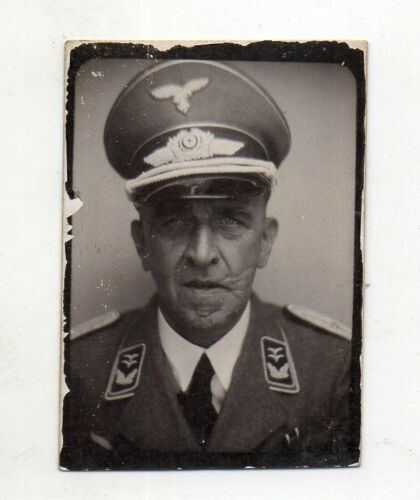
Luftwaffe Portrait Photo (from an eBay auction)
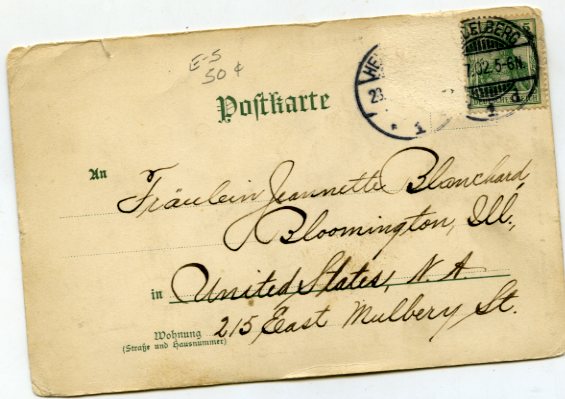
Luftwaffe Officer 1902 Postcard Sent from Heidelberg
A recent eBay purchase has lead me down a warren of research avenues that are helping shed light on the American involvement at the bloody fray at St. Etienne during the Battle of Blanc Mont Ridge in October of 1918. The photo depicts Lt. Carl Wehner with the following inscription on the verso:
“141st Inf., 36th Div. Lt. Carl Wehner killed Oct. 8, 1918 by a German sniper.”
It was this writing that pushed me to purchase the photo at a reasonable $25.00 in hopes of researching and fleshing out the life of the young Lieutenant and Wisconsin native who was killed in action only days after his 26th birthday.
Lt. Carl Wehner in France, 1918
This photo was most likely taken a month or so before his death in October, as he is sporting a 6 month overseas service chevron on his left cuff. August or September would roughly be six months after his arrival from stateside officers training. He was selected to be a Lieutenant with Company K of the 141st Infantry Regiment of the 36th Division – a unit comprised mostly of southern boys from Texas and surrounding states. Having been born in Lincoln, Kansas and spending most of his life in Madison, Wisconsin, he originally enlisted with the 32nd “Red Arrow” Division but elected to train to become an officer. At the time of his enlistment, he lived at 925 West Dayton Street in Madison.
Carl’s WWI Draft Registration Card
And I was able to find a fascinating account of his death while commanding Company K following the death of his Captain (Source – Entry by RavenHawk)
…It was near St. Etienne, as his captain layed dead, Wehner led his unit forward, until he himself was struck in the head, by enemy gunfire, and killed. One account of the battle (perhaps a little exagerated), said: “Lieutenat Wehner died with three machine gun bullets in his forehead and a smile on his lips as he led Company K of the 141st Infantry over the top after his captain was killed by the fire of the enemy.”….In a letter signed by the Marshall Of France, Commander in Chief of the French Armies of the East, Petain, it was written: “Lt. Wehner displayed audacity and disregard of danger during the operations near St. Etienne. At the head of his men, encouraging them with his skill, he largely contributed to the success of the operations which made it possible to capture all objectives. He was killed at his post of combat.” For his bravery, Wehner was awarded the Croix de Guerre with palm for bravery….As for Wehner’s family, they didn’t find out until after Christmas, that Wehner had been killed, in battle…Wehner’s body was returned to Madison in 1921, and reburied at Forest Hill on 10/21/1921.
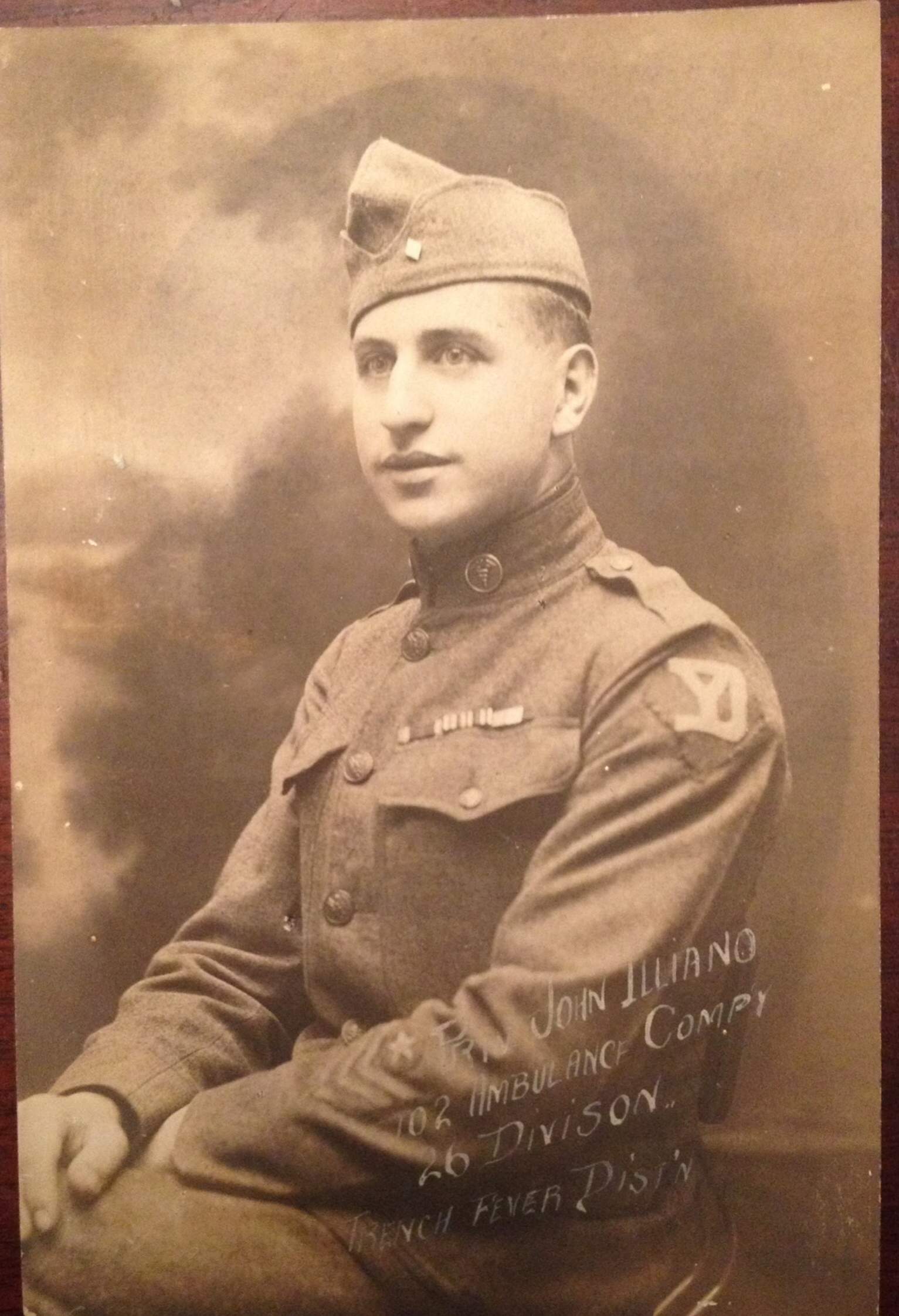
This photograph is a true mystery for me. I can’t identify the sitter of this photograph even though there is so much information to work with:
He’s identified on the print as Pvt. John Illiano of the 102nd Ambulance Company
He’s sporting a 26th Division uniform with at least 1 1/2 years overseas service
He was one of the first 100,000 US soldiers to enlist (conjecture based on star)
He’s most likely from New England at the time of enlistment
Probably Italian-American
I found a digital scan of this photo on War Relics Forum, a site dedicated to WWII artifact research. The OP of this photo, MD Helmets, doesn’t have any additional information but did claim he/she purchased it from Bay State Militaria back in 2013.

























 Portraits of War