WWI German Facial Dueling Scars – Mensur Scars and WWI Portraits


Apologies for not posting any interesting original material in the past few weeks, I’ve been busy dealing with the holidays and the celebrations that inevitably pop up at this time of year. Today’s blog post will be about a topic I’ve become fascinated with over the course of the past two years. Have you ever wondered why stereotypical WWI German media characters from WWI always seem to have a large scar on their face? Ever wonder why they always seem to be on the cheek and always are attributed with men of high status such as generals and higher ranking officers?

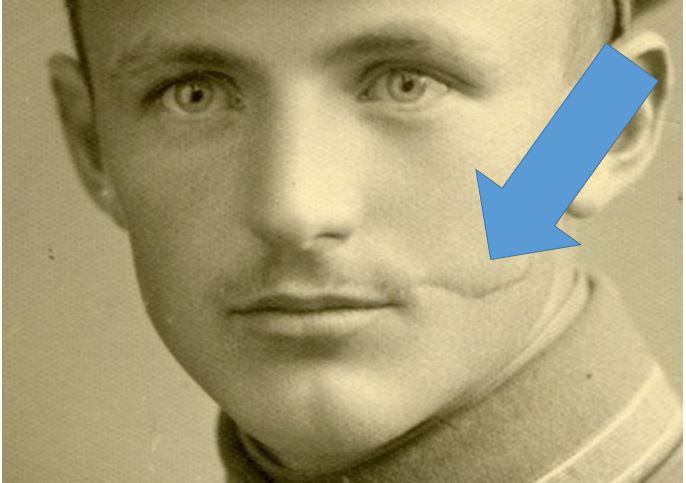
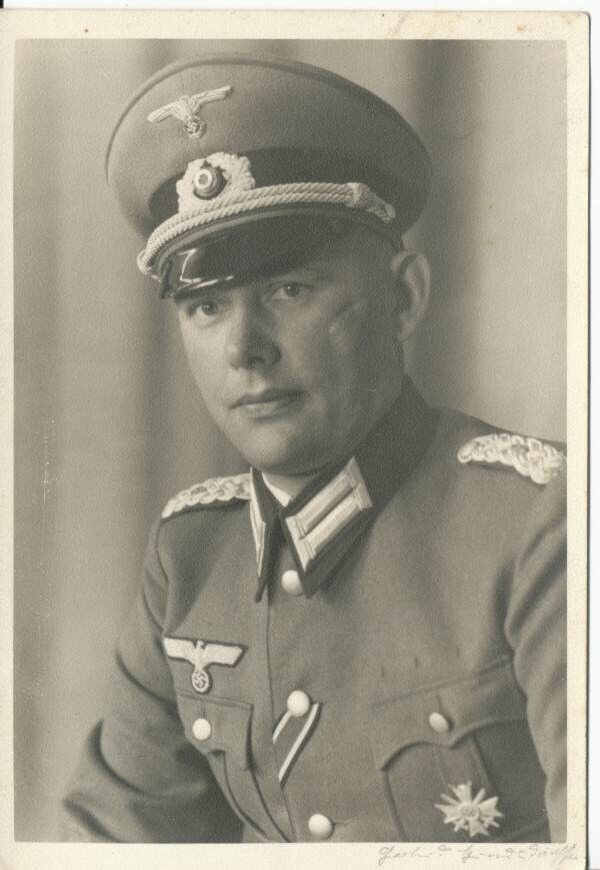
Well, recently I was able to purchase on eBay  an inexpensive photo ($4.99) on eBay that perfectly personifies the image of a young WWI German soldier with a prominent facial scar.

scarface005

Mensur Scar (New photo to collection)

Was this scar the result of a bad shaving accident? In fact, the answer is exactly the opposite; this left cheek scar is the result of a deliberate action.

scar

Ouch!

After a solid night of internet research, I was able to cobble together an answer regarding the odd number of facial scars associated with late 19th and early 20th century German and Austrian soldiers. The Dueling Scar!

Male (upper class) students who were members of fraternities of major German and Austrian universities during this time were often engaged in academic fencing which at times would, at times, become a duel between competing fraternities. These individualized duels between students eventually became a badge of honor among fraternity members – taking a blow to the face showed courage and was a lasting reminder of the fraternal bond.

Since these boys were often from a higher class, it was no surprise that many eventually became officers during WWI. This act was well know during the time and eventually became banned around the time of the outbreak of the war. The ban was lifted when Adolf Hitler came to power in 1933. Many of the German officers of WWII had these scars given the fact that they were in university prior to WWI.

A fun fact – The majority of scars appear on the left side of the face due to the fact that many fencers were trained in a right-handed style!

Skip ahead to 2:50 to see the duel in action!

ss-hauptsturmfuhrer otto skorzeny schmiss mensur scars

Otto Skorzeny with Mensur Scar


zorer

German Pilot Eduard Wolfgang Zorer

IscUC6I6vXdRk18qHI20k

scarebay

Cartoon View ca. 1909 (From eBay listing)


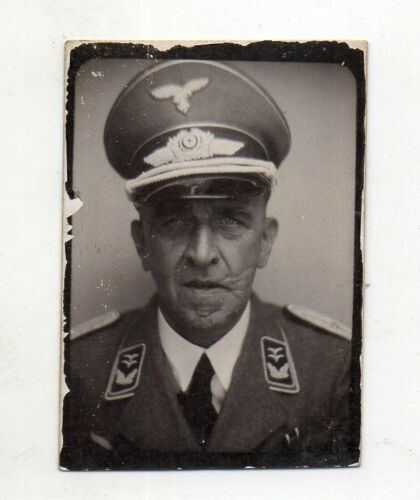
Luftwaffe Portrait Photo (from an eBay auction)

Luftwaffe Officer
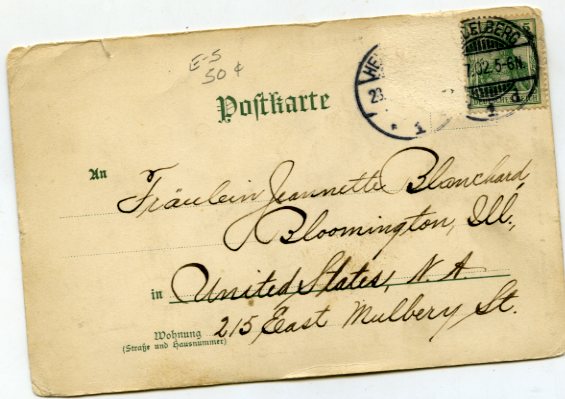
1902 Postcard Sent from Heidelberg

Gene Keessen: A Vietnam War Dentist in 35mm Kodachrome


I recently purchased a series of inexpensive (less than a dollar) 35mm Kodachrome color slides on eBay in hopes of identifying the men and women portrayed in the images. The slides were part of an estate sell out of an unnamed veteran who served with the 219th Medical Detachment during the Vietnam War. All the slides appear to be related to non-critical medical care “in country”.

My favorite slide from the purchase has to be a head-on shot taken of a dentist with the unit identified as Gene Keessen. He’s sporting an incredible blonde English pyramidal mustache (see guide below).

a-30

Guide to basic mustache styles

And here he is in his full glory – I’m guessing this photo was taken ca. 1969.

Vietnam056

I’ve tracked Mr. Keessen down and am making my best attempt to send him/his family these slides. I hope they get a kick out of the mustache!

gene2

Gene with a patient

Wounded WWI AEF Chaplain Poses in French Studio – Can We Identify Him?


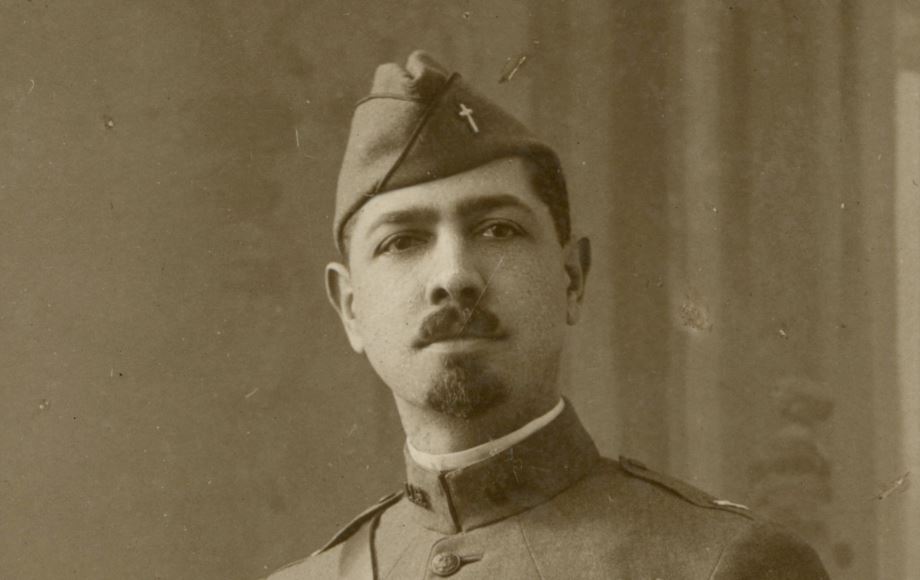
It is never easy to identify someone from a photograph taken nearly 100 years ago, but it’s even more difficult solely based on obscure details from his/her clothing. In today’s blog post I will focus on a photograph purchased on eBay from a fantastic seller named Colleen ( eBay name: cacdivi) who recently sold me a superb French real photo postcard of an American chaplain posed in a studio during World World I (WWI). Here’s the shot:

wwi026

Wounded American Chaplain in WWI

The scene is fairly typical of what was common of the time period: WWI soldiers/sailors/marine/nurses posed in photo studios in far off places in order to document their experiences to send to relatives and friends. In this case, a currently-unidentified US chaplain (see the crucifix on his shoulder and cap?) strikes a chin-up pose for a French photographer. How do we know that the photo was taken in France?

wwi027

French Postcard Paper

French postcard paper during WWI almost always contains a central vertical dividing mark with CARTE POSTALE emblazoned across the top. I’ve noted a fair number of varieties likely due to differences in production, but the main bulk of French postcard paper of the period look very similar to the above scan.


Dissection of Photographic Context

What are we looking at? I’ve already mentioned that the man posed in the photo is a US chaplain in a French studio during the war. But what details have I been pondering while waiting for the photo to arrive in my mailbox? (Thanks to Colleen – you rock!)

  1. The chaplain has served at least six months in Europe

    botharms

    His Left Sleeve (6th Months Overseas Service) Right Sleeve (Wound Chevron)

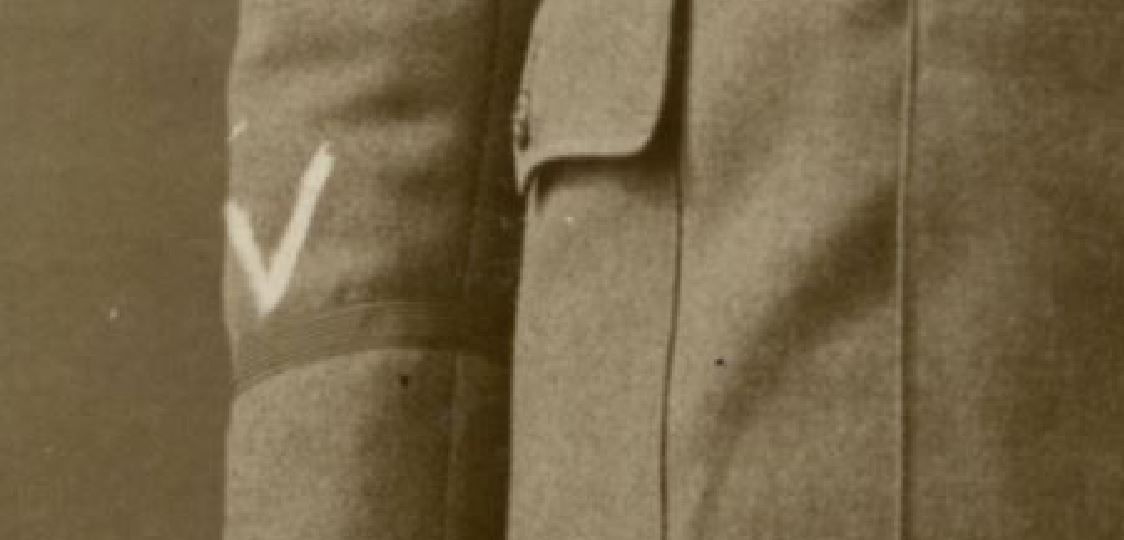
  2. He was wounded or gassed at least once during his service

    woundchev

    His Right Sleeve: Wound Chevron

  3. The photo was likely taken during wartime (before the armistice)
  4. He is oddly sporting a mustache and goatee

    headshot

    Rarely Seen Facial Hair in WWI

  5. He is wearing an identification bracelet made in France

    scan3

    WWI Bracelet Made in France

Why is a photograph of a wounded chaplain posed in a wartime studio worthy of devoting hours of research to? According to a website devoted to military chaplains, the number of wartime chaplains during WWI was incredibly low:

In 1918, Congress passed an act that called for one chaplain for every 1200 officers and enlisted men. Bishop Hayes, in a letter to Cardinal Farley, informs Farley of the current number of chaplains overseas. As of June 1918 there were 301 chaplains in the Army, 30 in the Navy, 7 with the Red Cross, 2 interpreters, and 95 volunteer or Knights of Columbus chaplains.

This photo most likely represents an Army chaplain included in the above June 1918 census: any US chaplain who served at least six months service would’ve been present in France in June of 1918. And to have been wounded or gassed, our unidentified chaplain was likely present during the earlier battles of the US involvement of the war.

Our Chaplain?

Okay, so we know our chaplain was wounded, was photographed at some point in the  spring or summer of 1918 and likely served in an Army division that arrived early (for the Americans). His identity, based on date, is narrowed down to 1 in 301 – a pretty good number when it comes to identifying a photo taken 100 years ago. Also, based on rules, he has to be less than 45 years of age.

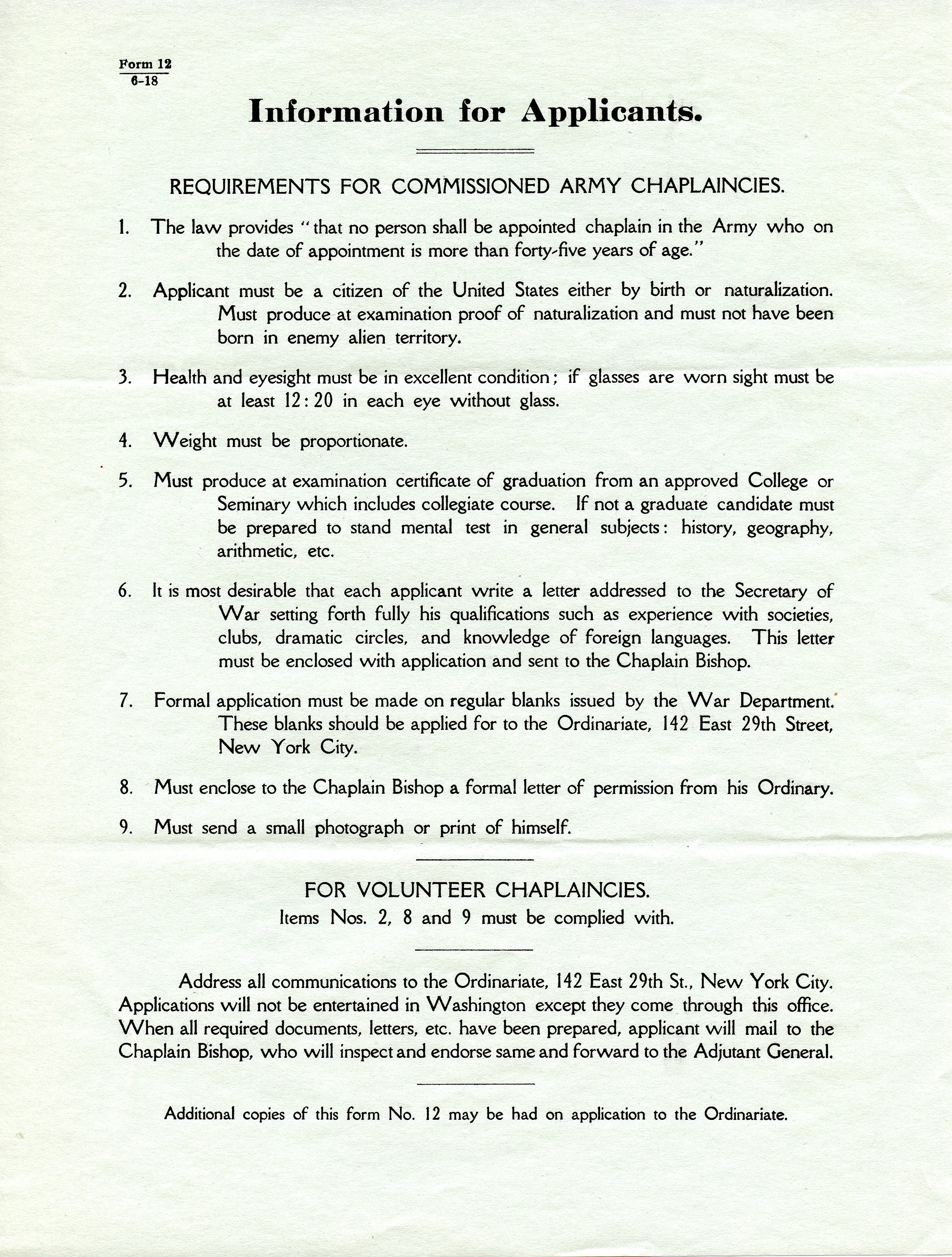
But what was required to be a US chaplain in WWI? Before researching this photo I had no idea of the low number of volunteers or the actual requirements for acceptance. My personal photo collection contains a half dozen photos of chaplains, which is a surprisingly high number based on the scarcity of the subject matter. I was lucky to track down a copy of the rules and regs of chaplainhood here: http://archnyarchives.org/2015/11/10/military-chaplains-in-world-war-i/

Official Chaplain Requirements

Requirements for Commissioned Army Chaplaincies

  1. The law provides that no person shall be appointed chaplain in the Army who on the date of appointment is more than forty-five years of age.
  2. Applicants must be a citizen of the United States either by birth or naturalization. Must produce at examination proof of naturalization and must not have been born in enemy alien territory.
  3. Health and eyesight must be in excellent condition; if glasses are worn sight must be at least 12:20 in each eye without glass.
  4. Weight must be proportionate.
  5. Must produce an examination certificate of graduation from an approved College or Seminary which includes collegiate course. If not a graduate candidate must be prepared to stand mental test in general subjects: history, geography, arithmetic. etc.
  6. It is most desirable that each applicant write a letter addressed to the Secretary of War setting forth fully his qualifications such as experience with societies, clubs, dramatic circles, and knowledge of foreign languages. This letter must be be enclosed with application and sent to the Chaplain Bishop.
  7. Formal application must be made on regular blanks made by the War Department. These Blanks should be applied for to the Ordinariate, 142 East 29th Street, New York City.
  8. Must enclose to the Chaplain Bishop a formal letter of permission from his Ordinary.
  9. Must send a small photographic print of himself.

Chaplain-Application006

1918 Chaplain Application Form


For now I have a good bit of information to extend my research with. Until then, stay tuned!


WWI Portrait Photo – 102nd Ambulance Company, 26th Division


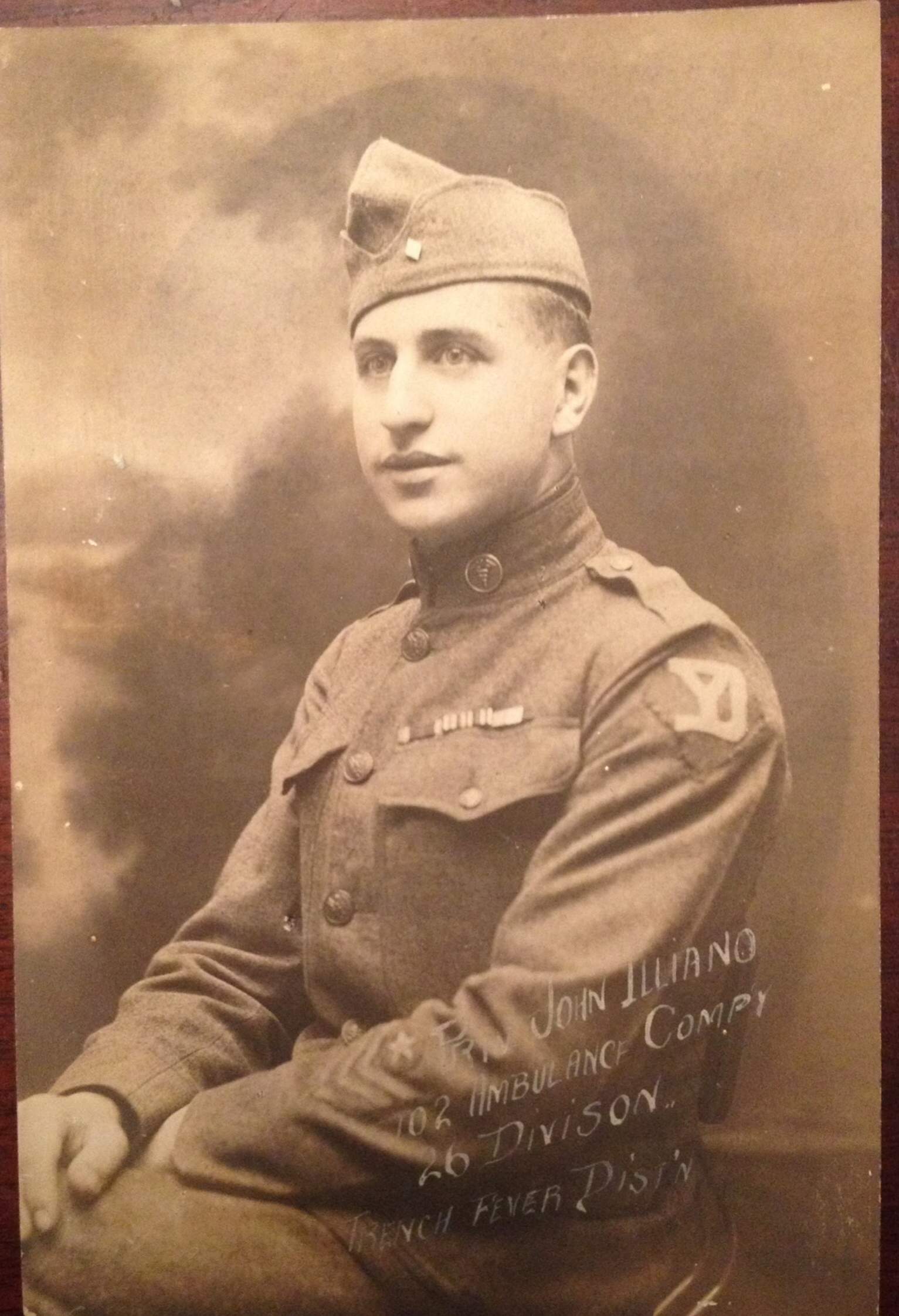
This photograph is a true mystery for me. I can’t identify the sitter of this photograph even though there is so much information to work with:

  1. He’s identified on the print as Pvt. John Illiano of the 102nd Ambulance Company
  2. He’s sporting a 26th Division uniform with at least 1 1/2 years overseas service
  3. He was one of the first 100,000 US soldiers to enlist (conjecture based on star)
  4. He’s most likely from New England at the time of enlistment
  5. Probably Italian-American

I found a digital scan of this photo on War Relics Forum, a site dedicated to WWII artifact research. The OP of this photo, MD Helmets, doesn’t have any additional information but did claim he/she purchased it from Bay State Militaria back in 2013.

What do you guys think? Any leads?

102ndambulance

102nd Ambulance Company “Mystery Sitter”

100 Years Later: Vermont’s Entry into the First World War


It has been called THE GREAT WAR and THE WAR TO END ALL WARS.

According to Tweets from WWI, the American intervention in the war can be summarized as:

There is only room for one: ‘s idealism vs. German ‘s imperialism (US caricature).

C8qcY9kWsAAUJvg.jpg large

Today, we know it as World War One (WWI). It began in 1914 and ended with an armistice at the eleventh hour of the eleventh day of the eleventh month in 1918. The global toll had already reached nearly 40 million casualties, including American losses of 117,465 dead and 204,002 wounded.

100 Years Ago Today

After War was officially declared (House and Senate) on April 6th, 1917 the U.S. began preparations to enter the quagmire of European trench warfare.

101stmg043a

Vermonter John Corcoran (r) in WWI

In June of 1917, U.S. transport ships carrying nearly 15,000 U.S. troops (many from New England) in the American Expeditionary Force (AEF) approached the shores of France, these soldiers would join the Allied fight against the Central Powers.  They disembarked at the port of Saint Nazaire; the landing site had been kept secret because of the menace of German submarines, but by the time the Americans had lined up to take their first salute on French soil, an enthusiastic crowd had gathered to welcome them. However, the “Doughboys,” as the British referred to the green American troops, were said to be untrained and ill-equipped, untested for the rigors of fighting along the Western Front.

djpub

PortraitsofWar’s WWI Smithsonian Cover

As U.S. troops landed in France, Americans were mindful of a 125+ year old debt owed that nation. France had been the colonists’ most important ally during the Revolutionary War, having supplied money, material and military brains. The Marquis de Lafayette had fought beside Patriot soldiers, equipping some of them at his own expense. He won the affection of George Washington and became a hero to the young nation. Urged on by Lafayette, France had sent ships, troops, and arms that played a key role in the Patriots’ victory. In early July 1917, the newly arrived American Expeditionary Force troops marched under the Arc de Triomphe, cheered by the people of Paris. In a ceremony at Lafayette’s tomb, where the Frenchman lies buried under dirt from Bunker Hill, an American officer lay down a wreath of pink and white roses. Another officer stepped forward, snapped a salute, and declared: “Lafayette, we are here!”

lavallee093

Earl F. Lavallee of Winooski, VT in Germany, 1918.

As followers of PortraitsofWar will know, we take a great pride in providing interesting and never-before-seen imagery and narration of wartime photography ranging from the American Civil War to the Korean War. In most cases, I take an authentic photograph from my personal collection and work towards uncovering various details that hopefully elucidate some aspect of the photo.

101st Ammunition Train

In this case, I worked the other way around. My familiarity with the First World War history of the State of Vermont is well known to followers of this blog as well as within my home state. One of my favorite Vermont units to serve in the war was the 101st Ammunition Train of the 26th “Yankee Division”.

unnamed

Jeannine Russell (Vermont Agency of Transportation Archaeology Officer), Myself (Vermont Agency of Transportation Archaeologist) and David Schütz (Vermont State Curator) inspecting WWI flags

Only a week ago I was lucky enough to be invited into the bowels of the Vermont Historical Society storage area to inspect a series of American Civil War flags with a few colleagues of mine from work. While in the holding area I mentioned that a series of WWI groups had donated regimental flags and/or guidons to the State of Vermont in the years following the war.

Although I can be a bit fuzzy in my recollections, I apparently had my facts straight and we moved a series of shelves to uncover the aforementioned flags. As I fingered through the labels I instantly recognized the attribution: 101st flags. Please see below for a bit of insight into my recollection…

vermont unit

101st Ammunition Train Guidon Donation Alert, Burlington Free Press, February, 1919

Ok – So my first attempt at searching on the Library of Congress Newspaper website turned up only one reference to the flags, I kept searching (tried COLORS) and came up with this…

flagspresented

Flags presented

The above snippit from a 1919 Burlington Free Press article reads:

Colors Presented

War Flags and Shields Presented to State

Montpelier, Oct. 23 – The presentation of the colors and shields of the organizations from Vermont participating in the the world war occurred this evening in the State House with some 200 veterans attending and over 400 spectators in the seats of the representative hall and balcony.

The services were fitting and were attended by many of the men who have been prominent in the connection with the war. Col. F.B. Thomas presided over the exercise and the program carried out consisted of the “History of the 57th Pioneer Infantry” Capt. Ernest W. Gibson – Brattleboro

Presentation of colors – First Vermont and 57th Pioneer Infantry, Col. F. B. Thomas… History and presentation of colors of 302nd Field Artillery , Color Sergeant Albert J. Seguin of Newport.

History and presentation of 101st Ammunition Train Col. William J. Keville of Boston Mass.

Presentation of guidon, Company E. 101st Ammunition Train, Capt. Harold M. Howe of Northfield, VT.

co#

Ca. 1919 Co. E101st Ammunition Train guidon photo (from Brennan C. Gauthier Collection)

Presentation of guidon, Company F 101st Ammunition Train, Captain McMath

Presentation of guidon, Company G, 101st Ammunition Train, Chester Mooney of Newport.

As I stated earlier, I remembered the fact that the 101st and the 302nd had presented the State of Vermont with standards and guidons from prominent units representing Vermont involvement in the war. The following photos show the results of my inquiries:

unnamed

Left to Right: Jeannine Russell (Vermont Agency of Transportation Archaeology Officer), Myself (Vermont Agency of Transportation Archaeologist) an David Schütz (Vermont State Curator)

In the above photo we have just unrolled the 101st Ammunition Train guidons from their muslin cocoons. Present are representative samples of Co. C, G, F and E of the 101st. Each of these matches with the above 1919 article. How amazing is it to read a 98 year old article about a presentation and see the EXACT pieces in living color?

I’m particular excited about the Co. E guidon. I own a ratty panoramic photo taken of the unit when they returned in 1919. Click here to see ever single facial feature of the men in that group.

Ok – so here’s a photo of the guidon taken right before donation in 1919:

co#

And here’s the guidon today (my big head is at the left edge of the frame):

F company 1

WWI guidons of the 101st Ammunition Train

Also, I requested that the regimental flag of the 302nd Field Artillery be brought out for photographing. Special thanks to Jonathan Croft for being the photographer!

302nd

302nd Field Artillery

Has it really been 100 years?

WWII Aerial Recon Photo: Burning German Convoy During Battle of the Bulge


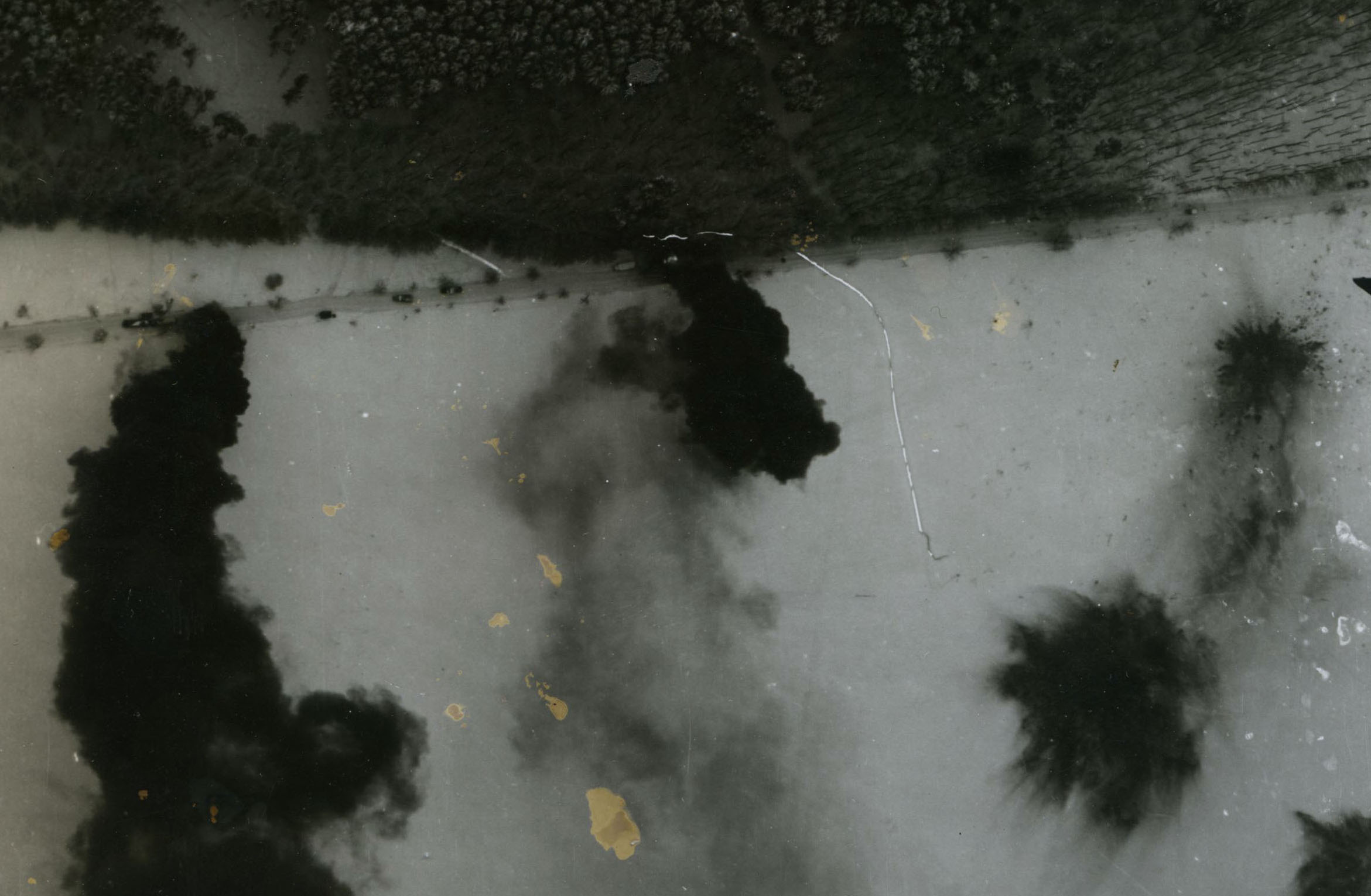
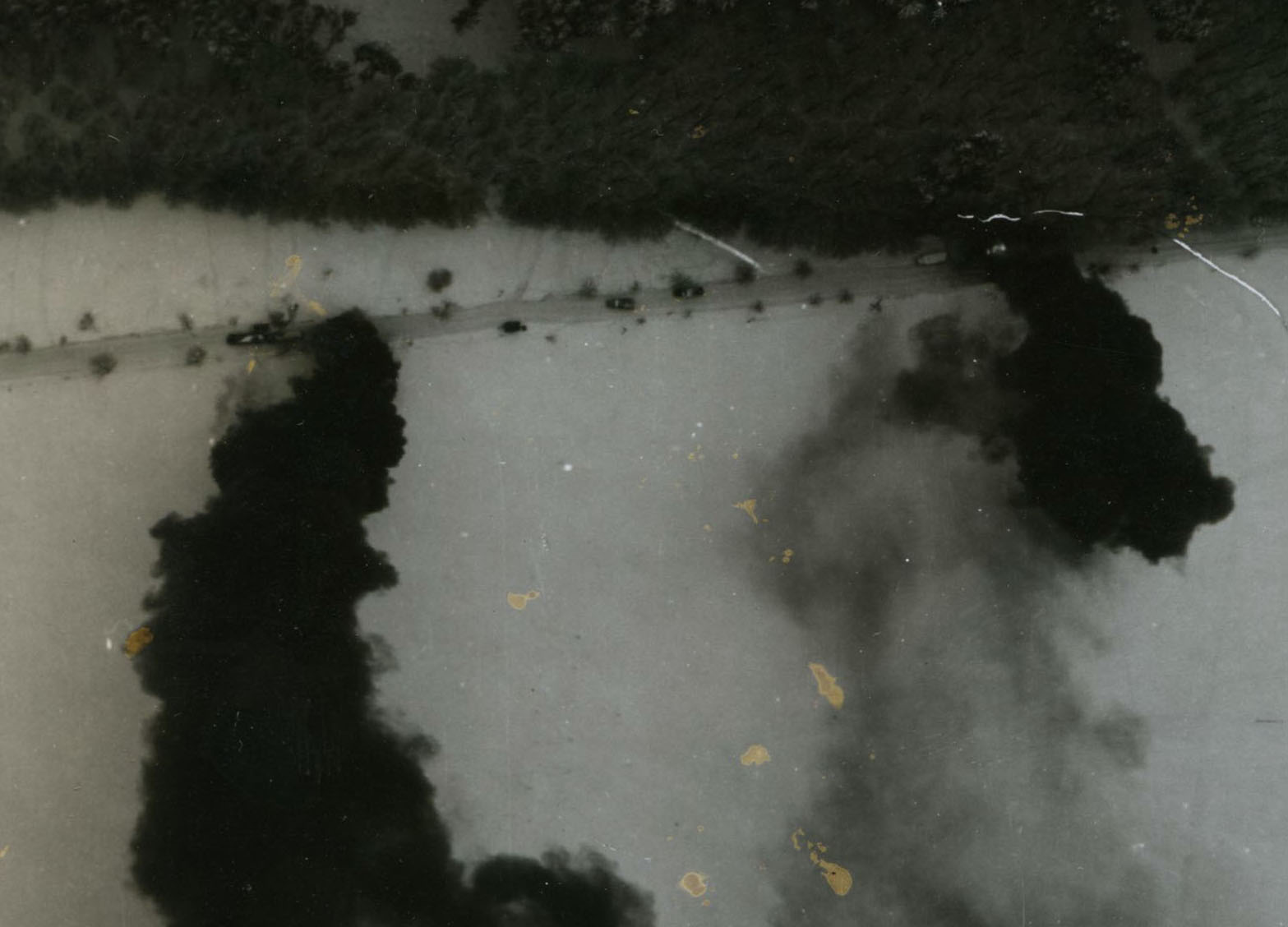
alvaalegre059In a follow up to the popularity of my last post (see here), I’ve decided to begin scanning my collection of large format 12×12 inch aerial photos taken during the Battle of the Bulge.  In this first post, we see a German motorized transport convoy in ruins following a strafing attack by P-47’s of the XAX Tactical Air Command (TAC) on January 23rd, 1945.  I acquired a large set of these original 12×12 inch prints (complete with pencil notes on the back) on eBay a few years ago directly from the estate of a 9th Air Force photo tech who apparently saved hundreds of original flyovers like this.  He saved duplicates as well!  This is one of those duplicates.

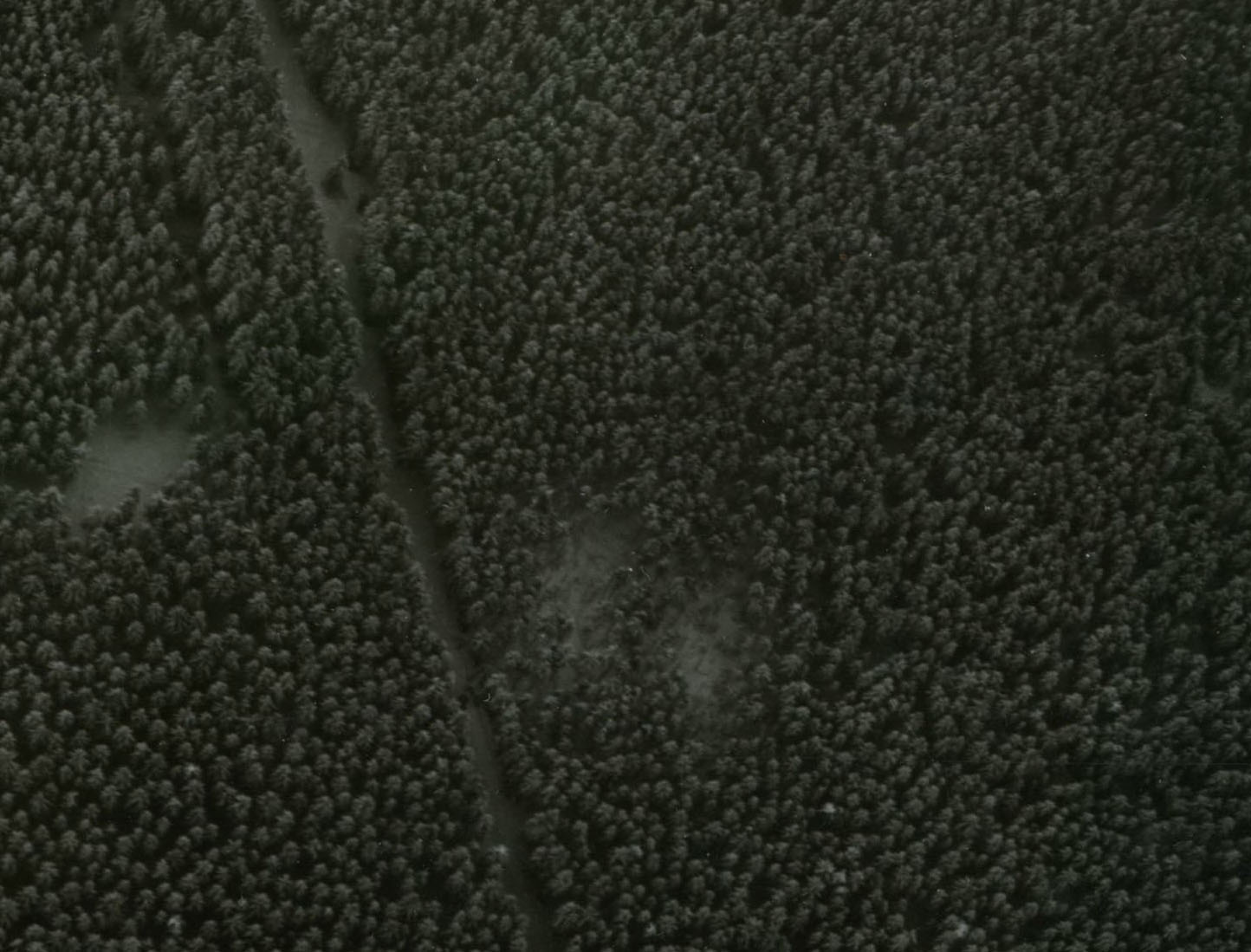
I’ve taken the time to crop the shot for close up views below.  With some luck, followers of this page may be able to track down the exact location of this image!  Good luck guys!

bulge6

January 23rd, 1945

bulge6abcdebulge6abcdefbulge6abulge6abbulge6abcbulge6abcd

Rare Aerial Photo of Gliders Taken After Operation Varsity, March 1945


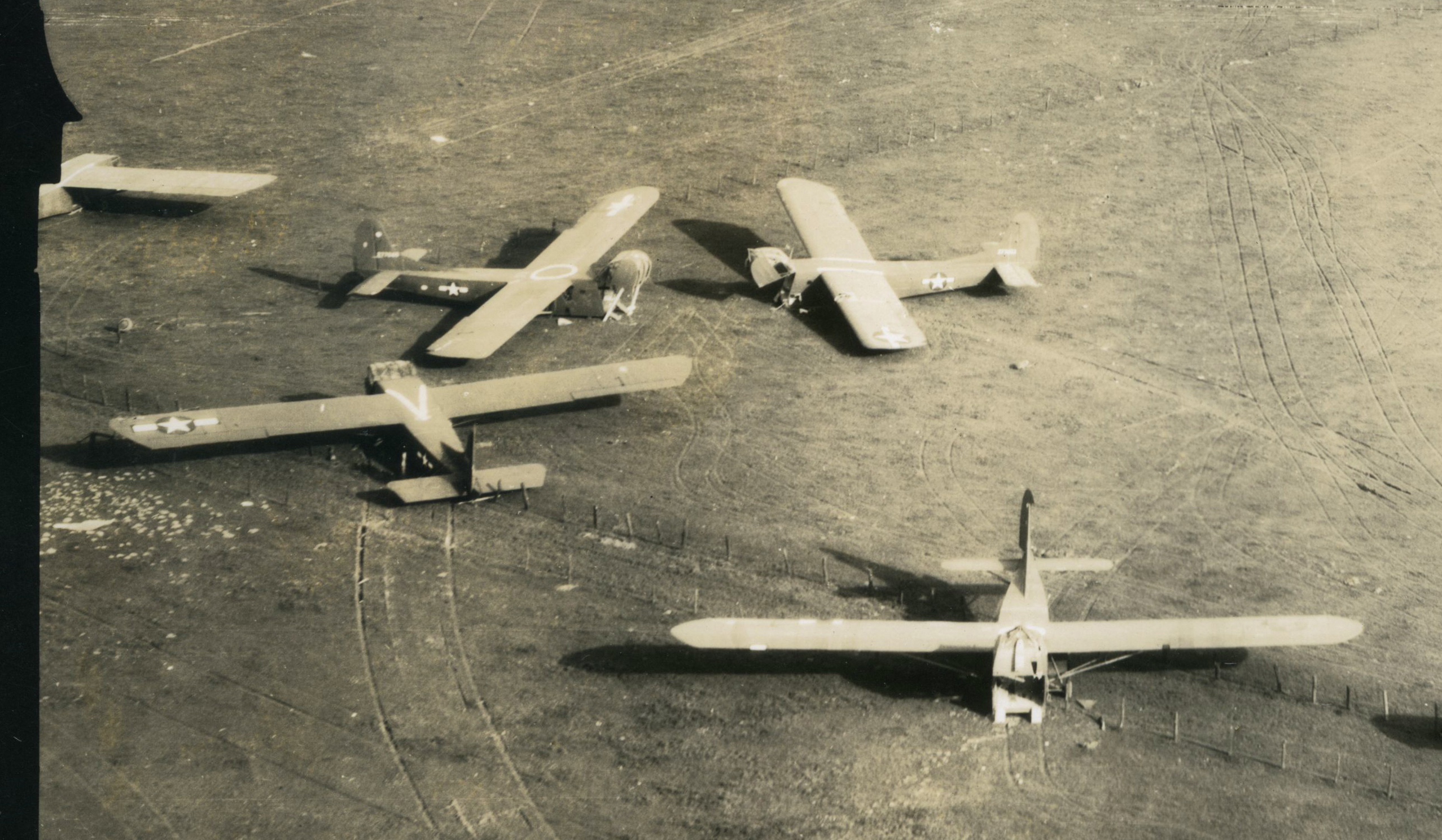
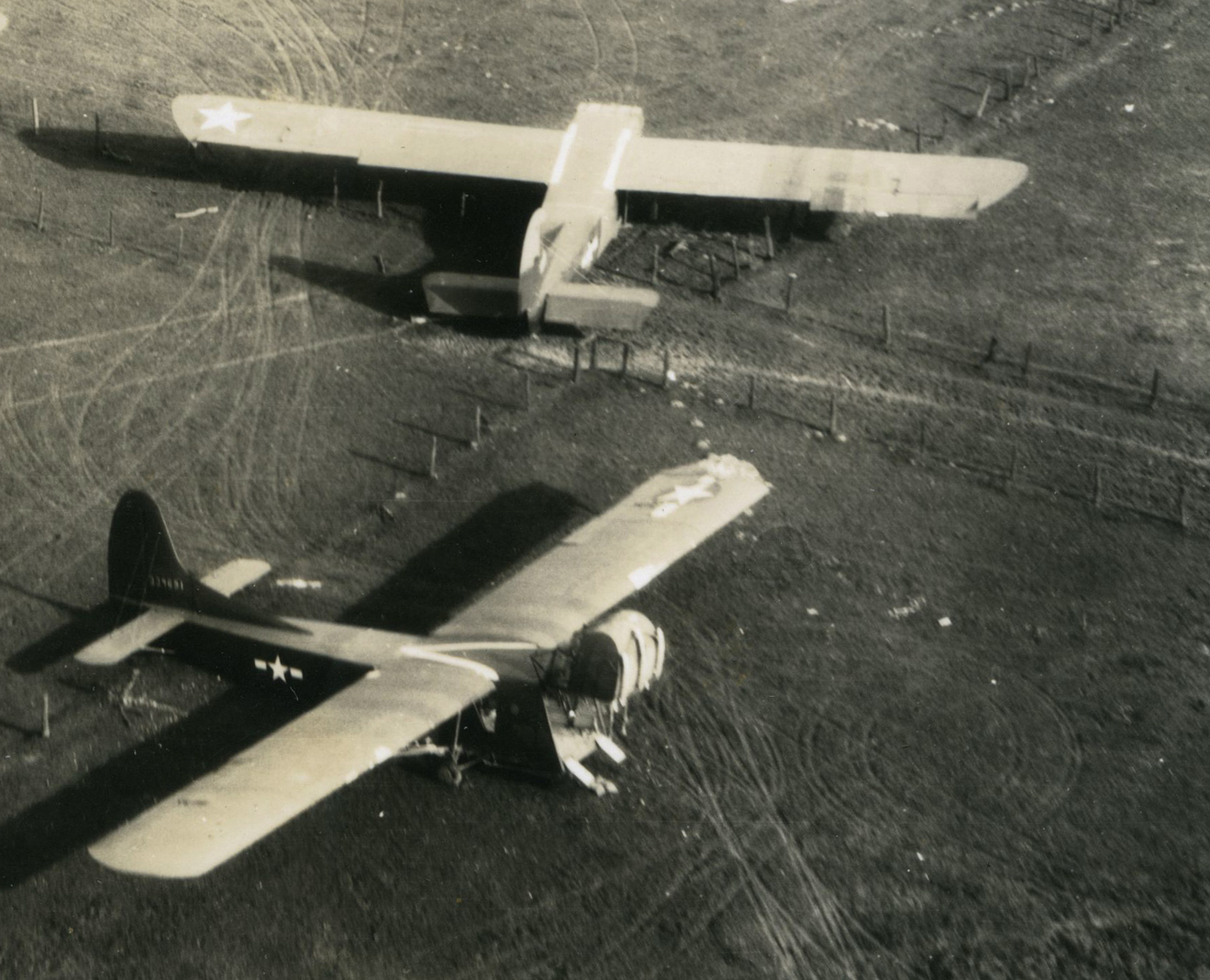
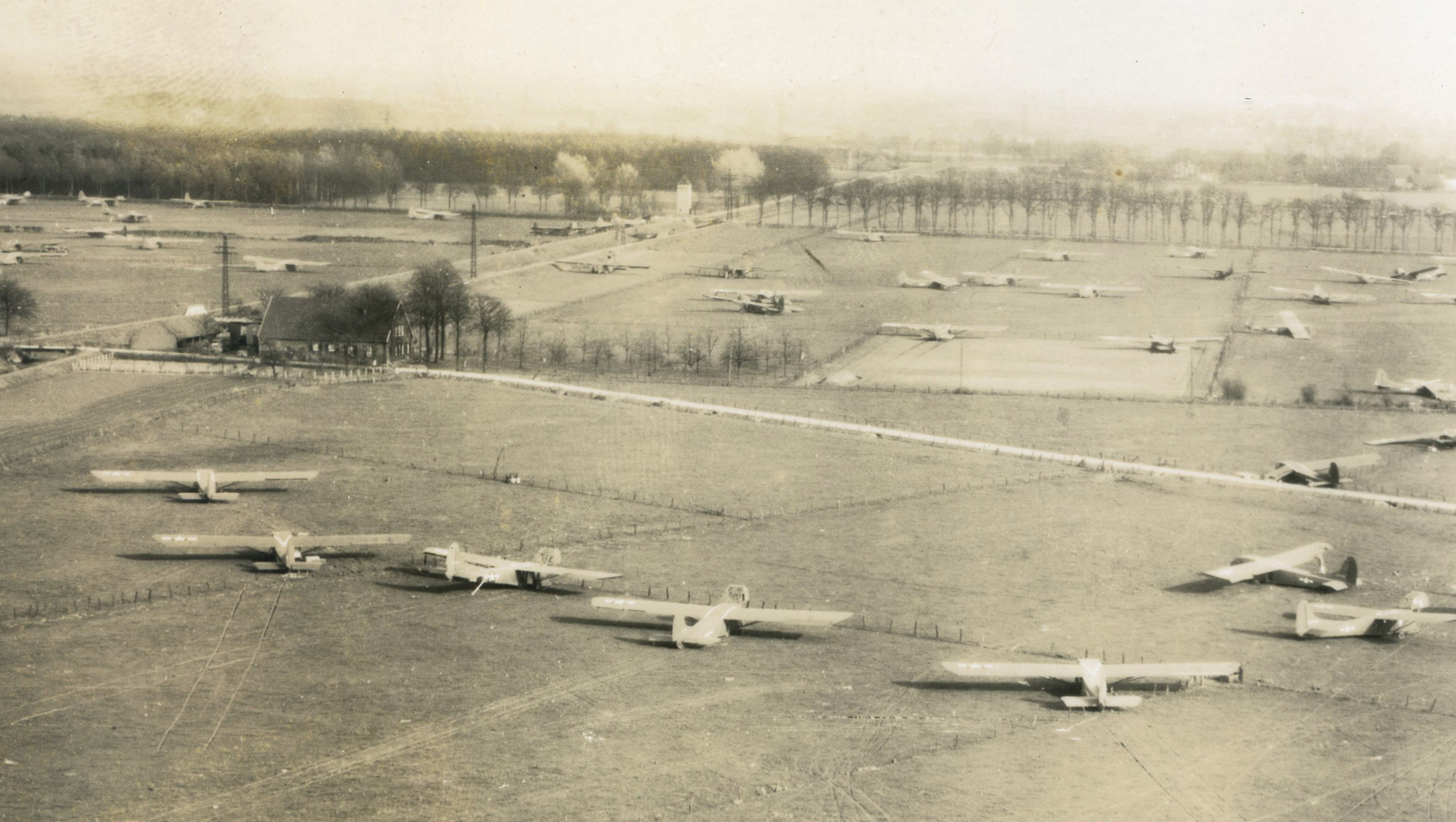
Taken on March 25th, 1945, this image was snapped by a low-flying P-38 or P-51 of the 363rd Photographic Reconnaissance Squadron.  I acquired a large set of these original 12×12 inch prints (complete with pencil notes on the back) on eBay a few years ago directly from the estate of a 9th Air Force photo tech who apparently saved hundreds of original flyovers like this.  He saved duplicates as well!  This is one of those duplicates.

This large format photo, taken a day after the strategic landing of two airborne divisions on the eastern bank of the Rhine River near the village of Hamminkeln and the Town of Wesel, Germany.  Know as Operation Varsity, the landing is regarded by many historians as the most successful airborne landing carried out during WWII.  Although I tend to argue such facts, the point is that the landing led to the quickening of the end of the war.

This series of photos provides an incredibly detailed view of the aftermath of the glider landings and a general layout of trenches, hedgerows and landscape features that may be obfuscated today.  These images can be found in many books and through government archives but may be of lesser quality due to multiple reproductions.  Enjoy!


panorama1small

Large Format Aerial Photo Showing Airborne Gliders, March 25th, 1945

panorama1apanorama1abpanorama1abc


The Photographic Archive of Wells C. Klein – Father of the Modern American Immigration and Refugee Field


It was a cool, drizzly afternoon in the waning summer of 2015 when I first discovered a piece of my photo collection that, to this day, sits underappreciated in a back corner of a dusty closet in my house.  Walking the squishy aisles of the Waterbury Flea Market, I quickly became disenchanted with the dealer turnout.  One tarp called to me from across the field; a dealer was selling everything from a recent Stowe, VT estate buy out and wanted to move material quickly and hit the road before the heavy rain set in.  Late summer rains in Vermont can blow in quickly over Lake Champlain, and being caught in a storm can spell disaster to an antique/junk seller.  As I approached, I noticed a small blue bag with PAA Pan American World Airlines emblazoned across the front.  I instantly recognized it as a vintage 1950s Pan Am carry on flight bag.  I had recently watched a few episodes of Pan Am and was familiar with the color and general shape of the carry on bags seen on the show.

IMG_0205

Wells’ 1960s Pan Am Bag

To my surprise, the bag was stuffed to the gills with photos, documents and 35mm negative envelopes.  Given the ominous weather and progressively moistening socks, I asked the dealer what he was looking to get for the bag.  “Give me five”, he hacked in the most perfect version of a northern Vermont accent I can imagine.  “Does that include the stuff inside?” I returned.  “Ayup.”

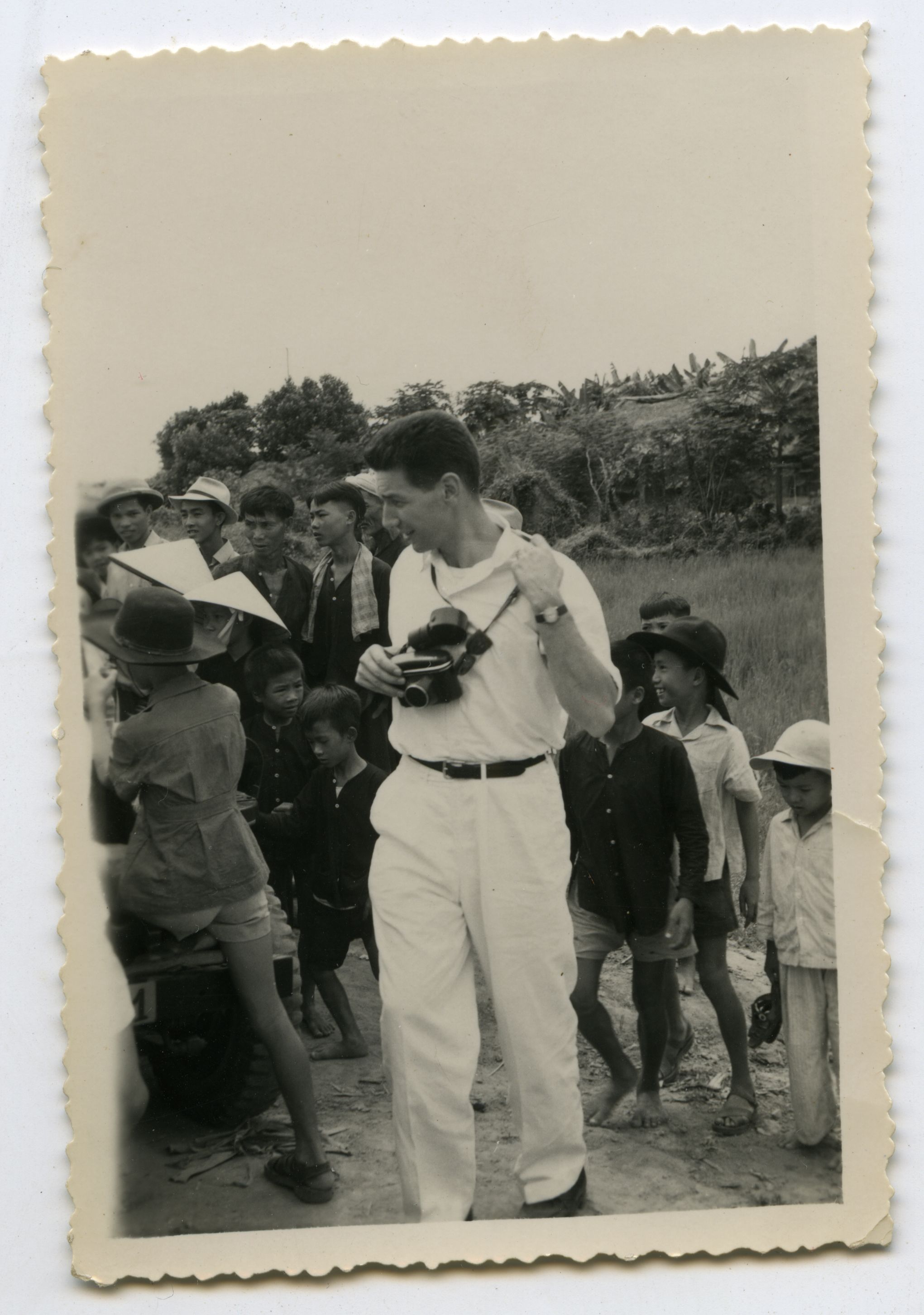
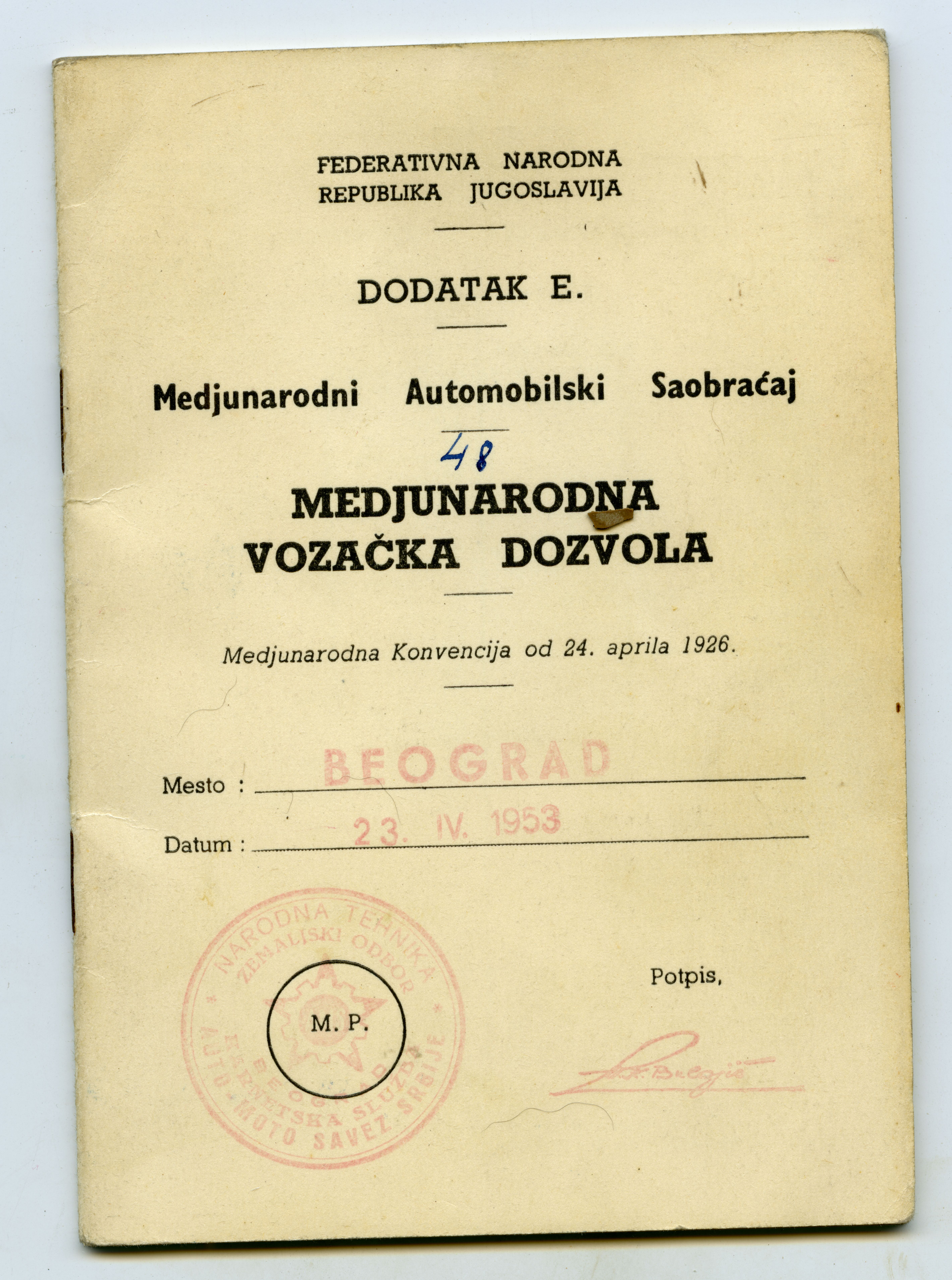
Five minutes later and five bucks lighter, I sat under the protective roof of my car and pawed through the photos.  The bag included a handful of foreign driver’s licenses, a WWII Navy ID card, a handwritten letter from Yugoslavia, hundreds and hundreds of loose photos taken in Vietnam, Yugoslavia, and stateside… and a substantial pack of 35mm negatives.

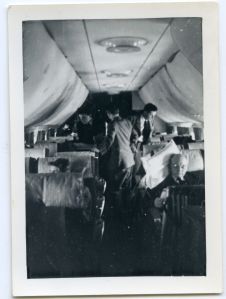
Based on my knowledge of the changing variations of printed photography in the 20th century, it became quickly evident that the bag and contents belonged to a fellow named Wells C. Klein (the ID cards gave this away) who worked in some capacity overseas in the 1950s and 1960s; the distinctive borders and print stock of the photos were correct for this period.  A few items included dates, so that really helps narrow it down……..

With the help of the internet and some sleuthing by friends, I’ve been able to figure out the Hardy Boys–esque Mystery of the Pan Am Bag.
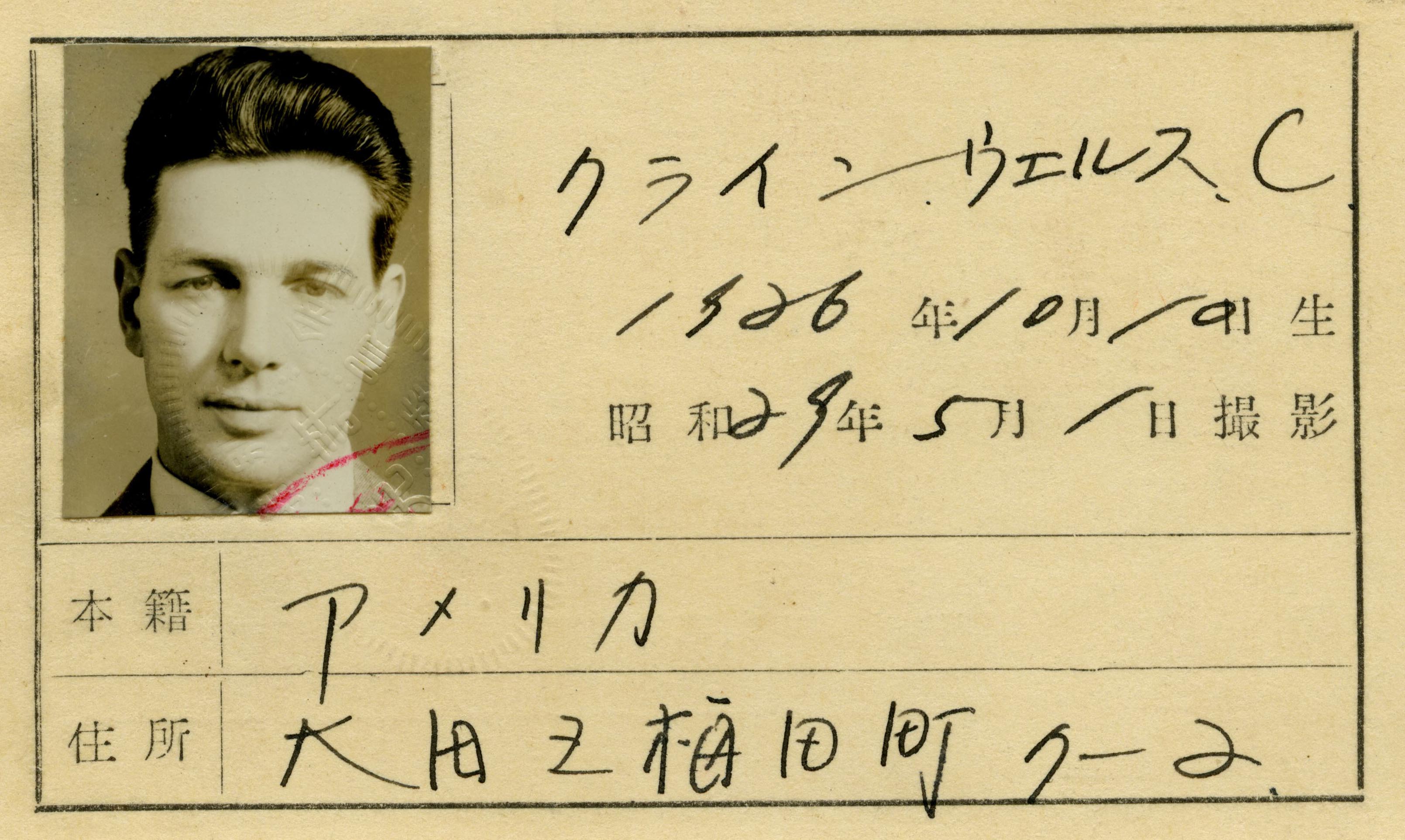
vietnam079a

Wells’ Foreign ID

Much of Wells’ bio comes from a series of New York Times, LA Times and other news outlet obituaries that circled the US in the days after his death in April of 2001.  Wells Campbell Klein was born on October 10th, 1926 in New York City  and raised in New Haven, CT by a family of well-educated, academically and socially influential parents. Similarly, his younger brother Malcolm W. Klein is a seminal expert on criminal street gang activity in the the decades prior to 2000.  Wells’ WWII Draft Registration card confirms that he sported hazel eyes, was of medium complexion, and weighed in at a solid 165 lbs at 5′ 10 1/2″.

wwiiregister

Wells’ WWII Ship – U.S.S. Duncan (DD-874)

Wells served (from July 1st, 1944-June 23rd, 1946) during and after the war as a Quartermaster in the US Navy and spent time in China and Japan. His familiarity with Asia would come in handy in the years to come, where he used his Anthropology degree from Cornell to use in his service to the immigration and refugee resettlement field from ca. 1950-2000. His 2001 LA Times death notice reads:

Wells C. Klein, an advocate for refugees and immigrants who played a central role in resettling thousands of Southeast Asians in the United States at the end of the Vietnam War and helped shape American policy toward refugees from other trouble spots, died of lung cancer April 5 at his home in Stowe Hollow, Vt. He was 74.

“He was a pioneer . . . a giant in creating the modern-day refugee and immigration field,” said Frank Sharry, executive director of the National Immigration Forum, a Washington-based advocacy and policy group.

Born in New Haven, Conn., he was raised in a family engrossed by social issues and causes. His father, Philip, was an eminent professor of social work at Columbia University. His mother, Alice Campbell Klein, was involved in social welfare agencies.

After serving in the Navy during World War II and studying at Sarah Lawrence College and Cornell University, where he majored in anthropology, Klein began his international work. He became a mission director for the humanitarian organization CARE in Yugoslavia and by the mid-1950s had become chief of the CARE mission in Saigon, where he spent much of the period of the American troop buildup.

In the late 1960s he became director of International Social Service, a worldwide, nonprofit family agency. It was the first in a series of organizations that Klein resuscitated. Expanding it into an international social work agency, he developed a special focus on finding homes for Vietnamese orphans and other displaced Vietnamese children, especially those fathered by Americans.

In 1975, he took over the American Council for Nationalities Service, a nonprofit group that at the turn of the 20th century had helped Eastern European immigrants adjust to American life. Moribund for decades because of immigration bans, it became, under Klein’s leadership, a major resettlement agency that helped more than 130,000 Southeast Asians adjust to life in the United States after Saigon’s collapse. The agency is now called Immigration and Refugee Services of America.

Klein played a central role in arranging federal and state aid to address the Southeast Asian refugees’ needs for counseling, language instruction and vocational training. He lobbied for the Indochinese Refugee Assistance Program, passed by Congress in 1975, which made Medicaid, food stamps and other benefits available to them.

……

In 1981 Klein resuscitated another long-dormant organization: the U.S. Committee for Refugees. It has become “the definitive voice on refugees, human rights and refugee crises,” said Lavinia Limon, who directed the federal Office of Refugee Resettlement for the Clinton White House. The committee publishes the annual World Refugee Survey, an authoritative summary of refugee conditions in more than 100 countries.
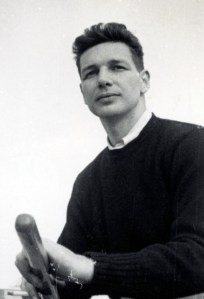
vietnam106a

Action Shot

Wells clearly lived an incredible life with years of selfless service to a cause he was raised to become an advocate for.  His name is intertwined with every major US refugee resettlement and advocacy program. NGO and governmental groups such as American Council for Nationalities Services, International Social Service, Immigration and Refugee Services of America, U.S. Committee for Refugees and many others were directly impacted by Wells’ hand.

Another Los Angeles Times article tells of his work in the 1980s:

In 1980 Klein led the resettlement community in welcoming and assisting the 125,000 immigrants Fidel Castro sent in a chaotic sea migration to the U.S. from Cuban prisons and mental hospitals. Rejected by their countrymen in South Florida, where they landed, the Mariel boat lift refugees “tested the bedrock values of the refugee program,” said Limon, who at the time worked for Klein at the American Council for Nationalities Service.
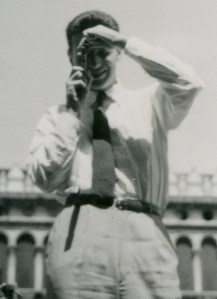
vietnam085a

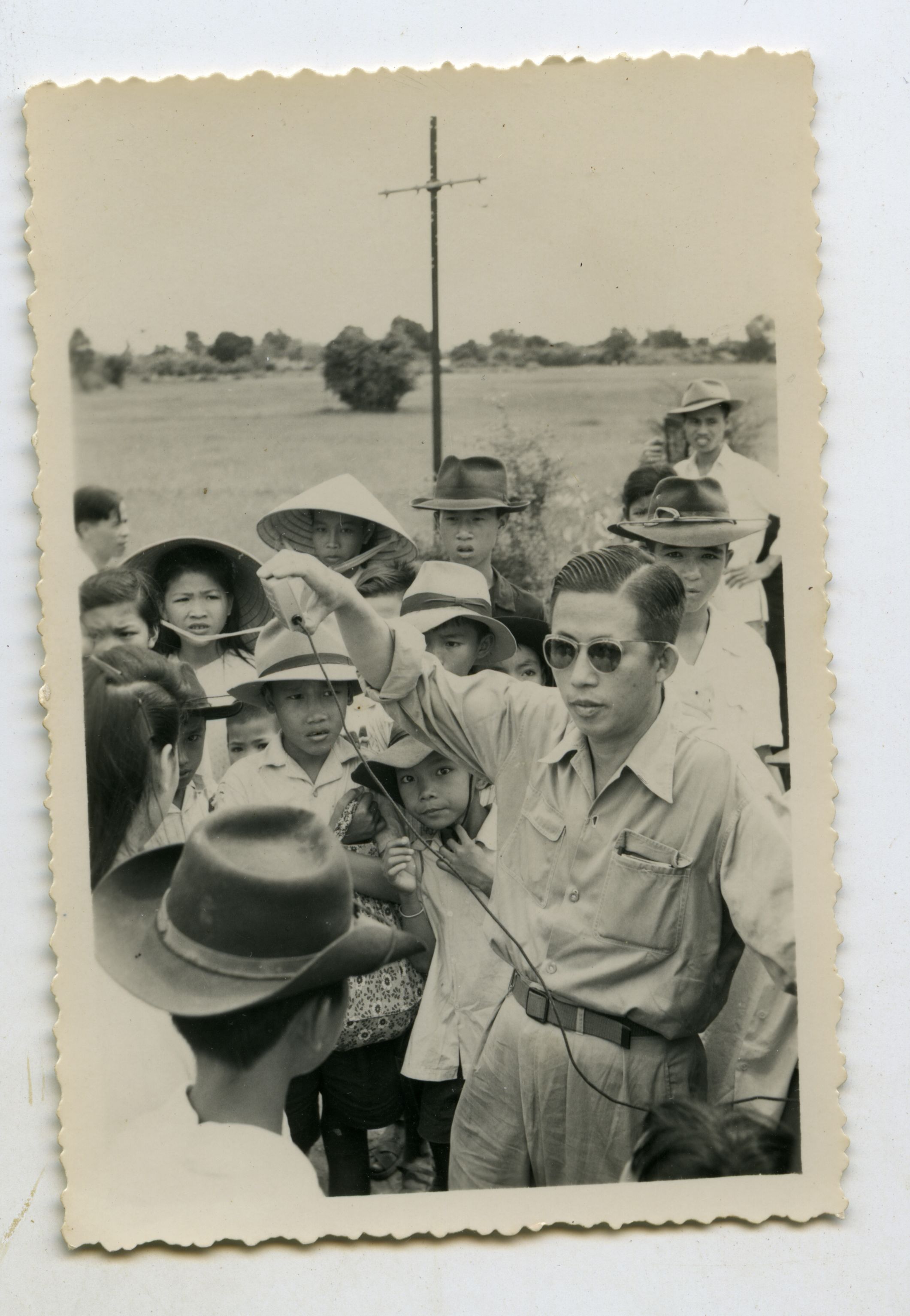
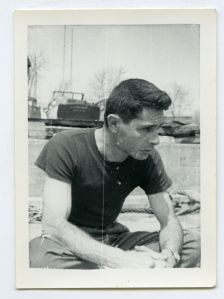
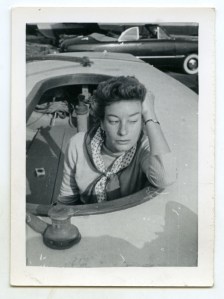
His photographic style hints to his study of Anthropology in college; his role as a participant observer in regions such as Yugoslavia and Vietnam clearly reflect his early training and academic encounters.  Sadly, his bag of photography seems to end with his trip to Vietnam.  Photos with friends and peers are unidentified, and capture the fun-loving reveries of a 30-something in the prime of his life. Please see below for a small selection of scans from “the bag”.

Vietnam ca. 1955

vietnam078.jpg

Vietnamese CARE Package Label

vietnam082

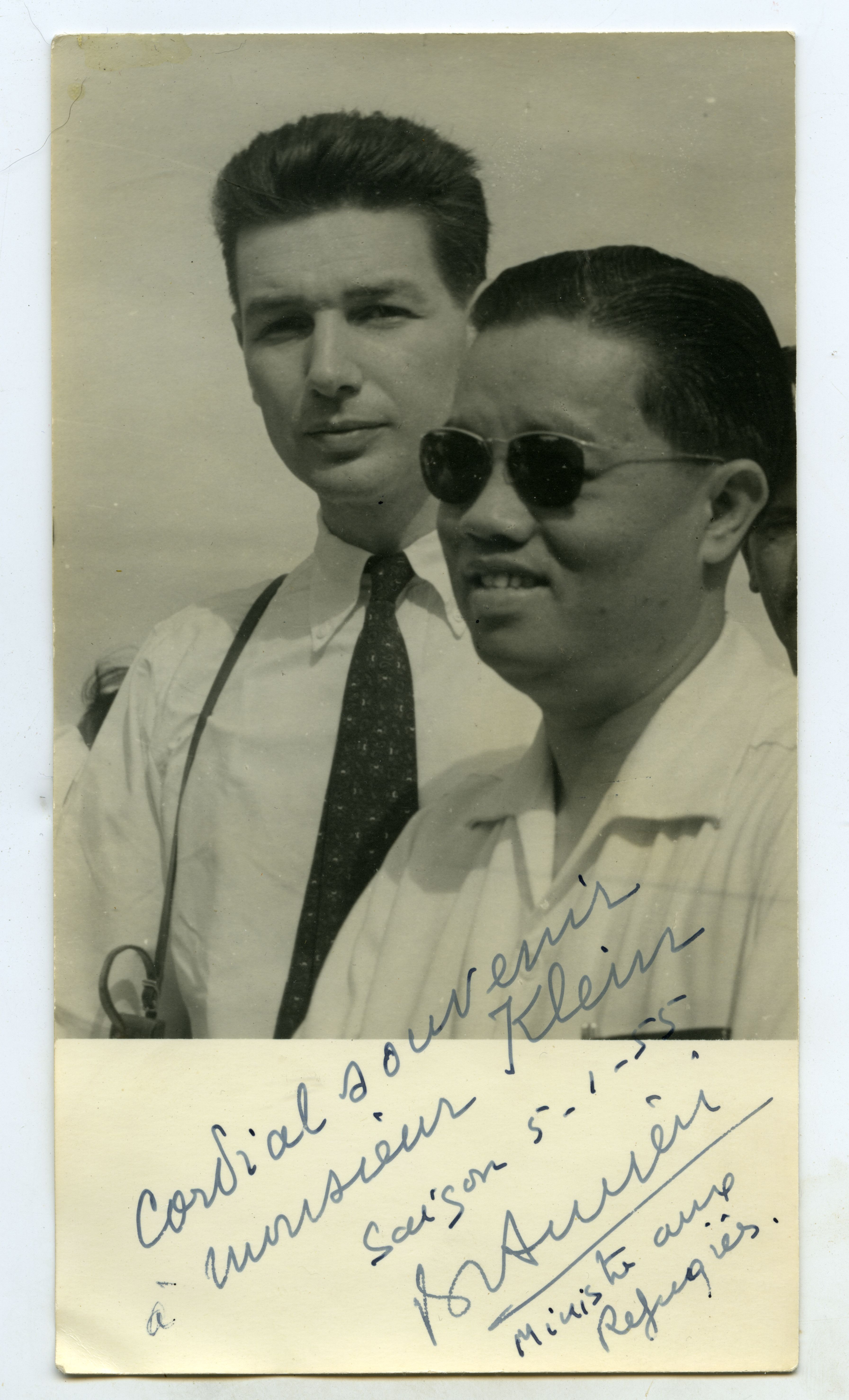
Signed Photo of Wells and the Vietnamese Refugee Minister
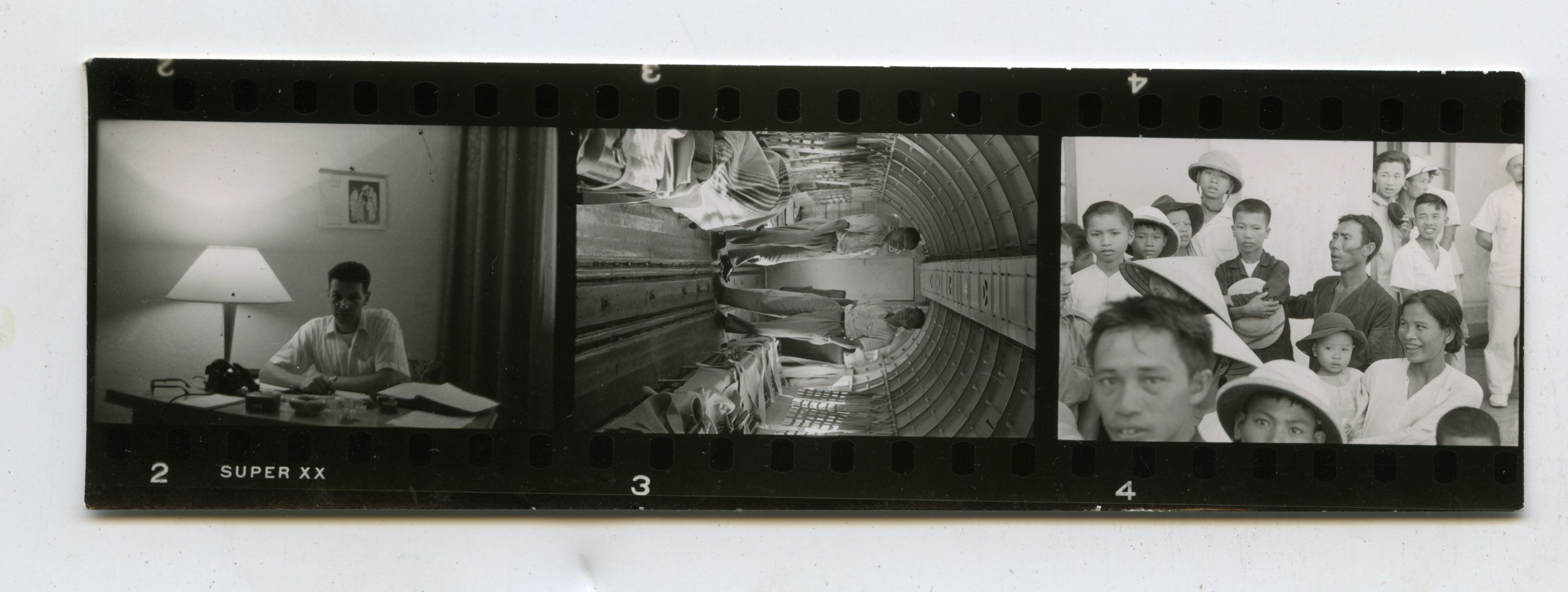
kleinscan009

vietnam076

vietnam077.jpg

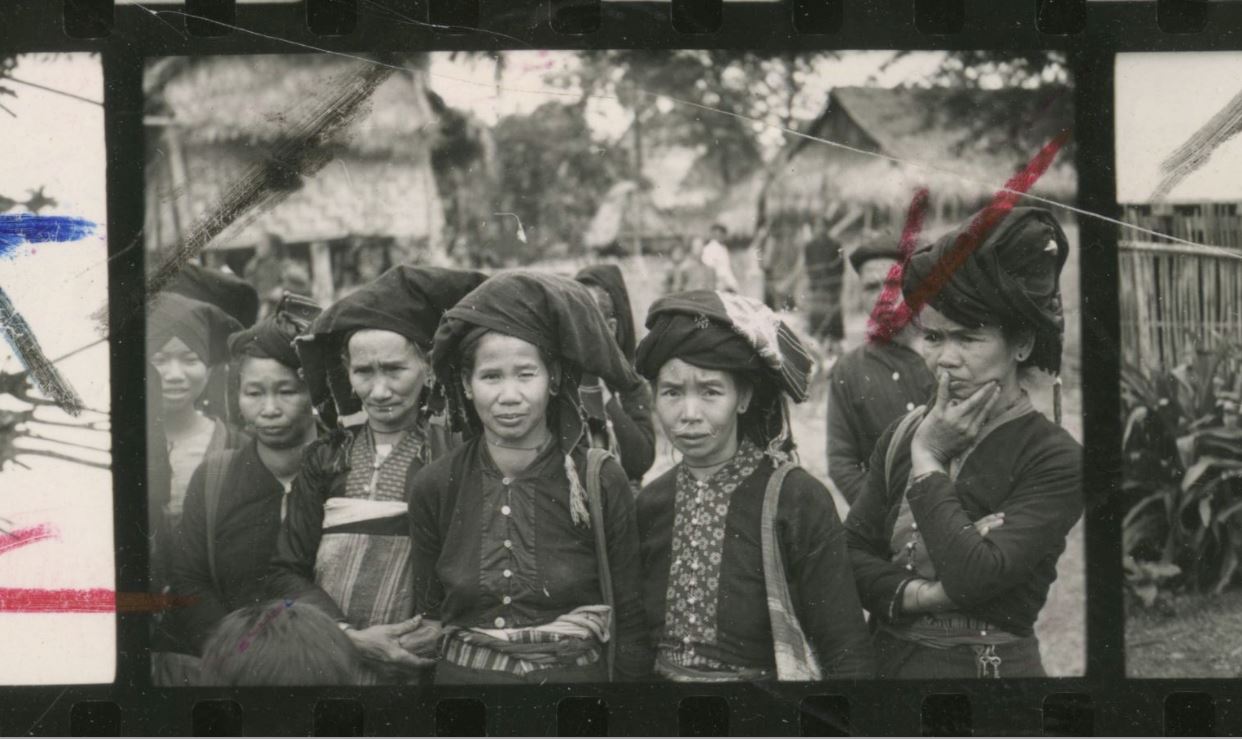
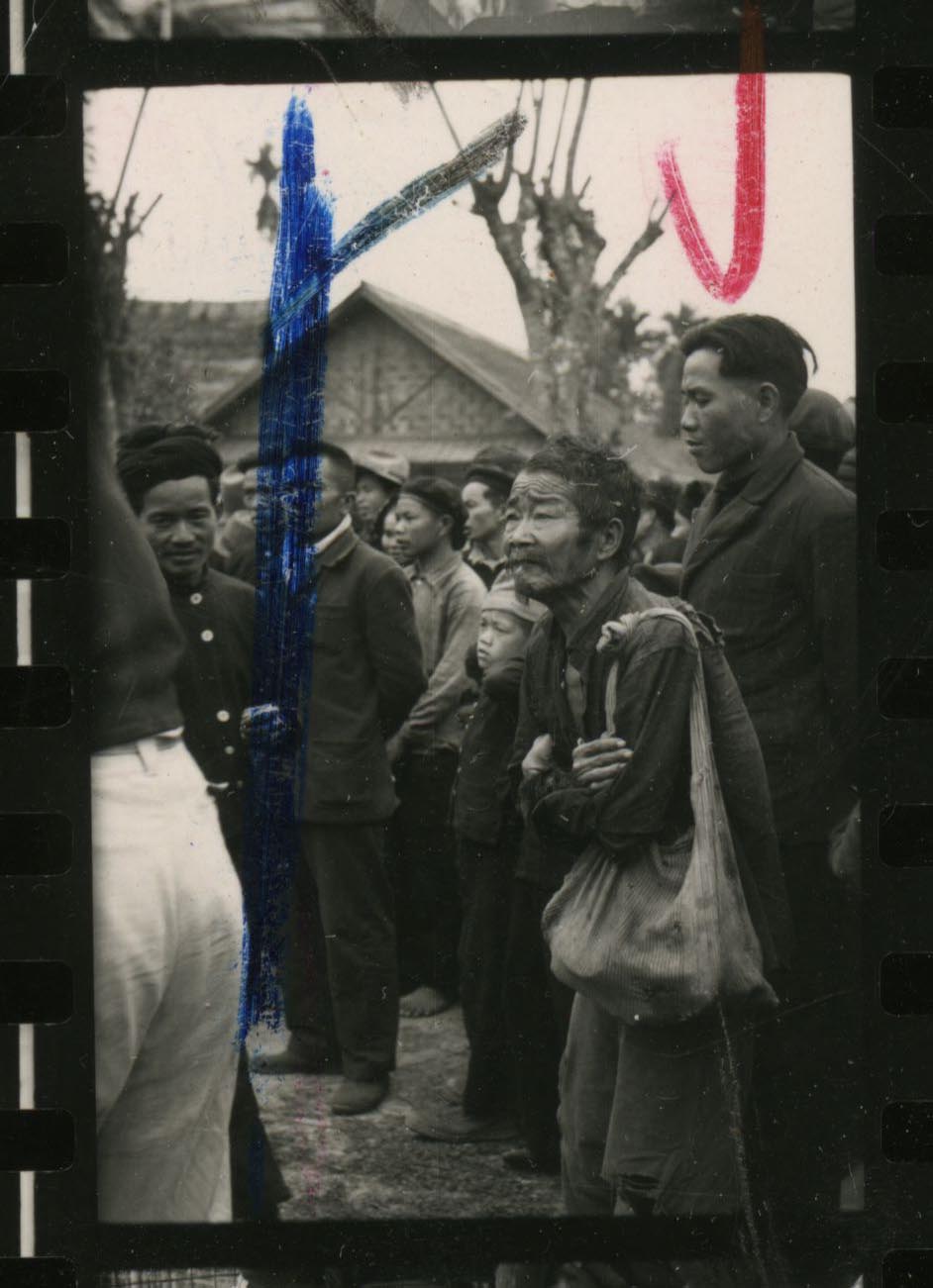
Crops from Contact Sheets

clip1

snap2

vietnam077c

vietnam076a

vietnam077b

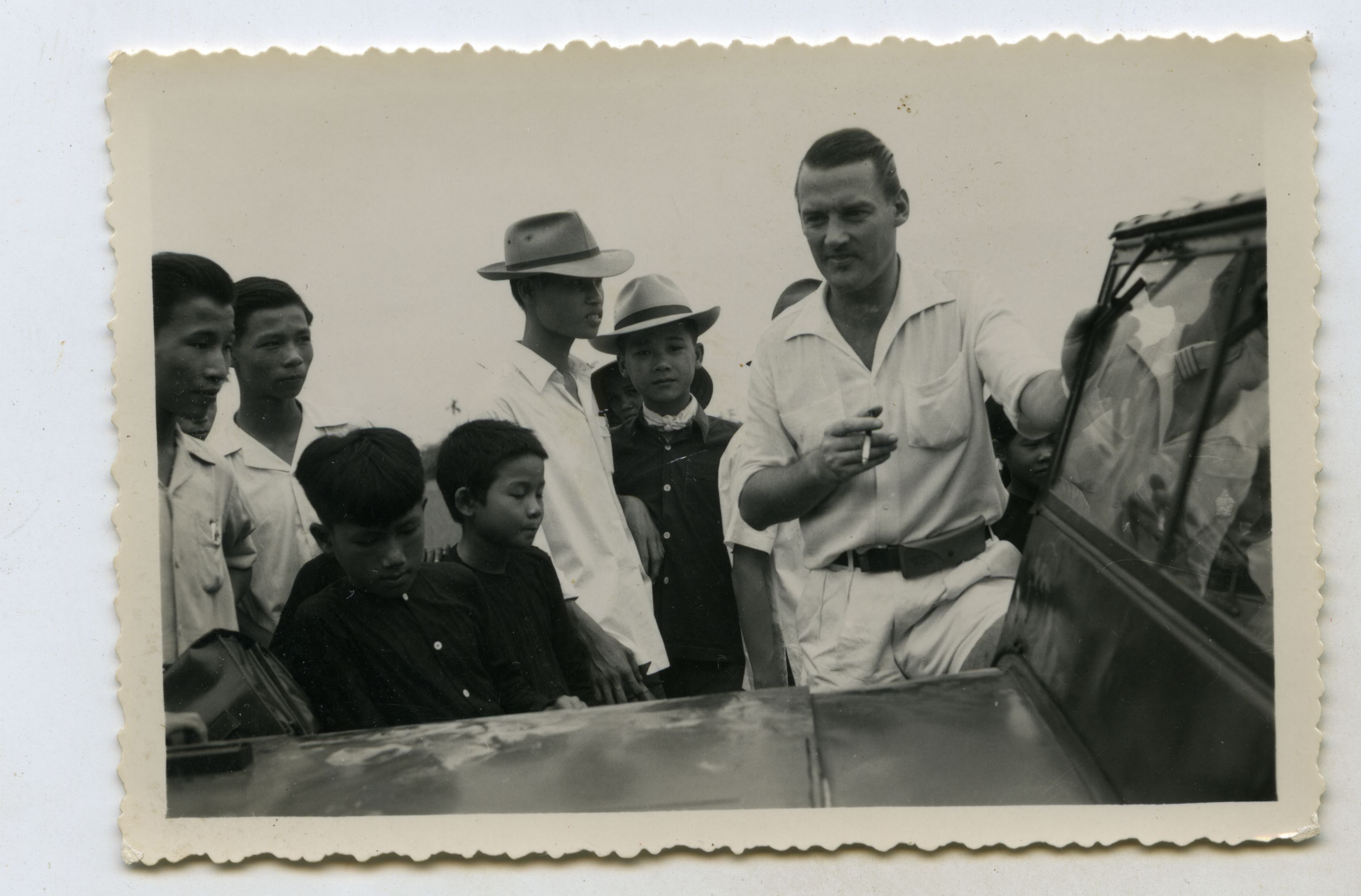
Larger Format Photos from Vietnam

kleinscan015

kleinscan006.jpg

kleinscan008

kleinscan017.jpg

kleinscan004

kleinscan018

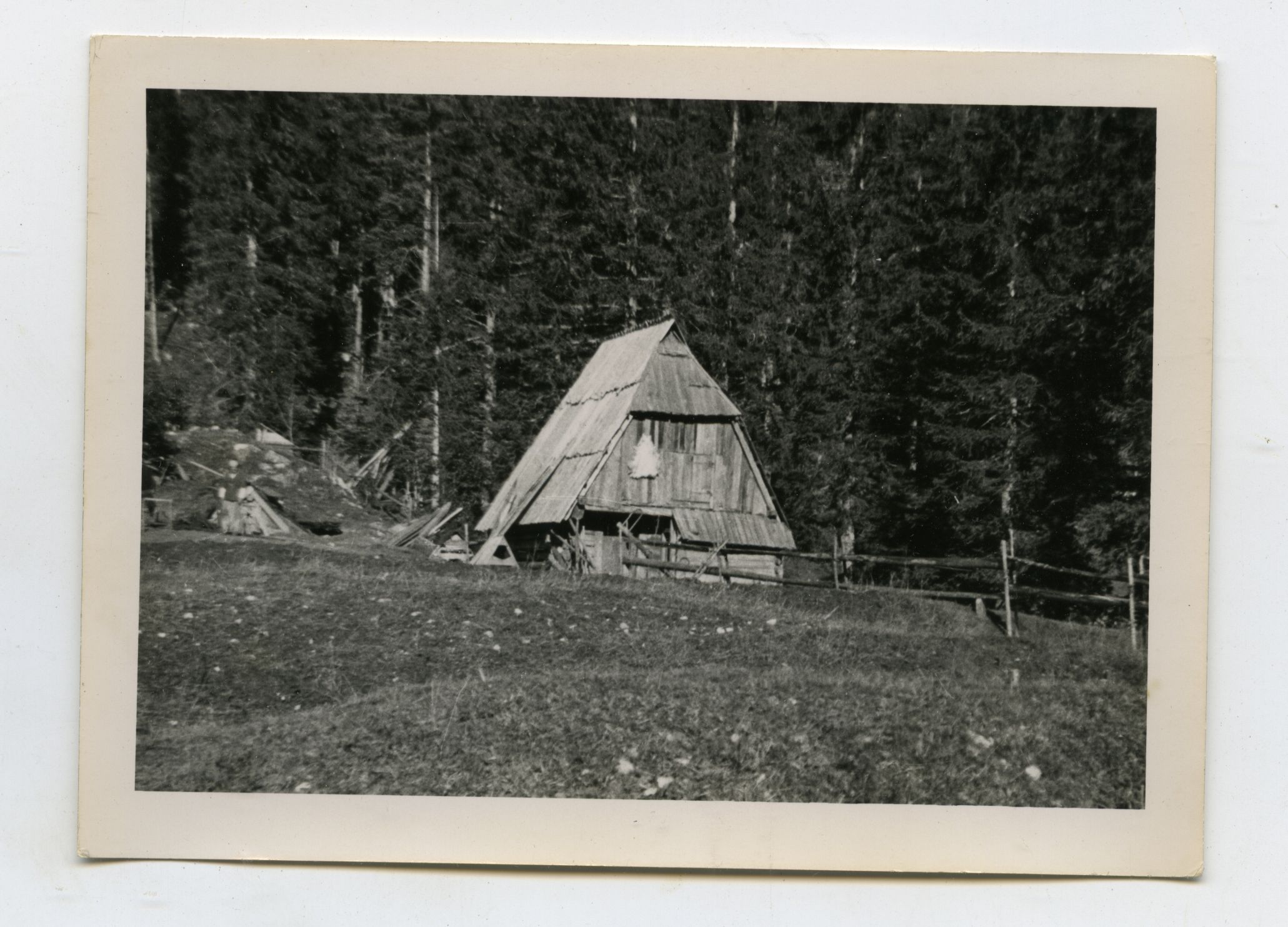
Yugoslavia ca. 1953

vietnam109

vietnam108

Letter from the Yugoslavian People to President Eisenhower
yugo003

yugo004.jpg

yugo006

Stateside Fun w/ Friends

vietnam087

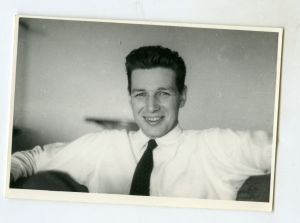
Formal Portrait Photo

I hope you’ve enjoyed this post.  To think…. this little bag of photos was very likely close to being tossed away in a soggy dumpster….. I’m glad I trecked out to Waterbury last year!

Famous Bougainville Signal Corps Photo Unraveled – 754th Tank Battalion


From time to time, a certain photo in my collection will call to me from beneath a dusty pile of books and other ephemera; pulling me away from other nocturnal pursuits, I will spend hours slipping down the rabbit hole of internet research.  In tonight’s post I dissect an image I picked up in a large photo grouping from an unidentified Pacific Theater of Operations U.S Army soldier whose estate was broken up on eBay.

nimitz099edited

This photo has taken me months to research, with new avenues of potential insight popping up at every twist and turn.  “My” version of the photo includes the portions of the negative’s border which, once deciphered, indicate the photographic unit responsible for the image.  These borders are typically not present on post-war copies of the photo, so this points towards a wartime first-generation version of the photo likely printed overseas. Additionally, later prints of the photo include inclusions and negative abrasions not present in earlier versions.

patch

What does the negative bar tell us?  For one, it gives us the number of the photographic unit responsible for the image.  The first number corresponds to the ID # for the 161st Signal Photographic Company. The 161st, as anticipated, shot still and moving images in the Pacific in WWII, working in tough weather conditions not conducive to normal photographic processing.  Through my exhaustive research, I’ve uncovered additional information about the photo not commonly known on the internet.


Commonly ascribed to Guadalcanal, New Guinea and other remote locations, the photo was actually taken in April (hence the 4-44 label on the negative) of 1944 on Bougainville Island, Papua New Guinea during the Bougainville Campaign.  Again, commonly ascribed to a Marine unit, the soldiers in the photo are actually of the Company F, 129th Infantry Regiment of the 37th Infantry Division.

insignia

Insignia of the 161st Photo Co.


The details of the photo are crisp, clear and perfectly printed with little great use of light, shadows and other atmospheric conditions in the heat of battle.  Bayonets affixed, the solders are scrambling for cover, firing and advancing behind a Sherman tank of the 754th Tank Battalion as it progresses forward through the dense jungle.  The tank at the forefront of the shot is “Lucky Legs II”, clearly a later iteration of a previously destroyed or abandoned armored vehicle. Tank and plane names were commonly derived from hometown sweethearts, pinup magazine, popular songs and movies, or unique creations.

nimitz099editedclip

Notice the play of light….

What isn’t immediately clear is the reason why the star is only partially visible on the turret. Using the power of the internet, I was able to track down a military forum with some information to help……

nimitz099editedclipa

Lucky Legs II in action (note star)

Apparently, the tanks were covered in oiled tar to protect from rust during overseas transport.  This includes the stars, which, in this case, was still partially covered in goop during the first counterattack after receiving the M4 mediums in March of 1944.  The above forum post provides a delicious detail, one that would be almost impossible to posit, without the help of a guy who “was there.”

754th TB ($75)

754th Tank Battalion Patch


According to research, tanks of this new delivery were equipped with armor plate protecting the driver from shots off the starboard and port sides of the tank.  This raised area was used by tankers of the 754th to paint the tank moniker.  Another example from the same group includes the “Wild Boar.”


Further distinguising insignia found on the tank include the 3 within a triangle, denoting that the tank was the Platoon Sergeant’s tank; the II adjacent to the triangle in the photo likely indicate that the tank is of the Second Platoon.

nimitz099editedclipab.jpg

Rear Painted Details

So, we have a tank commanded by the Platoon Sergeant of the 2nd Platoon of a an unknown company of the 754th Tank Battalion.  I can narrow this down only a bit more, but future research and reader commentary should elucidate some of the murky details.

754thtanker

Back to the previous image of the internet post regarding an angry response by a tanker who fought in Lucky Legs II:

“I said just from the inside of that turret.  That’s my tank, and probably my steel helmet hanging on the back. Because Tony Benardo, and Gus, had theirs inside with them.. I think.”

The same forum post refers to a US Signal Corps film that depicts the tank in question….. I think I found it…..

And if that wasn’t enough… I found more shots from the same photographic series


sedond


WWII Amateur Photo Discovery – Concentration Camp Family Photo Captured by US Soldier


Photo Background

From time to time new information comes along to help identify photographs from my collection.  In this case, I stumbled across an image during research into the liberation of Nordhausen (Mittelbau-Dora) concentration camp.  The image in my collection (seen below) was originally misidentified as having been taken at Dachau, but I just recently learned that it was actually taken at Nordhausen (Mittelbau-Dora) and captures a moment that US Signal Corps photographs also snapped at different angles.  According to information I’ve picked up in the past few days, the young boy was named Michael Kallaur and the father is Walter; both men buried the boy’s grandmother (Walter’s mother) after finding her body in the unfortunate lineup at Nordhausen.  Elizabeth Kallaur was killed at the camp only a few days before the liberation.

According to information at the United States Holocaust Memorial Museum, the Kallaur family was sent to Nordhausen as punishment for helping Jews in the Pinsk region.  The coat seen covering Mrs. Kallaur was given to Michael by John Florea, the Signal Corps photographer. Walter and Michael would not allow German citizens to touch the body of Elizabeth, and she was the first to be buried (at a deeper level) in the first burial trench.

KZ154

A Moment of Sorrow at Nordhausen (photo purchased from eBay that launched this post)

KZ154bcd

Walter holding Elizabeth’s legs


KZ154b

Michael watches on (note wounded hands)


Extensive Research

After hours of internet research, I came across the following Signal Corps photo and instantly recognized the boy….

michaelwalter

Walter and Michael looking over Elizabeth (Walter’s mother)

nord01as

A lesser quality image

This is the info attached to the image: (Click link for source)

Figure 1.–Here a Polish boy weeps over his grandfather’s body at Nordhausen after it was liberated by the Americans. It was dated April 21, 1945. That may have been when the photographed was released rather than taken. The press caption read, “Weep for the dead: A Polish boy weeps bitterly after he and a man at left buried (the) youngster’s grandmother who had died while a political prisoner of the Nazis in concentration camp at Nordhausen. Germans in the town were ordered to dig graves and bury the 2,500 dead, unburied prisoners found there by occupying American forces. The Polish boy refused to let the Germans touch his grandmother and insisted he bury her himself. Yanks look on in quiet sympathy.” We doubt if his grandmother was a political prisoner, but like the boy a slave laborer at Dora. He probably searched for her after the camps were liberated. Notice the German civilians at the right.

LIFe

Walter and Michael by John Florea, 1945

grave

An open burial spot (note the depth of Elizabeth’s burial)

And another series of Signal Corps photos showing the burial:

A Polish boy and his father bury the body of the boy's grandmother, who died in the Nordhausen c

A Polish man, Walter Kallaur and his son, Michael, bury the boy's grandmother

Walter and Michael Kallaur

A Polish boy, Michael Kallaur, weeps while helping his father bury the body of his grandmother

life_183

florea_john_1396_2005_crop_450558_displaysize

Walter buries his mother – note the shallow nature of the other bodies vs. the above image for Elizabeth

German civilians from the town of Nordhausen bury the bodies of former prisoners

A view past Elizabeth’s burial spot

burial

Walter continues to fill the grave

American soldiers walk along an open, mass grave prepared by the German residents of the town of

Walter and Michael at a distance

The boy, Michael,  traveled to the United States after the war ended.  Using the information in the image as a jumping off point, I was able to find some immigration travel information:

Michael Kallaur Arrival

1949 Border Crossing

The information on the card all matches up.  As seen in the previous images, he had a visibly wounded left hand; the card confirms this and the fact that his place of birth was Pinsk, Poland.  At the time of his arrival in the US at Niagara Falls, he was 18, putting his birth year at 1931.  The Signal Corps photographer noted his age in 1945 at 14, which matches up with the immigration card.  A website dedicated to the Kallaur family tree referenced a Walter Kallaur arriving in the Niagara region after the war; this jives with both the Signal Corps caption and the fact that Walter is referenced in the above 1949 border crossing documents.  He arrived in Quebec in April of 1948 on board the MV Beaverbrae (listed as the SS Beaven Bren in the document, a ship that eventually transported over 30,000 European refugees to Canada between 1947 and 1954.

Sadly, it appears that Michael passed away in Decemeber of 2000, so my hopes of reuniting this photo with him has been dashed.  His SSN confirms that he lived in Pennsylvania and was issued his card in 1955, six years after his entry into the US.

death

Social Security Death Index (he lied about his DOB)


Living Family Identified

My internet sleuthing tends to be obsessive at times, and I’m fairly certain with the following deduction.   I will leave out the details of the research in respect for the Kallaur family; some things are best left unsaid.

From what I can deduce, Michael married Eileen Gallagher at some point in the 1960s. Eileen was born in 1944, and was only five years old when Michael came to the US in 1949.  Ancestry.com doesn’t provide marriage records for the couple, but I’m basing my marriage dates in accordance with the birth of their forthcoming children.

My hopes are that a family member will google themselves, or possibly have a Google Alert set…….. All are originally from the Philadelphia, PA area.


Michael Kaullaur – 1931-2000

Eileen C. Kallaur – 1944 – LIVING

John Kallaur

Robert Kallaur

Christopher Kallaur

Walter Kallaur


Image Details:  Nordhausen Outdoor Generator

The major defining landscape feature of my eBay image is the presence of an outdoor generator.  This can be seen here:

genny

Generator? Most photos were taken on the opposite side


generator

Generator? from the other direction

HOT ON THE TRAIL OF THE FAMILY

APRIL 27th, 2013 POST BELOW

Casual followers of this blog will know that I never post photos of death or destruction.  My main goal is to present historic photography in a way to help educate internet followers about the world of war.  In this case I will post a photo that may be hard for some viewers to see.  I have hundreds of photos of concentration camps in my collection, yet have never been moved to post any of the photos to the web.

This image called to me.  The composition, the subject, the setting.  It’s all there.  A soldier snaps a shot at Dachau of a man holding the feet of his dead wife while his injured son watches on.  A procession of 3rd Armor Division soldiers file by as this tragic event unfolds; the event captured through the lens of an unknown soldier of an unknown family.  This scene was likely replicated tens of thousands of times at the tail end of the war.

KZ154a

KZ154b

KZ154bcKZ154bcd

KZ154