Meet Punkins – The Mixed-Breed Bull Terrier and Official Mascot of the 27th Engineer Regiment in WWI


After taking a break from writing, I’m excited to finally share some of the fascinating WWI photos and research I’ve uncovered over the past few years, little hidden gems I’ve been eager to bring to light on this little corner of the internet. In this quick post you will meet Punkins, the official mascot of Company C of the 27th Engineer Regiment. Photographs of unit mascots during WWI are not exceedingly rare, but studio portraits of an identified mascot/dog are nearly impossible to find. Most, if they exist, were kept in personal albums or letter collections and discarded or forgotten about over the past 100+ years, but this shot of Punkins somehow emerged on eBay several years ago.
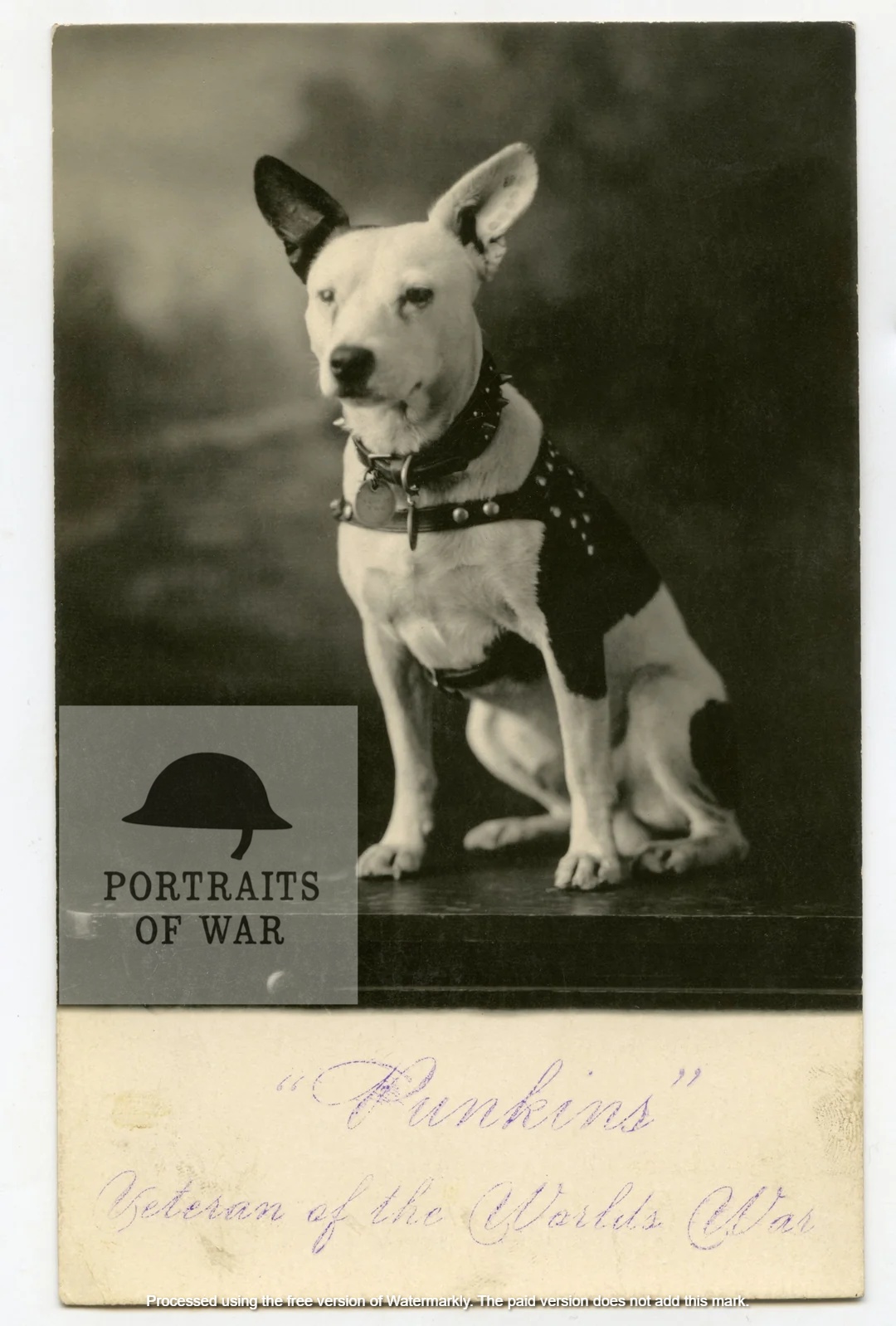
Punkins Posed for the Camera!

Sporting a studded leather collar and matching riveted harness, Punkins seems like a quite the bruiser, a fitting mascot for an engineering regiment during WWI. With just the image and brief stamped caption below (the stamping hints at a volumed production of photo postcards for veterans after the return home), it seemed a difficult task to identify the sitter based on contextual clues such as insignia or other identifying material. Although the postcard backstamp suggests a stateside printing of the postcard, I’m guessing the original photograph was taken in France or Germany and replicated stateside for dispersal to fellow soldiers who wanted photographs to remember their wartime experiences.

Luckily, I did some deep diving and discovered a digitized version of a unit history of the 27th Engineer Regiment that included a brief caption mentioning a ‘Punkins’ below a photograph of our mystery sitter with one of his wartime friends.

“Punkins” and PFC William H. Hall of Santa Clara, CA.

Punkins has now been identified as the regimental mascot of the 27th Engineer Regiment! Note that he is sporting a custom coat with markings and insignia showing he was a member of Company C. of the 27th Engineer Regiment with the First Army. His downward pointing chevron on the right means he served at least six months with the unit. Based on the background contextual clues in the unit history photo, this shot appears to have been taken aboard a return vessel from France to the USA in March of 1919. Private First Class William H. Hall of Santa Clara, CA was aboard the USS Dakotan, a US military transport ship that served in both WWI for the US and later in WWII for the Russians starting in 1942.
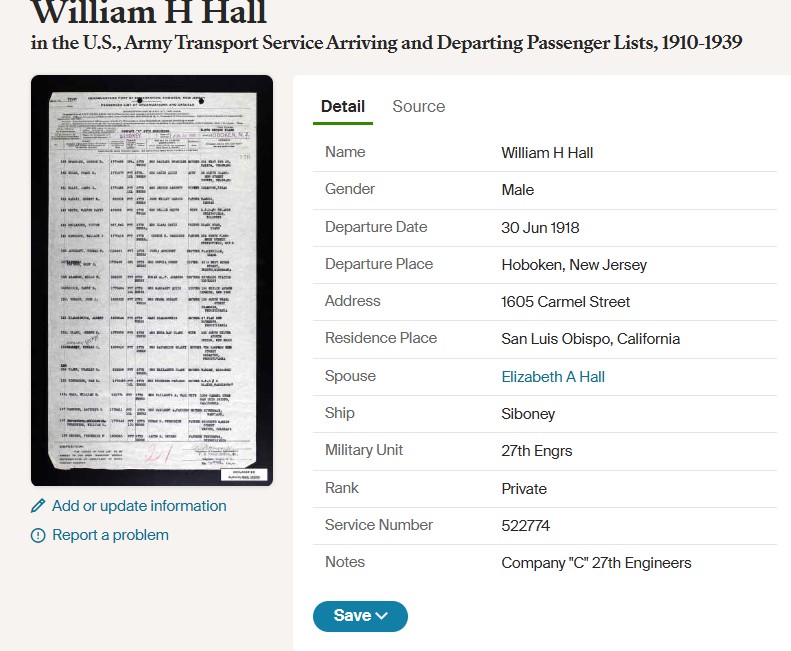
Pvt. William Hall heads to France in June of 1918

It’s unclear and likely impossible to know the circumstances of Punkins’ adoption by the 27th Engineer Regiment in WWI, but based on the visual info provided in the unit history, it’s likely that they were adopted at least three months before departure from France in March of 1919 which points towards an adoption date of August or September of 1918 while the unit was serving in Germany at the time. Punkins appears to be a Bull Terrier mix of some sort based on the pointed ears, coloring and general boxy frame. If anyone knows anything else about Punkins please reach out and share.

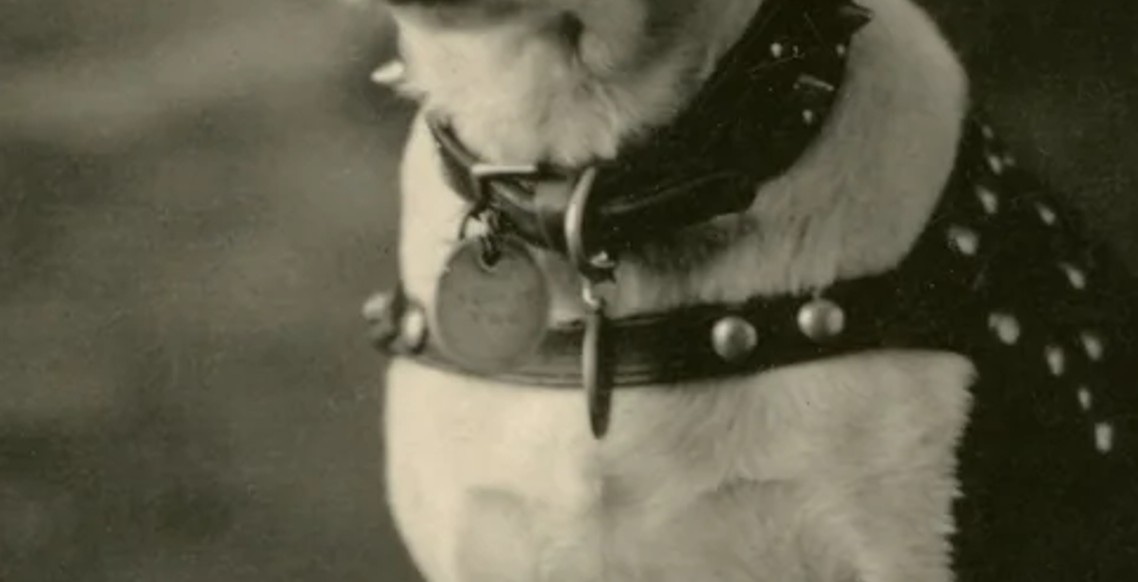
One last note – Punkins appears to be wearing an actual WWI US dog tag. Dog tags used by the US Army and Marines were primarily aluminum discs that could be hand punched with pertinent information bearing the owners name, unit, serial number and sometimes other personal touches. It looks like Punkins received a set of his own tags although the details are obscured. Note that the ridges on the left tag hole hints that they’ve been worn long enough to encounter some wear and tear. The circular tag to the right doesn’t seem to be a proverbial dog tag but some sort of other identifier or an actual DOG tag.
November, 2025 Update

It appears that Punkins sat for several photographs during his illustrious career as a mascot. Another eBay listing appeared a month or so ago (I didn’t win) that provided a bit more information about our sitter. Amazingly, we now know the birthdate, birthplace and wartime career of Punkins to a level of detail I never thought I would learn. See below for a transcription of the caption from the eBay postcard.

Nov. 2, 2025 Ended Listing for Another Punkins Postcard!

Punkins was born Dec. 30, 1917, in Baltimore, was mascot of Co. C., 27th Eng., was smuggled across on a transport in a suit case, thru the worst of the submarine zone, landed in France May 18, 1918. He spent nine months in the front line trenches, went over the top three times at the battles of Chateau Thierry, Argonne and St. Mihiel. He was gassed Sept. 28, 1918, in the Argonne. Punkins is the only dog that ever received an honorable discharge from the U.S. Army. He received a Medal of Honor from the French Government at Verdun, also wears the U.S. Victory button. Here’s to the Good Old U.S.A. – Punkins

Punkins’ “Other Portrait”

This secondary portrait of Punkins provides a very similar view but shows a few more details that “my” version does not include. Now, we can see a little more detail to the dog tag/medal attached to his collar.

The tag that I had originally assumed was some sort of identifier appears to have a castle at center which may be a 27th Engineers commemorative medal given out to members of that unit. See below (top left) for a possible match from the US Army Engineering collection website. (Image 16 in the first slideshow)

Possible Match to Punkins’ Medal

A Scottish Terrier Goes to War: 744th Light Tank Battalion’s Mascot Dog BLACKOUT


Followers of PortraitofWar will likely remember that I have a penchant for stories related to unit and individual mascots during wartime. I have a soft spot for small dogs and particularly enjoy tracking down photos of dogs acting as needed companions during the boredom and contrasting hellish days of war.  Cats are cool too……. I guess….

a9b5ea71b1367b23c570ba10be7acdef

Tonight’s post was submitted by a WWII buff I tracked down online who was generous enough to share the incredibly endearing story of his father’s WWII mascot who eventually made it stateside to live an additional thirteen years as the family pet until passing away in 1958.  The incredible story of Blackout takes us from a small town in England, to the shores of Normandy and across continental Europe as the German war machine is beaten into submission.  The following post was submitted by Rick Hunter:

paw-print-trail-clipart-kid

My father, Bill Hunter volunteered for the U.S. Army in 1940.  After training which included participation in the Louisiana maneuvers, he was assigned to the 744th Light Tank Battalion as initial cadre when it was formed at Camp Bowie, TX.  By January, 1944 he was a Master Sergeant in the service company of the 744th Light Tank Battalion, and the unit was in England training in preparation for D-Day.  Dad’s job was to supervise the maintenance of the Battalion’s vehicles and the recovery and repair of battle-damaged vehicles.  Light tank battalions were “separate battalions” that were typically attached to infantry units on an “as-needed” basis and as such they moved around a lot.  The service company was usually located somewhat to the rear of the front lines and Dad’s position gave him a bit of flexibility and was not as dangerous as those of many soldiers.  Perhaps for these reasons and his love of dogs, Dad bought a young female Scottie from a lady in nearby Manchester.  He named the dog Blackout.

Although against regulations, Blackout was apparently a hit within the unit and the leadership turned a blind-eye towards her.  She even received a coat crafted from an army blanket complete with sergeant’s stripes and the unit patch.  Blackout and my Dad went ashore with the Battalion at Utah Beach about 3 weeks after D-Day and the unit fought through France and Belgium and into the Netherlands.  They were camped near Geleen in the Netherlands for several weeks in October, 1944.

blackout-eto

Blackout in Geleen, Netherlands

The Dutch had been starved by the Germans and were in a desperate plight.  Attracted to Blackout, a 13 year-old boy and his 5 year-old sister from the town would make daily visits to see the dog.  My Dad began to give the children food and candy and made them some small wooden toys.  In 2008, my brother vacationed in the Netherlands and met those two children.  The girl, then in her 70’s, showed my brother those toys which she still treasured.

The tank battalion crossed into Germany in January, 1945.  They fought into Germany and participated in the post-war occupation of the town of Olpe before catching a crowded troop ship back to the U.S.  Dad was not about to leave Blackout behind and he smuggled her onto the troop ship.  Because there were many different units on the ship, it is difficult to imagine how he could have avoided detection, and in fact he did not.  Upon arrival in the U.S., the soldiers were subjected to a muster to verify all were present.  The officer in charge (not from my Dad’s unit) announced to the formation “Will the individual with the dog step forward?”  My Dad did not move.  The officer then said “Will the master sergeant with the dog step forward?”  My Dad did not move.  Finally the officer said “Do we have to call you by name?”  My Dad stepped forward.  The officer then announced “We just wanted you to know that we were aware of it all the time.”  Nothing more was said or done and over the next few weeks Dad and Blackout processed out of the Army and returned to civilian life in Tulsa.

744patch

Blackout’s jacket patch

My Dad had 4 brothers and all 5 boys served during World War II and returned safely.  Their mother was proud of her sons and displayed a Blue Star Mother banner with 5 stars in her front window.  The Tulsa World published an article about the family in late 1945 that included the attached picture of the boys with their mother and Blackout shortly after their return.

In the picture and starting from the right, the boy in civilian clothing served on a ship in the Pacific and refused to wear his Navy uniform after discharge.  Next is my Dad and the boy next to him was a navigator.  I believe he stayed in the States as an instructor.  Left of him is the youngest boy who had completed a pilot training program but I have little additional information.  The boy on the far left was in Iran and is wearing a Persian Gulf Command shoulder patch.

blackoutpicture

Hunter boys with Blackout, 1945


UPDATE! (5/1/2017)

As has become the norm here at PortraitsofWar, a family member of a WWII veteran has reached out with an additional photo related to the above post. Special thanks to Gail Becnel Boyd for contacting me to share this shot of Blackout that she found in her father’s WWII photo album. Thanks Gail!

blackoutasaPUO

Blackout as a puppy in England – On the back it says “Mascot of Service Co “Blackout“, England 1944”.


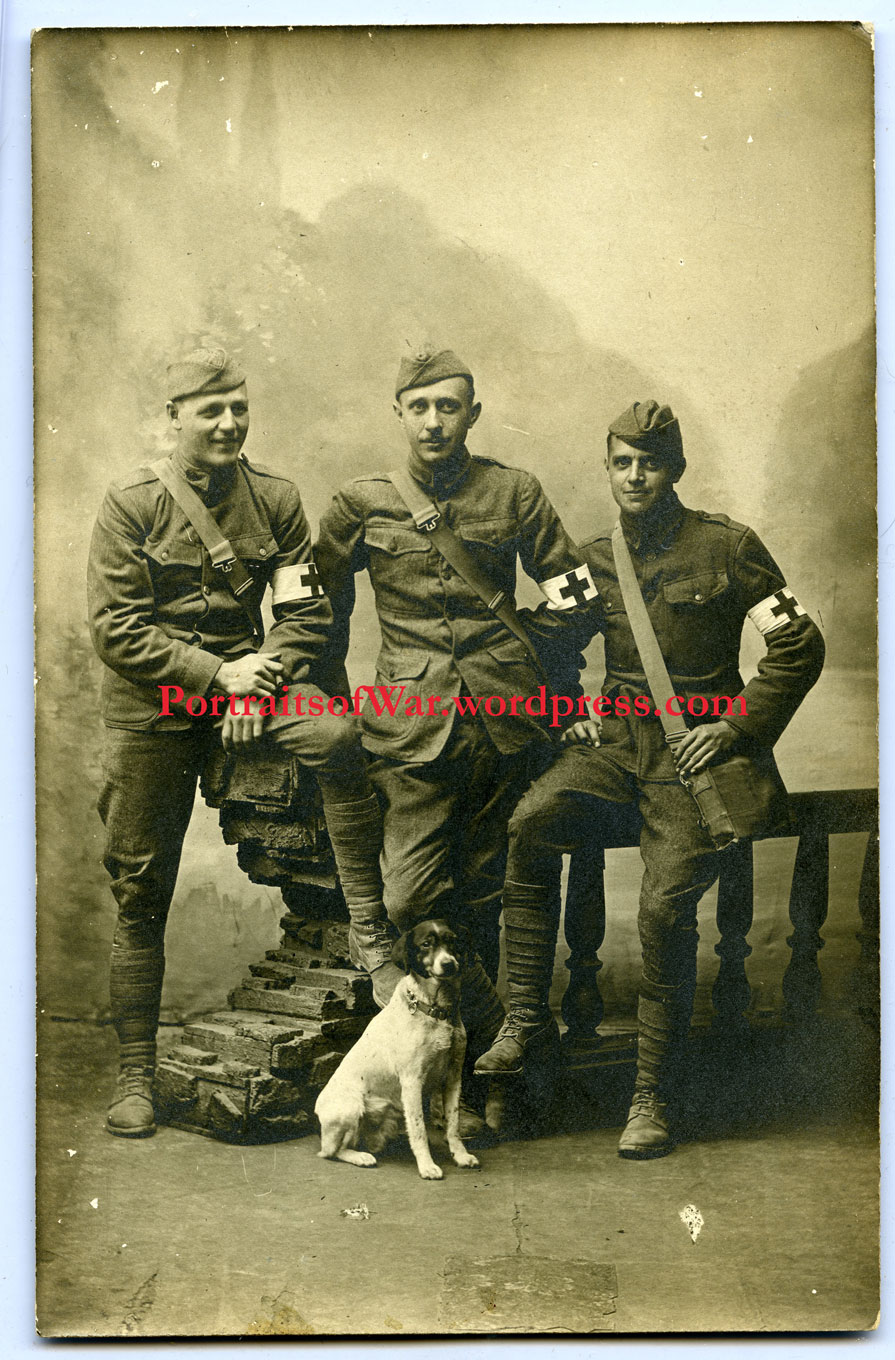
WWI Doughboy Medics Pose in France w/ Mascot Terrier


One of my favorite WWI photo tropes is the mascot dog pose.  This photo caught my eye due to the presence of the medics with visible red cross armbands but was further enhanced by a little Jack Russell Terrier mascot.  Taken in France in early 1918, this image is a wonderful representation of the lighthearted antics that kept front line medics sane during the horrors of WWI trench warfare.