The following article was graciously submitted by Sam Pestle. To see more stories of WWI soldiers with accompanying portrait photography, please check out Sam’s page – The United States in WW1 on Facebook.
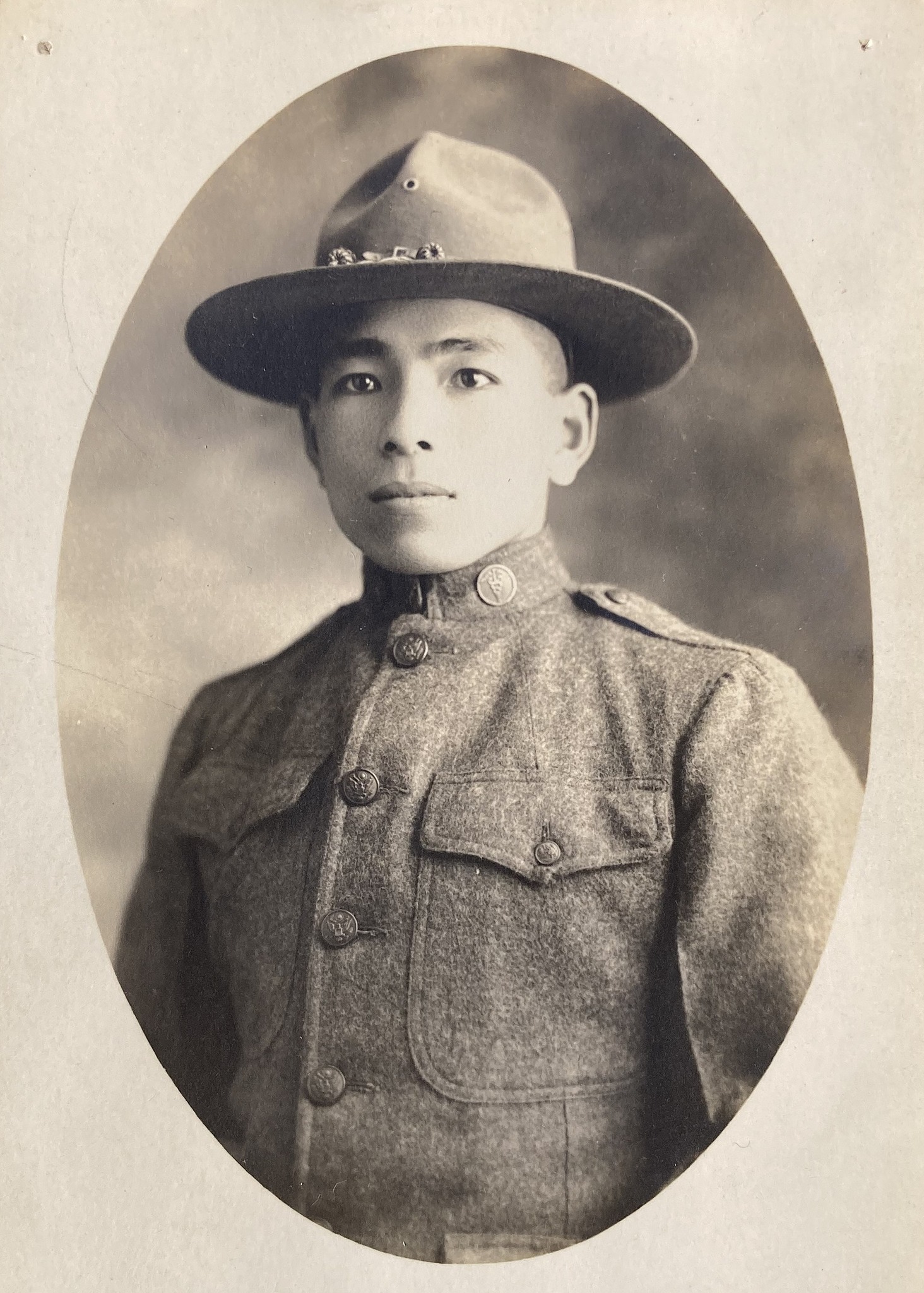
Albert Nobori Kawasaki WWI Studio Photograph
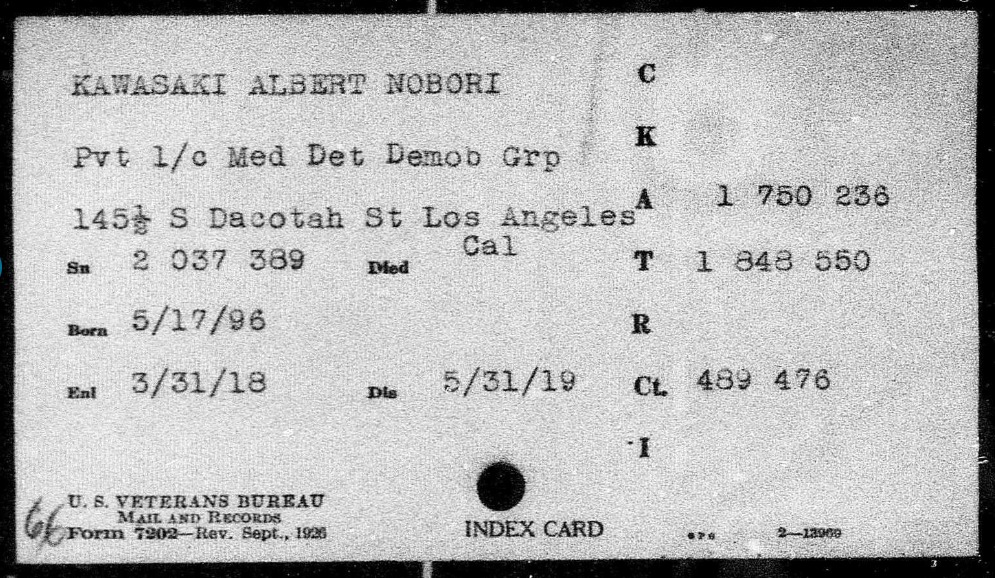
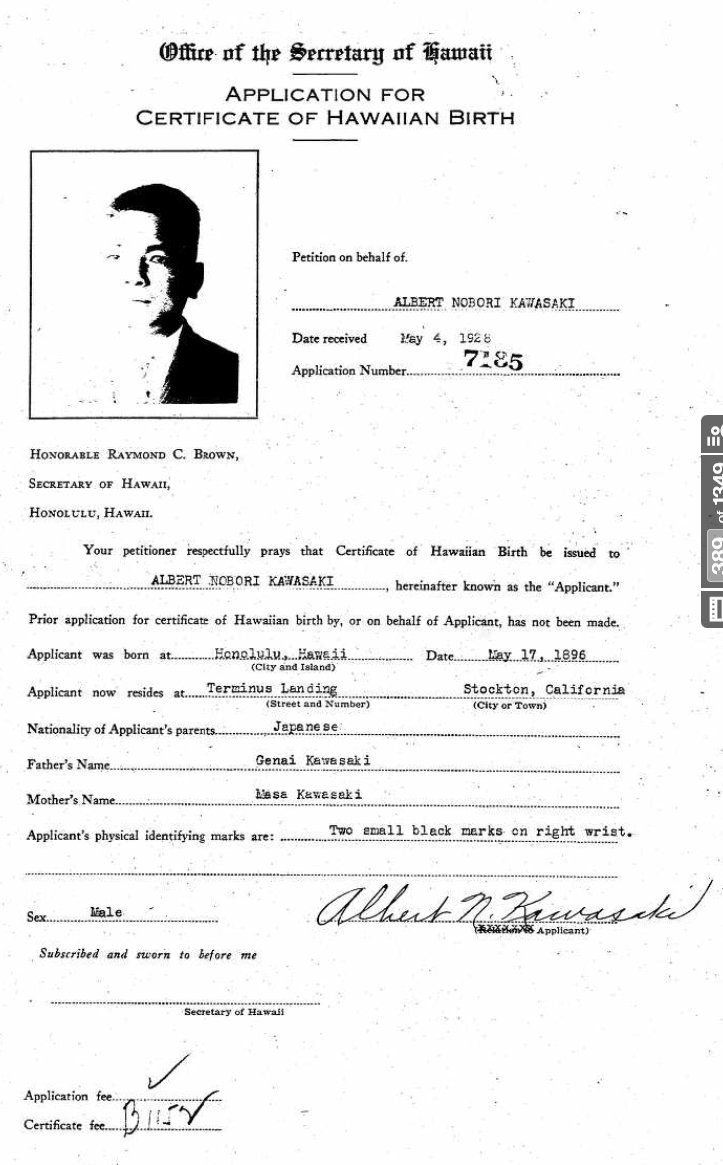
Albert Nobori Kawasaki was born in Honolulu, within the Republic of Hawaii, on May 17th, 1896. His parents were Japanese immigrants from the Hiroshima Prefecture, and government documents indicate that Albert spent six years in Japan attending school during his youth. He was bilingual in Japanese and English, and later moved to Sacramento, California (possibly in 1914). He was a student at the Sacramento High School during the 1917 draft registration and denied any deferments from military service. Albert was subsequently inducted into the US Army on March 31st, 1918, and was soon assigned as a Private First Class with the US Army Medical Corps.
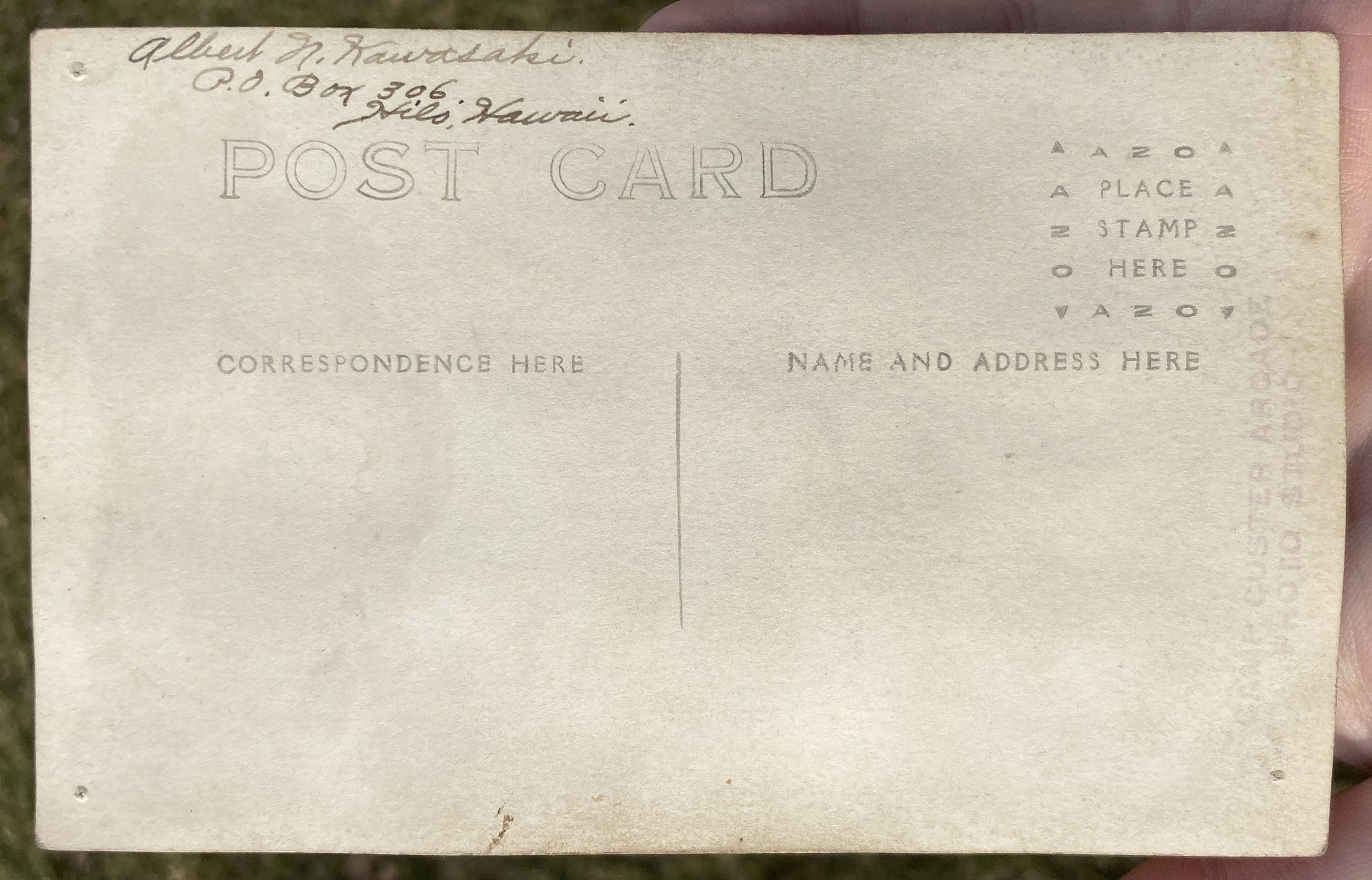
PFC Kawasaki was sent across the United States to Michigan and assigned to the Medical Detachment of the 160th Depot Brigade at Camp Custer. This photograph has a studio marking on the reverse that indicates that the image was taken at the Camp Custer photography studio. As a member of the medical corps, it seems likely that Albert was assigned to the base hospital throughout the final months of the First World War. An outbreak of Spanish Flu at the camp began in September of 1918 and left thousands of doughboys profoundly sick and requiring medical intervention. An estimated 674 soldiers died of influenza during this period, and it’s very likely that PFC Kawasaki regularly faced death throughout his military service (despite never traveling overseas for AEF service).
Reverse Side of Postcard Showing Kawasaki’s Name and Address
PFC Kawasaki received an honorable discharge from the army on May 31st, 1919, and his service number was 2037389. Albert subsequently sailed back to Hawaii aboard the SS Tenyo Maru in June of 1919, and I suspect he visited his aging parents in Hilo, HI. He returned to the United States four months afterward and continued his life in California. Albert was married in a Buddhist ceremony by Reverend Junjo Izumida on July 10th, 1922, and the couple soon had two sons born in 1925 and 1927.
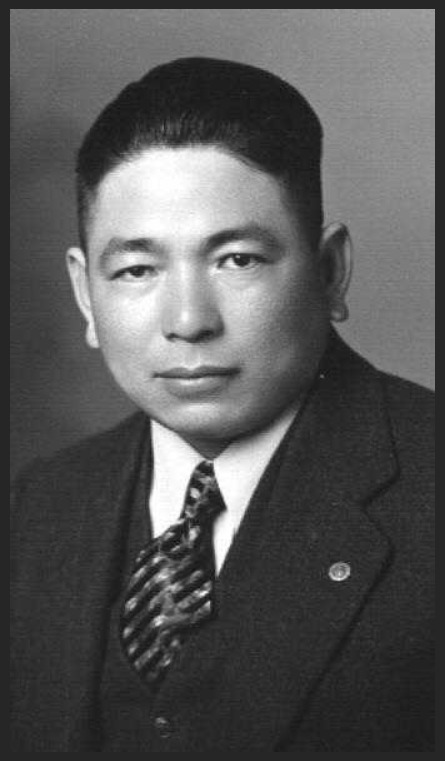
Beginning in 1923, Albert attended classes at the University of Southern California for three years but did not graduate with a degree. He later worked as a celery farmer, agricultural foreman, and farm manager. Albert was considered a local community leader and served as the President of the Japanese American Citizen League of Stockton, California. Unfortunately, Albert also faced multiple hardships throughout his lifetime, including filing for bankruptcy in 1928 and experiencing a divorce from his wife in April of 1942.
Kawasaki Later in Life
Just months following his divorce, Albert was notified that he would be among the 125,000 Japanese Americans interned by the Federal Government during the Second World War. Despite his American citizenship and honorable service within the US military, Albert was a victim of the national paranoia and racial prejudices following the Attack on Pearl Harbor. He was initially held at the Stockton Assembly Center but was later interned in Arkansas at the Rohwer Relocation Center between October 19th, 1942, to July 19th, 1943. He was among 8500 other internees at the Rohwer Camp during this period (including a young George Takei, later of Star Trek fame).
Following his release from the camp, Albert returned to California and died just four years later at the age of 51 years on June 13th, 1947. His remains were subsequently cremated and now rest in a niche at the Inglewood Park Cemetery of Inglewood, CA.
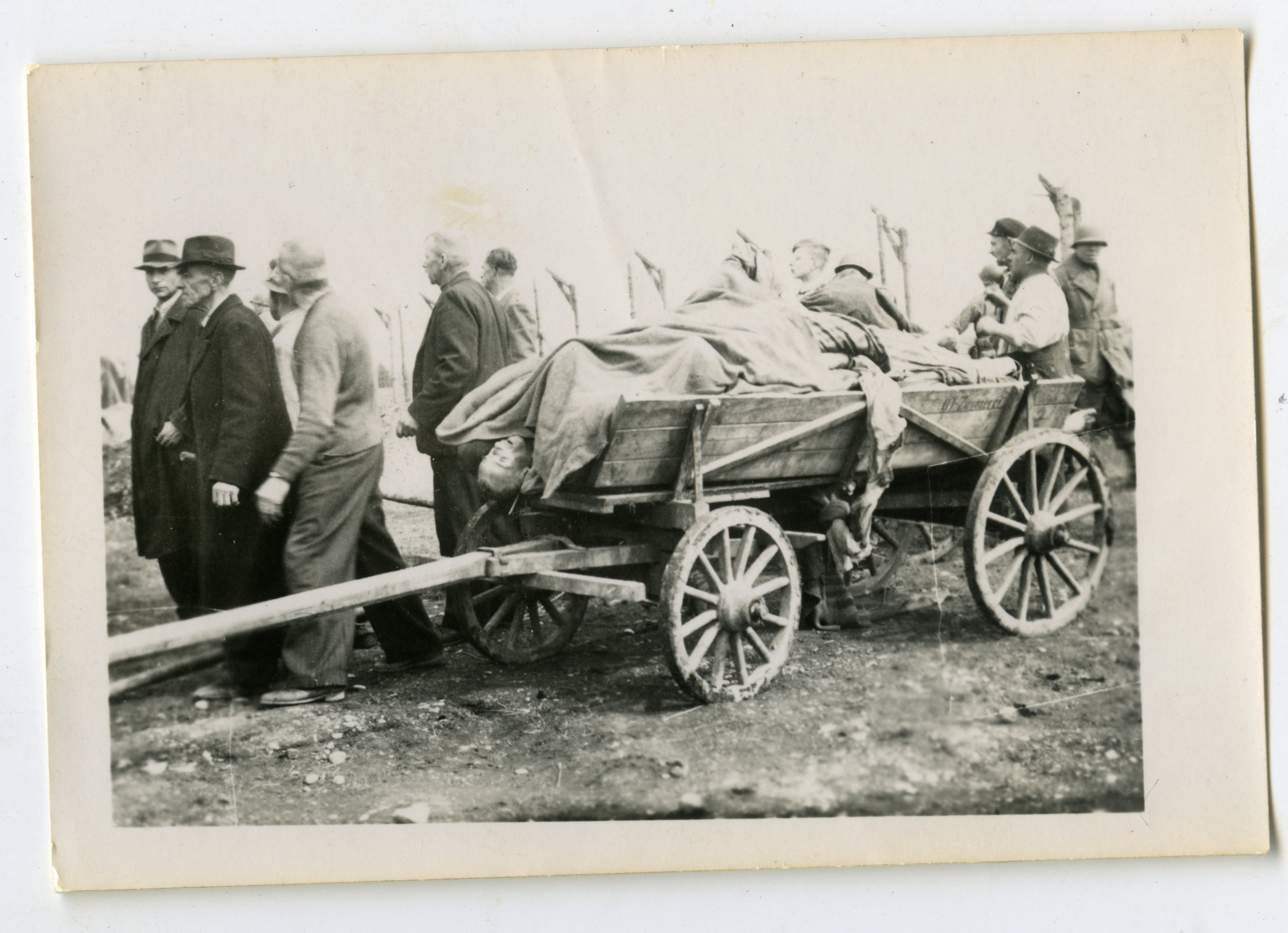
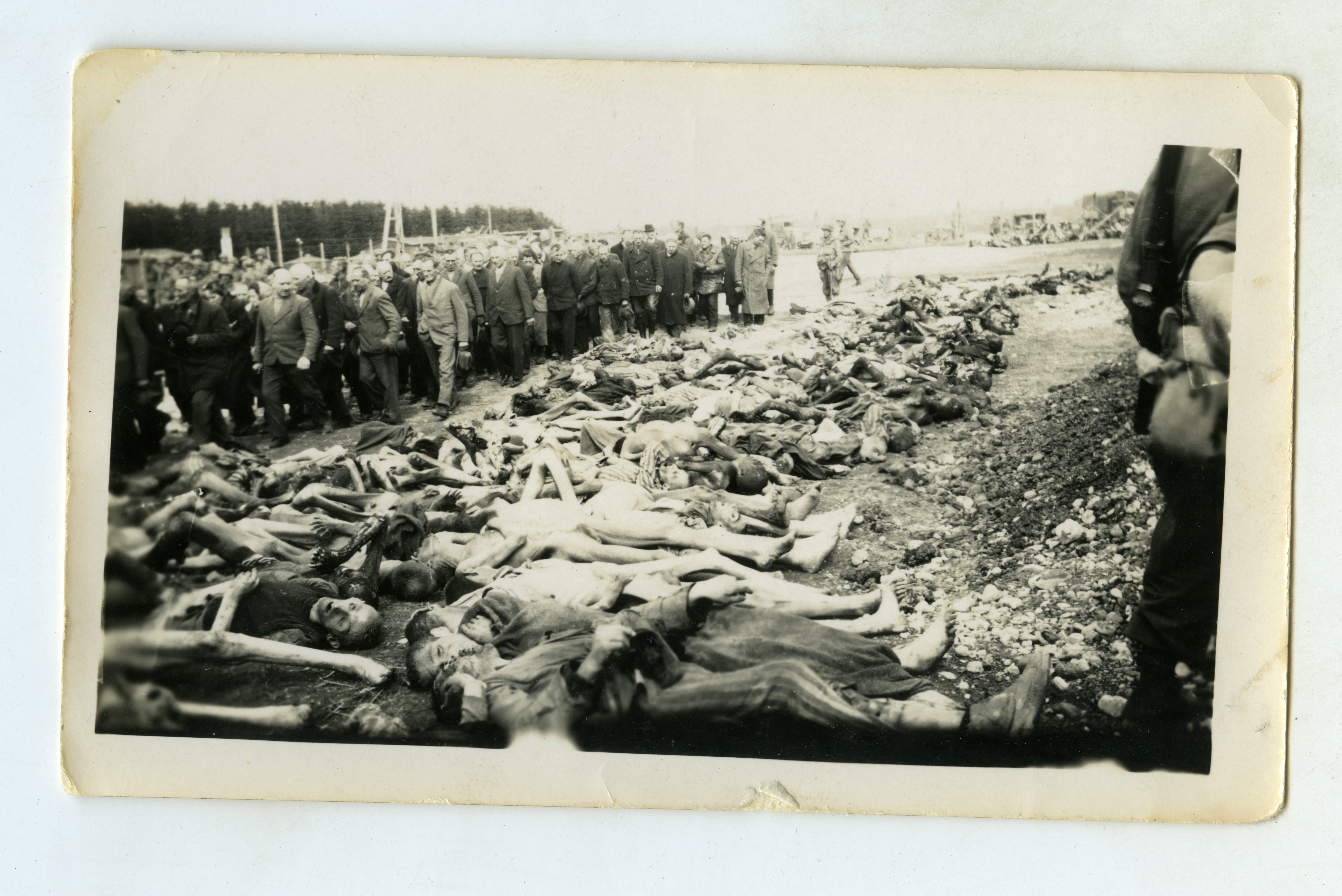
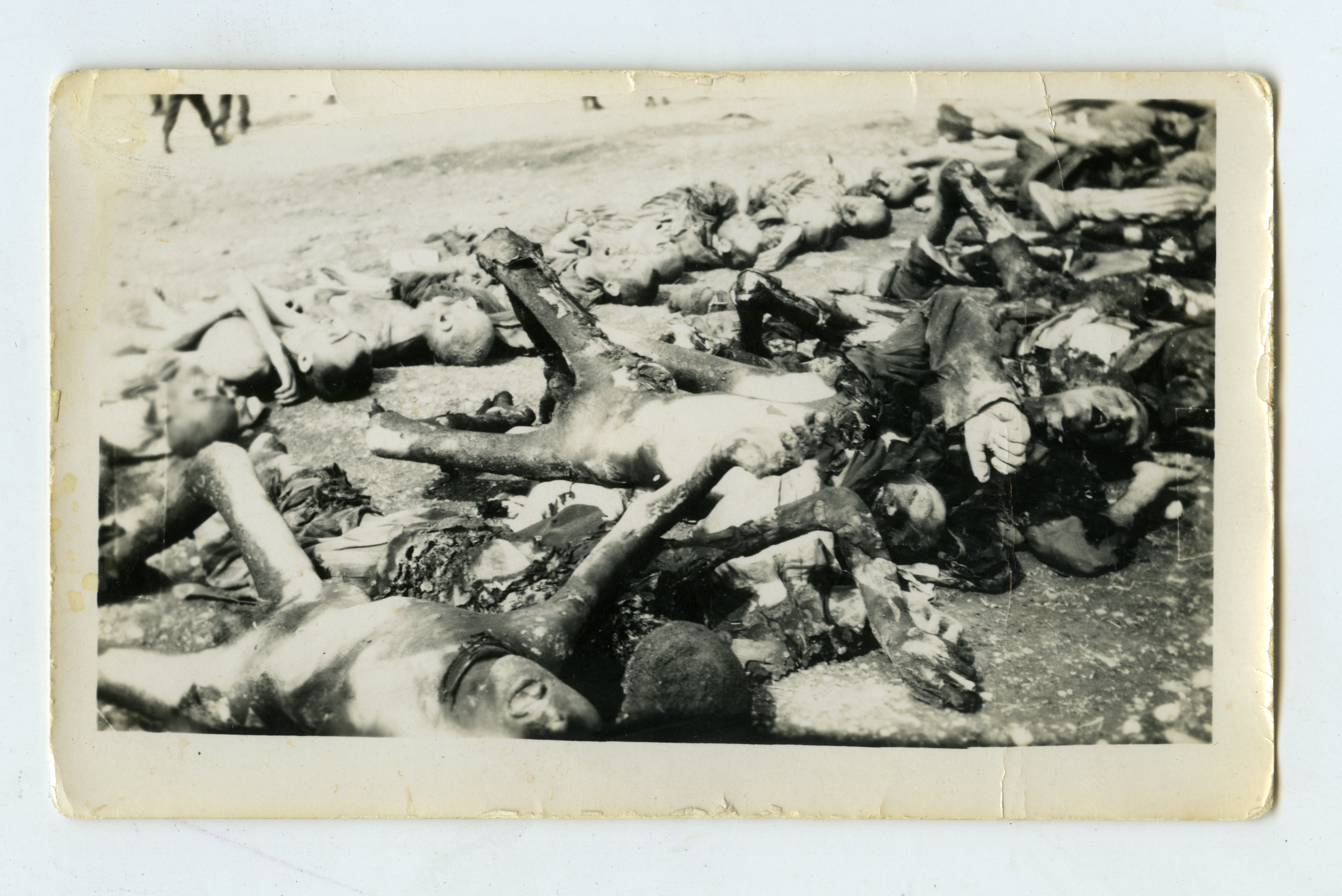
Eight years ago I posted a series of snapshots taken by a US soldier showing the liberation of an unknown concentration camp during WWII. When I acquired the photos, they had no provenance and no information on the reverse side to start the process of identification. Luckily, a blog follower was able to help with the identification of the camp through the same processes I typically use. By observing the surrounding architecture and general contextual clues, he was able to identify the camp as Kaufering IV, a large subcamp of Dachau. Here is what he provided:
Some thoughts:
i)This is certainly somewhere Upper Bavaria – the house architecture is fairly typical of the region.
ii)The presence of the 2 Luftwaffe officers suggests some sort of air force activity is close by. Lager Lechfeld was used as a fighter base and a shake-down airbase for the nearby Messerschmitt complex in Augsburg. Prisoners were engaged in constructing bomb-proof bunker-factories in appalling conditions.
iii)One of the photographs has a very distinctive semi-sunken barrack type, known as “Erdhütten” (Lit: “Earth huts”) – very primitive constructions, the timbers of which were made from off-cuts and waste from furniture production and which survivors testify, leaked terribly. These barracks were a distinctive feature of the Dachau sub-camps in the Kaufering/Buchlöe area.
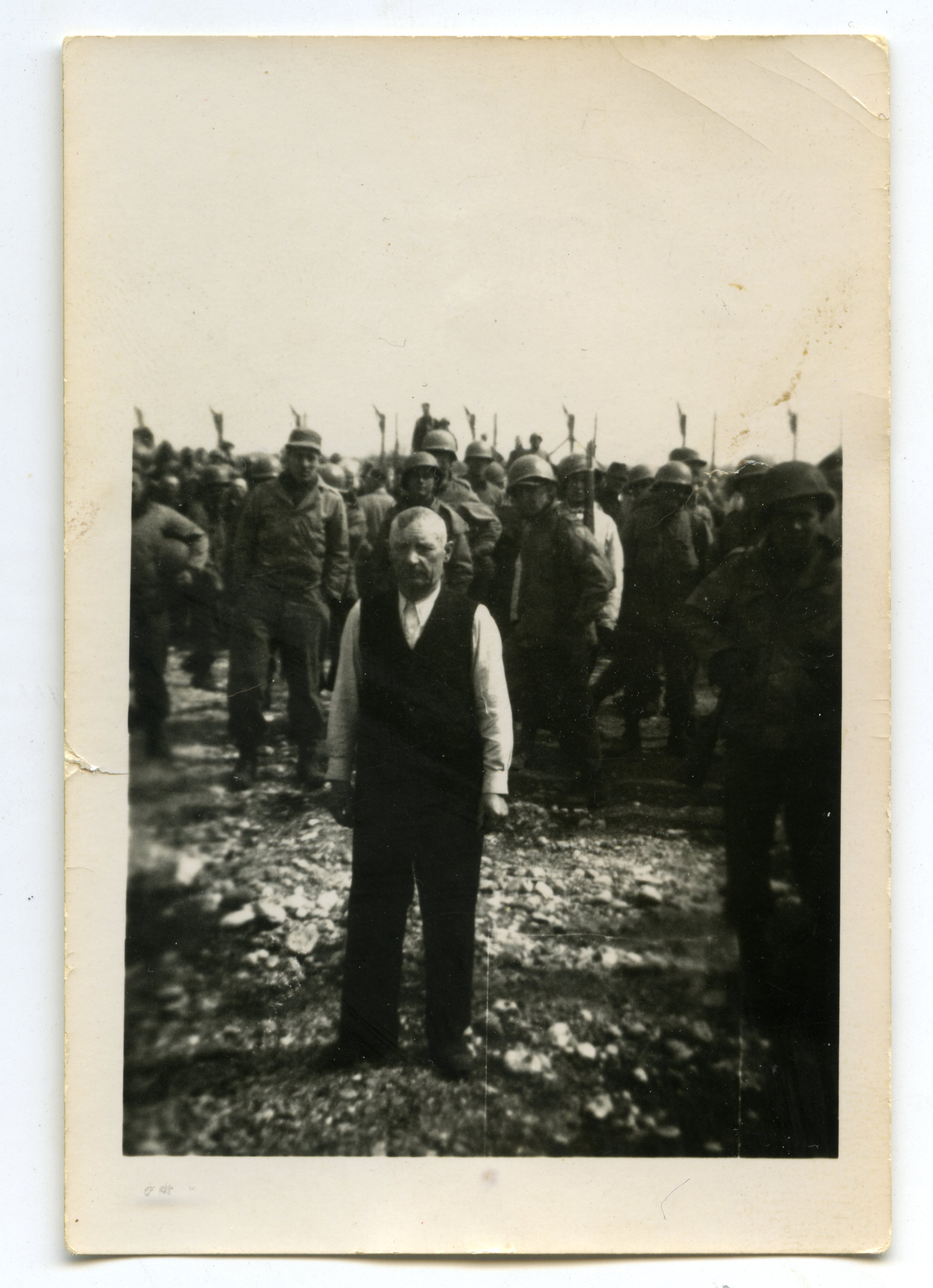
Thanks to the careful research of Taff Simon, we now know that the camp shown in these snapshots is Kaufering IV. A closer look at the details within the images supports his findings. One particular photograph offers the clearest confirmation: it shows an older man in civilian clothing with a closely shaven head, a haunting detail that anchors these scenes to the history of this Dachau subcamp.
Snapshot of SS Commandant Johann Baptist Eichelsdörfer
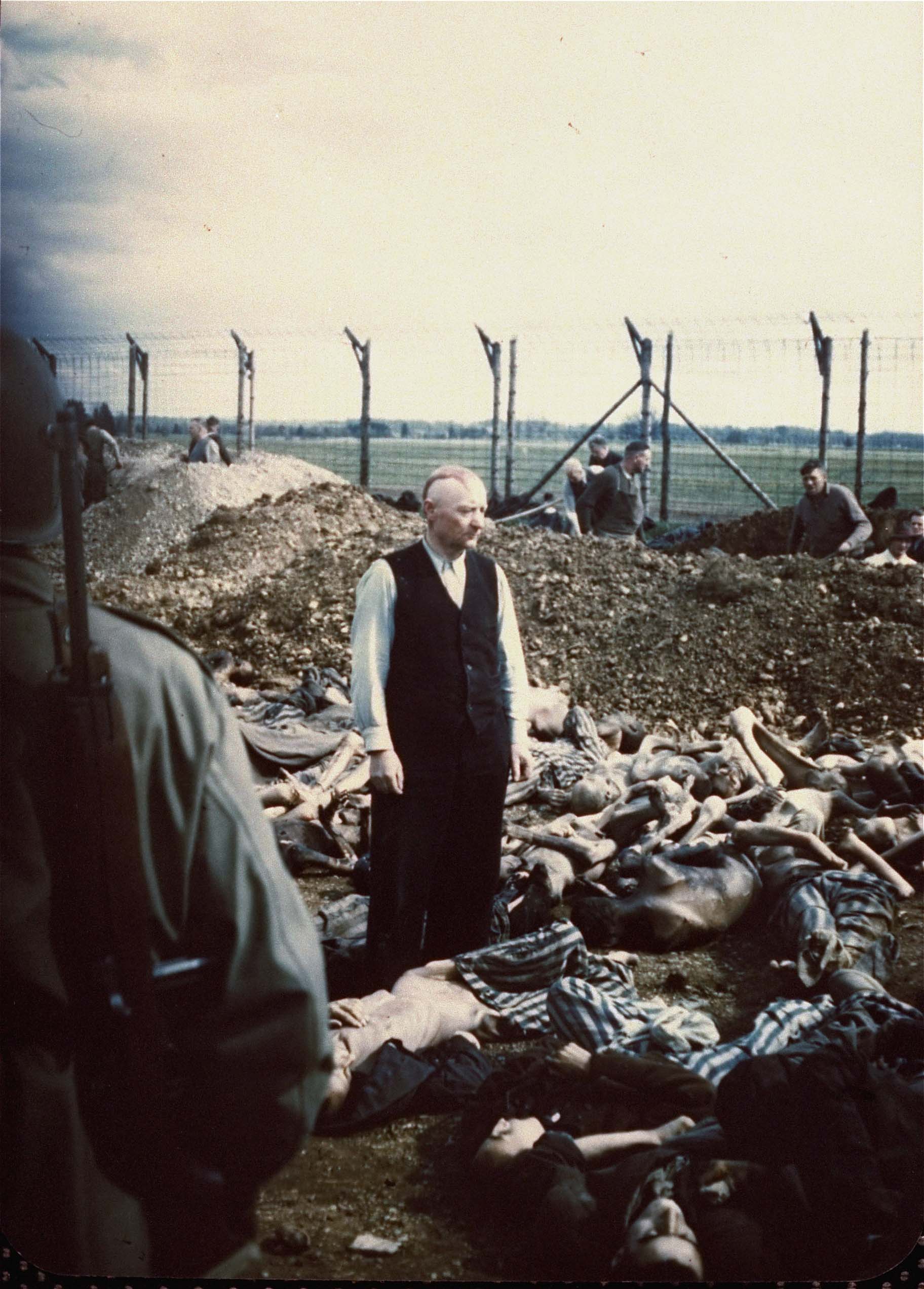
When I first wrote about the snapshot collection in 2017, I was unable to identify the man since he was in civilian garb. Artificial intelligence image searches at the time were unable to attribute the image to any individual, so I was under the assumption that he was a local civilian who was brought in to help with the burial of the camp victims. But now, with the attribution of the snapshots to Kaufering IV, I was able to find more images of Eichelsdörfer. His shaven head with the lopsided squirrel-tail appearance confirms his identity when compared to the images below.
Color Photo of Johann Baptist Eichelsdörfer (US Holocaust Museum image)
(SS officer Johann Baptist Eichelsdoerfer, the commandant of the Kaufering IV concentration camp, stands among the corpses of prisoners killed in his camp. US Holocaust Museum image)
(Wikipedia Commons)
Who was he?
Johann Baptist Eichelsdörfer was a German military officer and concentration camp commandant during World War II. Born on January 20, 1890, in Dachau, Germany, he served as a non-commissioned officer in the Bavarian Army during World War I and remained in the military after the war, retiring in 1924 with the rank of lieutenant. He rejoined the military in 1940 and served in various locations, including France, Poland, and the Soviet Union. In 1944, he was assigned to the Dachau concentration camp system, where he served as the commandant of several subcamps. In January 1945, he took command of Kaufering IV, a subcamp of Dachau located near Hurlach, which was designated as a “hospital camp” but was, in reality, a site where sick and dying prisoners were abandoned without adequate medical care. Under his command, thousands of prisoners died due to starvation, disease, and mistreatment.
Eichelsdörfer’s actions came to light when American forces liberated Kaufering IV on April 27, 1945. U.S. soldiers discovered hundreds of bodies and surviving prisoners who had been subjected to brutal conditions. Eichelsdörfer was captured and photographed standing among the bodies of dead inmates, a stark image used as evidence during his trial. He was tried at the Dachau Trials, a series of military tribunals held by the U.S. Army to prosecute Nazi war criminals. On December 13, 1945, he was convicted of war crimes and crimes against humanity and sentenced to death. Eichelsdörfer was executed by hanging on May 29, 1946, in Landsberg am Lech prison. His trial and execution highlighted the atrocities committed in the Nazi concentration camps and served as a reminder of the need for accountability in the aftermath of war.
The Other Snapshots
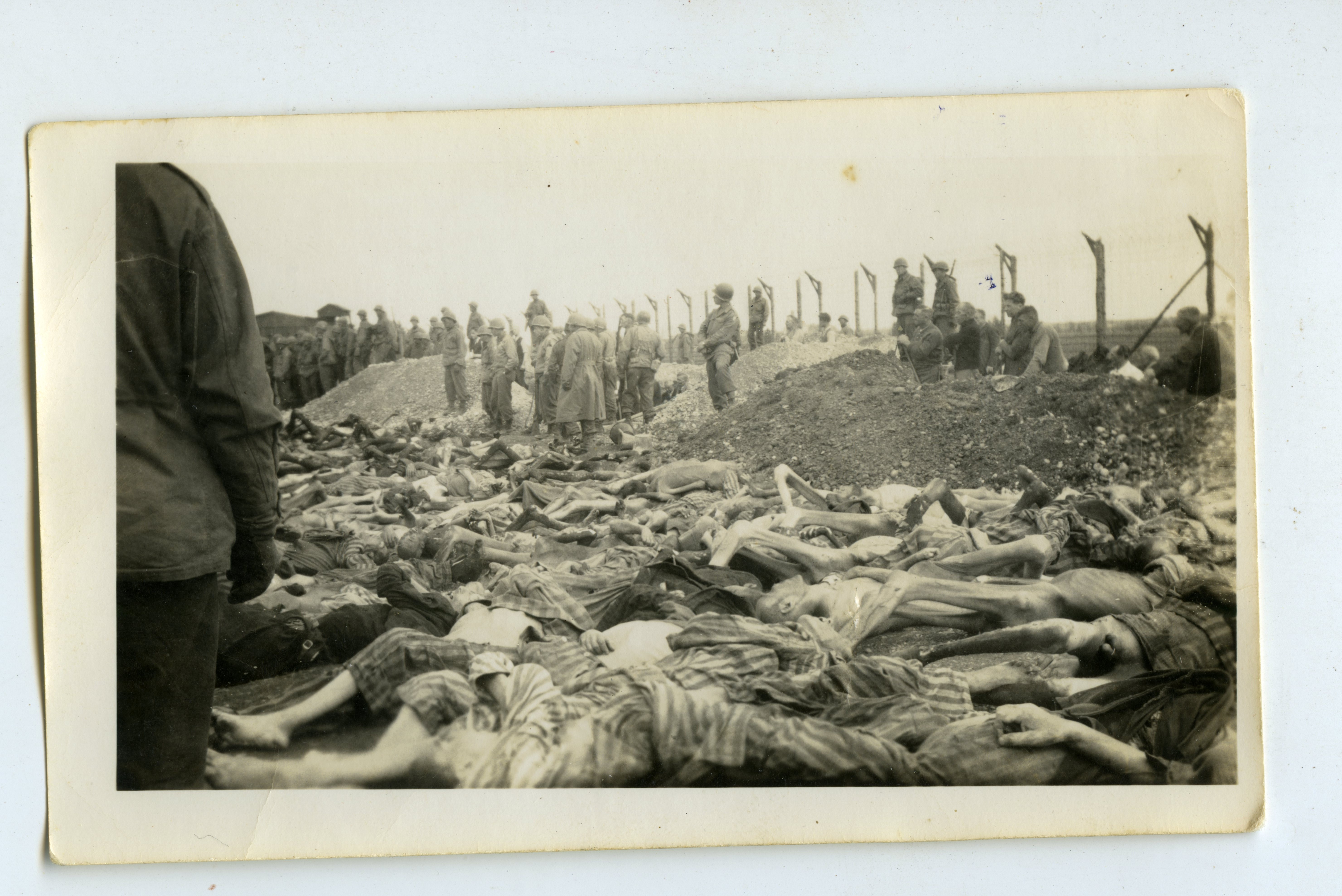
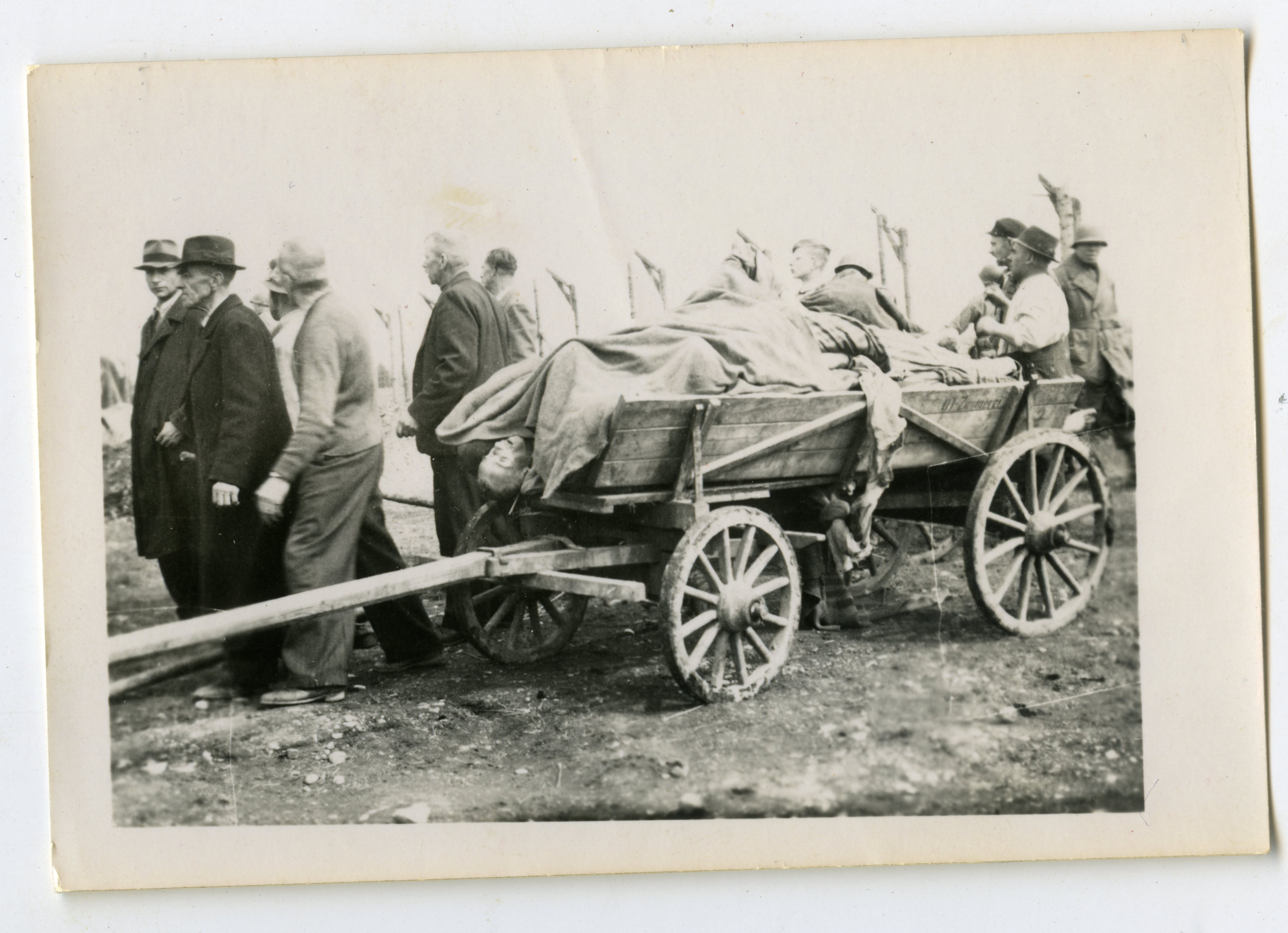
Now that we know the snapshots from the 2017 blog post were taken at Kaufering IV, the other images captured by an unknown US GI make more sense. I will post them here with some updated commentary. Feel free to weigh in if you have any comments or suggestions for descriptions.
Kaufering IV Survivor
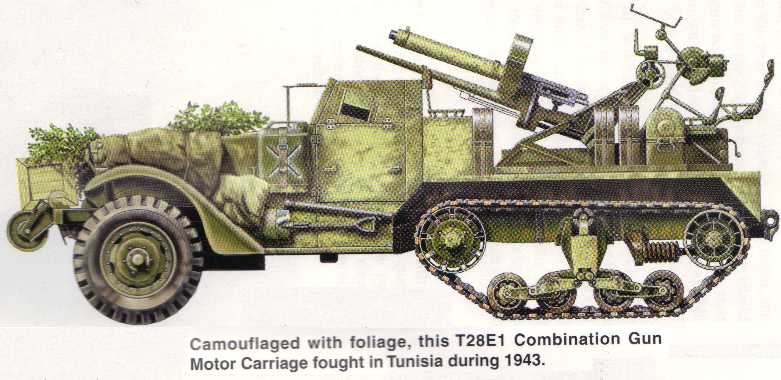
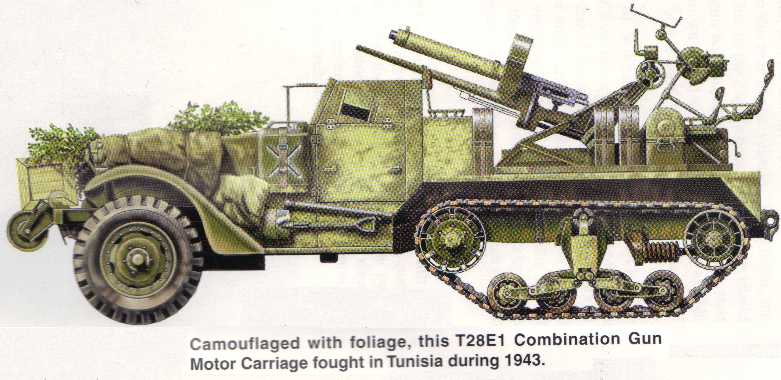
In the above image, we see a recently liberated survivor of his time at Kaufering IV. He’s using his bandaged hands to tie on a pair of shoes, likely a pair provided to him by US soldiers. He also appears to have some soup in a small can as well as a striped blanket wrapped around his head and body. In the back of the image appears a US T28E1 which was likely one of the 12th Armor Division’s anti-aircraft mobile vehicles. The painted sillouettes of 14 German aircraft on the side hint that the operators of the T28E1 shot down lots of German aircraft as the war came to an end.
Generalized View of the T28E1
German Luftwaffe Officers
German Civilians Help with Burial
Camp Building and Ditch
Local Civilians Observe the Dead
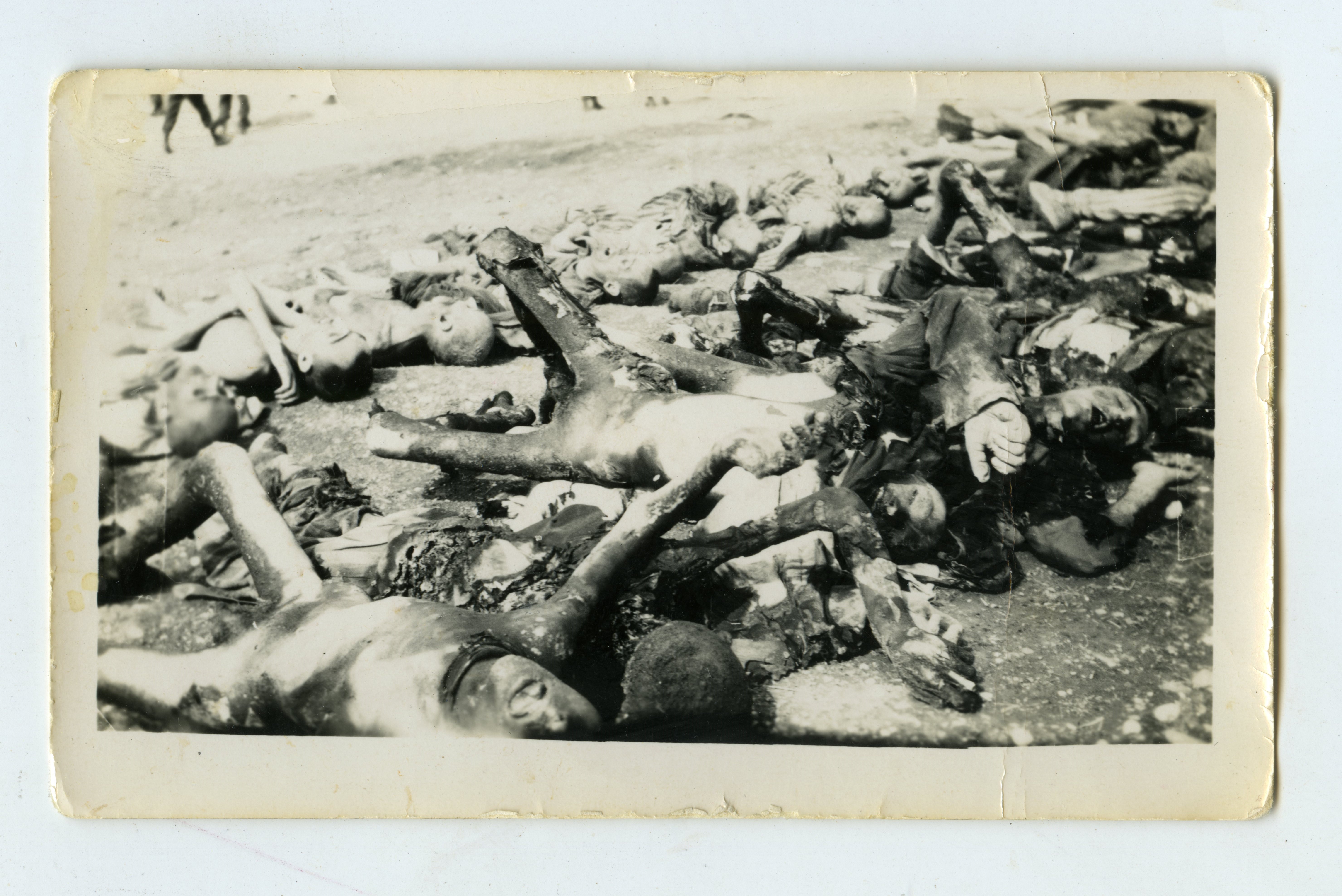
Kaufering IV Victims
US Officers Speak to a Crowd
US GI’s View the Dead
Camp Victims
Camp Victims and Army Officers
Camp Victims
Local German Civilians Listen to US Officers
I really don’t know how to close this sobering post update from 2017. I did pass the snapshots along to a WWII veterans museum based here in the United States, but I’m unsure of what they ended up doing with them. I hope that his post will help educate those researching Kaufering IV and bring some closure to the mystery of when and where these snapshots were taken.
If you want to see some footage from the camp liberation, please check out the video here.
Easy Co. 506th PIR, 101st Airborne, Band of Brothers at Kaufering IV
HBO’s Band of Brothers covered Kaufering IV briefly in one episode. The unit was involved in the liberation of the camp, along with the 12th Armored Division. See below for a dramatized version of the events. The small earthen huts described by Taff can be clearly depicted. The HBO historical accuracy consultants did a great job!
From time to time, I like to browse the pages of eBay in search of portrait photographs of identified U.S. soldiers — small windows into the past that I can casually research to uncover the individual’s story and their role in whichever conflict they served. In today’s post, I was drawn to one particular image: a portrait captured by a British photographer. Unlike the widely circulated press photos that often made their way into American newspapers, this photograph was unlikely to have been distributed stateside and equally unlikely to have fallen into the hands of the soldier’s family.
When soldiers were photographed, it was common for them to provide their names, ranks, and often their hometowns. Yet in most cases, there was little chance for photographers or newspapers to follow up and let those soldiers know that their likeness had appeared in print. That disconnect is part of what makes original press photographs so compelling today. Many remain unpublished, and most have never been thoroughly researched. In fact, I’ve noticed a growing trend in 2025: more and more World War II–era press photos are surfacing on the secondary market, offering new opportunities to rediscover stories that might otherwise have been lost.
PFC James “Jack” C. Warren of Kentucky
The photograph above was discovered in August 2025 during one of my routine eBay searches for intriguing portrait shots of World War II servicemen — images that spark my curiosity to uncover the stories behind the faces. This particular shot is especially striking: crisp, tightly framed, and, based on the other photographs sold by the same seller, likely taken in England at a collection point for wounded or ill soldiers. I cleaned up the scan and cropped the edges to make it more visually appealing for digital presentation.
The next question became the most important one: how do we identify him?
Reverse Side From eBay
What do we know?
The photo was taken on July 13, 1944 at a port in the South of England.
The photographer worked for a British newspaper.
The subject of the photo is a PFC J.C. Warren from Kentucky and was wounded.
The photo was approved for publication by US censors a few days later.
Who was J.C. Warren?
Given the information provided in the brief writeup on the reverse side of the photo, we know that the subject is a young male, likely aged 18-24 from Kentucky named J.C. Warren who was wounded or injured at some point after the D-Day landing a month earlier. His “walking wounded” paper tag (Form 52b-MEDICAL DEPARTMENT, U.S.A. (Revised October 25, 1940), 16-15434) seen poking up at the bottom hints that he wasn’t disabled or infectious. With that information in hand, I began narrowing the search. Since the most common first names beginning with “J” at the time were James and John, I started there, turning to an obscure database that tracks U.S. servicemembers admitted to hospitals during World War II.
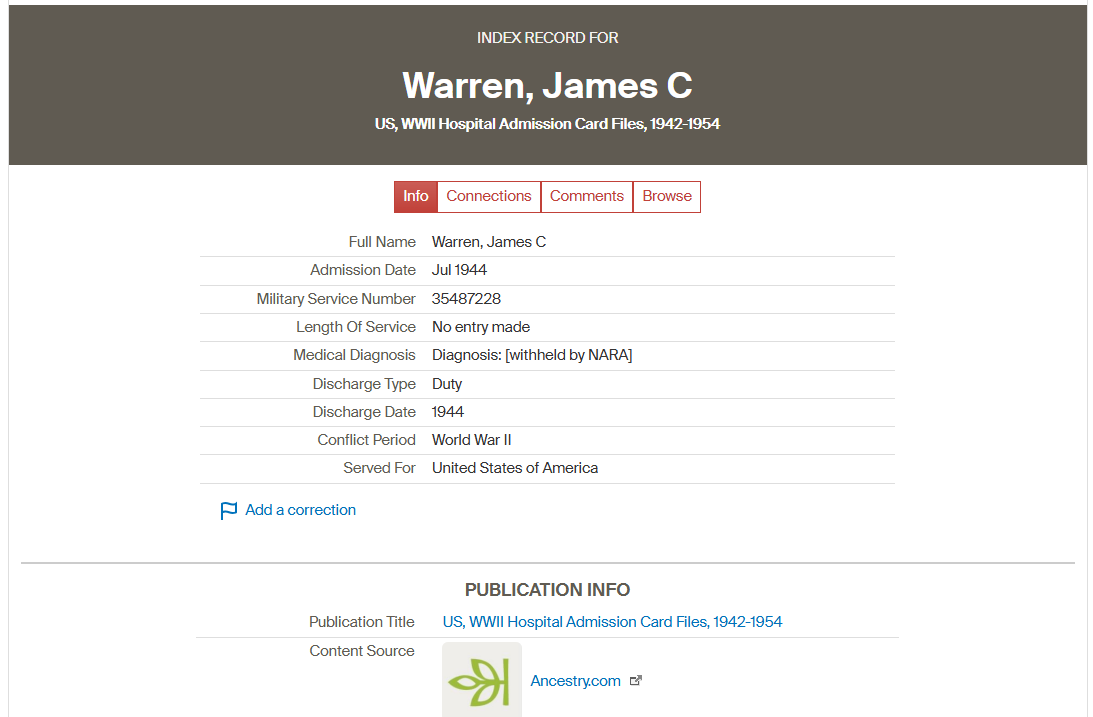
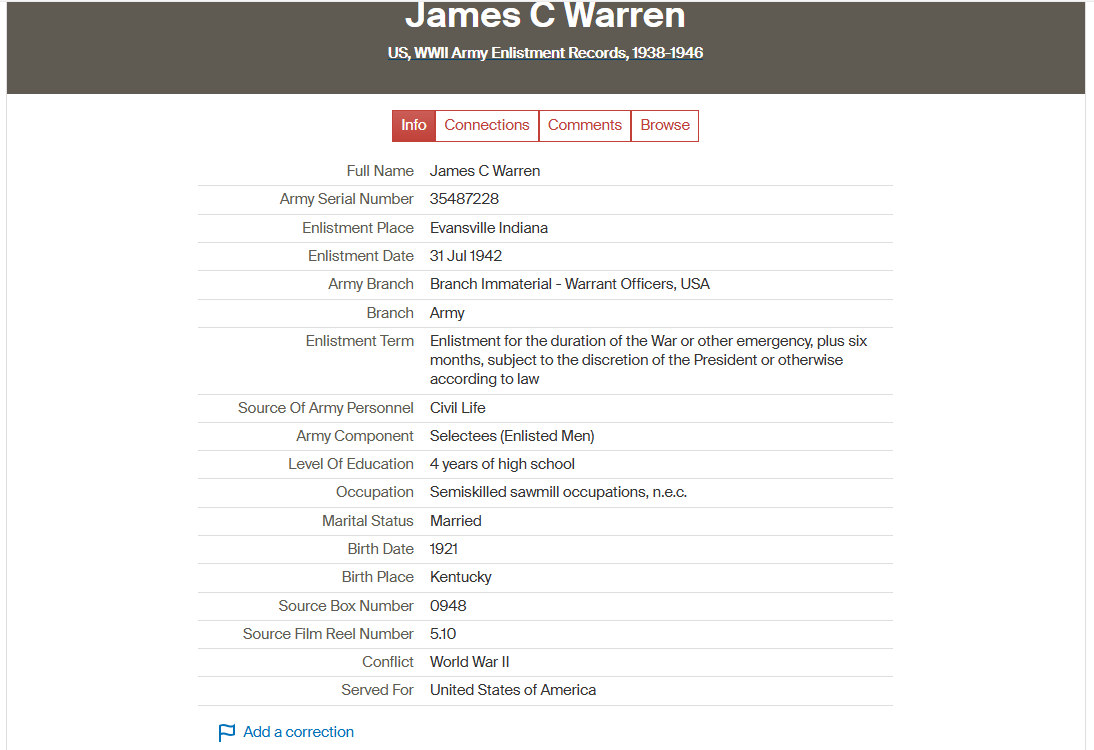
After only a few minutes of typing I found a hit to a James C. Warren with the Army Serial Number(ASN) of 35487228, and the only J C Warren who was from Kentucky that was admitted to a US hospital in July of 1944.
WWII Hospital Admission Card for James Warren
And when looking up his ASN…
WWII Draft Registration Information
With confirmation like this, I decided to dig deeper into PFC Warren’s life story in hopes of pulling out a few more details about his life story. Luckily, Ancestry.com and Fold3.com provide prompts based on confirmed information when researching so I was quickly on my way down the rabbit hole.
Veteran Headstone Application Form
It’s always a bittersweet discovery when I come across one of these documents, which tend to surface most often for veterans who passed away between the 1950s and 1980s. This particular record (which I’ll share below) shows that PFC Warren served with the 816th Ordnance Base Depot Company, a unit stationed in southern England at the time of his hospital admission. Interestingly, there is no mention of a Purple Heart on the form. That leaves me to wonder whether his injury did not meet the criteria for the medal, or whether it simply wasn’t recorded on his discharge papers after the war. Perhaps his family would know the answer.
Veteran Headstone Application
Luckily, the document provides just enough detail to shed light on who James Carmen Warren sadly left behind when he passed away in 1968. Born on April 8, 1921, he died on August 8, 1968, at the age of 47. He was survived by his wife, Mary Emma Green Warren, along with their two sons, Ivan and James C. Warren Jr.
The 158th Aero Squadron and the Sinking of the SS Tuscania
On the night of February 5, 1918, the troopship SS Tuscania was steaming off the coast of Islay, Scotland, when it was struck by a torpedo fired from the German submarine UB-77. The liner was carrying over 2,000 American soldiers bound for the Western Front as part of the earliest waves of U.S. troops to join the fight in Europe.
Among those aboard were men of the 158th Aero Squadron, a newly formed Air Service unit. Organized in late 1917, the squadron was composed largely of young Americans who had trained in Texas before embarking overseas. Their mission would be to support the burgeoning U.S. Air Service in France, a much needed element of warfare in the late stages of WWI.
When the torpedo struck, chaos erupted. Lifeboats were launched into rough seas, and the darkness made rescue operations difficult. British destroyers and local fishermen rushed to aid survivors. Despite these efforts, more than 200 soldiers and crewmen were lost, making the Tuscania the first U.S. troopship sunk in World War I.
Footage of the Survivors of the Tuscania Sinking
The men of the 158th Aero Squadron were among the survivors. Shaken but determined, they eventually reached England and continued their training before heading off to France. Looking at this group portrait, it’s striking to think that every face here carries the memory of that night in the frigid waters of the North Channel. For the men of the 158th, their war began not in the skies over France, but in the dark Atlantic, clinging to lifeboats and praying for rescue.
Roy Oplinger and the 158th Aero Squadron
While the group photo provides us with an overall snapshot of the 158th Aero Squadron in the days after their harrowing ordeal, the photograph also highlights the wartime experience of an individual soldier who decided to send this image home to his family.
The reverse side of this English postcard has a few unique elements that help point towards the ID of the soldier who sent the postcard home in 1918. The first and obvious clue is that the photograph is likely related to someone who served with the 158th Aero Squadron. The following clues can be found on the reverse side of the postcard.
Reverse Side of Postcard
The additional clues are pretty obvious given the stamp at the top right-hand corner paired with the writing on the bottom. We know his name is Roy, and that his Army Service Number was 250033. Using the powers of ancestry.com and fold3.com I was able to identify the sender as Corporal Roy Holden Oplinger who served as a mechanic with the 158th Aero Squadron. Born on May 8th, 1896 in Danielsville, PA to Adam and Edna Oplinger, Roy went on to enlist for the draft on June 5th, 1917 with a listed address in Walnutport, PA. What doesn’t jive is that he was a private at the time of the sinking of the SS Tuscania, so it appears that he didn’t actually send this postcard to his family (if ever) until later that year when he was promoted to corporal in October.
Roy’s WWI Draft Registration Card
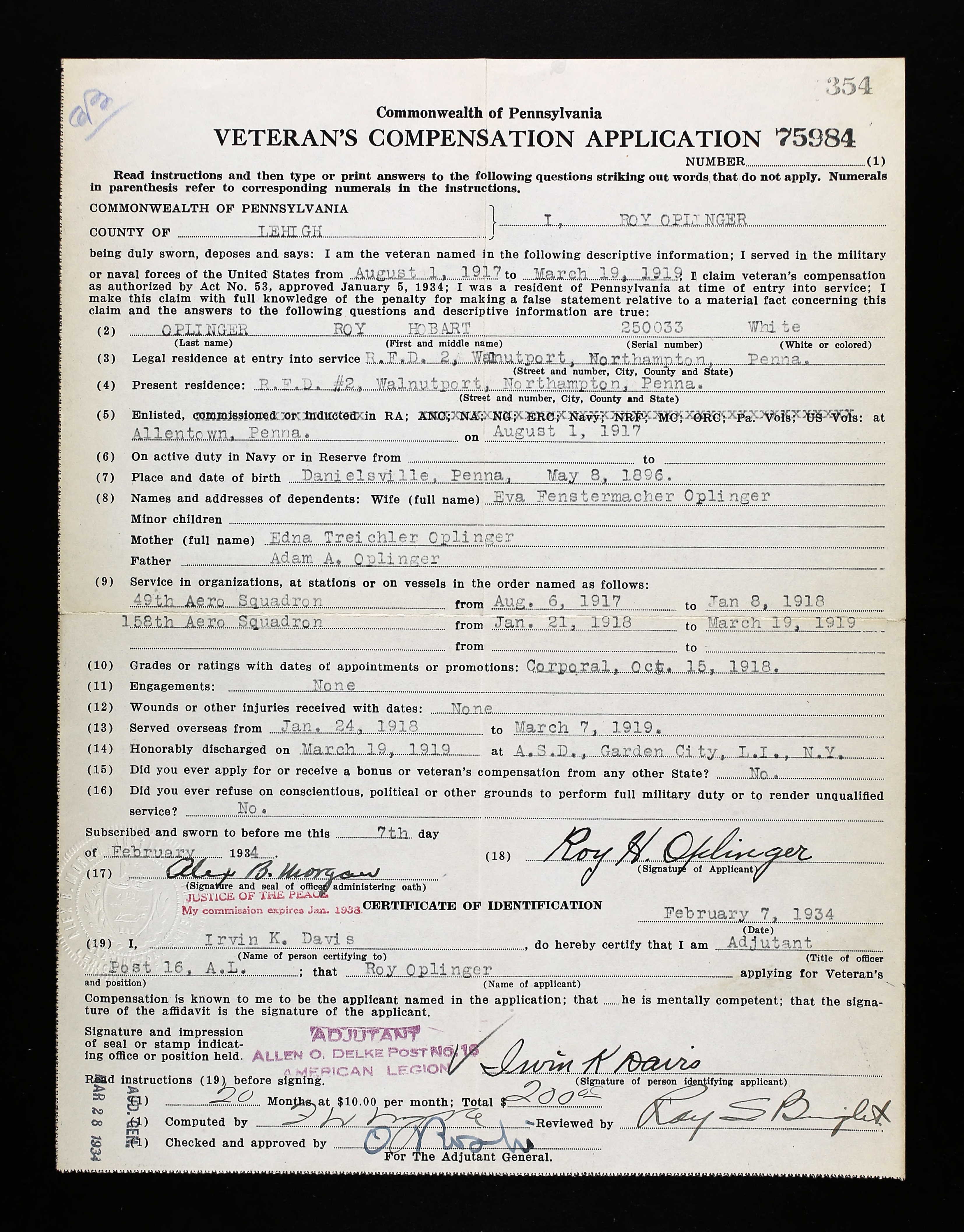
According to Roy’s WWI Pennsylvania Veteran’s Compensation Application, after enlistment he went on to serve with the 49th Aero Squadron (an obscure pursuit squadron) in August of the same year and then on January 8th of 1918 with the 158th Aero Squadron shortly before his departure aboard the SS Tuscania.
WWI Pennsylvania Veteran’s Compensation Application Form
A Letter Home to a Friend
In a rare stroke of luck, I struck photo researcher gold after searching for newspaper articles related to Roy’s WWI service. In this case, it looks like he sent a letter home to a close hometown friend, Samuel W. Danner on February 13th, 1918 only a few days before the group photo was taken. Anecdotes like this offer a rare glimpse into individual moments during the war, and I was lucky to stumble across it. Here’s a link to the The Morning Call, an Allentown, PA newspaper. Please disregard any typos in the OCR transcription of the article.
Roy H. Oplinger Private in 158th Aero Squadron now in France received the following letter: American Rest Camp, Winchester, England.
February 13, 1918. Dear Sir: best of health and hope you are well I will let you know that I am in the same in America. I will let you know that I have experienced the Torpedoing of the S. S. Tuscania.
The very first ship sunk with U. S. Soldiers on board. I had a narrow escape, I was on deck when we were submarined, but was soon floating on the Atlantic waters on a raft, shortly after we were struck about one hour and a half later we were picked up by a British patrol boat.
If the ship would have sunk as quick as the Lusitania, why I think we would have perished. The S. S. Tuscania went down some hours later, she was torpedoed about supper time somewhere on the Irish coast. How many lives were lost I am unable to tell.
Only a few of our squadron The clothing and my personal belongings I had with me are all the articles I have, all the rest of my stuff is at the bottom of the sea with the Tuscania. But my gold watch which mother presented to me as a present some years ago is out of commission as the salt water did not agree with her very well. I do not like the taste of it myself, it does not feel very comfortable to be in the water this time of the year. But I was kept warm as I was the only one on the raft that knew how to handle an oar. So you see what I had to do to get away from that sinking ship.
There is danger in being too near a sinking vessel as the suction will at times suck persons down that are near. I paddled along and when rescued we eight boys on the raft were a few miles from the ship. We were somewhat soaked. But I am dry by the time you received this letter. Ha Ha.
I will never forget that shock of that torpedo which hit us on that night February 5, 1918. The boys were brave and sang national hymns when we let her go down. Every soldier was coal as jar as I know not one was panic stricken, all left that ship in an excellent manner and can tell you from my experience what I have had in seeing a ship sunk. That you can thank God if you never have to witness that kind of a sight on a rough sea. I am sure glad that I am safe.
It was God’s will that only a few lives were lost in the ship wreck. I will sure do my best to do a little harm towards “Kaiser Bill” as he has to account for the lives that were lost on that cold night (you know). I am yours as before.
Address, Priv. Roy H. Oplinger, 158th Aero Squadron. A. E. (via) N. Y.
And Some Insight From a Friend
Fast forward to 2025, here’s some information about the photo from a WWI researcher friend of mine, Charles “Chuck” Thomas. Thanks Chuck!
Chuck’s Take
Here is a special image of the surviving members of the 158th Aero Squadron shortly after arriving at the American rest camp in Winchester, England. This squadron was aboard the Tuscania when it was sunk by a German submarine off the northern coast of Ireland 5 February 1918. When the 158th AS was reassembled at Winchester, it was determined that seventeen men had been lost during the sinking. After the picture was taken, the flying officers were sent to France for training and the enlisted members were broken up into four flights: one flight was sent to Beverly, Yorkshire and the other three went to Lincolnshire, England.
The squadron would later be reunited and sent to Issoudun on 27 September to finish out their service at that aerodrome.
The squadron officers were:
1st Lt. Phil E. Davant
1st Lt. Herbert B. Bartholf
1st Lt. J. W. Blackman (Gorrells has it spelled ‘Blakcman’ – typo?)
1st Lt. Merle H. Howe
1st Lt. Miner C. Markham
2nd Lt. Kenneth S. Hall
2nd Lt. Freeman A. Ballard
2nd Lt. LaRue Smith
2nd Lt. James McFaddan
Of note is the mixture of civilian attire with military uniforms being worn by some of the enlisted men.
I should also point out that the flag seen here was the only one saved during the sinking of the Tuscania by Corp. Guy W. Burnett.
Greetings to my dedicated readers of PortraitsofWar. I recently purchased a large grouping of 1000+ photos that was comprised of may different smaller collections. I was able to weasel out an interesting group of Pacific Theater of Operation (PTO) tactical recon group photos and do a bit of basic research. After some time on the web I’ve concluded that the following shots were taken by a unit photographer for the 110th Tactical Reconnaissance Squadron. Many of the photos are signed by the pilots who flew the planes depicted in the photographs. My guess is that the fellow who originally owned these photos was a plane mechanic who knew the pilots whose planes flew for the unit.
But who are these men?
UPDATES
Reader Responses (Thanks guys!)
From Tim:
“We Three” was a P-51K 44-12833 flown by the Maj George Noland, CO of the 110th TRS/71st TRG. Maj Noland might have scored the last P-51 kills of the war on 14 August 1945. More details are available in: “Mustang and Thunderbolt Aces of the Pacific and CBI” by John Stanaway. (Stanaway has this as a P-51K-10 while Joe Baugher’s list has it as a P-51K-15-NT).
B.N. Heyman is likely the late Bertam N. Heyman of Youngstown, Ohio.
“Bert’s education at Miami University was interrupted by World War II, where he proudly served as a fighter pilot in the Pacific Theatre. He was a decorated veteran who flew 57 combat missions during his service in the Air Force.”
Thanks for posting these; they’re handsome and worthwhile.
The photo of Major Archuleta (and presumably his crew chief S/Sgt Raver) show Rubel Archuleta, of New Mexico, who was C/O of the 110th TRS from the fall of 1944 into the spring of 1945. He was a schoolteacher before the war (New Mexico State grad, I believe) and under him the 110th seems to have taken on a new personality. They had been a longtime Air National Guard outfit from St. Louis, whose insignia had featured a Missouri mule with telescopes or machine-guns; they were now called The Flying Musketeers.
The photos of Lt. Wells I believe to show Lt. Robert Wells, who had formerly been with the 82nd TRSS on Biak. Wells was hit in the head by shrapnel and managed to fly back with a hole in his skull. Surprisingly, he recovered (although it appears that he was transferred from the 82nd TRS to the 110th.) Note that he’s in a P-40, which the 71st’s two fighter squadrons were flying in the last months of 1944, before upgrading to F-6’s and P-51’s. (Much of what I know about Wells I know through the courtesy and shared photos of Michael Moffitt, whose father, a pilot with the 82nd TRS, took many photos during the war.)
The other pilots I do not recognize off the top of my head. (Harry Johnson may have been my father’s tent mate in the last months of the war. I will check.)
The photo of the 71st TRS HQ looks very similar to photos of the HQ’s for the 82nd and 110th TRS’s at Binmaley, outside Lingayen, in mid-1945. (Taken by Fred Hill of the 17th TRS, these photos can be seen online in the small collection section of the USAF Academy Library. My father, Roscoe A. “Rocky” Boyer, was communications officer for the 71st Group and the 91st Photo Reconnaissance Wing from 1942 on, and then transferred to the 110th in December 1944. Some of the officers may be recognizable from photos.
Fuller information about Archuleta, Wells, and other officers can be found by scrolling through two Facebook Pages that I run, on the 71st TRG and “Rocky Boyer’s War,” a book that I wrote around my father’s wartime diary and that the Naval Institute Press published this year.
I would be glad to post some or all of these photos the 71st TRG page. You may also wish to contact the Facebook administrator for “Lindbergh’s Own” page, an on-line site for the 110th in its current form.
Hey PortraitofWar followers! I recently acquired an incredible grouping of photographs taken by a US soldier during the liberation of a concentration camp/labor camp during the tail end of WWII. There’s not much to go by in terms of identifiable visuals, but there are images of German military officers marching in line to view the bodies, as well as a liberated person in front of a T28E1 US tracked anti-aircraft gun. Additional photographs show an American officer speaking to a line of US soldiers passing before a group of bodies.
Any thoughts or ideas? I hope to pass these on to an organization that can present and appreciate them, but I want to identify the material before doing so.
A liberated prisoner tries on shoes for the first time in years
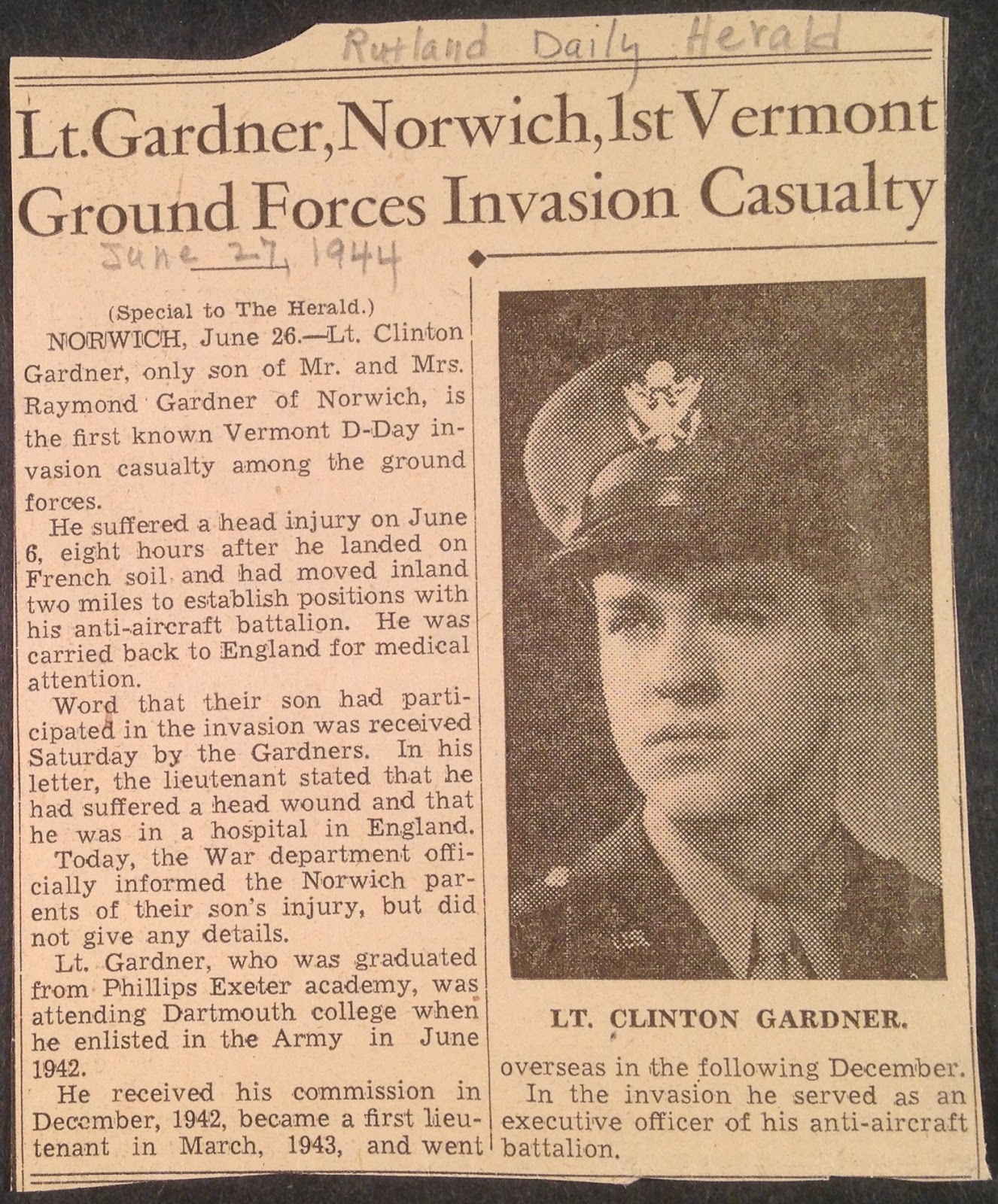
The following post was originally written (not by me) and posted to the Dartmouth Library blog. I’m including the entirety of the post in hopes of spreading the good word about Mr. Gardner and his work during WWII.
On June 6, 1944, Clinton Gardner, Class of 1944, found himself digging a foxhole on Omaha Beach as part of the D-Day invasion of German occupied Europe. The landing area was already strewn with bodies and the Germans were raking the incoming allied forces with artillery and machine gun fire. Gardner, a Lieutenant in the artillery, was not about to move any further inland until the infantry made a hole in the German defenses, and that did not seem to be about to happen.
Clint’s Battle Damaged M-1 Helmet w/ Hawley Liner
An incoming round suddenly exploded in front of him. His head snapped back and then a curtain of blood blinded him. In his memoir, D-Day and Beyond, Gardner recounts how he stood up and staggered toward two of his fellow officers wiping blood from his eyes. The two officers stared at him in horror. Then he reached up and felt his helmet. There was a gaping hole, large enough that he could get two hands into it. Gingerly he felt around and found that he could feel a soft, mushy surface that he assumed must be his brain. Sick and disoriented though he was, he managed to get his first aid kit out and pour sulfa powder into the hole and then stuff it full of gauze.
A Letter Home
Unable to walk or speak properly, Gardner watched as his unit packed up and began to move inland, following the infantry who had suddenly begun to advance. The other officers told him that they would send medics back for him. He was soon alone on the beach with a handful of wounded and dying soldiers, all of whom would have been killed by German mortar fire had not a group of British troops happened along. The British moved the wounded Americans up the beach to a sheltered area among some rocks.
Rutland Herald Article
After 23 hours wounded on the beach, a group of medics finally arrived and moved Gardner and the others to a field hospital in Vierville. There Gardner made the happy discovery that what he had felt through the gash in his helmet was not his brain, but badly lacerated scalp tissue. Though his skull was scarred, it was not broken. Getting the helmet off was another matter: it took three doctors and a fair amount of pulling and twisting as the edges had curled in and were imbedded in his scalp. Eventually Gardner was sent back to England to recover, but that was not the end of the war for him. Later he would find himself being bombed by friendly fire during Battle of the Bulge and still later he would serve as the American Commandant at Buchenwald following its liberation.
Gardner’s helmet remains, to this day, the most damaged helmet whose wearer survived his wounds.
To see Clint Gardner’s helmet or to read his letter home ask for MS-1109. A guide to the collection is available. To read his book, D-Day and Beyond, ask for Alumni G1728.
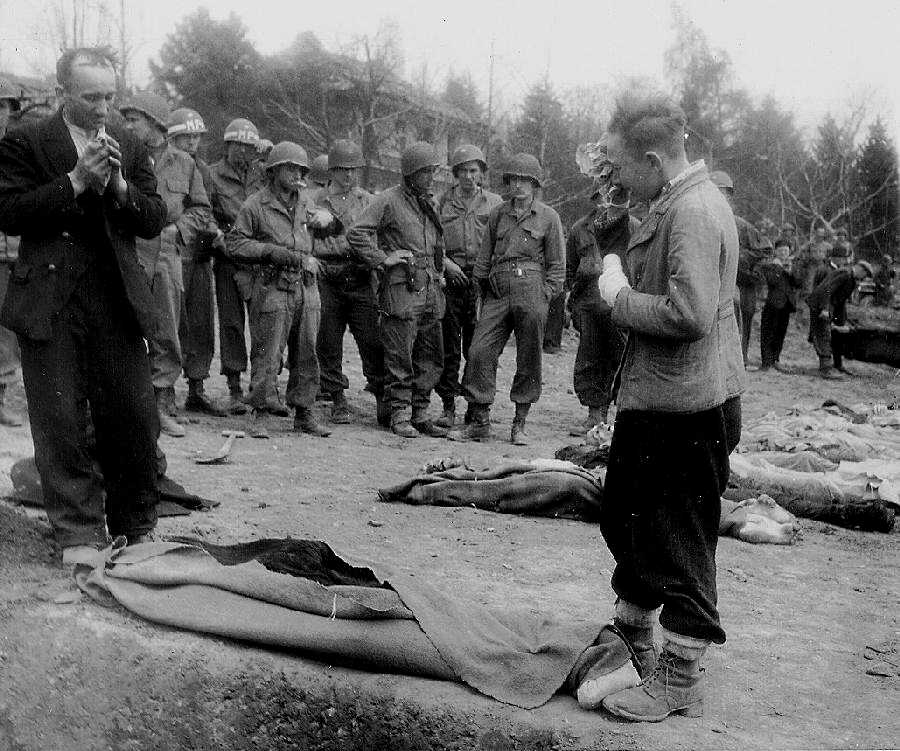
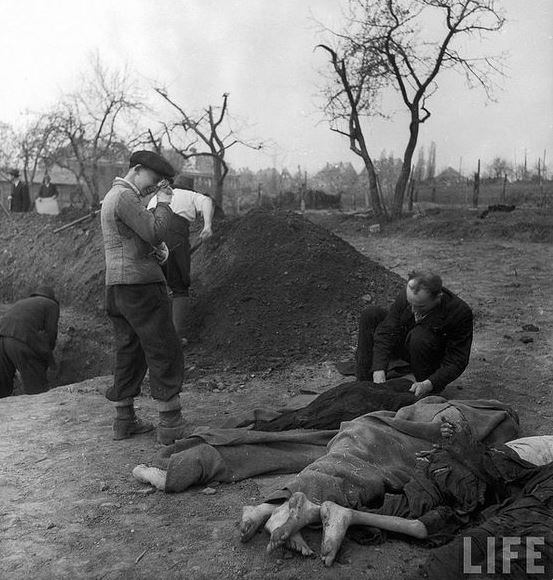
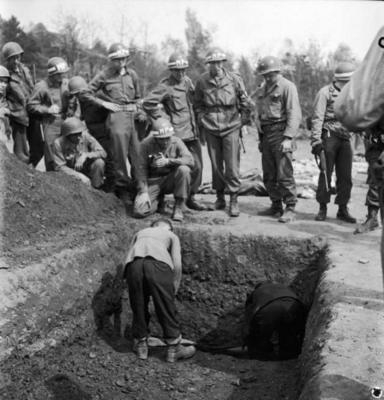
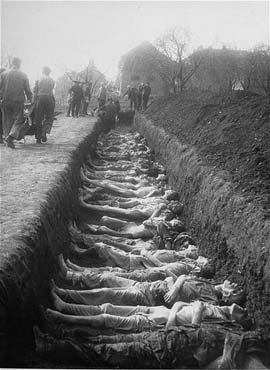
From time to time new information comes along to help identify photographs from my collection. In this case, I stumbled across an image during research into the liberation of Nordhausen (Mittelbau-Dora) concentration camp. The image in my collection (seen below) was originally misidentified as having been taken at Dachau, but I just recently learned that it was actually taken at Nordhausen (Mittelbau-Dora) and captures a moment that US Signal Corps photographs also snapped at different angles. According to information I’ve picked up in the past few days, the young boy was named Michael Kallaur and the father is Walter; both men buried the boy’s grandmother (Walter’s mother) after finding her body in the unfortunate lineup at Nordhausen. Elizabeth Kallaur was killed at the camp only a few days before the liberation.
According to information at the United States Holocaust Memorial Museum, the Kallaur family was sent to Nordhausen as punishment for helping Jews in the Pinsk region. The coat seen covering Mrs. Kallaur was given to Michael by John Florea, the Signal Corps photographer. Walter and Michael would not allow German citizens to touch the body of Elizabeth, and she was the first to be buried (at a deeper level) in the first burial trench.
A Moment of Sorrow at Nordhausen (photo purchased from eBay that launched this post)
Walter holding Elizabeth’s legs
Michael watches on (note wounded hands)
Extensive Research
After hours of internet research, I came across the following Signal Corps photo and instantly recognized the boy….
Walter and Michael looking over Elizabeth (Walter’s mother)
Figure 1.–Here a Polish boy weeps over his grandfather’s body at Nordhausen after it was liberated by the Americans. It was dated April 21, 1945. That may have been when the photographed was released rather than taken. The press caption read, “Weep for the dead: A Polish boy weeps bitterly after he and a man at left buried (the) youngster’s grandmother who had died while a political prisoner of the Nazis in concentration camp at Nordhausen. Germans in the town were ordered to dig graves and bury the 2,500 dead, unburied prisoners found there by occupying American forces. The Polish boy refused to let the Germans touch his grandmother and insisted he bury her himself. Yanks look on in quiet sympathy.” We doubt if his grandmother was a political prisoner, but like the boy a slave laborer at Dora. He probably searched for her after the camps were liberated. Notice the German civilians at the right.
Walter and Michael by John Florea, 1945
An open burial spot (note the depth of Elizabeth’s burial)
And another series of Signal Corps photos showing the burial:
Walter and Michael Kallaur
Walter buries his mother – note the shallow nature of the other bodies vs. the above image for Elizabeth
A view past Elizabeth’s burial spot
Walter continues to fill the grave
Walter and Michael at a distance
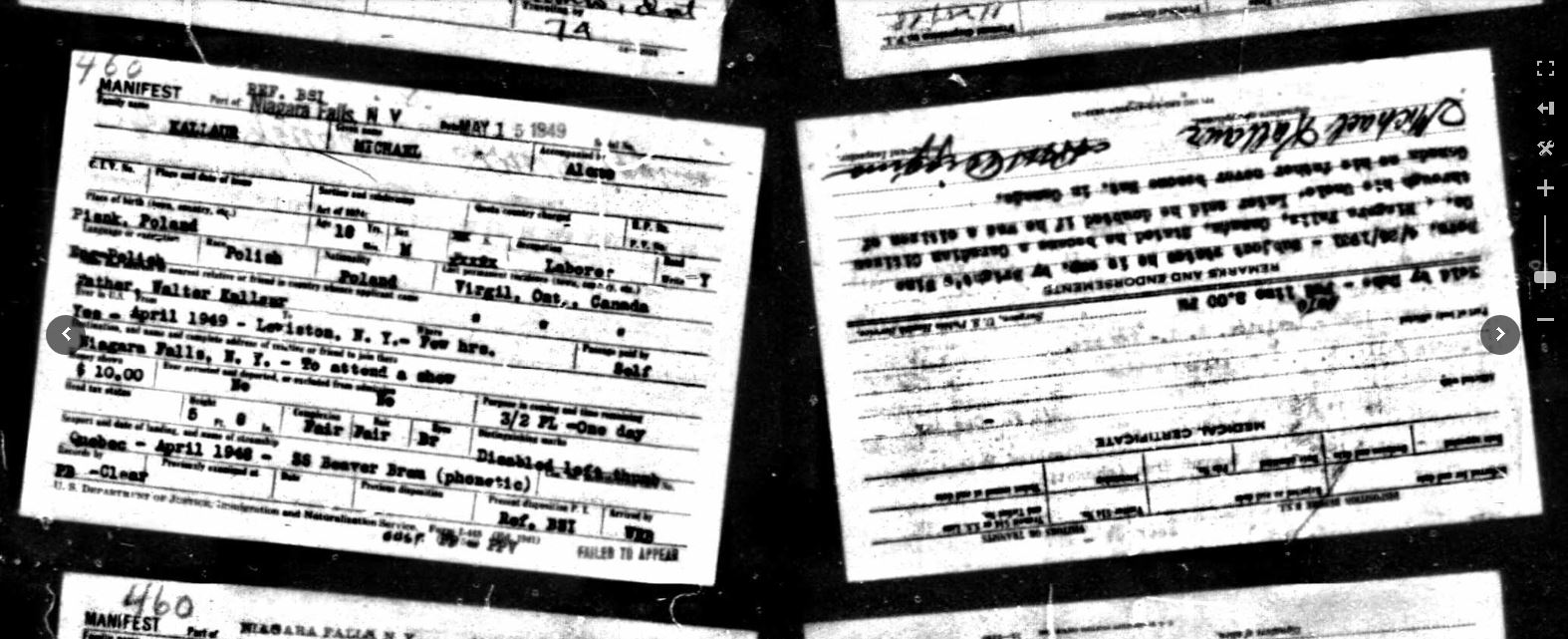
The boy, Michael, traveled to the United States after the war ended. Using the information in the image as a jumping off point, I was able to find some immigration travel information:
1949 Border Crossing
The information on the card all matches up. As seen in the previous images, he had a visibly wounded left hand; the card confirms this and the fact that his place of birth was Pinsk, Poland. At the time of his arrival in the US at Niagara Falls, he was 18, putting his birth year at 1931. The Signal Corps photographer noted his age in 1945 at 14, which matches up with the immigration card. A website dedicated to the Kallaur family tree referenced a Walter Kallaur arriving in the Niagara region after the war; this jives with both the Signal Corps caption and the fact that Walter is referenced in the above 1949 border crossing documents. He arrived in Quebec in April of 1948 on board the MV Beaverbrae (listed as the SS Beaven Bren in the document, a ship that eventually transported over 30,000 European refugees to Canada between 1947 and 1954.
Sadly, it appears that Michael passed away in Decemeber of 2000, so my hopes of reuniting this photo with him has been dashed. His SSN confirms that he lived in Pennsylvania and was issued his card in 1955, six years after his entry into the US.
Social Security Death Index (he lied about his DOB)
Living Family Identified
My internet sleuthing tends to be obsessive at times, and I’m fairly certain with the following deduction. I will leave out the details of the research in respect for the Kallaur family; some things are best left unsaid.
From what I can deduce, Michael married Eileen Gallagher at some point in the 1960s. Eileen was born in 1944, and was only five years old when Michael came to the US in 1949. Ancestry.com doesn’t provide marriage records for the couple, but I’m basing my marriage dates in accordance with the birth of their forthcoming children.
My hopes are that a family member will google themselves, or possibly have a Google Alert set…….. All are originally from the Philadelphia, PA area.
Michael Kaullaur – 1931-2000
Eileen C. Kallaur – 1944 – LIVING
John Kallaur
Robert Kallaur
Christopher Kallaur
Walter Kallaur
Image Details: Nordhausen Outdoor Generator
The major defining landscape feature of my eBay image is the presence of an outdoor generator. This can be seen here:
Generator? Most photos were taken on the opposite side
Generator? from the other direction
HOT ON THE TRAIL OF THE FAMILY
APRIL 27th, 2013 POST BELOW
Casual followers of this blog will know that I never post photos of death or destruction. My main goal is to present historic photography in a way to help educate internet followers about the world of war. In this case I will post a photo that may be hard for some viewers to see. I have hundreds of photos of concentration camps in my collection, yet have never been moved to post any of the photos to the web.
This image called to me. The composition, the subject, the setting. It’s all there. A soldier snaps a shot at Dachau of a man holding the feet of his dead wife while his injured son watches on. A procession of 3rd Armor Division soldiers file by as this tragic event unfolds; the event captured through the lens of an unknown soldier of an unknown family. This scene was likely replicated tens of thousands of times at the tail end of the war.





























 ‘
‘ Portraits of War