WWI Photo – New Jersey Hero Receives Croix de Guerre – Crashes Plane in the Marne River


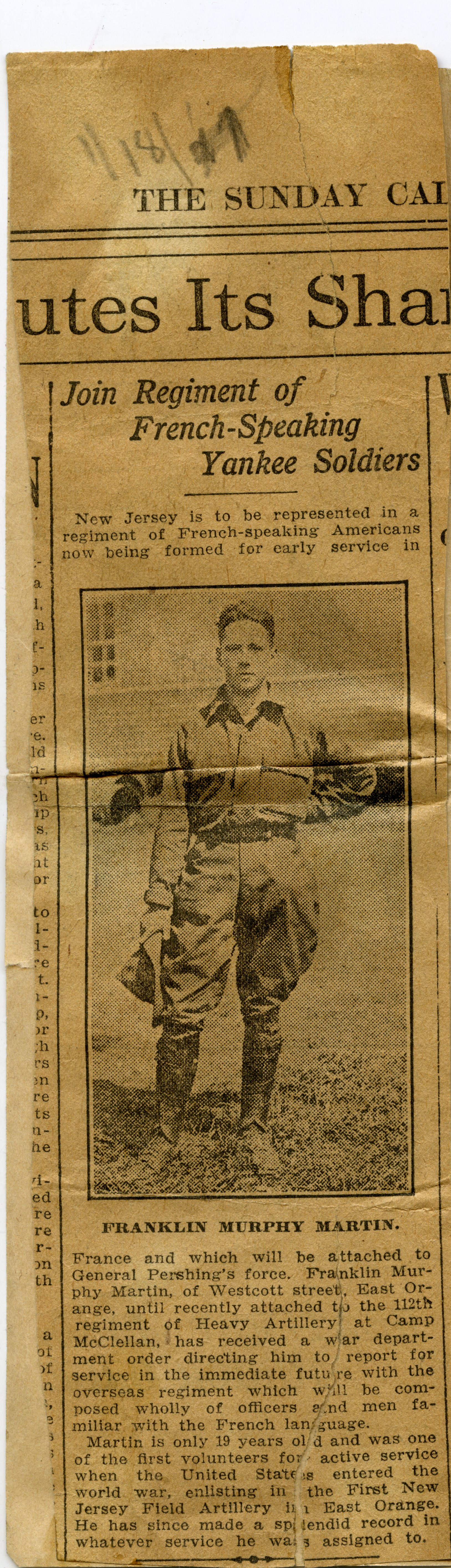
I purchased a large WWI photo album last month that was compiled by a young girl following her brother’s exploits in France.  Apparently Franklin M. Martin (Jack) of East Orange, NJ was fluent in French and was assigned as an interpreter on Pershing’s staff.  He became interested in flying and joined the 803rd Aero Squadron where he was in charge of map making from the air.  He was awarded the Croix de Guerre after he was shot down and landed in the Marne River.  After swimming across he was able to deliver his maps!  A great series of interior studio shots capture Franklin wearing his newly awarded CDG.  His friend is wearing a Distinguished Service Cross and is sporting a wound chevron.  Note the leather arm brace and private purchase lace up boots.


WWI Real Photo Postcard – Portrait Photo and Autograph of J. Warner Reed – 59th Pioneer Infantry Commander


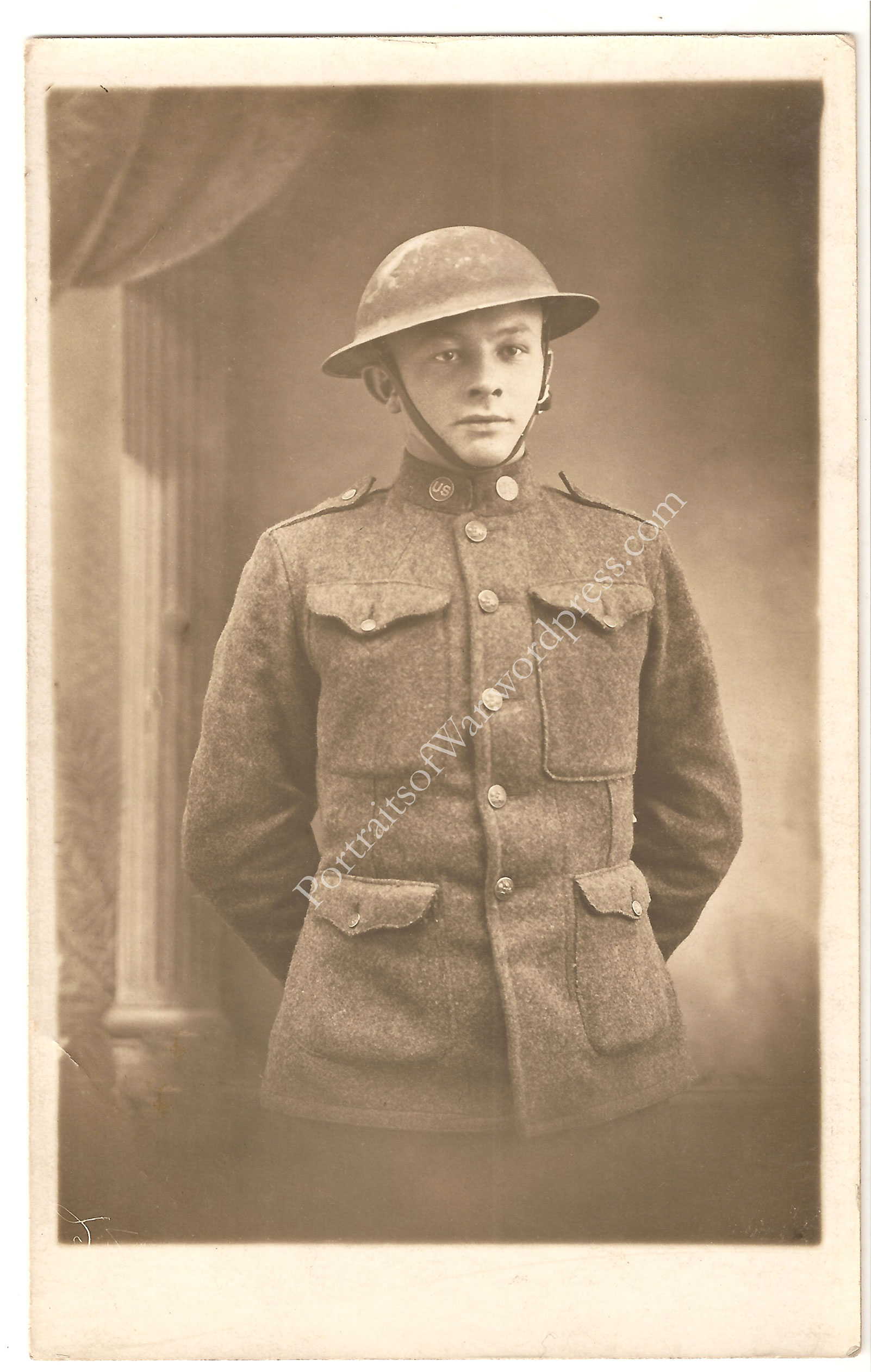
A new addition to my collection comes in the form of an autographed French RPPC of the 59th Pioneer Infantry Regiment commander.  J. Warner Reed was a colonel with the Delaware National Guard during the Mexican Border War and later went on to form the 59th Pioneer Infantry of the 2nd Army.  Units from this regiment were engaged in road building, bridge building, and front line construction and improvement projects.


For more info on the 59th Pioneers – check out this website from the Delaware National Guard: http://delawarenationalguard.com/aboutus/history/firstworldwar/


WWI 42nd Division Doughboy Sends Home a Real Photo Postcard


Ever wonder how doughboys sent their photo postcards home?  I actually don’t own a single example of a postmarked photo postcard from the war, but recently came across a grouping that contained an envelope and postcard sent home by a 42nd Division soldier.  A member of the 151st Field Artillery, Frank Svec sent home a studio portrait shot of himself.  Not incredibly rare, but a good example of how WWI photos were sent during the war.  The 42nd Division is one of my favorite divisions, so this is an addition “kicker”.

Veterans Days 1921 – Tomb of the Unknown Soldier Ceremony Service Attendant


As of the fall of 1920, the US Quartermaster Graves Registration Service had successfully identified over 90% of the bodies of US servicemen who died overseas during WWI.  The nation was still in mourning from the losses of the war, and the government looked to other countries for a suitable ceremony to honor those whose bodies were never identified.  In the fall of 1920, the caskets of four unidentified U.S. soldiers were chosen for reburial in Washington D.C.  One pallbearer, SGT Edward Younger, chose one body to be the Unknown Soldier of WWI.

The remains were transported aboard the USS Olympia, the flagship of Vermont’s Own Admiral Dewey, and arrived home on November 9th, 1921.  The body lay in state in the Capitol Rotunda for two days, where over 90,000 people quietly filtered through.  This Unknown Soldier was buried with full services on November 11th, 1921.

As I pawed through my large collection of WWI and WWII photography looking for a suitable candidate for a Veteran’s Day post, I came across one photo that stood out as a perfect blogpost.

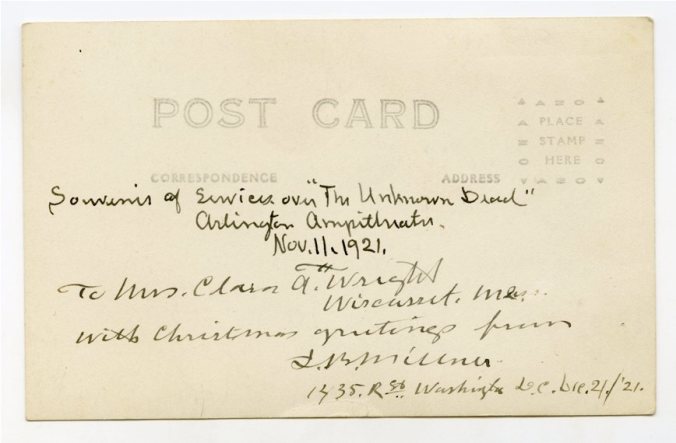
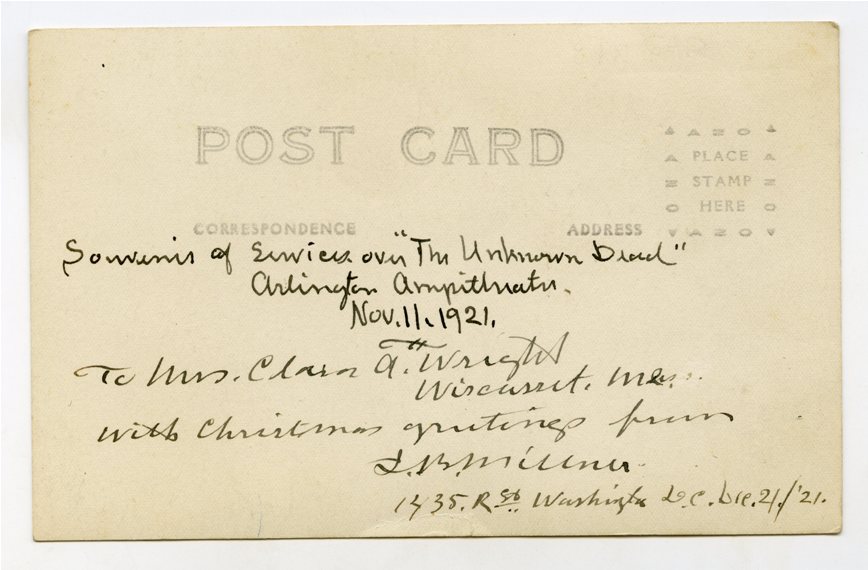
This veteran is wearing an Indian Wars medal on his chest, and looks distinguished in his black cap and jacket.  This photo was taken only moments after he was a member of the first Tomb of the Unknown Soldier ceremony on November 11th, 1921.  He inscribed a quick note to a loved one on the reverse.  I can’t find a list of the members of that first delegation anywhere, but I’m sure he is one of the visible veterans standing around the casket in this photo:

Courtesy of Wikipedia Commons

Although his identity is a mystery to me, maybe his name will come to the surface after this post hits the web.  What a fitting photo post for Veterans Day!

Special thanks to David R. Berry for the following message:

May I submit to you that the identity of the distinguished gentleman is Mr. Isaac B. Millner. US Navy, Civil War veteran –a seaman aboard the USS HARTFORD, flagship of Adm Farragut at the Battle of Mobile Bay 5 Aug 1864. Millner had a life-long interest in Adm Farragut, attending several commemorations of Farraguts life and career.

He was affiliated with the Dept. of Anthropology at the National Museum; holder of several patents; a specialist in Native American and Micronisian Indian cultures; a modeler for the Smithsonian working in the medium of paper’ machete and a member of the US Geological Survey. Author of the book: The Last Cruise (1917)

You will find many notations for him in Google under his full name as well as his initials I B Millner. He is mistakenly noted in the 1920 Census as Isaac B Mi-(one L) ner. What his relationship with Mrs. Clara A Wright Of Wincasset, Maine, might be is unclear, but one might note that the description and the address texts on the back of the portrait were written in two distinctly different hands. It could be that Mrs. Wright was a friend of his wife Mrs. Mary Millner.

A 1929 photo of IB Millner appears here:

http://www.loc.gov/pictures/resource/cph.3c31287/

WWI 310th Engineer “Polar Bear” in Archangel Russia, 1918 – US Northern Russia Expedition


310th Engineer in Archangel, Russia

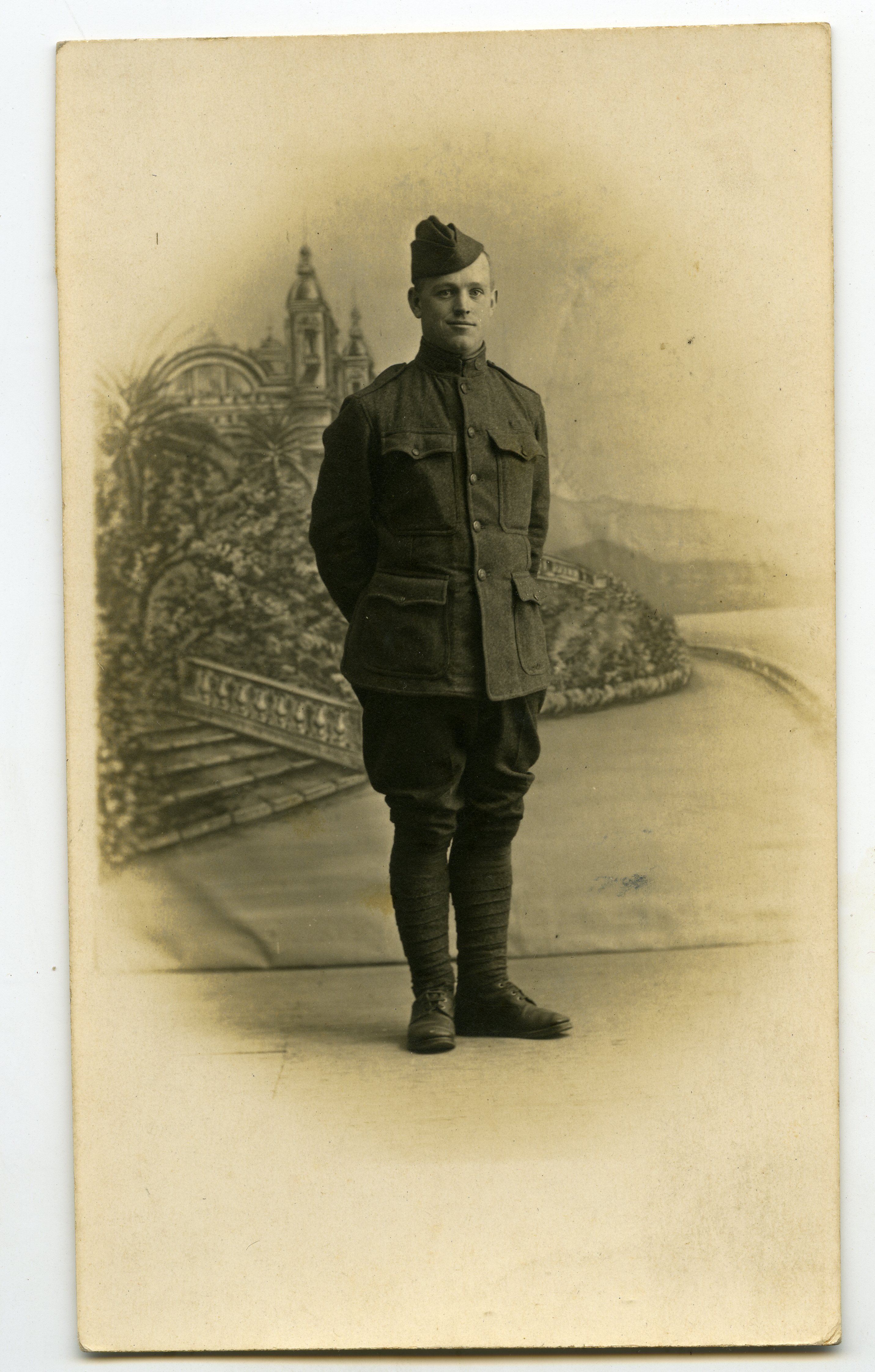
Don’t know too much about the US involvement in Russia during WWI?  Don’t worry, neither did I until a few years ago.  The above photo was acquired from a poorly listed eBay auction, and depicts a 310th Engineer posing for the camera in a Russian studio in the city of Archangel.  Photos of “Polar Bear” soldiers are incredibly rare, especially front-taken studio portraits.  I’ve seen a FEW example of Polar Bears posing back home, but only a couple taken overseas.  This one is particularly rare, as it shows a member of the 310th Engineers, who only sent ONE battalion of soldiers up to Russia.

Want to read more about the Polar Bears?  Visit the site below!

An excerpt taken from the Bentley Historical Library at the University of Michigan’s website:

(http://polarbears.si.umich.edu/index.pl?node=polar%20bear%20history)

“The American military intervention at Archangel, Russia, at the end of World War I, nicknamed the “Polar Bear Expedition,” is a strange episode in American history. Ostensibly sent to Russia to prevent a German advance and to help reopen the Eastern Front, American soldiers found themselves fighting Bolshevik revolutionaries for months after the Armistice ended fighting in France.

Because many of the American troops involved in the intervention were from Michigan, the Michigan Historical Collections has long been interested in documenting this episode. This guide describes the Collections’ holdings of manuscripts and photographs as well as maps and primary printed source materials relating to the Polar Bear Expedition.

During the summer of 1918, the U. S. Army’s 85th Division, made up primarily of men from Michigan and Wisconsin, completed its training at Fort Custer, outside of Battle Creek, Michigan, and proceeded to England. While the rest of the division was preparing to enter the fighting in France, some 5,000 troops of the 339th Infantry and support units (one battalion of the 310th Engineers, the 337th Field Hospital, and the 337th Ambulance Company) were issued Russian weapons and equipment and sailed for Archangel, a Russian port on the White Sea, 600 miles north of Moscow.

When American troops reached their destination in early September, they joined an international force commanded by the British that had been sent to northern Russia for purposes never made clear. Whatever the reasons for the intervention, however, the force was fighting the Bolsheviks who had taken power in Petrograd and Moscow the previous winter.”

WWI Doughboy Photo and Grandson Reunited: The Story of PFC Charles R. Nablo


Not every WWI photo in my collection has a name inscribed on the reverse, but this one comes with both a name and a modern day connection.  After buying the image on eBay with only minor excitement, I was pleased to find a name and address inscribed on the back giving me a glimmer of hope in identifying the soldier.  After doing a quick search on findagrave.com (a great site for cemetery information), I was able to find the name of the cemetery where Mr.Nablo is buried.  Without much hope, I submitted a grave photograph request and was astonished when, within a few days, my request was fulfilled with a snapshot of his grave marker.  I added his photo to the findagrave.com site and wiped my hands of the issue.  One week later, the grandson of Charles Nablo emailed me!  I sent him the photo in the mail, and helped reunite a lost photo to it’s rightful owner.

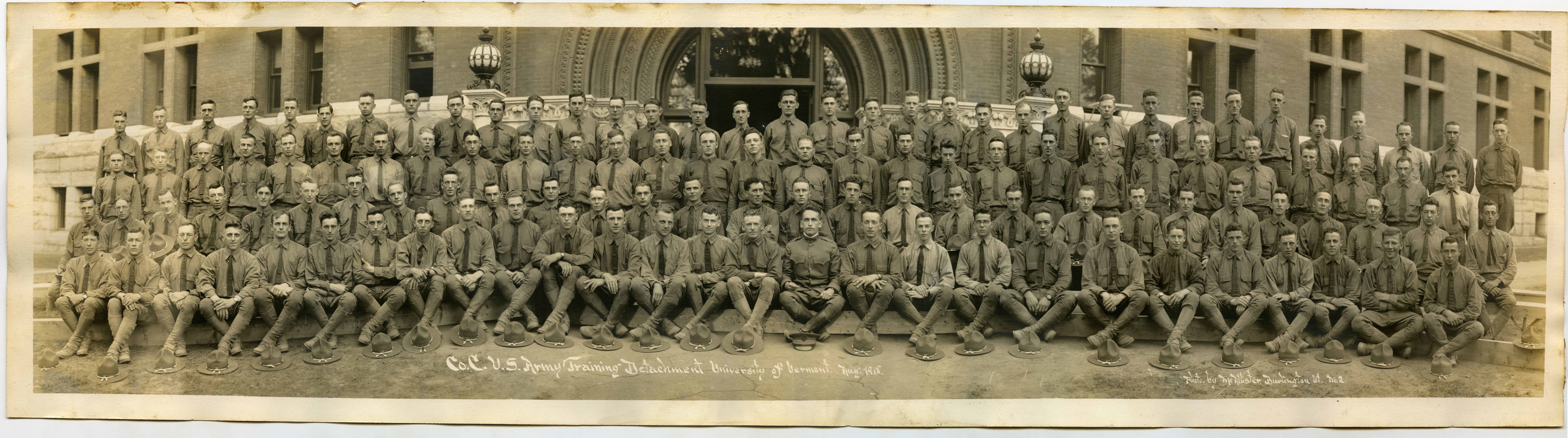
WWI The University of Vermont at War – Williams Hall Army Training Detachment – August 1918


Authors Collection


My recent trip to the local Burlington antique shop yielded some WWI gold; yet another WWI UVM panoramic photo to add to my extensive collection of war photography.  This one was taken in August of 1918 in front of Williams Hall at the University of Vermont.  I spent countless hours studying anthropology and archaeology in the hallowed halls of Williams, and I know the front facade well.  From the looks of it, not much has changed!   This photo shows Company C of the US Army Training Detachment which was housed at UVM in the months preceding the end of the war.

Looking at some of the details of the photo actually helped elucidate a bit of Louis McAllister’s business.  Check out the writing on each of the benches – it appears that McAllister wrote his name on each bench in his typical flowery style.  Very interesting!