The Congressional Medal of Honor was awarded to 119 members of the U.S. Army, Navy, and Marine Corps during World War I, 33 of them posthumously. Portrait photographs of these heroes are remarkably scarce, but I was fortunate to recently acquire one. The subject of tonight’s post is Captain Samuel Woodfill of Indiana, one of America’s most celebrated soldiers of the Great War.
Captain Samuel Woodfill, U.S. Army Often described by General John J. Pershing as “the outstanding soldier of the American Expeditionary Forces,” Captain Samuel Woodfill earned the Medal of Honor for extraordinary heroism during the Meuse-Argonne Offensive on October 12, 1918. Leading his company through heavy fog and enemy fire near Cunel, France, Woodfill singlehandedly attacked multiple German machine gun nests, killing or capturing their crews despite being gassed and exhausted. A career soldier from Indiana, Woodfill had already served in the Philippines and on the Mexican border before World War I, and his calm, precise marksmanship in France became legendary among his peers. After the war, he was personally honored by Pershing and later chosen to represent the U.S. Army’s enlisted men at the dedication of the Tomb of the Unknown Soldier in 1921.
Arlington National Cemetery Video: Major Samuel Woodfill
Reverse Side of Woodfill’s Portrait
His Medal of Honor citation reads:
“While he was leading his company against the enemy, First Lieutenant Woodfill’s line came under heavy machine gun fire, which threatened to hold up the advance. Followed by two soldiers at 25 yards, this officer went out ahead of his first line toward a machine gun nest and worked his way around its flank, leaving the two soldiers in front. When he got within ten yards of the gun it ceased firing, and four of the enemy appeared, three of whom were shot by First Lieutenant Woodfill. The fourth, an officer, rushed at First Lieutenant Woodfill, who attempted to club the officer with his rifle. After a hand-to-hand struggle, First Lieutenant Woodfill killed the officer with his pistol. His company there upon continued to advance, until shortly afterwards another machine gun nest was encountered. Calling on his men to follow, First Lieutenant Woodfill rushed ahead of his line in the face of heavy fire from the nest, and when several of the enemy appeared above the nest he shot them, capturing three other members of the crew and silencing the gun. A few minutes later this officer for the third time demonstrated conspicuous daring by charging another machine gun position, killing five men in one machine gun pit with his rifle. He then drew his revolver and started to jump into the pit, when two other gunners only a few yards away turned their gun on him. Failing to kill them with his revolver, he grabbed a pick lying nearby and killed both of them. Inspired by the exceptional courage displayed by this officer, his men pressed on to their objective under severe shell and machine gun fire.”
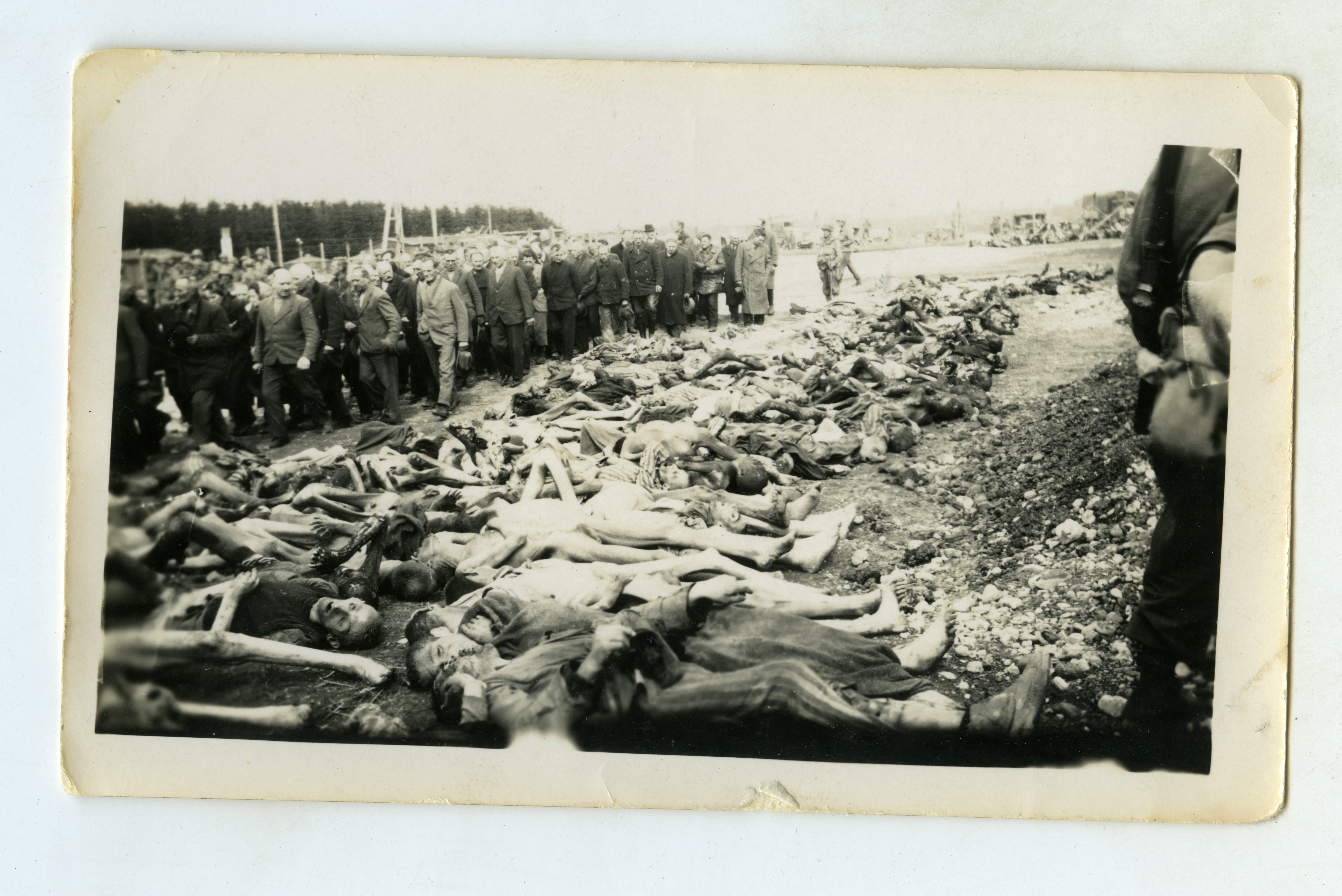
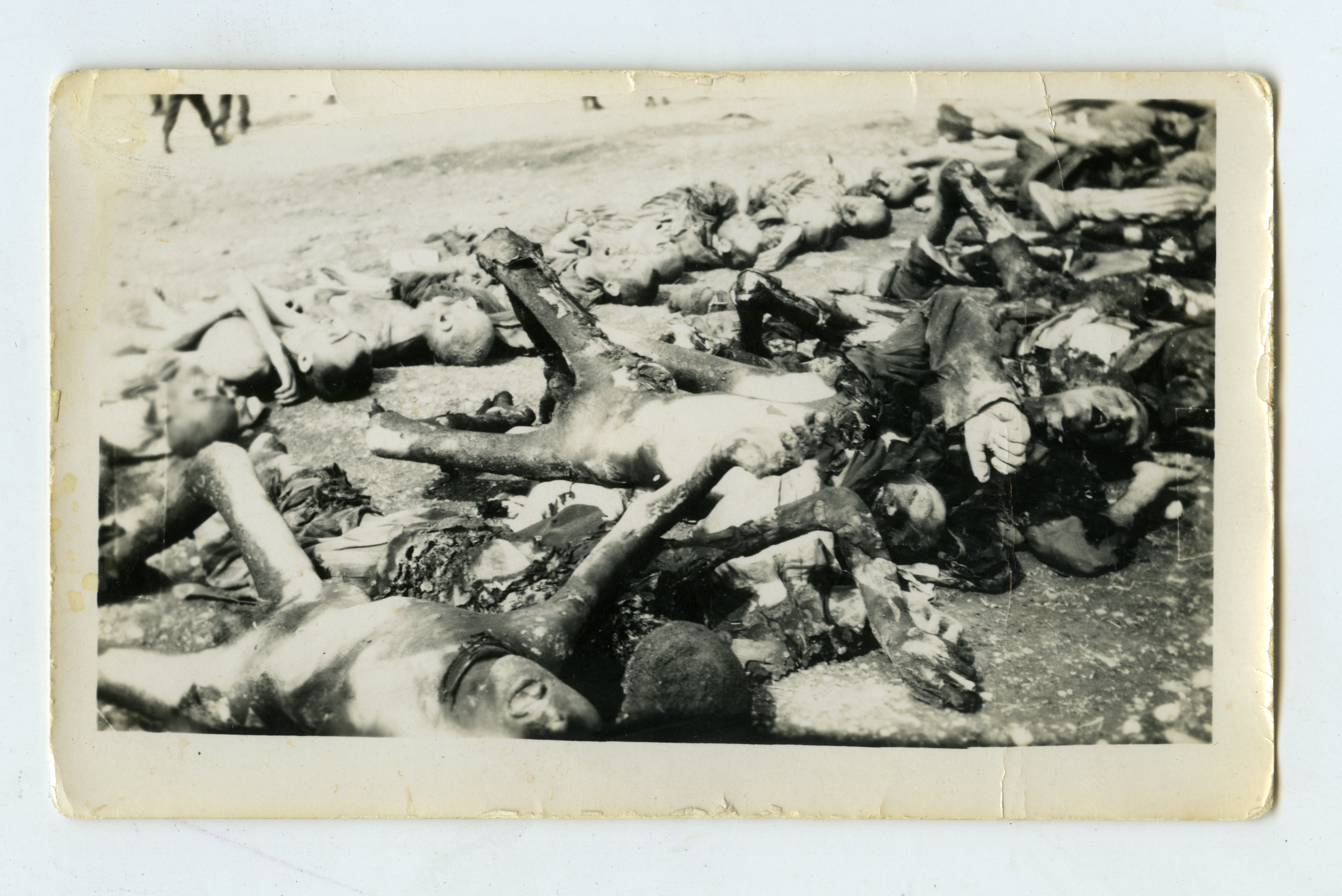
Eight years ago I posted a series of snapshots taken by a US soldier showing the liberation of an unknown concentration camp during WWII. When I acquired the photos, they had no provenance and no information on the reverse side to start the process of identification. Luckily, a blog follower was able to help with the identification of the camp through the same processes I typically use. By observing the surrounding architecture and general contextual clues, he was able to identify the camp as Kaufering IV, a large subcamp of Dachau. Here is what he provided:
Some thoughts:
i)This is certainly somewhere Upper Bavaria – the house architecture is fairly typical of the region.
ii)The presence of the 2 Luftwaffe officers suggests some sort of air force activity is close by. Lager Lechfeld was used as a fighter base and a shake-down airbase for the nearby Messerschmitt complex in Augsburg. Prisoners were engaged in constructing bomb-proof bunker-factories in appalling conditions.
iii)One of the photographs has a very distinctive semi-sunken barrack type, known as “Erdhütten” (Lit: “Earth huts”) – very primitive constructions, the timbers of which were made from off-cuts and waste from furniture production and which survivors testify, leaked terribly. These barracks were a distinctive feature of the Dachau sub-camps in the Kaufering/Buchlöe area.
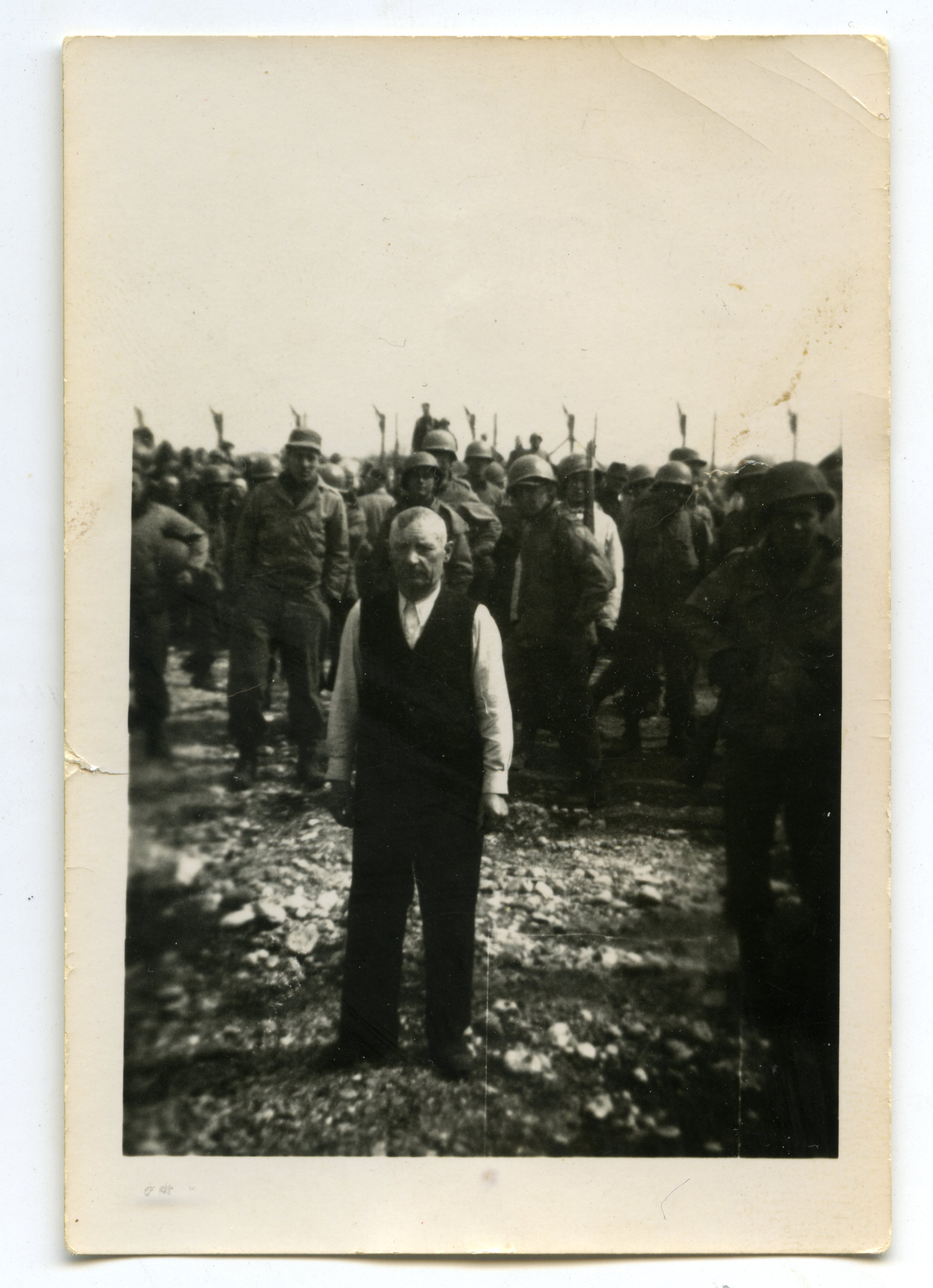
Thanks to the careful research of Taff Simon, we now know that the camp shown in these snapshots is Kaufering IV. A closer look at the details within the images supports his findings. One particular photograph offers the clearest confirmation: it shows an older man in civilian clothing with a closely shaven head, a haunting detail that anchors these scenes to the history of this Dachau subcamp.
Snapshot of SS Commandant Johann Baptist Eichelsdörfer
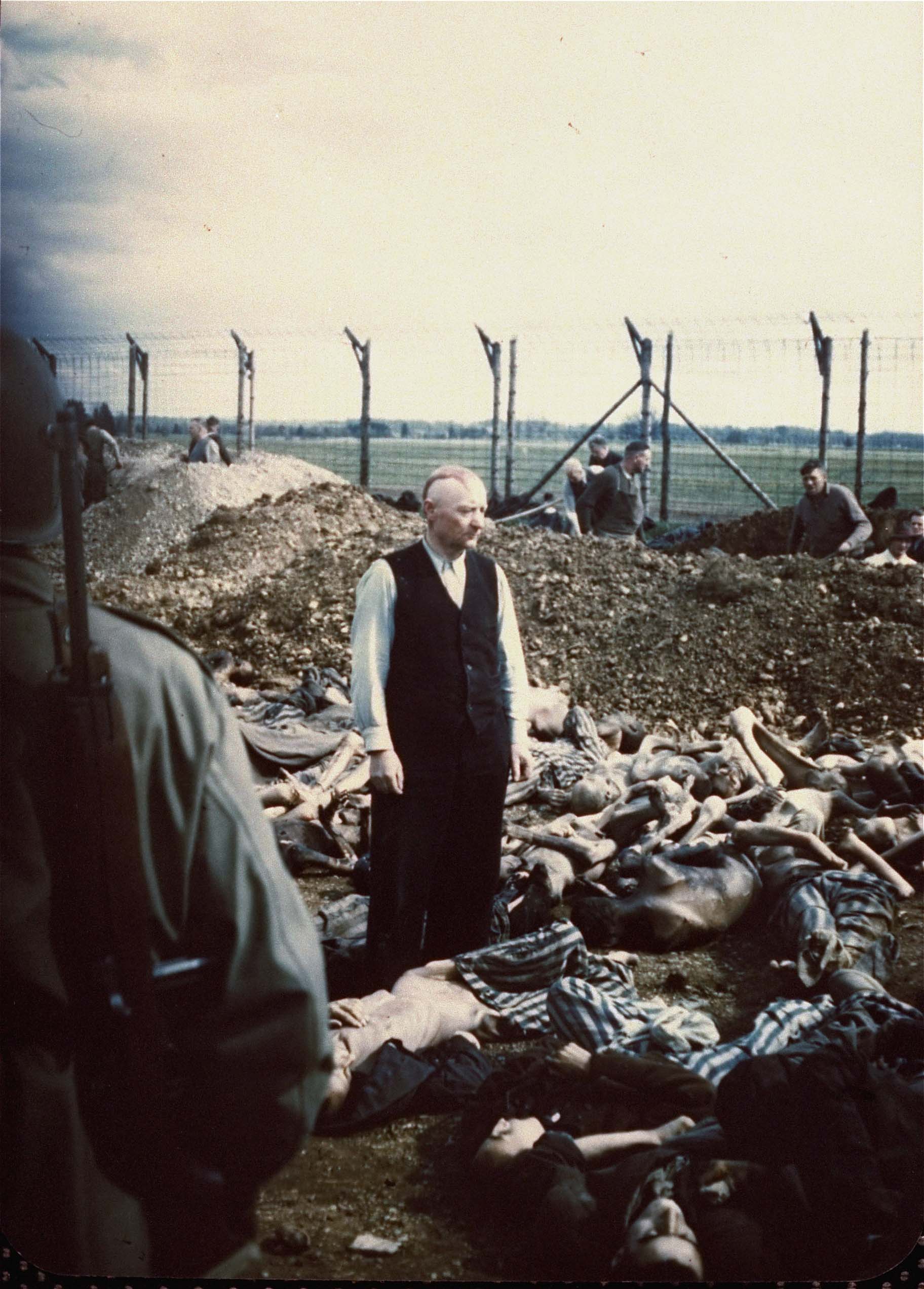
When I first wrote about the snapshot collection in 2017, I was unable to identify the man since he was in civilian garb. Artificial intelligence image searches at the time were unable to attribute the image to any individual, so I was under the assumption that he was a local civilian who was brought in to help with the burial of the camp victims. But now, with the attribution of the snapshots to Kaufering IV, I was able to find more images of Eichelsdörfer. His shaven head with the lopsided squirrel-tail appearance confirms his identity when compared to the images below.
Color Photo of Johann Baptist Eichelsdörfer (US Holocaust Museum image)
(SS officer Johann Baptist Eichelsdoerfer, the commandant of the Kaufering IV concentration camp, stands among the corpses of prisoners killed in his camp. US Holocaust Museum image)
(Wikipedia Commons)
Who was he?
Johann Baptist Eichelsdörfer was a German military officer and concentration camp commandant during World War II. Born on January 20, 1890, in Dachau, Germany, he served as a non-commissioned officer in the Bavarian Army during World War I and remained in the military after the war, retiring in 1924 with the rank of lieutenant. He rejoined the military in 1940 and served in various locations, including France, Poland, and the Soviet Union. In 1944, he was assigned to the Dachau concentration camp system, where he served as the commandant of several subcamps. In January 1945, he took command of Kaufering IV, a subcamp of Dachau located near Hurlach, which was designated as a “hospital camp” but was, in reality, a site where sick and dying prisoners were abandoned without adequate medical care. Under his command, thousands of prisoners died due to starvation, disease, and mistreatment.
Eichelsdörfer’s actions came to light when American forces liberated Kaufering IV on April 27, 1945. U.S. soldiers discovered hundreds of bodies and surviving prisoners who had been subjected to brutal conditions. Eichelsdörfer was captured and photographed standing among the bodies of dead inmates, a stark image used as evidence during his trial. He was tried at the Dachau Trials, a series of military tribunals held by the U.S. Army to prosecute Nazi war criminals. On December 13, 1945, he was convicted of war crimes and crimes against humanity and sentenced to death. Eichelsdörfer was executed by hanging on May 29, 1946, in Landsberg am Lech prison. His trial and execution highlighted the atrocities committed in the Nazi concentration camps and served as a reminder of the need for accountability in the aftermath of war.
The Other Snapshots
Now that we know the snapshots from the 2017 blog post were taken at Kaufering IV, the other images captured by an unknown US GI make more sense. I will post them here with some updated commentary. Feel free to weigh in if you have any comments or suggestions for descriptions.
Kaufering IV Survivor
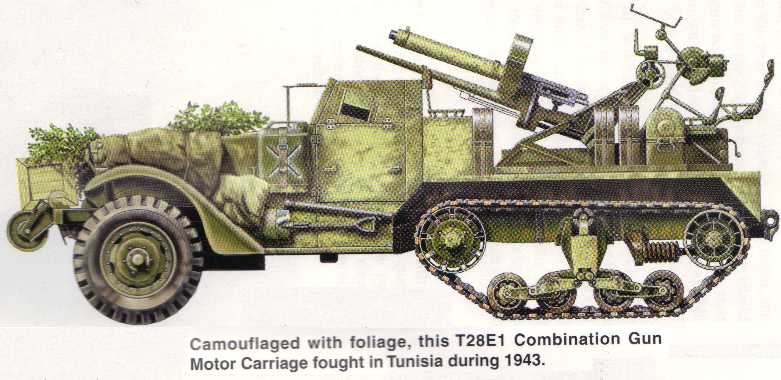
In the above image, we see a recently liberated survivor of his time at Kaufering IV. He’s using his bandaged hands to tie on a pair of shoes, likely a pair provided to him by US soldiers. He also appears to have some soup in a small can as well as a striped blanket wrapped around his head and body. In the back of the image appears a US T28E1 which was likely one of the 12th Armor Division’s anti-aircraft mobile vehicles. The painted sillouettes of 14 German aircraft on the side hint that the operators of the T28E1 shot down lots of German aircraft as the war came to an end.
Generalized View of the T28E1
German Luftwaffe Officers
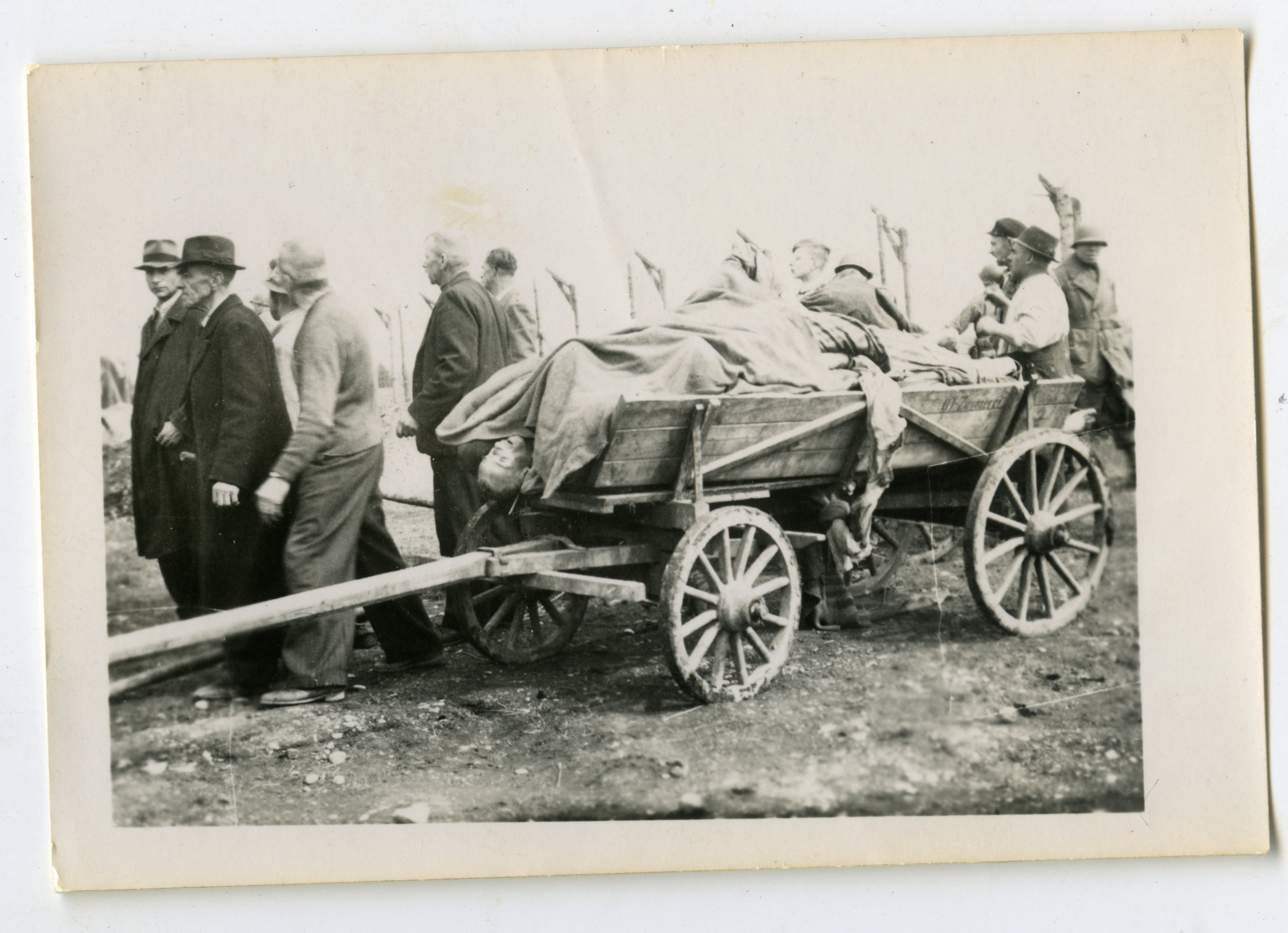
German Civilians Help with Burial
Camp Building and Ditch
Local Civilians Observe the Dead
Kaufering IV Victims
US Officers Speak to a Crowd
US GI’s View the Dead
Camp Victims
Camp Victims and Army Officers
Camp Victims
Local German Civilians Listen to US Officers
I really don’t know how to close this sobering post update from 2017. I did pass the snapshots along to a WWII veterans museum based here in the United States, but I’m unsure of what they ended up doing with them. I hope that his post will help educate those researching Kaufering IV and bring some closure to the mystery of when and where these snapshots were taken.
If you want to see some footage from the camp liberation, please check out the video here.
Easy Co. 506th PIR, 101st Airborne, Band of Brothers at Kaufering IV
HBO’s Band of Brothers covered Kaufering IV briefly in one episode. The unit was involved in the liberation of the camp, along with the 12th Armored Division. See below for a dramatized version of the events. The small earthen huts described by Taff can be clearly depicted. The HBO historical accuracy consultants did a great job!
Finding vintage photography to post to the site that has meaningful background history has been a tough mission the last few years. I was recently inspired to start posting to the blog more often from a group of friends who enjoy seeing great photography mixed in with background research. This site has always been a labor of love and I’ve neglected posting new material (but have updated older posts) since the global pandemic hit. I now introduce you to a new addition to the collection that showcases an underappreciated aspect of the the WWI US service experience.
The process of making these shots web-ready is a bit tedious but it involves the scanning, editing for dust and scratches as well as optimizing size for the web. It’s not a quick task but I like to take time to make these available whenever possible.
Ernie Rayburn and Ollie Stiger Smoking Cigars in France, 1918
This photograph struck me when I first viewed it for a few reasons. The role of African Americans in World War One has been touched upon in books, documentaries and museum exhibits but the photographic history of the common labor war worker has been eclipsed by the “fighting” units that are often depicted. These two men, Erie Rayburn of Coffeeville, MS and Ollie Stiger of Jackson of the same state have likely never been shown online. These postcard style shots were often taken to be sent to friends and family as a way of remembering a time where the normal day-to-day life of the 1910s was upended and normal guys were thrown into abnormal situations.
Ollie and Ernie in France
Both Ollie and Ernie served in the same labor unit – the Depot Service Company No. II based out of Brest, France during the war. I’m unsure of what exact labor duty they would have been assigned to but it likely involved the moving of material onto or off of ships onto trucks or trains. More research will need to be done.
Ollie Stiger (also spelled Steger in later documents) was born on August 6th, 1892 (also listed as 1891?) in Mississippi and died in San Diego, CA in October of 1972. After the war he worked with the Chicago and North Western Railroad as a “coach cleaner”. I’m unaware of any children or family at the point of writing this post.
Sgt. Ollie Stiger in France, 1918.
Corporal Erie Rayburn was also from the same hometown of Ollie of Coffeeville, MS and was born around the same time in 1895 and passed away a few years after Ollie in 1988. I sincerely hope they stayed friends after the war and after they parted ways to seek the true American Dream.
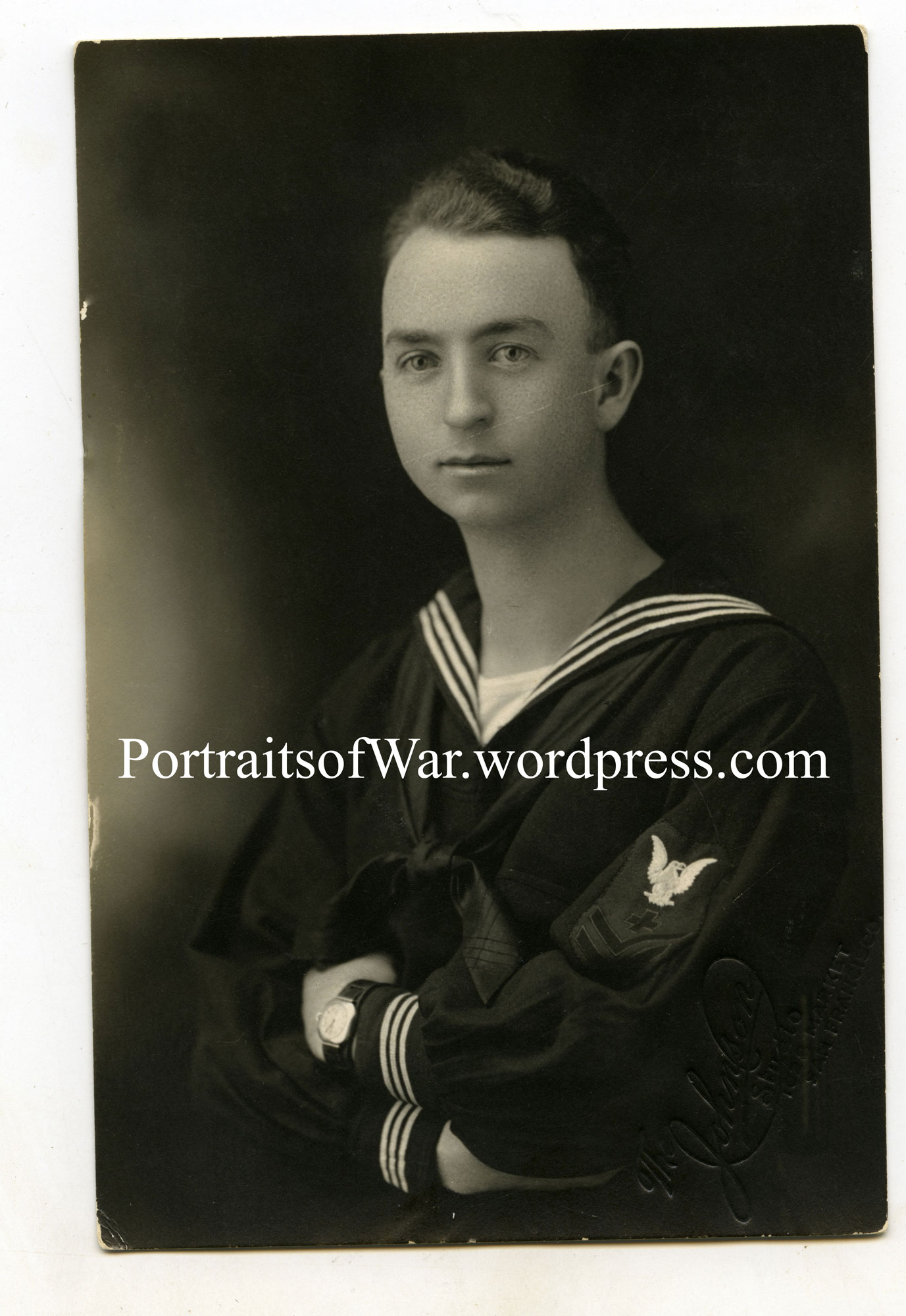
When searching for new portraiture to add to PortraitsofWar I generally tend to look for material with identifiable soldiers, uniforms, medals and other written or visual clues to help shed light on life during wartime. In this post, I will be researching a photograph of a US Navy sailor who caught my eye during a recent eBay search.
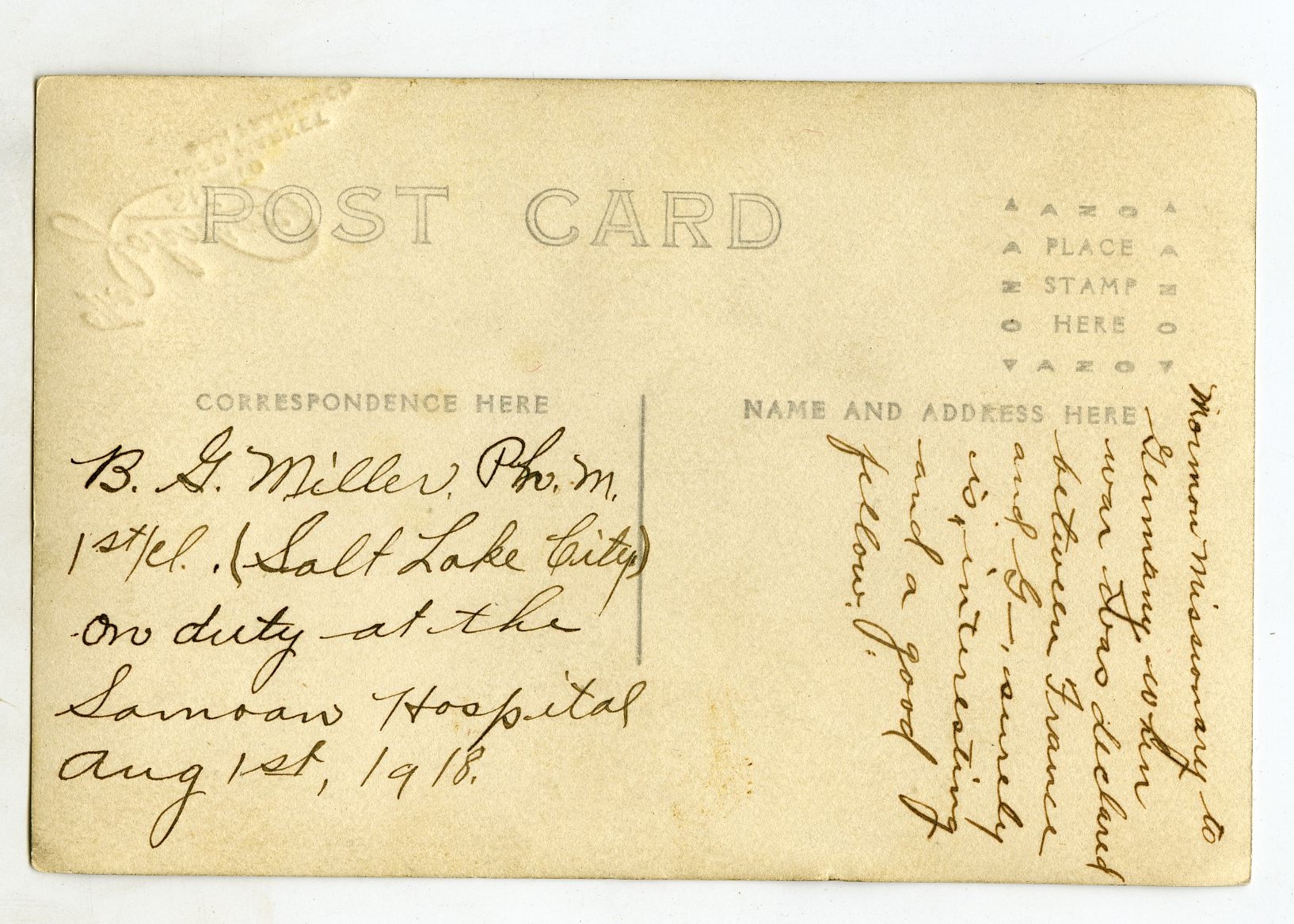
Reverse Side of Postcard
The information written on the back of the postcard shows an identification of the sitter as a B.G. Miller. He is identified as being a Pharmacist’s Mate 1st Class from Salt Lake City, Utah who was on duty at one point at a hospital in Samoa on August 1st, 1918. Additional info added to the photo includes an anecdote about his position as a Mormon missionary in Germany during the breakout of the war between Germany and France.
With a little bit of luck and a lot of research I was able to track down our mysterious B.G. Miller. Byron Gardener Miller was found listed in the Utah World War 1 Military Service Questionnaire on ancestry.com. Please see his card below:
Byron’s WWI War Service Card
It looks like Byron attended the University of Utah for a year before being shipped off for his overseas missionary work. This is likely the reason for his service as a Pharmacist’s Mate with the US NAVY as can be seen in the details of his uniform.
Navy Pharmacist Rate Patch
The reference to his missionary service in Germany during the outbreak of war in July of 1914 is partially confirmed through my discovery of his listing aboard a ship ledger arriving in Montreal, PQ in September of 1914.
His service in Samoa has also been confirmed through the same series of records.
Sadly, his arrival back in the US in 1919 wasn’t likely a time of joy for the Miller family; a Utah death certificate shows that he died of the Spanish Influenza only a few months later on February 7th, 1920. Interestingly enough, my research into the US Hospital in Samoa shows that a MASSIVE flu outbreak in the Samoan Islands lead to the deaths of nearly 25% of the population. With over 8500 deaths, the Spanish Flu was devastating to the island. In response, the US Navy set up an epidemic commission to deal with the issue. The results of the intervention in American Samoa were incredible. Apparently the method of using maritime quarantine lowered mortality rates to nearly 1%. It’s strange that Byron would die of influenza only a few months later while in the United State…
One of the main goals of this website is to help share photos and pertinent military service information with the families of the men and women depicted in the images I collect. In this case, I’m hoping a Miller family representative will discover a rare image of their ancestor who witnessed a formative time in history.
I really enjoy meeting with elderly citizens who can remember local events of historic significance and always make an effort to ask them where they were during critical national or international turning points in history. But in the case of the man below, I’m not sure I could top his story. At the time this TV show was filmed in 1956, Mr. Samuel J. Seymour (1860-1856) had already lived through the Civil War, the financial depressions of the late 1800s, the Spanish American War, the invention of the automobile, the invention of flight, WWI (he was in his 50s when that happened), the jazz era, the Great Depression, WWII, the nuclear era, the beginning Korean War and McCarthyism. This guy had seen it all!
Although the contestants figured out his story pretty quickly, the story of his traveling to the show and his determination to tell his story are remarkable. Encounters with people who witnessed history like this are examples of what drives me to continue to take the time to chat with WWII veterans when I encounter them. With so few left, it’s important to just… talk to people. Mr. Seymour passed away only 63 days after his filming of the episode shown below. Enjoy.
The title idiom of this post is an apt description when it comes to the wild world of collecting World War One photography, and especially portrait/studio shots.
More than meets the eye: A hiddensignificance,greaterthan is firstapparent, as in Thisagreementinvolvesmorethanmeetstheeye. [Mid-1800s]
The hidden significance, as stated in McGraw Hill’s Diction of American Idioms is what makes pursuing,collecting and sharing “lost” photos from the world wars so interesting and important to researchers. The individual men and women who lived and breathed the history of our past are often presented as watered-down versions of the average Joe or Jill of their time period. By finding, researching and publishing these photos, I hope to help the public realize that every story is worth telling, irregardless of perceived heroism involved. In the case of this blog post, I’ve decided to pick a current (May 31st, 2017) eBay auction that will certainly meet the criteria of the Mid-1800s idiom seen above.
May/June 2017 eBay Auction
I will post auction details at the conclusion of this blog post, but I wanted to start with a breakdown of why this photograph will sell for hundreds of dollars more than a normal, unidentified U.S. soldier/Marine/sailor from WWI. First, lets see some of the auction details (the seller did a great job of pointing all these out and deserves credit for his research!) that make this a 10/10 snag for the lucky bidder.
What makes this a 10/10 photo for the WWI portrait collector?
Photo aesthetics – The young man in the French studio photo (Carte Postale postcards are French) is striking a casual pose with the intention of showing off multiple pieces of his uniform/accessories. He’s sporting a bold eagle/globe/anchor (EGA) insignia on his cap, a very nice privately purchased trench watch on his left hand (indicating that he’s right handed), an overseas chevron, wound chevron and a nice set of sergeant stripes on his right sleeve.
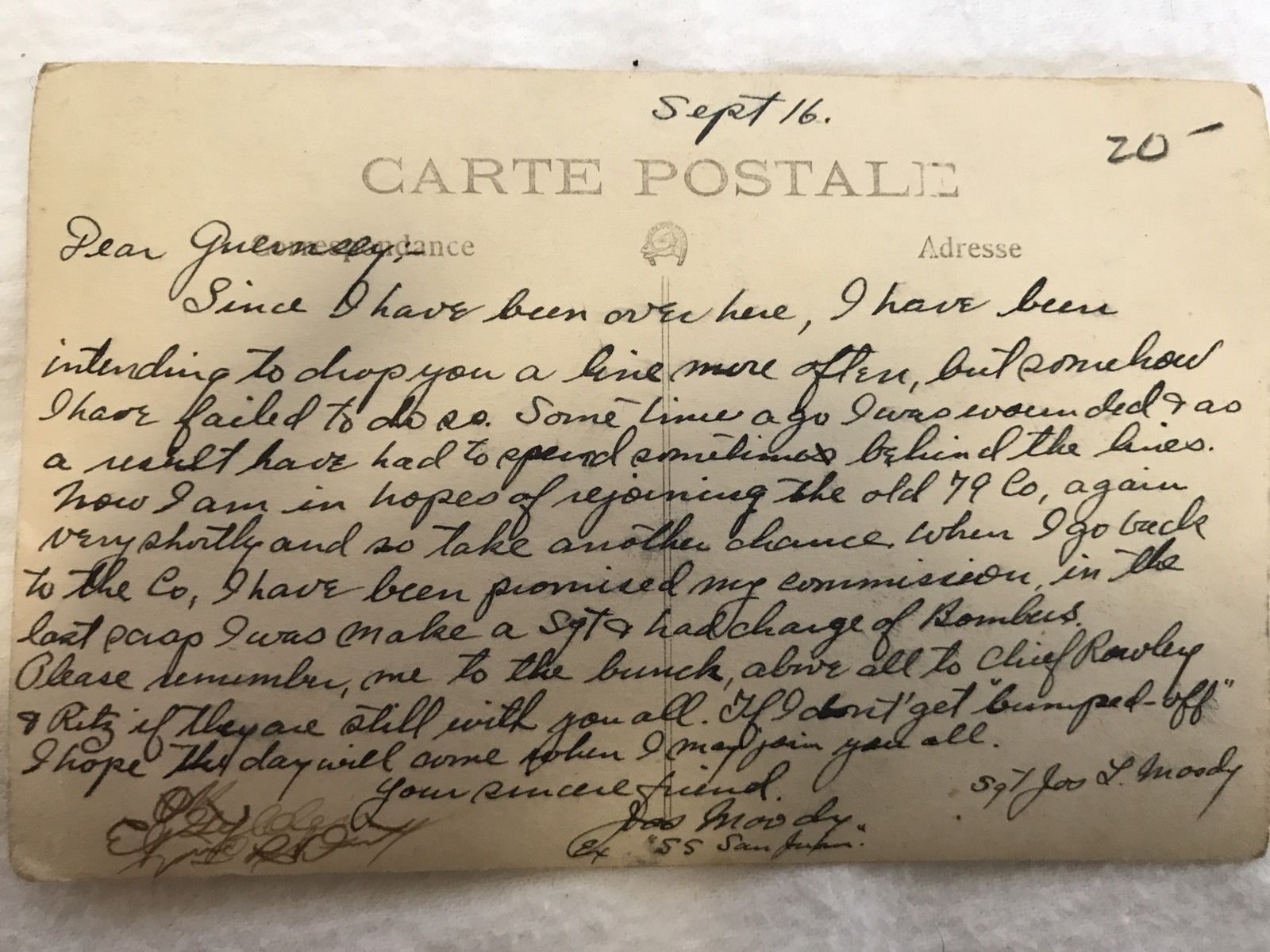
Identification – The period inked identification on the bottom right hand corner gives the intrepid researcher a good place to start searching. I own dozens of shots signed in the same manner. Jos L Moody 6th Marines, ex “SS San Juan” is a good jumping off place…
Written content – The back of the postcard gives a vivid description of his service time to a friend who he appears to have some strong connection to. He mentions the occasion of his wounding, his promotion of sergeant “I was made charge of Bombers” as well as an ominous mention of being “bumped off” as well as his pending commission. Further, the reverse tells us that the photo was taken and sent at least two months before the end of the war, being dated September of 1918, and therefor raises it a few notches in desirability.
Research! – The most vital piece of elevating the significance of a photograph is the story behind the photo. What do all the other key elements tell you? In this case we have, with further research, a photograph of a U.S. Marine who was awarded the Silver Star for his actions at Chateat-Thierry. His Silver Star valor award reads:
By direction of the President, under the provisions of the act of Congress approved July 9, 1918 (Bul. No. 43, W.D., 1918), Corporal Joseph L. Moody, Jr. (MCSN: 92820), United States Marine Corps, is cited by the Commanding General, SECOND Division, American Expeditionary Forces, for gallantry in action and a silver star may be placed upon the ribbon of the Victory Medals awarded him. Corporal Moody distinguished himself while serving with the 79th Company, Sixth Regiment (Marines), 2d Division, American Expeditionary Forces at Chateau-Thierry, France, 6 June – 10 July 1918
Additionally, he is further mentioned in the unit history for the 6th Marines and some additional info can be gleaned: “The six men above {Moody included} named delivered messages through intense machine gun fire from the front line to their battalion commanders , going and returning with important messages…”
Postcard back (officer censured)
So where does this leave us? I’ve pointed out all the salient points that make an interesting photo. But my observations don’t need to be valued in any specific way. I enjoy collecting extraordinarily interesting portraits that don’t need to include identification or a “cool story”. On the flip side, a junky shot of a well-identified soldier/Marine/sailor with a cool history won’t make me open my wallet. It’s really about what you want. Go with your gut!
Ok – so here’s my prediction based on my 10+ years of buying/selling/trading WWI portrait photos. This photograph should sell for anywhere between US $175-$275. It may go for much more if someone has Sgt. Moody’s uniform, medals or has a specific affinity for the 79th Marines. I wouldn’t be surprised if it topped $350 on a good day. Tax returns are coming in?
As of 8:00 PM Eastern Time on 5/31/2017 the bid is at $23.49. I will update the post once the auction ends.
Here’s the address for those of you who have some cash to spend! (Also, $7.75 is a crazy price for shipping!)
FILM PRODUCER’S EX-WIFE SUES Divorce Action Filed Against Retired Officer Faith Cole MacLean Moody, ;former wife of Douglas Mac- ‘Lean, film producer, yesterday filed suit for divorce from’ Capt Joseph L. Moody, United States Marine Corps, retired, charging , incompatibility. Capt. Moody, a brother-in-law of Helen Wills Moody, tennis star, married Mrs. MacLean in Shanghai in January, 1932, while he was stationed in China as an adjutant in charge of American shore forces during the Sino-Japanese troubles. He now is in theatrical work here. The couple separated March 19, according to the complaint filed by Attorney A. S. Gold- ‘flam. There are no children.
eBay Auction Result
Surprisingly enough, my estimate on the final result of the photo sale came in slightly higher than the exact average of my original estimate of $175-$275. Well, maybe it’s not that surprising given that I’ve bid on over 1,000 WWI portrait photos in the past decade….
Here’s the result! – The photo sold for $239.50 plus shipping.
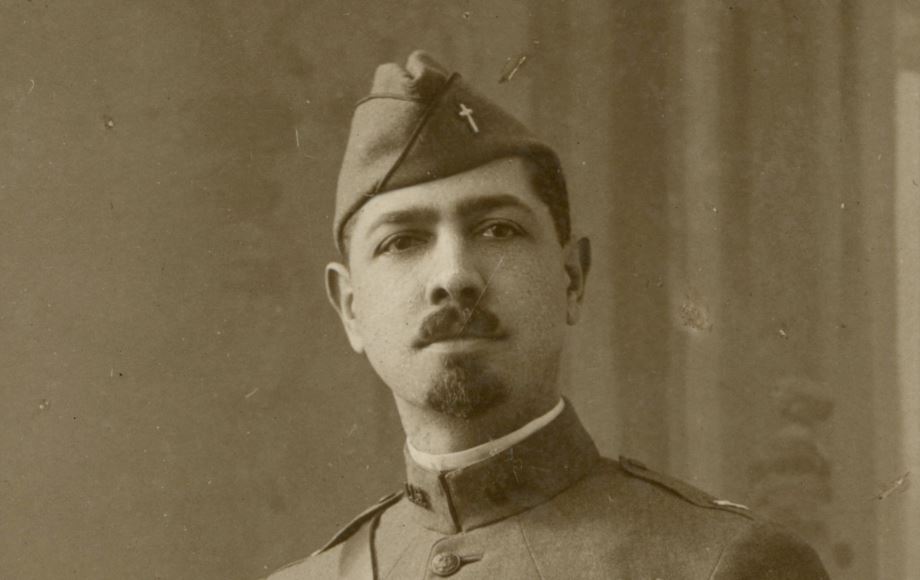
It is never easy to identify someone from a photograph taken nearly 100 years ago, but it’s even more difficult solely based on obscure details from his/her clothing. In today’s blog post I will focus on a photograph purchased on eBay from a fantastic seller named Colleen ( eBay name: cacdivi) who recently sold me a superb French real photo postcard of an American chaplain posed in a studio during World World I (WWI). Here’s the shot:
Wounded American Chaplain in WWI
The scene is fairly typical of what was common of the time period: WWI soldiers/sailors/marine/nurses posed in photo studios in far off places in order to document their experiences to send to relatives and friends. In this case, a currently-unidentified US chaplain (see the crucifix on his shoulder and cap?) strikes a chin-up pose for a French photographer. How do we know that the photo was taken in France?
French Postcard Paper
French postcard paper during WWI almost always contains a central vertical dividing mark with CARTE POSTALE emblazoned across the top. I’ve noted a fair number of varieties likely due to differences in production, but the main bulk of French postcard paper of the period look very similar to the above scan.
Dissection of Photographic Context
What are we looking at? I’ve already mentioned that the man posed in the photo is a US chaplain in a French studio during the war. But what details have I been pondering while waiting for the photo to arrive in my mailbox? (Thanks to Colleen – you rock!)
The chaplain has served at least six months in Europe
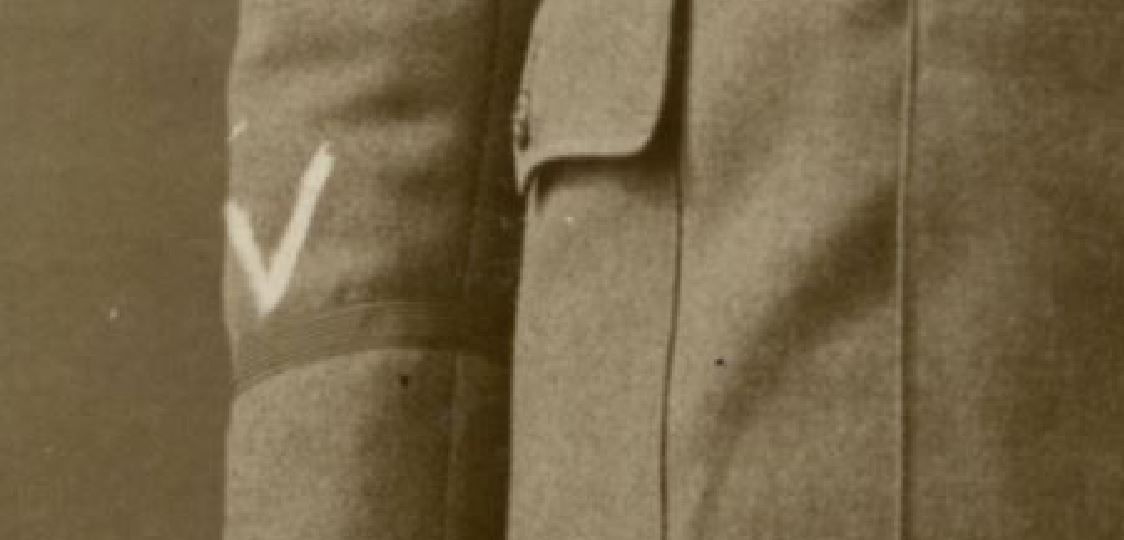
His Left Sleeve (6th Months Overseas Service) Right Sleeve (Wound Chevron)
He was wounded or gassed at least once during his service
His Right Sleeve: Wound Chevron
The photo was likely taken during wartime (before the armistice)
He is oddly sporting a mustache and goatee
Rarely Seen Facial Hair in WWI
He is wearing an identification bracelet made in France
WWI Bracelet Made in France
Why is a photograph of a wounded chaplain posed in a wartime studio worthy of devoting hours of research to? According to a website devoted to military chaplains, the number of wartime chaplains during WWI was incredibly low:
In 1918, Congress passed an act that called for one chaplain for every 1200 officers and enlisted men. Bishop Hayes, in a letter to Cardinal Farley, informs Farley of the current number of chaplains overseas. As of June 1918 there were 301 chaplains in the Army, 30 in the Navy, 7 with the Red Cross, 2 interpreters, and 95 volunteer or Knights of Columbus chaplains.
This photo most likely represents an Army chaplain included in the above June 1918 census: any US chaplain who served at least six months service would’ve been present in France in June of 1918. And to have been wounded or gassed, our unidentified chaplain was likely present during the earlier battles of the US involvement of the war.
Our Chaplain?
Okay, so we know our chaplain was wounded, was photographed at some point in the spring or summer of 1918 and likely served in an Army division that arrived early (for the Americans). His identity, based on date, is narrowed down to 1 in 301 – a pretty good number when it comes to identifying a photo taken 100 years ago. Also, based on rules, he has to be less than 45 years of age.
But what was required to be a US chaplain in WWI? Before researching this photo I had no idea of the low number of volunteers or the actual requirements for acceptance. My personal photo collection contains a half dozen photos of chaplains, which is a surprisingly high number based on the scarcity of the subject matter. I was lucky to track down a copy of the rules and regs of chaplainhood here: http://archnyarchives.org/2015/11/10/military-chaplains-in-world-war-i/
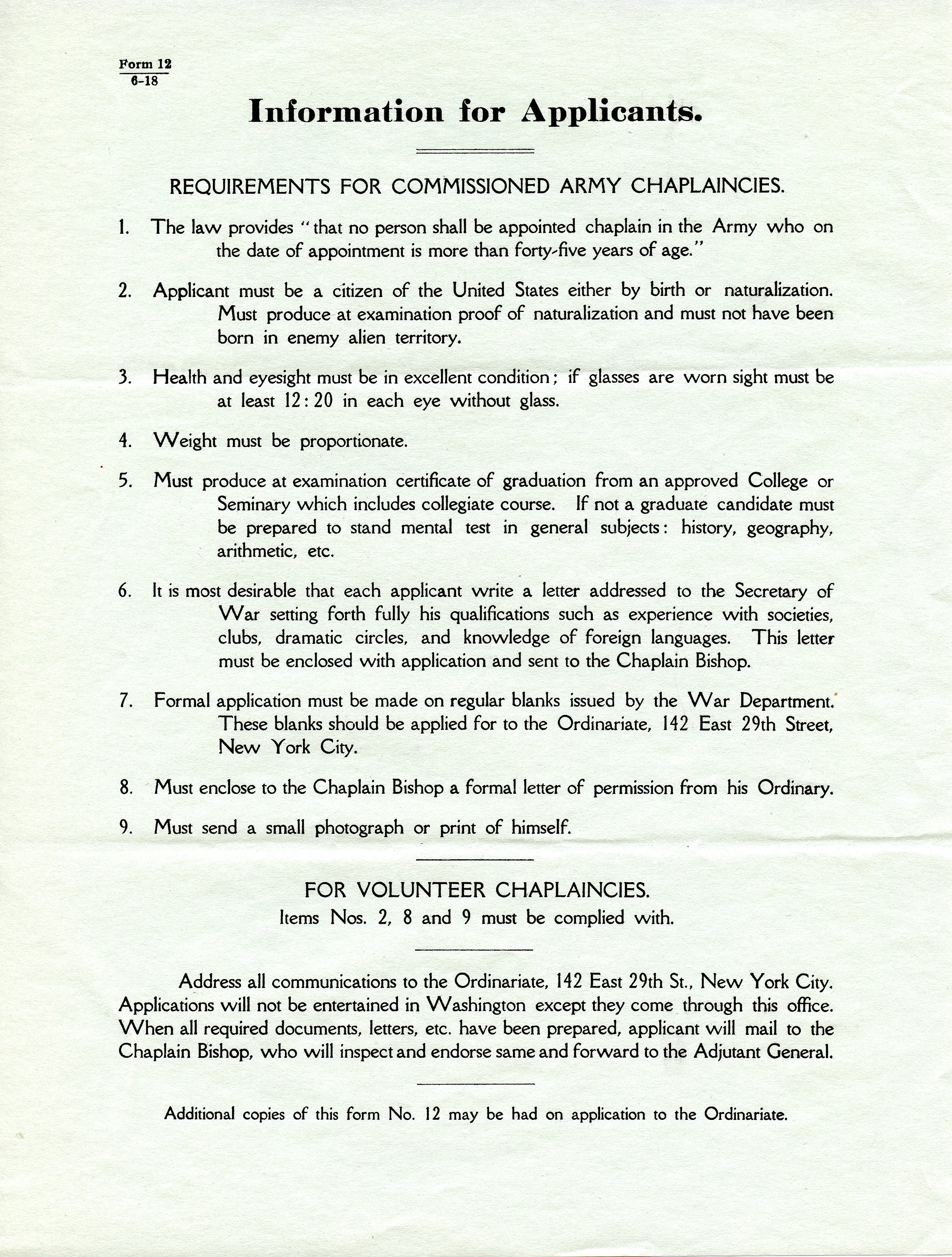
Official Chaplain Requirements
Requirements for Commissioned Army Chaplaincies
The law provides that no person shall be appointed chaplain in the Army who on the date of appointment is more than forty-five years of age.
Applicants must be a citizen of the United States either by birth or naturalization. Must produce at examination proof of naturalization and must not have been born in enemy alien territory.
Health and eyesight must be in excellent condition; if glasses are worn sight must be at least 12:20 in each eye without glass.
Weight must be proportionate.
Must produce an examination certificate of graduation from an approved College or Seminary which includes collegiate course. If not a graduate candidate must be prepared to stand mental test in general subjects: history, geography, arithmetic. etc.
It is most desirable that each applicant write a letter addressed to the Secretary of War setting forth fully his qualifications such as experience with societies, clubs, dramatic circles, and knowledge of foreign languages. This letter must be be enclosed with application and sent to the Chaplain Bishop.
Formal application must be made on regular blanks made by the War Department. These Blanks should be applied for to the Ordinariate, 142 East 29th Street, New York City.
Must enclose to the Chaplain Bishop a formal letter of permission from his Ordinary.
Must send a small photographic print of himself.
1918 Chaplain Application Form
For now I have a good bit of information to extend my research with. Until then, stay tuned!
It’s always fun to sift through assorted boxes from my collection in search of new material to post here to PortraitofWar. In tonight’s case, I stumbled across a portrait shot of a WWI Catholic chaplain from my adopted home of Vermont! With only 16,000 soldiers, marines and sailors during WWI, Vermont is a hard state to collect.
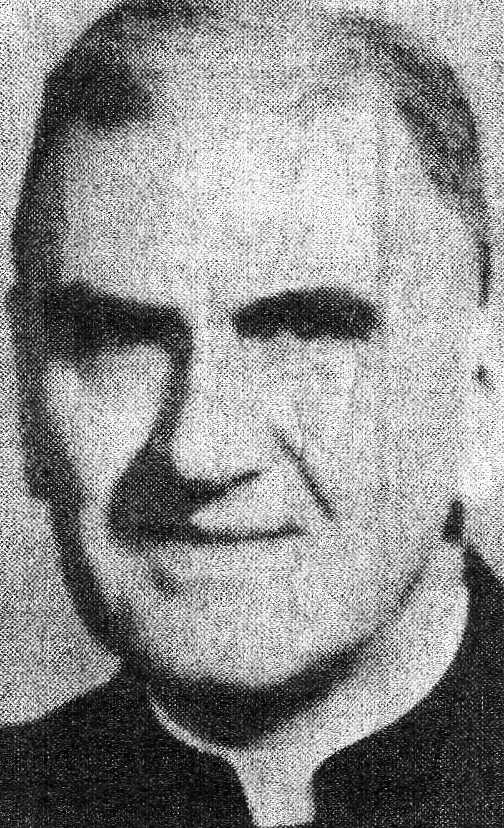
102nd Infantry Regiment Chaplain Arthur J. LeVeer in 1918
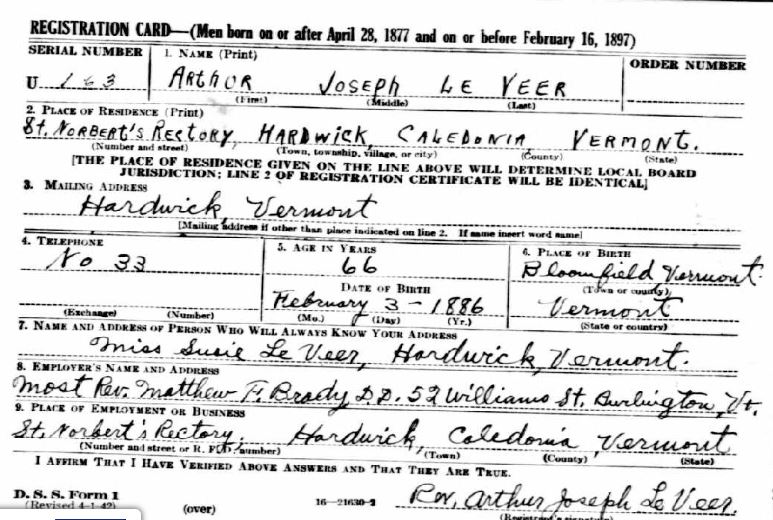
Chaplain Arthur Joseph LaVeer was born along the Connecticut River in the Northeast Kingdom (a regional name) town of Bloomfield, Vermont on February 3rd, 1886. Commissioned as a 1st Lt. on August 22nd, 1918, LeVeer was quickly sent overseas to serve as a chaplain with the 102nd Infantry Regiment of the 26th “Yankee Division.”
Identified chaplain photos are incredibly hard to find on the open market, and to find an example taken overseas showing a unit patch and chaplain insignia makes this an exciting acquisition. Father LeVeer served at St. Norbert’s Church in Hardwick for the remainder of his life; this is a spot that I’ve passed hundreds of times during my life without giving a second thought to the WWI history of the area.
Arthur’s WWI Record
Arthur’s WWII Draft Card
Rev. Arthur LeVeer is buried in the Mount Cavalry Cemetery in Saint Albans, Franklin County, Vermont.
A female US service member rocks a summer dress and snaps a shot of the photographer; what more can you ask for from a blog dedicated to obscure vernacular snapshots taken during wartime? Originally digitally cropped down from a slightly larger print, this shot exudes the youthful demeanor of downtime during WWII. The taut, braced legs also hint to a slightly posed sexualized snapshot….


















 Portraits of War