WWI 2nd Cavalry Postal Cover Letter – Fort Ethan Allen Vermont Letter January 1918 – Good Details!


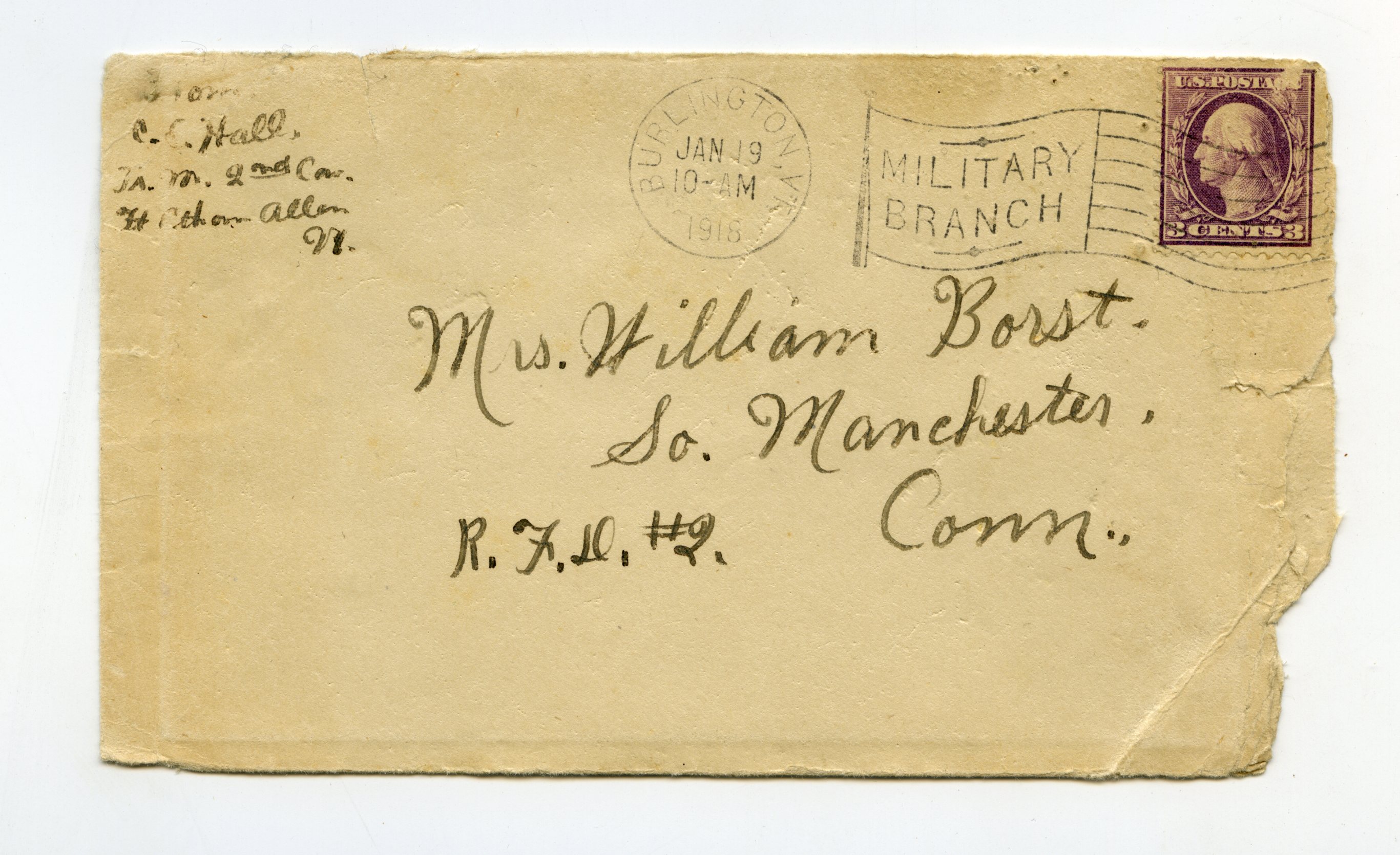
Followers of PortraitsofWar will know that I was lucky enough to acquire a great letter written by a member of the 2nd Cav while the unit was stationed at Fort Ethan Allen in my current hometown of Colchester, Vermont.  Obviously anything related to Fort Ethan Allen will be of interest to me and, by association, PortraitsofWar.  The letter was written by a Mr. Everett Hall from Connecticut, and includes some good cavalry related details as well as some tongue-in-cheek Vermont humor.  Alright!

Fort Ethan Allen,

January 18th, 1919

Dear Marion,

Your welcome letter received.  Also the postal.

Tell Kermit I thank him very much for the wash cloth.  It is a dandy and will be fine when we get over accross(sic). And the way things look now we may be over anytime.

We are having fine weather now.  Lots of snow, nearly three feet, weather is war.  About zero. {YES!  Awesome line}

I am getting so I can stick pretty good bareback. We get fifty munutes every other day monkey drill now.

Just got my last two test papers back.  I got a 98 on first aid and a 91 on guard duty. We have school every day on military matters.  And a test about three times a week.

Just like going to school again only that its different studies.   Have to use algebra too.  We have to study everything first aid for both men and horses.  And the best way of defeating an enemy.  Learn someting new every day.

There’s lots of Manchester fellows in now.  That man you spoke about, Thrall, is here. I heard his name called the other day.  I haven’t seen him to know him yet. Funny how you meet people you used to know.

I see both of A.L. Brown’s boys are going and Allen Balch.  I went to school with Marion Brown.

Well there’s not much news so I guess I’ll have to stop and get fixed up for inspection tomorrow.

We have all kinds of inspections now that we are getting ready for leaving.

With lots of love,

Everett

WWI Real Photo Postcard – Portrait Photo and Autograph of J. Warner Reed – 59th Pioneer Infantry Commander


A new addition to my collection comes in the form of an autographed French RPPC of the 59th Pioneer Infantry Regiment commander.  J. Warner Reed was a colonel with the Delaware National Guard during the Mexican Border War and later went on to form the 59th Pioneer Infantry of the 2nd Army.  Units from this regiment were engaged in road building, bridge building, and front line construction and improvement projects.


For more info on the 59th Pioneers – check out this website from the Delaware National Guard: http://delawarenationalguard.com/aboutus/history/firstworldwar/


WWI 42nd Division Doughboy Sends Home a Real Photo Postcard


Ever wonder how doughboys sent their photo postcards home?  I actually don’t own a single example of a postmarked photo postcard from the war, but recently came across a grouping that contained an envelope and postcard sent home by a 42nd Division soldier.  A member of the 151st Field Artillery, Frank Svec sent home a studio portrait shot of himself.  Not incredibly rare, but a good example of how WWI photos were sent during the war.  The 42nd Division is one of my favorite divisions, so this is an addition “kicker”.

WWI Wounded 78th Division Soldier – Exciting Research Update!


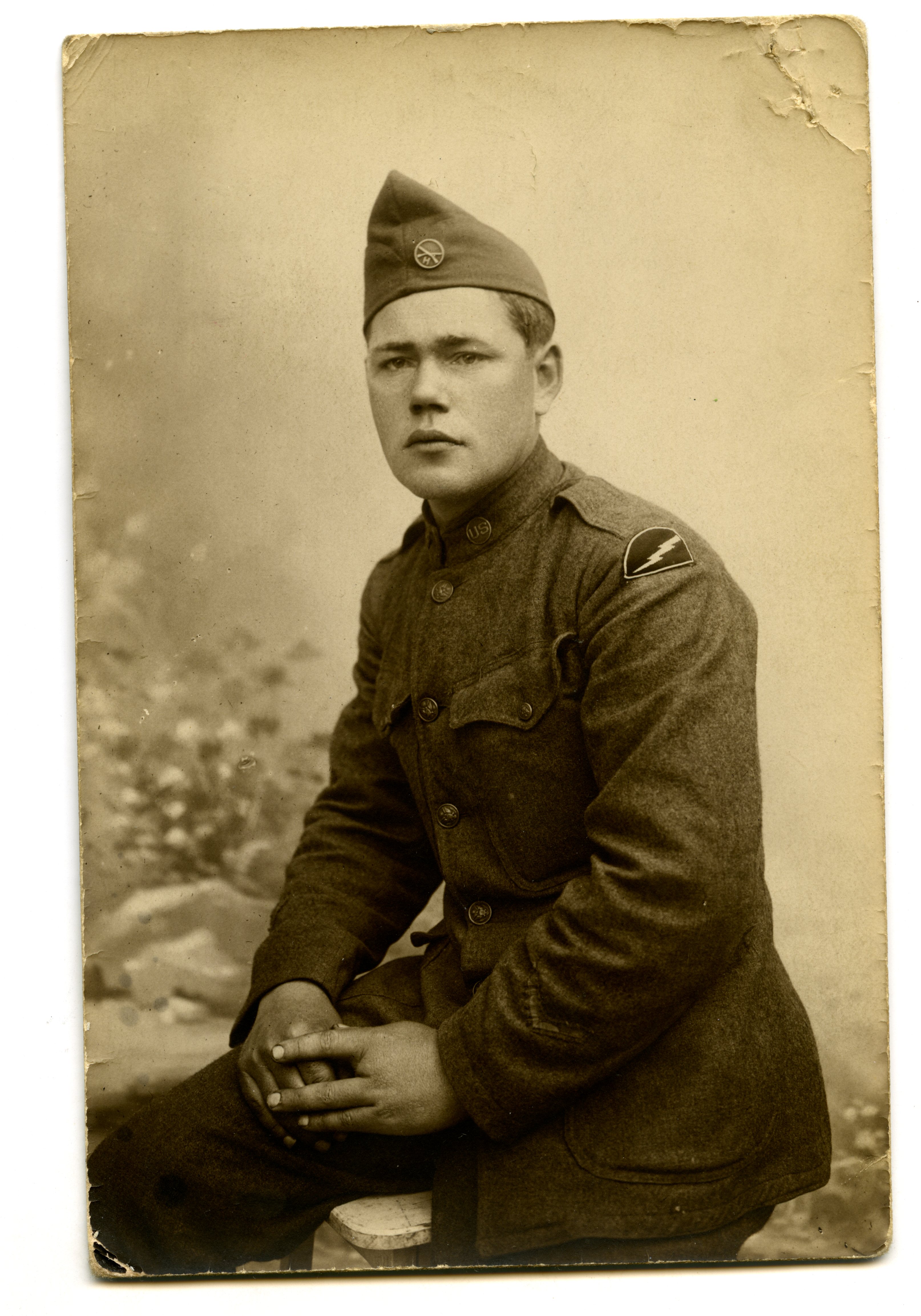
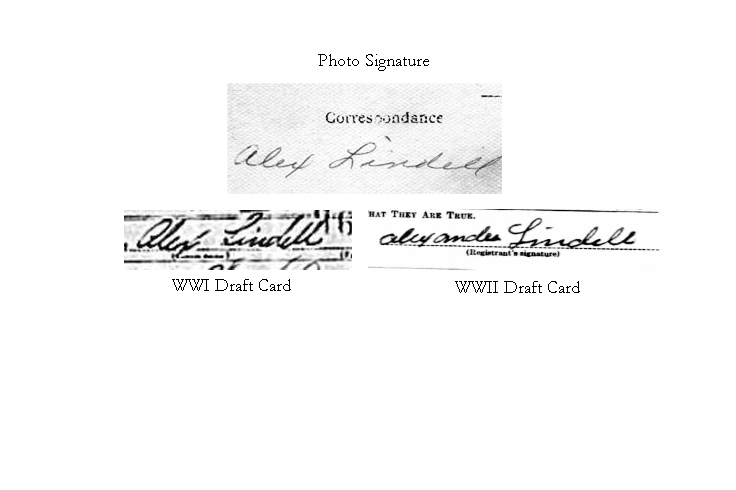
I’ve been recently turned on to the magic of ancestry.com, one of the best tools for researching WWI images I’ve yet to discover. I decided to start a search for one of the names written on the back of one of my better WWI images. Alex Lindell poses in his WWI French portrait photo showing off his missing finger – likely a battle wound received on October 18th, 1918 while he was with the 309th Infantry Regiment (78th Division) during the Meuse-Argonne Offensive. After a search of draft cards through the National Archives, I came across a pair of WWI and WWII draft cards with the presumed identity of Alex Lindell. After comparing the signatures on both my photo and the draft cards, I realized I had a match! Success! His ASN was 2451963.

Alex served in Company H, 309th Infantry Regiment, 78th Division and was originally born in Oeland, Finland but eventually ended up in Brooklyn, NY. He was born on May 5th, 1889 and passed away just shy of the age of 61 on April 11th. 1950 where he was buried in Long Island National Cemetery. He was listed as being severely wounded in action on October 18th, 1918 where he presumably lost his finger as seen in the below photo.

50832936_397060720865632_6570596971222925312_n

Photo Colorized by the Photo Alchemist

Signature on Obverse


WWI Draft Card


WWII Draft Card


Signatures Compared

20120205-224310.jpg

Alexander’s WWI Veterans Burial Card
Footage of the 78th Division during the Meuse-Argonne Offensive

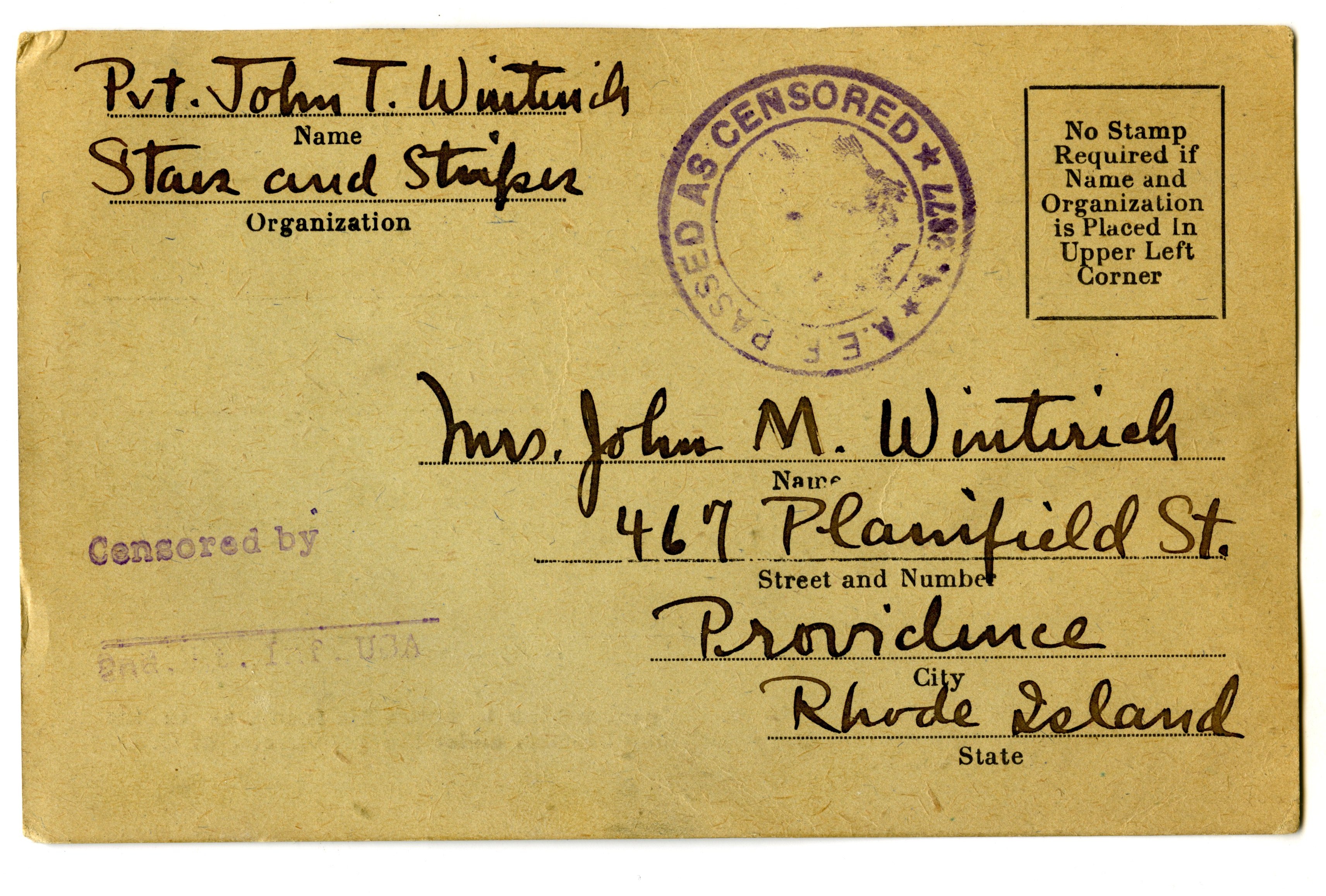
WWI Stars and Stripes Editor John T. Winterich Original Wartime Autographed Postcard


John Winterich was one of the first writers for the Stars and Stripes, managing editor, and eventually one of the most influential bibliophiles of the early twentieth century.  He is credited with having penned over 275 articles in over nearly 150 publications as well as having written the introduction to the American classic Of Mice and Men.  In a rare acquisition, I was able to pick up an original wartime signed postcard by Mr. Winterich in which he describes his present location and state of health to his mother back home in Rhode Island.  The best part?  I only paid $3.00!


"Censor & Press Co. No. 1. Staff of Stars & Stripes. Brest, France. July '19." Photograph. From Harry L. Katz, A Brief History of The Stars and Stripes, Official Newspaper of the American Expeditionary Forces in France (Washington, D.C.: Columbia Publishing Co., 1921), p. 41.

WWI Fort Ethan Allen 2nd Vermont Cav. Detailed Letter – Officer Shot in the Head! – Vermont WWI Content


The 2nd Vermont Cavalry trained at Fort Ethan Allen in Colchester Vermont prior to WWI and, after training, shipped off to France to fight with the only US cavalry unit during the war.  I currently live only ten minutes from the fort, and have previously posted a panoramic photo from an infantry regiment that trained there as well.  Collecting WWI Vermont items can be hard; the material seems to never come up to auction.  In this case, I was able to find a little nugget of Vermont history hidden amongst the seemingly endless WWI eBay listing section.

Looks like Clarence “Everett” Hall was originally from Manchester, Connecticut.  In his letter he mentions a number of interesting topics, including the everyday life of a cavalry troop as well as an interesting encounter where he inadvertantly shoots an officer in the head!  A great read, and a must for any fan of WWI cav.


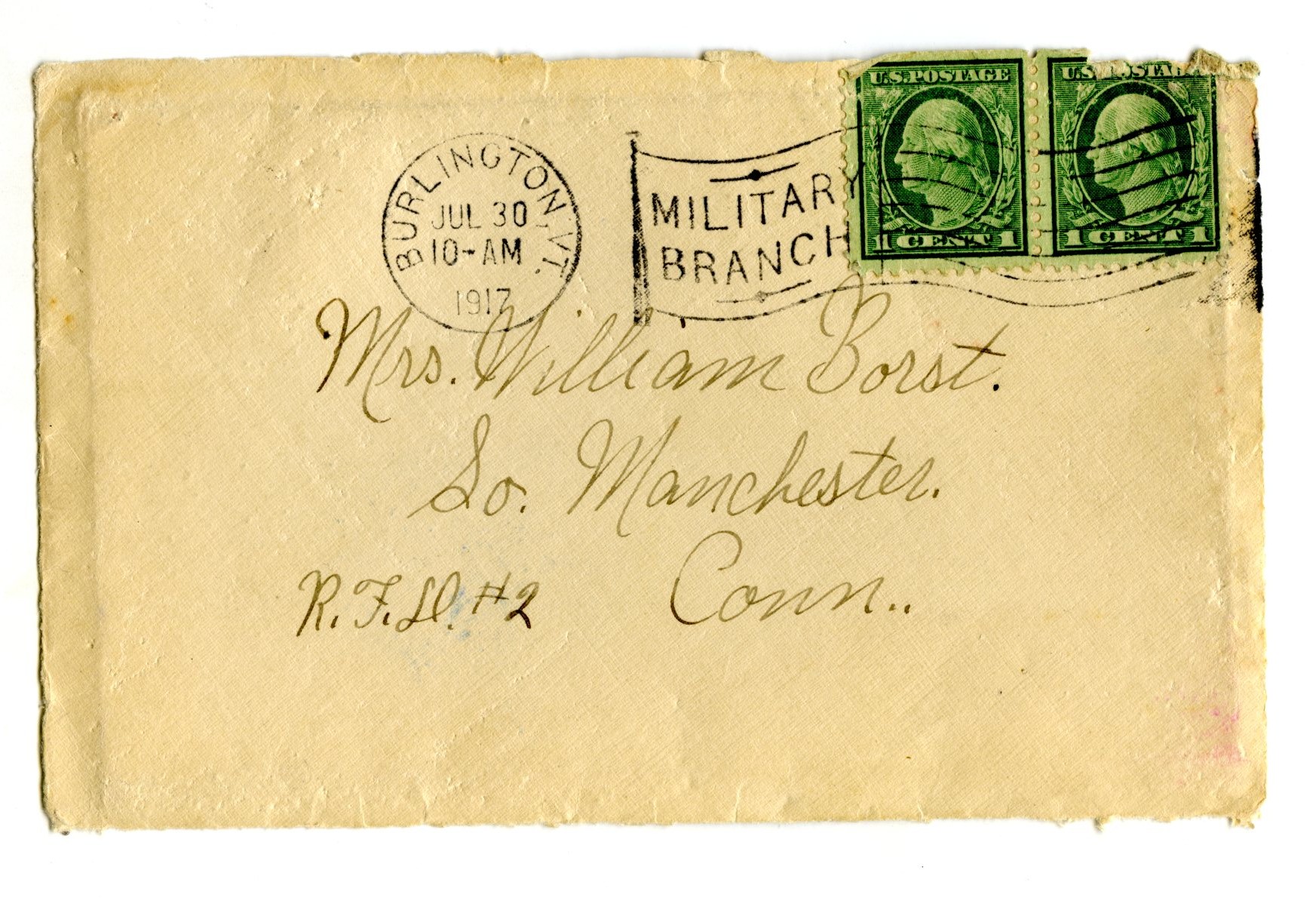
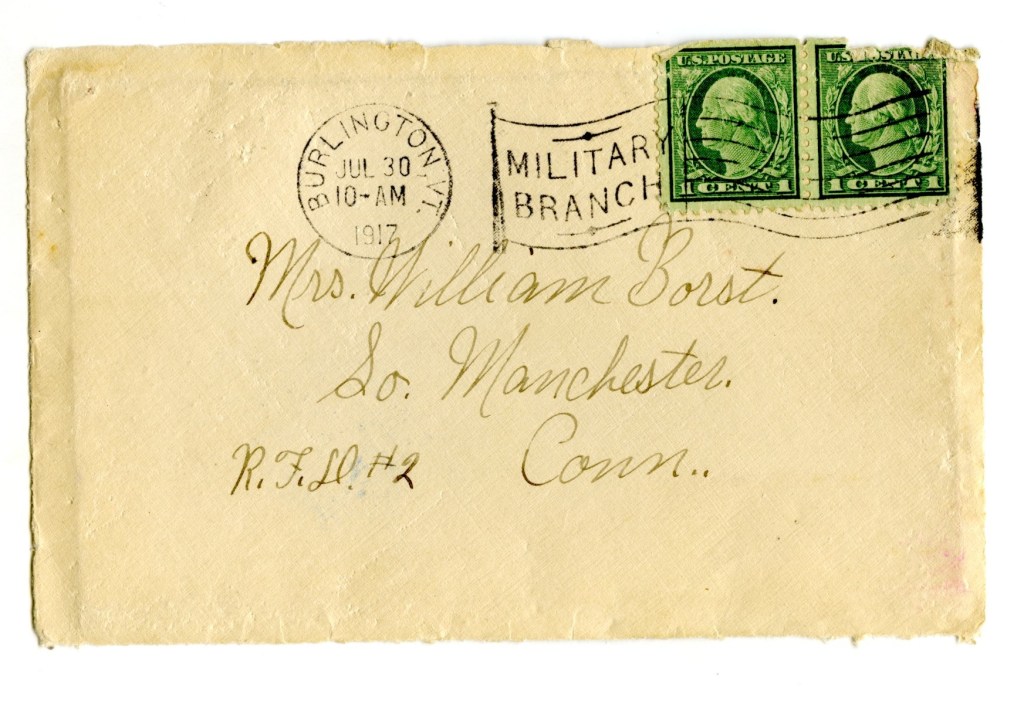
Postmarked Burlington on July 30th, 1917.

Clarence Everett Hall

Fort Ethan Allen

Troop M. 2nd Vermont Cav.

July 28th, 1917

Dear Marion,

Your welcome letter received.  Will write while I have time.

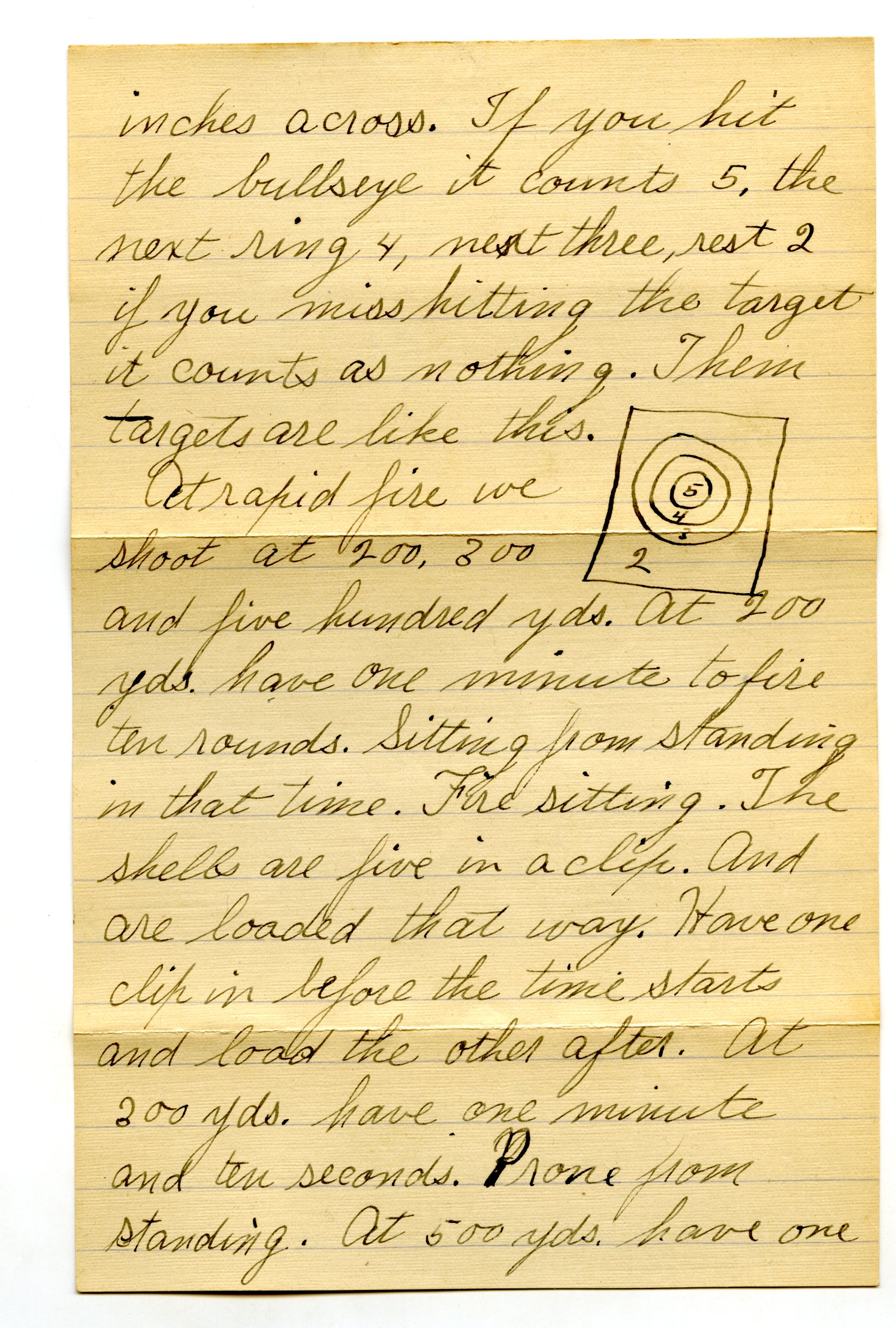
Haveing(sic) a little better weather now.  It was 102 Wednesday on the range.  We was shooting for record shoot slow and rapid fire.  At slow you can take all the time to shoot you want.  Fire at 300, 500 and 600 yards slow fire.  Ten shots or rounds at each.  At 300 yards the bullseye is twelve inches across.  At 500 and 600 yards its twenty inches across.  If you hit the bullseye it counts as 5, the next ring 4, next 3 , rest 2 if you miss hitting the target it counts as nothing.  Then targets are like this.

On rapid fire we shoot 200, 300 and 500 yards.  At 200 yards have one minute to fire ten rounds.  Sitting from standing that time.  Fire sitting.  The shells are five in a clip.  And are loaded that way.  Have one clip in before the time starts and load the others after.  At 300 yards have one minute and ten seconds.  Prone from standing.  At 500 yards have one minute and twenty seconds to fire 10 rounds in.  And fire prone, laying down before the time starts.  The rapid fire target represents a mans head and shoulders.  And count the same.  The bullseye is forty inches across.

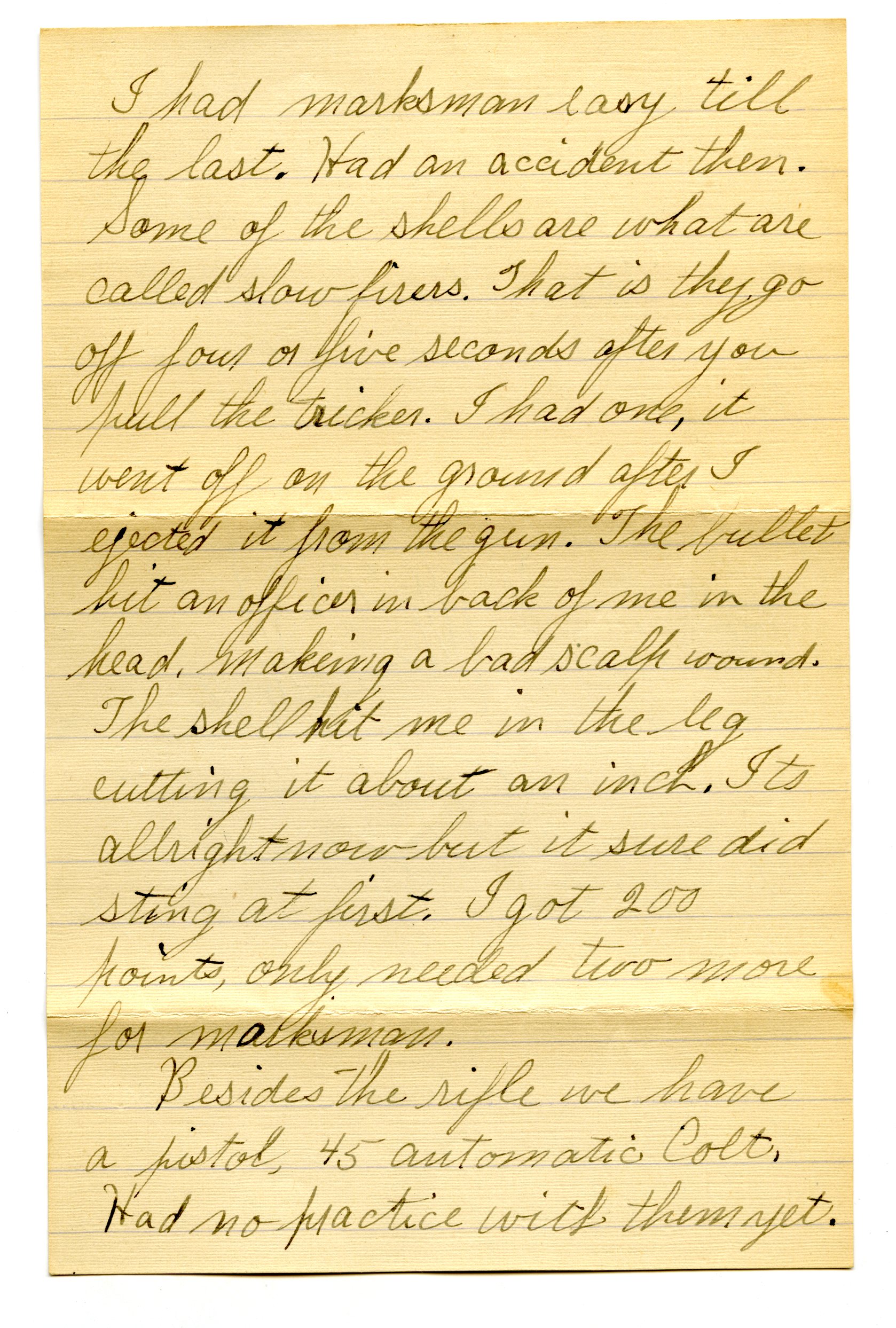
The higher score you get the better it is.  252 points gives you expert rifleman, that pays fire dollars a month extra.  238 gives you sharpshooter, that pays you three dollar a month.  202 pays two dollars a month and is marksman.  Nobody in the troop got expert several got sharpshooter, and several marksman.  I had marksman easy till the last.  Had an accident then.  Some of the shells are what are called slow fires.  That is they go off four or five seconds after you pull the trigger.  I had one, it went off on the ground after I ejected it from the gun.  The bullet hit an officer in back of me in the head, making a bad scalp wound.  The shell hit me in the leg cutting it about an inch.  It’s allright(sic) now but it sure did sting at first.  I got 200 points, only needed two more for marksman.

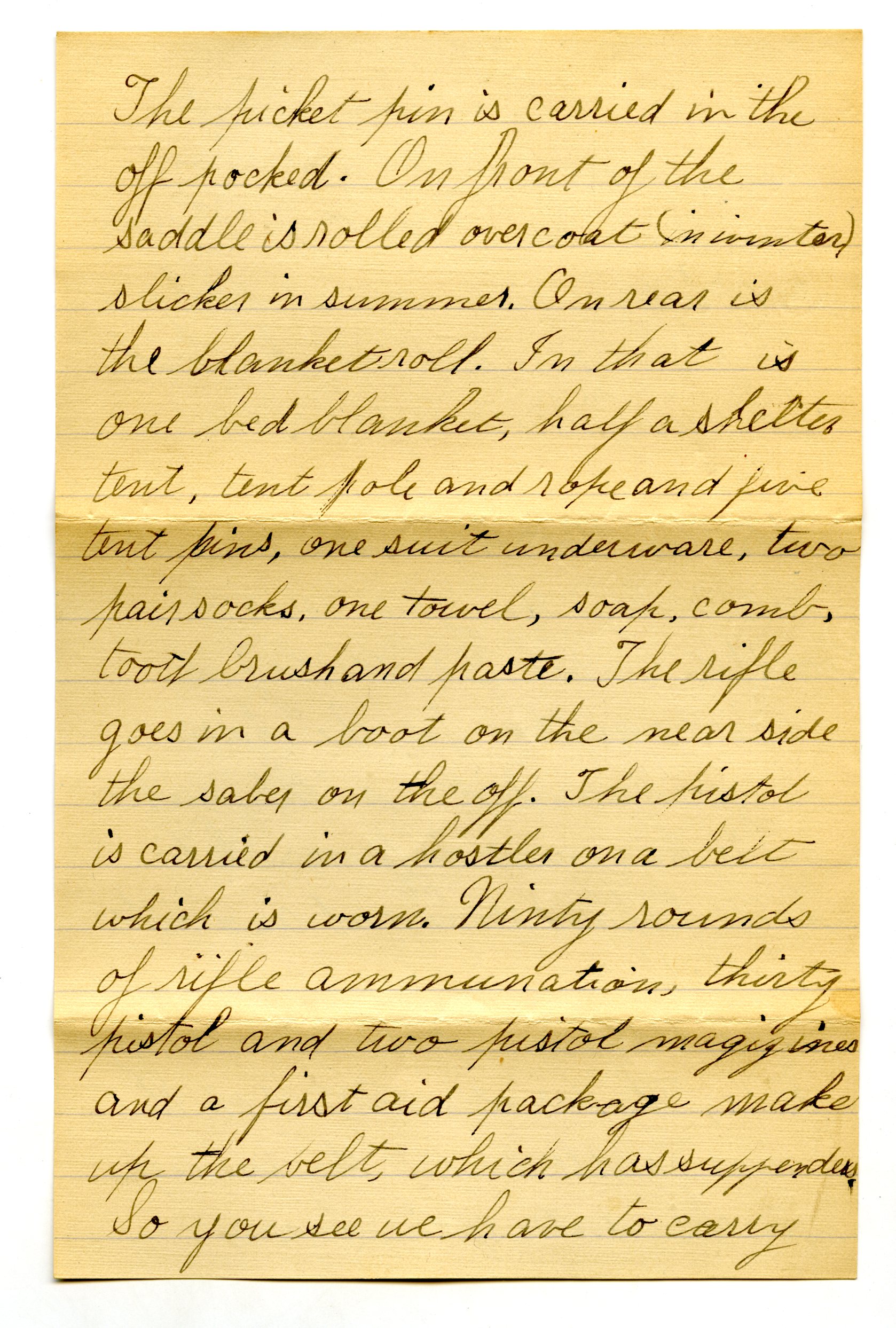
Besides the rifle we have a pistol, 45 automatic Colt.  Had no practice with them yet.  Besides that we have a saber.  Like a sword.  Straight and about three and a half feet long.  At full pack, “thats when we are ready for a long march we have the following.” One saddle, one saddle blanket, that foes on the horse, one surscingle, one pair saddle bags, they go on the read of the saddle.  In the saddle bag is carried everything for the horse.  Curry comb, brush, etc.  In the rear one is the man stuff messkit.  Knife, fork and spoon and any other little thing you want to carry.  The canteen in carried on the rear saddle packet the tin cup in the center of the loops.  The picket pin carried in the off pocket.  On front of the saddle is rolled overcoat (in winter), slicker in summer.  On rear is the blanketroll.  In that is one bed blanket, half a shelter tent, tent pole and rope and five tent pins, one suit underwear, two pair socks, one towel, soap, comb, toothbrush and paste.  The rifle goes in a boot on the near side, the saber on the off.  The pistol is carried in a holster on the belt which is worn.  Ninety rounds of rifle ammunition, thirty pistol and two pistol magazines and a first aid package make up the belt, which has suspenders so you can carry quite a little. The rest of out clothing etc. is put in a bag and carried in the wagons.  We just use the saddle for regular drill.

We have revellie, first call 5:15 roll call 5:30, breakfast at 6, drill at 7 until 10:30 mounted stables, that’s grooming the horses until 10:50.  11 till 11:30 dismounted drill with rifles.  12 dismiss.  In the afternoon if its not to(sic) hot have rifle, pistol, sabre drill.  Semaphore and wigwag practice, that’s sending messages with one and two flags.  Saturdays we have inspections of everything.  No drilling, afternoon off.  Sundays off except stables and water call.  Water call is 4:30.  Water and tie up the horses then.  5:30 retreat and supper.  Tatoo at nine, taps at eleven.  We have to put all lights out in the squad room at nine.

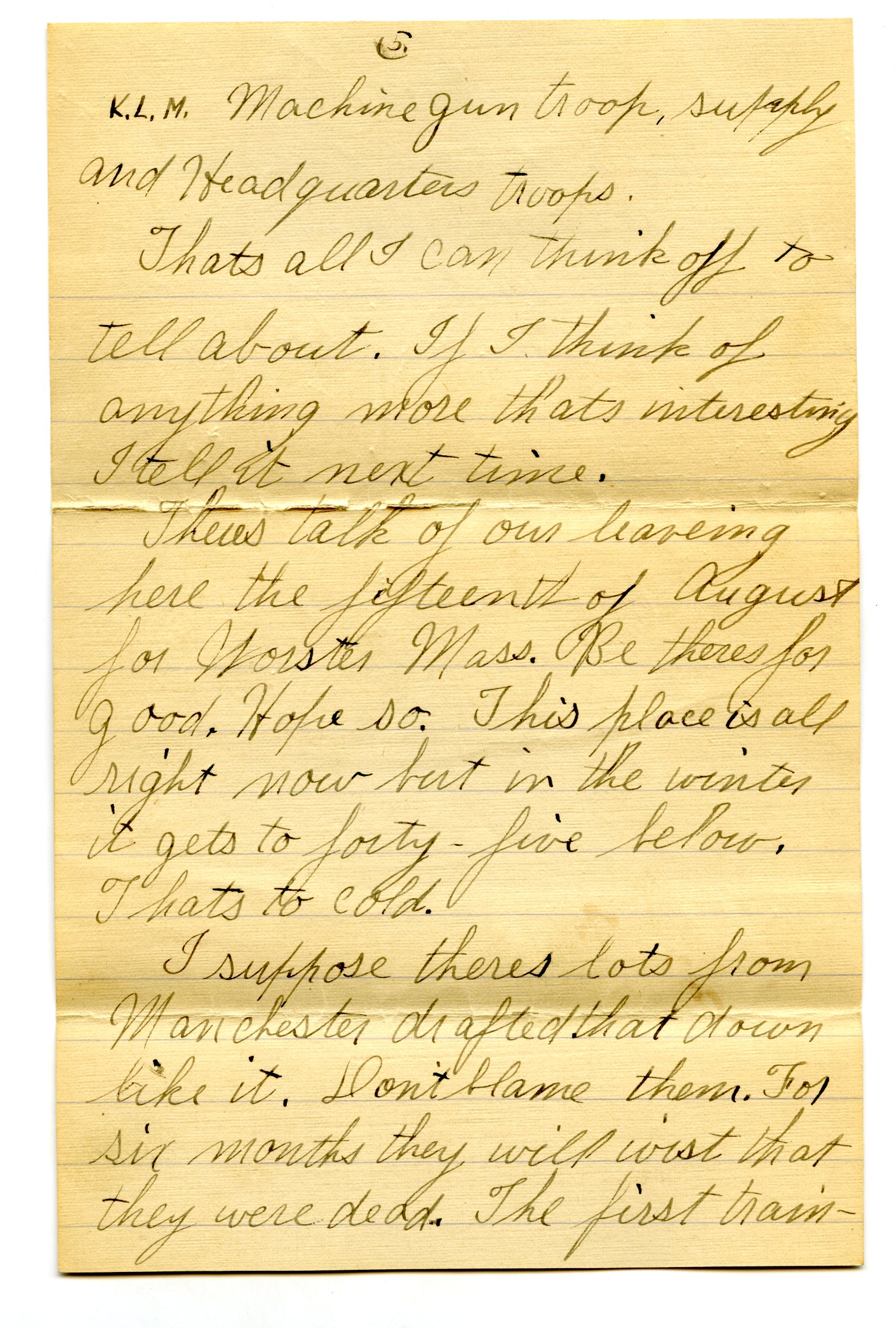
We have a nice building to sleep in .  Have a large day room downstairs, music library etc. there.  Shower, baths, etc. in the basement.  Have regular bunks to sleep in with springs, sheets, pillows etc.  There’s 105 in the troop.  Theres 15 troops in a regiment, four squadrons, three troops to a squadron and three troops over A.B.C, D.E.F, G.H.I, K.L.M, machine gun troop, supply and headquarters troops.

That’s all I can think off(sic) to tell about.  If I think of anything more that’s interesting I will tell it next time.  There’s talk of our leaving here the fifteenth of August for Worcester, Mass.  Be there for good.  Hope so.  This place is all right now but in the winter it gets to 45 below.  That’s too cold. 

I suppose there’s lots from Manchester drafted that don’t like it.  Don’t blame them.  For six months they will wish they were dead.  The first training is very hard.

Guess I will close now its time for retreat and if I write much more I’ll have to send this parcel post.

With Love,

Everett

Clarence E. Hall
Rare WWI 2nd Cavalry Photo RPPC Taken in France – 2nd Dragoons Training Station


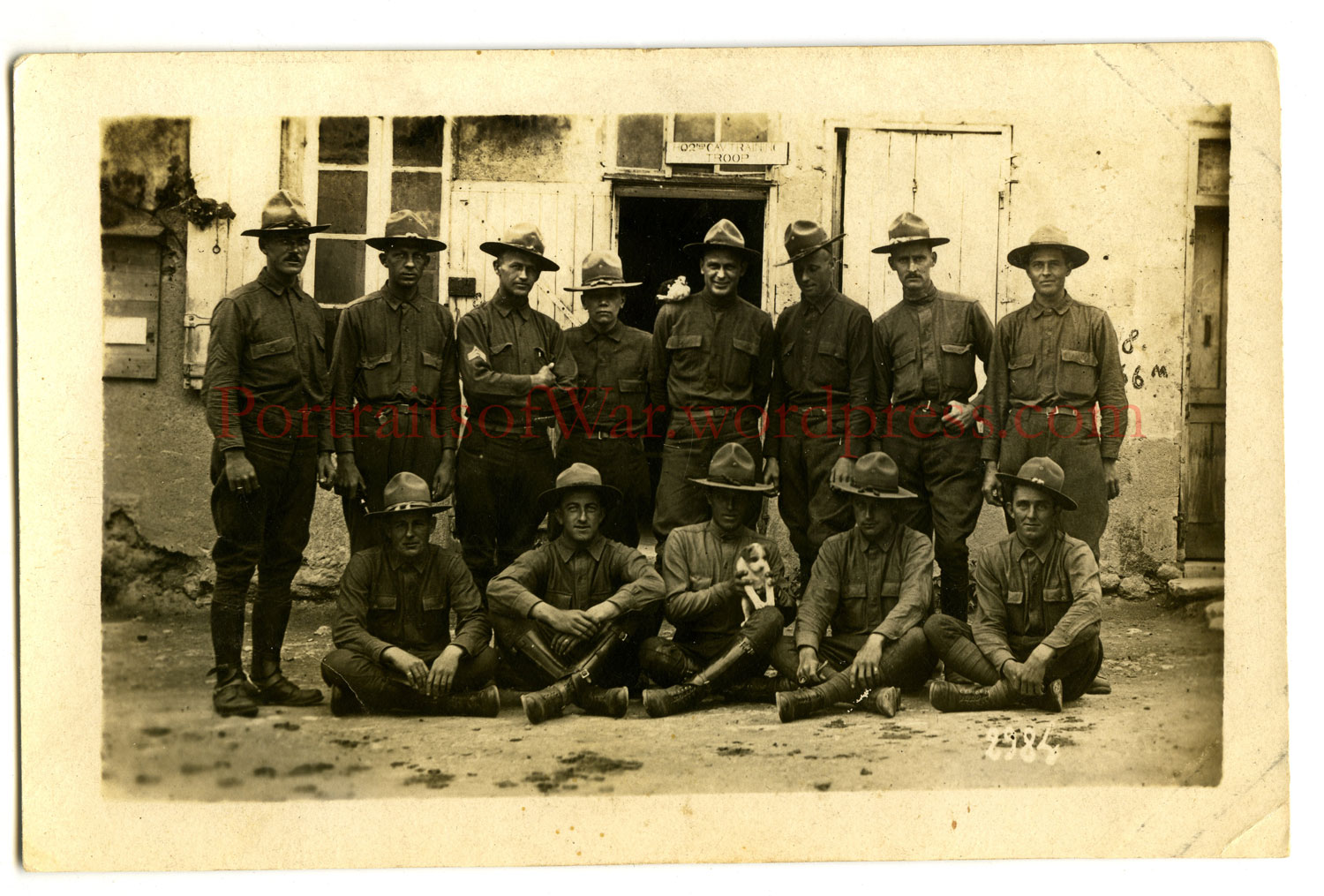
A particularly special photo acquisition comes in the form of a 2nd Cavalry RPPC (real photo postcard) taken somewhere near Tours, France during the war.  The 2nd Cav. trained only ten miles from my house in Vermont, at Fort Ethan Allen before their departure to Hoboken for transfer overseas to France.  Considered by many to be the only  true U.S. mounted cavalry units to serve during WWI, the 2nd Cav. was a unique unit that tends to be glossed over by WWI histories.  I’m proud to add this photo to my collection!

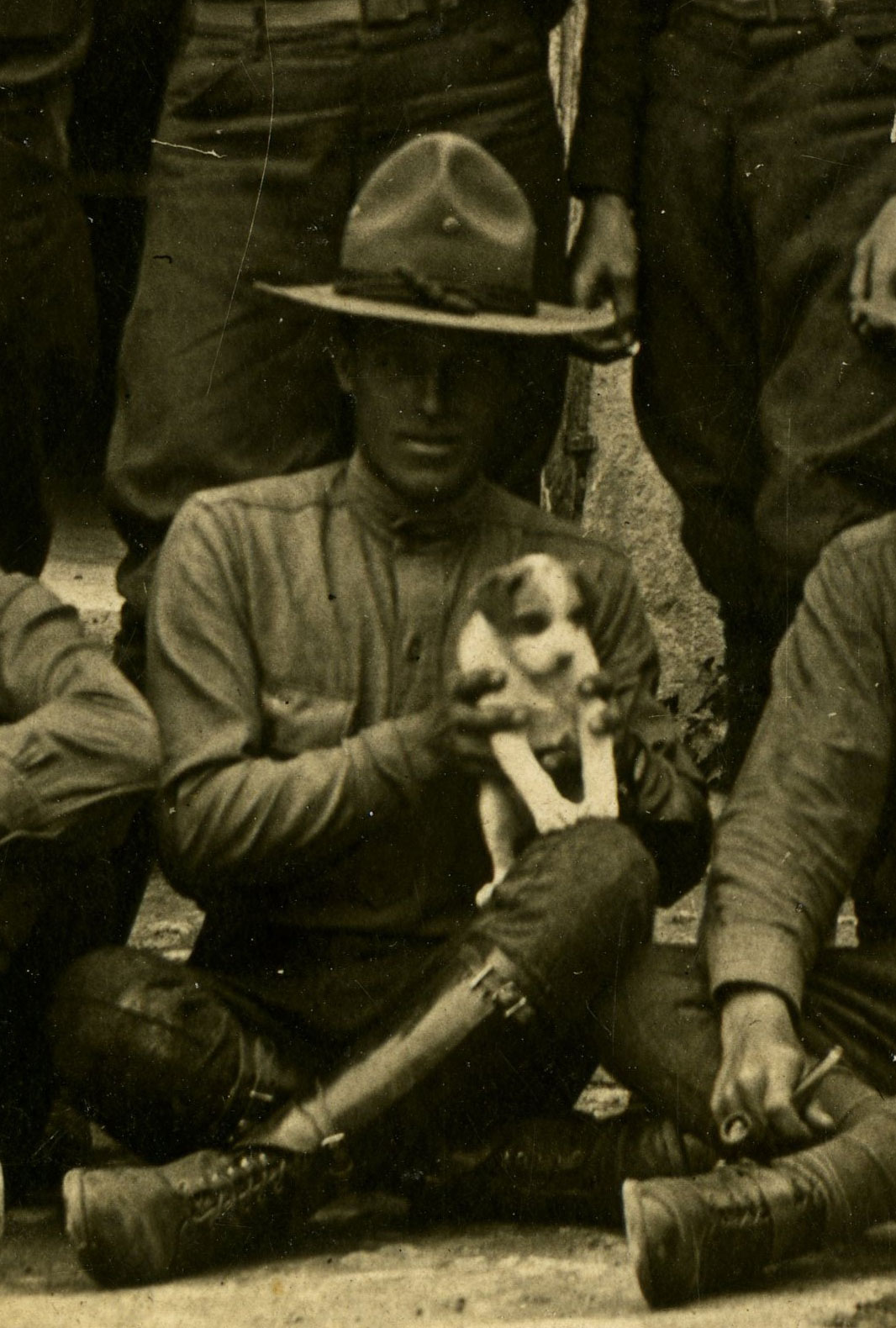
Interesting details of the photo include a mascot puppy, the use of spurs, and a raggedy pigeon perched on a shoulder.

For those interested in reading more on the history of the 2nd Cavalry, check out this website:  http://history.dragoons.org/category/world-war-i/

2nd Cav. Puppy Dog Mascot

WWI RPPC Studio Photo – Armed w/ Colt Model 1911 and w/ M1917 Helmet in Germany


They don’t get much better than this!  Check out the detail on the equipment – this is the first photo in my collection that shows the M1911 pistol lanyard hanging from the right breast pocket.  I’ve owned a few in my day, but have always sold them to buy photos!  The soldier is proudly posing with his slightly dented helmet and his M1911 and leather holster proudly presented.  A top ten shot for me!