Captain Samuel Woodfill’s Medal of Honor Portrait


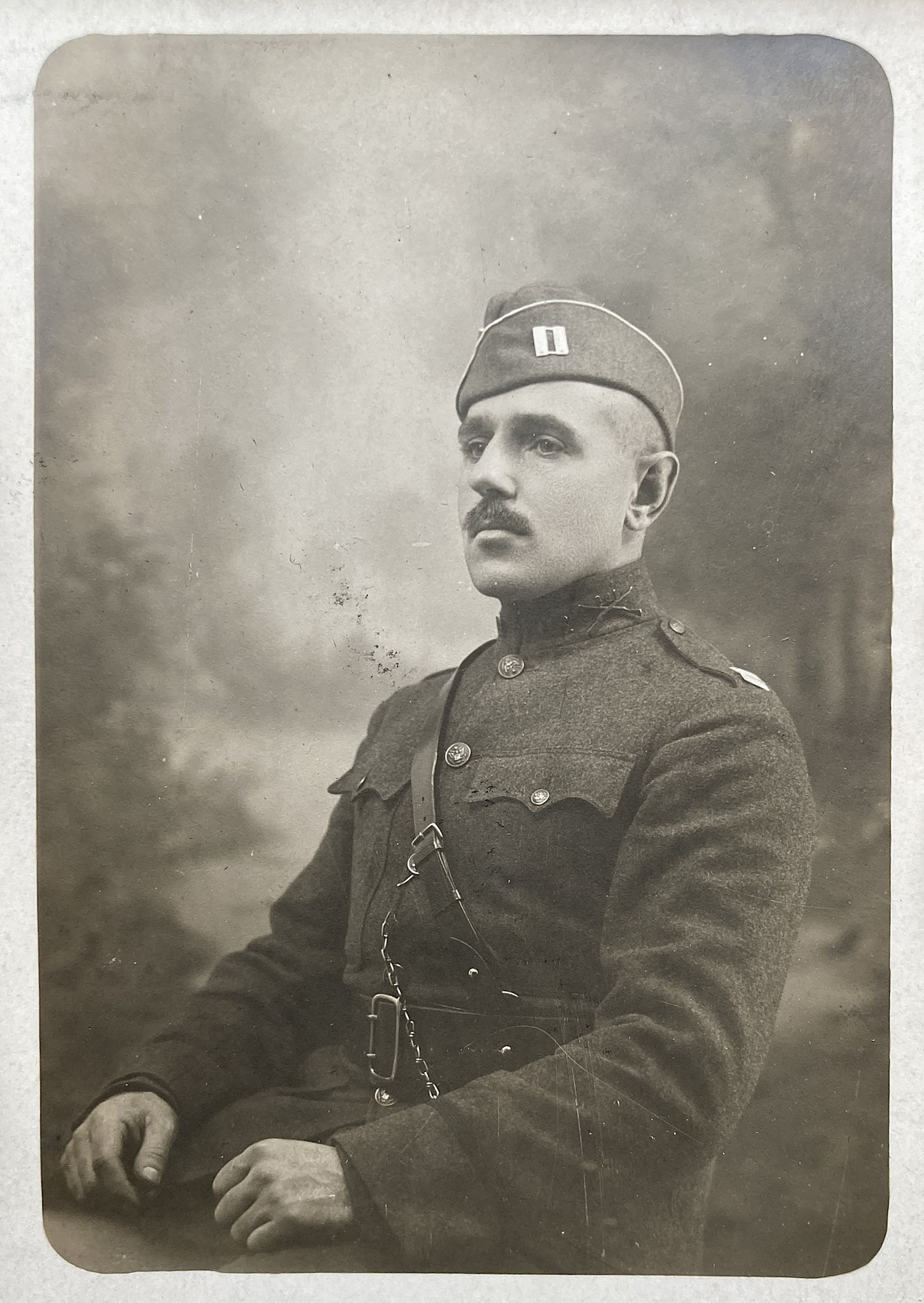
The Congressional Medal of Honor was awarded to 119 members of the U.S. Army, Navy, and Marine Corps during World War I, 33 of them posthumously. Portrait photographs of these heroes are remarkably scarce, but I was fortunate to recently acquire one. The subject of tonight’s post is Captain Samuel Woodfill of Indiana, one of America’s most celebrated soldiers of the Great War.

Captain Samuel Woodfill, U.S. Army
Often described by General John J. Pershing as “the outstanding soldier of the American Expeditionary Forces,” Captain Samuel Woodfill earned the Medal of Honor for extraordinary heroism during the Meuse-Argonne Offensive on October 12, 1918. Leading his company through heavy fog and enemy fire near Cunel, France, Woodfill singlehandedly attacked multiple German machine gun nests, killing or capturing their crews despite being gassed and exhausted. A career soldier from Indiana, Woodfill had already served in the Philippines and on the Mexican border before World War I, and his calm, precise marksmanship in France became legendary among his peers. After the war, he was personally honored by Pershing and later chosen to represent the U.S. Army’s enlisted men at the dedication of the Tomb of the Unknown Soldier in 1921.

Arlington National Cemetery Video: Major Samuel Woodfill

Reverse Side of Woodfill’s Portrait

His Medal of Honor citation reads:

“While he was leading his company against the enemy, First Lieutenant Woodfill’s line came under heavy machine gun fire, which threatened to hold up the advance. Followed by two soldiers at 25 yards, this officer went out ahead of his first line toward a machine gun nest and worked his way around its flank, leaving the two soldiers in front. When he got within ten yards of the gun it ceased firing, and four of the enemy appeared, three of whom were shot by First Lieutenant Woodfill. The fourth, an officer, rushed at First Lieutenant Woodfill, who attempted to club the officer with his rifle. After a hand-to-hand struggle, First Lieutenant Woodfill killed the officer with his pistol. His company there upon continued to advance, until shortly afterwards another machine gun nest was encountered. Calling on his men to follow, First Lieutenant Woodfill rushed ahead of his line in the face of heavy fire from the nest, and when several of the enemy appeared above the nest he shot them, capturing three other members of the crew and silencing the gun. A few minutes later this officer for the third time demonstrated conspicuous daring by charging another machine gun position, killing five men in one machine gun pit with his rifle. He then drew his revolver and started to jump into the pit, when two other gunners only a few yards away turned their gun on him. Failing to kill them with his revolver, he grabbed a pick lying nearby and killed both of them. Inspired by the exceptional courage displayed by this officer, his men pressed on to their objective under severe shell and machine gun fire.”


Southbridge, MA Native Charles Edwin Hellner’s WWI Journey


Southbridge’s First Soldier

Writeup by: Andrew Locke

(All photographs and narrative were provided by Locke)

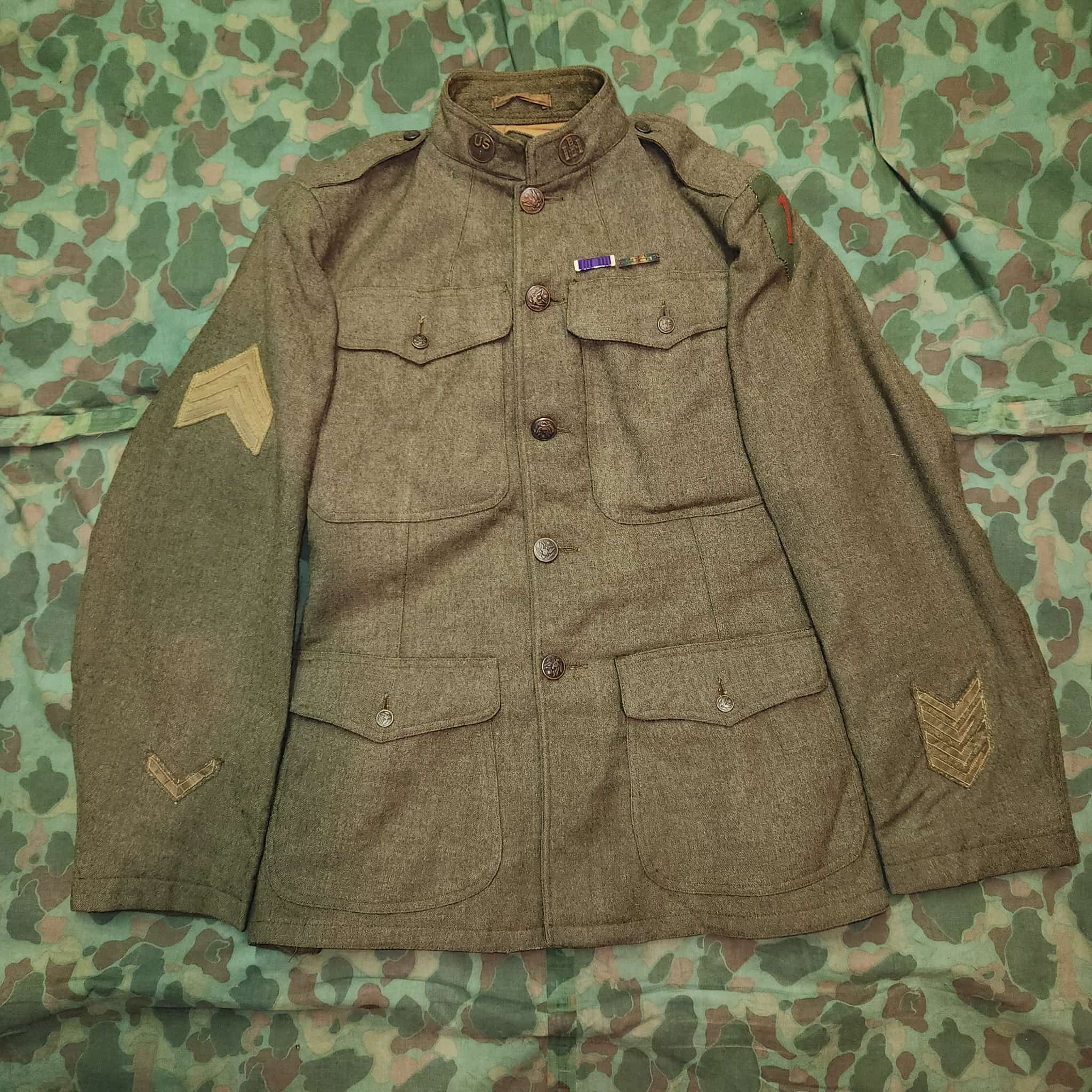
The first man from Southbridge, Massachusetts to enlist during World War 1 was Charles Edwin Hellner. He was born on April 11th, 1897 and was at the age of 20 when he enlisted for the US Army on May 7th, 1917. He was placed into B company of the 1st Engineer Regiment (part of the 1st Infantry Division) with about 30 other Southbridge men. After exactly three months of training he departed for France. 

Sgt. Hellner’s WWI Uniform

     Following their arrival, the soldiers of B company then spent more time training. This time it was in the tactics of trench warfare with the French as their experienced instructors. In later parts of the training, American units would serve alongside French ones in relatively idle sections of the frontline so that the doughboys could get some experience. While serving with elements of the 16th infantry on the morning of November 3rd, 1917, Hellner would be present for the first raid on American troops by the German army. The first three American deaths of the war occurred there.

Hellner’s Diary, Cigarette Case, Pocket Watch and War Medals

     Training and engineer work continued for Hellner’s unit until the 1st Division was called into action again. On May 28th, 1918 the 28th infantry regiment had attacked and successfully captured the French town of Cantigny. The 1st Engineers moved into the sector and began work fortifying the area and digging trenches. Hellner memorialized his service there with a large pennant that bears “Cantigny 1918” and his portrait which speaks to the fame of the battle at the time. While in these trenches at and around Cantigny, B company experienced shelling and fought off diversionary attacks from the German’s Montdidier-Noyon offensive that was aimed at nearby French positions.

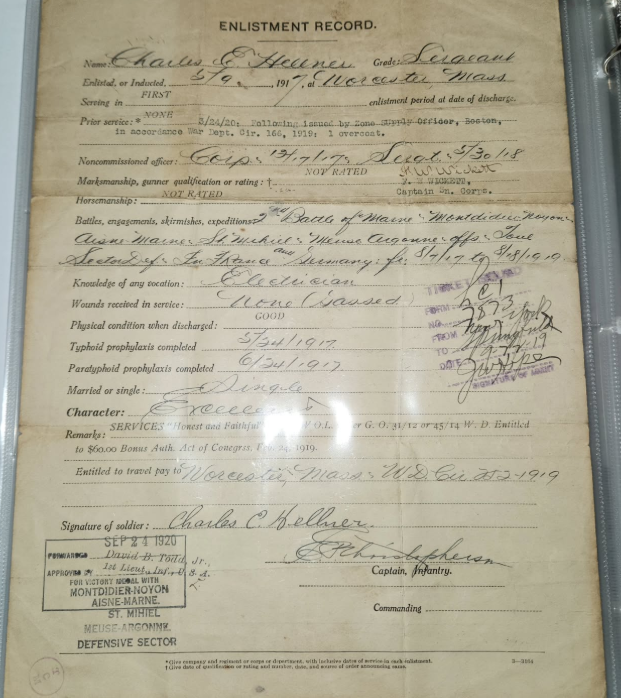
Hellner’s Discharge Paperwork

     On July 18th the 1st Engineers began its involvement in the Second Battle of the Marne. A German attack had recently pushed back allied lines before it faltered and it was realized that this was an opportunity for a counterattack. Hellner had recently been given command of his own squad and would now be leading them into battle. B company spent three days attacking the Germans near the town of Soissons. During the first day of attack on July 18th, a member of Hellner’s squad named William Broughton was hit in the stomach by a piece of shrapnel. Unfortunately, he eventually died from his wounds. Broughton had also come from Southbridge and Hellner wrote a letter home that informed his family that he had passed. July 19th saw B company’s advance slowed by machine gun fire that wounded several men and an officer. On July 20th, Hellner led his squad over the top at 4 AM with the rest of B company in the first wave. With heavy losses they were able to fight until they reached a railroad where they remained the rest of the day.  While taking cover behind an embankment near this railroad, Hellner experienced his first wound of the war. He later wrote a letter about the incident: “I was lying on a railroad embankment when a high explosive German shell burst near me, digging up the dirt and stones all around, and a heavy stone fell upon my foot, breaking one of the bones.” This artillery shell had actually caused much more damage than he’d thought. It dislocated his shoulder, broke a bone in his foot, and gave him a severe rupture. He never reported these wounds and continued to fight at Soissons for two more days. By the end of the battle he was the only man from his squad to report to an officer, the rest had either been killed or wounded. B company in total sustained 74 casualties at Soissons from July 18th to the 22nd.

     After the chaos of their first large scale offensive, they now had a few moments of relief. For the next few months they went back to being engineers and did manual labor including building roads during the St. Mihiel campaign in early September. It is during this time I believe Hellner attended gas school. One of his journals has a section with the same heading that includes details about each type of gas and various mortars including the Livens projector.

Silk Portrait Photo and Cantigny 1918 Pennant

     For the last and largest battle of the war the 1st Engineers was once again called up to act as infantry. The Meuse-Argonne offensive began on September 26th but B company didn’t attack until October 9th. Hill 269 in the Argonne Forest needed to be captured and B company was part of the force chosen for the job. The fight for the hill was intense with the attackers engaging in hand to hand combat. After capturing the hill the engineers immediately braced for a counterattack. One didn’t come until the following day when the Germans stormed the hill with the support of heavy artillery. The enemy never reached the top of the hill and were successfully repelled. At some point during this engagement Hellner was gassed and evacuated to a hospital. 

     Unfortunately I don’t know when he left the hospital but I do know that by November 11th he had returned to B company and was marching towards the frontline near the town of Sedan with the rest of the regiment. Suddenly, a courier on horseback rushed down the column of men telling them to stop marching because the war had ended. In Hellner’s own words: “When we realized it was all over, we whistled, screamed, cheered and raised the devil, and I was so hoarse I couldn’t speak next day above a whisper.” That night the frontline was almost as bright as day with bonfires, flares, and rockets from the celebrating soldiers. 

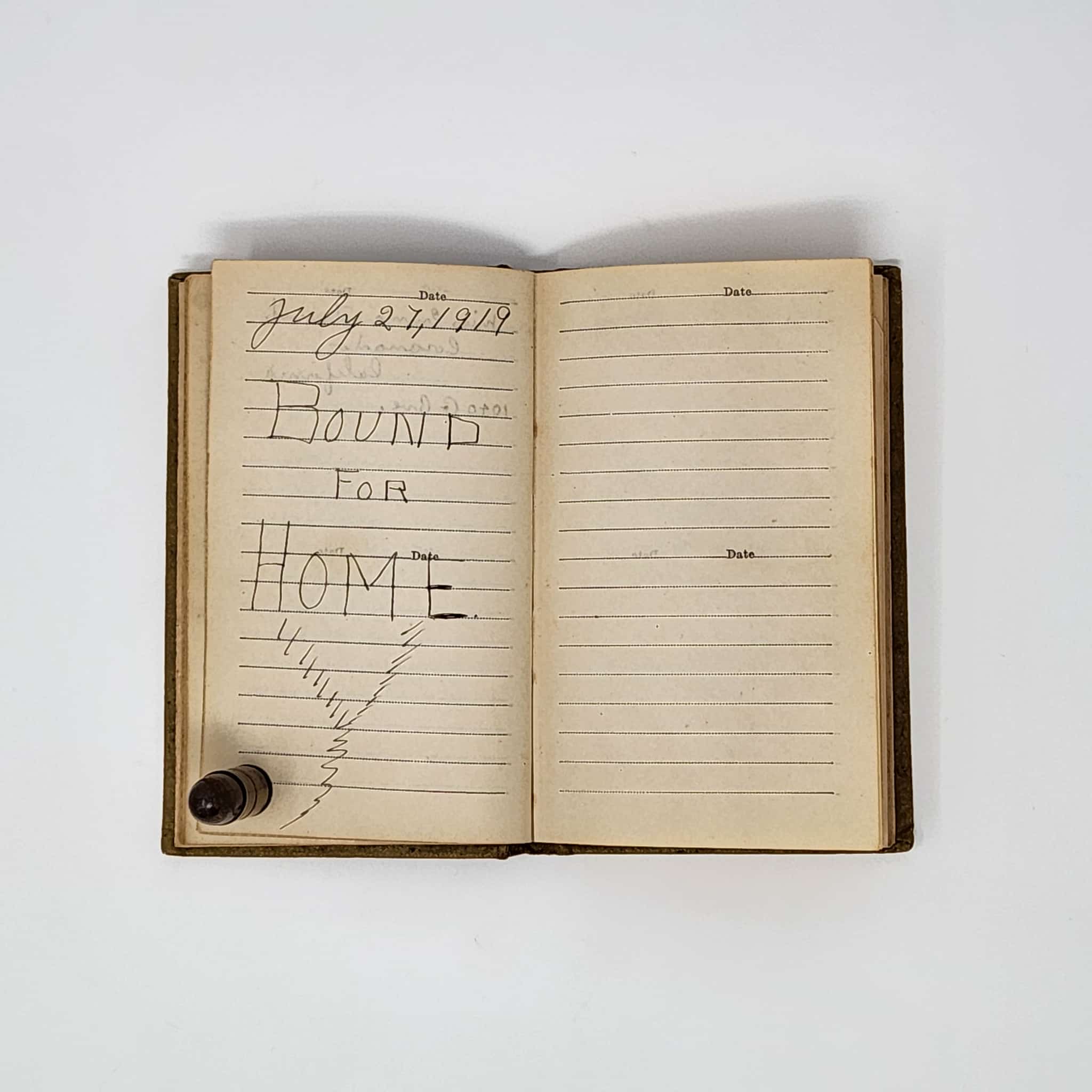
“Bound for Home” – Last Diary Entry

    In December the 1st division was sent into Germany to be a part of the army of occupation. The 1st Engineers remained on this post until July 21st, 1919 when they were detailed to finally return home. He returned to the United States in August and was supposed to receive a discharge but a medical officer advised him to re-enlist so that his wounds from Soissons could finally be tended to by army doctors. This was when the true extent of his injury was truly discovered. It was necessary to fracture his dislocated arm to get it back into its socket. After this though, he could finally return to Southbridge. Funnily enough, even after his wounds from Soissons were corrected, he wasn’t given credit for a wound in action. So his only wound according to his enlistment record was being gassed on Hill 269. Hellner got married in June of 1921 and went on to have two daughters. In later life he moved to Florida and passed away there on June 26th, 1975 at the age of 78.

Meet Punkins – The Mixed-Breed Bull Terrier and Official Mascot of the 27th Engineer Regiment in WWI


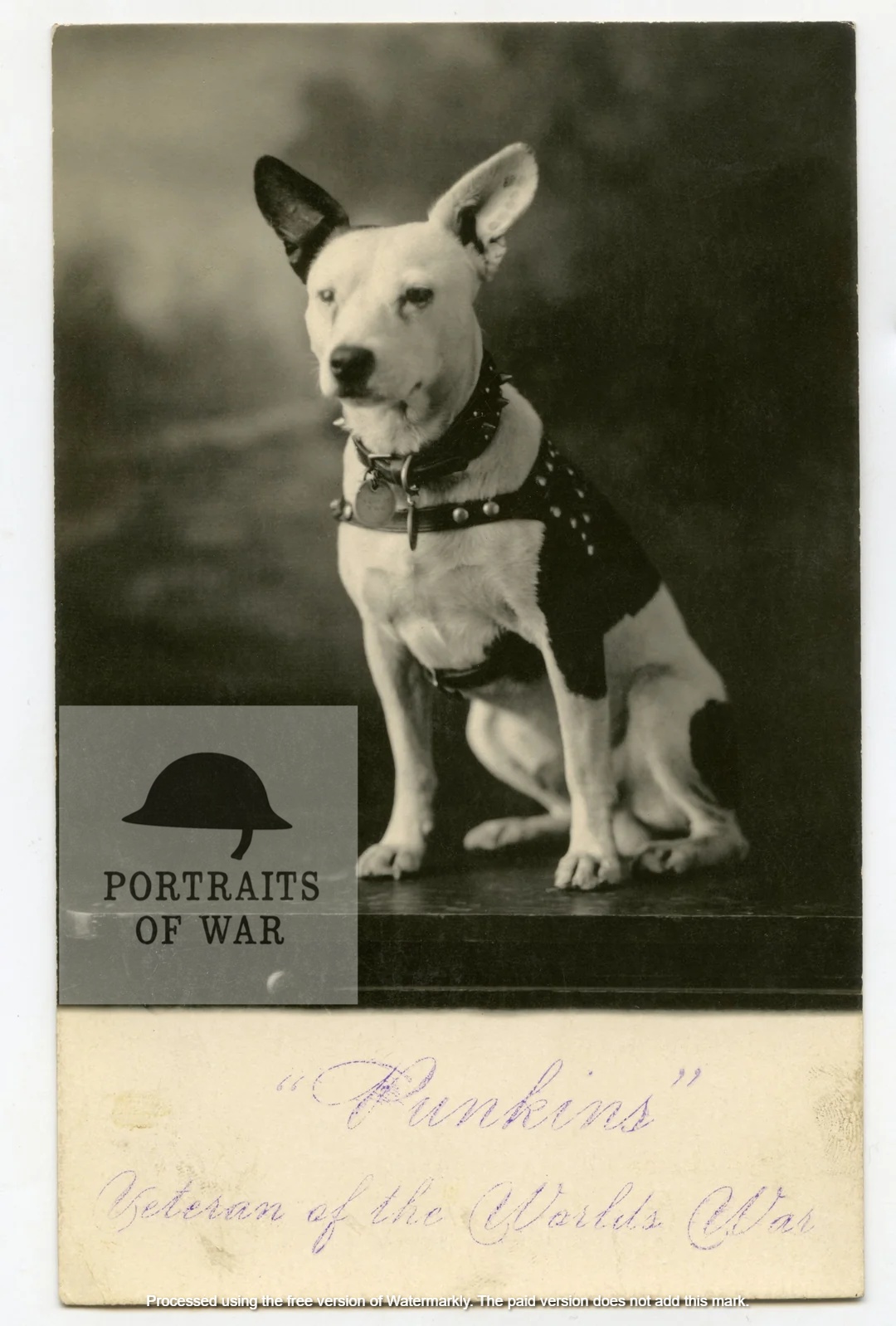
After taking a break from writing, I’m excited to finally share some of the fascinating WWI photos and research I’ve uncovered over the past few years, little hidden gems I’ve been eager to bring to light on this little corner of the internet. In this quick post you will meet Punkins, the official mascot of Company C of the 27th Engineer Regiment. Photographs of unit mascots during WWI are not exceedingly rare, but studio portraits of an identified mascot/dog are nearly impossible to find. Most, if they exist, were kept in personal albums or letter collections and discarded or forgotten about over the past 100+ years, but this shot of Punkins somehow emerged on eBay several years ago.

Punkins Posed for the Camera!

Sporting a studded leather collar and matching riveted harness, Punkins seems like a quite the bruiser, a fitting mascot for an engineering regiment during WWI. With just the image and brief stamped caption below (the stamping hints at a volumed production of photo postcards for veterans after the return home), it seemed a difficult task to identify the sitter based on contextual clues such as insignia or other identifying material. Although the postcard backstamp suggests a stateside printing of the postcard, I’m guessing the original photograph was taken in France or Germany and replicated stateside for dispersal to fellow soldiers who wanted photographs to remember their wartime experiences.

Luckily, I did some deep diving and discovered a digitized version of a unit history of the 27th Engineer Regiment that included a brief caption mentioning a ‘Punkins’ below a photograph of our mystery sitter with one of his wartime friends.

“Punkins” and PFC William H. Hall of Santa Clara, CA.
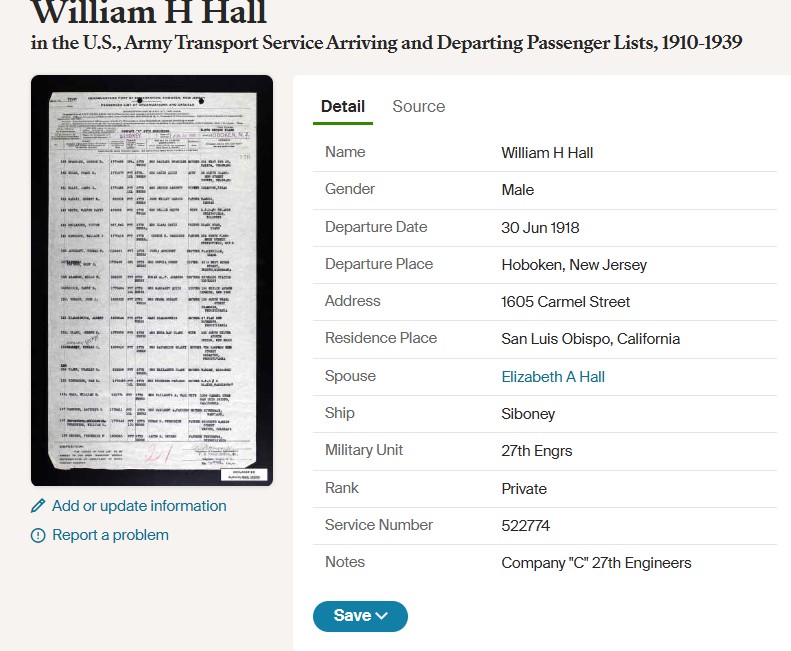
Punkins has now been identified as the regimental mascot of the 27th Engineer Regiment! Note that he is sporting a custom coat with markings and insignia showing he was a member of Company C. of the 27th Engineer Regiment with the First Army. His downward pointing chevron on the right means he served at least six months with the unit. Based on the background contextual clues in the unit history photo, this shot appears to have been taken aboard a return vessel from France to the USA in March of 1919. Private First Class William H. Hall of Santa Clara, CA was aboard the USS Dakotan, a US military transport ship that served in both WWI for the US and later in WWII for the Russians starting in 1942.

Pvt. William Hall heads to France in June of 1918

It’s unclear and likely impossible to know the circumstances of Punkins’ adoption by the 27th Engineer Regiment in WWI, but based on the visual info provided in the unit history, it’s likely that they were adopted at least three months before departure from France in March of 1919 which points towards an adoption date of August or September of 1918 while the unit was serving in Germany at the time. Punkins appears to be a Bull Terrier mix of some sort based on the pointed ears, coloring and general boxy frame. If anyone knows anything else about Punkins please reach out and share.

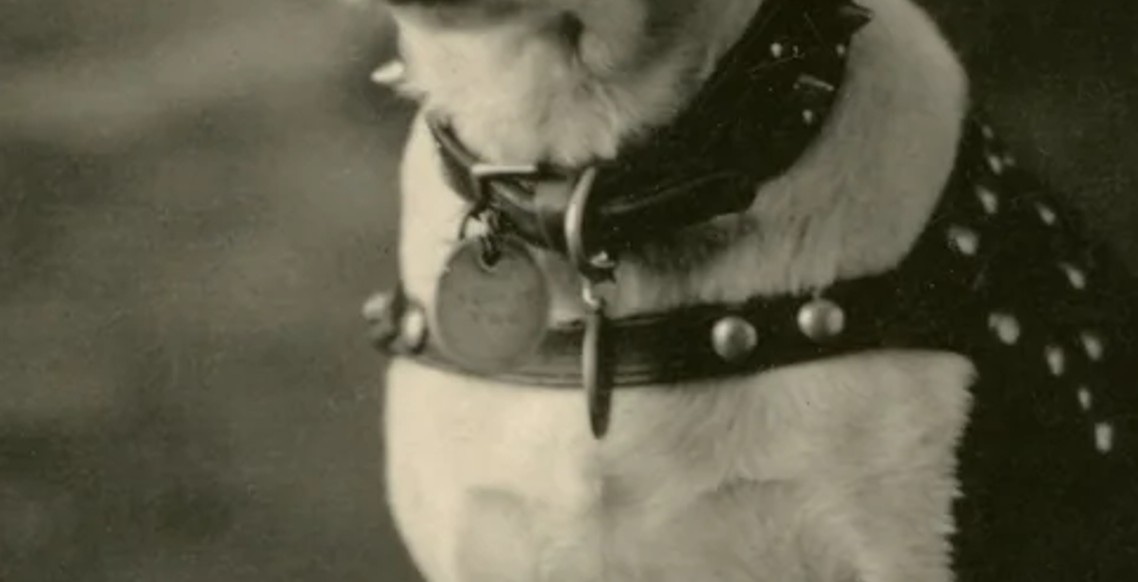
One last note – Punkins appears to be wearing an actual WWI US dog tag. Dog tags used by the US Army and Marines were primarily aluminum discs that could be hand punched with pertinent information bearing the owners name, unit, serial number and sometimes other personal touches. It looks like Punkins received a set of his own tags although the details are obscured. Note that the ridges on the left tag hole hints that they’ve been worn long enough to encounter some wear and tear. The circular tag to the right doesn’t seem to be a proverbial dog tag but some sort of other identifier or an actual DOG tag.

November, 2025 Update

It appears that Punkins sat for several photographs during his illustrious career as a mascot. Another eBay listing appeared a month or so ago (I didn’t win) that provided a bit more information about our sitter. Amazingly, we now know the birthdate, birthplace and wartime career of Punkins to a level of detail I never thought I would learn. See below for a transcription of the caption from the eBay postcard.

Nov. 2, 2025 Ended Listing for Another Punkins Postcard!

Punkins was born Dec. 30, 1917, in Baltimore, was mascot of Co. C., 27th Eng., was smuggled across on a transport in a suit case, thru the worst of the submarine zone, landed in France May 18, 1918. He spent nine months in the front line trenches, went over the top three times at the battles of Chateau Thierry, Argonne and St. Mihiel. He was gassed Sept. 28, 1918, in the Argonne. Punkins is the only dog that ever received an honorable discharge from the U.S. Army. He received a Medal of Honor from the French Government at Verdun, also wears the U.S. Victory button. Here’s to the Good Old U.S.A. – Punkins

Punkins’ “Other Portrait”

This secondary portrait of Punkins provides a very similar view but shows a few more details that “my” version does not include. Now, we can see a little more detail to the dog tag/medal attached to his collar.

The tag that I had originally assumed was some sort of identifier appears to have a castle at center which may be a 27th Engineers commemorative medal given out to members of that unit. See below (top left) for a possible match from the US Army Engineering collection website. (Image 16 in the first slideshow)

Possible Match to Punkins’ Medal

Two Mississippi Doughboys in France, 1918


Finding vintage photography to post to the site that has meaningful background history has been a tough mission the last few years. I was recently inspired to start posting to the blog more often from a group of friends who enjoy seeing great photography mixed in with background research. This site has always been a labor of love and I’ve neglected posting new material (but have updated older posts) since the global pandemic hit. I now introduce you to a new addition to the collection that showcases an underappreciated aspect of the the WWI US service experience.

The process of making these shots web-ready is a bit tedious but it involves the scanning, editing for dust and scratches as well as optimizing size for the web. It’s not a quick task but I like to take time to make these available whenever possible.

Ernie Rayburn and Ollie Stiger Smoking Cigars in France, 1918

This photograph struck me when I first viewed it for a few reasons. The role of African Americans in World War One has been touched upon in books, documentaries and museum exhibits but the photographic history of the common labor war worker has been eclipsed by the “fighting” units that are often depicted. These two men, Erie Rayburn of Coffeeville, MS and Ollie Stiger of Jackson of the same state have likely never been shown online. These postcard style shots were often taken to be sent to friends and family as a way of remembering a time where the normal day-to-day life of the 1910s was upended and normal guys were thrown into abnormal situations.

Ollie and Ernie in France

Both Ollie and Ernie served in the same labor unit – the Depot Service Company No. II based out of Brest, France during the war. I’m unsure of what exact labor duty they would have been assigned to but it likely involved the moving of material onto or off of ships onto trucks or trains. More research will need to be done.

Ollie Stiger (also spelled Steger in later documents) was born on August 6th, 1892 (also listed as 1891?) in Mississippi and died in San Diego, CA in October of 1972. After the war he worked with the Chicago and North Western Railroad as a “coach cleaner”. I’m unaware of any children or family at the point of writing this post.

Corporal Erie Rayburn was also from the same hometown of Ollie of Coffeeville, MS and was born around the same time in 1895 and passed away a few years after Ollie in 1988. I sincerely hope they stayed friends after the war and after they parted ways to seek the true American Dream.

More research to come…

The French 111th Infantry Regiment in the Battle of Verdun


Tonight we have a guest post from a Facebook friend who also enjoys collecting WWI photography. Special thanks to James Taub for providing us with this interesting shot of a French soldier!

A Poliu of the unfortunate 111e régiment d’infanterie. During the Battle of Verdun, on 20 March, 1916 the 111e was in positions in the woods near Malancourt and Avocourt. (Later to be crucial points during the 1918 Meuse-Argonne Offensive.) They suffered under an intense German bombardment before being assaulted by flame throwers. The four German regiments from Bavaria and Wurttemberg infiltrated deep into the 111e’s position. The regimental commander, the colors the JMO (war diary), and 1,200 other officers and men were lost, many taken prisoner. The Germans used the capture of the 111e as propaganda, and the French Army responded by disbanding the regiment and accusing all 13 companies of treason. One French official even stated that “the uninjured prisoners before the end of the war be worked into a court-martial “. It would not be until the late 1920s that it was admitted by General Petain that the regiment was one of the many sacrificed to slow down the German assault. In 1929 the 111e was reformed, and their colors allowed to hang in Les Invalides

Capitaine Jean Nardou of the 111e wrote:

“A 7h00, un bombardement très violent commence (grosses torpilles et engins de tranchées de toutes sortes) sur nos tranchées de première série et petits postes ; obus de gros calibres sur les deuxième séries et boyaux.
Vers 9h00 j’envoie à mon chef de bataillon la communication suivante par un planton : “Les tranchées sont détruites, les abris démolis ou bouchés ; le téléphone, le bureau sont en miettes, la poudrerie a sauté, mes papiers sont détruits, la situation me paraît très critique”. Le bombardement a continué avec une intensité de plus en plus grande et est devenu d’une violence inouïe après 15h00. A partir de ce moment , tout mouvement dans les tranchées et boyaux était impossible, tant le bombardement était grand. Un peu avant 16h00, les Allemands ont lancé des liquides enflammés sur plusieurs petits postes qu’ils ont également fait sauter à la mine et ont profité de la fumée noire et épaisse qui se dégageait pour s’approcher de nos tranchées qu’ils ont attaquées de revers et de face à l’aide de grenades, pendant que leur bombardement continuait.”

“At 7:00 am, a very violent bombardment begins (big mortars bombs and trench machines of all kinds) on our first series trenches and small posts; shells of large caliber on the second series and dugouts.
Around 9:00 am I send the following communication to my battalion commander: “The trenches are destroyed, the shelters demolished or plugged, the telephone, the office are in pieces, the blowing snow has blown up, my papers are destroyed, the situation seems to me very critical “. The bombing continued with increasing intensity and became incredible violence after 15:00. From that moment, any movement in the trenches and dugouts was impossible, so much was the bombing. A little before 4 pm, the Germans fired flamethrowers on several small posts that they also blew up at the mine and took advantage of the thick black smoke that was emerging to approach our trenches they attacked. from behind and from the front with grenades, while their bombardment continued.”

73482662_10221072262697085_5127926471632879616_n

French Poliu of the 111th Infantry Regiment

WWI “Just Got Back” card deciphered – Railway Engineer from Minnesota


One of my favorite pieces of WWI ephemera to research is the pre-printed postcard that was handed out to soldiers intended to be sent to loved ones from the decks/bunks of the multitude of transport ships that brought doughboys back from Europe in the years following the war. In tonight’s case, I purchased this card on eBay without any prior research. The date of 9/11 caught me as particularly interesting given the 2001 connotation, so I made a quick bid and won the postcard. My research process can be followed below:

Step 1: Purchase the card

JewishCard040abcd

Only $9.89+0.99 shipping!

Step 2: Receive the card in the mail

JewishCard039

Front side of the postcard

JewishCard040

Back side of the postcard

Step 3: What the heck is going on?

The first actual step in the interpretation and research of a WWI postcard is to figure out when it was made, when it was sent and who sent it. This one should be pretty easy.

JewishCard040a

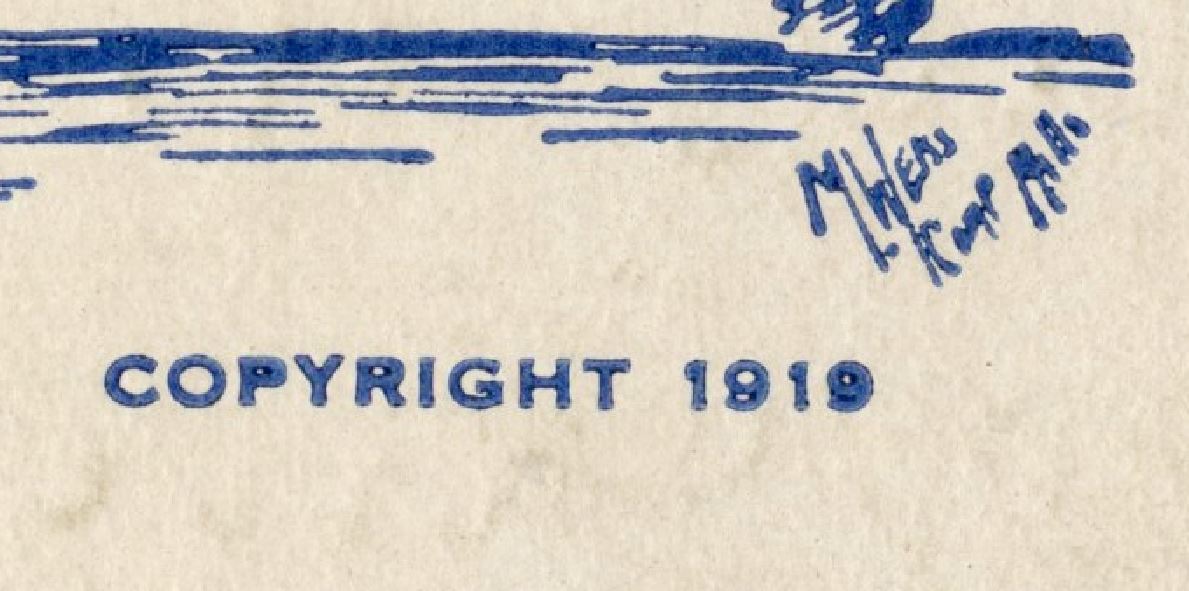
Copyright date of 1919

Most WWI postcards don’t usually come with a Copyright date and/or an artist’s signature. This one comes with both. I don’t have time to delve into the identity of the artist, but I can say that the card was copyrighted in 1919.

So, the written portion is from September 11th, 1919 at the very earliest.

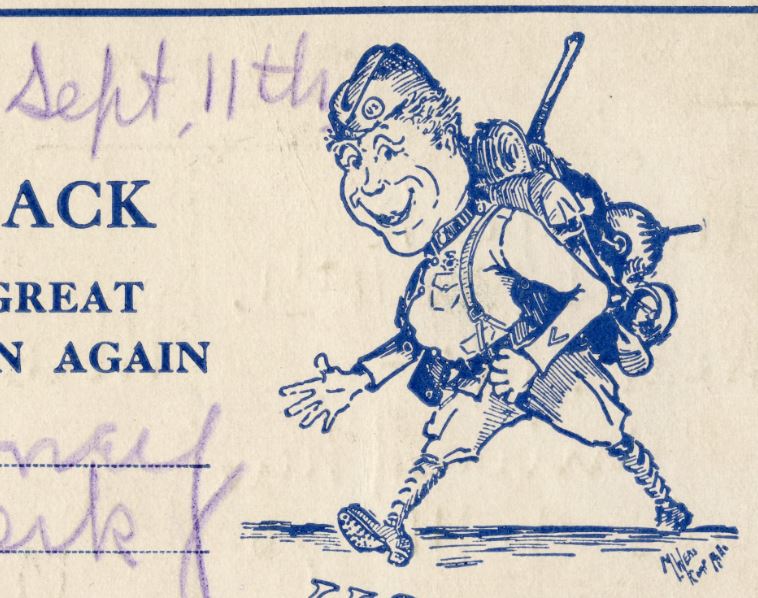
JewishCard040ab

September 11th

Step 4: Who the heck sent this thing?

Whenever I attempt to identify a soldier-sent postcard, I always try to research the recipient first. Normally, we have the name of well established member of a community as well as a normal mailing address and town name intended as the recipient. Assuming most postcards are sent to a mother or father, it doesn’t take much effort to track down the 1910 census record for that family using Ancestry.com. This is exactly what I did in this case. The first Maroney to appear in the Eyota, MN 1910 census was a Patrick C. Maroney… Bingo.

JewishCard040abcde

1910 Census record

From here I researched the children of Patrick and Emma Maroney (the card says “Dear Ma”) and found that they had a son named Charles E. Maroney who was born on September 22nd, 1895 and passed away on September 5th, 1934.

charlesmaroney1

Charles’ September 11th, 1919 return to the USA

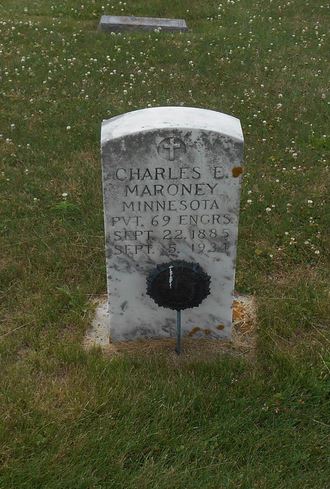
Charles signed in aboard the U.S.S. Montpelier after his time in France on August 28th, 1919 and landed back in the US on September 11th. It was at this time that he was most likely given the above card to fill out and ship to his parents back in Minnesota. His wartime record puts him with an engineering unit that was focused on railway work during the war and this tombstone identifies him as a Private with the 69th Engineers . This doesn’t exactly jive with his US Headstone Application or the US Army Transport records seen above. According to records, his grave should’ve listed him as being with the 144th Transportation Corps. Please note that his mother was also the recipient of his body after he passed away in 1934. 😦

144th

US Headstone Application

charlesmaroney.JPG

Charles E. Maroney’s resting place

WWI Portrait Photo – Lt. Carl Wehner, 141st Infantry Regiment, KIA at St. Etienne, France


A recent eBay purchase has lead me down a warren of research avenues that are helping shed light on the American involvement at the bloody fray at St. Etienne during the Battle of Blanc Mont Ridge in October of 1918. The photo depicts Lt. Carl Wehner with the following inscription on the verso:

“141st Inf., 36th Div. Lt. Carl Wehner killed Oct. 8, 1918 by a German sniper.”

It was this writing that pushed me to purchase the photo at a reasonable $25.00 in hopes of researching and fleshing out the life of the young Lieutenant and Wisconsin native who was killed in action only days after his 26th birthday.

wwi024

Lt. Carl Wehner in France, 1918

This photo was most likely taken a month or so before his death in October, as he is sporting a 6 month overseas service chevron on his left cuff. August or September would roughly be six months after his arrival from stateside officers training. He was selected to be a Lieutenant with Company K of the 141st Infantry Regiment of the 36th Division – a unit comprised mostly of southern boys from Texas and surrounding states. Having been born in Lincoln, Kansas and spending most of his life in Madison, Wisconsin, he originally enlisted with the 32nd “Red Arrow” Division but elected to train to become an officer. At the time of his enlistment, he lived at 925 West Dayton Street in Madison.

005251478_02371

Carl’s WWI Draft Registration Card

And I was able to find a fascinating account of his death while commanding Company K following the death of his Captain (Source – Entry by RavenHawk)

…It was near St. Etienne, as his captain layed dead, Wehner led his unit forward, until he himself was struck in the head, by enemy gunfire, and killed. One account of the battle (perhaps a little exagerated), said: “Lieutenat Wehner died with three machine gun bullets in his forehead and a smile on his lips as he led Company K of the 141st Infantry over the top after his captain was killed by the fire of the enemy.”….In a letter signed by the Marshall Of France, Commander in Chief of the French Armies of the East, Petain, it was written: “Lt. Wehner displayed audacity and disregard of danger during the operations near St. Etienne. At the head of his men, encouraging them with his skill, he largely contributed to the success of the operations which made it possible to capture all objectives. He was killed at his post of combat.” For his bravery, Wehner was awarded the Croix de Guerre with palm for bravery….As for Wehner’s family, they didn’t find out until after Christmas, that Wehner had been killed, in battle…Wehner’s body was returned to Madison in 1921, and reburied at Forest Hill on 10/21/1921.

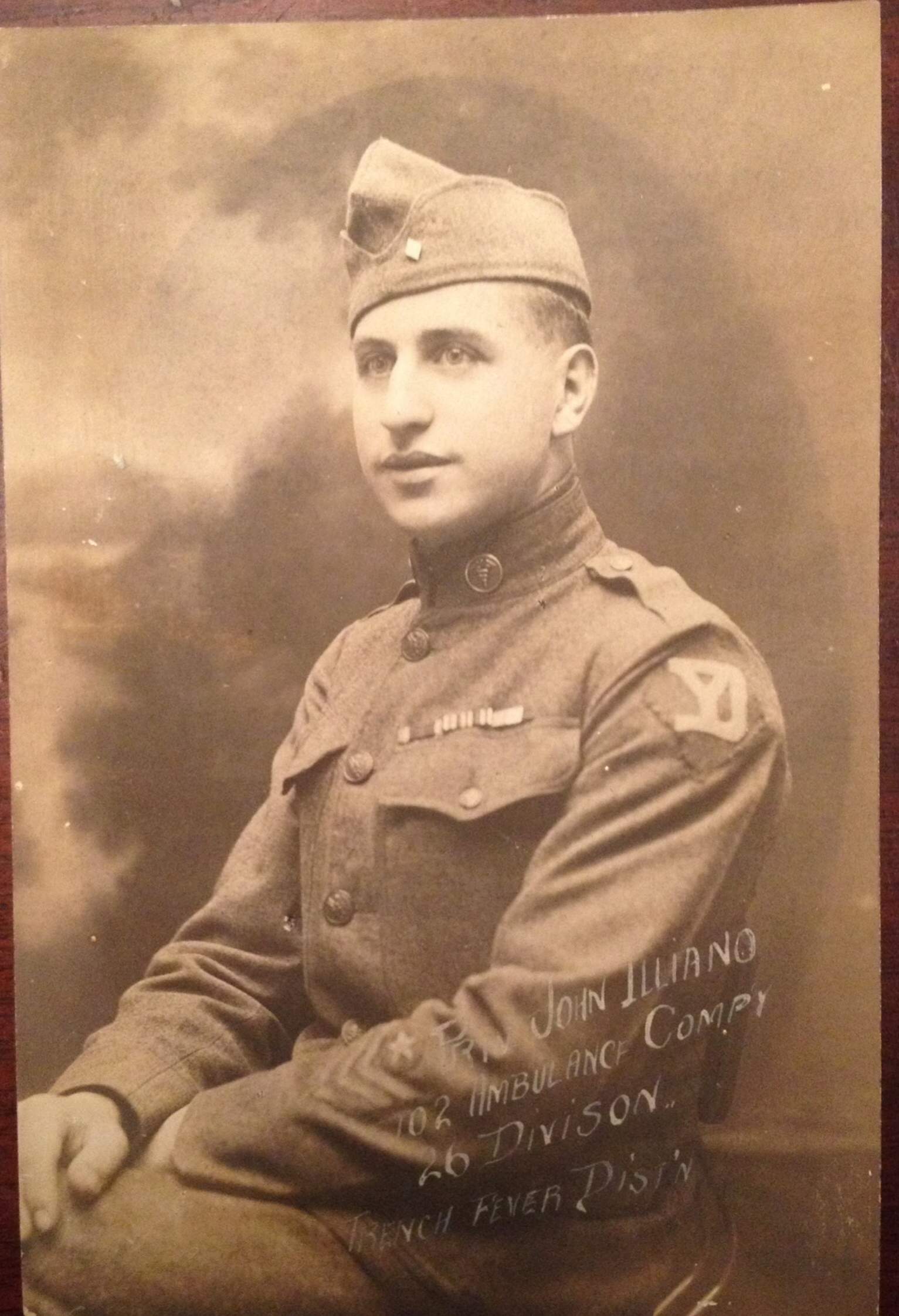
WWI Portrait Photo – 102nd Ambulance Company, 26th Division


This photograph is a true mystery for me. I can’t identify the sitter of this photograph even though there is so much information to work with:

  1. He’s identified on the print as Pvt. John Illiano of the 102nd Ambulance Company
  2. He’s sporting a 26th Division uniform with at least 1 1/2 years overseas service
  3. He was one of the first 100,000 US soldiers to enlist (conjecture based on star)
  4. He’s most likely from New England at the time of enlistment
  5. Probably Italian-American

I found a digital scan of this photo on War Relics Forum, a site dedicated to WWII artifact research. The OP of this photo, MD Helmets, doesn’t have any additional information but did claim he/she purchased it from Bay State Militaria back in 2013.

What do you guys think? Any leads?

102ndambulance

102nd Ambulance Company “Mystery Sitter”

100 Years Later: Vermont’s Entry into the First World War


It has been called THE GREAT WAR and THE WAR TO END ALL WARS.

According to Tweets from WWI, the American intervention in the war can be summarized as:

There is only room for one: ‘s idealism vs. German ‘s imperialism (US caricature).

C8qcY9kWsAAUJvg.jpg large

Today, we know it as World War One (WWI). It began in 1914 and ended with an armistice at the eleventh hour of the eleventh day of the eleventh month in 1918. The global toll had already reached nearly 40 million casualties, including American losses of 117,465 dead and 204,002 wounded.

100 Years Ago Today

After War was officially declared (House and Senate) on April 6th, 1917 the U.S. began preparations to enter the quagmire of European trench warfare.

101stmg043a

Vermonter John Corcoran (r) in WWI

In June of 1917, U.S. transport ships carrying nearly 15,000 U.S. troops (many from New England) in the American Expeditionary Force (AEF) approached the shores of France, these soldiers would join the Allied fight against the Central Powers.  They disembarked at the port of Saint Nazaire; the landing site had been kept secret because of the menace of German submarines, but by the time the Americans had lined up to take their first salute on French soil, an enthusiastic crowd had gathered to welcome them. However, the “Doughboys,” as the British referred to the green American troops, were said to be untrained and ill-equipped, untested for the rigors of fighting along the Western Front.

djpub

PortraitsofWar’s WWI Smithsonian Cover

As U.S. troops landed in France, Americans were mindful of a 125+ year old debt owed that nation. France had been the colonists’ most important ally during the Revolutionary War, having supplied money, material and military brains. The Marquis de Lafayette had fought beside Patriot soldiers, equipping some of them at his own expense. He won the affection of George Washington and became a hero to the young nation. Urged on by Lafayette, France had sent ships, troops, and arms that played a key role in the Patriots’ victory. In early July 1917, the newly arrived American Expeditionary Force troops marched under the Arc de Triomphe, cheered by the people of Paris. In a ceremony at Lafayette’s tomb, where the Frenchman lies buried under dirt from Bunker Hill, an American officer lay down a wreath of pink and white roses. Another officer stepped forward, snapped a salute, and declared: “Lafayette, we are here!”

lavallee093

Earl F. Lavallee of Winooski, VT in Germany, 1918.

As followers of PortraitsofWar will know, we take a great pride in providing interesting and never-before-seen imagery and narration of wartime photography ranging from the American Civil War to the Korean War. In most cases, I take an authentic photograph from my personal collection and work towards uncovering various details that hopefully elucidate some aspect of the photo.

101st Ammunition Train

In this case, I worked the other way around. My familiarity with the First World War history of the State of Vermont is well known to followers of this blog as well as within my home state. One of my favorite Vermont units to serve in the war was the 101st Ammunition Train of the 26th “Yankee Division”.

unnamed

Jeannine Russell (Vermont Agency of Transportation Archaeology Officer), Myself (Vermont Agency of Transportation Archaeologist) and David Schütz (Vermont State Curator) inspecting WWI flags

Only a week ago I was lucky enough to be invited into the bowels of the Vermont Historical Society storage area to inspect a series of American Civil War flags with a few colleagues of mine from work. While in the holding area I mentioned that a series of WWI groups had donated regimental flags and/or guidons to the State of Vermont in the years following the war.

Although I can be a bit fuzzy in my recollections, I apparently had my facts straight and we moved a series of shelves to uncover the aforementioned flags. As I fingered through the labels I instantly recognized the attribution: 101st flags. Please see below for a bit of insight into my recollection…

vermont unit

101st Ammunition Train Guidon Donation Alert, Burlington Free Press, February, 1919

Ok – So my first attempt at searching on the Library of Congress Newspaper website turned up only one reference to the flags, I kept searching (tried COLORS) and came up with this…

flagspresented

Flags presented

The above snippit from a 1919 Burlington Free Press article reads:

Colors Presented

War Flags and Shields Presented to State

Montpelier, Oct. 23 – The presentation of the colors and shields of the organizations from Vermont participating in the the world war occurred this evening in the State House with some 200 veterans attending and over 400 spectators in the seats of the representative hall and balcony.

The services were fitting and were attended by many of the men who have been prominent in the connection with the war. Col. F.B. Thomas presided over the exercise and the program carried out consisted of the “History of the 57th Pioneer Infantry” Capt. Ernest W. Gibson – Brattleboro

Presentation of colors – First Vermont and 57th Pioneer Infantry, Col. F. B. Thomas… History and presentation of colors of 302nd Field Artillery , Color Sergeant Albert J. Seguin of Newport.

History and presentation of 101st Ammunition Train Col. William J. Keville of Boston Mass.

Presentation of guidon, Company E. 101st Ammunition Train, Capt. Harold M. Howe of Northfield, VT.

co#

Ca. 1919 Co. E101st Ammunition Train guidon photo (from Brennan C. Gauthier Collection)

Presentation of guidon, Company F 101st Ammunition Train, Captain McMath

Presentation of guidon, Company G, 101st Ammunition Train, Chester Mooney of Newport.

As I stated earlier, I remembered the fact that the 101st and the 302nd had presented the State of Vermont with standards and guidons from prominent units representing Vermont involvement in the war. The following photos show the results of my inquiries:

unnamed

Left to Right: Jeannine Russell (Vermont Agency of Transportation Archaeology Officer), Myself (Vermont Agency of Transportation Archaeologist) an David Schütz (Vermont State Curator)

In the above photo we have just unrolled the 101st Ammunition Train guidons from their muslin cocoons. Present are representative samples of Co. C, G, F and E of the 101st. Each of these matches with the above 1919 article. How amazing is it to read a 98 year old article about a presentation and see the EXACT pieces in living color?

I’m particular excited about the Co. E guidon. I own a ratty panoramic photo taken of the unit when they returned in 1919. Click here to see ever single facial feature of the men in that group.

Ok – so here’s a photo of the guidon taken right before donation in 1919:

co#

And here’s the guidon today (my big head is at the left edge of the frame):

F company 1

WWI guidons of the 101st Ammunition Train

Also, I requested that the regimental flag of the 302nd Field Artillery be brought out for photographing. Special thanks to Jonathan Croft for being the photographer!

302nd

302nd Field Artillery

Has it really been 100 years?

Local Burlington, VT WWI Headstone Research – William F. Duggan (1895-1970)


My daily jogging routine takes me past St. Joseph Cemetery in Burlington, VT; this cemetery is fairly discrete with no over-the-top entryway and is located in a section of Burlington typically used as a pass-between for the Old North End and the UVM campus.  St. Joseph is the oldest Catholic cemetery in Burlington, and primarily consists of Irish-Catholic and French-Catholic burials.  The cemetery property was donated by Col. Archibald Waterman Hyde (1786-1847) in 1830, a War of 1812 veteran who served as Barracks Master in Burlington during the war.  According to his FindaGrave.com entry, Hyde:

“In his later years he affected antique costumes and habits, dressed in small-clothes, wore knee- and shoe-buckles, or long boots, with a long cue hanging down his back; eulogized the forefathers, and lamented the degeneracy of their descendants. He was a man of his word, a faithful friend, open-handed to the poor. He never married.”

An interesting side-piece to this post! (So many questions about Hyde….)  Now let’s focus on William F. Duggan…

IMG_1030

William F. Duggan Headstone

I always take pause to check out the various headstones as I do my pre and post run stretches, and I take particular notice of interesting military-related graves. In this case, I found a semi-obscured headstone with three small American flags clearly marking a veteran grave.  I snapped a picture in hopes of researching and posting the info to PortraitsofWar.  This post is dedicated to William F. Duggan – just an ordinary Vermont WWI veteran who deserves a place in the digital world!  I hope a few of his relatives chime in…

Biography

William Francis Duggan was born on September 25th, 1895 in Burlington, Chittenden County, VT.  The son of William Amos and Katherine M. Duggan, he married Georgianna Esther Hall of 19 Cherry Street, Burlington on June 6th, 1916.

1stmarriage

1st Marriage Registration Card

William was sent away to war a few years later and served in a number of disparate units during the three months he spent in France and Germany during the war; he served stateside with the 52nd Aero Squadron from March until June 17th, 1918, and then transferred to Battery B of the 110th Field Artillery (29th Division) until July 10th, he then transferred again to Company L of the 340th Infantry Regiment, 85th Division, and later to Battery F of the 137th Field Artillery, 41st Division.   He served overseas with the 137th from October 6th, 1918 until December 24th, 1918.  He left Europe and returned to the US on January 17th, 1919, where he was summarily discharged.  His home at the time (and for years prior) was 57 Rose Street, Burlington, Chittenden County, VT:

57rose street

Duggan’s Childhoom Home – 57 Rose Street, Burlington

William F. Duggan’s Wartime Record

WarRecord

WWI Service Record

With William’s WWI service record researched, I began to look into his pre and postwar life in Burlington.  He lived in the my community, and such, I’m interested in his comings and goings on the streets that I frequent.  It turns out that Will likely knew the streets of Burlington better than most 2016 residents!  During his lifetime, William F. Duggan worked as a streetcar operator, fireman,used furniture salesman, taxi driver (many years), and as a Burlington Electric employee.  Quite the credentials!

005271323_05471

WWI Draft Card – Note STREETCAR Operator

1928Directory

1928 Burlington Directory – Note occupation as second hand furniture salesman

1944Directory

1944 Burlington Directory – Note occupation as fireman at Fort Ethan Allen

WilliamDugganWWII

WWII Draft Card – Note occupation as Burlington Light Department

1954Directory

1954 Burlington Directory – Note occupation as taxi driver at the corner of Main and St. Paul St.

1962Directory

1962 Burlington Directory – Finally retired!  Woo Hoo!


Although I can’t find the marriage record for his second marriage, I do know that he remarried later in life and had six children with his second wife.  William and Mary Louis Rielling had six children together – Patricia, Dorothy (Quintin), Mary (Kidder), Elizabeth (Rousseau), Kathleen (Dutra), and Robert Duggan.  As of the writing of this post, only Patricia has passed.

William sounds like an incredible guy, and I hope to learn more about him and his exploits through this post. A wartime photo of him would be the icing on the cake!

I plan to trim a bit of the grass around his headstone to allow for easier view, and he will certainly be a part of my daily run routine for years to come 🙂