POST STILL IN DRAFT FORM

David T. Zweibel
It’s a rare occasion when I post material related to a familial relation; tonight I’m posting an identified photo of Lt. Col. David T. Zweibel, commander of my grandfather’s WWII 777th Tank Battalion.

US Silver Star Medal
UNCONFIRMED – Citation Needed: David T. Zweibel, United States Army, is reported to have been awarded the Silver Star under the below-listed General Orders for conspicuous gallantry and intrepidity in action against the enemy while serving with the 69th Infantry Division during World War II.
General Orders: Headquarters, 69th Infantry Division, General Orders No. 39 (1945)
I also own a rare snapshot of his award ceremony – this is the first I’ve seen of this event, and I wonder if other 777th researchers have additional photographs to share?
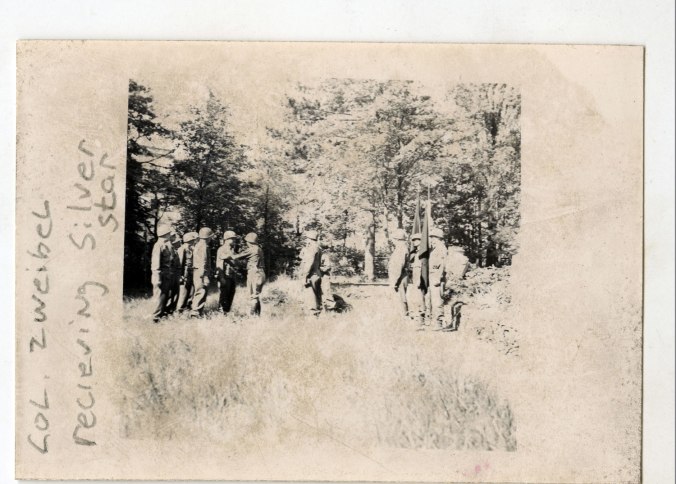
Silver Star Award Ceremony
Lt. Col. Zweibel’s WWII After Action Report/Diary
The 777th Tank Battalion
777th TD Battalion
Lt. Col. David T. Zweibel =
Battalion Commander
777th TD Battalion
Photograph unavailable
The Super Race
On February 28, 1945, the 777th Tank Battalion was attached to the 28th Infantry Division, and we marched to their sector in the Monschau Forest in Germany. The route was through Louveigne and Eupen, and the people waved and cheered us until we came to a sign, You are entering Germany, 94 and then it was silent, hurrying people, who neither looked nor paused as we went by. It was our first glimpse of the so-called herrenvolk.
Remember how strange it seemed going through the ruins of Aachen to see the Red Cross soldiers club there in one of the few untouched buildings?
In the Monschau Forest, we had our first taste of combat billeting, and found it cold and wet. It was cold, and the mud was knee-deep; the sound of battle was close by; the evidence of what our artillery had done to the German army was there for all of us to see in the hurriedly deserted lean-to. The Krauts had left us all their equipment for souvenirs. Here it was too, that the battalion was split up, the medium companies being parceled out to the infantry regiments. And it was here that our tanks provided the punch that sent the 28th Infantry Division through mud and mines to Schleidten , Sistig, Mulenhausen, and the battalion on to Zingsheim, where we again assembled and billeted in the homes of the town from March 8 to March 17, on which date we moved in convoy to Ettringen, a march of 54 miles, and on March 19 to Wassenach on the Laacher See.
While billeted at Wassenach
The 777th Tank Battalion was detached from the 28th Infantry Division and attached to the 69th Infantry Division. The date was March 27, and at 0610, we left Wassenach, crossed the Rhine on the Victor Bridge, 1,372 feet in length, six miles south of Remagen, and bivouacked north of Bendorf at 1100.
At Bendorf, we had our first chance to fight intact as a battalion, and Dausenau, Nassau, and Weinahr, on the Lahn River, fell in quick succession. The battalion was reassembled at Weinahr on March 29, and marched 32 miles to Neidertiefenbach, arriving 1600, March 30, 1945.
At Neidertiefenbach(sic)
The battalion was again split so that the mediums went with the infantry regiments and got into position as the division moved north toward Kassel. From that time, we fought separately, and it is nearly impossible to present a coherent picture of the situation without calling upon the After Action Report of the battalion, which is presented here so that we can see what each of us was doing through the following weeks.
Application
Company A, 777th Tank Battalion
1 April 1945: First and Third Platoons, working with Third Battalion, 271st Infantry Regiment, Company L, cleared the vicinity of Wetzlar, Germany, with little resistance. Turned over to infantry 12 prisoners of war (PWs), two of which were in civilian clothes.
2 April:Departed Wetzlar for Geisen at 1200, carrying Company L, Third Battalion, 271st Infantry Regiment, on tanks. Departed vicinity of Geisen for Friztlar at 1930.
3 April:One tank fell through bridge at Fritzlar but was recovered with no casualties. Remained at Fritzlar working on maintenance.
4 April: Worked on maintenance and were alerted for counterattack, which didn’t materialize.
5 April: Departed Fritzlar and arrived in the vicinity of Kassel at 1345 with Company B, 271st Infantry Regiment, on tanks. Billeted at Betenhausen on northeast outskirts of Kassel.
6 April: Departed Betenhausen, arrived in Lutterberg, and joined the 273rd Infantry Regiment at 2030. Moved to edge of autobahn, east of Lutterberg.
7 April: At 0530, moved with task force composed of Company A, 777th Tank Battalion; Company A, 661st Tank Destroyer Battalion; K and L Companies, 3rd Battalion, 273rd Infantry Regiment; Reconnaissance platoon, 661st Tank Destroyer Battalion; and two platoons of light tanks, Company D, 777th Tank Battalion; under command of Colonel Miller, 661st Tank Destroyer Battalion, to clear area from Lutterberg to Oberode, Germany. Reconnaissance platoon encountered five Royal Tiger Tanks and lost three Jeeps and one armored car. Light tanks withdrew to the north. Task Force proceeded east until two miles west of Oberode; encountered very heavy machine-gun fire in woods. Company A, 777th Tank Battalion, passed through Tank Destroyers who were held up by the enemy. All tanks dismounted infantry and moved through enemy machine-gun positions with all automatic weapons firing. Known killed: 15 enemy, wounded 10, and 50 PWs turned over to infantry. One mile west of Oberode, encountered two roadblocks; tanks were held up while tank-dozer removed the blocks. Moved into Oberode and remained for the night.
Crossfire
8 April: Relieved from 273rd Infantry Regiment and returned to Lutterberg. Contacted Command Post, 777th Tank Battalion, and were sent to join 1st Battalion, 271st Infantry Regiment, at Wittzenhausen. Crossed Werra River at Wittzenhausen, moved to Gertenbach, picked up Company B, 1st Battalion, 271st Infantry Regiment, and took Mollenfeldt. Turned over 6 PWs to infantry. French laborers stated that six German tanks and 50 enemy had departed Mollenfeldt three hours previous. Remained in the vicinity for the night.
9 April: At 0630, departed Mollenfeldt with Friedland as an initial objective. Took Herrmannrode and Marghausen, and reached Friedland at 0800 with 4 PWs. Departed Friedland at 0830 for Brenke. At Reckerhausen, turned over to infantry 51 PWs. Were fired on by friendly artillery, causing casualties among civilians. Moved toward Reiffershausen. One mile south of Reckershausen, fired on by friendly outpost, and returned fire, inflicting two slight casualties. Took Reiffershausen, Ludoffshusen, Eishenrode, and moved to outskirts of Brenke. Took one PW in the outskirts, and received enemy machine-gun fire. Automatic weapons dispersed enemy. Lead tank sighted what he through was enemy tank at 1,200 yards and destroyed friendly tank destroyer with two rounds, causing no casualties. Were fired on by friendly anti-tank gun and destroyed it, causing two slight casualties. Regimental commanders of the 271st Infantry Regiment and 9th Infantry Regiment conferred in Brenke and found confusion caused by both units having the same boundaries. Orders had been that no friendly troops were in the area. Moved from Brenke to Heilingenstadt. Enroute, turned over seven PWs and two enemy officers to the infantry and located German infantry two miles west of Heilingenstadt. Infantry dismounted from tanks, and tanks led assault in line with marching fire, killing one enemy, wounding one, and capturing 40. Moved through Heilingenstadt to Westhausen and took 10 PWs. Moved to Bodenrode and enemy fled into woods. Fired high explosives, but because of darkness, couldn’t check results. Returned to Westhausen for night.
10 April: Remained at Westhausen for maintenance and moved to Krungen at 2300. On this date, company’s objective was to follow the 9th Armored Division and mop up any enemy resistance bypassed by the 9th Armored Division. Orders were to also bypass any heavy resistance.
11 April: Departed Krengen and moved east following 9th Armored Division. At Beichlingen, which was bypassed by the 9th Armored Division, ran into small arms, panzerfaust (sic) and sniper fire. Dismounted infantry and captured 25 PWs. Lost one tank, and one enlisted man was seriously wounded. Moved toward Bernsdorf through Billroda. First platoon at Billroda turned over to infantry 49 enemy enlisted men and one captain. At Bernsdorf, took 17 PWs and outposted the town for the night.
On to Leipzig
12 April: At 0330, a German truck was destroyed by outpost, seriously wounding one enemy. At 1100, moved east in direction of Leipzig, with one company of 661st Tank Destroyers and 1st Battalion,271st Infantry Regiment. On outskirts of Schortau, 5 PWs were captured. Received heavy 20, 40, and 88mm mortar fire, causing heavy casualties among the infantry. Returned fire with all tank weapons, destroying six 88mm mortar and three 20mm guns. Withdrew and bypassed area, then moved south through Branderoda and Grost, taking 12 PWs, and then moved to Pettstadt. At outskirts, encountered panzerfaust(sic), heavy machine-gun, and small-arms fire from dug-in positions. Took 51 PWs and one officer; destroyed two gas trucks with trailers. Sustained one casualty. Remained at Pettstadt for night and received occasional flak fire.
13 April: During the morning, received heavy artillery and flak fire. Moved out with third platoon leading and received 88mm fire direct. Bypassed enemy and moved through Naumberg to Stontzsch at 2330. Remained for the night.
14 April: Performed maintenance and received occasional enemy artillery fire. Third platoon attached to 3rd Battalion, 271st Infantry Regiment, and departed at 1500.
First and Second Platoons, and Company Headquarters, Less Second Section, Second Platoon
19 April: Moved from Stontzsch to Lippendorf. Encountered four enemy anti-tank guns, destroyed them, and turned over 80 PWs to the infantry; remained for night.
16 April: Moved through Rotha to Espenhain, toward Gruna. One mile south of Gruna, leading tanks with Company A, 1st Battalion, 271st Infantry Regiment, were subjected to heavy enemy fire of all caliber, ranging from small arms to 88mm mortar. One tank was destroyed by panzerfaust(sic) and one enlisted man wounded. Infantry suffered heavy casualties. Returned fire, knocking out several enemy positions, and were ordered to hold while artillery brought fire on enemy. Waited for artillery in open position for three hours and then were ordered to withdraw to Espenhain. One German officer was killed with pistol at point-blank range; other enemy killed were considerable, but were unable to verify. Before withdrawing, lead tank evacuated wounded infantry under heavy fire. Second platoon attached to 2nd Battalion, 271st Infantry Regiment, at this time.
Second Seection, Second Platoon, Company A
15 April: Moved into Pegau, with elements of the 271st Infantry Regiment, and engaged enemy pocket in town, capturing a German infantry company of 100 men and officers. Rejoined Company A, 777th Tank Battalion, on the 16th of April at Espenhain, Germany.
First Platoon and Company Headquarters, Company A
17 April: Remained at Espenhain, performing maintenance.
18 April: Moved from Espenhain through Potzschau and Oberschau to Lieberwolkwitz. Joined First Battalion, 273rd Infantry Regiment, and were given mission to clear pockets at Guldengossa, Magdborn, Gruna, and Stornthal, and then returned to Lieberwolkwitz. Twenty-three PWs were taken at Guldengossa, and four enemy killed. At Magdborn, took 17 PWs and were subjected to 20mm and 40mm flak fire and some small-arms fire. Remained at Magdborn, sleeping in tanks. Sustained one counter-attack, which was repulsed by automatic tank weapons. During the night, friendly artillery was brought to within 50 yards of tanks, and the next morning, 50 enemy dead were counted.
19 April: Captured two officers; one colonel and one captain; entering Magdborn in a vehicle. Thirty-four PWs were taken. Moved from Magdborn to Gruna, with infantry walking in front of tanks. Found 15 88mm guns and 30 flak guns with great quantities of ammunition abandoned. Moved to Stormthal, and found no resistance, then returned to Lieberwolkwitz. Tanks were gassed and proceeded into Leipzig and remained the night.
20 April: Moved from Leipzig to Taucha and returned under battalion control to Naunhof.
Second Platoon, Company A
16 April: Moved from Espenhain and joined 2nd Battalion, 271st Infantry Regiment, atRotha.
17 April: Were alerted at 0400, and at 1000, moved to Bolen and took up positions firing at enemy gun emplacements at 3,200 yards. Sustained three slight casualties. Later, made an attempt to move to Pulgar, but were forced to return due to heavy artillery fire. At 1800, engaged enemy at Pulgar and took 200 PWs. At 2000, moved to Zwenkau, with infantry walking in front of tanks. Took city with slight resistance after dark and remained the night.
18 April: At 0700, moved to Eythra with infantry marching. Infantry was pinned down by small-arms fire, and tanks cleared town with marching fire. One 40mm and one 88 mm gun were destroyed. Platoon was split and town divided, and 250 PWs were taken. An attempt was made to take an enemy gun position containing 46 flak and 88mm guns, but were orderedto evacuate town, preparatory for artillery barrage of the Second Division. Platoon leader, while making a personal reconnaissance for the tanks, was killed by enemy artillery fire. The platoon withdrew to Zwenkau under command of the platoon sergeant and remained for night.
19 April: Remained at Zwenkau until 1715 due to lack of gas, and then moved with the regiment to Markkleeberg.
20 April: Moved to regiment at Taucha and rejoined Company A, then moved to Naunhof under battalion control.
Third Platoon, Company A
14 April: Attached to Third Battalion, 271st Infantry Regiment, and departed Stonzsch at 1500. Picked up infantry at Werben and moved toward Lutzen. South of Lutzen, received enemy artillery and flak concentration, forcing infantry to dismount. Tanks dispersed and fired at probable targets. Took up defensive positions at Rhana and moved into the town after dark.
15 April: Cleared town of Lutzen and moved into Pegau, remaining for the night.
16 April: Moved out at 1100 to Audigast with infantry on tanks, and received heavy small-arms fire. Infantry dismounted and town was subjected to artillery concentration. Infantry and tanks started to move in, and panzerfaust knocked out platoon leader=92s tank, killing the platoon leader and seriously wounding two enlisted men. Platoon sergeant took command, and all tank weapons were used in marching fire, causing extremely heavy casualties among the enemy. Two tanks remained at Audigast to clear town, and two proceeded to Kobschutz. At northern end of town, the platoon sergeant tank received 88mm fire on the turret. The column proceeded, and second tank received four direct hits from 88mm at point-blank range, killing three crew members, seriously wounding one, and slightly wounding the fifth. The enemy gun position was destroyed, and an ammunition dump set on fire. Enemy opened up with heavy artillery concentration, and the remaining tank withdrew into Audigast and remained for the night.
88s Destroyed
17 April: Took town of Kleinstarkwitz, and six 88mm guns were destroyed and 47 PWs were taken. Remained at Pegau for the night.
18 April: Performed maintenance on tanks. Marched to Naunhof with the battalion and rejoined company (19 April).
20-30 April: Remained under battalion control at Naunhof in division reserve.
Company B, 777th Tank Battalion
1 April: Attached to 272nd Infantry Regiment at Hoffen. Spent day on maintenance of vehicles.
2 April: Departed Hoffen, Germany, at 2130, and marched to Giessen.
3 April: Departed Giessen, arrived Altenstadt
4 April: Departed Altenstadt, arrived Istha. Departed Istha, arrived Dornberg.
5 April: Departed Dornberg and marched through Kassel in attack on Landwehrhagen. Took the town and destroyed one Mark IV tank and crew, and turned over 12 PWs to the infantry. Repelled a counterattack, and took 70 more PWs, killing 35 enemy.
6 April: Took cities of Dapheim, Nieste,Kl. Amerode, Ellingerode, and Witzenhausen. Destroyed two enemy tanks and two armored vehicles. Turned over to the infantry 42 PWs and killed 12 enemy.
7 April: With the 272nd Infantry Regiment, shelled towns of Eichenberg and Hohenganborn, and returned to Witzenhausen.
8 April: Moved with 880th Field Artillery, 661st Tank Destroyers, and 272nd Infantry Regiment, and took towns of Eichenberg, Hohenganborn, and Arenschausen against heav=y resistance. Knocked out one enemy truck and one American Jeep, manned by the enemy. Took 45 PWs and killed 15 enemy.
9 April: Took towns of Schonan, Uder, and Heilingenstadt with little resistance. Turned over 20 PWs to infantry and remained at Heuthen for the night.
10 April: Marched from Heuthen to Korner.
11 April: Marched from Korner to Grossneuhausen and thence through Naumberg to Teuchern.
12 April:: Marched from Teucherhn to Obernessa.
13 April: Marched from Obernessa to Elstertrebnitz.
14 April: Attacked Quisau at 1700 with the 2nd Battalion, 272nd Infantry Regiment. Captured and destroyed 36 88mm guns and the complete fire control center. Took 200 PWs, some of which were women in uniform. Returned to Elstertrebnitz.
15 April: Remained at Elstertrebnitz, working on tanks
16 April: Departed Elstertrebnitz at 0900 enroute to Zweenfurth. Encountered light, scattered resistance enroute. Turned over 10 PWs to infantry.
17 April: Company B, minus 1st Platoon, remained at Zweenfurth. 1st Platoon, with Company C, 1st Battalion, 272nd Infantry Regiment, took towns of Hirshfield and Alton, taking seven PWs.
18 April: Departed Zweenfurth 66 1st, 2nd, and 3rd platoons with 1st, 2nd, and 3rd battalions, 272nd Infantry Regiment, to attack the outskirts of Leipzig, Germany. At the outskirts, took 150 PWs. At 1800, the first three tanks of 2nd platoon went forward as a reconnaissance element and ran into heavy opposition. The balance of the platoon came forward in their zone to the vicinity of the railroad station, where the lead tank was knocked out. The crew dismounted, and the leader was killed. Ten enemy were killed and 10 captured, including an SS captain. The platoon returned under regimental orders to Phase Line Three and patrolled the area. The 1st and 3rd platoons worked with their respective battalions, patrolling enemy escape routes from the city of Leipzig.
19 April: At 1800, the company withdrew from Leipzig and reassembled in regimental area.
20 April: Rejoined the 777th Tank Battalion at Naunhof.
Bloody Eilenberg
21 April: At 1300, company alerted to move to attack on Eilenberg. Departed at 1547 and joined Company A, 271st Infantry Regiment. Attempted to force entrance of town, but were forced to retire. Returned to Wedelwitz for the night. During the night, several concentrations of enemy high explosives were received by the tanks.
22 April: At 0900, one platoon was sent to attack the city from the south, and the balance of the company from the east. Both columns moved forward under heavy resistance from enemy artillery and panzer-faust. The column moving from the east worked forward as far as the creek, where the infantry was pinned down. Two tanks were hit at this point, killing one officer and wounding two enlisted men. The column withdrew, and artillery fire was brought to bear on the enemy. The column moving from the south made repeated attempts to work forward into the town, but were unable to gain headway due to heavy panzer-faust fire. Repeated attempts were made, but both columns were pushed back trying to reach the Mulde River. One additional tank was knocked out, but was recovered and turned over to maintenance. Between each attack,artillery was brought to bear on the enemy. During the night, heavy concentrations of 4.2 mortars were used to dislodge the enemy.
23 April: At 0600, after a heavy artillery concentration, the town was cleared and the Mulde River was reached. One enlisted man was wounded in attempting the leave the tank. Company regrouped and returned to Naunhof under battalion control.
24-30 April: Company remained at Naunhof under battalion control in divisional reserve.
Company C, 777th Tank Battalion
1 April: Movedwith the 273rd Infantry Regiment from Faulkenbach to Weilberg.
2 April:Departed Weilberg, arrived Ippinghausen.
3 April: Departed Ippinghausen, arrived Niederelsungen.
5 April: Working with Company E, 273rd Infantry Regiment, took towns of Monchehof, Hohenkirchen, and Holzhausen. At Holzhausen, killed 75 enemy in a barn and took eight PWs. One officer and three enlisted men were killed, and three enlisted men were seriously wounded in the action.
6 April: In the vicinity of Wilhemhausen, took up firing positions and shelled Bonaport, enabling Company G, 273rd Infantry Regiment, to enter the town and drive two companies of German infantry to the north. Known material destroyed: two machine-gun positions and 50 bazookas. Repaired crater in road and removed roadblock with tank-dozer, then moved to Lutterberg.
7 April: Attacked down autobahn to Laubach, and joined 1st Battalion, 273rd Infantry Regiment. Shelled Lippoldshausen and forced withdrawal of German column of six vehicles. Shelled column, completely destroying it at 4,500 yards. Identified one large towed cannon and ammunition truck, which burned.
8 April: Moved to Afzenhausen without incident
9 April: Moved from Afzenhausen to Mollenfeldt.
10 April: Second and third platoons attached to 2nd and 3rd battalions, 273rd Infantry Regiment, respectively. Balance of company moved to Heiligenstadt.
First Platoon and Headquarters Section, Company C
11 April: Departed Heiligenstadt,arrived Schtolheim.
12 April: Departed Schtolheim, arrived Saubach
13 April: Remained at Saubach.
14 April: Departed Saubach, arrived Teuchern.
15 April: Remained in Teuchern.
16 April: Departed Teuchern, arrived Borna.
17 April: Joined Task Force Zweibel (see Task Force Zweibel) and cleared area north of Borna. Took 40 PWs and liberated 1,400 Allied PWs.
50 =93Good=94 Krauts
18 April: Spearheaded advance to Lieberwolkwitz, taking enroute towns of Kohra, Thrana and Grossprona. First Platoon with Company B, 273rd Infantry Regiment, fought their way into center of Leipzig, destroying 12 machine guns, killing 50 enemy and forcing the surrender of several strong points. Headquarters Section worked with a platoon of Company B, 273rd Infantry Regiment, patrolling escape routes from the city, and rejoined 1st Platoon.
19 April: Patrolled Leipzig.
20 April: First Platoon moved to Pausitz and took up defensive positions with Company B, 273rd Infantry Regiment. Headquarters Section moved to Zwititz and established roadblocks with Company D, 272nd Infantry Regiment.
21 April: Rejoined 777th Tank Battalion at Naunhof.
22 April: At 1800 hours, moved to attachment with Company C, 1st Battalion, 271st Infantry Regiment, at Kospa. Moved to a point west of Eilenberg, where 100 PWs voluntarily surrendered. One tank was lost by mines. Several buildings from which snipers were firing was set afire by incendiaries. One of these buildings was a German military hospital. Platoon was relieved at 2100 hours and remained at Kospa for the night.
23 April: Returned to battalion control at Naunhof.
Second Platoon, Company C
10 April: Reported to White Battalion, 273rd Infantry Regiment, 69th Division, and formed part of the advance guard for Combat Command A, 9th Armored Division. Advanced east along the following route:
Volkerode, Mariengarten, Kl. Schneen, Gr. Schneen, Lichtenhagen, Bremke, Siemepode, Gunterode, Reinholterode, Bodenrode, Wingerode, Beuren, Leinefelde, Birkungen, Beberstadt, Hupstadt, Zannroden, Keula, Holzthaleben, Toba, Wiedermuth, Ebeleben, Gundersleben, Schernberg
11 April:
Schernberg, Thalebra, Oberspier, Westerengel, Kirchengel, Hohenebra, Holzengel, Trebra, Niederbosa, Oberbode, Bilzingsleben, Kannawurf, Sachsenburg, Heldrungen, Reinsdorf, Gehofen, Nansitz, Donndorf, Wiehe, Memleben, Nebra, Wetzendorf, Karsdorf, Steigra, Glein, Zeuchfeld
12 April:
Zeuchfeld, Under Wershen, Stossen, Grossgrimma, Krossuln, Runthal, Naumberg, Steckelberg. Stontzsch, Krauschwitz, Markrohlitz, Zembschen, Kostplatz
Formed with Company G, 273rd Infantry Regiment, a separate task force, and advanced northwest. Took the towns of Domsen, Tornau, Schestan, Muschwitz, Pobles, Bossen, Klein Gohran, and Gr. Gohren. Cut route 87, the eastern escape route from Weissenfels, and destroyed the personnel and equipment of an anti-aircraft position in grid square E0201.
13-14 April: Formed the advance party of Combat Command A, 9th Armored Division, with Company E, 273rd Infantry Regiment, and led the advance along the following route:
Strontzsch, Pegau, Groitzsch, Wischstauden, Brosen, Podelwitz, Drossdorf, Breunsdorf, Bergisdorf, Lobstadt, Kleinzossen, Eula, Dittmannsdorf, Stockheim
15 April:Grossbach, Seelingstadt, Grethen, Trebaen, Beirsdorf
Snipers
16-17 April: With Company F, 273rd Infantry Regiment, moved from Tre=bsen to Grimma to relieve the unit outposting the town. Heavy sniper and mortar action from enemy positions on the east bank of the Mulde River, neutralized and reduced to inactivity.
18-19 April: Rejoined White Battalion, 273rd Infantry Regiment, at Grethen, and moved to Lieberwolkwitz for theassault and capture of Leipzig.
20 April: Returned to Trebsen with White Battalion, 273rd Infantry Regiment, released to rejoin 777 Tank Battalion at Naunhof.
21 April: Moved to Taucha to form part of Task Force Sikes.
22 April: Released and rejoined 777th Tank Battalion at Naunhof.
Third Platoon, Company C
10 April: Attached to Company L, 3rd Battalion,273rd Infantry Regiment, and in turn attached to Combat Command R, 9th Armored Division, at Gertenbach on the Wessen River. Mission was to follow advance of 9th Armored Division and mop up enemy pockets which had been bypassed.
11 April: Patrolled vicinity of Mulhausen.
12 April: Patrolled vicinity of Bachra.
13 April: Returned to vicinity of Naumberg and contacted Company B, 131st Ordnance. Stripped one of the platoon tanks and repaired the other four.
14 April: Rejoined 273rd Infantry Regiment at Beersdorf and proceeded to Hobenback and shelled Colditz in conjunction with the artillery. Fire was restricted because the town contained a PW camp for Allied officers.
15 April: Took the town of Colditz and freed 500 Allied officers. Many PWs had been evacuated two days previous by the Germans. Among those taken away was the nephew of Prime Minister Churchill, the son of Joseph Stalin, and the son of Ambassador Winant.
16-18 April: Remained at Colditz and patrolled surrounding area.
19 April: While on an offensive patrol, received 30 rounds of 105 heavy explosives at Bockwitz. Six infantrymen were seriously wounded by this friendly artillery and were evacuated on the tanks. Artillery clearance had been obtained in this area
20 April: Cleared town of Thrana.
21 April: Cleared woods and area southwest of Thrana and returned to control of 777th Tank Battalion at Naunhof.
Company C, 777th Tank Battalion
21-30 April: Entire company remained under battalion control at Naunhof, in division reserve.
Company D, 777th Tank Battalion
1 April: Third Platoon attached to 102nd Cavalry, 69th Infantry Division, under V Corps=92 control as reconnaissance elements. Remainder of company moved with battalion command post.
2 April: Third Platoon at grid coordinate 001041. Remainder of company with battalion command post.
3 April: Third Platoon attempted to take town at grid coordinate 140227. Enemy too strong for reconnaissance element and forced to withdraw. Expended 4,500 rounds 30 caliber, 69 rounds 37 heavy explosives, and 2 rounds armor-piercing. Took one PW and killed unknown number.
4 April: Third Platoon remained under V Corps 92 control. Balance of comp=any remained with battalion command post.
5 April: Third Platoon rejoined company. Entire company with battalion command post.
6 April: Entire company remained with battalion command post.
7 April: Second Platoon, working with 273rd Infantry Regiment, departed Lutterberg enroute to Oberode. Engaged small enemy pockets, destroying several machine-gun nests and one armored car. Returned to company control. First Platoon, working with Battalion Headquarters Tank Section and Headquarters Company, Assault Gun Platoon, 777th Tank Battalion, encountered mines and roadblock in vicinity of Hann Munden. One tank lost, one enlisted man killed and two enlisted men seriously wounded.
8 April: Second Platoon returned to company control after protecting Engineers in removal of roadblock and minefield in vicinity of Hann Munden. Entire company moved with battalion command post.
9-12 April: Entire company moved with battalion command post.
First Platoon, Company D
13 April: Moved into Weissenfels at 1700 with Task Force Zweibel, carrying infantry of 271st Infantry Regiment on tanks. Encountered heavy machine-gun, sniper, and panzer-faust fire. Task force gathered in center of city and remained for the night.
14 April: At 0700, moved to attack a garrison in the castle and lost one enlisted man in 1st platoon to sniper fire. Objective taken and 200 PWs captured. First Platoon ordered to move east through Selau to autobahn. Found village of Selau clear, but at autobahn, received air bursts and direct fire from 88mm guns, knocking out one tank, killing the bow gunner and wounding several infantrymen and two other crew members of the tank. The wounded were evacuated, and the tanks were withdrawn and rejoined the task force at Weissenfels, and remained for the night.
Helpful Hollander
15 April: Proceeded with task force to take town of Kriechan. From information obtained from a Hollander in Wiessenfels, the exact location of a group of 32 anti-aircraft/anti-tank dual-purpose 88mm guns was determined. This emplacement was destroyed with 4.2 mortar fire, and 200 PWs were taken. Returned to Weissenfels.
12 April: Moved to Pegau.
17 April: Task force divided into three sections and patrolled area north of Borna. Picked up 37 PWs.
18 April: Moved toLieberwolkwitz. At 1730, proceeded with Task Force Zweibel to capture city hall of Leipzig. Near Napoleon Platz, heavy enemy panzer-faust and 20mm fire knocked out one of the medium tanks. Task force commander ordered light tanks to withdraw.
19 April: Attached to 2nd Battalion, 273rd Infantry Regiment, and stood by the remainder of the day.
20 April: Moved with 273rd Infantry Regiment to Trebsen and were relieved and joined the battalion at Naunhof.
Second Platoon, Company D 13 April: Departed Plotha with Task Force Zweibel enroute to Weissenfels. Remained in center of citywith task force in defensive positions for the night. Set fire to an enemy truck beside a ground-mounted 88mm gun.
14 April: Assisted task forcein capturing the castle in Weissenfels and also a military barracks. Returned to company headquarters to bring supplies to task force, receiving artillery fire twice during the trip.
15-16 April: Returned to battalion control.
17 April: Rejoined Task Force Zweibel and patrolled the area north of Borna. Received 88 mm fire at Espenhain and returned to Borna at 2000 to rejoin balance of task force.
18 April: Moved to Lieberwolkwitz and attached to 2nd Battalion, 273rd Infantry Regiment at 1400. At 1800, proceeded to Leipzig. Fired at targets of opportunity and supported infantryin capture of the ballpark.
19 April: Remained in regimental reserve.
20 April: Rejoined the battalion at Naunhof.
Third Platoon, Company D
13 April: Joined Task Force Zweibel and moved to attack city of Weissenfels. Fought in the streets until darkness and grouped in center for the night.
14 April: Assisted in attack and capture of the castle and military barracks. Task force divided into three columns and patrolled north and east sections of Weissenfels.
15 April: Attacked town of Kriechen, taking 200 PWs and 32 88mm anti-aircraft/anti-tank guns.
16 April: Moved with task force to Stontzch and were sent with Assault Gun platoon, Headquarters Company, 777th Tank Battalion, plus one medium tank of Battalion Headquarters Tank Section, and infantry of the 69th Infantry to Thesau to reduce a radio station and forward observation point located in a windmill, eastof Thesau. This mission was accomplished. Received enemy artillery fire at this point and also upon return to Stontzch. Moved to Pegau and rejoined company.
17 April: Moved from Pegau with task force and patrolled area north of Borna. Returned to Pegau and marched to Lieberwolkwitz to take up defensive positions, guarding escape routes from Leipzig.
18 April: Moved to Lieberwolkwitz proper and occupied town without resistance. At 0915, attached to Company A, 271st Infantry Regiment, and proceeded to Holzhausen. Remained in reserve while infantry proceeded to attack Leipzig. Infantry was pinned down on outskirts of city, and tanks were brought up as support. Enemy automatic weapons were reduced, and unit proceeded to First Phase Line. At 2200, began advance to Phase Line Four with infantry leading tanks and mortars in support. Phase Line Four was reached.
19 April: At 0300, infantry of Company F, 272nd Infantry Regiment, were surrounded by enemy and asked for aid of Company A. One platoon of infantry proceeded on mission but was immediately pinned down by enemy fire. Two tanks plus another platoon of infantry were sent to relieve members of A and F companies. Tanks under command of S-Sgt. Coffenberg and Sgt. Smith engaged the enemy at the city hall until the infantry could withdraw. At 0530, two light tanks under command of Sgt. Hucock and Sgt. Tool plus infantry of Company A proceeded to city hall to engage enemy and relieve Company F. Enemy garrison was entirely too strong for the force, but fire was maintained until heavier support arrived from Task Force Zweibel. The two light tanks were used to evacuate wounded infantry men under fire. Both tanks made two trips to the city hall and returned. The remaining three tanks of the platoon took up positions behind the city hall and engaged enemy until surrender of the garrison was forced by the task force.
20 April: Moved with Company A, 271st Infantry Regiment, and took up defensive positions along Mulde River in vicinity of Schmolrn.
21 April: Returned to battalion control at Naunhof.
Company D, 777th Tank Battalion
22-30 April: Entire company remained under battalion control at Naunhof, in division reserve.
Task Force Zweibel
9 April: Task force formed to move under division control and clear enemy pockets bypassed by 9th Armored Division. Composition of task force was as follows:
Assault Gun & Mortar Platoon, 777th Tank Battalion
Company D, 777th Tank Battalion
Reconnaissance Troop, 69th Infantry Division
Cannon Company & Anti-Tank Company, 273rd Infantry Regiment
The task force was ordered to assemble at Geisleden at 1300, 10 April.
10 April: Task force assembled at Geisleden and moved to Dachrieden.
11 April: Remained at Dachrieden.
=
12 April: Departed Dachrieden, arrived Steinbach at 1900. Company A, 86th Chemical Mortar Battalion, attached to Task Force Zweibel.
13 April: Moved to attack in Weissenfels at 1400 with 2nd Battalion, 271st Infantry Regiment, on tanks. Patrolled area assigned to 271st Infantry Regiment, engaging enemy machine-gun and small-arms fire. Reconnaissance disclosed main enemy forces in a castle and a military barracks, but darkness was closing in, and task force gathered in center of city in a defensive position for the night.
14 April: Attacked enemy garrison in a castle. After firing a few rounds from the tanks, garrison surrendered, and 200 PWs were turned over to the infantry. Moved next to attack enemy located in a warehouse, inflicting heavy casualties on enemy. Attack was then brought on a militarybarracks. After heavy concentration of heavy explosives and machine-gun fire, a German captain offered to surrender the barracks if firing would cease. Four hundred were removed. Task force continued to patrol north and east portions of the city for the remainder of the day.
15 April: Departed Weissenfels and took towns of Burgwerden, Schkortleben and Kriechen. At Kriechen, upon information received from a Hollander, a strongpoint was taken with the use of mortar. Thirty-two 88 mm guns and 400 PWs were taken. Many of the prisoners were Italian fascists. Returned to Weissenfels for the night.
16 April: Task Force Zweibel was dissolved, and elements of the 777th Tank Battalion joined the battalion command post at Pegau.
17=
April: A new Task Force Zweibel was formed and composed of:
Tank Section, Battalion Headquarters, 777th Tank Battalion
Assault Gun Platoon, Headquarters Company, 777th Tank Battalion
2=
nd Platoon, Company C, 777th Tank Battalion
Four light tanks o=
f Company D, 777th Tank Battalion
Company F, 2nd Battalion, 27=
3rd Infantry Regiment
The task force departed from Pegau on orders to pa=
trol and clear area north of Borna. The task force was split into three co=
lumns and the area assigned covered, but no enemy resistance was encountere=
d. Proceeded on orders to Lieberwolkwitz and remained in vicinity of road =
junction south of town until dawn.
Our Big Prize
18 April: Occupied L=
ieberwolkwitz with a minimum of resistance. At 1700, 1st Platoon, Company =
B 661st Tank Destroyer Battalion, joined the task force. Moved into Leipzi=
g on Highway 176 with infantry on tanks at 1800. Received heavy machine-gu=
n fire, causing severe casualties in the infantry. All vehicles began firi=
ng automatic weapons, and infantry mounted on tanks began operation of smal=
l arms. At Napoleon Platz, column was met with terrific machine-gun, small=
arms, panzer-faust and anti-tank fire, causing heavy infantry casualties a=
nd knocking out one tank. At this point, the light tanks were ordered to h=
old up, and remainder of column moved in at full speed. Heavy fire continu=
ed until the center of the city was reached. Due to the use of old maps, t=
he objective, the city hall, was over-shot, placing the task force in a ver=
y precarious position. Tanks could not move forward or bring fire on enemy=
. Tanks remained in vicinity of city hall, defending themselves by fire un=
til darkness, when they withdrew a few blocks to consolidate their position=
and formulate plans for assault on the garrison in the city hall the next =
morning.
19 April: At 0730, plans were executed, and the garrison was a=
ttacked at point-blank range of 150 yards with all tank weapons available. =
Fire was maintained until 0910, when an ultimatum was sent into the city h=
all by way of a captured German officer, demanding unconditional surrender =
of the garrison. The unconditional surrender terms were accepted by the Ge=
rman commandant at 0930, and the garrison surrendered. Captured were one m=
ajor general, 175 enlisted men, and 13 Gestapo police. There was found the=
Burgomeister and his assistant who had committed suicide by poison, the mi=
litary commandant and 6 Nazi officials, two of which were women, who had sh=
ot themselves to death. Vast stores of arms of all types and caliber plus =
food and liquor were found in the stronghold. The city hall and city Nazi =
flag were turned over by the task force commander to the commanding general=
, 69th Infantry Division, at approximately 1200. The American flag was rai=
sed over the city hall after the arrival of the commanding general.
20 A=
pril: Task force dissolved, and elements of 777th Tank Battalion joined co=
mmand post at Naunhof.
Battalion Headquarters, 777th Tank Battalion
Du=
ring April, the battalion command post, in order to maintain liaison, moved=
as follows:
1-3 April: Niedertiefenbach
4-5 Apri=
l: Konigshagen
6 April: Kassel
7 April: Lutterber=
g
8 April: Hann Munden
9 April: Witzenhausen
=
10 April: Dingelstadt
11 April: Kolleda
=
12 April: Markrohlitz
13 April: Weissenfels
14 Ap=
ril: Plotha
15 April: Prittitz
16-17 April: Pegau
18 April: Naunhof, for the remainder of April
Assigned units: none
Attached units: See =93Task Force Zweibel=94
Detached Units: At v=
arious times during the month of April, all combat elements of this organiz=
ation were attached to units of the 69th Infantry Division.
Throughout a=
ll of the period, the tanks were attached to and worked in close support of=
the units to which they were attached. The results of most of the actions=
as participated in by the tanks were very difficult to portray, due to the=
extremely small units of tanks working with larger units that are usually =
credited with the successes. It is estimated that the speed in which many =
of the strong points were reduced was 75% due to tank action. The small nu=
mber of prisoners taken is due to the difficulty of armor to handle prisone=
rs, so a very large percentage of the prisoners were turned over to the fro=
nt troops who were being supported. Results of operations:
1. 14 med=
ium and 2 light tanks lost.
2. 3 officers and 10 enlisted men killed,=
2 officers and 22 enlisted men wounded, and 3 enlisted men missing.
3. =
2,746 PWs turned over to the infantry.
Anticipation
This after-act=
ion report has graphically shown that our battalion was in there swinging e=
very minute from the time we marched up to the front lines until the time w=
hen, the enemy defeated, we stood our ground and waited for our lines throu=
gh Europe to face our Russian ally. But there are some things vital to the=
battalion that this purely military history does not show.
It doesn=92t=
show, for instance, that Service Company had three trucks parceled out to =
each company to supply fuel, rations, and ammunition, even though the remar=
kable record of the battalion infers that our supply trains always came thr=
ough. It doesn=92t show again our maintenance section working under diffic=
ult conditions, keeping the equipment fit for combat, and securing replacem=
ents for those vehicles put out of action. Nor does it picture the job don=
e by our medical detachment, the enlisted men of which were split between t=
he line companies and put entirely on their own. They were in the thick of=
it too, and there are three bronze stars in the medical detachment to ampl=
y prove that the medics were in the tight spots taking care of our boys.
=
Payrolls in Combat
There are a lot of other miscellaneous jobs impossibl=
e to include for which we can say, =93Well done.=94 Such jobs as sticking =
to radio sets 24 hours a day, and long, grueling drives on the autobahns an=
d secondary highways for replacements of men and supplies. The battalion a=
lways had its mail call regularly, and there was always a PX ration coming =
through. Whenever possible there was a movie presented, and back of all wa=
s a comfortable feeling that the Personnel Section was doing its bit for us=
, getting the payrolls and keeping our affairs in order so that our familie=
s were suffering as little as possible. And in a final last toot of our co=
llective horn, let us give praise to those cooks, and thanksgiving for each=
time they reached us from the horrors of a cold can of C-rations.
Who w=
as it who made the famous quotation, =93Home is where you make it?=94 Whoe=
ver it was never traveled from Germany to France on a =9340 and 8.=94 =93H=
ome=94 in that case was a newly disinfected boxcar renovated with two cross=
bars spiked over each door so you had something to lean against as the land=
scape went by. We each had our one-man dream sac and our own spot, 2-1/2 f=
eet by 6 feet, to place it in, but the big show was over, and we were going=
in the right direction at last. We had had many homes since the war=92s e=
nd, and most of them were good, comfortable homes, the best that we could f=
ind, in fact. When the Germans gave up and admitted they were licked, our =
battalion was firmly entrenched at Naunhof, just six kilometers from Leipzi=
g, our big bag, and we were still with the 69th Infantry Division, having m=
ade the headlines in every newspaper throughout the world when the first li=
nkup with the Russian army was achieved. Most of us were still getting our=
personal stories in shape for the day when we would get back to the States=
and swap them with our friends back home.
On the 3rd of May, 1945, the =
battalion was given an area to police 20 miles south of Leipzig, and depart=
ed from Naunhof at 0800 to set up headquarters in Thrana. On May 10, this =
police area was changed to take in the eastern outskirts of the city of Lei=
pzig, and the battalion headquarters was moved to Lieberwolkwitz, and the c=
ompanies were spread throughout the surrounding towns. The next six weeks =
were spent chiefly in resting and recreation, and, of course, resisting the=
temptation of fraternization with the usual display of the American soldie=
r=92s willpower.
During these six weeks, the point system was thoroughly debated, the chances of discharge hashed and rehashed, German champagne, wine, and beer critically assessed, and the virtues of the German frauleins compared with anything else we might be familiar with.
Having been preceded by a barrage of latrine rumors, the orders to prepare for redeployment through the United States were received, and the battalion departed by 40 and 8’s from Leipzig at 0800 on the 15th of June. We crossed the Rhine on the Roosevelt Memorial Bridge at Mainz, and arrived at our starting point,Duclair, France (Camp Twenty Grand) on the 19th of June at 1200. We departed from Camp Twenty Grand by trucks at 0700 on the 28th of June to Le Havre, and boarded the U.S.S. Wakefield (army transport).
At 0520, 30 June, =
the shores of France fell away steadily on our stern, and we were on our way home. It hadn’t been easy many times, and there were some good friends and buddies who weren’t making the trip back with us. All of us have felt the loss of these heroes strongly, and any of us would do anything in his power if they could have been on board the Wakefield as she pulled into the Boston Port of Embarkation at 1530, 6th of July, amid the shrieking sirens and hooting of the welcoming nation. There was a lump in many throats no one would admit it, but it was all eyes overboard for the American brand of girls lining the docks waving, although one battalion wag was heard shouting, Kommen sie hier, Fraulein.
At 2200, 6 July, 1945, the 777th Tank Battalion debarked and entrained for Camp Miles Standish, where the battalion was divided into reception station groups to be sent home for a well-earned 30 days recuperation period, after which the battalion was to be reassembled at Camp San Luis Obispo, California, between the 14th and 21st of August, 1945.
It would be a fine thing if we were able to put every man’s personal experiences in this battalion history, and it would, for the most part, make exciting reading, but, of course, that is impossible. But it is hoped that each of you will be able to read between the lines of this history and fill in the gaps with your own memories, not only now but in the years to come when you will read over this history, perhaps with your family by your side. The battalion staff hopes sincerely that this is so and wishes the very best for each of you throughout all the coming years.
BEST OF LUCK FROM YOUR OWN OUTFIT, THE LUCKY TRIPLE SEVENS.
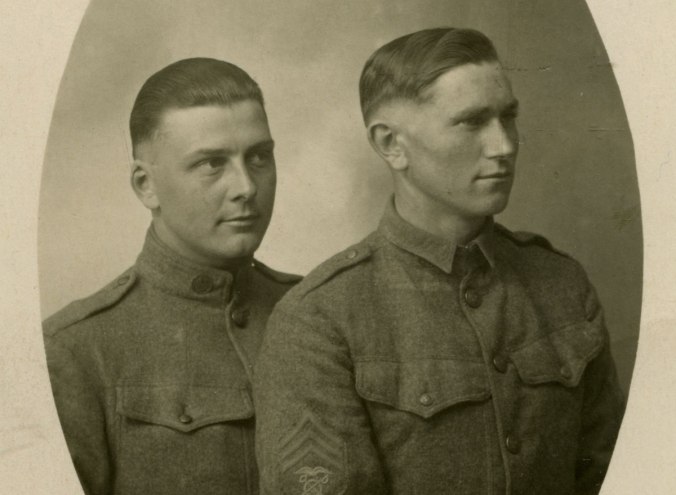
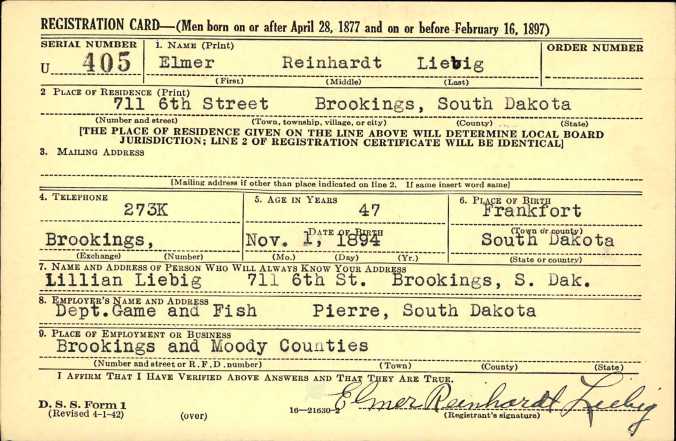
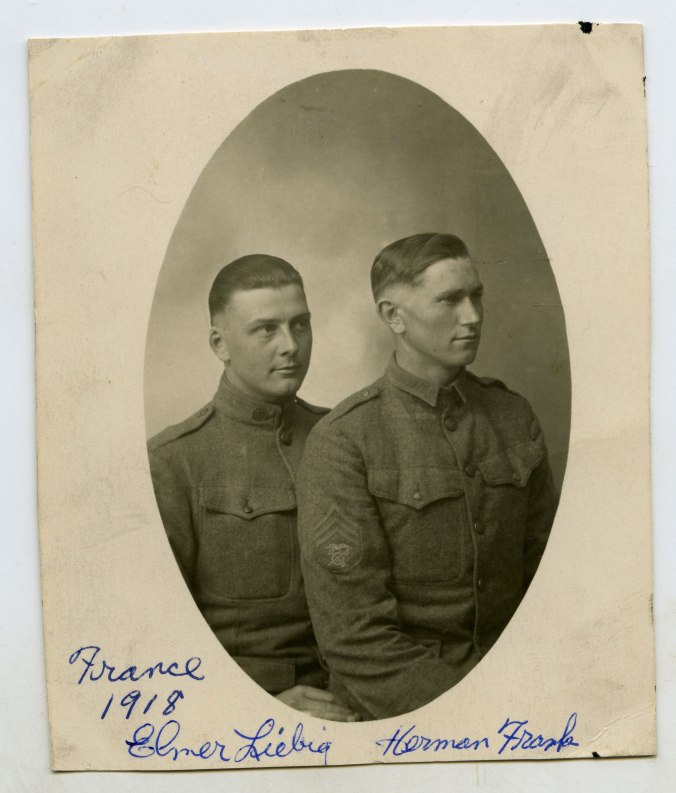








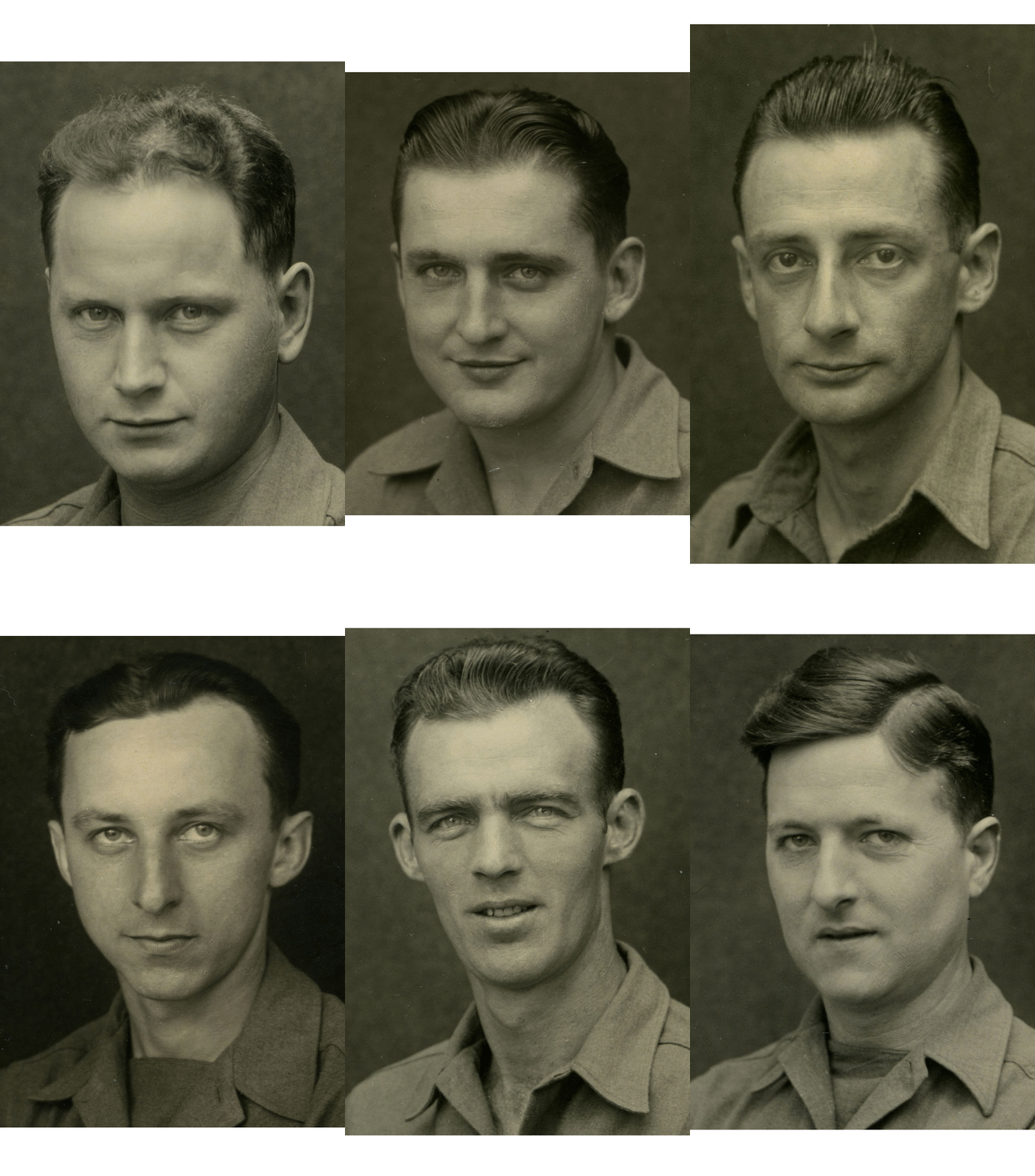
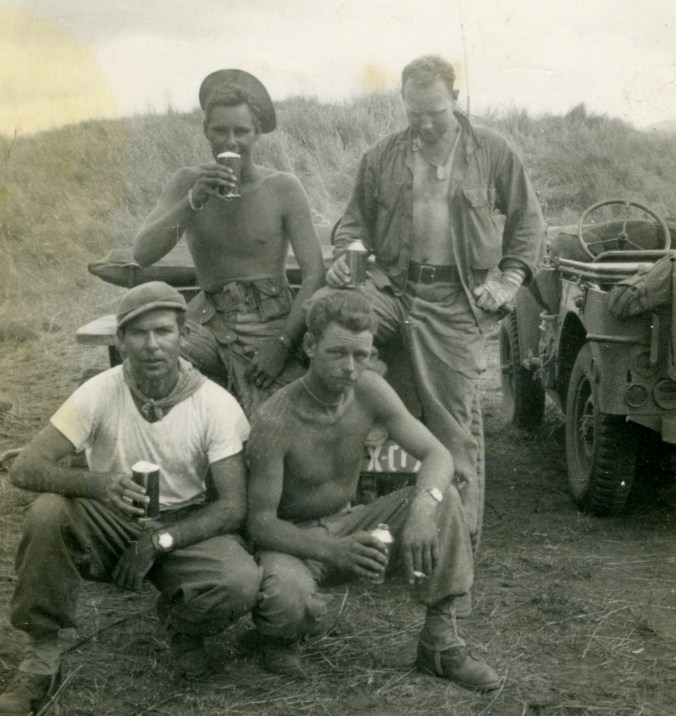

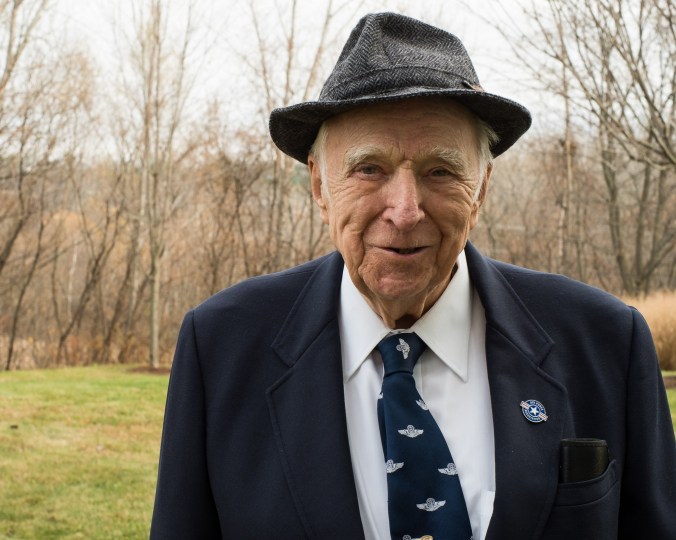

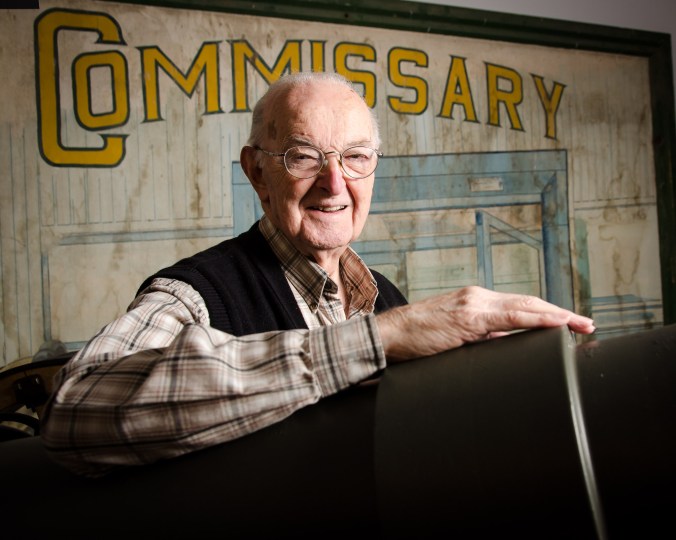




 Portraits of War