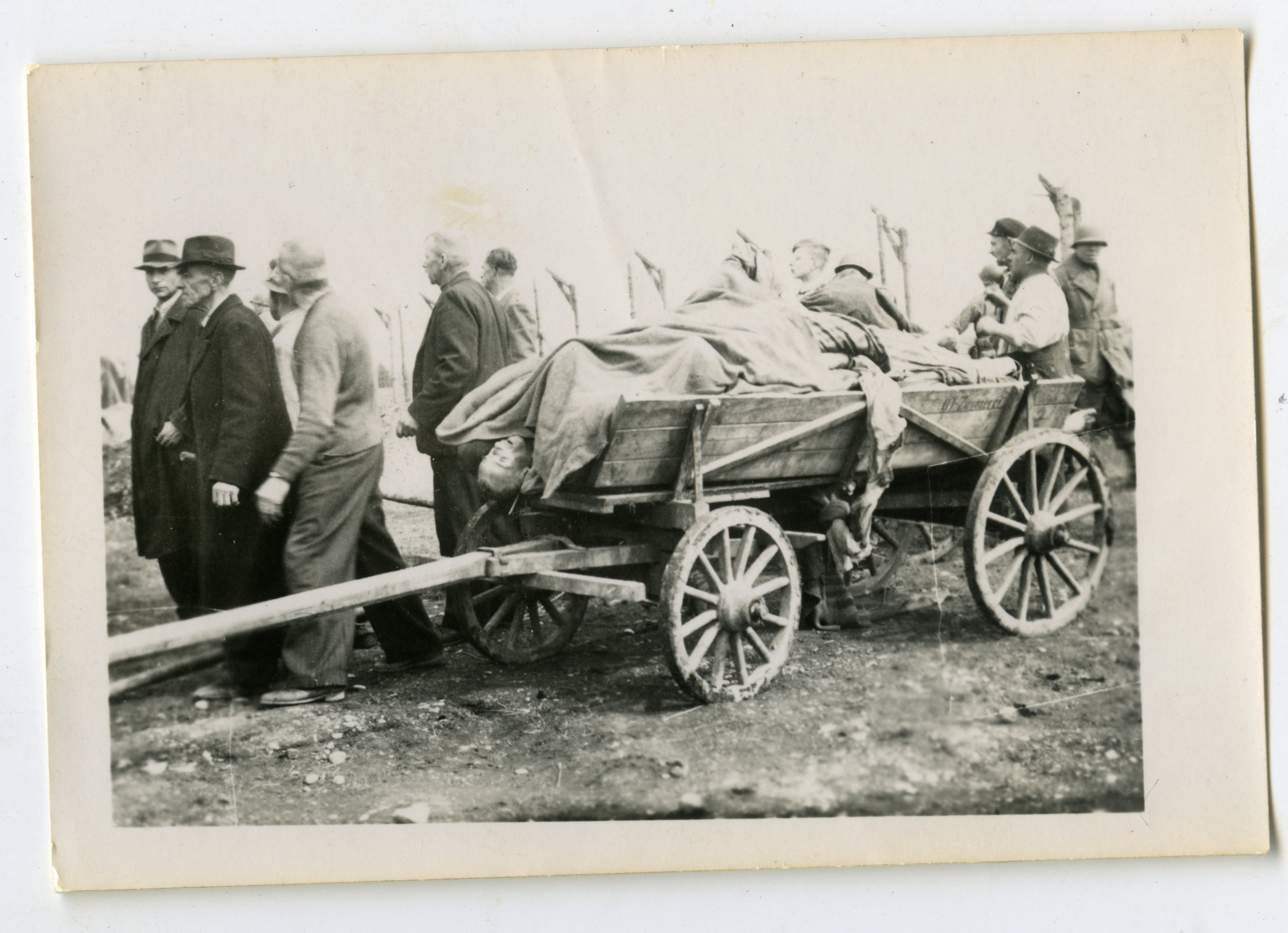
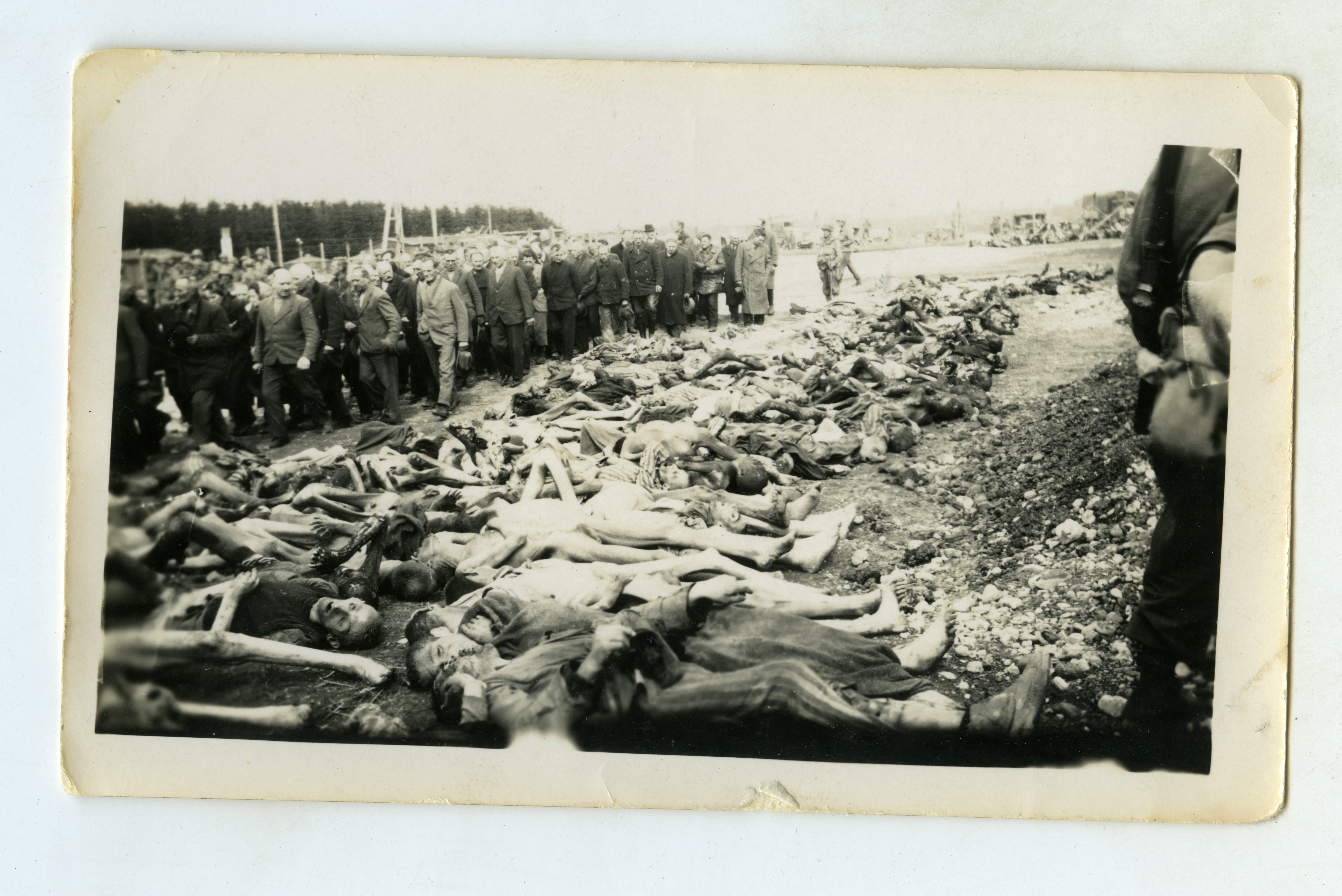
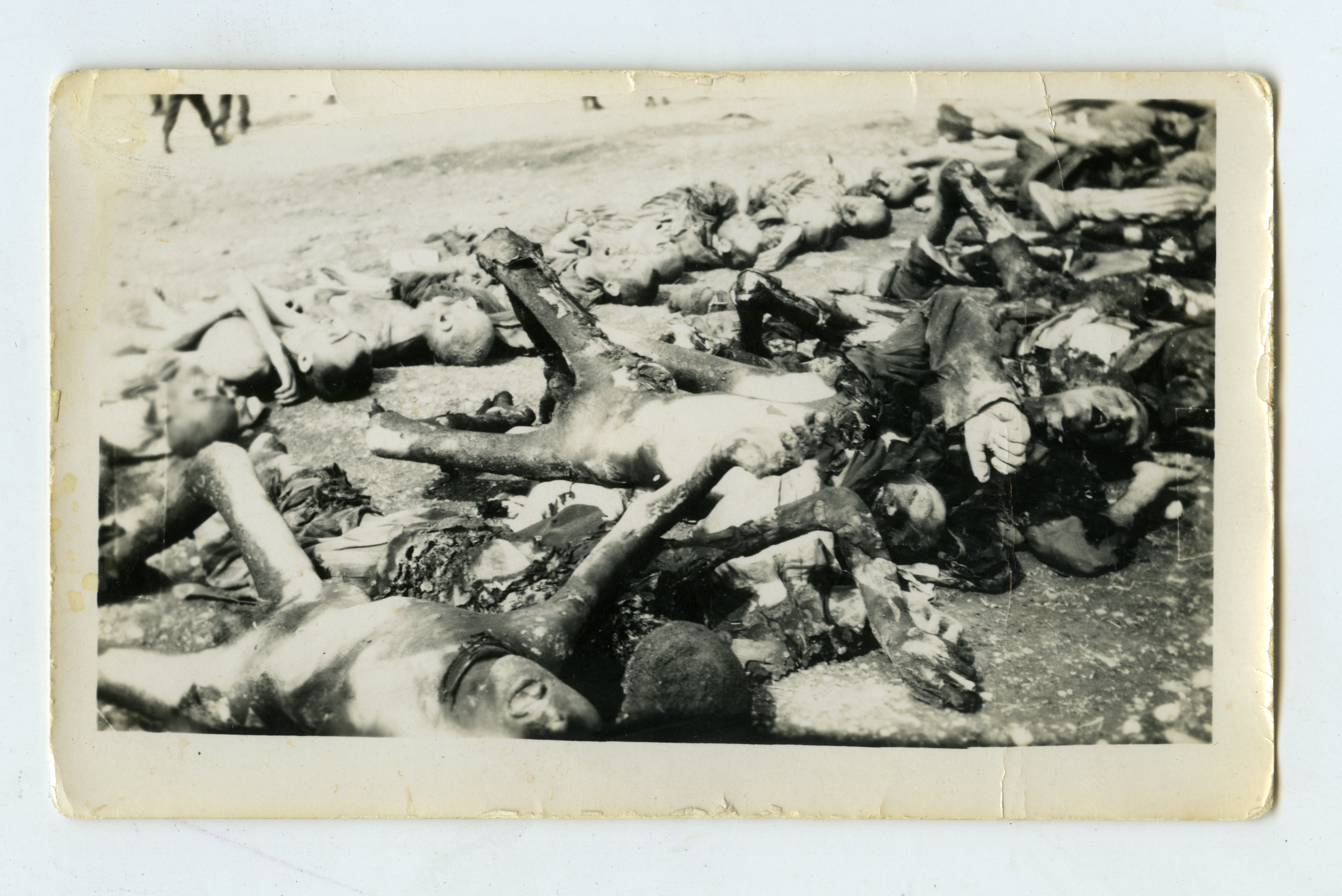
Snapshots from Kaufering IV: A Dachau Subcamp


Follow Up Post: The Liberation of Kaufering IV

Eight years ago I posted a series of snapshots taken by a US soldier showing the liberation of an unknown concentration camp during WWII. When I acquired the photos, they had no provenance and no information on the reverse side to start the process of identification. Luckily, a blog follower was able to help with the identification of the camp through the same processes I typically use. By observing the surrounding architecture and general contextual clues, he was able to identify the camp as Kaufering IV, a large subcamp of Dachau. Here is what he provided:

Some thoughts:

i)This is certainly somewhere Upper Bavaria – the house architecture is fairly typical of the region.

ii)The presence of the 2 Luftwaffe officers suggests some sort of air force activity is close by. Lager Lechfeld was used as a fighter base and a shake-down airbase for the nearby Messerschmitt complex in Augsburg. Prisoners were engaged in constructing bomb-proof bunker-factories in appalling conditions.

iii)One of the photographs has a very distinctive semi-sunken barrack type, known as “Erdhütten” (Lit: “Earth huts”) – very primitive constructions, the timbers of which were made from off-cuts and waste from furniture production and which survivors testify, leaked terribly. These barracks were a distinctive feature of the Dachau sub-camps in the Kaufering/Buchlöe area.

iv)The brief Wiki article tallies fairly well with the photos and my comments: https://en.wikipedia.org/wiki/Kaufering_concentration_camp

Hope this helps,

Taff Simon

The Snapshots

Thanks to the careful research of Taff Simon, we now know that the camp shown in these snapshots is Kaufering IV. A closer look at the details within the images supports his findings. One particular photograph offers the clearest confirmation: it shows an older man in civilian clothing with a closely shaven head, a haunting detail that anchors these scenes to the history of this Dachau subcamp.
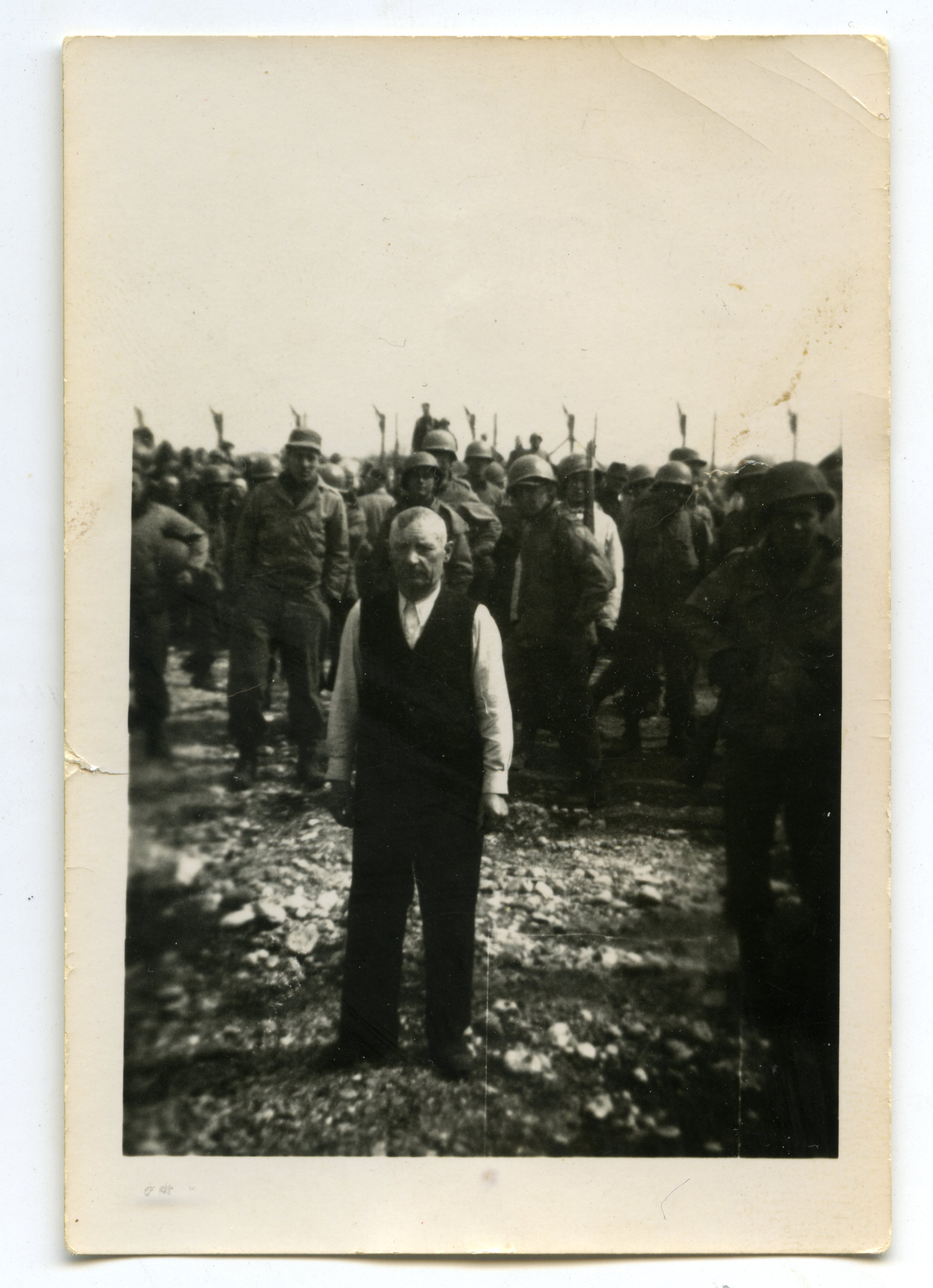
Snapshot of SS Commandant Johann Baptist Eichelsdörfer

When I first wrote about the snapshot collection in 2017, I was unable to identify the man since he was in civilian garb. Artificial intelligence image searches at the time were unable to attribute the image to any individual, so I was under the assumption that he was a local civilian who was brought in to help with the burial of the camp victims. But now, with the attribution of the snapshots to Kaufering IV, I was able to find more images of Eichelsdörfer. His shaven head with the lopsided squirrel-tail appearance confirms his identity when compared to the images below.
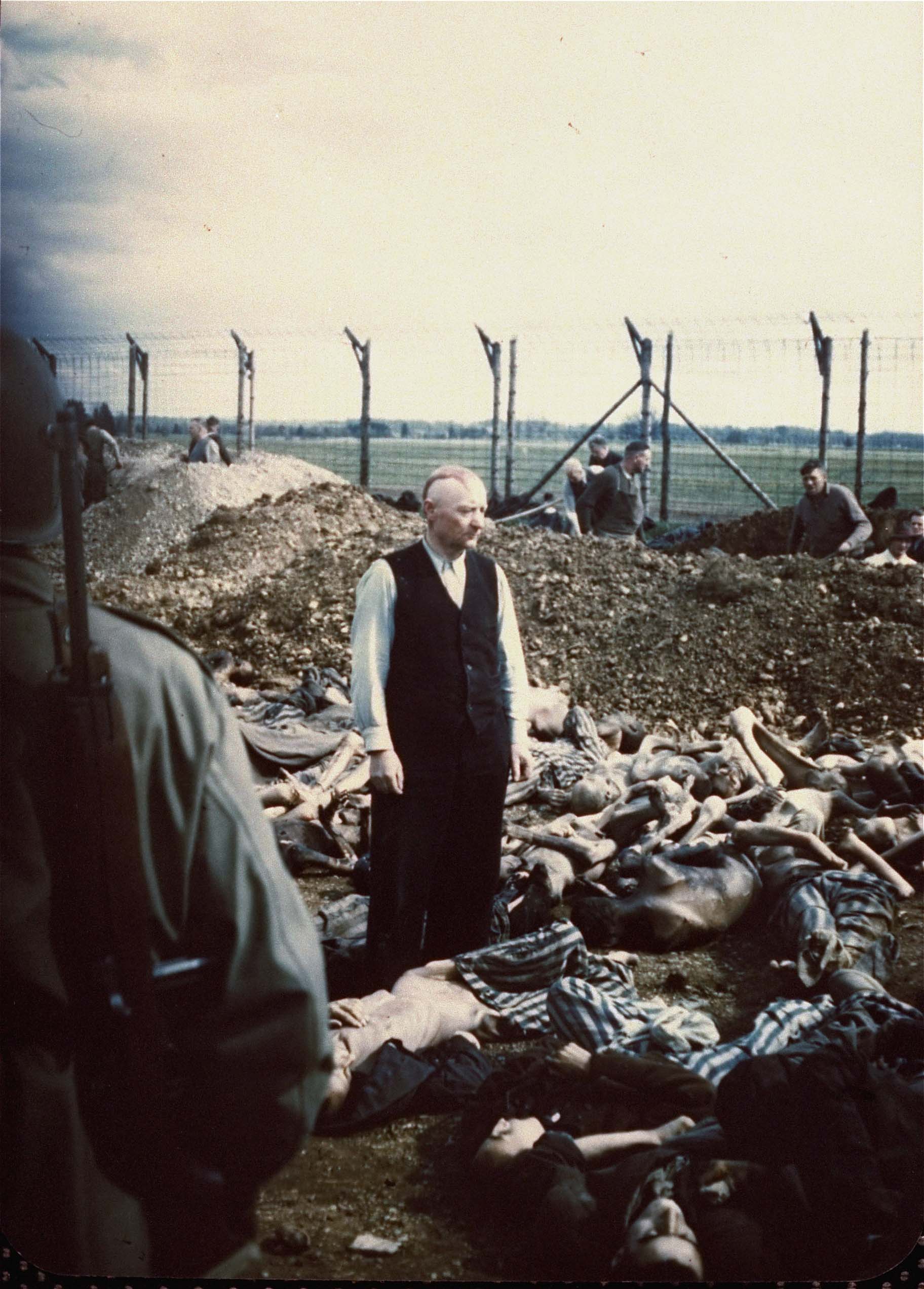
Color Photo of Johann Baptist Eichelsdörfer (US Holocaust Museum image)
(SS officer Johann Baptist Eichelsdoerfer, the commandant of the Kaufering IV concentration camp, stands among the corpses of prisoners killed in his camp. US Holocaust Museum image)
(Wikipedia Commons)

Who was he?

Johann Baptist Eichelsdörfer was a German military officer and concentration camp commandant during World War II. Born on January 20, 1890, in Dachau, Germany, he served as a non-commissioned officer in the Bavarian Army during World War I and remained in the military after the war, retiring in 1924 with the rank of lieutenant. He rejoined the military in 1940 and served in various locations, including France, Poland, and the Soviet Union. In 1944, he was assigned to the Dachau concentration camp system, where he served as the commandant of several subcamps. In January 1945, he took command of Kaufering IV, a subcamp of Dachau located near Hurlach, which was designated as a “hospital camp” but was, in reality, a site where sick and dying prisoners were abandoned without adequate medical care. Under his command, thousands of prisoners died due to starvation, disease, and mistreatment.

Eichelsdörfer’s actions came to light when American forces liberated Kaufering IV on April 27, 1945. U.S. soldiers discovered hundreds of bodies and surviving prisoners who had been subjected to brutal conditions. Eichelsdörfer was captured and photographed standing among the bodies of dead inmates, a stark image used as evidence during his trial. He was tried at the Dachau Trials, a series of military tribunals held by the U.S. Army to prosecute Nazi war criminals. On December 13, 1945, he was convicted of war crimes and crimes against humanity and sentenced to death. Eichelsdörfer was executed by hanging on May 29, 1946, in Landsberg am Lech prison. His trial and execution highlighted the atrocities committed in the Nazi concentration camps and served as a reminder of the need for accountability in the aftermath of war.

The Other Snapshots

Now that we know the snapshots from the 2017 blog post were taken at Kaufering IV, the other images captured by an unknown US GI make more sense. I will post them here with some updated commentary. Feel free to weigh in if you have any comments or suggestions for descriptions.

Kaufering IV Survivor

In the above image, we see a recently liberated survivor of his time at Kaufering IV. He’s using his bandaged hands to tie on a pair of shoes, likely a pair provided to him by US soldiers. He also appears to have some soup in a small can as well as a striped blanket wrapped around his head and body. In the back of the image appears a US T28E1 which was likely one of the 12th Armor Division’s anti-aircraft mobile vehicles. The painted sillouettes of 14 German aircraft on the side hint that the operators of the T28E1 shot down lots of German aircraft as the war came to an end.
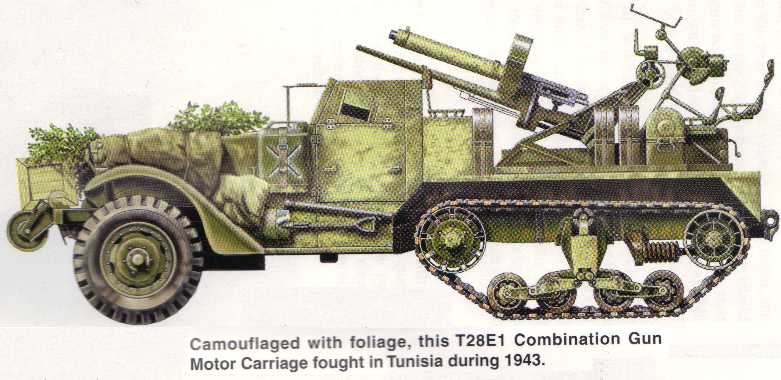
Generalized View of the T28E1
German Luftwaffe Officers
German Civilians Help with Burial
Camp Building and Ditch
Local Civilians Observe the Dead
Kaufering IV Victims
US Officers Speak to a Crowd
US GI’s View the Dead
Camp Victims
Camp Victims and Army Officers
Camp Victims
Local German Civilians Listen to US Officers

I really don’t know how to close this sobering post update from 2017. I did pass the snapshots along to a WWII veterans museum based here in the United States, but I’m unsure of what they ended up doing with them. I hope that his post will help educate those researching Kaufering IV and bring some closure to the mystery of when and where these snapshots were taken.

If you want to see some footage from the camp liberation, please check out the video here.

Easy Co. 506th PIR, 101st Airborne, Band of Brothers at Kaufering IV

HBO’s Band of Brothers covered Kaufering IV briefly in one episode. The unit was involved in the liberation of the camp, along with the 12th Armored Division. See below for a dramatized version of the events. The small earthen huts described by Taff can be clearly depicted. The HBO historical accuracy consultants did a great job!

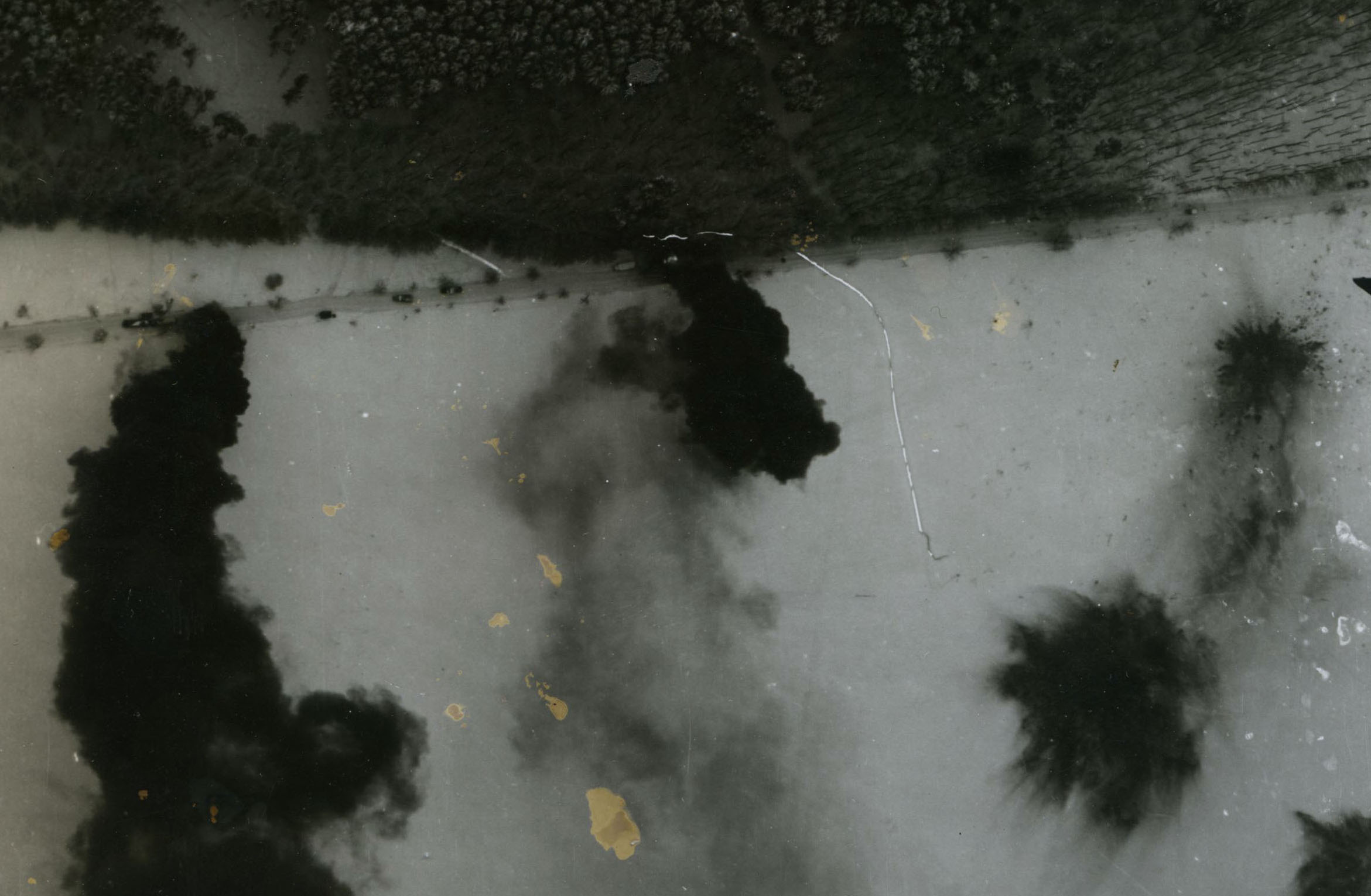
WWII Aerial Recon Photo: Burning German Convoy During Battle of the Bulge


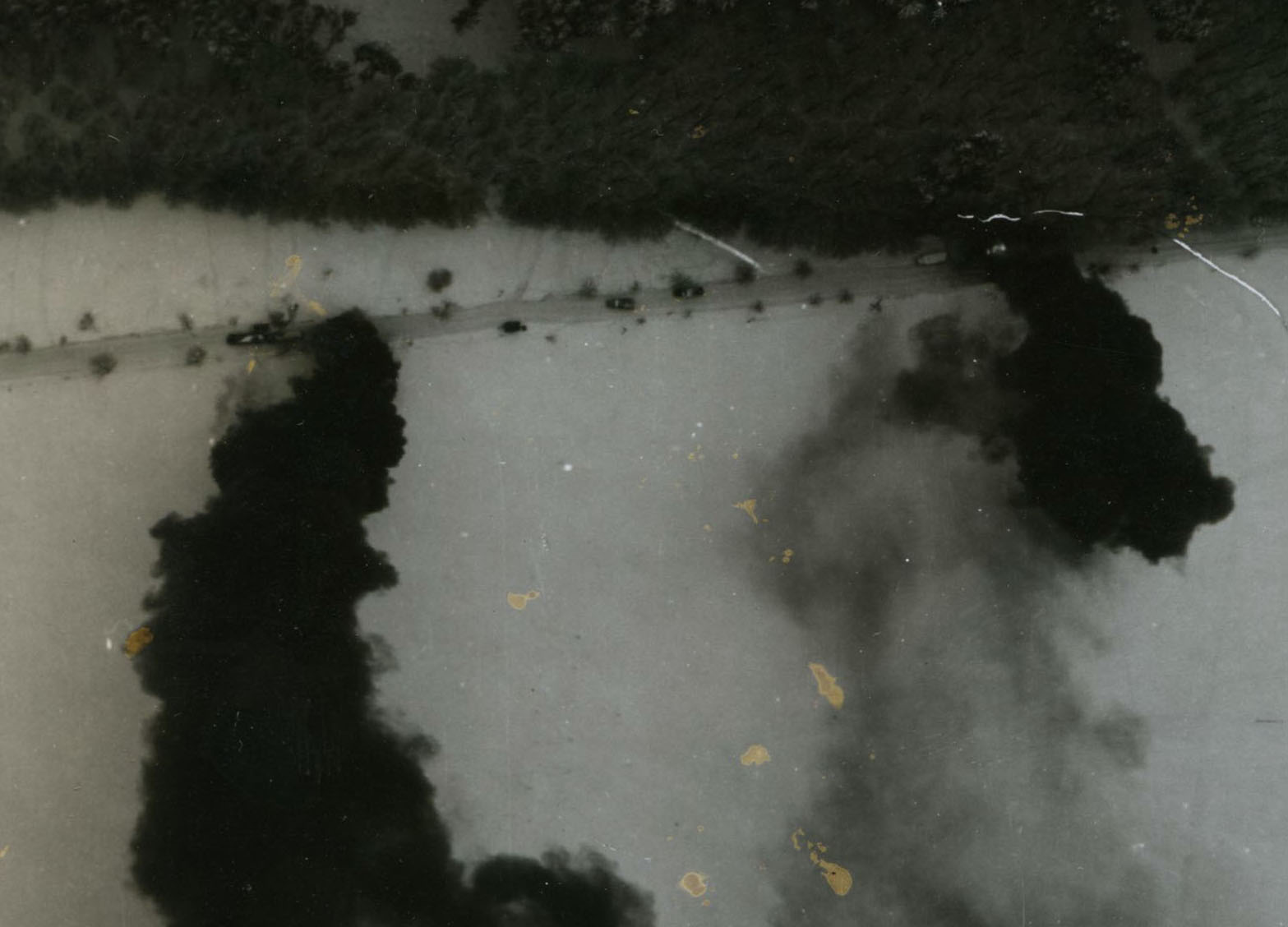
alvaalegre059In a follow up to the popularity of my last post (see here), I’ve decided to begin scanning my collection of large format 12×12 inch aerial photos taken during the Battle of the Bulge.  In this first post, we see a German motorized transport convoy in ruins following a strafing attack by P-47’s of the XAX Tactical Air Command (TAC) on January 23rd, 1945.  I acquired a large set of these original 12×12 inch prints (complete with pencil notes on the back) on eBay a few years ago directly from the estate of a 9th Air Force photo tech who apparently saved hundreds of original flyovers like this.  He saved duplicates as well!  This is one of those duplicates.

I’ve taken the time to crop the shot for close up views below.  With some luck, followers of this page may be able to track down the exact location of this image!  Good luck guys!

bulge6

January 23rd, 1945

bulge6abcdebulge6abcdefbulge6abulge6abbulge6abcbulge6abcd

WWII Color Photo Post: An Unopened Box of Developed WWII Kodak Color Slides!


Many of my followers know that I actively collect WWII color slides, predominantly those developed by the Eastman Kodak Company.  These Kodachrome slides are typically regarded in the field of vintage color photo collecting as the crème de la crème of vintage color.  Taken at a time of incredible social and political upheaval, these images capture an era that will never be seen in the same light or colors again. With the small percentage of the world populace that used color photography, an even smaller percentage of the slides have been passed down or purchased by people with the ability to scan and post them to the internet.

photounopenedbox

In this rare case, I was able to purchase a large set of Kodachrome slides taken by a US serviceman before he shipped off to war.  One box of the Kodak-developed slides were unopened.  I took a photo of the seal, opened the box and immediately scanned them!  Please enjoy the following 12 slides that are only seeing the light of day 70+ years later….

Taken in Fort Benning, GA, these slides were shipped home in January of 1945 to only be opened in 2016! Enjoy.

binzel01

Binzel02.jpg

Binzel03.jpg

Binzel04.jpg

Binzel05.jpg

Binzel06.jpg

Binzel07.jpg

Binzel08.jpg

Binzel09.jpg

Binzel10.jpg


WWII Photo: American Medics in the Battle of the Bulge – 4th Infantry Division


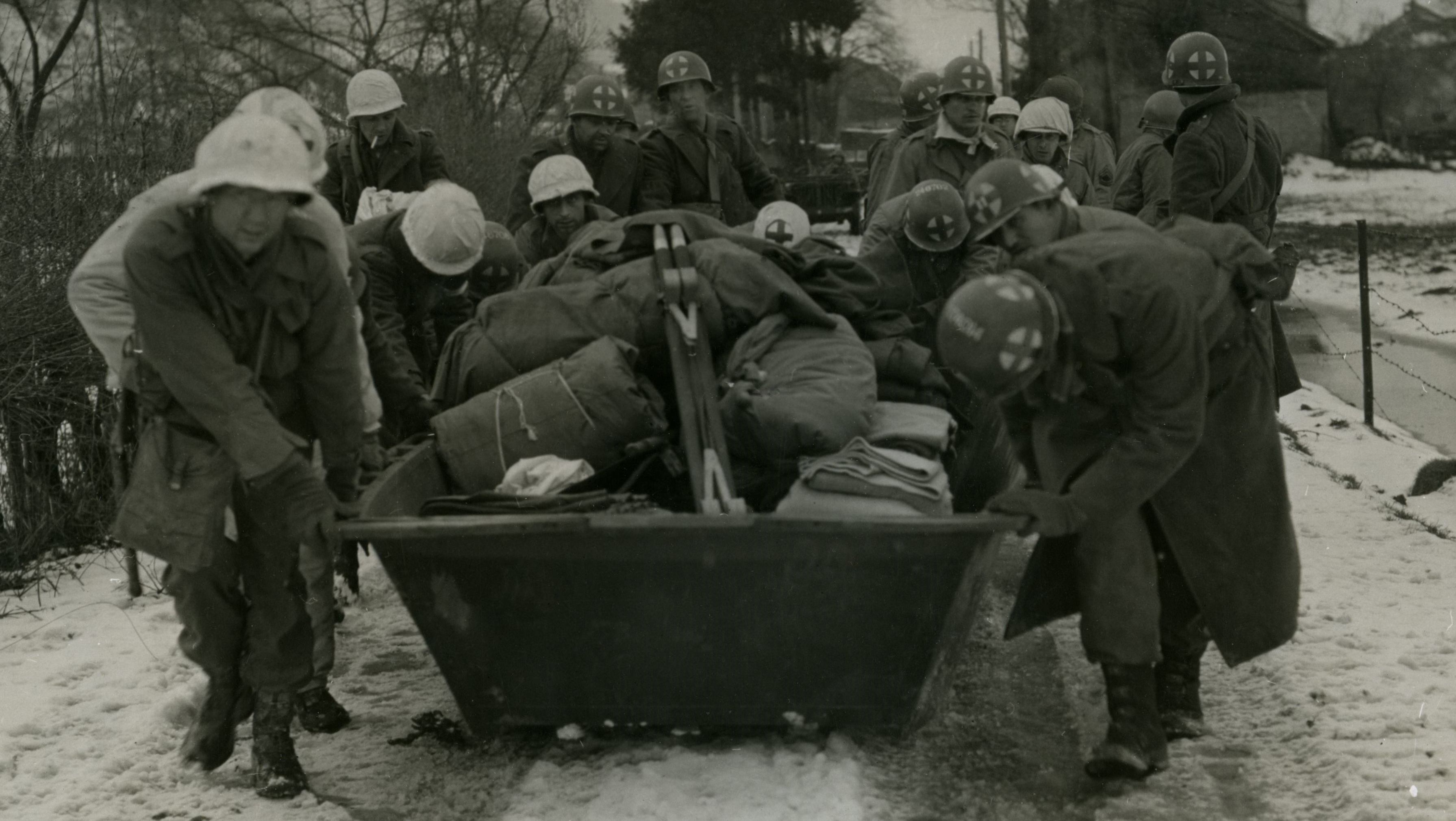
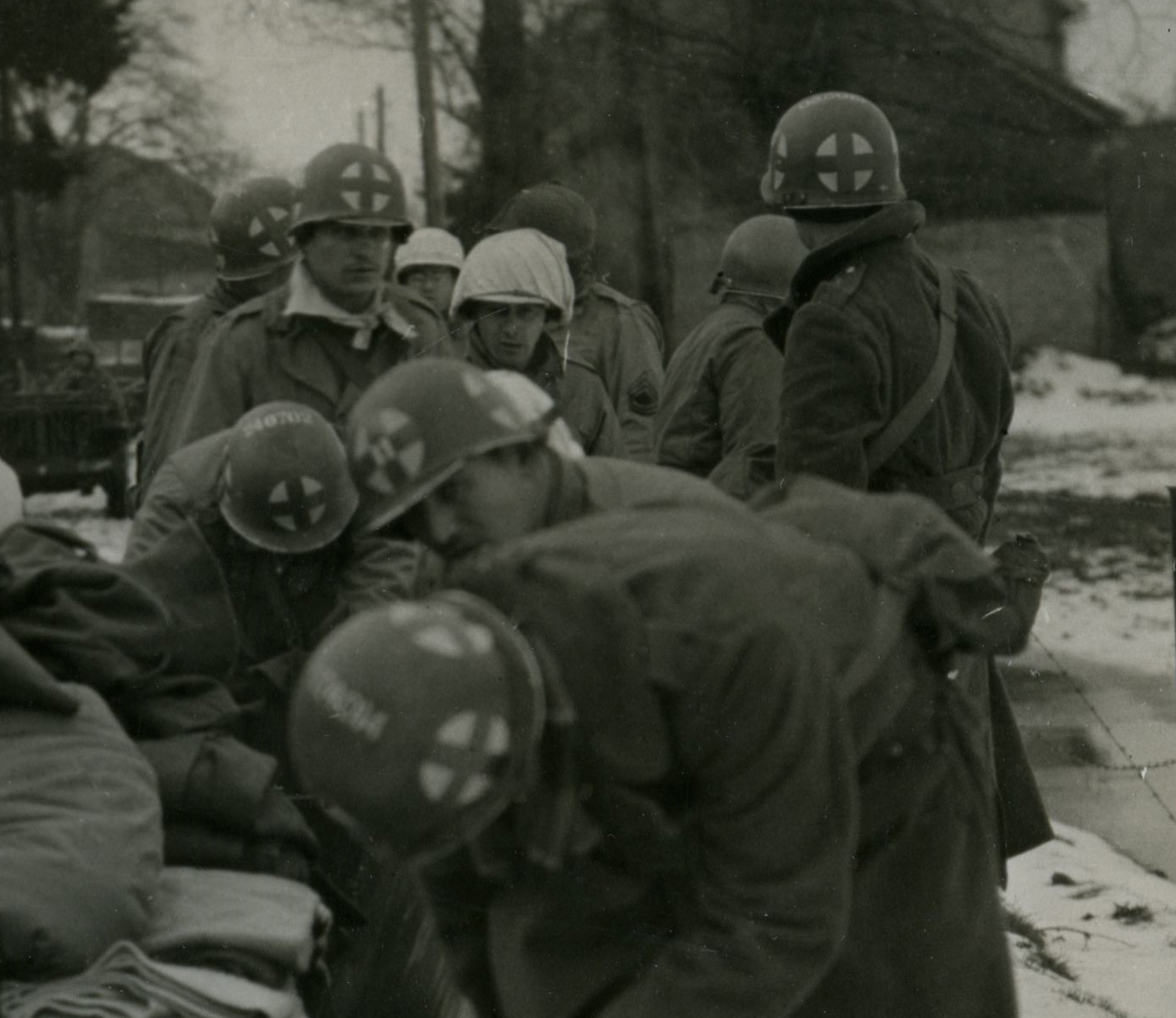
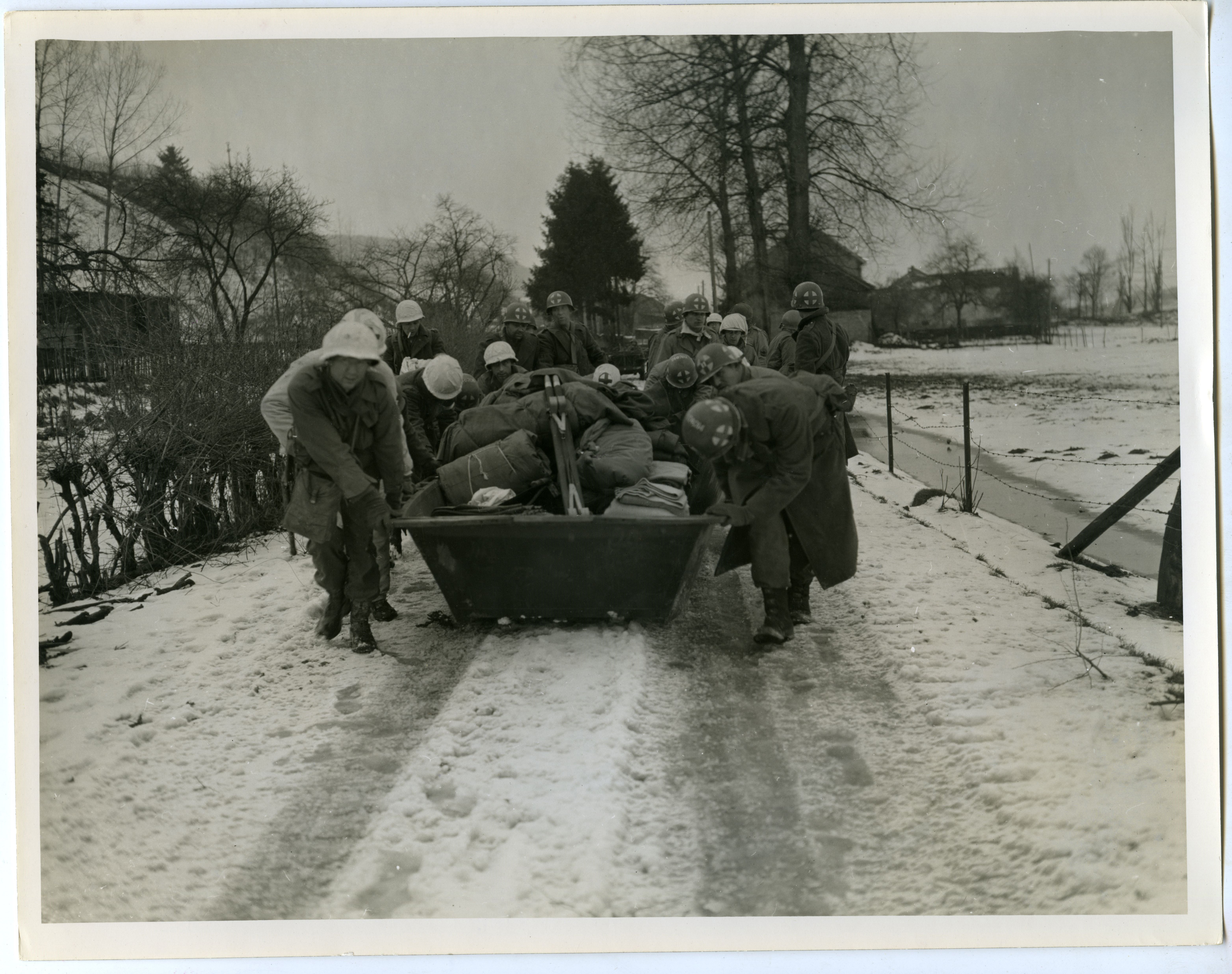
Captured on medium format film by US Army Photographer Cpl. Edward Belfer, this image comes from my extensive collection of US WWII photography and depicts a group of US medics pushing a metal pontoon boat along the snowy streets of Bettendorf, Luxembourg on January 19th, 1945.  The boat, loaded with medical supplies, is headed towards the Sure River.  An oddball detail in this shot include a theater-made snow camouflage helmet covers with the fronts cut out to reveal the medical cross beneath.

167thsignal094a

167thsignal094ab

167thsignal094

167thsignal095

Christmas Mass During the Battle of the Bulge – Liege, Belgium 1944


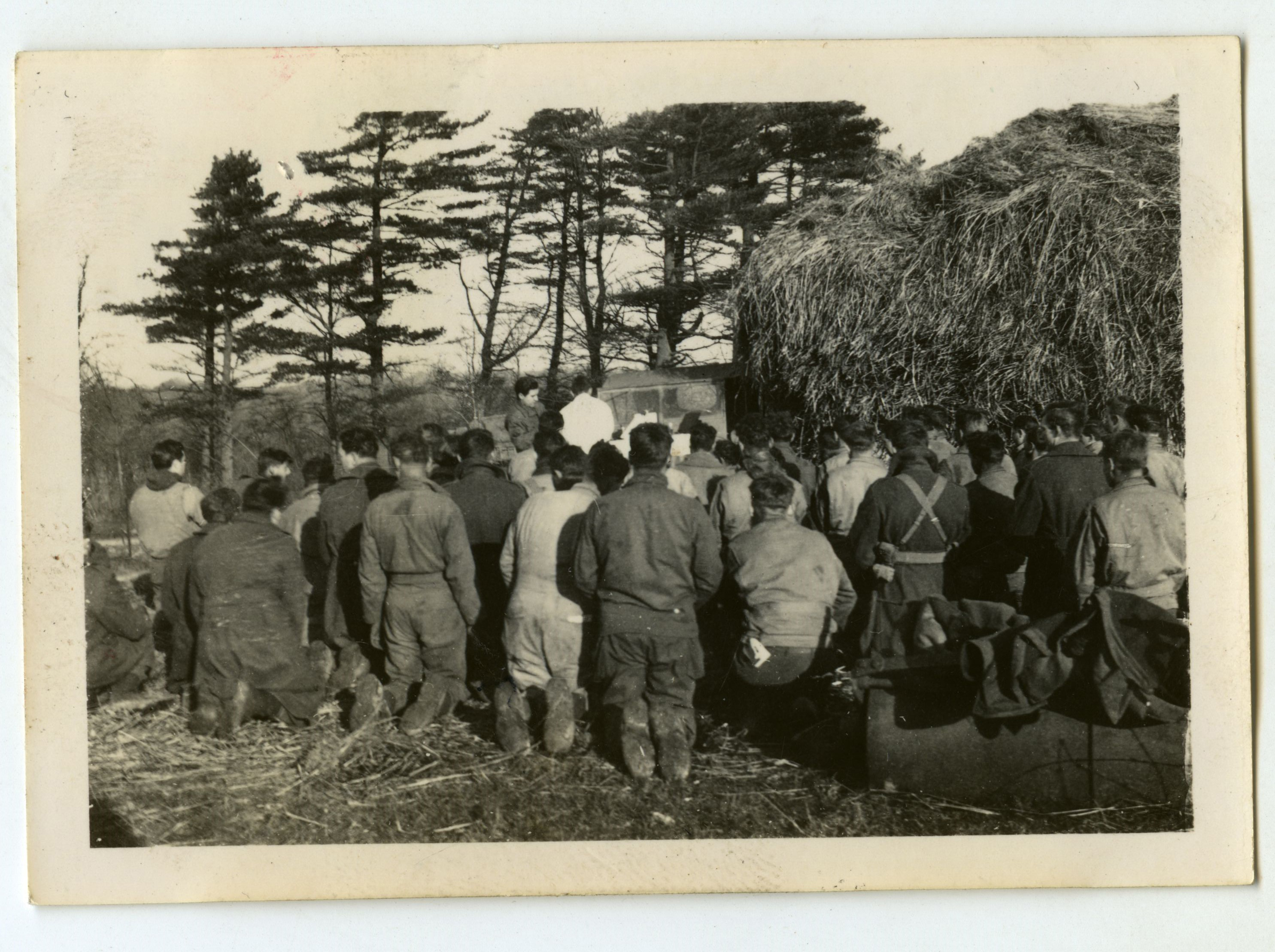
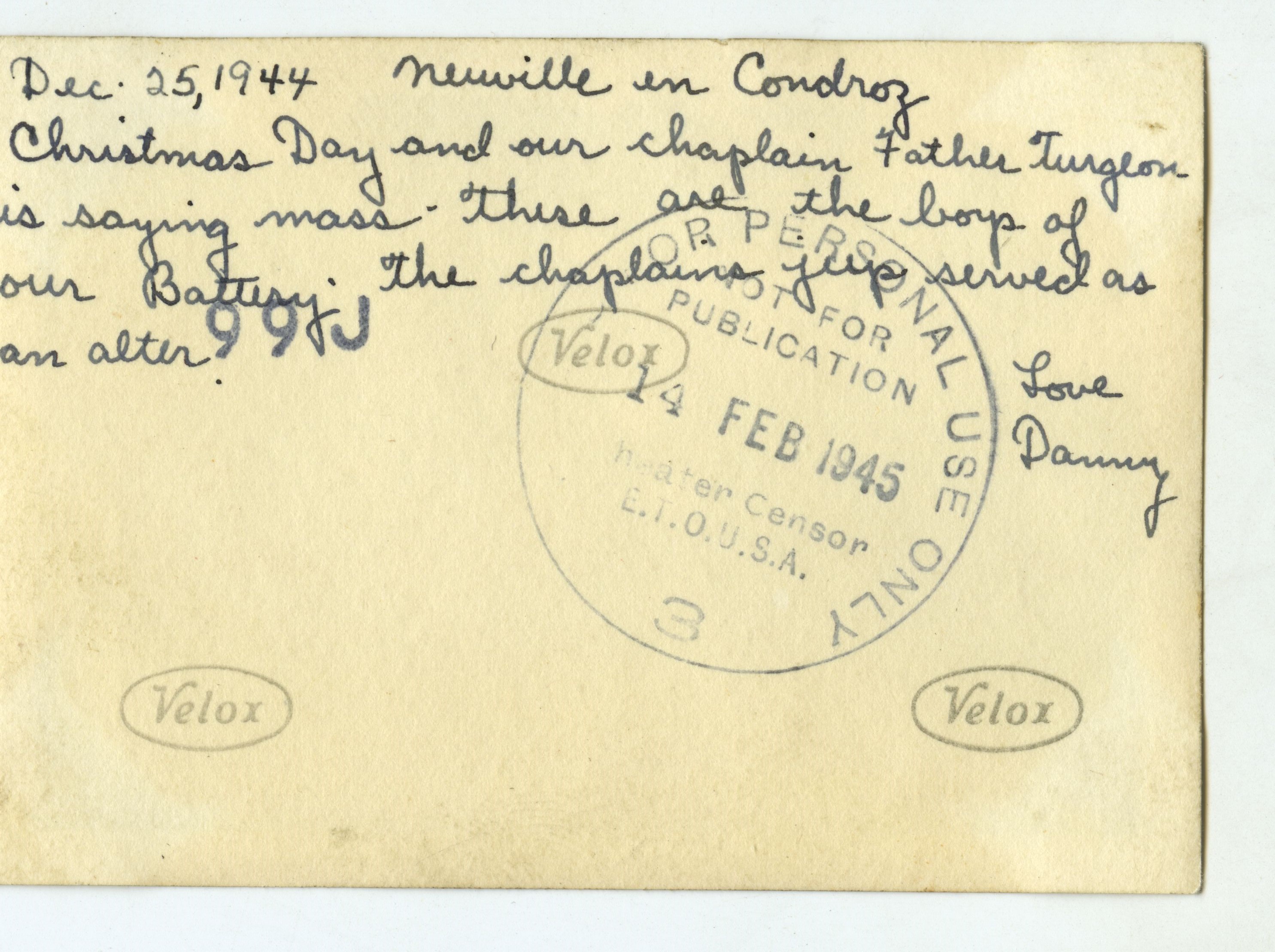
Attempting to track down new material for a fresh blog post is not an easy task…… Especially when my material has generally been languishing unseen in a shoe box since 1945.  But occasionally I will come across a photo that I’ve neglected to bring to the light of the internet since it crossed my scanner’s bed.  In today’s post, I will dissect a photo taken on Christmas  of 1944 in the small town of Neuville en Condroz, Belgium. This is a small village near Liege, Wallone, Belgium and was occupied at the time by an anti-aircraft unit on the front lines of the Bulge. Interestingly, the hood of the Chaplain’s Jeep served as an alter.

bulge008

Christmas Mass in Neuville-en-Condroz Belgium, 1944

bulge009

To see the area today check out the link below:

Neuville-en-Condroz Map


WWII Snapshot – Female Photographer Pauses for the Camera


A female US service member rocks a summer dress and snaps a shot of the photographer; what more can you ask for from a blog dedicated to obscure vernacular snapshots taken during wartime?   Originally digitally cropped down from a slightly larger print, this shot exudes the youthful demeanor of downtime during WWII. The taut, braced legs also hint to a slightly posed sexualized snapshot….

photographerchick

Freshly Liberated 17th Airborne Paratrooper POW – Battle of the Bulge Portrait Photo


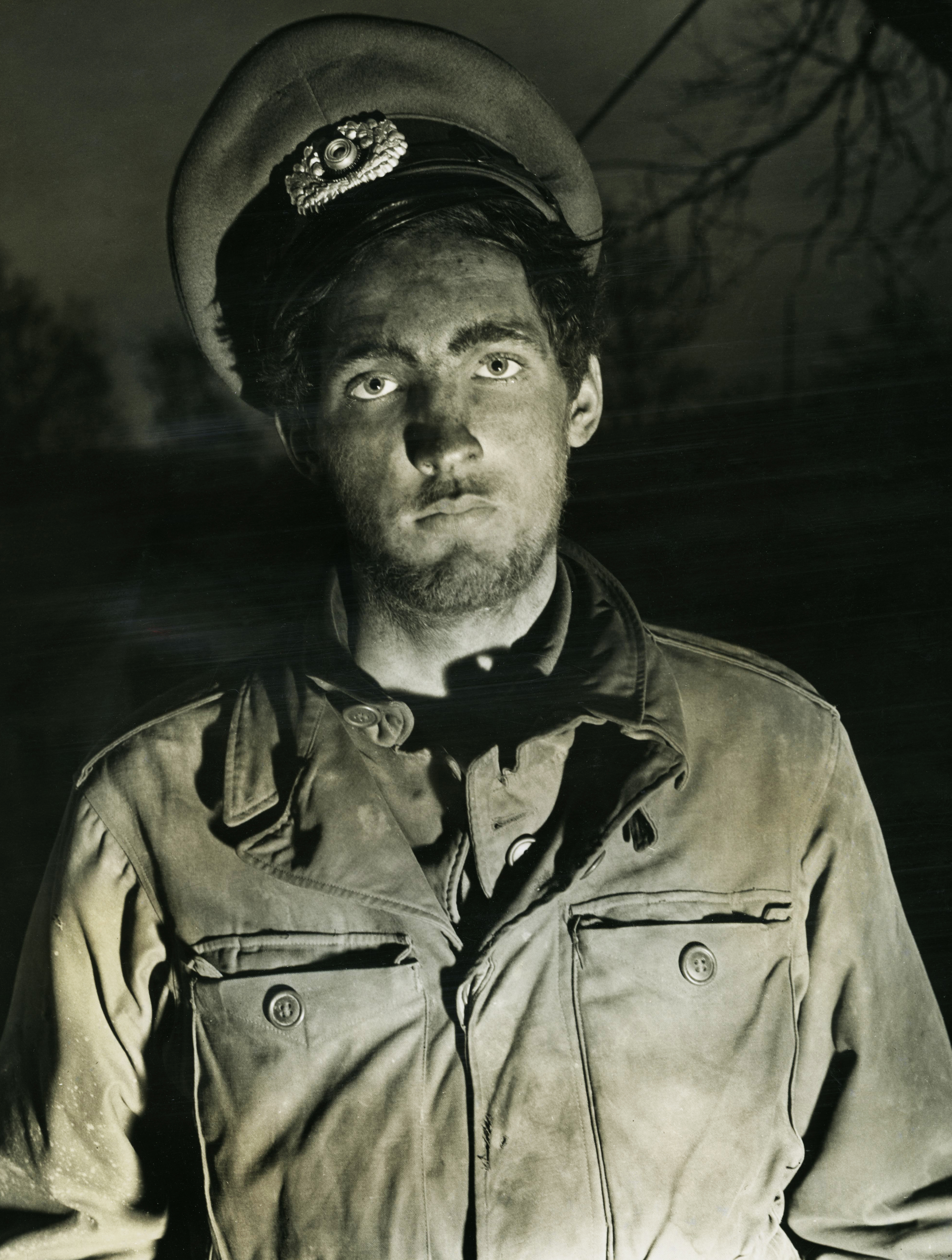
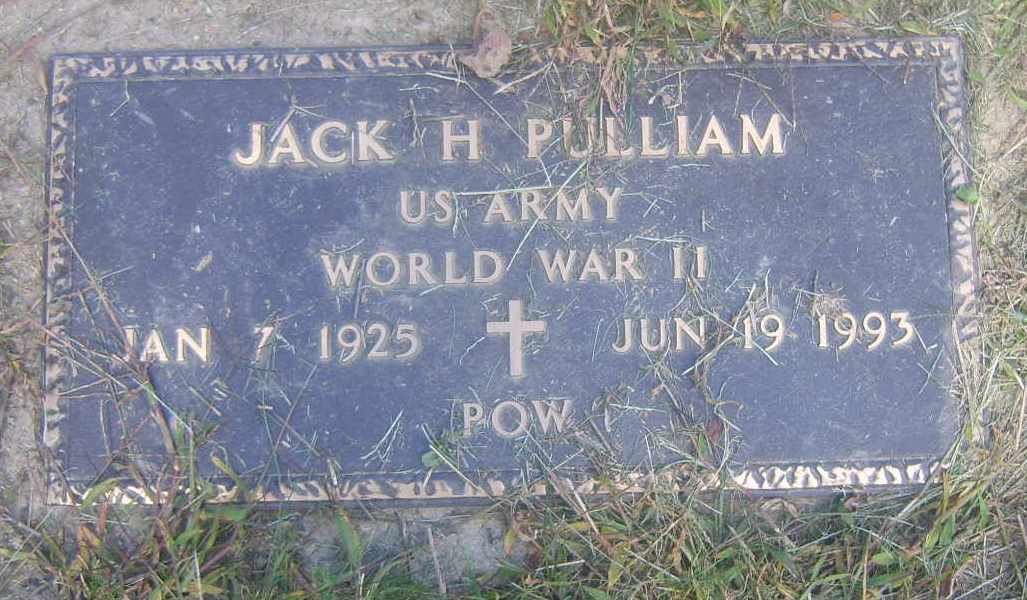
Many incredible WWII US Signal Corps photos were taken during the war, printed, examined and never widely published or circulated.  In tonight’s post, I’m bringing one of these “lost” Signal Corps shots to the world wide web. Staff Sergeant (SSgt) Jack H. Pulliam was a paratrooper assigned as a light machine gunner to Company G of the 513th Parachute Infantry Regiment of the 17th Airborne Division. Pulliam was captured on his 20th birthday during the Battle of the Bulge on January 7th, 1945 in a small village twelve miles outside Bastogne; known as Dead Man’s Ridge, the battle was the first for the “green” 17th Division.  Suffering catastrophic casualties, the 17th was eventually successful in countering the German troops it encountered.  Spending nearly a month in captivity (being wounded during this time) Jack escaped and was eventually picked up by elements of the 4th Division.  The photo below perfectly captures how Jack must’ve felt during the hell of the Bulge and his time imprisoned with the Germans.  Note the dirt and grime on his face and clothes, the stubble and long hair associated with being constantly on the move without access to a razor or washcloth.  He’s also sporting a captured German officers cap with the eagle removed.  I’m hoping SSgt Pulliam took that hat home as a memento of his time in captivity!
167thSignal176cropped

Jack’s National Archives and Records Administration file:

(courtesy of the 17th Airborne tribute site)

Jack was born in January 7, 1925 and spent his youth in Lucerne, PA. He was volunteer for the Army in January 7, 1943 and was inducted on February 20, 1943 at Altoona, PA. He received ASN 33573517 and was sent to the 44th Infantry Division at Fort Lewis, WA. He was volunteer for the Airborne troops and was transferred to Parachute School at Fort Benning in March 1944 where he was finally assigned to Company G / 513th PIR as light machine gunner after having successfully completed his paratrooper course.

On January 7, 1945, on his 20th birthday, he was captured at Flamierge during the terrible battle of “Dead Man’s Ridge”. He was sent to Clervaux, then to Prüm. He was wounded at Garolstein, Germany and escaped the Germans on February 7 with Ed SUMMERS. They reached Prüm on February 9 and went into hiding until the town was taken by the men of the 4th Infantry Division on February 13.

He spent two weeks in hospital to recovering from malnutrition and was unable to return in his unit because of Prisoner of War status. He was finally shipped back to States in March 1945 and completed military as automatic weapons instructor at Fort Benning. He was discharged in November 1945 as S/Sgt.

10707080_129027181351

43191_2421406272_0953-03202

WWII Service Record

Famous Bougainville Signal Corps Photo Unraveled – 754th Tank Battalion


From time to time, a certain photo in my collection will call to me from beneath a dusty pile of books and other ephemera; pulling me away from other nocturnal pursuits, I will spend hours slipping down the rabbit hole of internet research.  In tonight’s post I dissect an image I picked up in a large photo grouping from an unidentified Pacific Theater of Operations U.S Army soldier whose estate was broken up on eBay.

nimitz099edited

This photo has taken me months to research, with new avenues of potential insight popping up at every twist and turn.  “My” version of the photo includes the portions of the negative’s border which, once deciphered, indicate the photographic unit responsible for the image.  These borders are typically not present on post-war copies of the photo, so this points towards a wartime first-generation version of the photo likely printed overseas. Additionally, later prints of the photo include inclusions and negative abrasions not present in earlier versions.

patch

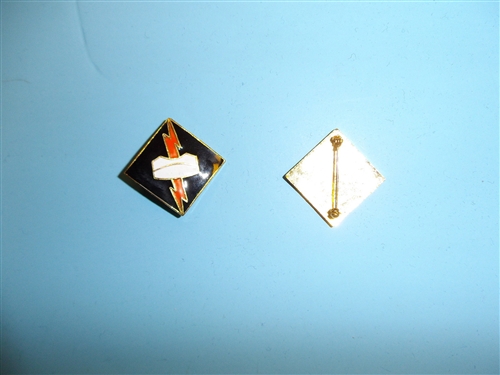
What does the negative bar tell us?  For one, it gives us the number of the photographic unit responsible for the image.  The first number corresponds to the ID # for the 161st Signal Photographic Company. The 161st, as anticipated, shot still and moving images in the Pacific in WWII, working in tough weather conditions not conducive to normal photographic processing.  Through my exhaustive research, I’ve uncovered additional information about the photo not commonly known on the internet.


Commonly ascribed to Guadalcanal, New Guinea and other remote locations, the photo was actually taken in April (hence the 4-44 label on the negative) of 1944 on Bougainville Island, Papua New Guinea during the Bougainville Campaign.  Again, commonly ascribed to a Marine unit, the soldiers in the photo are actually of the Company F, 129th Infantry Regiment of the 37th Infantry Division.

insignia

Insignia of the 161st Photo Co.


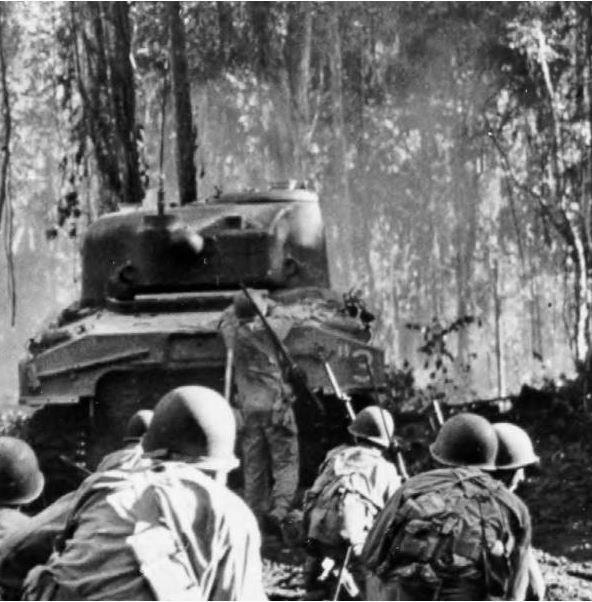
The details of the photo are crisp, clear and perfectly printed with little great use of light, shadows and other atmospheric conditions in the heat of battle.  Bayonets affixed, the solders are scrambling for cover, firing and advancing behind a Sherman tank of the 754th Tank Battalion as it progresses forward through the dense jungle.  The tank at the forefront of the shot is “Lucky Legs II”, clearly a later iteration of a previously destroyed or abandoned armored vehicle. Tank and plane names were commonly derived from hometown sweethearts, pinup magazine, popular songs and movies, or unique creations.

nimitz099editedclip

Notice the play of light….

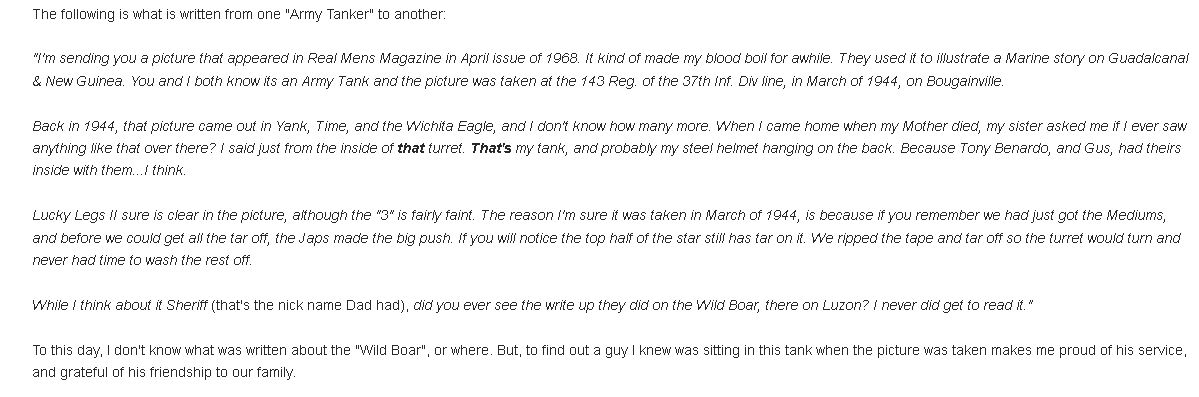
What isn’t immediately clear is the reason why the star is only partially visible on the turret. Using the power of the internet, I was able to track down a military forum with some information to help……

nimitz099editedclipa

Lucky Legs II in action (note star)

Apparently, the tanks were covered in oiled tar to protect from rust during overseas transport.  This includes the stars, which, in this case, was still partially covered in goop during the first counterattack after receiving the M4 mediums in March of 1944.  The above forum post provides a delicious detail, one that would be almost impossible to posit, without the help of a guy who “was there.”

754th TB ($75)

754th Tank Battalion Patch


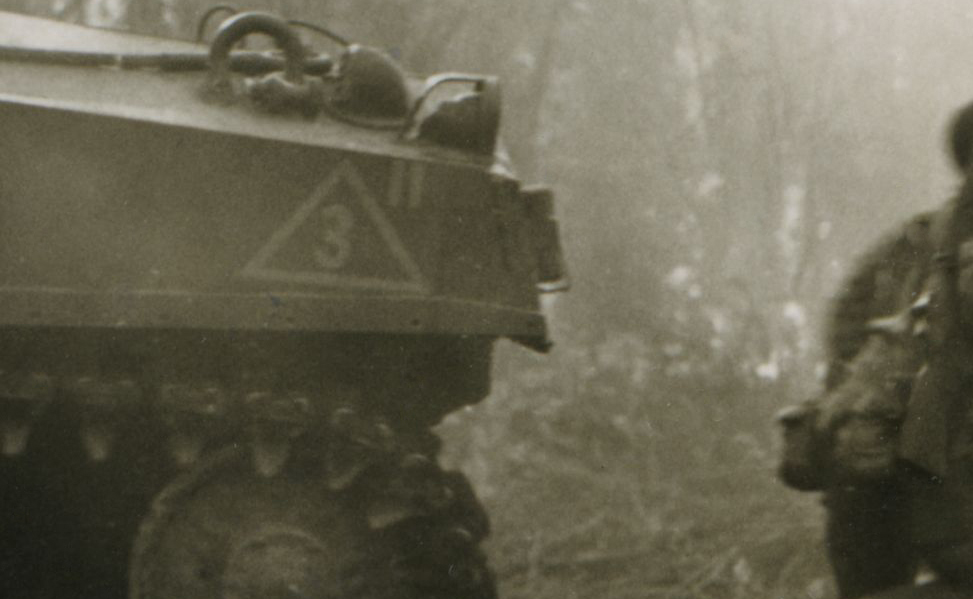
According to research, tanks of this new delivery were equipped with armor plate protecting the driver from shots off the starboard and port sides of the tank.  This raised area was used by tankers of the 754th to paint the tank moniker.  Another example from the same group includes the “Wild Boar.”


Further distinguising insignia found on the tank include the 3 within a triangle, denoting that the tank was the Platoon Sergeant’s tank; the II adjacent to the triangle in the photo likely indicate that the tank is of the Second Platoon.

nimitz099editedclipab.jpg

Rear Painted Details

So, we have a tank commanded by the Platoon Sergeant of the 2nd Platoon of a an unknown company of the 754th Tank Battalion.  I can narrow this down only a bit more, but future research and reader commentary should elucidate some of the murky details.

754thtanker

Back to the previous image of the internet post regarding an angry response by a tanker who fought in Lucky Legs II:

“I said just from the inside of that turret.  That’s my tank, and probably my steel helmet hanging on the back. Because Tony Benardo, and Gus, had theirs inside with them.. I think.”

The same forum post refers to a US Signal Corps film that depicts the tank in question….. I think I found it…..

And if that wasn’t enough… I found more shots from the same photographic series


sedond


WWII Pilot ID Portrait Photos – Boring? or Riveting?


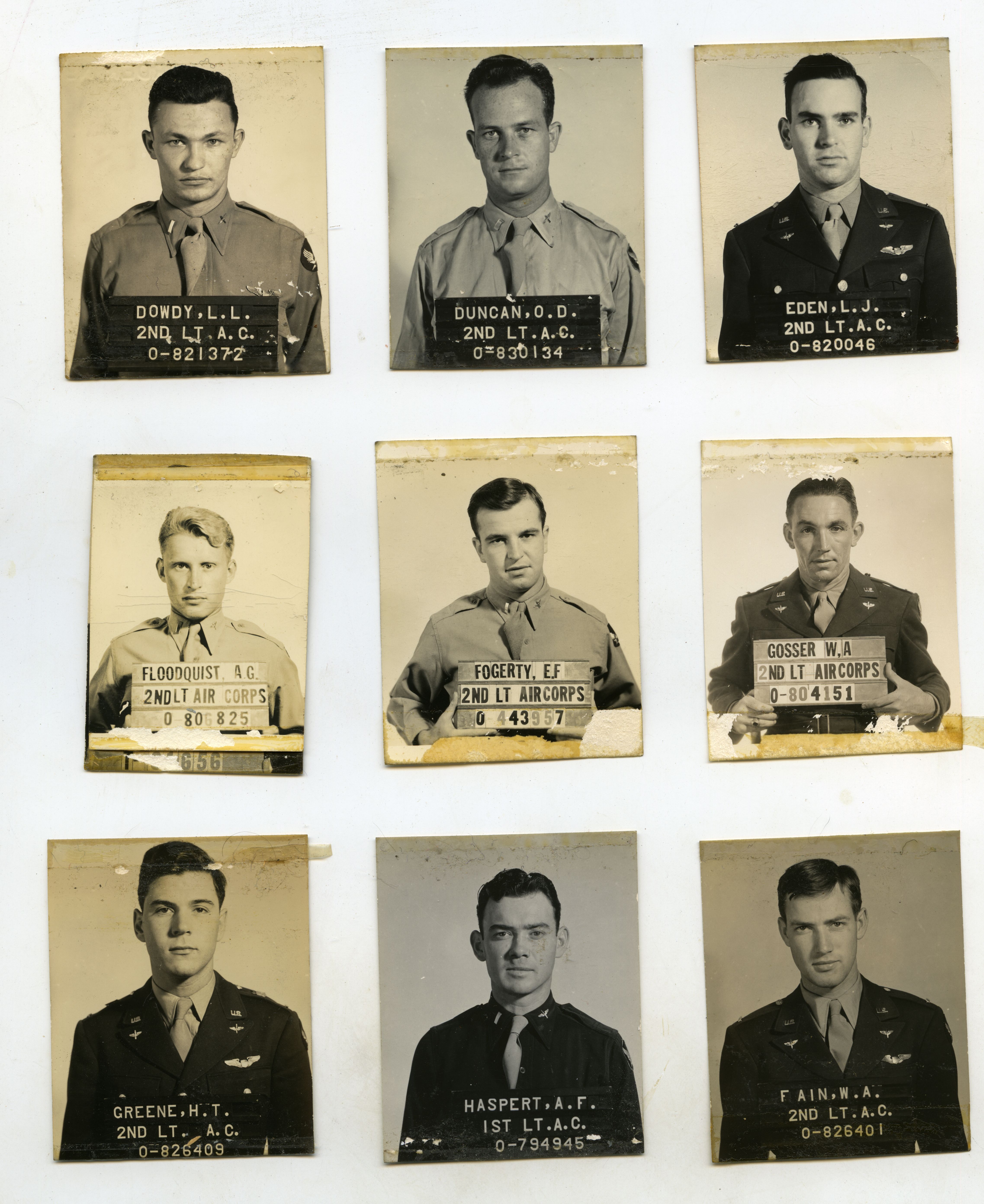
Remember having your second grade yearbook photo?  Yeah, I don’t either….. The same is true for WWII veterans who had their snapshots taken in front of numbered placards and blinding flashbulbs. Generally, these type of shots were taken of Army Air Corps and Marine Corps officers, but I’ve seen a few Navy portraits pop up on eBay on occasion.  In the case of tonight’s post, I’m specifically presenting US Air Corps officer ID photo which were compiled by an enterprising veteran(sadly unnamed) who collected shots of his friends and colleagues who trained with him as pilots in the early years of WWII.

Pilot103.jpg

General scan of type of photos in the collection: Scan 1

Each photo is unique and captures the airman with his guard down; a true snapshot portrait, these men and women had no idea that these photographs would be preserved for posterity.  Each one of these photographs has a story behind it…and each is worthy of an individual blog post.  Sadly, I don’t have the time or capacity to identify them all, and I look to the general public to track down shots of their ancestors. I will do my best to post the surnames of the officers in this post, but I need help…

Pilot083

Scan 2

Pilot113

Scan 3

Pilot093

Scan 4

Pilot123

Scan 5


output_RESBap

GIF of 40 US Army Air Corps Pilot Photos Identification Photos