From time to time, I like to browse the pages of eBay in search of portrait photographs of identified U.S. soldiers — small windows into the past that I can casually research to uncover the individual’s story and their role in whichever conflict they served. In today’s post, I was drawn to one particular image: a portrait captured by a British photographer. Unlike the widely circulated press photos that often made their way into American newspapers, this photograph was unlikely to have been distributed stateside and equally unlikely to have fallen into the hands of the soldier’s family.
When soldiers were photographed, it was common for them to provide their names, ranks, and often their hometowns. Yet in most cases, there was little chance for photographers or newspapers to follow up and let those soldiers know that their likeness had appeared in print. That disconnect is part of what makes original press photographs so compelling today. Many remain unpublished, and most have never been thoroughly researched. In fact, I’ve noticed a growing trend in 2025: more and more World War II–era press photos are surfacing on the secondary market, offering new opportunities to rediscover stories that might otherwise have been lost.

The photograph above was discovered in August 2025 during one of my routine eBay searches for intriguing portrait shots of World War II servicemen — images that spark my curiosity to uncover the stories behind the faces. This particular shot is especially striking: crisp, tightly framed, and, based on the other photographs sold by the same seller, likely taken in England at a collection point for wounded or ill soldiers. I cleaned up the scan and cropped the edges to make it more visually appealing for digital presentation.
The next question became the most important one: how do we identify him?

What do we know?
The photo was taken on July 13, 1944 at a port in the South of England.
The photographer worked for a British newspaper.
The subject of the photo is a PFC J.C. Warren from Kentucky and was wounded.
The photo was approved for publication by US censors a few days later.
Who was J.C. Warren?
Given the information provided in the brief writeup on the reverse side of the photo, we know that the subject is a young male, likely aged 18-24 from Kentucky named J.C. Warren who was wounded or injured at some point after the D-Day landing a month earlier. His “walking wounded” paper tag (Form 52b-MEDICAL DEPARTMENT, U.S.A. (Revised October 25, 1940), 16-15434) seen poking up at the bottom hints that he wasn’t disabled or infectious. With that information in hand, I began narrowing the search. Since the most common first names beginning with “J” at the time were James and John, I started there, turning to an obscure database that tracks U.S. servicemembers admitted to hospitals during World War II.
After only a few minutes of typing I found a hit to a James C. Warren with the Army Serial Number(ASN) of 35487228, and the only J C Warren who was from Kentucky that was admitted to a US hospital in July of 1944.
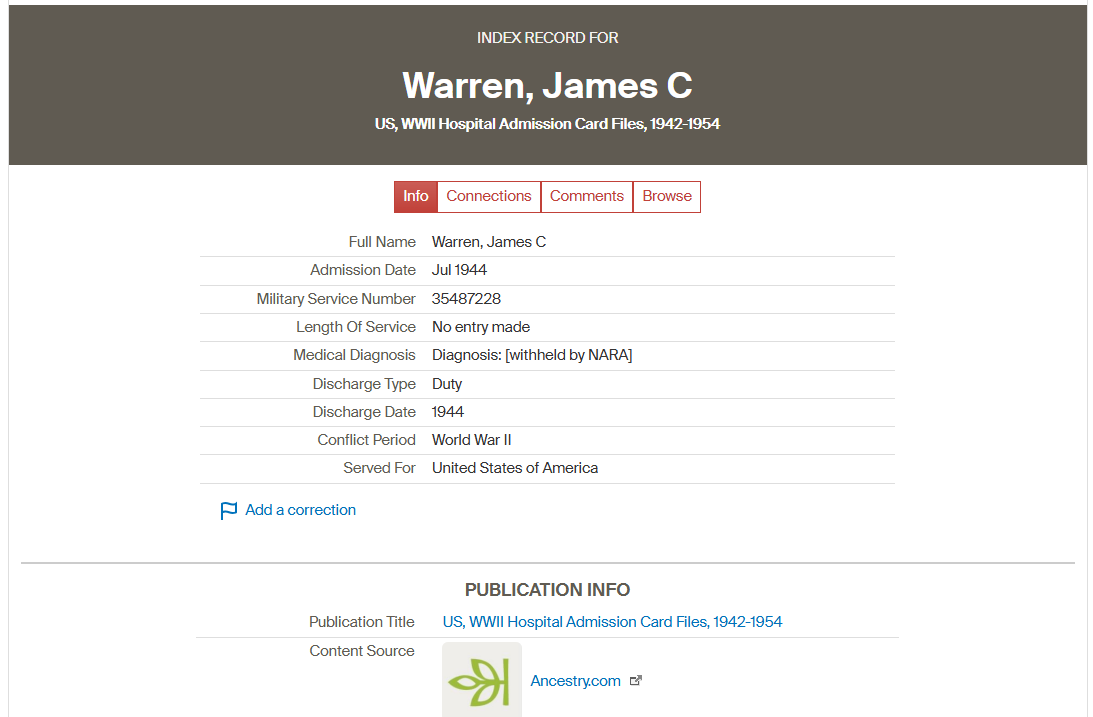
And when looking up his ASN…
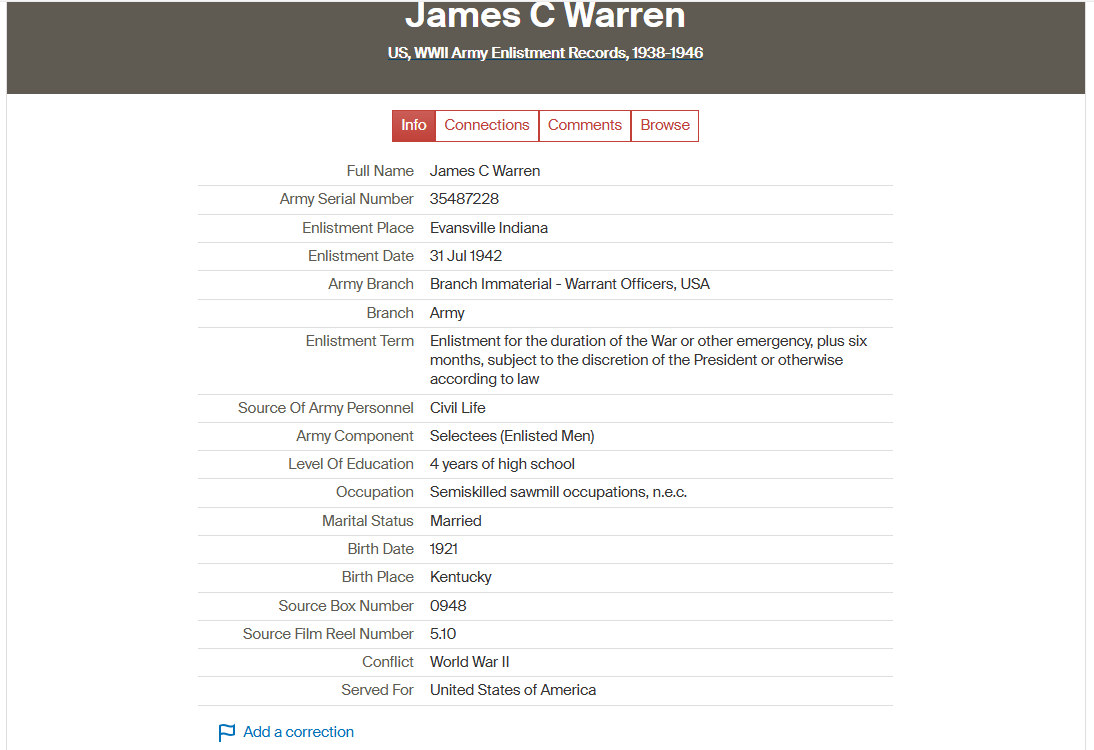
With confirmation like this, I decided to dig deeper into PFC Warren’s life story in hopes of pulling out a few more details about his life story. Luckily, Ancestry.com and Fold3.com provide prompts based on confirmed information when researching so I was quickly on my way down the rabbit hole.

It’s always a bittersweet discovery when I come across one of these documents, which tend to surface most often for veterans who passed away between the 1950s and 1980s. This particular record (which I’ll share below) shows that PFC Warren served with the 816th Ordnance Base Depot Company, a unit stationed in southern England at the time of his hospital admission. Interestingly, there is no mention of a Purple Heart on the form. That leaves me to wonder whether his injury did not meet the criteria for the medal, or whether it simply wasn’t recorded on his discharge papers after the war. Perhaps his family would know the answer.

Luckily, the document provides just enough detail to shed light on who James Carmen Warren sadly left behind when he passed away in 1968. Born on April 8, 1921, he died on August 8, 1968, at the age of 47. He was survived by his wife, Mary Emma Green Warren, along with their two sons, Ivan and James C. Warren Jr.
More to come!


 Portraits of War