Snapshots from Kaufering IV: A Dachau Subcamp


Follow Up Post: The Liberation of Kaufering IV

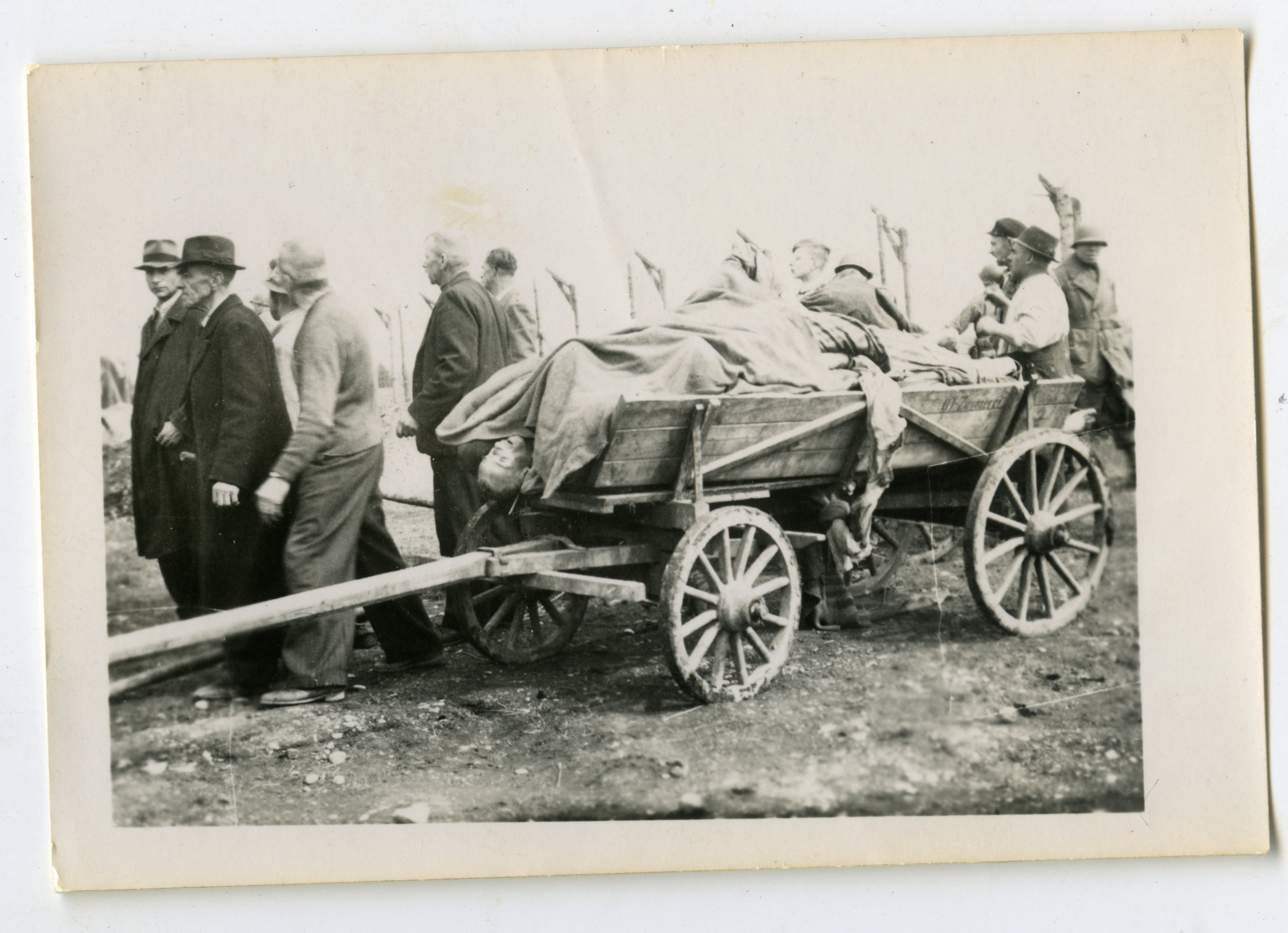
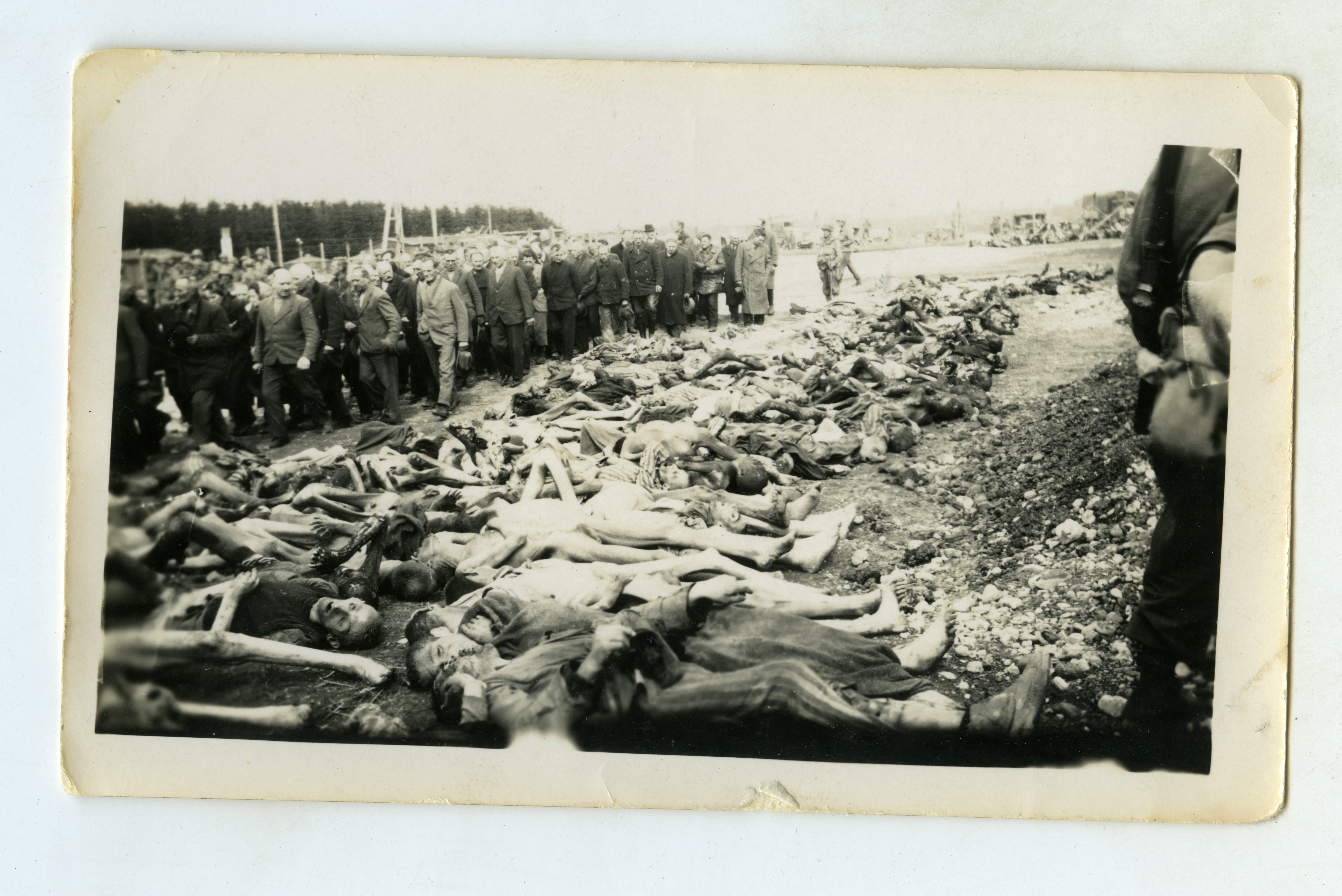
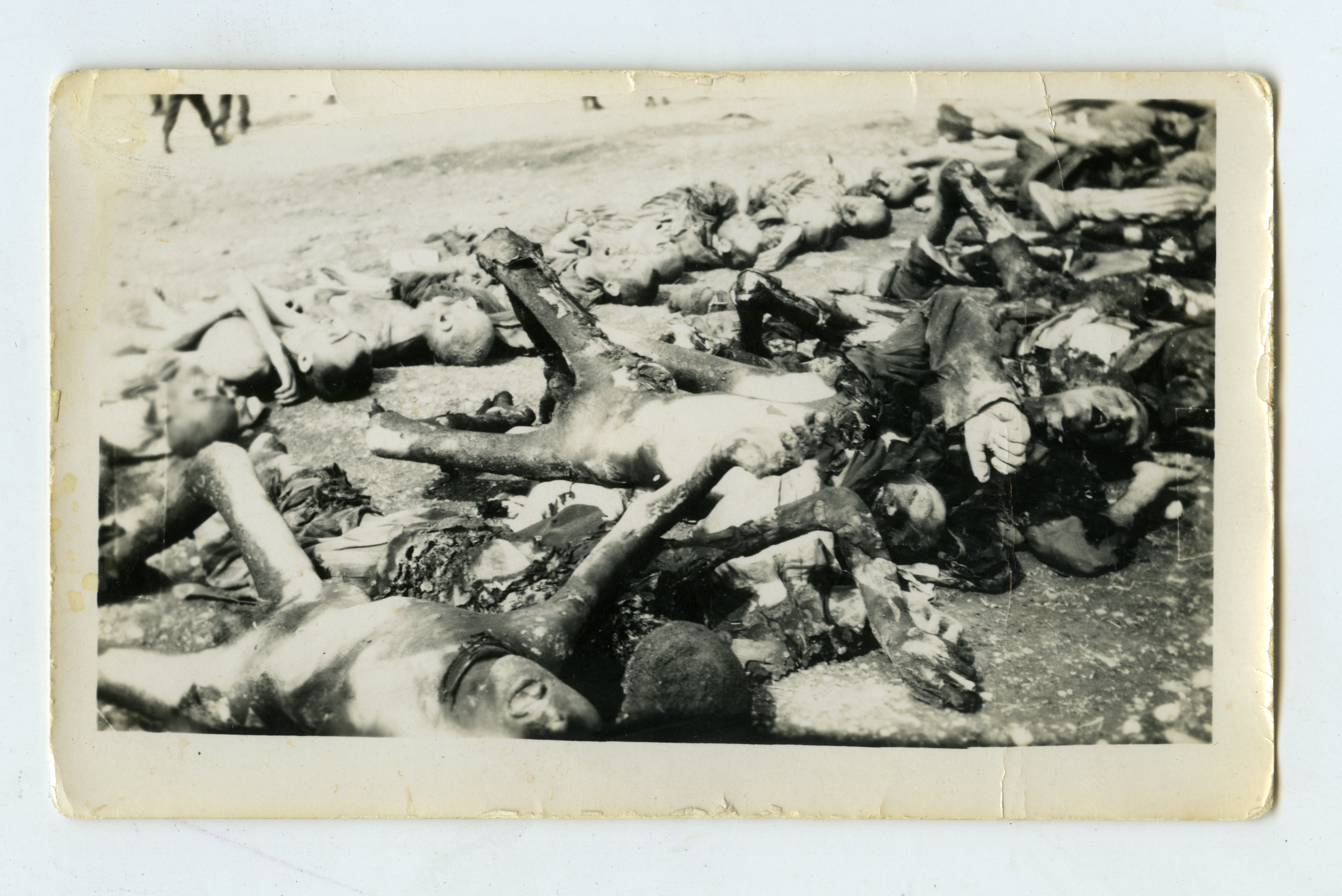
Eight years ago I posted a series of snapshots taken by a US soldier showing the liberation of an unknown concentration camp during WWII. When I acquired the photos, they had no provenance and no information on the reverse side to start the process of identification. Luckily, a blog follower was able to help with the identification of the camp through the same processes I typically use. By observing the surrounding architecture and general contextual clues, he was able to identify the camp as Kaufering IV, a large subcamp of Dachau. Here is what he provided:

Some thoughts:

i)This is certainly somewhere Upper Bavaria – the house architecture is fairly typical of the region.

ii)The presence of the 2 Luftwaffe officers suggests some sort of air force activity is close by. Lager Lechfeld was used as a fighter base and a shake-down airbase for the nearby Messerschmitt complex in Augsburg. Prisoners were engaged in constructing bomb-proof bunker-factories in appalling conditions.

iii)One of the photographs has a very distinctive semi-sunken barrack type, known as “Erdhütten” (Lit: “Earth huts”) – very primitive constructions, the timbers of which were made from off-cuts and waste from furniture production and which survivors testify, leaked terribly. These barracks were a distinctive feature of the Dachau sub-camps in the Kaufering/Buchlöe area.

iv)The brief Wiki article tallies fairly well with the photos and my comments: https://en.wikipedia.org/wiki/Kaufering_concentration_camp

Hope this helps,

Taff Simon

The Snapshots

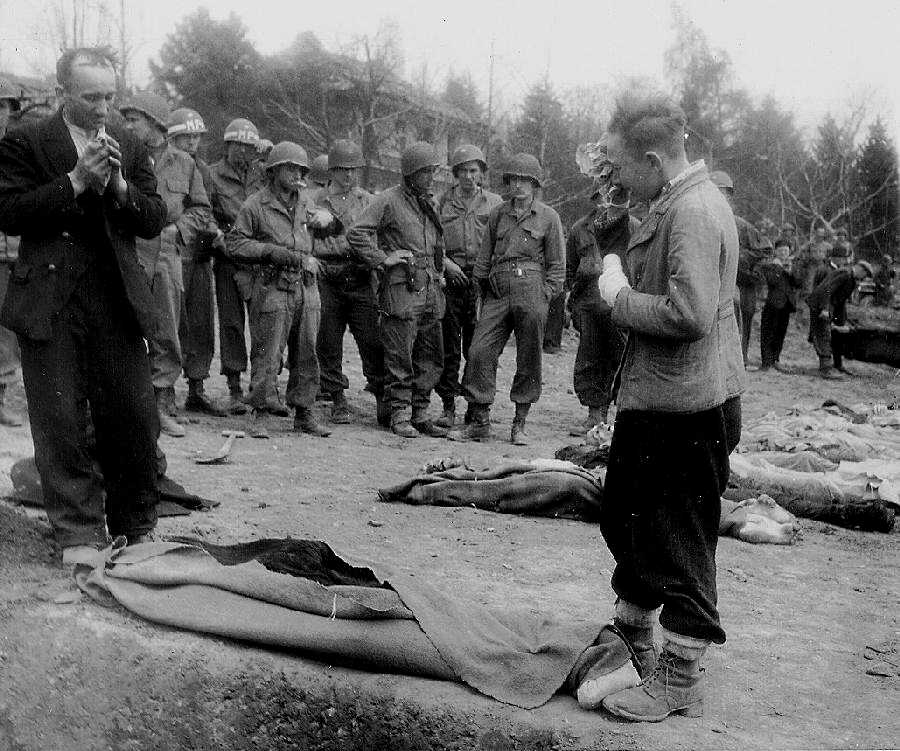
Thanks to the careful research of Taff Simon, we now know that the camp shown in these snapshots is Kaufering IV. A closer look at the details within the images supports his findings. One particular photograph offers the clearest confirmation: it shows an older man in civilian clothing with a closely shaven head, a haunting detail that anchors these scenes to the history of this Dachau subcamp.
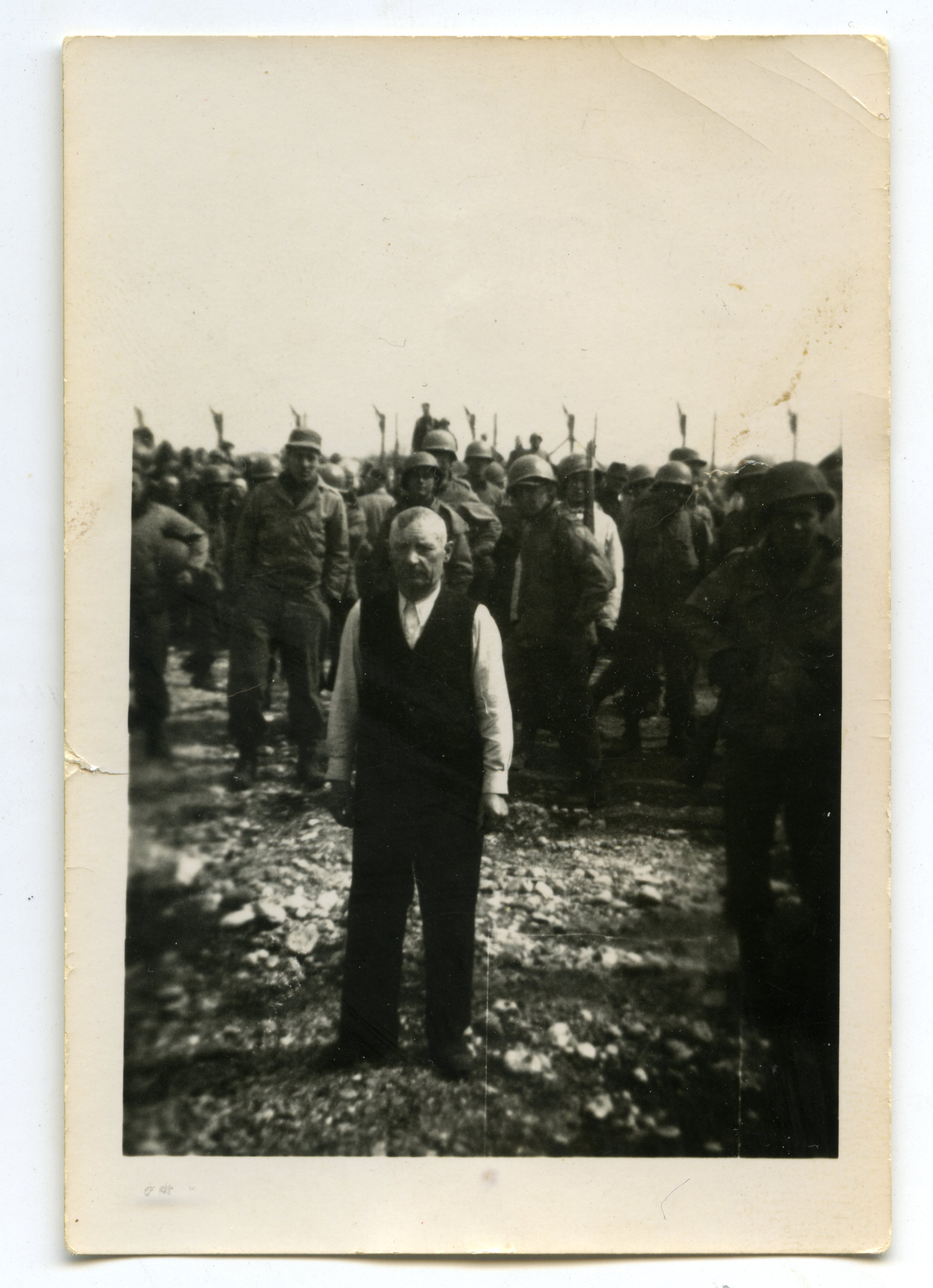
Snapshot of SS Commandant Johann Baptist Eichelsdörfer

When I first wrote about the snapshot collection in 2017, I was unable to identify the man since he was in civilian garb. Artificial intelligence image searches at the time were unable to attribute the image to any individual, so I was under the assumption that he was a local civilian who was brought in to help with the burial of the camp victims. But now, with the attribution of the snapshots to Kaufering IV, I was able to find more images of Eichelsdörfer. His shaven head with the lopsided squirrel-tail appearance confirms his identity when compared to the images below.
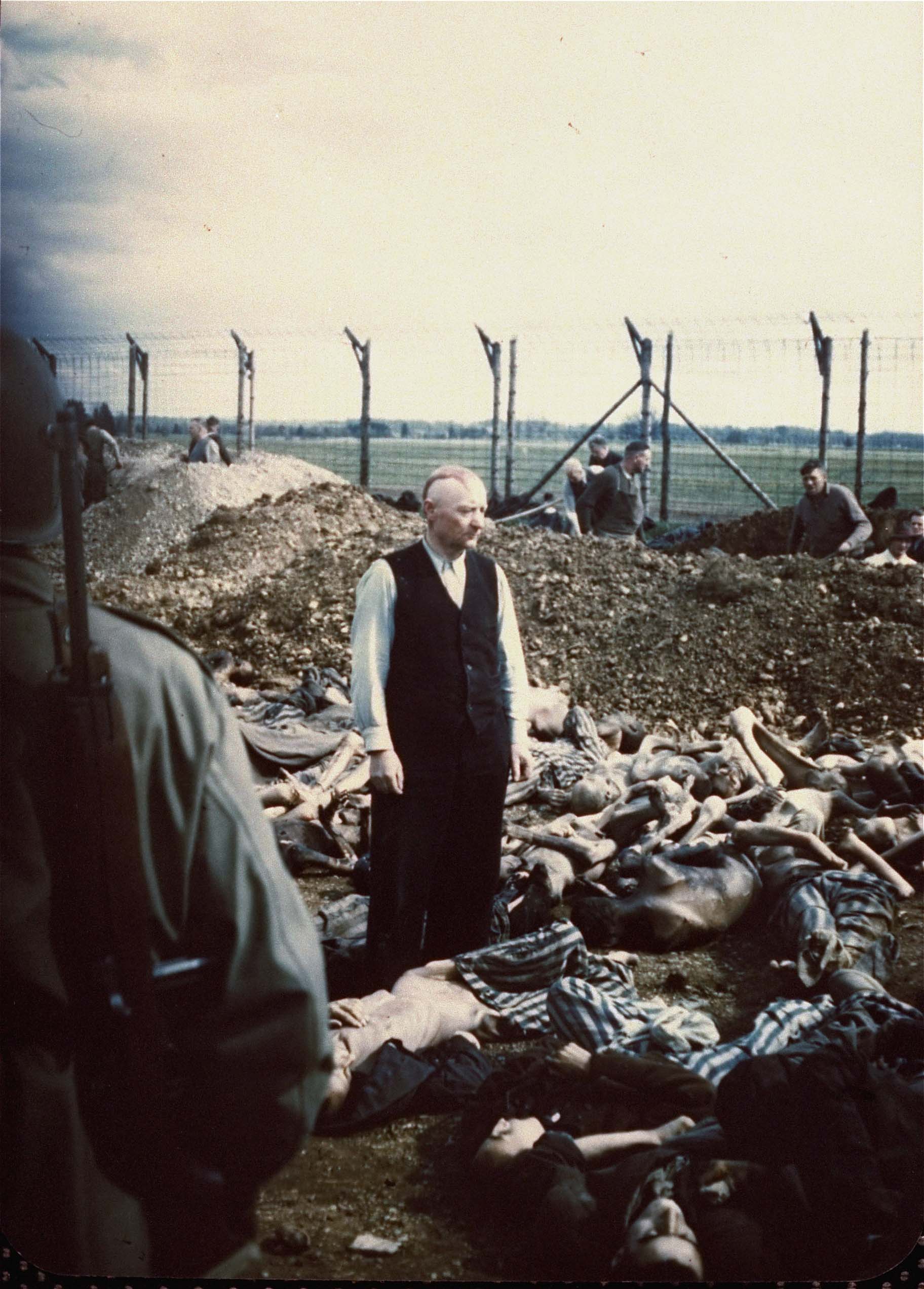
Color Photo of Johann Baptist Eichelsdörfer (US Holocaust Museum image)
(SS officer Johann Baptist Eichelsdoerfer, the commandant of the Kaufering IV concentration camp, stands among the corpses of prisoners killed in his camp. US Holocaust Museum image)
(Wikipedia Commons)

Who was he?

Johann Baptist Eichelsdörfer was a German military officer and concentration camp commandant during World War II. Born on January 20, 1890, in Dachau, Germany, he served as a non-commissioned officer in the Bavarian Army during World War I and remained in the military after the war, retiring in 1924 with the rank of lieutenant. He rejoined the military in 1940 and served in various locations, including France, Poland, and the Soviet Union. In 1944, he was assigned to the Dachau concentration camp system, where he served as the commandant of several subcamps. In January 1945, he took command of Kaufering IV, a subcamp of Dachau located near Hurlach, which was designated as a “hospital camp” but was, in reality, a site where sick and dying prisoners were abandoned without adequate medical care. Under his command, thousands of prisoners died due to starvation, disease, and mistreatment.

Eichelsdörfer’s actions came to light when American forces liberated Kaufering IV on April 27, 1945. U.S. soldiers discovered hundreds of bodies and surviving prisoners who had been subjected to brutal conditions. Eichelsdörfer was captured and photographed standing among the bodies of dead inmates, a stark image used as evidence during his trial. He was tried at the Dachau Trials, a series of military tribunals held by the U.S. Army to prosecute Nazi war criminals. On December 13, 1945, he was convicted of war crimes and crimes against humanity and sentenced to death. Eichelsdörfer was executed by hanging on May 29, 1946, in Landsberg am Lech prison. His trial and execution highlighted the atrocities committed in the Nazi concentration camps and served as a reminder of the need for accountability in the aftermath of war.

The Other Snapshots

Now that we know the snapshots from the 2017 blog post were taken at Kaufering IV, the other images captured by an unknown US GI make more sense. I will post them here with some updated commentary. Feel free to weigh in if you have any comments or suggestions for descriptions.

Kaufering IV Survivor

In the above image, we see a recently liberated survivor of his time at Kaufering IV. He’s using his bandaged hands to tie on a pair of shoes, likely a pair provided to him by US soldiers. He also appears to have some soup in a small can as well as a striped blanket wrapped around his head and body. In the back of the image appears a US T28E1 which was likely one of the 12th Armor Division’s anti-aircraft mobile vehicles. The painted sillouettes of 14 German aircraft on the side hint that the operators of the T28E1 shot down lots of German aircraft as the war came to an end.
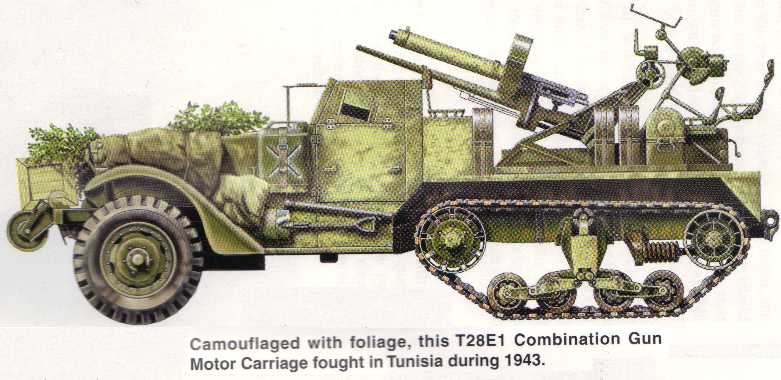
Generalized View of the T28E1
German Luftwaffe Officers
German Civilians Help with Burial
Camp Building and Ditch
Local Civilians Observe the Dead
Kaufering IV Victims
US Officers Speak to a Crowd
US GI’s View the Dead
Camp Victims
Camp Victims and Army Officers
Camp Victims
Local German Civilians Listen to US Officers

I really don’t know how to close this sobering post update from 2017. I did pass the snapshots along to a WWII veterans museum based here in the United States, but I’m unsure of what they ended up doing with them. I hope that his post will help educate those researching Kaufering IV and bring some closure to the mystery of when and where these snapshots were taken.

If you want to see some footage from the camp liberation, please check out the video here.

Easy Co. 506th PIR, 101st Airborne, Band of Brothers at Kaufering IV

HBO’s Band of Brothers covered Kaufering IV briefly in one episode. The unit was involved in the liberation of the camp, along with the 12th Armored Division. See below for a dramatized version of the events. The small earthen huts described by Taff can be clearly depicted. The HBO historical accuracy consultants did a great job!

WWII Amateur Photo Discovery – Concentration Camp Family Photo Captured by US Soldier


Photo Background

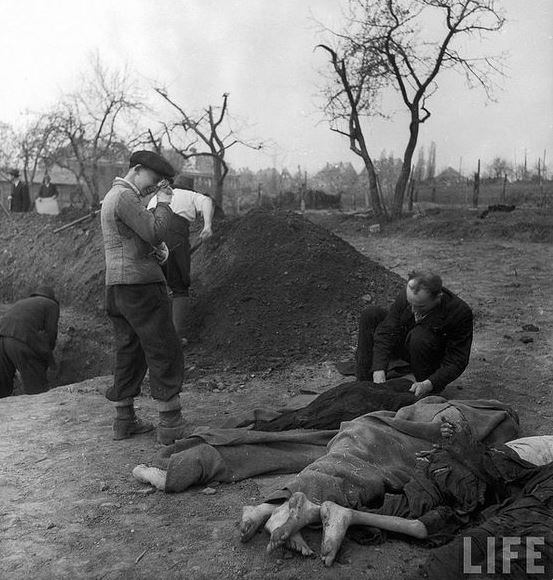
From time to time new information comes along to help identify photographs from my collection.  In this case, I stumbled across an image during research into the liberation of Nordhausen (Mittelbau-Dora) concentration camp.  The image in my collection (seen below) was originally misidentified as having been taken at Dachau, but I just recently learned that it was actually taken at Nordhausen (Mittelbau-Dora) and captures a moment that US Signal Corps photographs also snapped at different angles.  According to information I’ve picked up in the past few days, the young boy was named Michael Kallaur and the father is Walter; both men buried the boy’s grandmother (Walter’s mother) after finding her body in the unfortunate lineup at Nordhausen.  Elizabeth Kallaur was killed at the camp only a few days before the liberation.

According to information at the United States Holocaust Memorial Museum, the Kallaur family was sent to Nordhausen as punishment for helping Jews in the Pinsk region.  The coat seen covering Mrs. Kallaur was given to Michael by John Florea, the Signal Corps photographer. Walter and Michael would not allow German citizens to touch the body of Elizabeth, and she was the first to be buried (at a deeper level) in the first burial trench.

KZ154

A Moment of Sorrow at Nordhausen (photo purchased from eBay that launched this post)

KZ154bcd

Walter holding Elizabeth’s legs


KZ154b

Michael watches on (note wounded hands)


Extensive Research

After hours of internet research, I came across the following Signal Corps photo and instantly recognized the boy….

michaelwalter

Walter and Michael looking over Elizabeth (Walter’s mother)

nord01as

A lesser quality image

This is the info attached to the image: (Click link for source)

Figure 1.–Here a Polish boy weeps over his grandfather’s body at Nordhausen after it was liberated by the Americans. It was dated April 21, 1945. That may have been when the photographed was released rather than taken. The press caption read, “Weep for the dead: A Polish boy weeps bitterly after he and a man at left buried (the) youngster’s grandmother who had died while a political prisoner of the Nazis in concentration camp at Nordhausen. Germans in the town were ordered to dig graves and bury the 2,500 dead, unburied prisoners found there by occupying American forces. The Polish boy refused to let the Germans touch his grandmother and insisted he bury her himself. Yanks look on in quiet sympathy.” We doubt if his grandmother was a political prisoner, but like the boy a slave laborer at Dora. He probably searched for her after the camps were liberated. Notice the German civilians at the right.

LIFe

Walter and Michael by John Florea, 1945

grave

An open burial spot (note the depth of Elizabeth’s burial)

And another series of Signal Corps photos showing the burial:

A Polish boy and his father bury the body of the boy's grandmother, who died in the Nordhausen c

A Polish man, Walter Kallaur and his son, Michael, bury the boy's grandmother

Walter and Michael Kallaur

A Polish boy, Michael Kallaur, weeps while helping his father bury the body of his grandmother

life_183

florea_john_1396_2005_crop_450558_displaysize

Walter buries his mother – note the shallow nature of the other bodies vs. the above image for Elizabeth

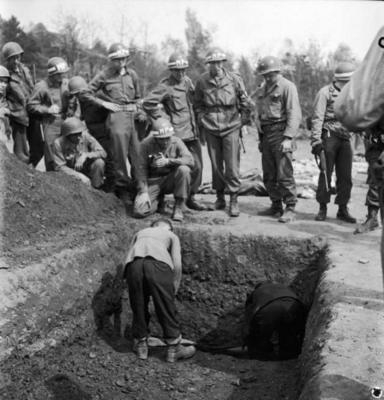
German civilians from the town of Nordhausen bury the bodies of former prisoners

A view past Elizabeth’s burial spot

burial

Walter continues to fill the grave

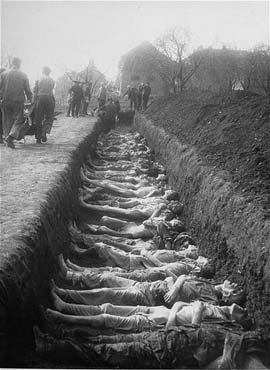
American soldiers walk along an open, mass grave prepared by the German residents of the town of

Walter and Michael at a distance

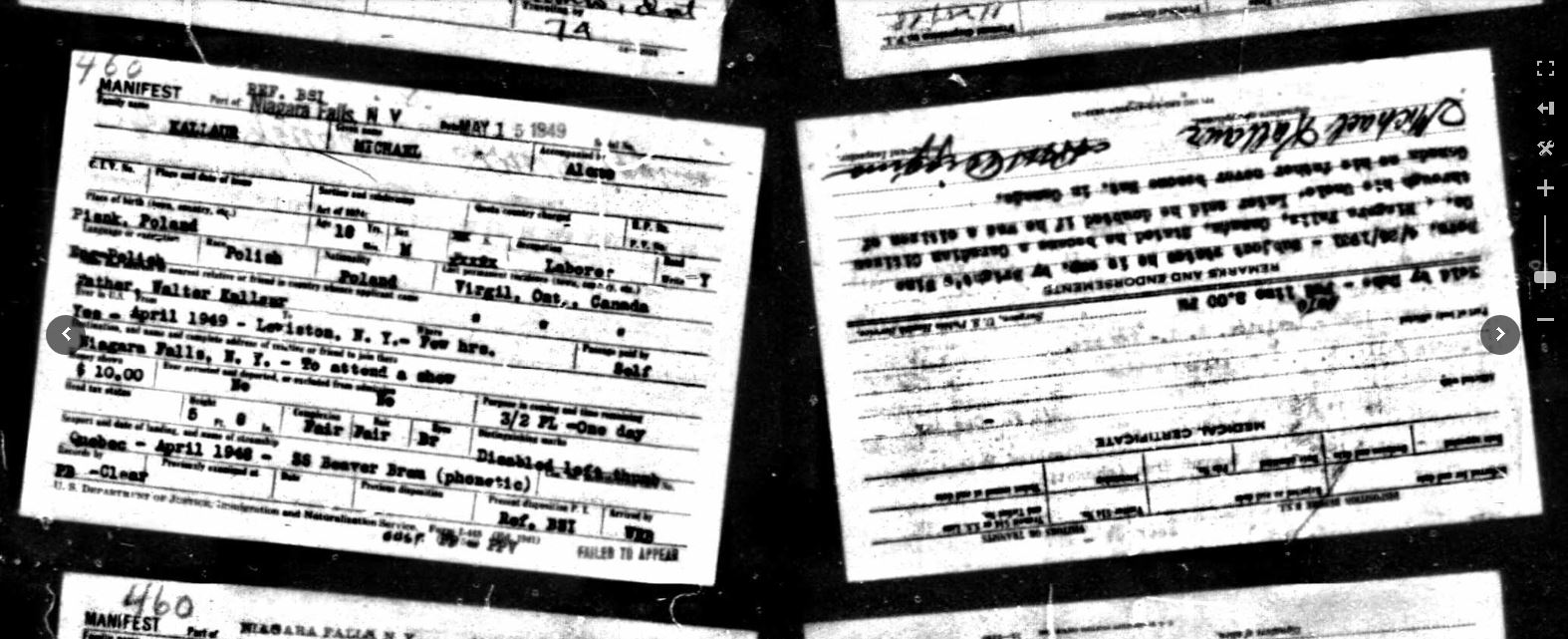
The boy, Michael,  traveled to the United States after the war ended.  Using the information in the image as a jumping off point, I was able to find some immigration travel information:

Michael Kallaur Arrival

1949 Border Crossing

The information on the card all matches up.  As seen in the previous images, he had a visibly wounded left hand; the card confirms this and the fact that his place of birth was Pinsk, Poland.  At the time of his arrival in the US at Niagara Falls, he was 18, putting his birth year at 1931.  The Signal Corps photographer noted his age in 1945 at 14, which matches up with the immigration card.  A website dedicated to the Kallaur family tree referenced a Walter Kallaur arriving in the Niagara region after the war; this jives with both the Signal Corps caption and the fact that Walter is referenced in the above 1949 border crossing documents.  He arrived in Quebec in April of 1948 on board the MV Beaverbrae (listed as the SS Beaven Bren in the document, a ship that eventually transported over 30,000 European refugees to Canada between 1947 and 1954.

Sadly, it appears that Michael passed away in Decemeber of 2000, so my hopes of reuniting this photo with him has been dashed.  His SSN confirms that he lived in Pennsylvania and was issued his card in 1955, six years after his entry into the US.

death

Social Security Death Index (he lied about his DOB)


Living Family Identified

My internet sleuthing tends to be obsessive at times, and I’m fairly certain with the following deduction.   I will leave out the details of the research in respect for the Kallaur family; some things are best left unsaid.

From what I can deduce, Michael married Eileen Gallagher at some point in the 1960s. Eileen was born in 1944, and was only five years old when Michael came to the US in 1949.  Ancestry.com doesn’t provide marriage records for the couple, but I’m basing my marriage dates in accordance with the birth of their forthcoming children.

My hopes are that a family member will google themselves, or possibly have a Google Alert set…….. All are originally from the Philadelphia, PA area.


Michael Kaullaur – 1931-2000

Eileen C. Kallaur – 1944 – LIVING

John Kallaur

Robert Kallaur

Christopher Kallaur

Walter Kallaur


Image Details:  Nordhausen Outdoor Generator

The major defining landscape feature of my eBay image is the presence of an outdoor generator.  This can be seen here:

genny

Generator? Most photos were taken on the opposite side


generator

Generator? from the other direction

HOT ON THE TRAIL OF THE FAMILY

APRIL 27th, 2013 POST BELOW

Casual followers of this blog will know that I never post photos of death or destruction.  My main goal is to present historic photography in a way to help educate internet followers about the world of war.  In this case I will post a photo that may be hard for some viewers to see.  I have hundreds of photos of concentration camps in my collection, yet have never been moved to post any of the photos to the web.

This image called to me.  The composition, the subject, the setting.  It’s all there.  A soldier snaps a shot at Dachau of a man holding the feet of his dead wife while his injured son watches on.  A procession of 3rd Armor Division soldiers file by as this tragic event unfolds; the event captured through the lens of an unknown soldier of an unknown family.  This scene was likely replicated tens of thousands of times at the tail end of the war.

KZ154a

KZ154b

KZ154bcKZ154bcd

KZ154