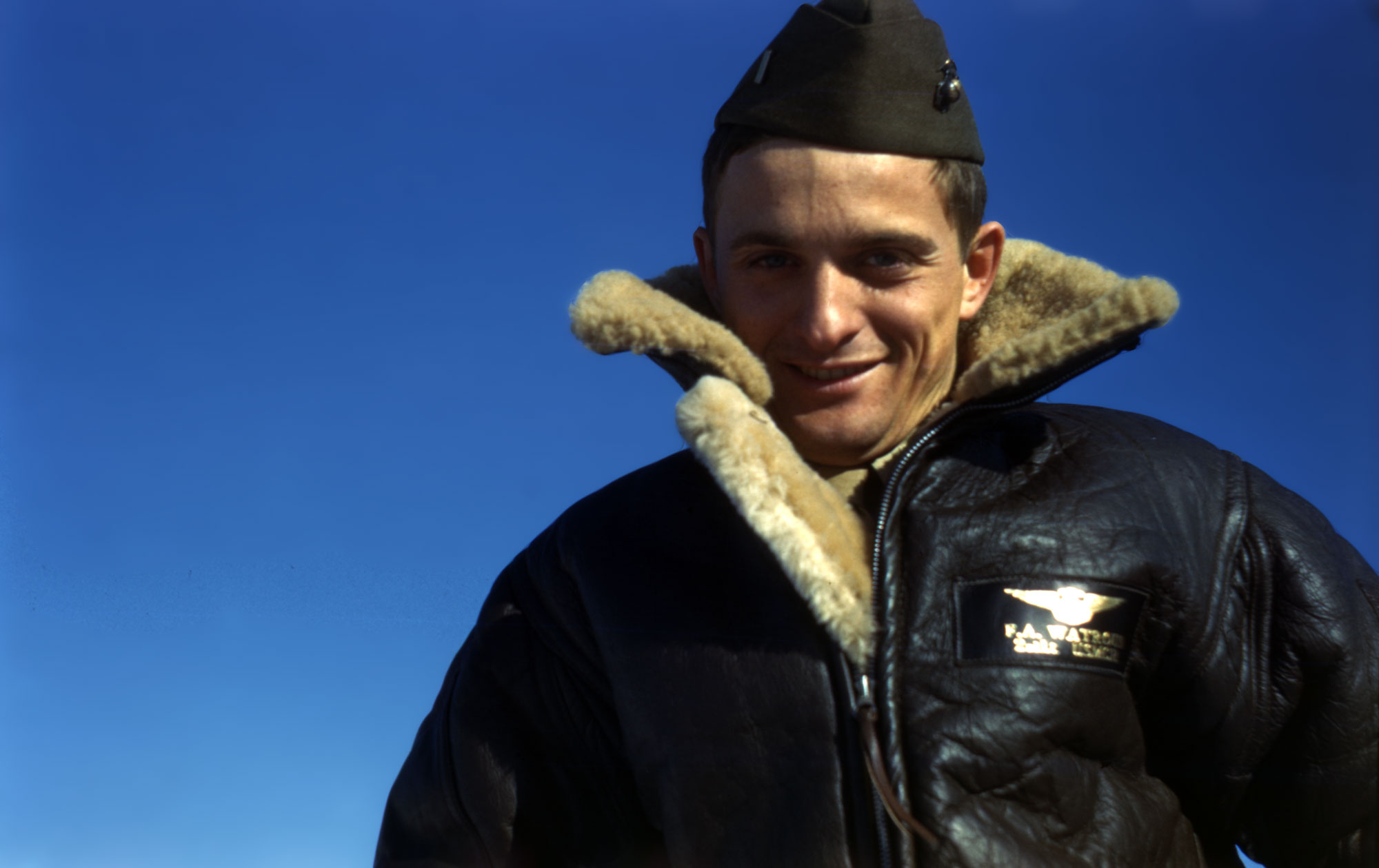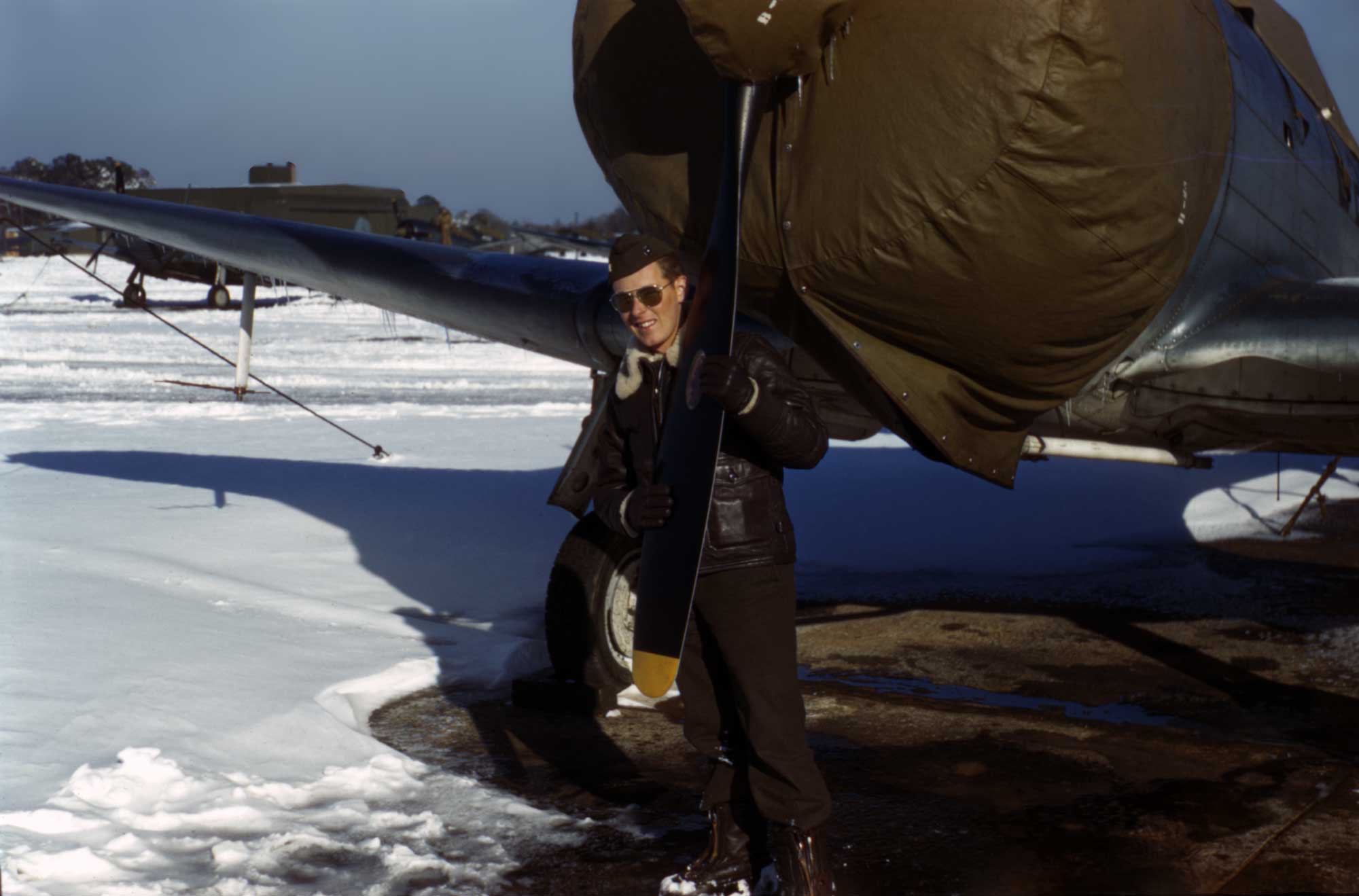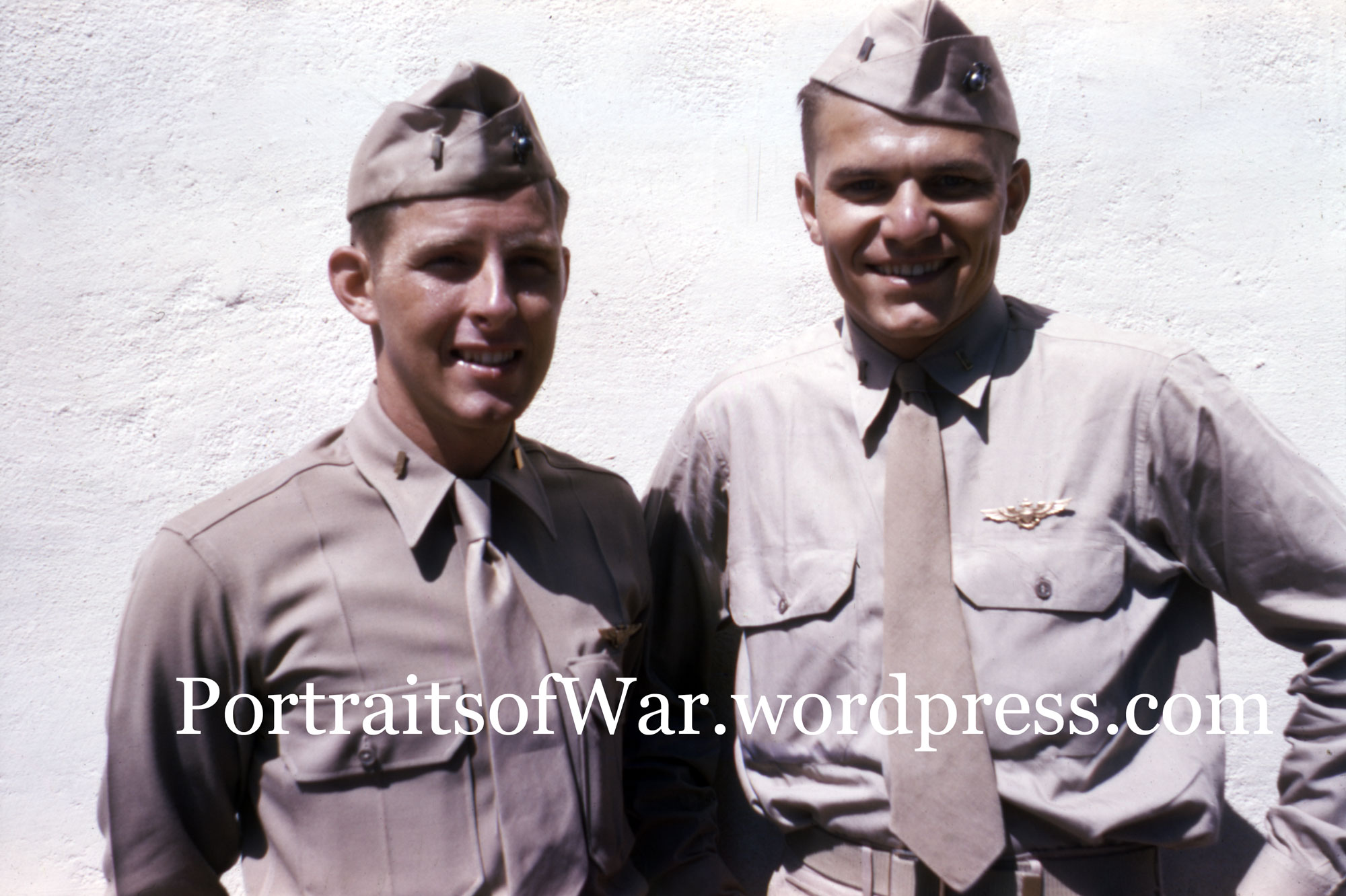
The vibrant colors of 1945 pop to life in the period color Kodachrome film 35mm slide. The sitter is posed next to a signpost in Turangi, New Zealand. Lake Taupo can be seen in the background in a vibrant blue. This area is known for it’s world-class trout fishing.
WWII plane
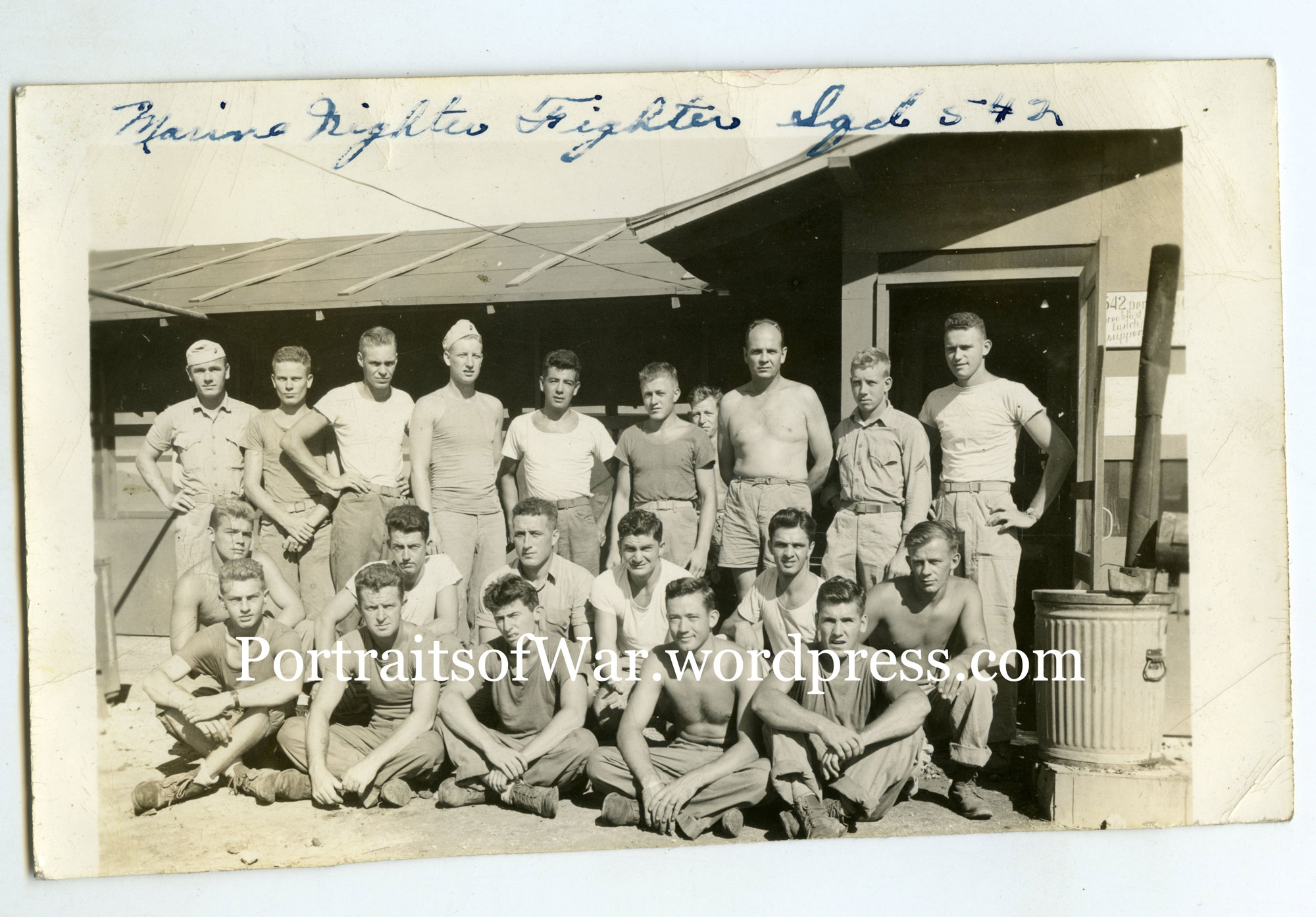
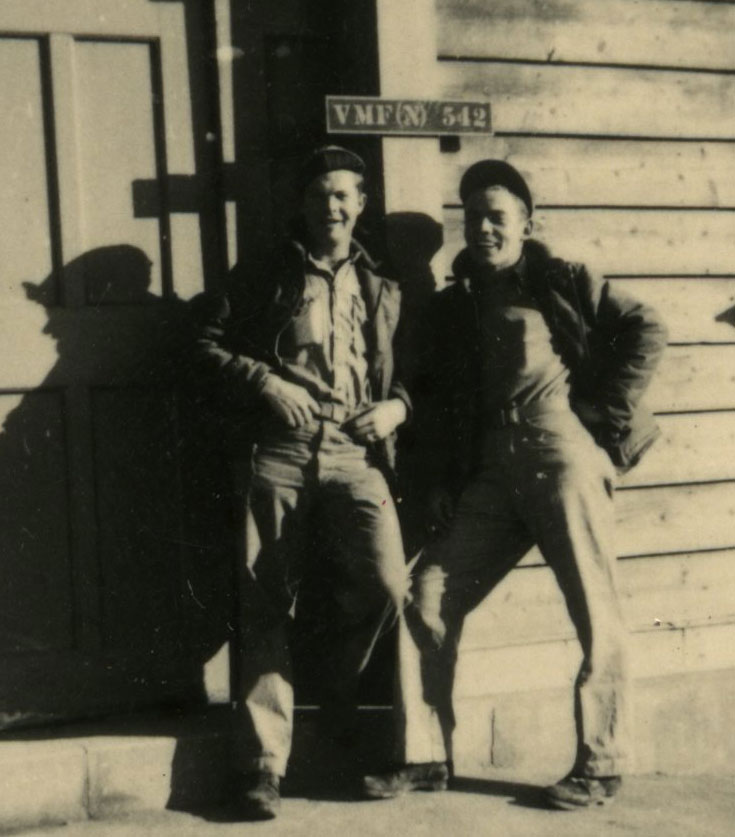
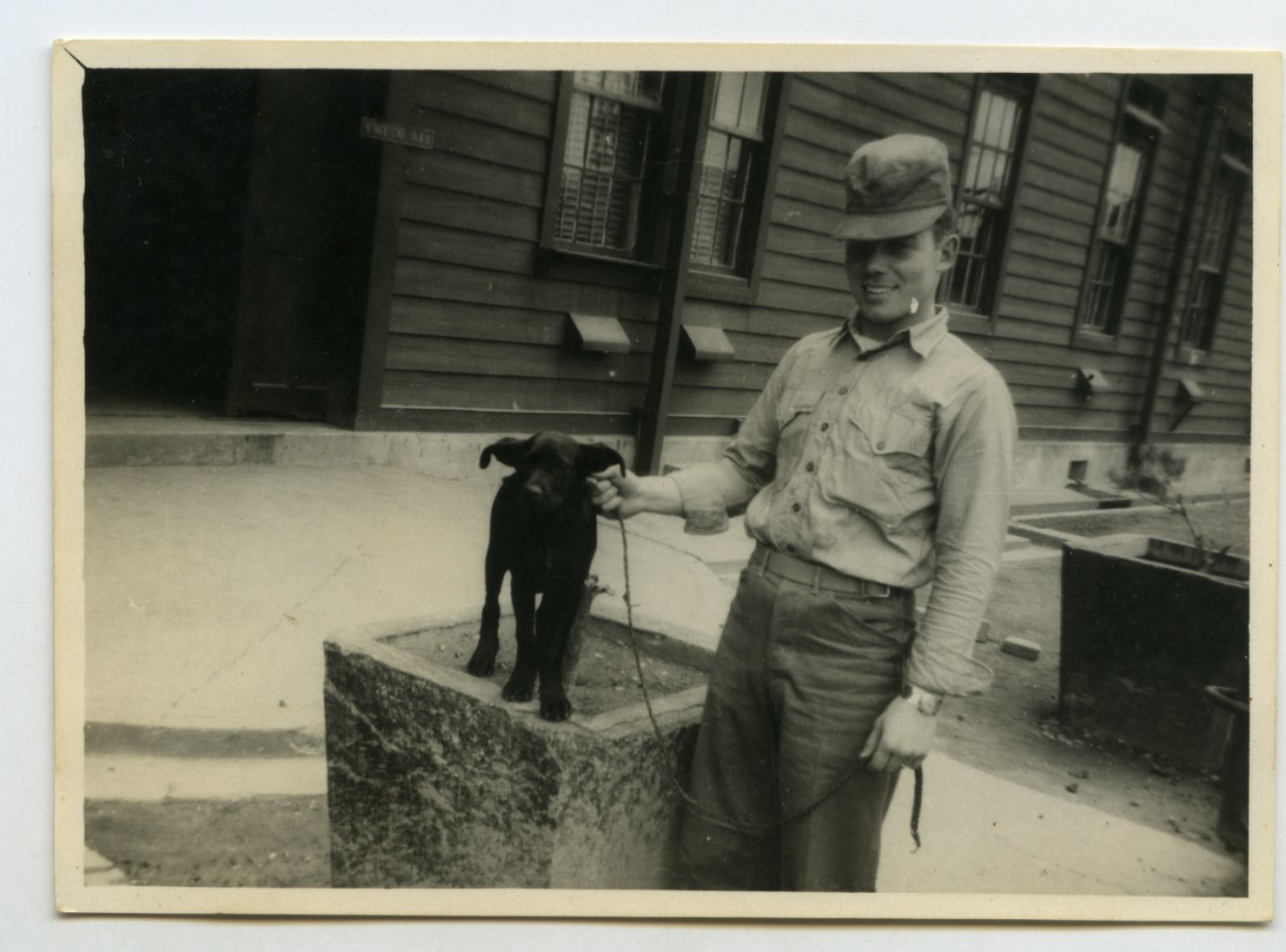
WWII USMC Marine Night Fighter Air Squadron VMF-542 Photo Album
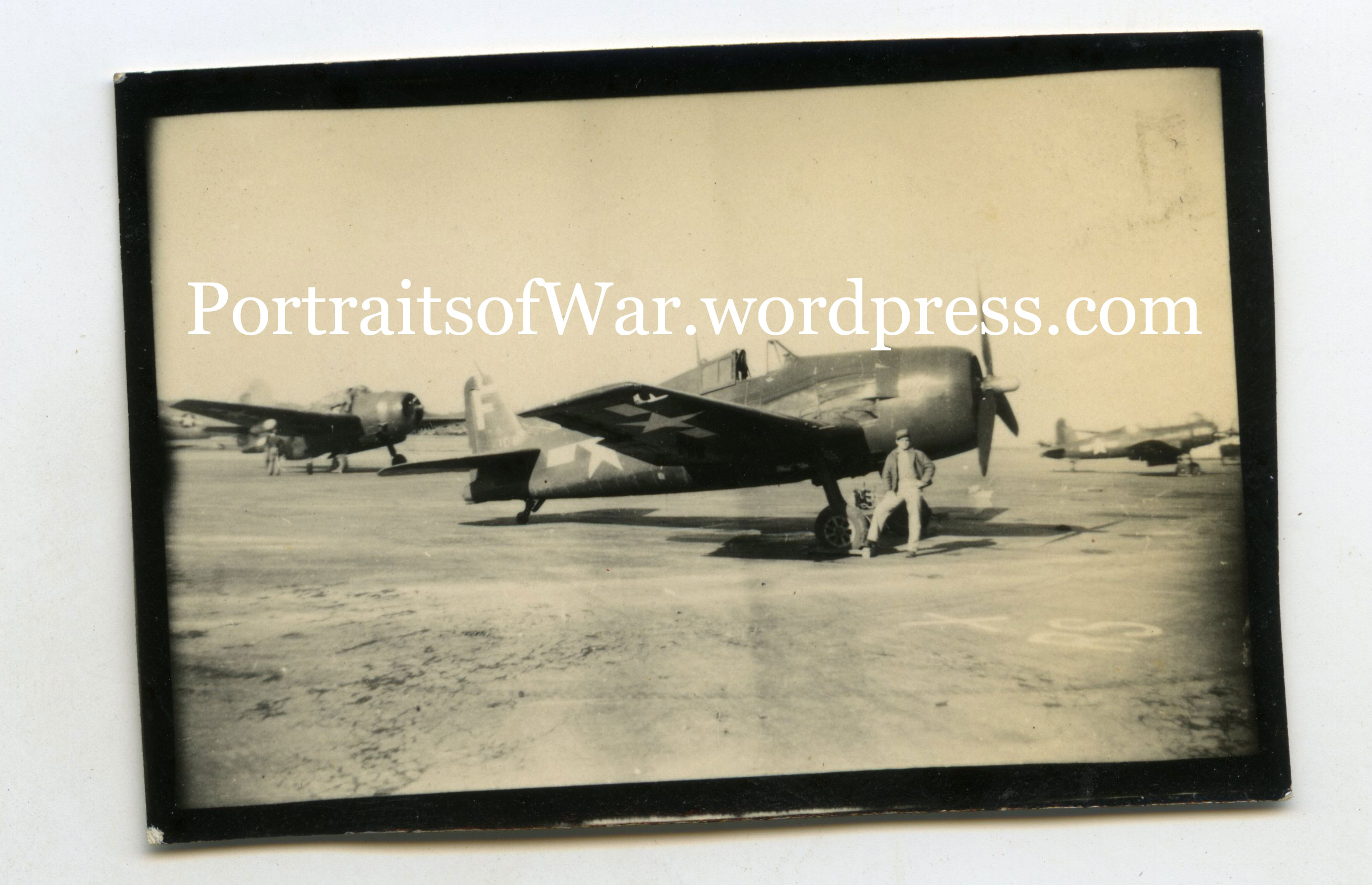
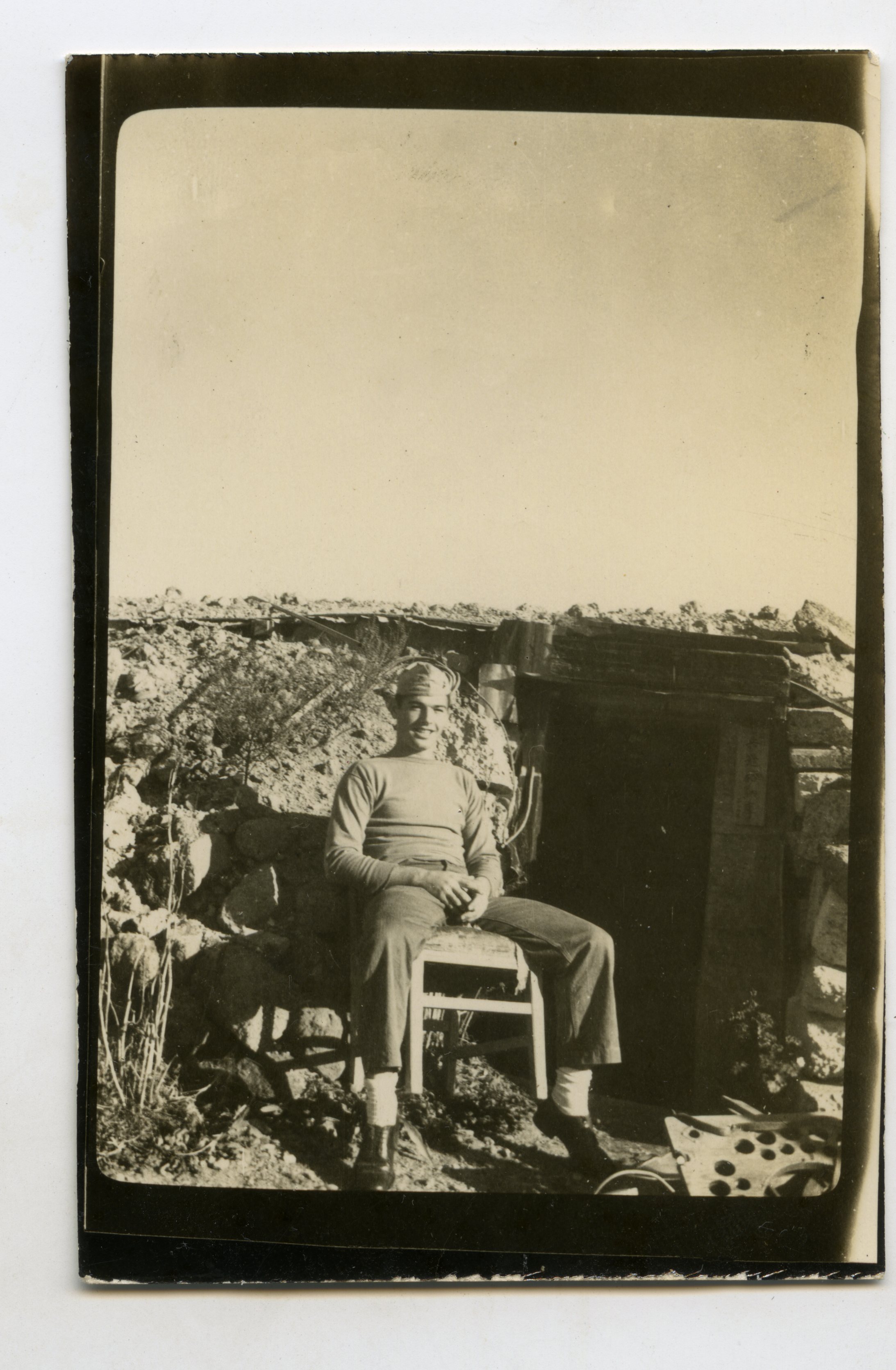
My most recent album purchase comes in the form of a grouping of photos from a member of the ground crew of the VMF-542 Night Fighter Squadron. Comprised of USMC (Marine) pilots flying the F6F Hellcat, the 542nd flew missions in the PTO during WWII. The album is a great little glimpse into the mysterious world of the night fighter squadron during WWII.
Marine Attack Squadron 542 was initially commissioned as Marine Night Fighter Squadron 542 (VMF(N)-542) on March 6, 1944, at Marine Corps Air Station Cherry Point, North Carolina. Upon commissioning, the squadron was assigned the F6F Hellcat. They were relocated to San Diego, California in mid-summer, 1944 in preparation for a move to the combat zone. Late in October, the squadron arrived at Ulithi, in the Caroline Islands and immediately began flying combat air patrols.
Later in 1944, VMF(N)-542 deployed to the Pacific theater. By early April 1945, most of the squadron had deployed to take part in the Battle of Okinawa. Night operations against the enemy began on April 15 with missions being flown from Yontan Airfield, Okinawa. Second Lieutenant Arcenaux was the first squadron pilot to down an enemy warplane with a night fighter on April 16, 1945. While stationed at Yontan, the Tigers were credited with destroying eighteen Japanese airplanes and carrying out rocket attacks on the Ryukyu Islands chain of Amami, Amami Ōshima, Tokunoshima, Kikai Shima, Miyako Jima, and Amami Gunto. For these actions the Tigers were awarded the Presidential Unit Citation. Between April and August 1945, Major Robert B. Porter and Captain Wallace E. Sigler became the first night fighter aces on Okinawa.
Following a short tour of occupation duty at Yokosuka, Japan, VMF(N)-542 was transferred to Marine Corps Air Station El Toro, California. Training during this period was oriented towards night and all-weather fighter tactics and resulted in the squadron being re-designated Marine Night All-Weather Fighter Squadron 542 (VMF(AW)-542) in 1948.
WWII Marine Nightfighter Unit – VMA-542 – Identified Photo! – Henry H. Thellman of Beaver Falls, PA
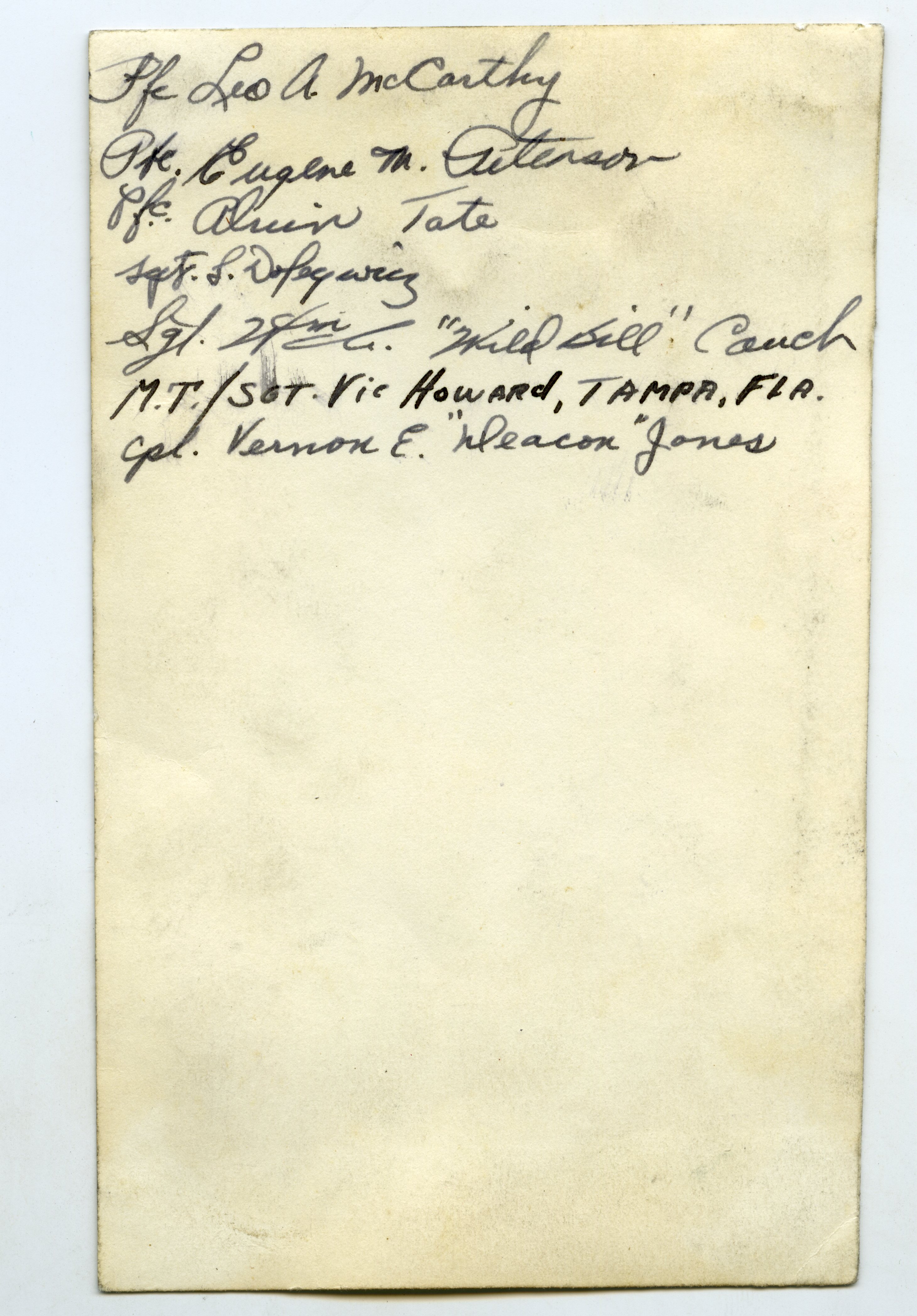
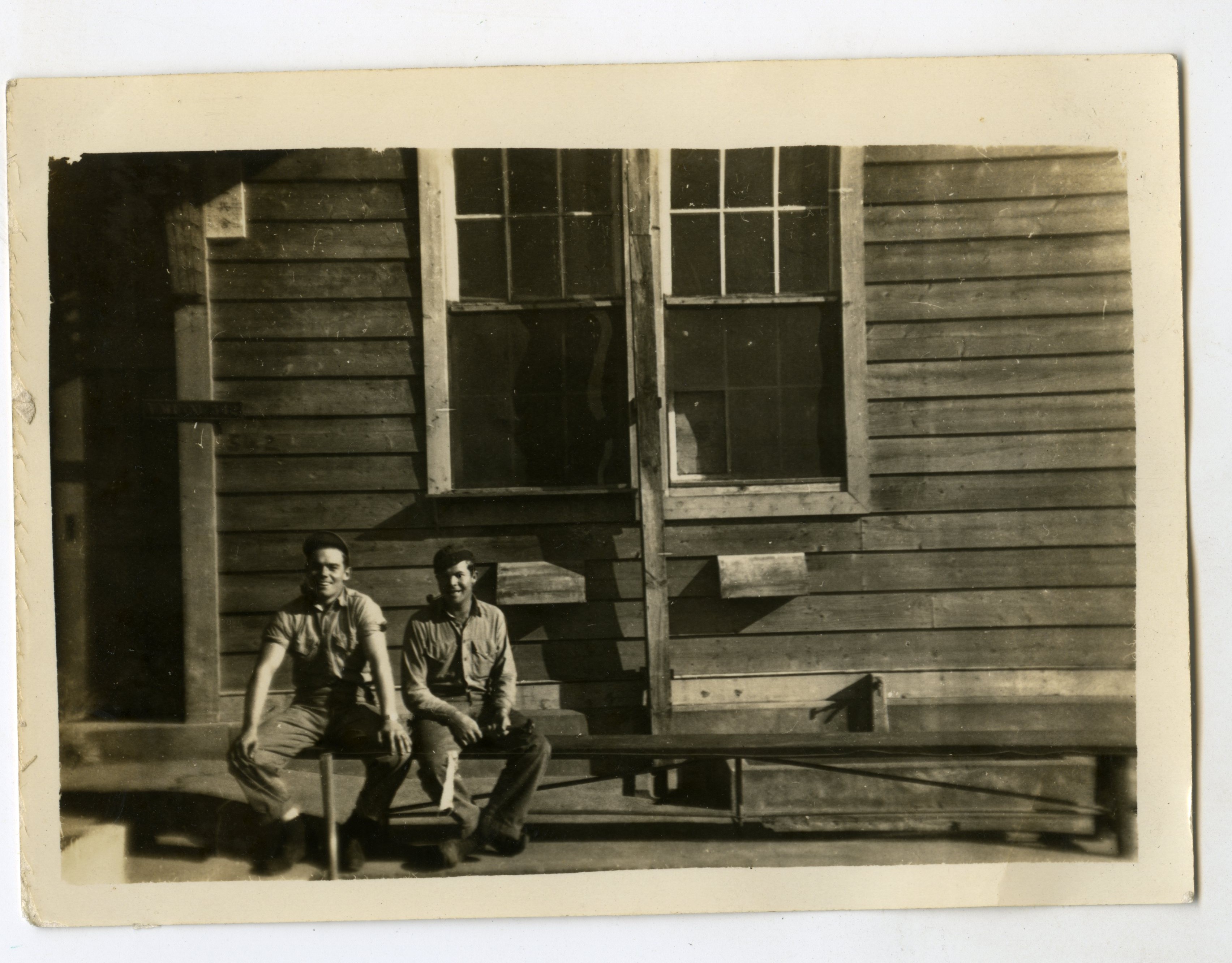
A recent eBay purchase turned out to be from an obscure Marine Nightfighter (airplanes) unit stationed in the PTO during the tail end of WWII. Included in the album are many shots of planes, tropical scenes, buildings, trucks and veteran “buddies”. I always try to do research on name in the hopes of tracking down a living veteran. I’ve succeeded on a number of occasions, but the search usually ends unfulfilled. In this case, I was able to successfully track down the veteran. Sadly, he passed way a few months back, but I’m hoping to contact one of the living relatives.
Here’s a copy of the obituary which I found on a public website:
Posted: Tuesday, January 31, 2012 4:00 am
Henry H. ‘Heinie’ Thellman, 85, of Tampa, Florida, peacefully passed away on Thursday, January 26, 2012 in the University Hospital of Tampa. Born February 21, 1926 in West Mayfield, he was the son of Daniel and Regina (Untch) Thellman.
He served in the United States Marine Corps during World War II. He had been employed by the Kohlmann Bottling Co. and Babcock & Wilcox Co. He was a member of the Beaver Falls Owls Club where he was steward for many years.
Preceding him in death were his parents; his beloved wife, Pauline (Frier) Thellman; a daughter, Tammy; his son, Mark, and three brothers, Steve, Daniel and Richard.
He will be dearly missed by a daughter, Paula (Jeff) Jones, and three grandchildren, Megan Jones, Lauren and Alex Thellman, all of Tampa, Florida. Also surviving are his sister, Regina (Jennie) Karczewski, Chippewa Twp.; a brother, Michael Thellman, West Mayfield; sisters-in-law, Loretta Thellman, West Mayfield, and Margaret Thellman of East Palestine, OH; a brother-in-law, Walter (Dutch) Frier and his wife Betty, and numerous nieces and nephews.
A memorial will be held at a later date.
Without a doubt the same veteran. Maybe the family would like to see photos from the album?
Further research shows that Henry was one of four brothers who all served in the Marines during WWII. What a family!
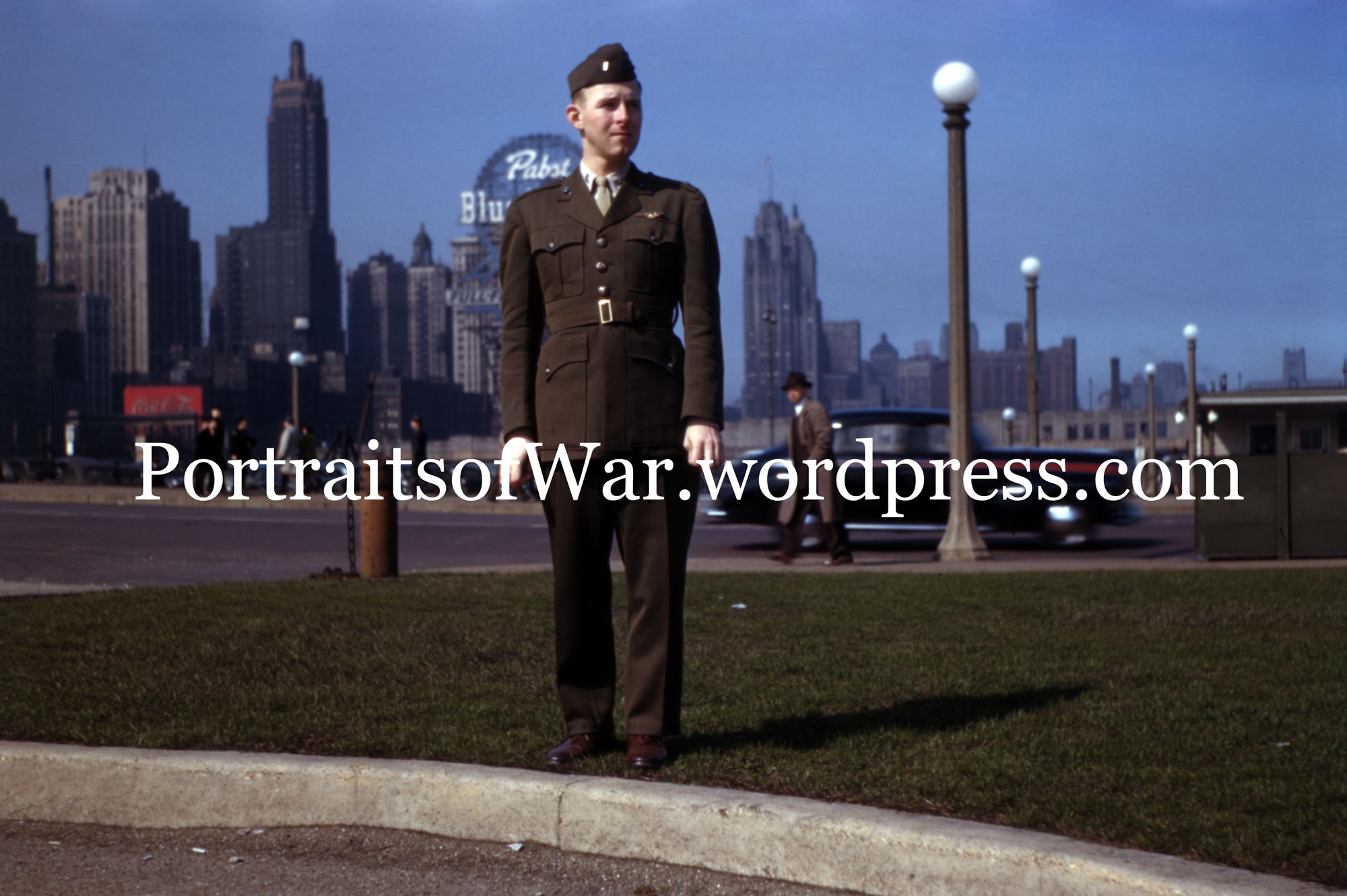
WWII in Color: Marine SBD Pilot on Leave in Milwaukee, WI 1944 – Pabst Blue Ribbon Sign!
For those of you who missed my first posting. please check out my posting from two weeks ago displaying photos from the same WWII Marine pilot. Walter A. Huff flew Dauntless SBD dive bombers during WWII with the VMSB-332. In this series of slides Walter is on leave in Milwaukee, WI. Note the PBR plant!
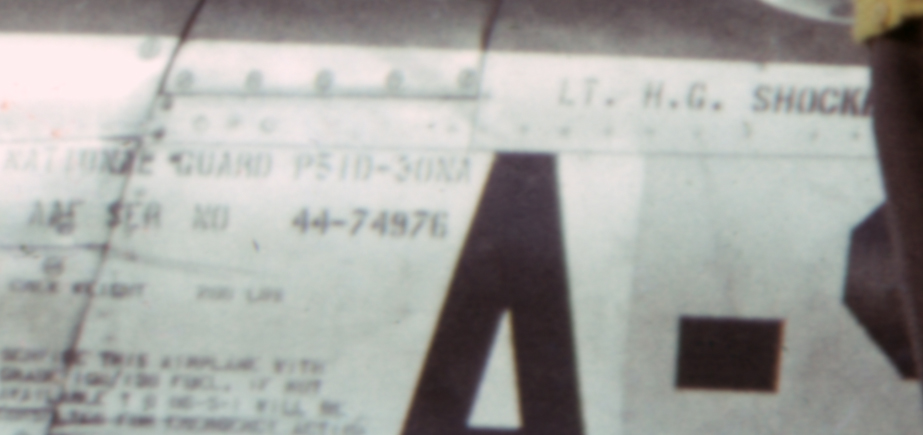
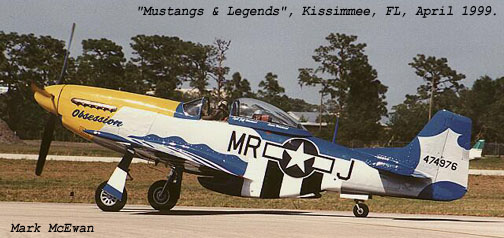
WWII P-51 Mustang 35mm Color Slide Photo – 44-74976 – Currently Still in Operation as Jeffrey Michael’s “Obsession”
Picked this little gem off eBay for a great price and couldn’t help but do some research on the plane. It appears to have been taken while it was with the New Mexico Air National Guard. Likely in 1945 or 1946. I missed out on another listing from the same seller showing the plane with it’s full insignia painted on the side, which was the New Mexico state symbol. I believe this photo may be considered rare, as I can’t find another shot of the 44-74976 on the web, and certainly not in color. I hope the current owner finds my site!
From what I can gather, as pictured, this aircraft was used by the New Mexico Air National Guard in WWII and in the 1940s and then was sold to Indonesia in 1958 or 1959. It was then recovered in 1978 from Indonesia and purchased by a Ralph W. Johnson of Oakland, CA and registered as N98582. It’s first flight after being recovered from Indonesia was in 1983. It was then purchased by it’s current owner, Jeff R. Michael and restored to airworthy and redesignated as “Obsession” with it’s original tail code of 44-74976. Phew!
WWII Bellerose, Long Island B-18 Bomber Crash in Neighborhood Backyard
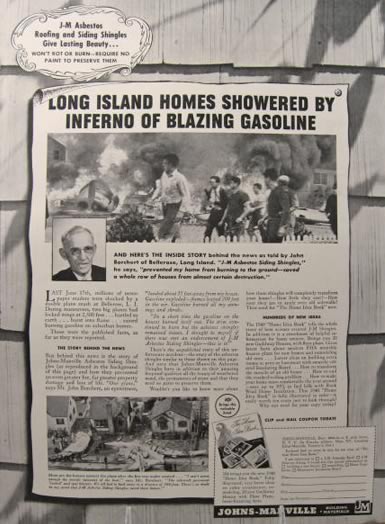
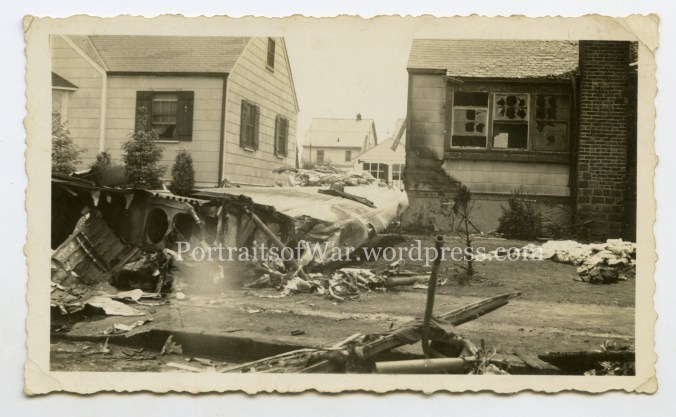
Occasionally I revisit my WWII photo collection to cull through material I’ve overlooked. In this instance, I found a real gem that I somehow never took the time to research. I remember buying this photo at a local flea market with the intention of doing some research on the crash incident, but never got around to it. I assumed that the wreckage in the image was from a B-17 or C-47, but it turns out to be from two B-18 bombers that collided mid-air over Bellerose, Long Island on June 17th, 1940. Eleven men died in the crash, and one Bellerose citizen died of burns following the event. Scanning the internet, I was able to find an advertisement for asbestos siding from 1940 that makes reference to the event. This photo is an incredibly close up shot of the event. A fireman’s hat and jacket can be seen on the wing of the B-18 in the backyard of the burned home. Incredible.
I was able to find an article written by one of the local survivors of the crash:
http://www.christianitytoday.com/le/2009/june-online-only/survivingaplanecrash.html
Also, a minor league baseball played died in the fiery inferno. Here’s an excerpt from the Baseball in Wartime website:
“On Sunday, June 16, 1940, Bedient sent his parents a telegram stating that he was spending the day with his wife at Great Neck. At around 9:00 A.M. on Monday, June 17, two twin-engined Douglas B-18 Bolo bombers, escorted by two fighter planes, left Mitchel Field on a routine training flight. The two bombers carried a crew of 11, including Second Lieutenant Bedient. Just 15 miles from Mitchel Field, above the densely populated area of Bellerose Manor on the eastern edge of Queens, New York, the two bombers were executing a maneuver at 2,500 feet. One plane had to pass under the other and there was not enough clearance. The two planes collided and crashed in flames. One landed within a block of a school and the second smashed into a one-story residence that instantly went up in flames. All 11 crewmen — two of whom unsuccessfully attempted to escape by parachute — perished in the wreckage.”
http://www.baseballinwartime.com/in_memoriam/bedient_hugh.htm
UPDATE
An author who is writing a book on the B-18 emailed me with the following technical info on the two planes that crashed.
Douglas B-18A – AAC 37-576 Accepted 17 May 1939 and immediately assigned to Langley Field, VA. To Mitchel Field, NY 10 November 1939. Accident 17 June 1940 at Bellerose, Long Island, NY 1LT P. Burlingame, collided with B-18A 37-583 (q.v.), w/o. Coded 9B45 and 9B43 at the time, order uncertain.
Douglas B-18A – AAC 37-583 Accepted 9 June 1939. Assigned to Langley Field, VA 10 June 1939. To Mitchel Field, NY 12 November 1939. Accident 17 June 1940 at Bellerose, LI, NY, 2LT R. M. Bylander, collided with B-18A 37-576 (q.v.), w/o.
Thanks!
WWII in Color – Color Kodachrome Slides – 1944 SBD Dauntless Marine Dive Bombers VMSB-332 w/ Aircraft
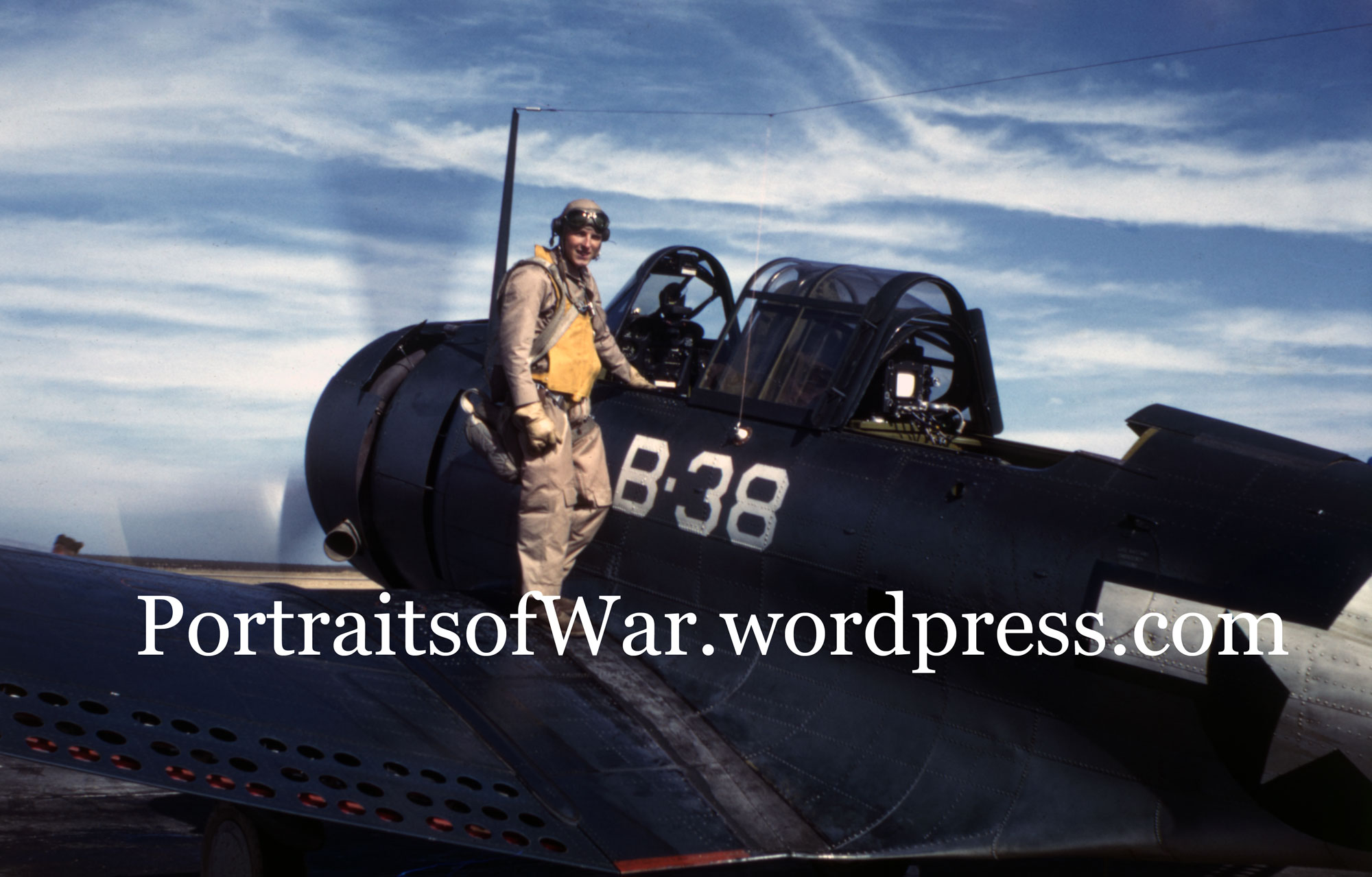
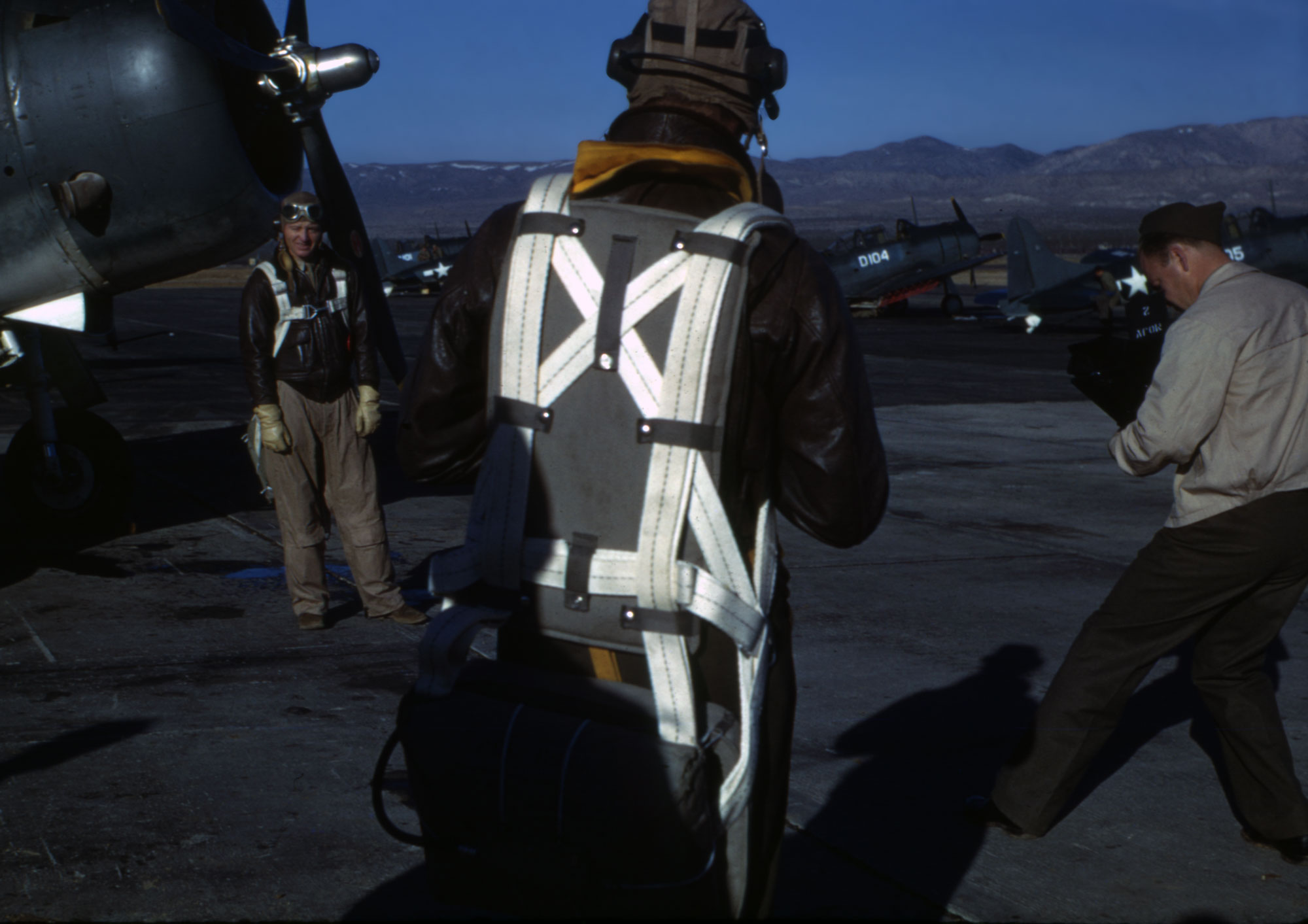
The color of WWII is something lost on our generation; WWII has been a war fought in black and white for everyone but actual WWII veterans who witnessed it firsthand. One of my goals here at PortraitsofWar is to collect color slides from WWII and make them accessible to those who don’t know it exists. Yes, color film was shot in 35mm(and sometimes larger format) and was used on a somewhat regular basis by shutterbug soldiers during WWII. My collection is roughly 500:1, black and white : color. To find a complete collection of color slides is like hitting the WWII photography jackpot. In this case, I was able to pick up a small selection of color slides from a Marine dive bomber. Although I was only able to snag 7 from a grouping of nearly 200, I am still happy to pass along the images to interested parties.
From the collection of Walter Huff.
Please enjoy the colors of WWII as they were meant to be seen!
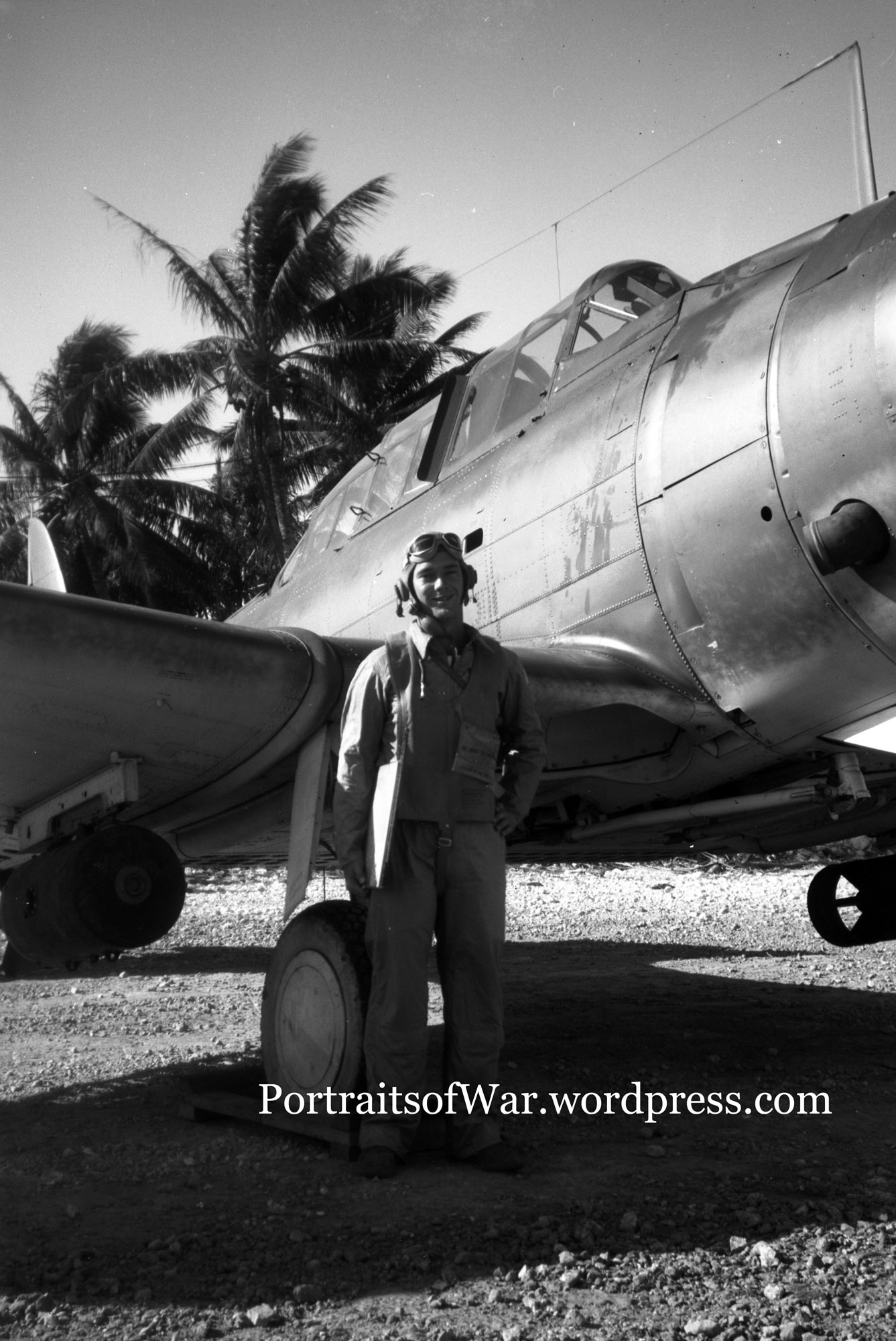
WWII USMC Marine Corps SBD Dauntless VMSB-231 Pilot and Dive Bomber on Majuro, Marshall Islands
An eBay seller recently posted an anomalous grouping of negatives online. The photos were reportedly from the collection of a US ETO fighter pilot, but were clearly taken in a tropical location. My BS radar went off, and I placed a single bid on one of the “better” images. After the negative arrived (2.5 by 3.5 in original glassine envelope), I was able to extract a bit more info; although the man posed in the photo is still a mystery. His name appears to be Jud – and I’ve narrowed down the unit info to place him as a pilot with the VMSB-231 station on Majuro in the Marshall Islands in 1944. I’ve contacted the seller to track down more shots from this historic grouping.
The VMSB-231 stands for Marine Scout Bombing Squadron # 231. They were known as the “Ace of Spades” and can sometimes be seen sporting spade insignia on their planes. The unit was responsible for dive bombing Japanese shipping and freight. The SBD was a radial engined dive-bomber that was extensively used in the early portion of the US involvement in the PTO. Here’s a good site regarding the SBD: http://science.howstuffworks.com/douglas-sbd-dauntless.htm
Some technical data on the SBD:
Douglas SBD Dauntless Specifications
Wingspan: 41 ft. 6-1/2 in.
Length: 33 ft. 1-1/2 in.
Height: 13 ft. 7 in.
Empty Weight: 6,500 lbs
Gross Weight: 10,700 lbs
Top Speed: 252 mph
Service Ceiling: 26,100 ft.
Range: 1,100 miles
Engine/Horsepower: One Wright R-1820/1200
Crew: 2
Armament: Two .50-inch Browning machine guns in the nose; two .50-inch Browning machine guns flexibly mounted in the rear cockpit; 1,600 lbs of bombs under fuselage; 650 lbs under the wing
WWII German Snapshot Photo – RAF Gravestones in Germany 1939 – 1st Australian Soldier Killed in Action
Today’s post comes from a loyal PortraitsofWar follower from the Netherlands. He recently stumbled across a single snapshot at a Dutch flea market and did some savvy investigative work to tease out the historical significance. Thanks Werner!
Begraafplaats Engelse Vliegeniers
By: Werner Peters
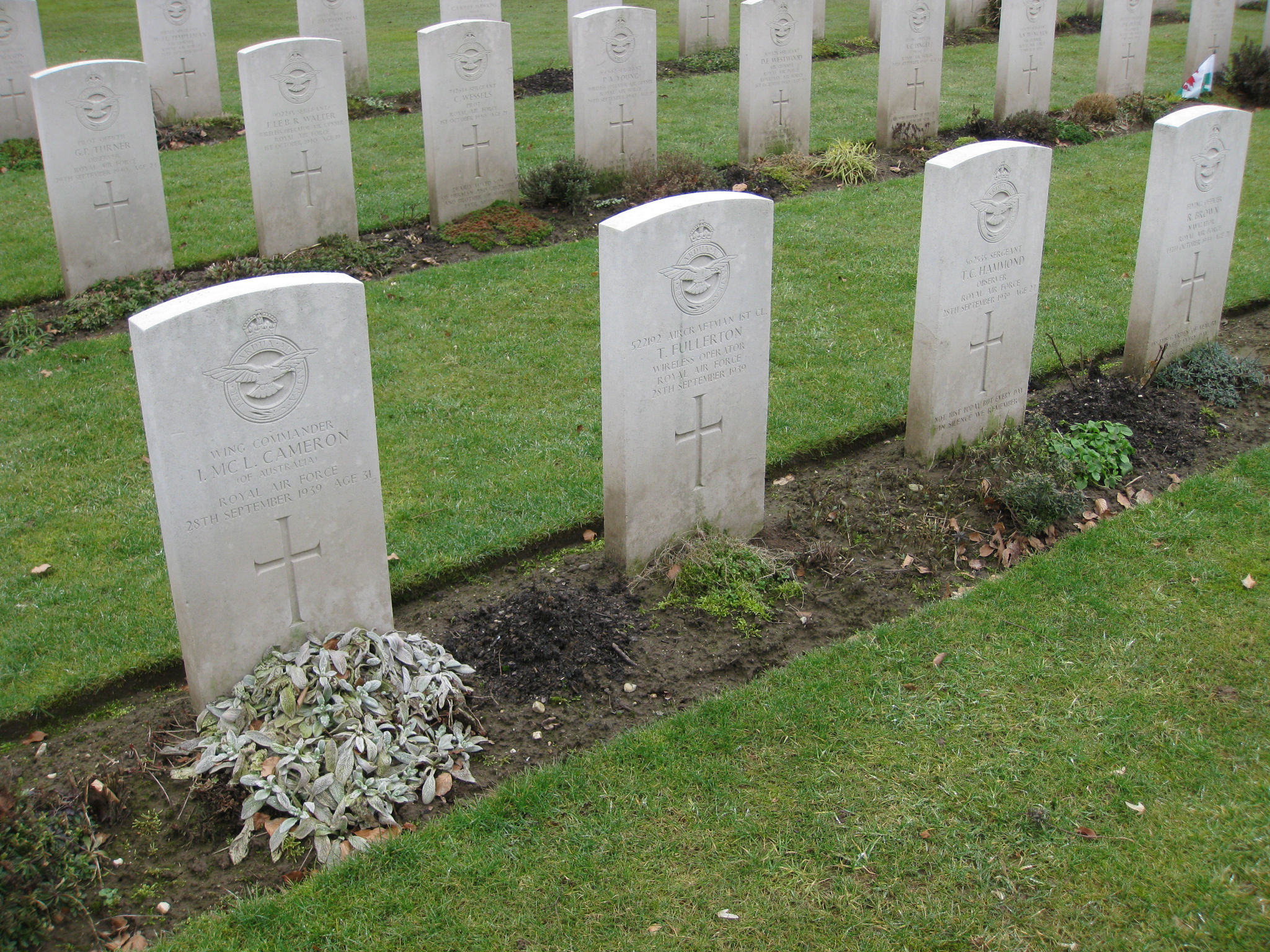
Here we have a photo taken by a German soldier depicting the graves of three Allied airmen who lost their lives in the skies over Germany. These soldiers were likely recovered from their crashed plane and buried with full military honors by their German adversaries. A Nazi laurel wreath can be seen in the left corner of the photo.
At the time, two of the airmen could be positively identified by the Germans; one body was unidentifiable. One the left side of the burial plot lies Mr.Hammond whose RAF identification number was 562535RAF. On the right side of the grave lies J. MCI. Cameron, Offr res 24225RAF. The middle marker merely says , Engl. Flieger(English Airman). On all three grave posts is written “Hier ruht ein Engl. Flieger – im luftkampf gefallen 28.9.1939 Vorden” – which translates as “here rests an English airman who died in aerial combat on 28.9.1939 Vorden(?)”.
With a little research it turns out that this crew belonged to the 110th RAF squadron. They were flying a Bristol Blenheim type IV, number N6212 which crashed on September 28th, 1939 during a recon mission over Munster in the neighborhood of Kiel, Germany. They were shot down by a German pilot named Klaus Faber, a feldwebel of the Ersten Abiteilung. Jagdgeschwader Eins (1st Section of the 1st Fighter Group).
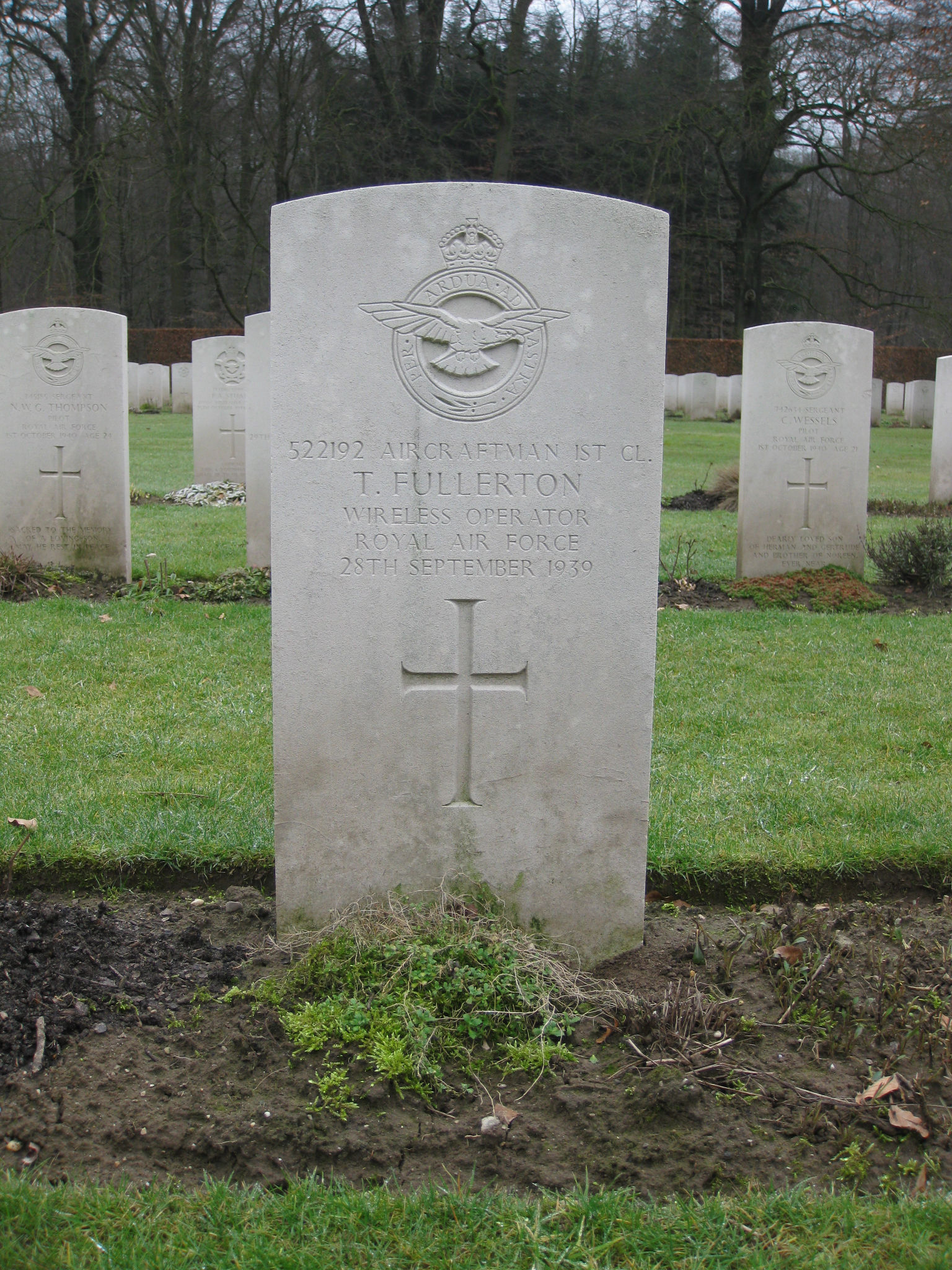
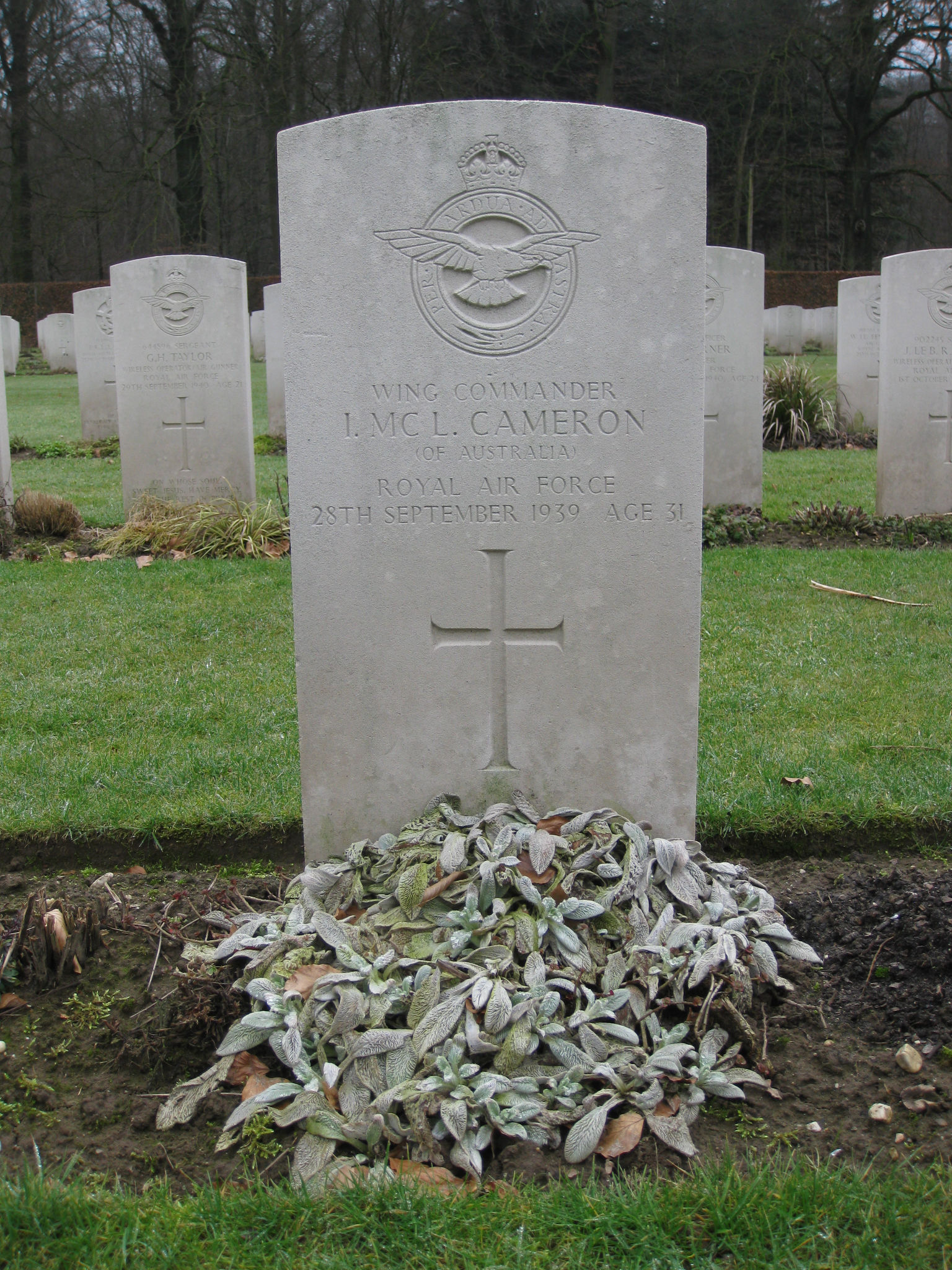
It turns out that the man buried on the right is wing commander Ivan McLoed Cameron, an Australian who, in fact, is the first Australian to die in action during WWII. The man to the left is Thomas Cecil Hammond, an Irishman. The last grave belongs to Thomas Fullerton.
For more information regarding the crash, please check out the following website: http://ww2chat.com/biographies/5839-raf-australians-wing-commander-ivan-mcleod-cameron.html
After researching the photograph, Werner visited the current grave site in Kleve, Germany where the three men were reburied after the war. He snapped some great photos and generously allowed for them to be posted here at PortraitsofWar.
Thanks Werner!
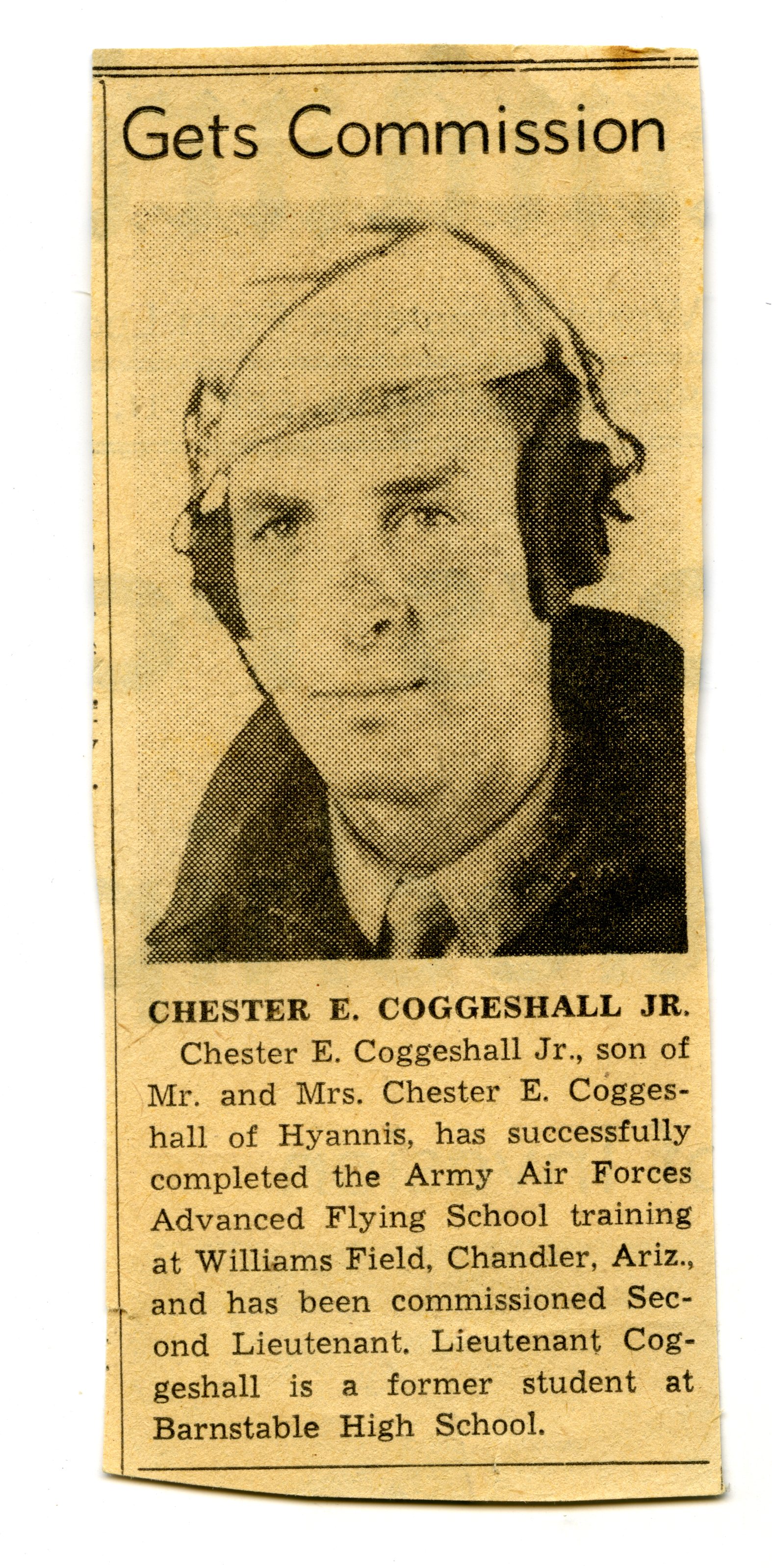
WWII Memorial Post – Cape Cod Native Captain Chester E. Coggeshall, P-51 Pilot Shot Down Over Austria
| The discovery of a photo and clipping from a Massachusetts flea market yields a wealth of interesting material related to the last hours of Captain Chester Coggeshall’s life. A sad story, but one that deserves to be told. Captain Coggeshall was born and raised on Cape Cod (Hyannis) and entered the war after attending Barnstable High School. He flew two tours in the ETO, the first with a P-38 (pictured below) and a P-51. His final mission of the war ended in his tragic murder. Please read below for more details.
343rd Fighter Squadron, 55th Fighter Group. From Find A Grave Contributer #47444799 Entered service from Hyannis, Massachusetts After action report from his wingman: A postwar inquiry found that Capt. Coggeshall had been executed by the mayor of the town of Freilassing, Germany. After being denied medical care, he was taken to a wooded area outside of the town and shot twice in the head by Burgermeister August Korbus. This was done by the civilian authorities of the town over the objections of German Army medical personnel. The two Nazi party officials responsible were tried and sentenced to death by a U.S. Military Court. |
|
| Burial: Long Island National Cemetery Farmingdale Suffolk County New York, USA Plot: J, 15558 |
An amazing oral history account of the story of Captain Coggeshall: