World War One German Veteran Interviews: WWI Vets Describe the Battle of Verdun in Graphic Detail


I don’t often post material relating to the German viewpoint of the First World War, but after watching a number of WWI German veteran interviews on youtube, I’ve decided to post a few of the best.  It’s rare to view digital interviews with veterans who fought nearly 100 years ago.  These vets were nearly 100 when interviewed in the 1980s and early 1990s. Take a moment to put historical viewpoints aside and listen to the accounts of historical events that are all but forgotten by todays generation. Luckily, the digital age has preserved some of these memories.

Details about the battle are ones that can’t be gleaned from history books, they are anecdotes that can only come from the veterans who fought the battles trench-trench.  Make sure to listen for the story about drinking machine gun coolant to quench the thirst of battle as well as the horrific details of artillery barrages.  Details about the repair of uniforms after battle in order to march in front of Kaiser Wilhelm as well as the fact that the veteran took his helmet spike off during combat to avoid damage only help add to the personal value of listening to a veteran interview.

For more WWI German material please check out the following blog: www.gottmituns.net/

http://www.youtube.com/watch?v=DyaeoUZ0DHA&feature=player_embedded

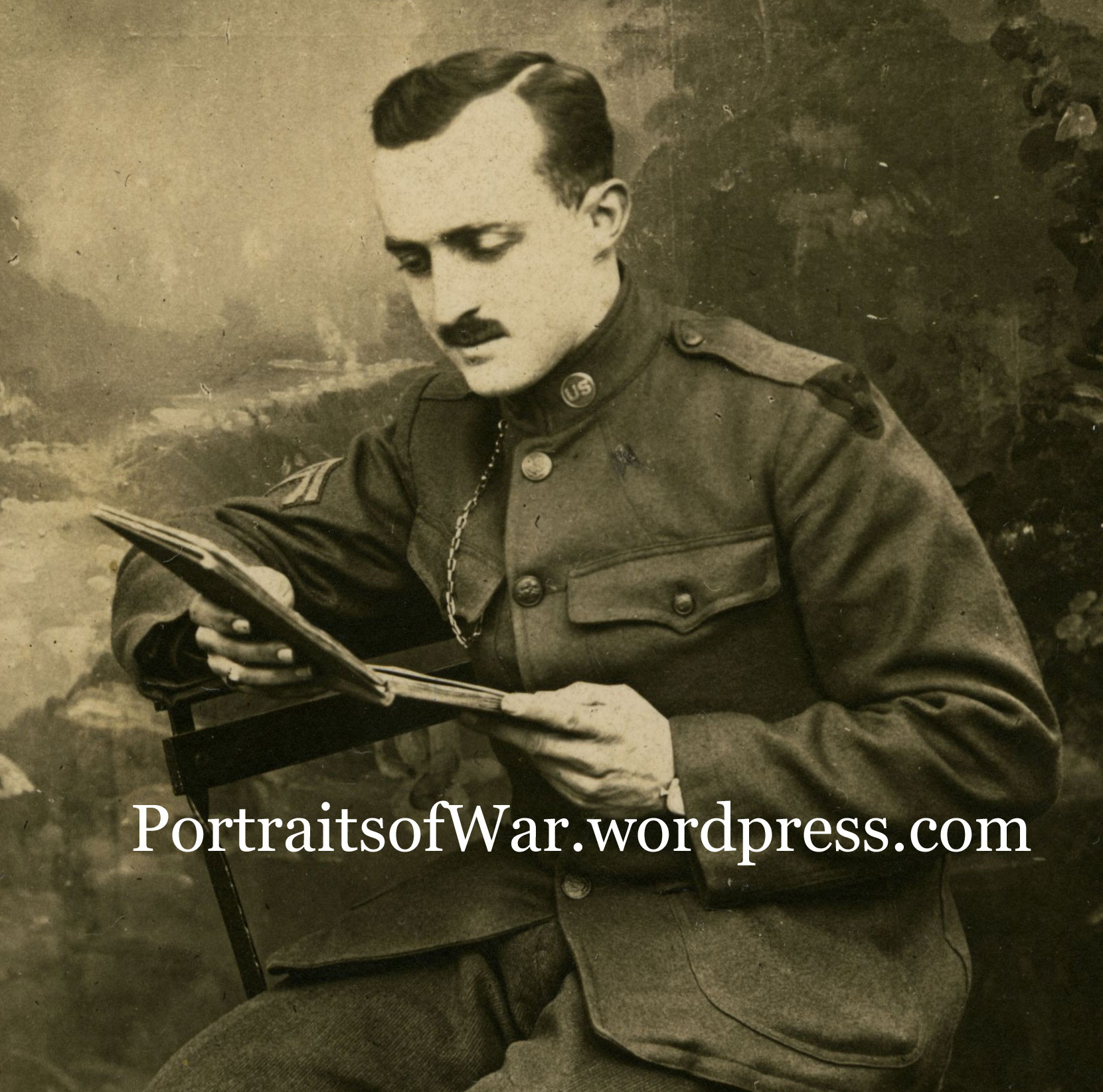
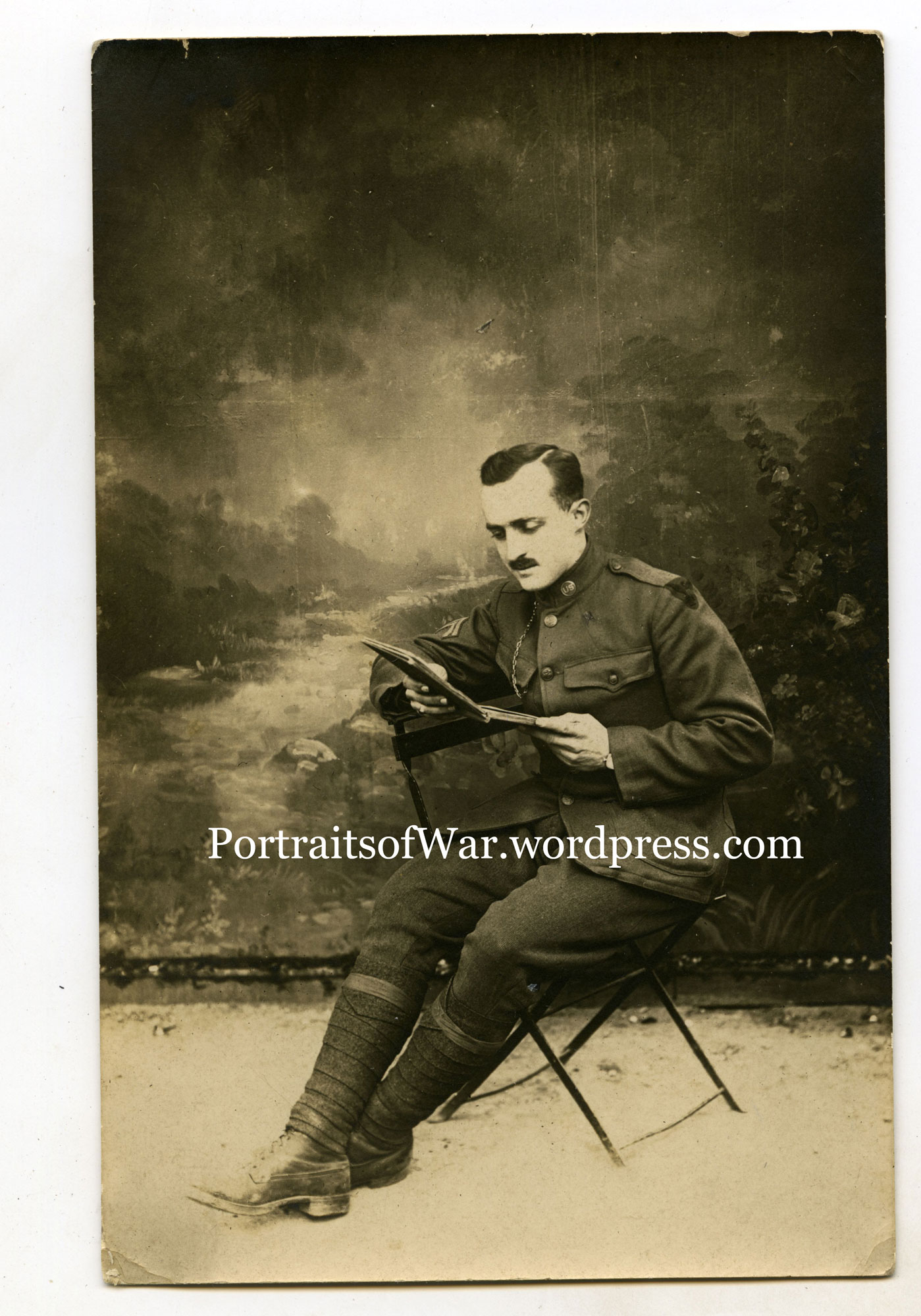
WWI Patched Studio Photo: Corporal Harold Dannhorn, Illinois WWI and WWII Veteran of the 86th Division


Harold Dannhorn Reads a Book in France

Harold Dannhorn Reads a Book in France

Corporal Dannhorn served in the HQ Company of the 343rd Infantry Regiment of the 86th Division while stationed in France before being switched over to the 256th Prisoner of War Escort Company #256 during the Occupation of Germany.  Here he poses in a studio in Menton, France on February 20th, 1919.


Veteran Gravestone Registration
Veteran Gravestone Registration


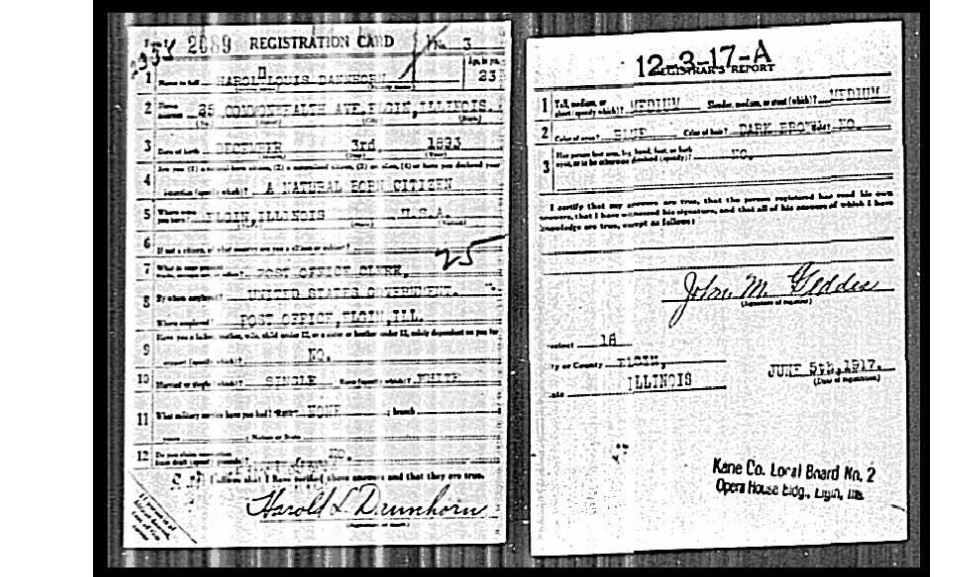
WWI Draft Card

WWI Draft Card


Uncropped RPPC

Uncropped RPPC

86thPOWEscort320


WWI Dog Tag Identified: Ancestry.com Research Discovery – WWI Ohio Veteran Identified


Charles L. Fox

Charles L. Fox

Dog tags and identified material are easily collected by militaria enthusiasts due to the personal connections with names, families and units/divisions. Collecting dog tags is an easy way to feel a connection with the past; many dog tags were actually worn during combat and followed a soldier across the European continent.  In this case I was able to pick up a cheap (less than $5) dog tag on eBay.  A quick search for Charles L. Fox Brought up a smattering of possible leads that crisscrossed the country. Census records and marriages were of no help. I spent over an hour searching through military records for a man named Charles Fox born between 1885 and 1899 (a generally good search range for WWI veterans) and landed a solid hit.  It’s not often that I identify a veteran through his/her serial number, but I was able to ID Charles L. Fox as having been born on December 14th, 1889 in Whitehouse, Ohio.  He served with an ordnance supply unit in France during the war and was honorably discharged on July 26th, 1919. I was lucky to find both the veteran headstone marker card as well as the state veteran roll.  A fun find, and another reason to invest in an ancestry.com account!

Serial Number 2895973

Serial Number 2895973

Charles Fox Headstone Card

Charles Fox Headstone Card

Ohio WWI Veterans Book Entry

Ohio WWI Veterans Book Entry

Forestry Engineers of WWI: The Unsung Heroes of the 20th Engineer Regiment


My interest in the forestry units of WWI started with an inexpensive eBay purchase back in 2012. I was lucky enough to pick up a copy of the 20th Engineer Regiment’s unit history from WWI.  This particular copy had been in a fire at one point in it’s long life and was luckily only singed on the corners.  The burned edges and soiled pages give the book a feeling of age and rugged dignity.  The inside cover in inscribed by an Ed. Peterman of Florence, OR who was assigned to the 6th Battalion of the 20th Engineers.

Ed's Burnt Book

Ed’s Burnt Book

Inscription

Inscription

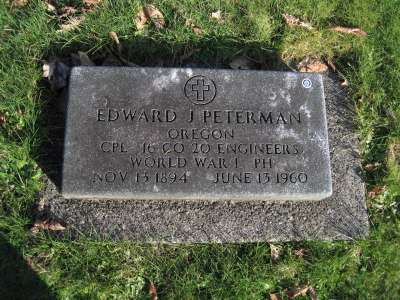
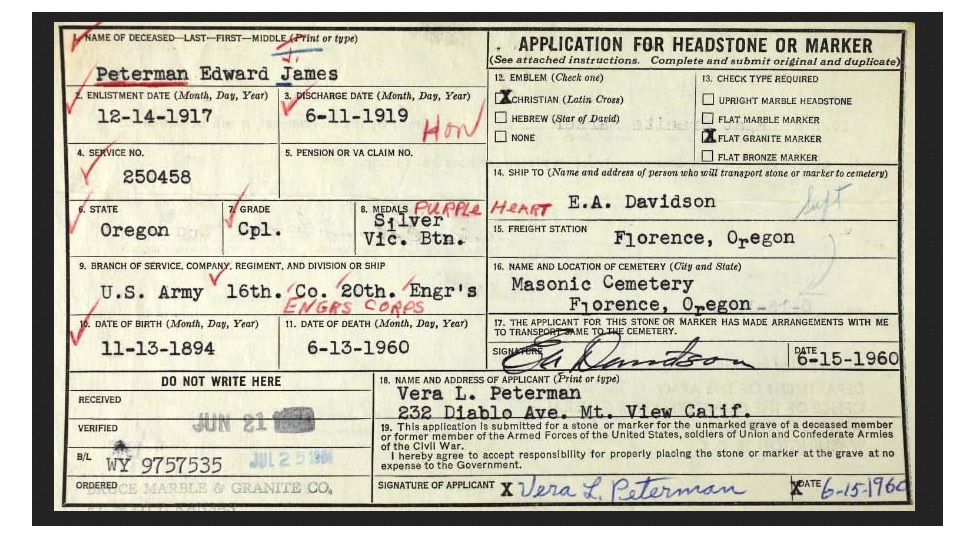
In an incredible stroke of luck I was able to find a 1920s photo of Mr.Peterman on ancestry.com.  Ed was born in Winona, MN on November 13th, 1894 and later moved to Oregon, where he signed up with the forestry engineers.  According to his gravestone, he served with both the 6th Battalion, 20th engineers until 10/1918 and then transferred to the 18th Company in October of 1918.  He is listed as being a corporal and was wounded by enemy action, which is very rare for a forestry engineer.  Ed was also a distinguished member of a very exclusive club. He was on board the S.S. Tuscania when it was torpedoed by a German U-Boat off the coast of Britain on February 5th, 1918. The boat sunk, taking 33 of Ed’s fellow Company F, 6th Battalion, 20th Engineer comrades with her.  The 6th Battalion lost 95 men that day.   Luckily, Ed was one of survivors.


This post is dedicated to the 20th Engineers and my continued interest in the unit. For more info on the 20th Engineers and the idea of forestry units in wartime, please check out The Forest History Society’s website here: http://www.foresthistory.org/research/WWI_ForestryEngineers.htm

Ed Peterman (right)

Ed Peterman (right)

Mr. Peterman's Grave

Mr. Peterman’s Grave

Gravestone Card

Gravestone Card

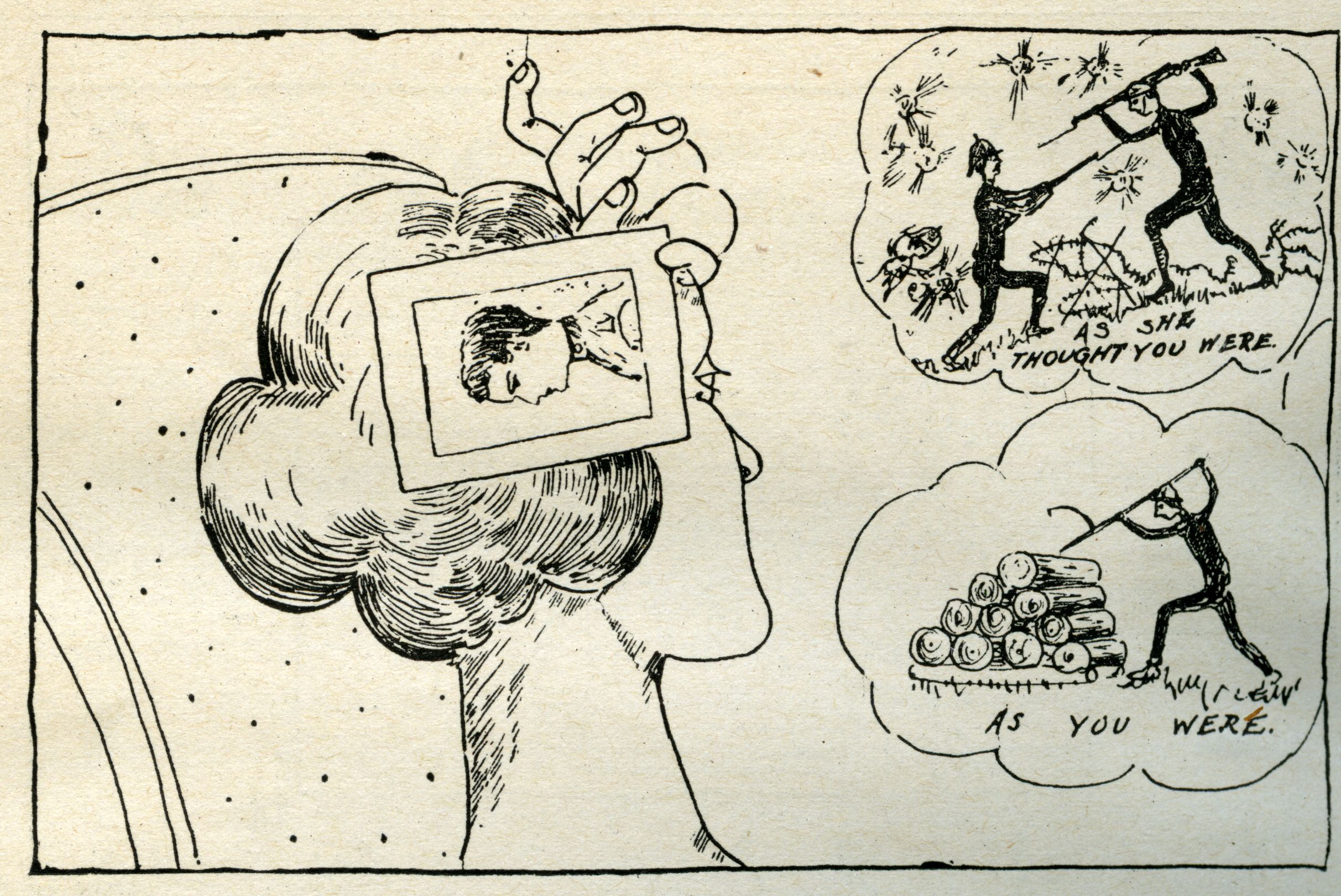
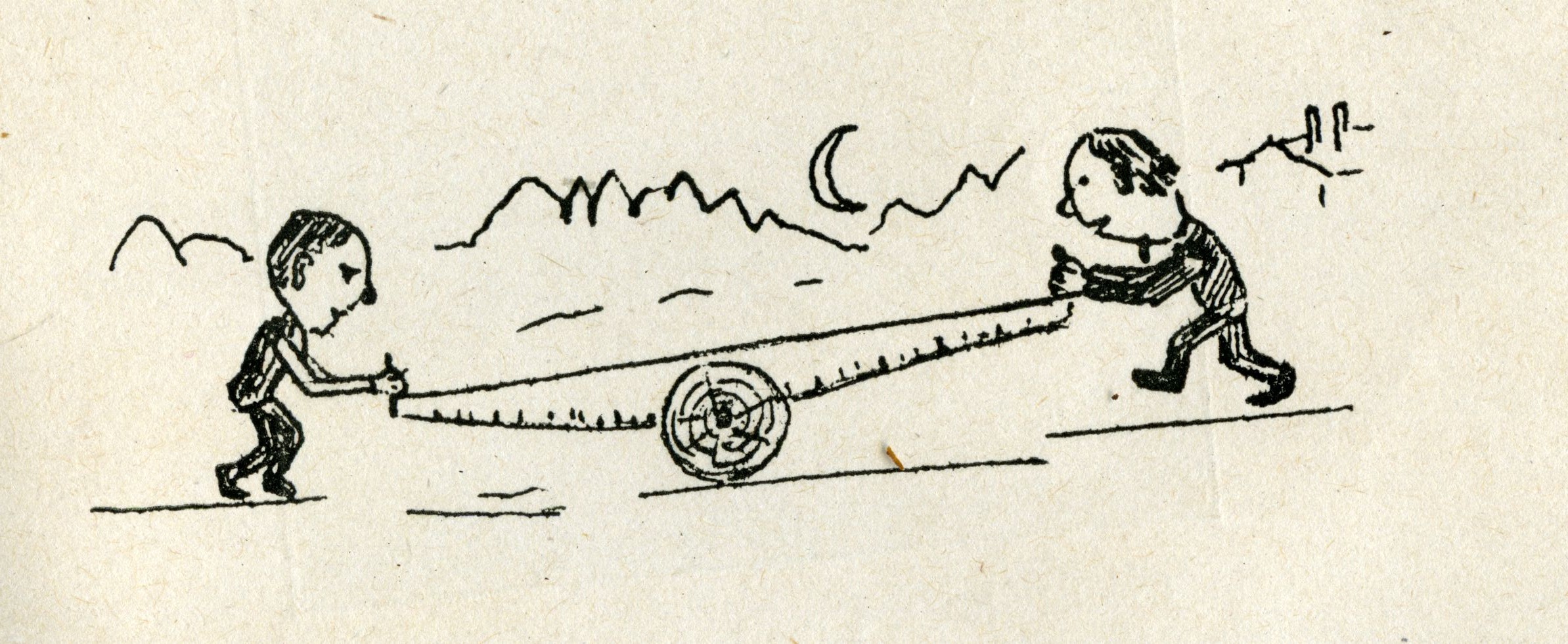
Ed’s book is filled with plenty of wonderful tidbits about the 20th Engineers during WWI as well as a series of funny cartoons and sketches done to help illustrate the book. Here are a few of my favorites:


20thEngineers29620thEngineers295

20thEngineers293


20thEngineers292

Maine in the First World War: The Maine National Guard and the 54th Artillery Regiment Coastal Artillery Corps in WWI


Everyone knows that I love Vermont WWI material, but I also enjoy collecting photos from other New England states as well.  I have a handful from every state but only one from Maine.  Now I have another!

This fantastic interior studio RPPC has a ton of great qualities that drove me to make the purchase.  The crossed flags at center, the helmet and pistol props, the uniform details, and the identification on the reverse all make it a great shot to add to the collection.  This particular group is comprised of men from Portland and Bath.

Battery D of the 54th Artillery Regiment, C.A.C.

Battery D of the 54th Artillery Regiment, C.A.C.

Identified to a Corporal Carl L. Pearson who I believe is positioned directly right of the flag, this shot shows a group of 19 soldiers posed in a French studio.  This may be a record for my collection!   I have a few with 6-8, but none with more than 10.

Pearson was from West Falmouth, Maine and was born in January of 1893.  He enlisted with the National Guard in Portland in March of 1917 and reported for Federal service in June of that year.  He was overseas from March of 1918 to March of 1919.  This photo was taken in either late March, or April or May of 1918.  He was promoted in early June of 1918.  Since this photo shows him as a Corporal at the time of the photo, we know it was taken before his promotion.  Also, his lack of OS chevron and the abundance of spats likely points towards an early photo taken in France.

54th037a

A little info on the 54th CAC

Source: http://freepages.military.rootsweb.ancestry.com/~cacunithistories/54thcac.htm

WORLD WAR I — 1917 – 1919The Coast Artillery Corps a Maine National Guard were mobilized on 25 July, 1917, and all companies, band, field officers, and non-commissioner staff officers reported on 27 July. 14 staff officers reported at Portland Coast Defenses and were assigned to duty in the Coast Defenses. The several companies were re-designated at once. This designation was changed again on 23 August 1917, and on 25 December 1917, nine of the thirteen C.A.C. Maine National Guard companies were made a part of the 54th Artillery, C.A.C., the supply company and Batteries B, D, E, and F, of the new 54th Artillery, C.A.C. 6 inch guns (Motor drawn), were entirely constituted from the nine companies Maine National Guard.

The 54th Artillery, C.A.C., was organized with a Headquarters Company, a supply company, and three battalions of two batteries each. Of the 6 batteries, four were taken from the Maine National Guard and from 25 December 1917, the further World War history of the C.A.C. Maine National Guard is properly that of the 54th Artillery since over 62 percent of its units were entirely Maine National Guard. In addition, only 30 percent of the units of the Maine National Guard were not included in the organization of the 54th Artillery C.A.C.

The 54th Artillery, CAC, (6-Inch Guns, Motor)

This regiment was organized in Portland Harbor Forts on 25 December 1917, five of its units being formed from National Guard units and three from Regular Army units.

The batteries of the 54th Artillery were organized as follows:

Headquarters Company, and Batteries A and C from the Regular Army.

Supply Company, from 20th Company, Lewiston.

Battery B, from 4th Company, Portland, and 7th Company, Biddeford.

Battery D, from 2nd Company, Portland, and 4th Company, Bath.

Battery E, from 3rd Company, Auburn, and 3rd Company, Kennebunk.

Battery F, from 9th Company, Lewiston and 11th Company, Portland.

Headquarters Company, Batteries C, D, E, and F, sailed from Portland, Maine, on the CANADA, 22 March 1918 and arrived Glasgow, Scotland 2 April, Winchester, England 3 April, and LeHarve, France, 6 April 1918.

The Supply Company, Batteries A and B, left Portland 14 March, sailed from Hoboken 16 March, 1918 on BALTIC arrived LeHarve, France, 6 April 1918.

The 54th Artillery C.A.C. was sent to rest camp at Mailly-le-camp (Aube) and on 2 May 1918, transferred to Haussimont (Marne), as replacement regimen to Railway Artillery Reserve and Tractor Artillery Regiments. On 20 September 1918, the 54th Artillery was reorganized into three battalion stations as follows:

1st Battalion, Training Battalion (A and B Battery) Angers (Marne-et-Loire).

2nd Battalion, Tractor replacement(E and F Battery), Haussimont (Marne) Angers (Marne-et-Loire.)

3rd Battalion, Unknown.

After the Armistice the 54th Artillery was assigned to Brest, and part of the Regiment sailed 23 February 1919 on the Vedic arriving in Boston 7 March 1919. It was completely demobilized at Camp Devons by 13 March 1919.

The four companies (1st, 6th, 10th and 12th) that were not formed into the 54th Artillery, C.A.C. were demobilized in January 1919 at Harbor Defenses of Portland however, but few of the original members of the companies remained in them late in 1918. Two large transfers of enlisted men from these batteries were made. The first was made on 23 August 1917, to the 26th Division Artillery and Engineers. One hundred-sixty-nine men were taken from these four companies in the transfer. On May 31 1918, the other large transfer was made to the 72d Artillery, C.A.C. From the 1st Company, 147 men were taken, and from the other three companies large numbers. However, the transfers were made as individuals no units being reformed or discontinued.

In July 1922, the regiment was reorganized and designated as the First Coast Defense Command, C.A.C., Maine National Guard. The regiment was formed into Headquarters, Headquarters Detachment, Band, Medical Detachment and 1st Fort Command.

1st Fort Command

301st Company, Portland, org. 1803 – later Btry A

306th Company, Sanford, org. 1903 – later Btry B

307th Company, Brunswick, org. 1884 – later Btry C

311th Company, Portland, org. 1807 – later Btry D

2nd Fort Command

303d Company, Camden, org. 1920 – later Btry E

304th Company, Thomaston, org. 1921 – later Btry F

305th Company, Rockland, org. 1921 – later Btry G

302d Company, Vinalhaven, org. 1921 – later Btry H

On 17 September 1923, the 1st C.D.C. was re-designated as the 240th Artillery, C.A.C., and individual batteries as shown above. The designation was again changed to 240th Coast Artillery, Harbor Defense, on 16 April 1924.

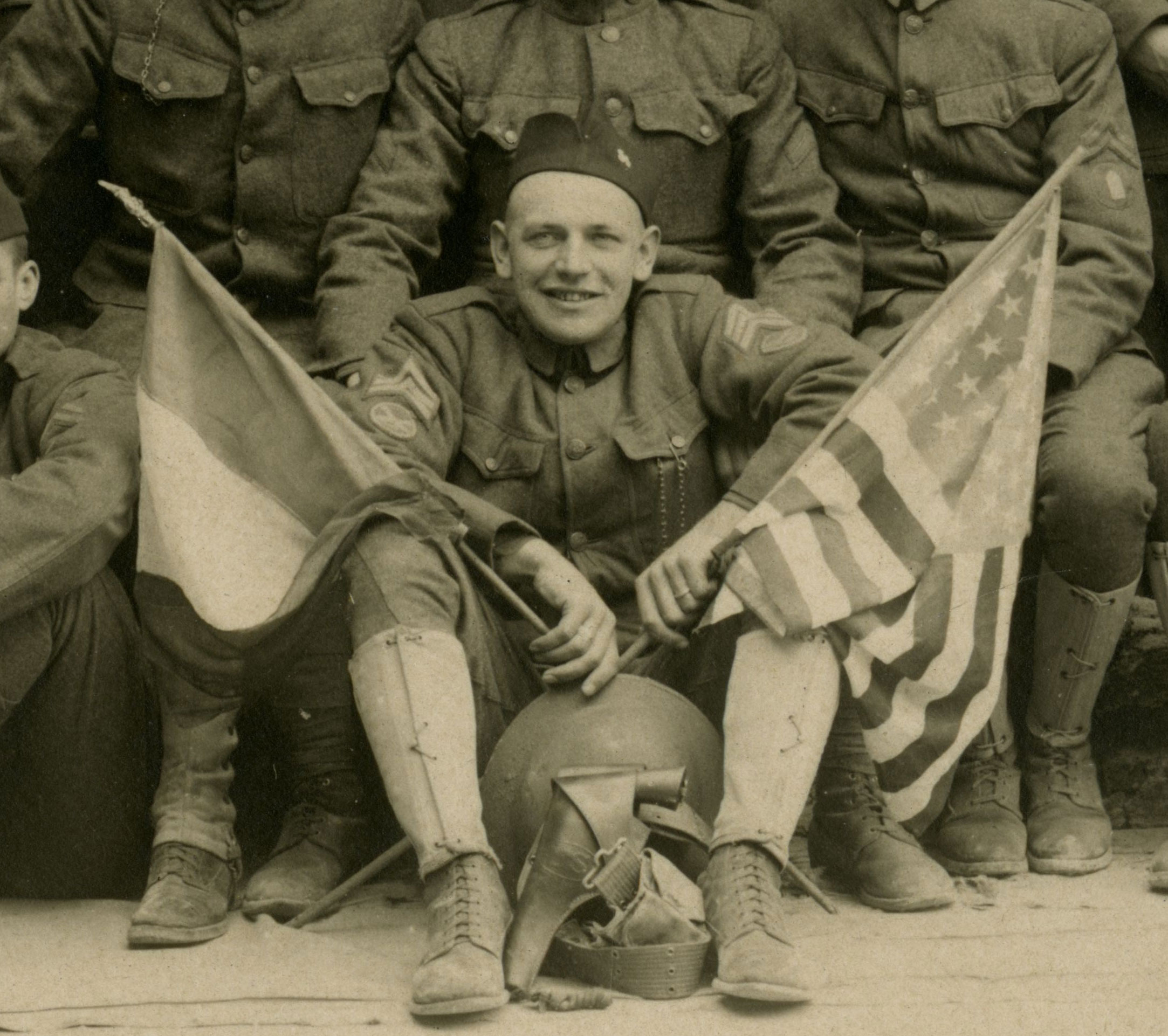
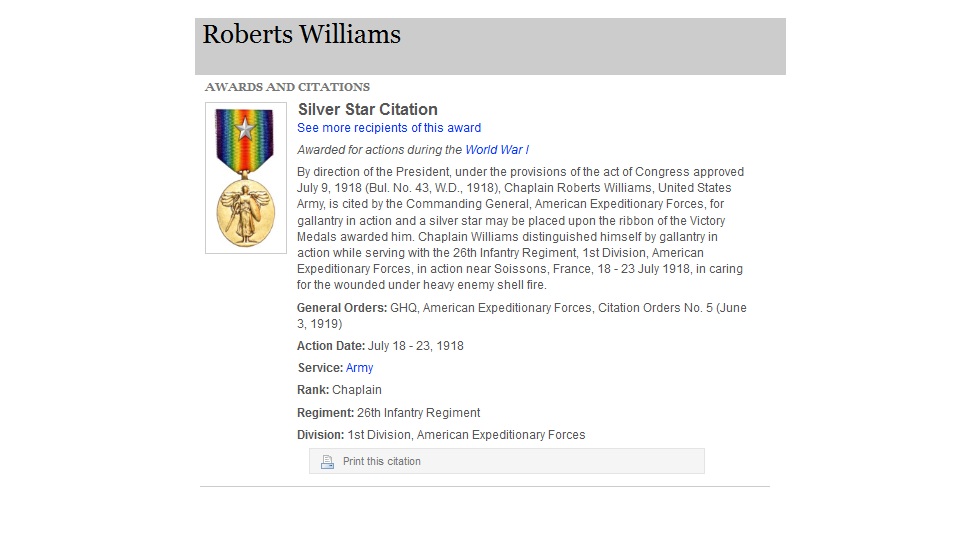
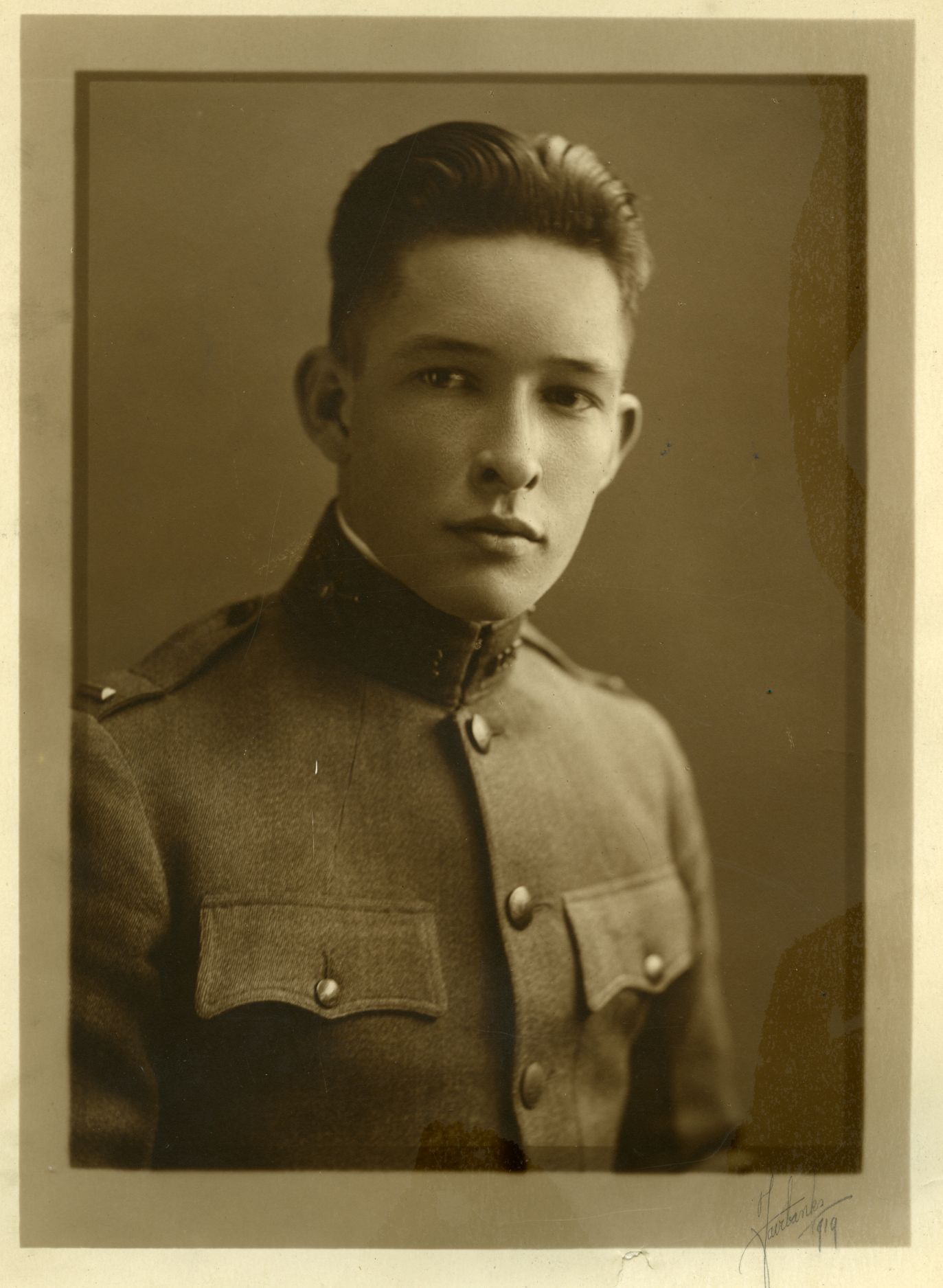
WWI 1st Division Chaplain 26th Infantry Regiment – Chaplain Roberts Williams, Silver Star Recipient


Chaplain Roberts Williams in Germany

Chaplain Roberts Williams in Germany

chaplain151

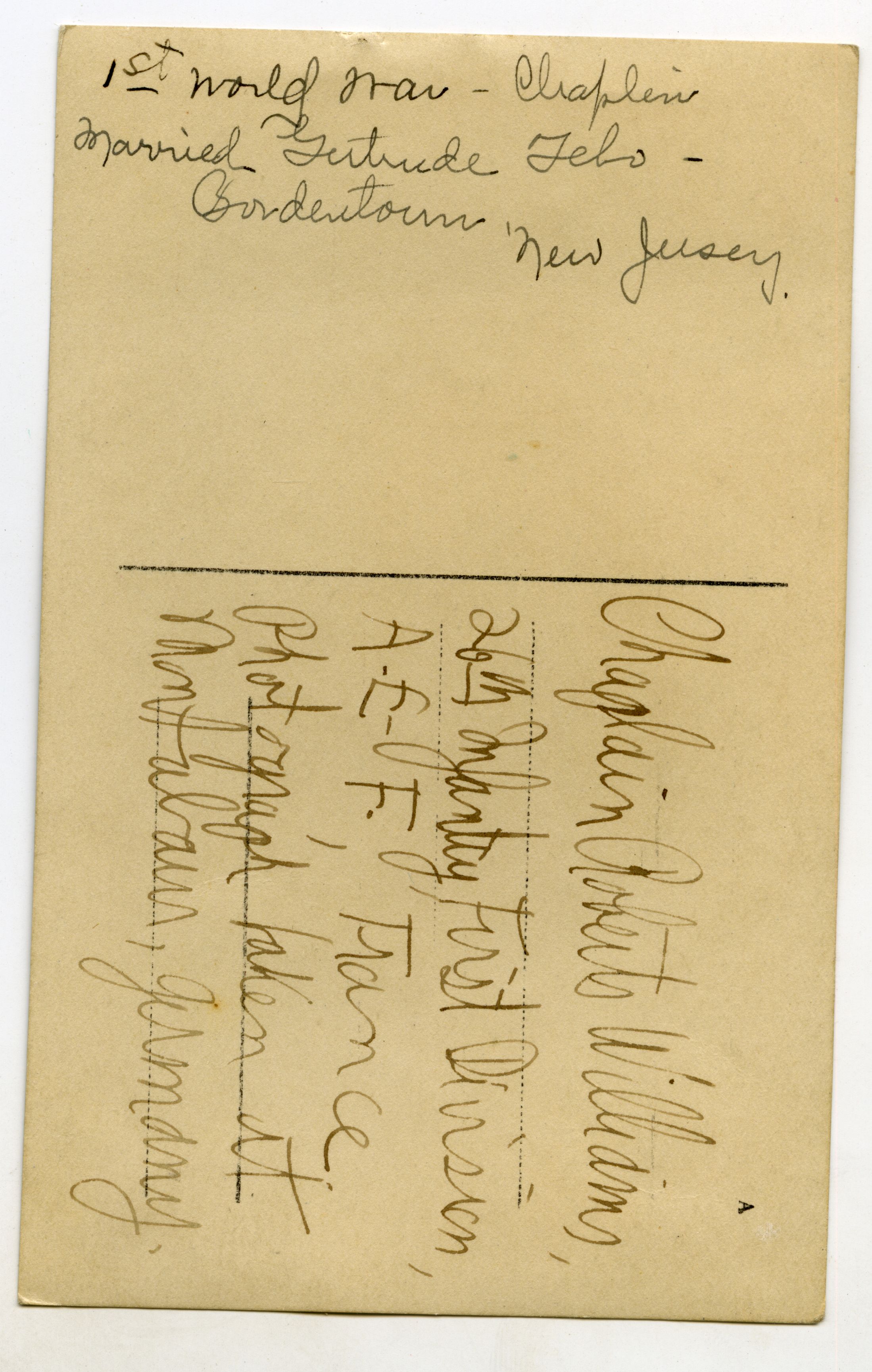
Obverse Side

Another incredible WWI portrait photo has come across my desk via my dedicated searching regime on eBay.  I bought this shot with the knowledge that the sitter was a chaplain.  Chaplain shots are far and few between, and to have an ink identified example is very uncommon. In this case I was able to ply the internet and dig up some wonderful information on our sitter. Chaplain(Protestant) Roberts Williams originally enlisted as a private in the 17th Engineers but was eventually hooked up with the 26th Infantry Regiment of the 1st Division.   He was awarded the Silver Star and was recommended for the Distinguished Service Crossed by his commander, Lt. Col. Theodore Roosevelt, Jr.  He was gassed and the wound chevron can be seen on his right sleeve in the above image.

Here’s a quick transcription of his war service courtesy of a post-war Princeton Alumni newsletter.  Interestingly, he graduated the same year as his commander, Teddy Roosevelt Jr.

“Chaplain Robert Williams, chaplain of the 26th Infantry of the First Division, has returned home, 55 Park Ave., Wilkes-Barre, Pa., to enjoy a brief leave of absence after twenty-one months’ service in France.  Mr. Williams enlisted as a private in the 17th Engineers and served ten months at St. Nazaire.  This regiment was among those composed of railroad men, to be reviewed by King George in London.  During May, 1918, Private Williams was commissioned a chaplain.  Immediately thereafter he was sent to the trenches where with the First Division he spent fifty-four days in the fighting of the Picardy front, culminating in the capture of Cantigny, the first planned American offensive.  Withdrawn for a rest, his unit was unexpectedly sent into the fray again at the pivot of Marchal Foch’s counter attack northeast towards Soissons to cut the Soissons Chateau-Thierry railroad, which supplied the Germans in the Marne Salient.  During this battle Chaplain Williams was gassed and here it was that his commander cited him for bravery and recommended that the DSC be conferred upon him. Chaplain Williams also spent three months in Germany, his unit being engaged in outpost duty twenty miles from the Rhine within Hunland.  He says the Germans are very hard up for raw materials and that soap is worth more than money.”

RobertWilliams

RobertWilliams2

I was also able to find a transcription of a letter Chaplain Williams penned to the family of a soldier killed in action:

“His battalion had gone over the top that morning, across a great
National Highway, the Paris-Soissons Road. The German machine-gun fire
was extremely severe, and we suffered heavily.

“A detail of four soldiers was given me by Major Legge to bury Captain
Richards and Lieutenant Boone. We buried your husband where he fell
and marked the grave with a cross upon which his identification tag was
placed. His personal effects, as I found them, were removed, and later
placed in his bedding-roll. We endeavored to remove his ring, but found it
impossible to do so, so we buried it with him. Records of the location of
the grave were sent to the Adjunct General, American Expeditionary Forces,
and to the Graves Registration Service; so his grave can be readily found after the war is over.

“It was remarkable what a peaceful and spiritual expression was upon
the face of Captain Richards. It did not seem as if he had suffered greatly,
and we could fancy that he seemed well pleased to pay the supreme sacrifice
upon the field of battle.

“I have heard among the enlisted men and officers who knew your
husband many, many remarks as to Captain Richard’s ouiet thoughtfulness.
his constant care for those under his command, his unfailing cheer, and his
courage, and efficiency as a soldier and leader of men. His memory lives
with us, and inspires us to emulate his devoted service to his Country.

“We ask that you will accept our sincere sympathy for the burden of
grief you bear; but we trust that your pride and joy in your husband’s
noble life and glorious death will enable you to bear his loss with courage.

“May God strengthen and help you, and may the promise of our
Savior comfort you with the thought of meeting your husband in a better
world.

Sincerely yours,

Robert Williams,
Chaplain (Protestant), 26th Infantry.”

Williams' Silver Star Citation

Williams’ Silver Star Citation

WWI Photo: Flea Market Find Yields Research Gold – Lt. Robert Slocum of Burlington, VT


Robert H. Slocum in 1919

Robert H. Slocum in 1919

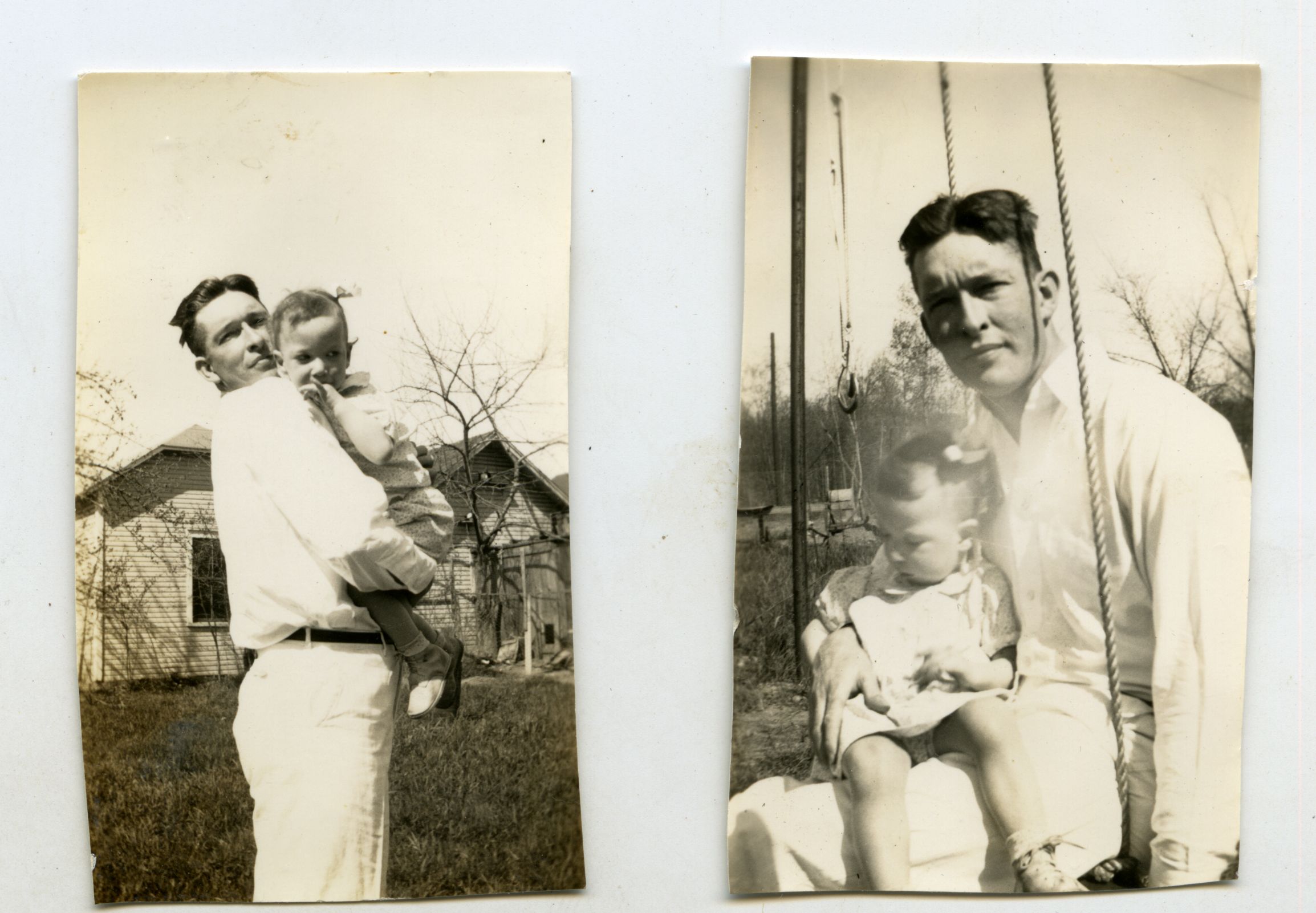
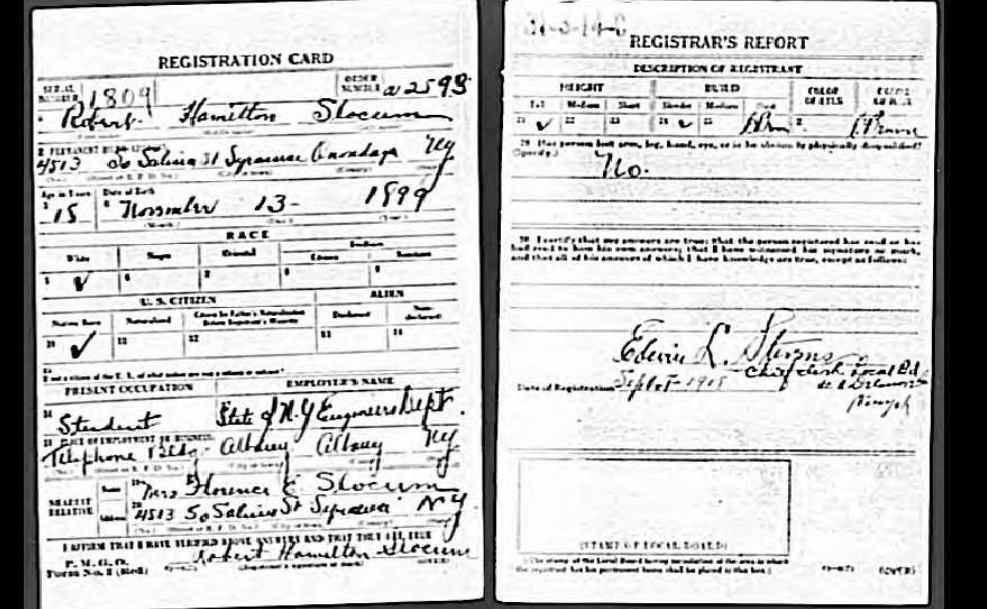
Although Lt. Robert H. Slocum was born and raised in Syracuse, NY, he resided in Burlington(VT) for the majority of his life.  A recent photo discovery by a friend of mine at a local flea market has provided a wealth of research potential.  The photo clearly depicts a young Lieutenant sporting a Coastal Artillery Corps insignia on his collar.  The name Robert H. Slocum was inked on the reverse of the image.  I wasn’t able to find a wartime record of Lt. Slocum in the Vermont files, but was able to find his draft card from Syracuse.  He was a student at the time at Syracuse University and was originally from the area.

Draft Card

Draft Card

Slocum was likely a Lieutenant with the 59th Coastal Artillery, a Syracuse/Upstate New York based unit.  This is only speculation, but the likelyhood is strong.

slocumcert

Lt. Slocum's grave in Syracuse

Lt. Slocum’s grave in Syracuse

Mr. Slocum lived for nearly six decades at his home on 21 Alfred Street in the South End of Burlington.  I was able to purchase his photo albums from the 1930s which include many interesting images of the Burlington lakefront and Southend area.  His son recently passed and his estate was broken up, ending up at a local flea market.  Luckily I was able to keep most of the early albums together.

Post-WWI Residence of Lt. Slocum – 21 Alfred Street, Burlington, VT

Lt. Slocum posed with his son, Robert H. Slocum III

Lt. Slocum posed with daughter in May of 1935

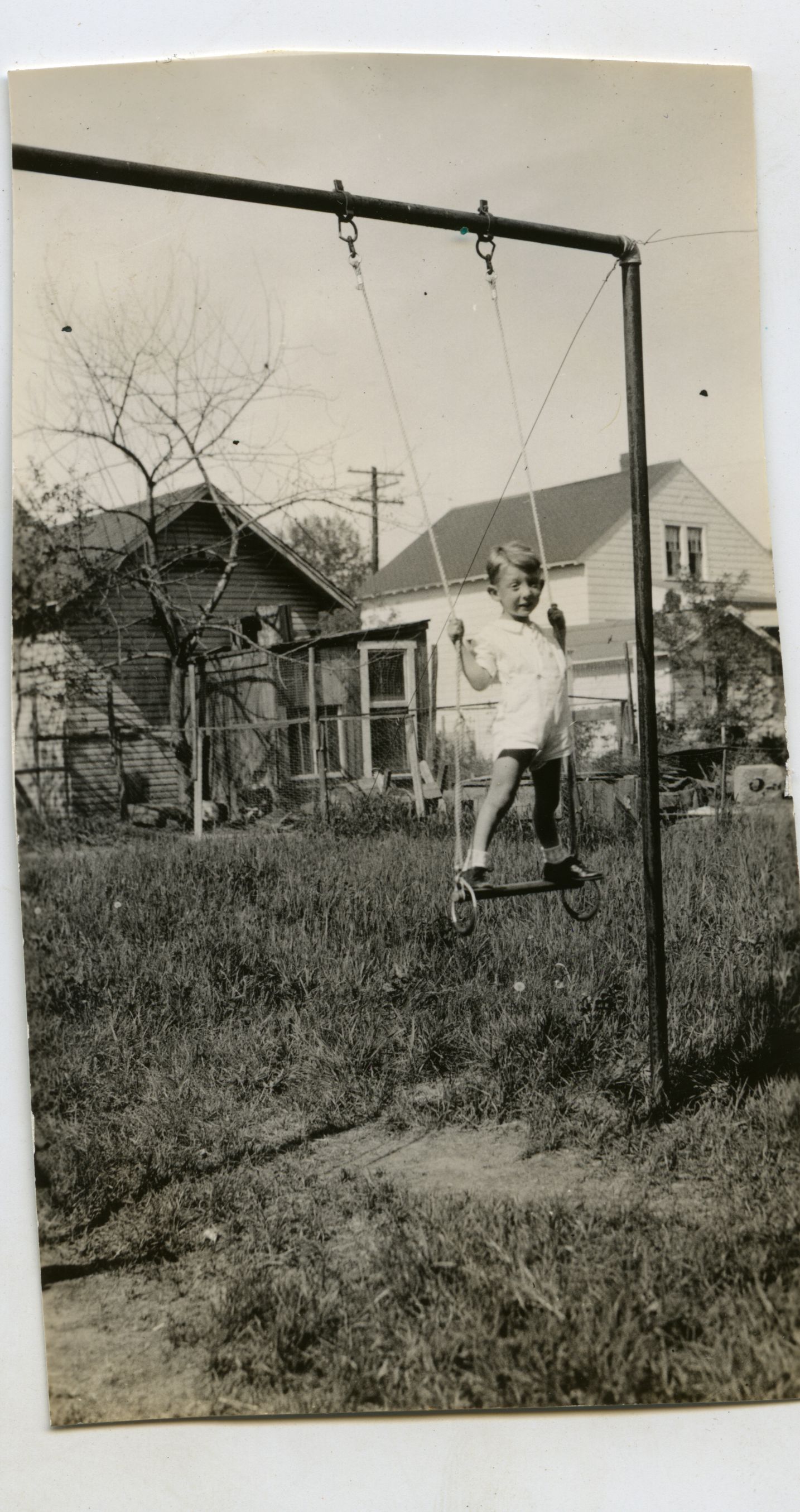
Little Bobby playing in a local Burlington playground

Little Bobby playing in a local Burlington playground (note the chicken coop)

Cruising the mean streets of Burlington in 1936

Cruising the mean streets of Burlington in 1936

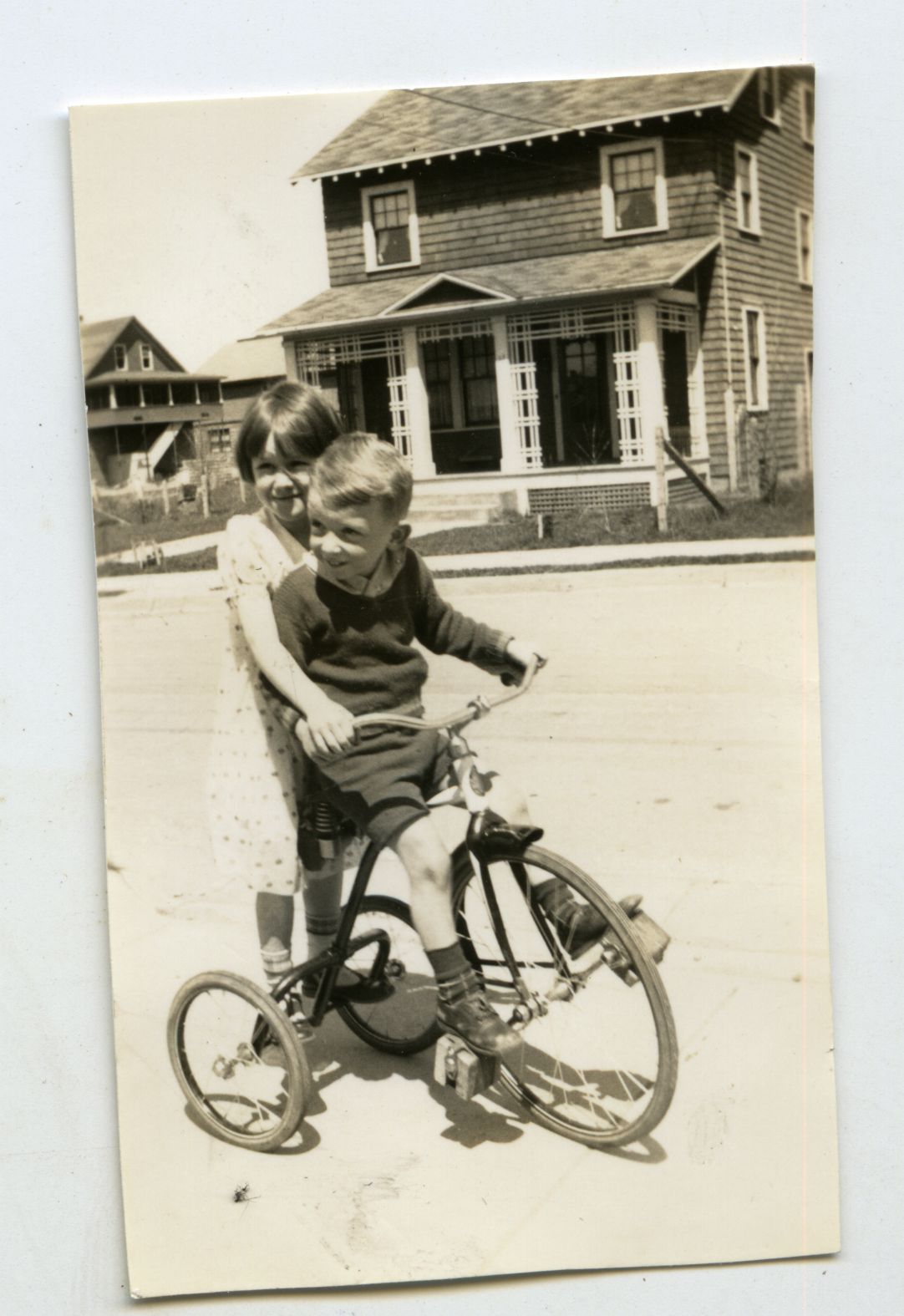
Little Bobby on a tricycle (note the decorative porch treatment in the background)

Little Bobby on a tricycle (note the decorative porch treatment in the background)

Background house in 2012

Background house in 2012

Lt. Slocum and family at the beach.  Possibly North Beach

Lt. Slocum and family at the beach. Possibly North Beach

It would seem that Lt. Slocum lived a long and happy life.  I found a 2012 obituary for his son which makes reference to Robert Slocum Jr, who passed away in 1993.

A 2012 obituary for Robert Slocum III

ROBERT H. SLOCUM III – BURLINGTON – On Nov. 15, 2012, Robert H. Slocum III died peacefully in his cherished home, following a brief illness. Born on May 31, 1931, he was the son of Robert H. Slocum II and Frances Slocum. Bob graduated from Burlington High School in the Class of 1949 and the Middlebury College, Class of 1954. For many years he was an elementary school teacher in Deep River, Conn. Music was an important part of his life and he hoped to instill a love of music in his students. For many years he would write and produce a musical for his students to perform. Upon his retirement, he returned to Burlington to live with his father. Both men enjoyed the company of their cat named Scooter who seemed to know his job was to make them happy. When Scooter died, Bob adopted a stray cat and most recently one from the humane society. Bob looked forward to his high school class reunions each summer and, of course, the Red Sox games. He is survived by his sister, Cynthia Slocum of Pittsford; and his cousins, Joan and Phil Hoff and their children, Susan Haynes, Dagny Hoff, Andrea MacNaughton and Gretchen Hoff. The family is most grateful to Philomena Gicheru for her friendship and caring assistance provided to Bob these past thirteen years. There will be a gathering of remembrance on Nov. 26, 2012, at 10:30 am at 35 Hillcrest Rd., Burlington.

WWI 26th Division Photo Identified – Leo Hayden of Natick, MA, Company L, 101st Infantry, 26th “Yankee Division”


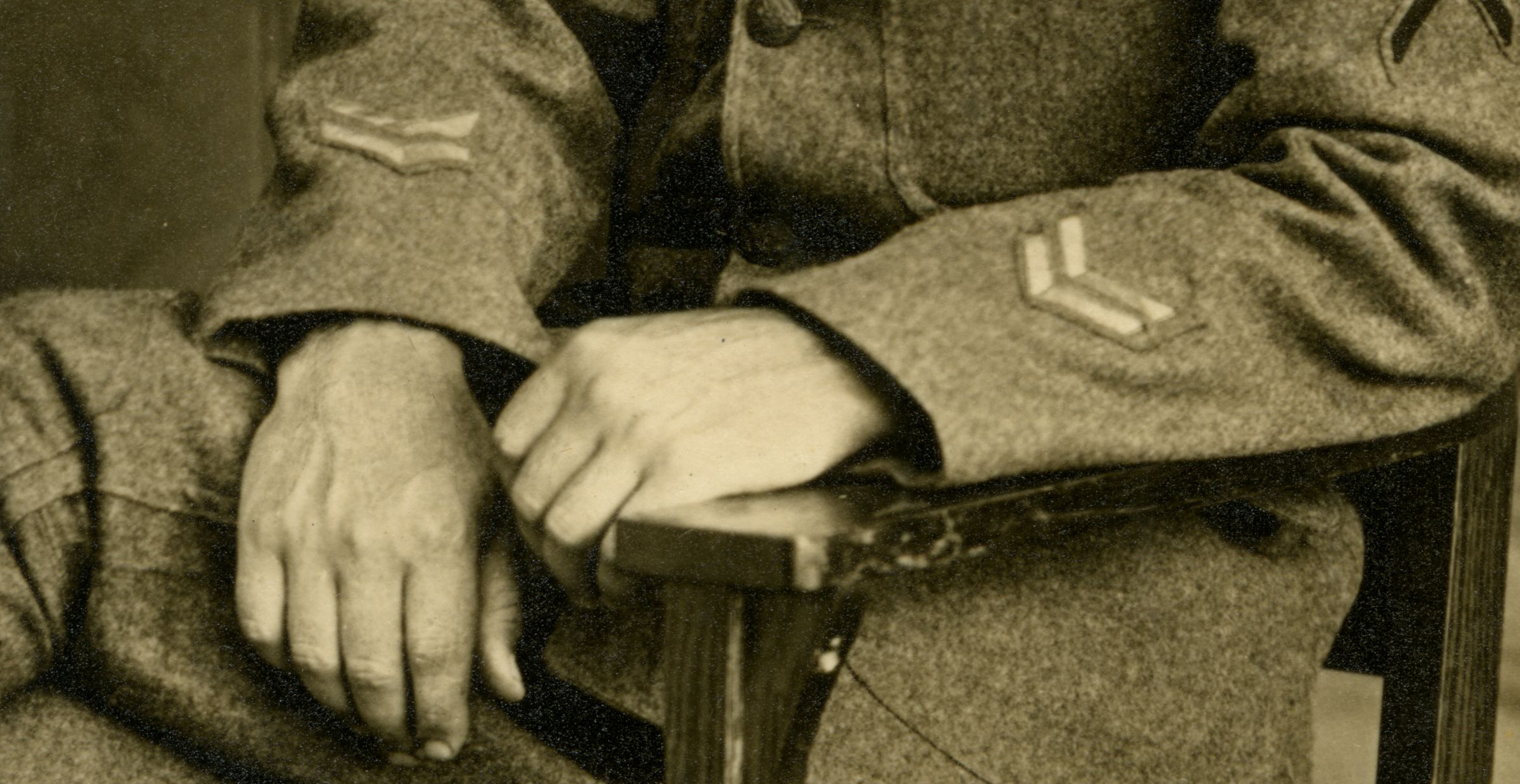
Anyone who follows this blog knows that I’m from New England and have a particular interest in the history of the 26th Division given it’s designation as the New England “Yankee” Division.  I’ve had this photo for a few years and recently decided to reexamine it to hopefully find some extra info on the veteran.  Low and behold I was able to discover a treasure trove of info on his service during WWI.  A particularly fine pose showing the two wound chevrons and the OS stripes, this shot is one of my favorites from the 26th Division.
Leo Hayden was a member of Company L of the 101st Infantry Regiment of the 26th Division.  He is buried in St. Patrick’s Cemetery in Natick, MA.

One mysterious point about the image is the fact that he is wearing a 104th Infantry Regiment collar disc but is listed as being a 1st Sgt. with the 101st Infantry.  Is it possible that he was moved to the 104th prior to shipping stateside?

Leo Posed in Studio

Leo Posed in Studio


Veteran Grave Card

Veteran Grave Card

Leo064b


leoback065

WWI Photo Research – Dedication Provides 26th Division, 103rd Regiment DSC Recipient’s Identity – Maine Veteran


Sometimes a little research and hard work pay off.  In this case, I received a WWI 26th Division portrait in the mail from a friend in Pennsylvania.  I knew it was a good image given the subject matter and the fact that the soldier was likely from the Lewiston area given the photographers embossed stamp.  Not an easy task.  I counted a dozen or so guys in a thirty mile radius of Lewiston that were possible contenders.  Lots of Maine men were members of the 26th during the war, and it’s not always easy to associate a location given a photographers stamp.

Mellen F. Tuttle

Mellen F. Tuttle

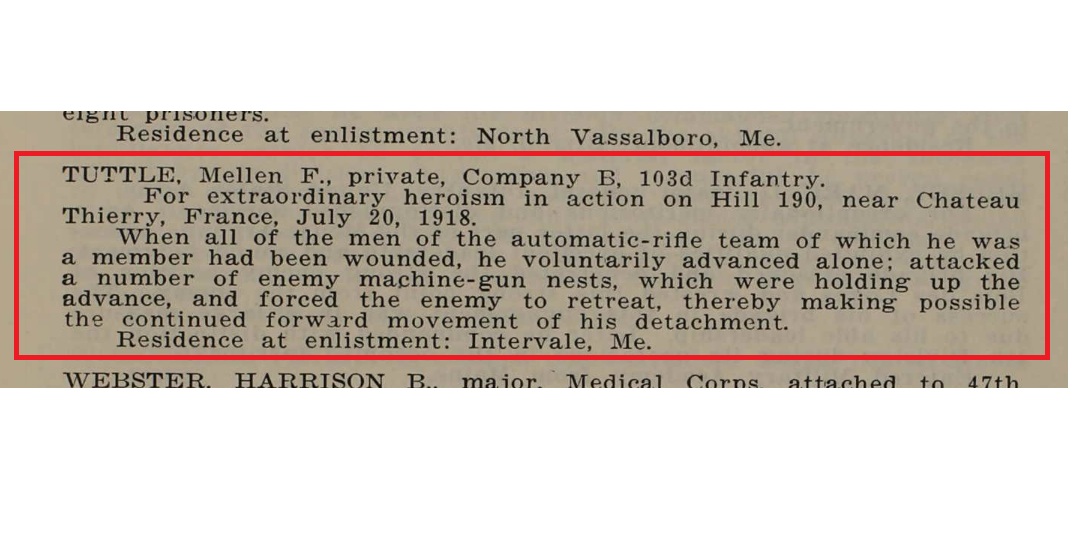
With a little forensic work I was able to figure out the identity of our mysterious hero.  Since I’ve handled thousands of vintage photos and negatives, I know that photographers often penciled info on the back of the print, or etched names/numbers on the bottom of the original negative.  The numbers would cross reference to a name and address to ship the photo.  In this case I was lucky to find a name etched on the original negative.  Obviously it was in reverse on the positive image, so I flipped it 180 degrees with photoshop and tweaked the contrast and brightness.  Bingo, a name appeared.  Tuttle.  A quick search found a Mellen F. Tuttle from New Gloucester, ME who served as a private in Company B of the 103rd Infantry Regiment.

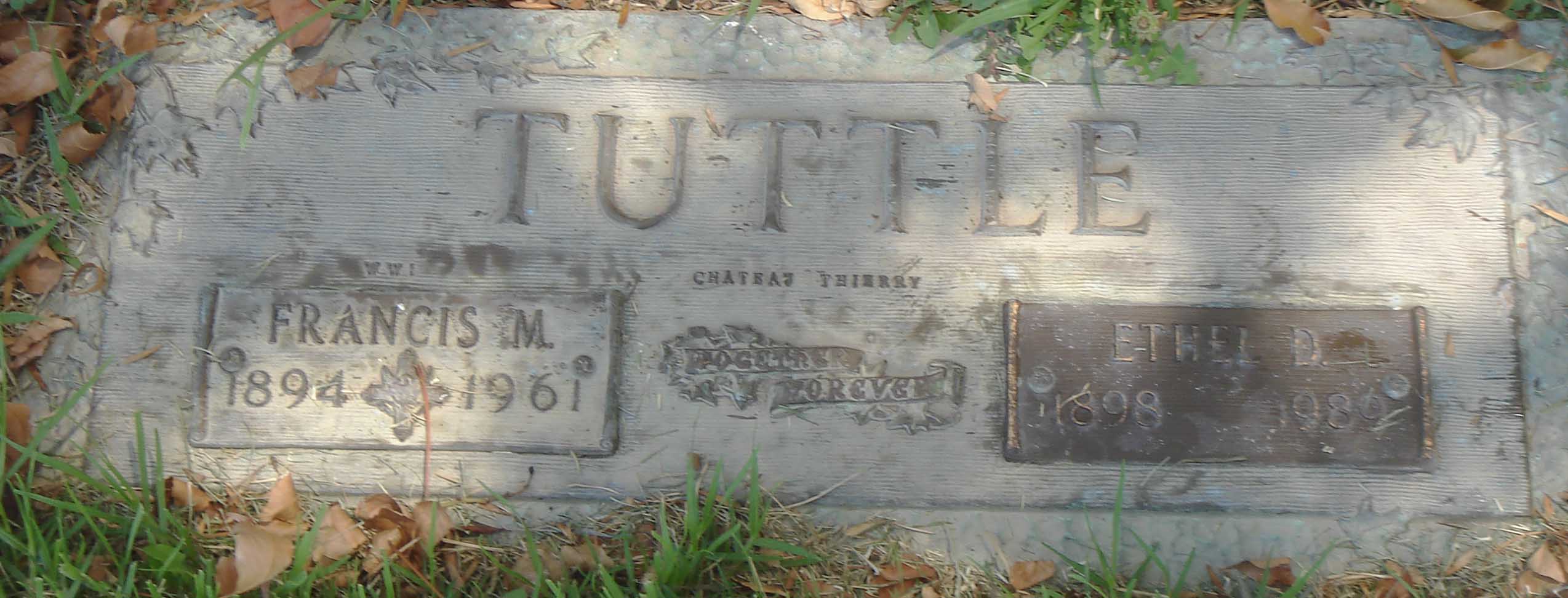
Further research shows that his actual name was Francis Mellen Tuttle, but he went by Mellen F. Tuttle during the war.  After an hour of searching in vain for the death records of Mellen F. Tuttle, I decided to search for birth records for the Tuttle family in Maine.  I came across a Francis M. Tuttle Jr. and clicked on the birth record.  His father was Francis Mellen Tuttle!  Everything fell into place after that. Please see the end of the article for a photo of his grave showing his name as Francis M. Tuttle.  Somehow he made it all the way to Los Angeles and passed away in 1961!

His feat of bravery occured on July 20th, 1918 on Hill 190 near Rochet Woods, Chateau Thierry.  Mellen was with an automatic rifle team of Co. B of the 103rd when all of his fellow soldiers wounded.  He single-handedly advanced on an enemy MG nest and forced them to retreat.  His detachment was able to advance due to his bravery.

Reversed photographer etching

Reversed photographer etching

Lewiston, ME Photographers Stamp

Hammond Brothers
Lewiston, ME Photographers Stamp


DSC102small

Maine soldier registry entry

Maine soldier registry entry

Name: Mellen F. Tuttle
Serial Number: 67163
Birth Place: Freeport, Maine
Age: 22 6/12 yrs.
Residence: New Gloucester
Comment: Enl: NG Augusta, May 30/17. Pvt 1st cl Jan. 2/18; Cpl July 18/19. Org: Co B 2 Inf Me NG (Co B 103 Inf) to Mar. 6/19; 291 Co MPC to disch. Eng: St Mihiel; Defensive Sector. Awarded French Croix de Guerre; awarded DSC. Overseas: Sept. 26/17 to Aug. 3/19. Hon disch on demob: Aug. 8, 1919.

72151927_131116584196

Note the Chateau Thierry reference on the grave marker!

WWI Photo – The Incredible Story of Roger Paget, Mascot of the 306th Field Artillery, 77th Division


The cherubic face of the little French boy in a recent photo acquisition belies the true sadness he felt when his father (Henri Paget) was killed in action while serving with the French 8th Cuirassiers in April of 1918.  The boy can clearly be seen wearing a US cap with Lt. insignia as well as a pair of decorated French Croix de Guerre medals.  A quick bit of internet research turned up an interesting story related to Roger Paget and his role as unit mascot for the 306th Field Artillery.

Roger Paget and his Mother

Roger Paget and his Mother

From the History of the 306th Field Artillery :

Roger Paget, the Son of the Regiment

On Sunday morning, June 9th, at a memorable
assembly at Camp de Souge, four-year-old
Roger Paget of Bordeaux was adopted as the
protege of the regiment. His father, Lieutenant Henri
Paget of the 8th Cuirassiers a poilu, was killed in action
on April 29, 1917, at a point north of the Marne near
where most of our own men were killed in action.
Lieutenant Paget twice received the Croix de
Guerre and was named for the Medal of the Legion of
Honor. We have been proud to have the son of
such a brave soldier and a representative of the
children of France, become a part of the regiment.

Madame Paget, Roger’s mother, and a detail from
the American Red Cross were present at the cere-
mony, which was opened by the regimental band
and the singing of America. The chaplain referred
to the story of Lieutenant Paget and introduced
Roger and his mother. Colonel Miller then accepted
Roger in behalf of the regiment while the handsome
boy himself stood on the table by his side.

Sergeant Levi then spoke briefly in French trans-
lating what had been said and expressing the senti-
ment of the occasion. The climax of the program
was reached when Rudolfi stood by the side of the
lad and sang Sweetest Little Feller, Mighty Lak’ a Rose
and the Marseillaise.

Captain Van Keuren of the Red Cross then con-
gratulated the regiment, after which the band played
Sousa’s 306th Field Artillery march. Most of the
men came to the platform to meet Roger and his
mother personally.

Bordeaux, Paris, Boston, New York, Philadelphia
papers have written up the event and referred in
glowing terms to Roger and his regiment. His pic-
ture was also published and sent to hundreds of
friends of the regiment who in turn have showered
letters and souvenirs on him. The 306th Field
Artillery Association at a mass meeting in Brooklyn,
unanimously adopted Roger and sent him a bountiful
box for Christmas, 1918.

Many of our men on leave visited the Pagets both
in Bordeaux and Lyon to which city they moved in
February, 1919. “9 Rue Valdeck-Bousseau, Brot-
teaux Lyon,” is the address. They will, in turn,
surely visit New York occasionally.

The Farmers Loan and Trust Company of Bor-
deaux is handling the fund we have established for
Roger’s education.

As we left France we of the 306th Field Artillery
had no more happy reminiscence than the thought of
the boy who has become a symbol to us of the mean-
ing of our fight for the children of France, our own
boys and girls, and the future generations of the whole
world. We are proud that we helped to finish the
work for which his father gave his life, and that some
of our comrades shared his noble sacrifice.

That thought will always bind Roger closely to the
306th Field Artillery.

RogPaget070a

RogPaget071