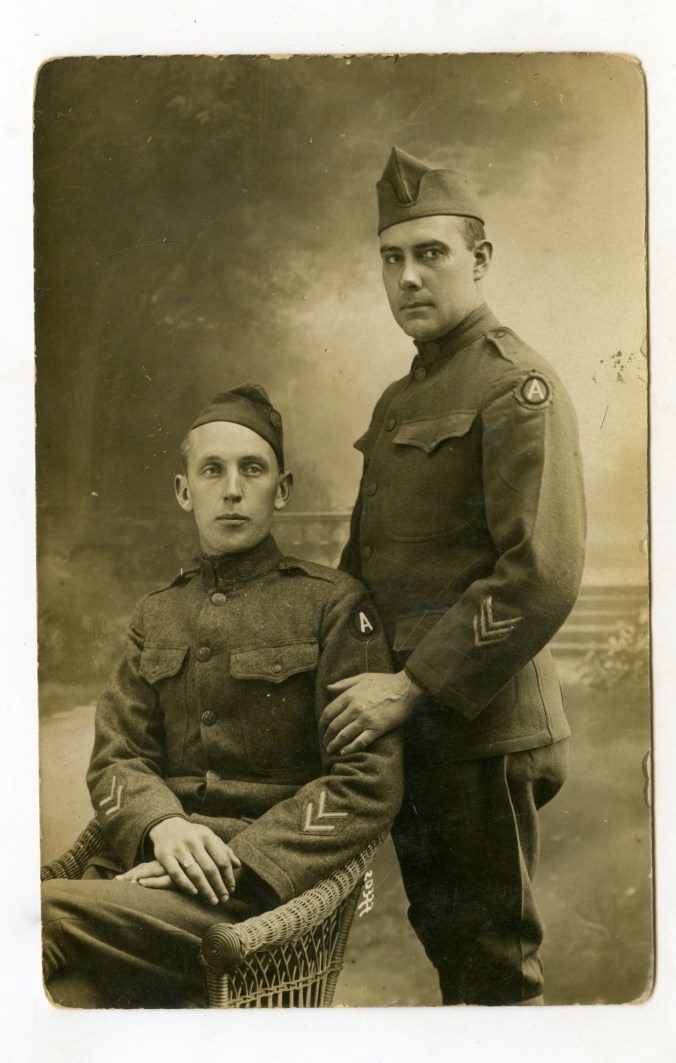
After a long hiatus I’ve decided to come out of obscurity and begin posting to the blog again! A recent Facebook purchase from a WWI collecting colleague has proved to be a classic PortraitsofWar photo for interpretation. The photo depicts two US soldiers posed in a German studio during the postwar occupation of Germany in 1919. The soldier at right is shown with three overseas (OS) stripes on his left cuff denoting 1 1/2 years of overseas service as well as a French-style cap. Both soldiers are wearing 3rd Army patches on their left shoulders, which would have been worn during the postwar occupation period. The seated doughboy is sporting two wound stripes as well as two OS stripes and a Wisconsin collar disc on his cap. The reverse of the photo lists one of the soldiers in the photo as Robert B. Alexander of 914 Adams Street, Portage, WI. Given that the seated soldier is wearing a Wisconsin disc on his cap, it is presumable that the identification on the reverse is leaning towards the sitter at left.
Pvt. Robert B. Alexander (seated), Co. F 16th Infantry Regiment, 1st Infantry Division
Reverse Identification of Pvt. Alexander
Some quick research revealed that that Pvt. Alexander was born on April 20th, 1892 in the town of Portage, Wisconsin to Robert M. and Mary Alexander. He lived much of his teen years at 913 and 914 Adams Street in Portage and was listed as working as a switchman with the Chicago, Milwaukee, St. Paul and Pacific Railroad as of 1917 before he enlisted in August of that year.
Railroad Switchman, Ca. 1940
914 Adams Street
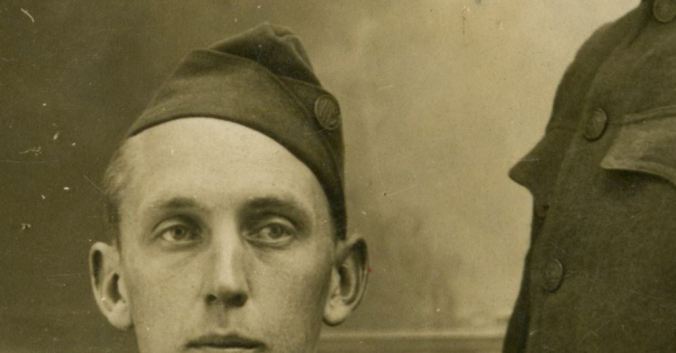
Attempts to find a photograph of Robert Alexander using traditional research methods failed, but I was able to track down a yearbook photo of Robert’s youngest son. Claire Alexander sat for a yearbook photo in 1944; a side-by-side comparison leaves no doubt in my mind that Claire is a progeny of the seated doughboy.
Pvt. Alexander
Claire L. Alexander in 1944
Wartime Service
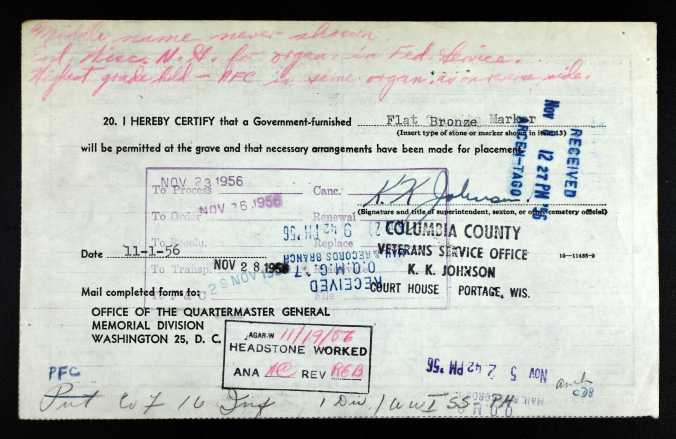
Research into Alexander’s wartime service has revealed that Robert was involved in heavy combat in September of 1918 only months before the end of the war on November 11th, 1918. His accolades are laid out in an unlikely document:
Veteran Headstone Document
Reverse of Above Document
This document confirms that Robert served with Company F of the 16th Infantry Regiment, 1st Division. He was wounded at least once and received the Purple Heart (After 1932) and also the Silver Star. Details about his wounding and SS are still pending… stay tuned.
Private Alexander’s 1956 headstone was made by the Acme Bronze Company of Maple Park, IL and was delivered to the family on November 6th, 1956 following Robert’s death on October 23rd, 1956.
Mr. Alexander’s Headstone (Courtesy of Findagrave.com)
Research into living members of the Alexander family have proven fruitful…stay tuned for details related to the reunion of this photo with a great-granddaughter!
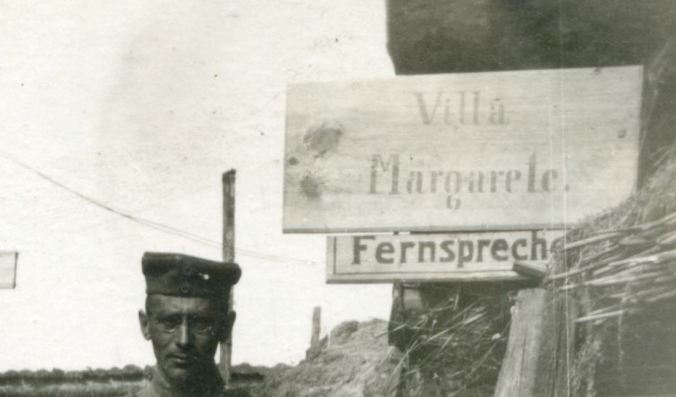
The main focus of this blog is to highlight individual photographs from WWI and WWII veterans whose photos have made their way to the secondary market; eBay and flea markets are a good way to find these photographs, and the typical image comes with little-to-no context. Today’s photograph shows a typical German trench in the spring of 1917 with a pair of handmade signs.
I collect WWI German trench signs and shots like this are a good way to identify the style and construction techniques of a period trench-made sign.
Villa Margarete – Fernsprechen (Telephone)
Translation Below
Thanks to a Reddit user I was able to translate the writing on the reverse side of the postcard:
In the dwelling trench by the phone dugout.
NCO Biernacki, me, NCO Schwabacher, ?? Puppchen of the artillery observers.
May 1917.
The trench signs that are shown in the image are as follows: Villa Margarete and Fernsprechen (Telephone)
One of my closely held collecting secrets is that I love WWII and WWI photographs of soldiers holding or interacting with their dogs. My recently dearly departed furry companion Violet originally led me to start collecting shots of soldiers with their canine friends nearly eight years ago. Without her I would’ve never thought twice to bid on a dog photograph.
Violet at the Hilton Portland, ME
I dedicate this post to her. In this particular case, I bid on and won (eBay) a photograph of a US soldier holding a young puppy during wartime in France. Typically, shots of US soldiers holding dogs or other mascots were taken (at least that I’ve found) in the post-war era following the 11/11/18 Armistice. This studio photograph was taken on September 10th, 1918 and shows Thomas (Tom) Gray Jr. posing in a French studio with a puppy cradled in his left arm while sporting a custom knit necktie.
Thomas Gray Jr. and a cute puppy!
The photo was taken in September of 1918 and the writing on the back (see below) notes that Thomas had been overseas for ten months at this point. Additionally, he addresses the postcard photo to his mother, Mrs. Thomas Gray of 329 North Pearl Street, Bridgeton, NJ. After my normal run of extensive research it appears that his father and brothers worked, at some point, for a local glass factory as glass and bottle blowers. This company was likely the Cumberland Glass Works which was located not far from their duplex home. Additionally, the factory could’ve been the More-Jones factory that appears in a series of Lewis Hine photographs depicting child labor. In fact, Thomas appears in the New Jersey State Census of 1905 and is listed a “Snapper Boy” in the occupation column. So, at age 14 Thomas was working in a glass factory… Could he be one of the young boys captured by Hine?
Lewis Hine Photograph Taken in Bridgeton, NJ Ca. 1909
Reverse side of the postcard
As far as I can tell, Thomas served with Company B, 501st Engineers and shipped out in November of 1917 and served until mid 1919 when he eventually went home to New Jersey with no mention of a companion. I wish I could learn more about the dog in his hand and about his service in this obscure unit, but I can only do so much research before moving on. I hope that a relative finds this post at some point and can help fill in the gaps. Crazier things have happened on this blog.
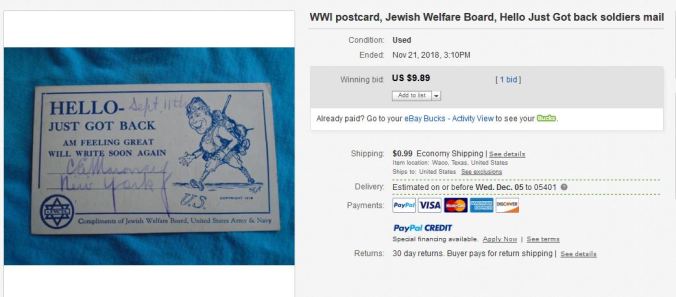
One of my favorite pieces of WWI ephemera to research is the pre-printed postcard that was handed out to soldiers intended to be sent to loved ones from the decks/bunks of the multitude of transport ships that brought doughboys back from Europe in the years following the war. In tonight’s case, I purchased this card on eBay without any prior research. The date of 9/11 caught me as particularly interesting given the 2001 connotation, so I made a quick bid and won the postcard. My research process can be followed below:
Step 1: Purchase the card
Only $9.89+0.99 shipping!
Step 2: Receive the card in the mail
Front side of the postcard
Back side of the postcard
Step 3: What the heck is going on?
The first actual step in the interpretation and research of a WWI postcard is to figure out when it was made, when it was sent and who sent it. This one should be pretty easy.
Copyright date of 1919
Most WWI postcards don’t usually come with a Copyright date and/or an artist’s signature. This one comes with both. I don’t have time to delve into the identity of the artist, but I can say that the card was copyrighted in 1919.
So, the written portion is from September 11th, 1919 at the very earliest.
September 11th
Step 4: Who the heck sent this thing?
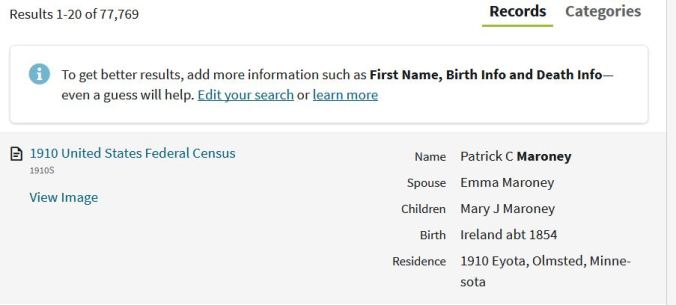
Whenever I attempt to identify a soldier-sent postcard, I always try to research the recipient first. Normally, we have the name of well established member of a community as well as a normal mailing address and town name intended as the recipient. Assuming most postcards are sent to a mother or father, it doesn’t take much effort to track down the 1910 census record for that family using Ancestry.com. This is exactly what I did in this case. The first Maroney to appear in the Eyota, MN 1910 census was a Patrick C. Maroney… Bingo.
1910 Census record
From here I researched the children of Patrick and Emma Maroney (the card says “Dear Ma”) and found that they had a son named Charles E. Maroney who was born on September 22nd, 1895 and passed away on September 5th, 1934.
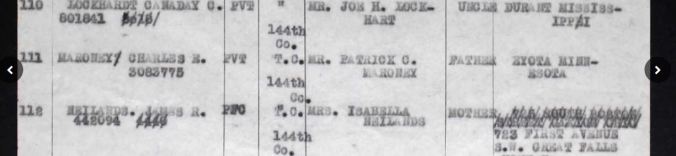
Charles’ September 11th, 1919 return to the USA
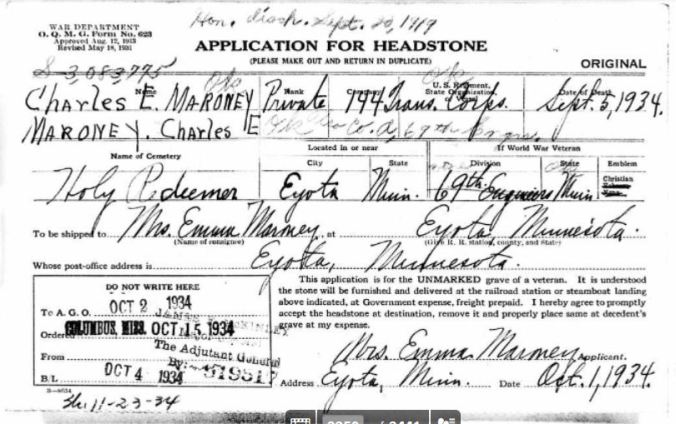
Charles signed in aboard the U.S.S. Montpelier after his time in France on August 28th, 1919 and landed back in the US on September 11th. It was at this time that he was most likely given the above card to fill out and ship to his parents back in Minnesota. His wartime record puts him with an engineering unit that was focused on railway work during the war and this tombstone identifies him as a Private with the 69th Engineers . This doesn’t exactly jive with his US Headstone Application or the US Army Transport records seen above. According to records, his grave should’ve listed him as being with the 144th Transportation Corps. Please note that his mother was also the recipient of his body after he passed away in 1934. 😦
I apologize for not posting more frequently, but I’ve been focusing on preparing presentations and talks for local historical societies here in my home state of Vermont. Tonight’s post is the first that focuses around a recently-purchased portrait photo. A dealer from the Philadelphia area has been selling off what appears to be an entire collection of WWI portraits from a Charleroi, Pennsylvania photo studio. Of the several dozen portraits sold by this seller in the past two months, I’ve been lucky enough to pick up two photos. The best of the two is the image photograph presented below:
At first glance, this photograph clearly presents evidence of damage in the hands of an ink-wielding enemy. Who knows how this was damaged, but it didn’t seem to impact the final value of the photograph, which sold for a healthy $68.00. The particularly interesting elements of the photograph are presented here:
English Style Cap and Engineer Collar Disc
French Croix de Guerre medal w/ silver star and 1st Army patch variant
After a bit of research into the sitter above, it quickly became clear that he was an engineer with the 1st Gas and Flame Regiment, previously the 30th Engineer Regiment. As a Private with the regiment, he would’ve been involved in the maintenance and mobilization of Livens gas projectors during the last several months of the war.
Born on April 21st of 1897 in Naples Italy, Louis emigrated to the United States on May 26th, 1910 in hopes of linking up with family members in Pennsylvania. He gained his citizenship when he was naturalized in May of 1928 due to his service for the U.S. during the war.
The men of the 1st Gas and Flame would be charged with maintaining, resupplying and moving the Liven’s projectors during the tail end of the war. What did this involve?
Levin’s Projector schematic
Louis is sporting a wound chevron in the portrait photo above – he was gassed on November 1st, 1918 only ten days before the Armistice of November 11th.
Note wound chevron (stripe) on right hand sleeve
It’s unclear through the records on how he received his gas wounds, but it’s highly probable that his gassing took place during the Meuse-Argonne Offensive, when the 1st Gas Regiment was actively moving forward during the “third-phase” of the offensive. The attack in which Louis was wounded began at 5:30 on the morning of the 1st of November. Sadly, the gas mortars that were projected that morning were done so under less-than-ideal conditions and it appears that shifting wind blew toxic gas back towards the 1st Gas Regiment. All those who were gassed during this event were brought off the line to Sommerance, France where they were treated. All of this information can be found in the unit history of the 1st Gas Regiment, which is hyperlinked here.
Louis’ War Record (Note gassing date)
What Louis achieved after the war is unknown to me, but I hope that he lived a full and rewarding life. His war record and portrait will remain a part of my website, but I hope to pass the photo along to a relative one day.
I really enjoy meeting with elderly citizens who can remember local events of historic significance and always make an effort to ask them where they were during critical national or international turning points in history. But in the case of the man below, I’m not sure I could top his story. At the time this TV show was filmed in 1956, Mr. Samuel J. Seymour (1860-1856) had already lived through the Civil War, the financial depressions of the late 1800s, the Spanish American War, the invention of the automobile, the invention of flight, WWI (he was in his 50s when that happened), the jazz era, the Great Depression, WWII, the nuclear era, the beginning Korean War and McCarthyism. This guy had seen it all!
Although the contestants figured out his story pretty quickly, the story of his traveling to the show and his determination to tell his story are remarkable. Encounters with people who witnessed history like this are examples of what drives me to continue to take the time to chat with WWII veterans when I encounter them. With so few left, it’s important to just… talk to people. Mr. Seymour passed away only 63 days after his filming of the episode shown below. Enjoy.
eBay can be a fun way to research WWI soldiers in a way that wouldn’t have been possible ten years ago. With the emerging databases of WWI soldier roster information and the ever-expanding capacity of Ancestry.com for genealogical data, WWI veterans are becoming easier and easier to research. In this case, I purchased a photo of two US officers posing in a French studio in March of 1919. The signature on the front and the inscription on the back give roughly enough information to make a positive identification. The standing officer is 2nd Lt. William H. Barry of Langley, Washington. He served with F. Co of the 28th Infantry Regiment, 1st Division during the American involvement in WWI. He was awarded the Distinguished Service Cross (DSC) for his bravery and extraordinary heroism in the breakthrough of the Hindenburg Line. A large percentage of his company became casualties and he assumed command after the CO was wounded. He reorganized the company and completed their objective under the rain of German machine fun fire.
To think, this photograph was obtained on an internet auction site for less than the price of a tank of gasoline and had been sitting in a pile of postcards for years before it was posted. I’m glad to provide this information – I hope a family member can find this post and learn a little about their ancestor!
Lt. William H. Barry (Standing)
Lt. Barry’s March 1919 Signature
BARRY, WILLIAM H. Second Lieutenant, U.S. Army
28th Infantry Regiment, 1st Division, A.E.F.
Date of Action: October 5, 1918 Citation:
The Distinguished Service Cross is presented to William H. Barry, Second Lieutenant, U.S. Army, for extraordinary heroism in action near Exermont, France, October 5, 1918. Assuming command of his company after his company commander and a major portion of the company became casualties, Second Lieutenant Barry reorganized his company and personally led it forward in the attack, successfully attaining his objective in the face of intense machine-gun and artillery fire. He constantly exposed himself to enemy fire in order to encourage and insure the protection of his men. General Orders No. 103, W.D., 1919
Home Town: Langley, WA
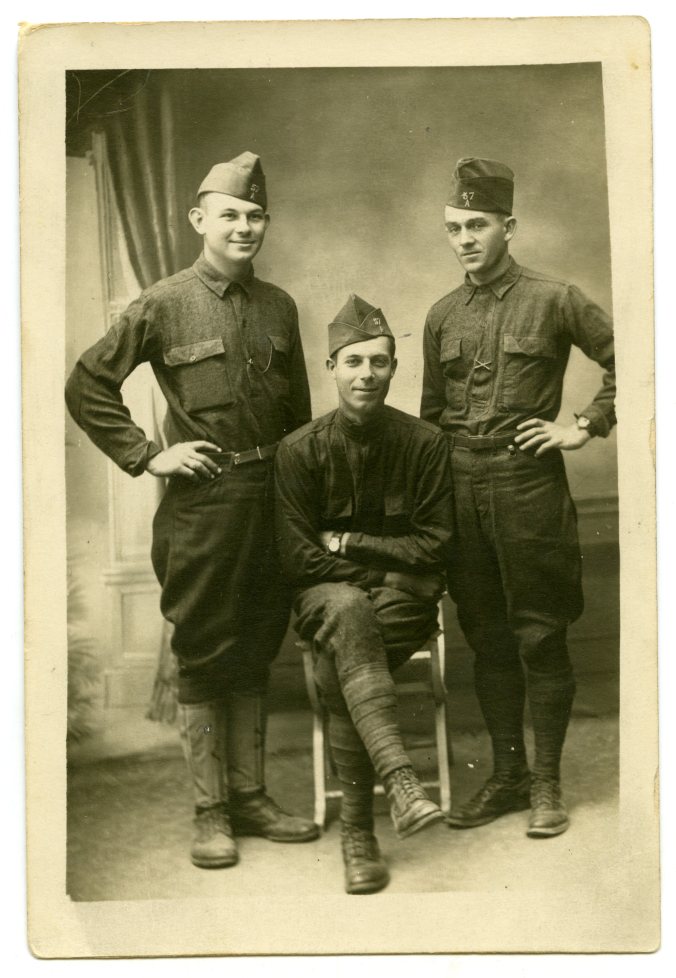
A recent purchase just arrived in my mailbox and I’ve been researching the details in hopes of identifying something interesting to write about. Well, this photo has a few good details that will hopefully help future collectors with identifying their WWI photographs!
57th Field Artillery Brigade
The first details that pop out are the accessories that these doughboys decided to wear into the studio. These small nuances of WWI photos really help researchers, reenactors and collectors understand that uniform and insignia regulations in 1918 were at time blurry, and interesting one-off uniform presentations did exist. In this case we see a handful of elements that are not typically found in photos of the period.
Leg Covering
One soldier (far left) is wearing M1910 canvas gaiters, while the other two are sporting wool puttees.
Cap Insignia
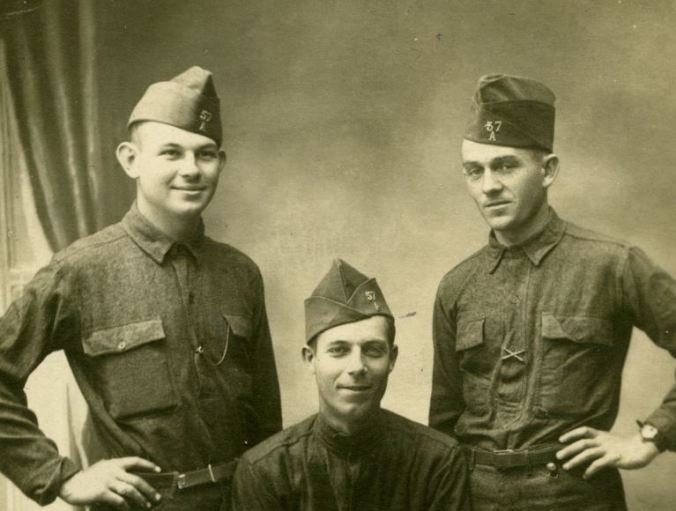
All three doughboys are wearing French lettering on their caps denoting their specific unit affiliation. In this case, they are wearing the number 57 with a letter A. In any other scenario I would assume that this would place them within the 57th Infantry Regiment, Company A, or possibly 57th Pioneer Regiment, Company A. In this case, the next detail down drives the unit ID home. These letters and numbers are often seen on French collars.
French Cap Numbering
Officer’s Field Artillery Insignia
The soldier at the far right is wearing an officer collar insignia for a Field Artillery Regiment. An odd thing on an enlisted man, and especially odd at the center of the chest. Who knows?
Watches
All three are wearing watches! The first on the left has a pocket watch with fob and chain clipped to his shirt. The other two are wearing “trench watches” with kitchener straps. Interestingly, they both do not currently have crystal guards AKA “shrapnel guards” on the watch face to protect from wartime damage. These were popular amongst watch-wearing soldiers of WWI.
Field Artillery Ring
One detail that I always look for is the presence of a ring on WWI soldiers. The soldier at the far left is wearing a sterling silver Field Artillery ring – another clue that supports the 57th Field Artillery ID for this photo.
Oval Sterling Field Artillery Ring
In summary, the tiny details of a photo can actually make an unidentified WWI photo incredibly interesting and fun to dissect. These little nuances of wartime accessory can, at time make the difference between a $5.00 photo and a $50.00 photo to the discerning collector. It also helps expand knowledge into unknown areas of military material culture collecting. Pull out your magnifying glass and look through your collection!
The nature of the prolonged war that was WWI and the stalemate and boredom of life in the trenches left a lot of soldiers with time on their hands. Additionally, some soldiers were raised hunting deer, boar and other game in the forests of Europe and North America in the early 1900s. A rifle in the hands of these men could become a weapon that could do immense damage from one concealed trench to another. Today’s post will highlight a United States Marine who was shot through both eyes by a German sniper in October of 1918. But first, please check out this video on snipers during WWI by The Great War, a youtube channel with daily videos about events during WWI.
PFC. Andrew H. Knebel, 18th Company/5th Marine Regiment
PFC Andrew H. Knebel, 18th Co./5th Marines – Lost both eyes during WWI
The story behind the above photograph of PFC Andrew H. Knebel of the United States Marine Corps is one that pulled at the heartstrings of the American populace during the war. I was lucky enough to acquire the photo from a fellow collector/friend of mine who I had helped aid in the identification several years previous. A faintly scribbled name on the reverse of the image took several weeks to properly identify, but we were eventually able to track down the story of the blinded Marine in the photo. Taken in a Paris studio in 1918, PFC Knebel is posed with a French nurse who has taken the time to wheel him (note the wet wheelchair marks) into the studio from a nearby hospital.
Details of Knebel’s wartime epic were tracked down in a Detroit Free Press article from 1919:
ANDREW KNEBEL (1897-1968), of the United States Marine Corps, had been fighting the Germans for ten months before a sniper’s bullet, on October 4, 1918, entered bis left eye, passed through the right. The last, thing he saw on earth was light. The last sight he saw on earth was a clump of wet trees glistening in the morning sunshine in the Champagne sector. But it took a better marksman than the German sniper in one or those trees to pond a shaft through Andrew’s heart. Dan Cupid did that job, which has counteracted the calamity to such an extent that the twenty-two-year-old marine is ready to tell anyone that the law of compensation Is the surest thing in the world. Andrew Knebel, on July 11, married his nurse. Miss Anna D. Kelley who took care of him at the Baltimore Institute for the Blind. “If I hadn’t been blinded I wouldn’t have met Anna” he philosophized. “And I wouldn’t give her up for the sight, of my eyes not on your life. She’s the dearest, gentlest girl in the world. I guess one reason why I always liked her was because the treated me as if I wasn’t blind at all. She never pitied me. She’s a wonderful gal.
“Are you there, mother, old dear?”
He called, peering with empty eye sockets towards the kitchen, from which came a delectable aroma of baking apple pie. “May I have a light, mother?” “Destiny is a funny old bird,” the bride remarked, while Andrew’s rosy-cheeked mother was lighting his cigarette. “I didn’t want to go to the Baltimore institute to nurse blind boys. I did everything I could to avoid going. I was nursing at the Army Hospital at Camp Wadsworth when the chief superintendent asked for volunteers to go to Baltimore. I shied away from that chief superintendent for a week. But it was no use. She sent four or us.
“The Institute for the Blind at Baltimore is a beautiful place on a 100-acre estate which was. loaned to the government by Mrs. T. Harrison Garrett. When I’d see those boys feeling their way along the paths in that wonderful Elizabethan garden it took all the grit I had to keep from crying all the time and me an army nurse! Everything there is so beautiful that it hurt me to think they couldn’t see their own place.”
Institute for the Blind in Baltimore
“Then I got acquainted with Andy. I had often heard him singing, but hadn’t paid much attention to him. We nurses were pretty busy and we hadn’t much time for anything but work. He has a splendid voice sang second tenor with the battalion quartet, and he just couldn’t quit singing. They call him ‘the songbird of the Marines.”
“We were supposed to be cheerful to the patients, but Andy turned the tables and jollied the nurses. I’m afraid he jollied me a good deal. I got into tho habit of forgetting his handicap. Somehow I never can think of him as being blind. He finds his own collar buttons and adjusts his own neckties, and it’s almost uncanny the way he knows whether his clothes are pressed and bis shoes shiny. When he puts on his dark glasses and goes walking with me I don’t think a stranger would know he is blind. And you just ought to see him dance!”
“I’m being introduced to all sorts of new interests. For example, I never used to read the sporting page In the newspaper. Now, of course, it’s the first page I open, because Andrew is always in a hurry to learn the baseball and boxing news. I’m getting to be quite a fan myself.”
We were sitting in the dining room of the Knebel homestead at Irvington, N. J., where the young couple spent their honeymoon with tho bridegroom’s parents. Whatever life has in store for this youth who lost his eyes in the country’s service, anyone could see that there was a good deal of compensation in his convalescence, while two were engaged in a sympathetic rivalry which could do the most for him.
“Anna understands him so much better than I do,” his mother admitted. “I am so glad to have my boy back that to be doing things for him all the time. I keep reminding him that he’s blind, but his wife seems never to think of that. It’s wonderful to think that she’s going to care for him his whole life.”
Post-Identification
After identifying the photo and posting it to PortraitsofWar, I decided to do a little more digging and was eventually able to link up, via eMail, a few of the family members. I offered the photo to them, but apparently they had an exact copy (in much better condition).