North Ferrisburgh, VT’s Laurance Newton Wilson’s WWI Service


The following article was graciously submitted by Sam Pestle. To see more stories of WWI soldiers with accompanying portrait photography, please check out Sam’s page – The United States in WW1 on Facebook.
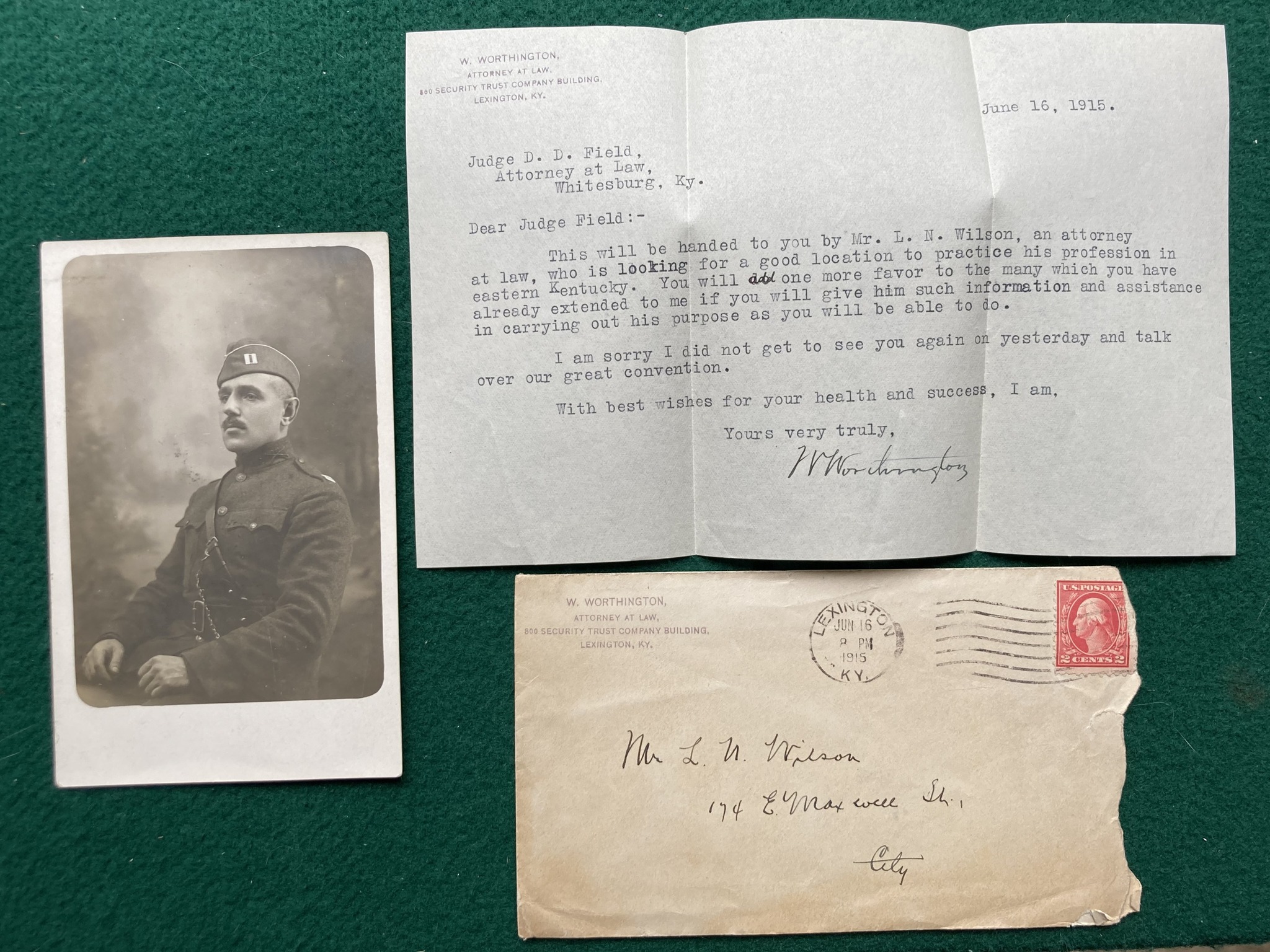
The son of a presbyterian minister, Laurance Newton Wilson was born in Kansas City, Missouri, on January 19th, 1890. His family later relocated to Washington D.C. and Laurance graduated from high school in 1909. Laurance then chose to pursue higher education and was accepted into the Law School at George Washington University. Records indicate that he was an exceptional student at GWU and became a member of the Sigma Phi Epsilon fraternity. Of particular interest, future FBI Director J. Edgar Hoover was also in attendance at the law school during this period, although he graduated a year after Laurance.

Following his graduation in 1915, Laurance passed the bar and began practicing law in Lexington, Kentucky. He had been working for less than two years when America became involved in the First World War, and Laurance applied as a candidate to the US Army Reserve Corps on May 15th, 1917. He was sent to Fort Benjamin Harrison for officer training and received a 2nd Lieutenant’s commission on August 17th.

Laurance was later promoted to 1st Lieutenant and assigned to command Company “C” of the 801st Pioneer Infantry Regiment. It is important to note that this was a segregated unit of the US Army that was composed of enlisted African American doughboys commanded by white officers. The 801st Pioneers sailed to France aboard the USS Manchuria on September 8th, 1918, and arrived along the Western Front in the final weeks of the conflict. The regiment served under the American 1st Army and was assigned to battlefield salvage operations and munition disposal efforts in the Chateau-Thierry Sector (this was a hazardous job which led to several men being killed or wounded in the regiment).

Following the November Armistice, Laurance was promoted to Captain and the French photograph seen below originates from that time period. Cpt. Wilson was then reassigned to command Company “F” of the 305th Infantry Regiment in December of 1918. He later completed his AEF experience while serving as a regimental adjutant and returned to the United States aboard the RMS Aquitania on April 24th, 1919. He received an honorable discharge on May 29th.

Laurance returned to his work as an attorney after the war and was employed by the Royal-Globe Insurance Company for several decades. He married in 1924 and lived much of his subsequent adult life in New Jersey. Laurance does not appear to have had any children and later retired to North Ferrisburgh, Vermont. He suffered a stroke in his final years and died of bronchopneumonia due to aspiration on April 26th, 1970, at the age of 80 years. He now rests beneath a civilian gravestone beside his wife in the North Ferrisburgh Cemetery of North Ferrisburgh, VT.
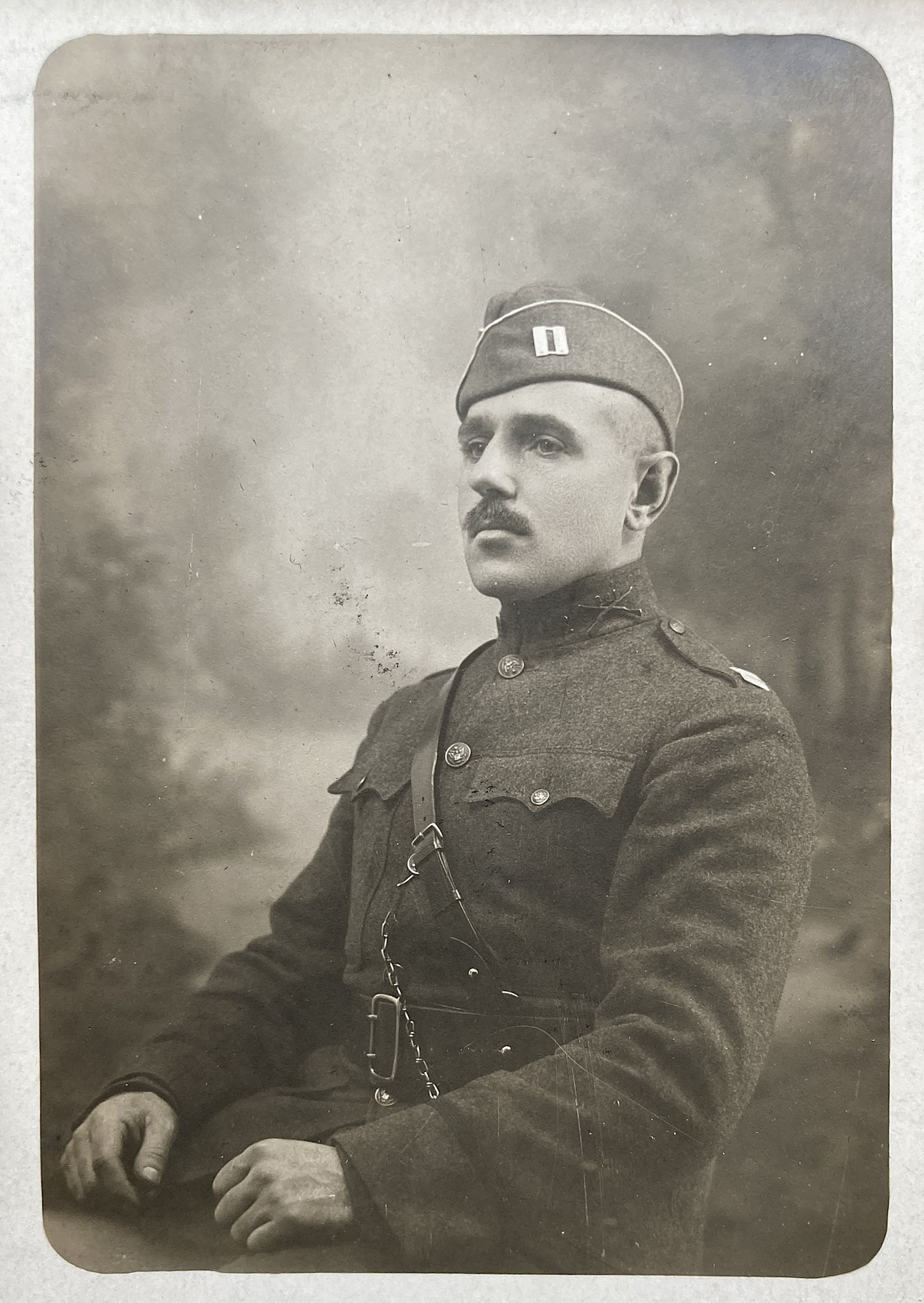
Captain Lawrence Newton Wilson of the 801st Pioneer Infantry

WWI 1st Division Photo Identification, Robert B. Alexander – Portage, Wisconsin Veteran


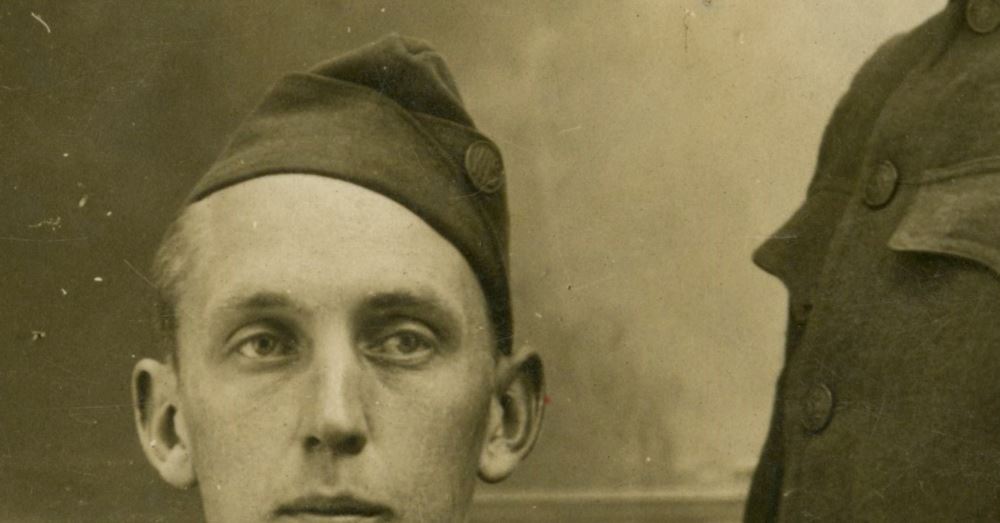
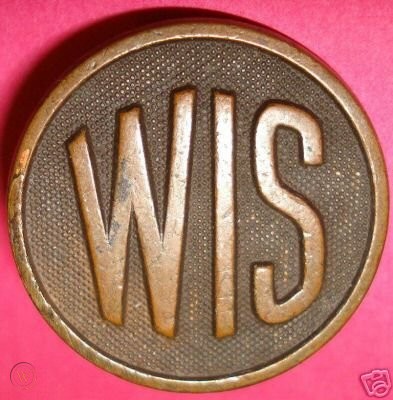
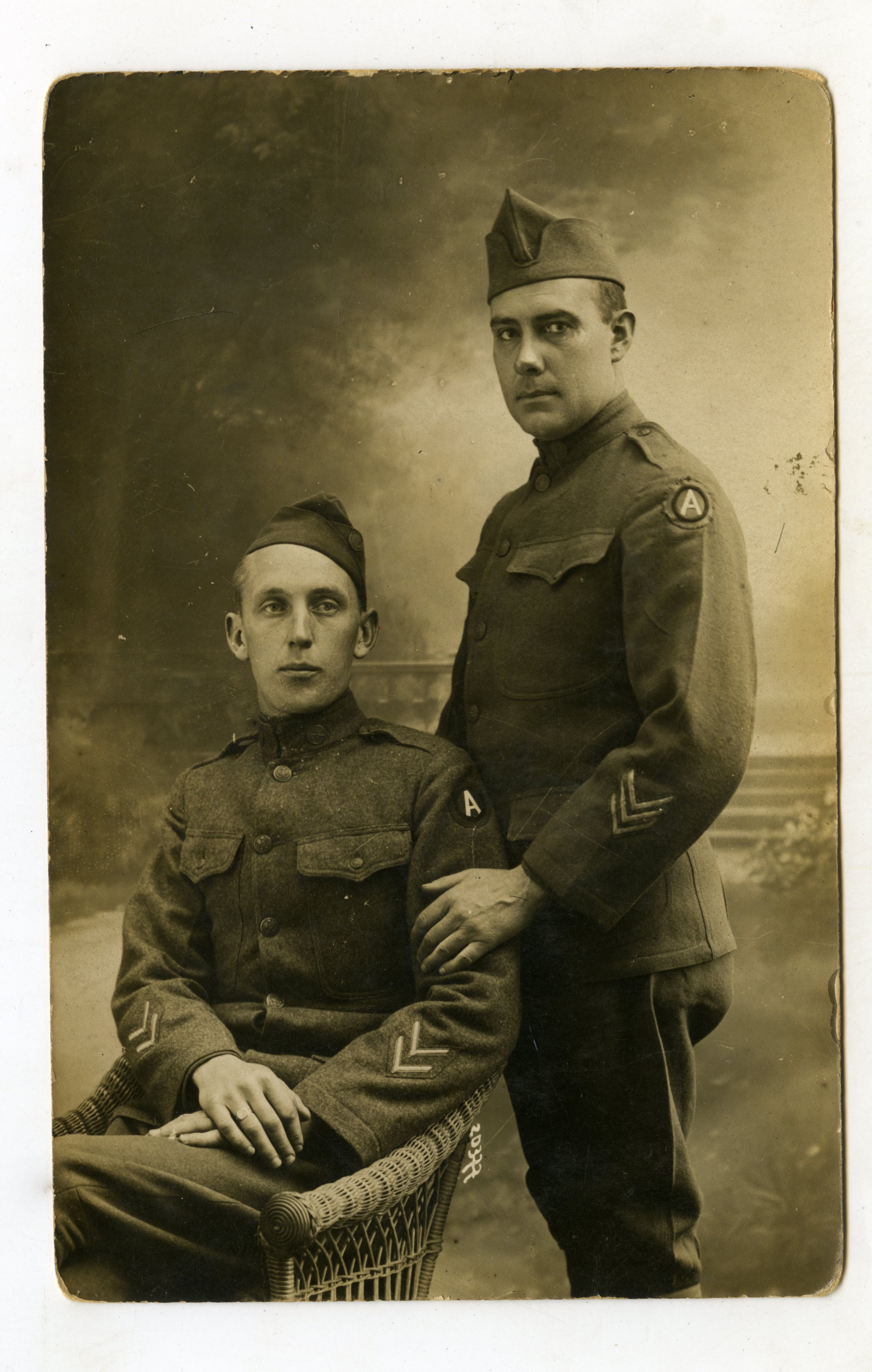
After a long hiatus I’ve decided to come out of obscurity and begin posting to the blog again! A recent Facebook purchase from a WWI collecting colleague has proved to be a classic PortraitsofWar photo for interpretation. The photo depicts two US soldiers posed in a German studio during the postwar occupation of Germany in 1919. The soldier at right is shown with three overseas (OS) stripes on his left cuff denoting 1 1/2 years of overseas service as well as a French-style cap. Both soldiers are wearing 3rd Army patches on their left shoulders, which would have been worn during the postwar occupation period. The seated doughboy is sporting two wound stripes as well as two OS stripes and a Wisconsin collar disc on his cap. The reverse of the photo lists one of the soldiers in the photo as Robert B. Alexander of 914 Adams Street, Portage, WI. Given that the seated soldier is wearing a Wisconsin disc on his cap, it is presumable that the identification on the reverse is leaning towards the sitter at left.

16thInfantry022

Pvt. Robert B. Alexander (seated), Co. F 16th Infantry Regiment, 1st Infantry Division

103rd0711

Reverse Identification of Pvt. Alexander

Some quick research revealed that that Pvt. Alexander was born on April 20th, 1892 in the town of Portage, Wisconsin to Robert M. and Mary Alexander. He lived much of his teen years at 913 and 914 Adams Street in Portage and was listed as working as a switchman with the Chicago, Milwaukee, St. Paul and Pacific Railroad as of 1917 before he enlisted in August of that year.

RR

Railroad Switchman, Ca. 1940

914

914 Adams Street

Attempts to find a photograph of Robert Alexander using traditional research methods failed, but I was able to track down a yearbook photo of Robert’s youngest son. Claire Alexander sat for a yearbook photo in 1944; a side-by-side comparison leaves no doubt in my mind that Claire is a progeny of the seated doughboy.

dudeclose

Pvt. Alexander

sonclaire

Claire L. Alexander in 1944


Wartime Service

Research into Alexander’s wartime service has revealed that Robert was involved in heavy combat in September of 1918 only months before the end of the war on November 11th, 1918. His accolades are laid out in an unlikely document:

silverstar

Veteran Headstone Document

silverstar2

Reverse of Above Document

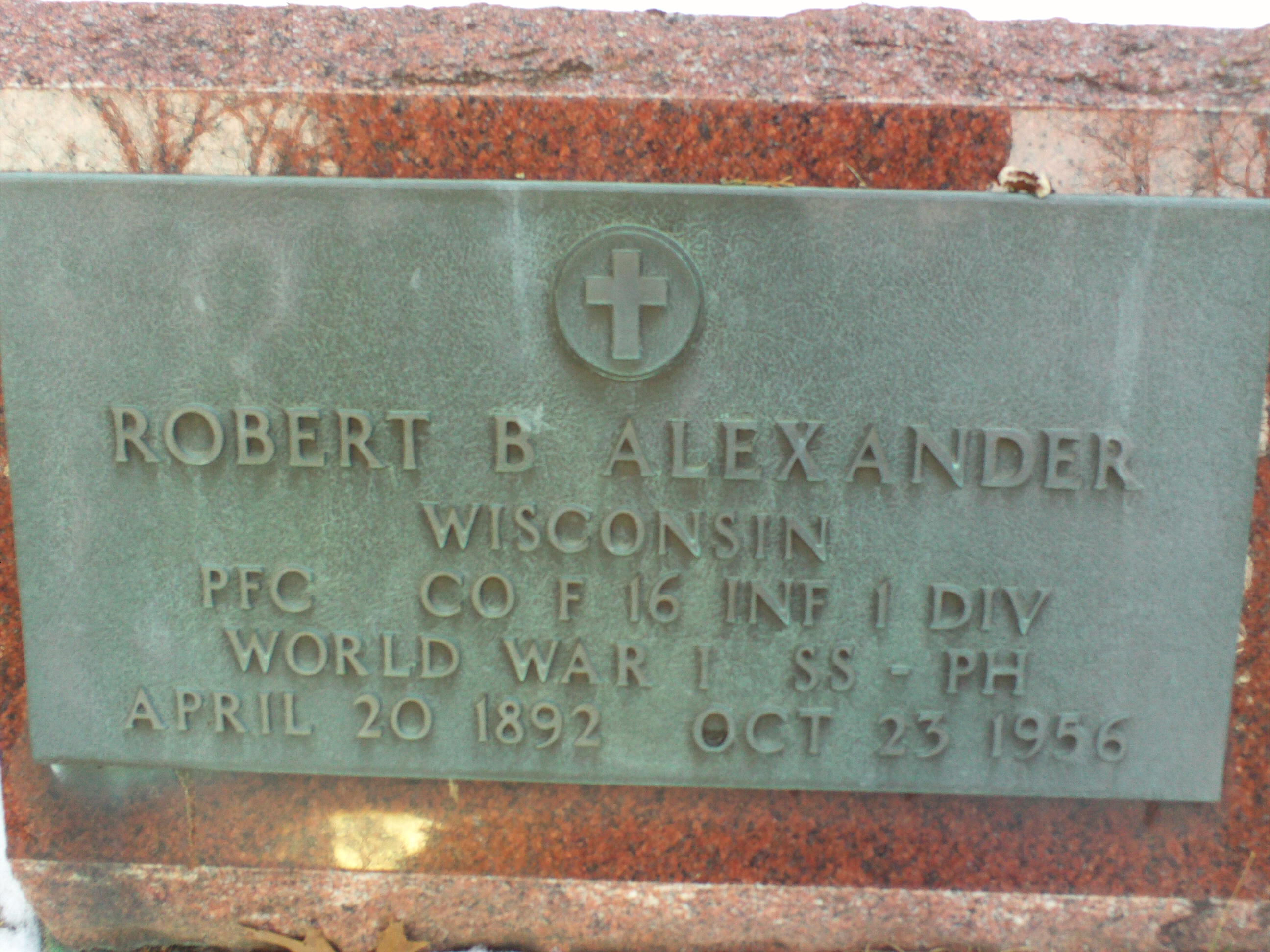
This document confirms that Robert served with Company F of the 16th Infantry Regiment, 1st Division. He was wounded at least once and received the Purple Heart (After 1932) and also the Silver Star. Details about his wounding and SS are still pending… stay tuned.

Private Alexander’s 1956 headstone was made by the Acme Bronze Company of Maple Park, IL and was delivered to the family on November 6th, 1956 following Robert’s death on October 23rd, 1956.

DCIM101MEDIA

Mr. Alexander’s Headstone (Courtesy of Findagrave.com)

Research into living members of the Alexander family have proven fruitful…stay tuned for details related to the reunion of this photo with a great-granddaughter!

Wisconsin

Wisconsin Collar Disc on Cap


wwi-collar-disk-disc-wis-wisconsin-national-guard-wi_1_88787f81f60301c5cdf36ab46f71d0fc

Wisconsin Collar Disc (Worthpoint Photo)


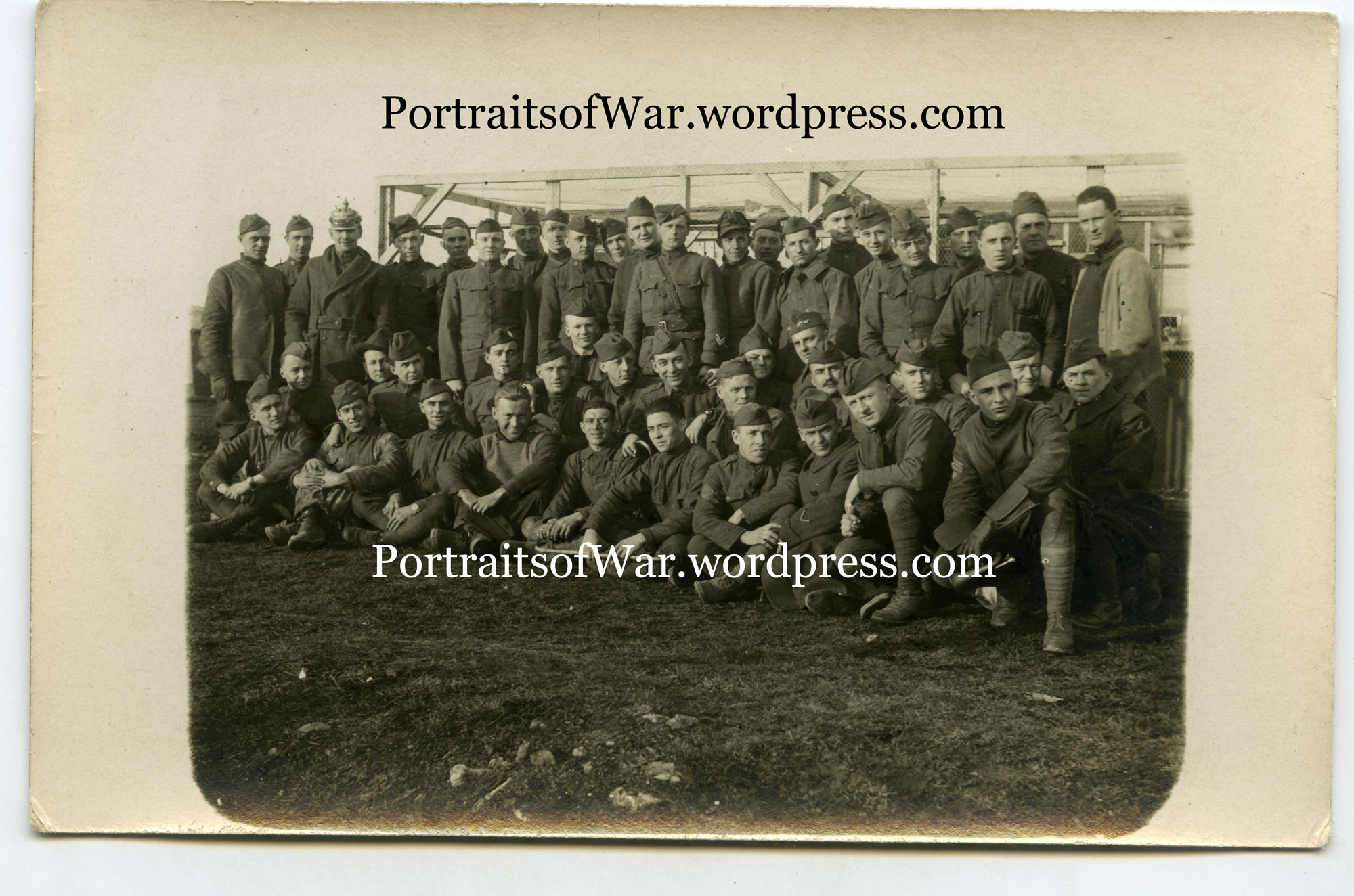
WWI Messenger Homing Pigeon Unit Poses in Germany – Captured German Helmet + Uniform Detail


One of the most interesting forms of communication used during WWI has to be the homing pigeon.  Front line troops couldn’t rely on wire messages getting through to rear echelon support units.  Often times homing pigeons were used to relay messages back to HQ.  Here’s a nice shot of a pigeon unit posing for the camera sometime after the armistice.

And some nice details!  Including a captured German helmet for good measure.