This will be a constantly updated theme here at Portraits of War so please check back often.
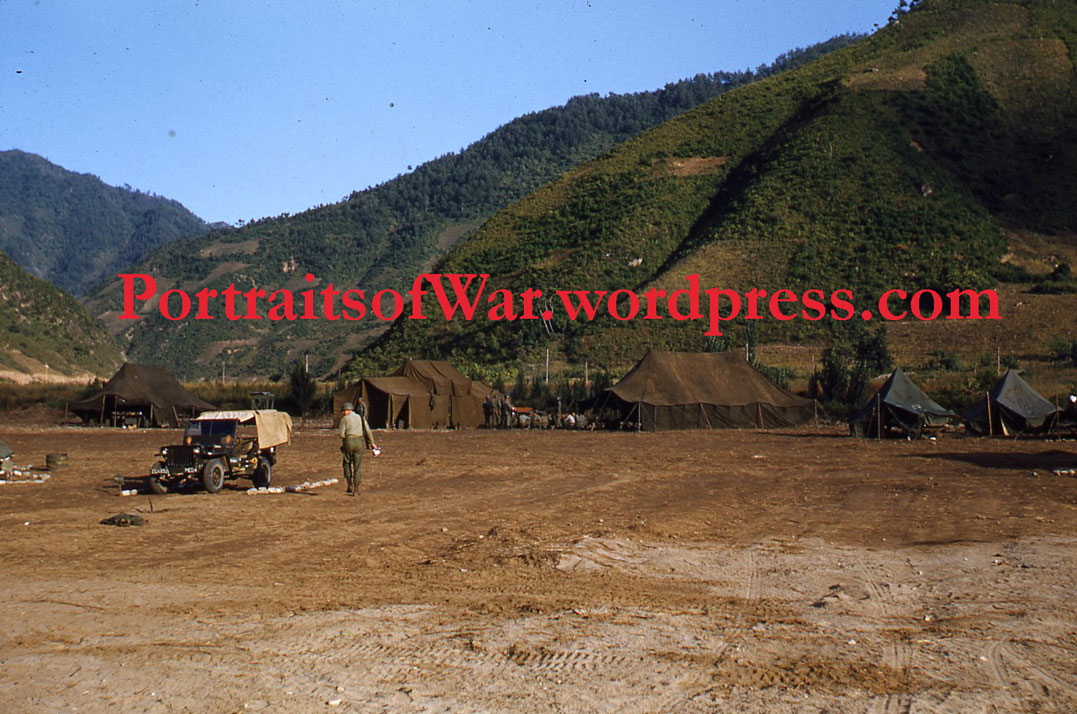
Today’s posts are from the 89th Medium Tank Battalion taken in 1952 during the middle of the Korean War.
The 89th TB ……………………….




This will be a constantly updated theme here at Portraits of War so please check back often.
Today’s posts are from the 89th Medium Tank Battalion taken in 1952 during the middle of the Korean War.
The 89th TB ……………………….
This story starts with a 23 year old Earl F. Lavalle scribbling his name on the back of a photo to pass along to a friend during WWI and ends with a full identification of Mr. Lavallee’s life experience. The main goal of PortraitsofWar is to research and seek out every possible lead to identify an early 20th century photograph; recent digitization efforts have enhanced our ability to complete genealogical research from the confines of a remote desktop.

Earl in 1918
Our first accounts of Earl show him being born on November 29th 1894 to Fred Lavallee of Canada and Emma Pollinger of (my current hometown!) Colchester. Earl worked his entire life as a laborer in the American Woolen Co. in Winooski, VT, located along the Winooski/Onion River near Burlington,VT. He lived at various locations during his tenure at the woolen mill including 36 Hood Street, Winooski, 102 Mallets Bay Ave, 22 Park Street and many more.
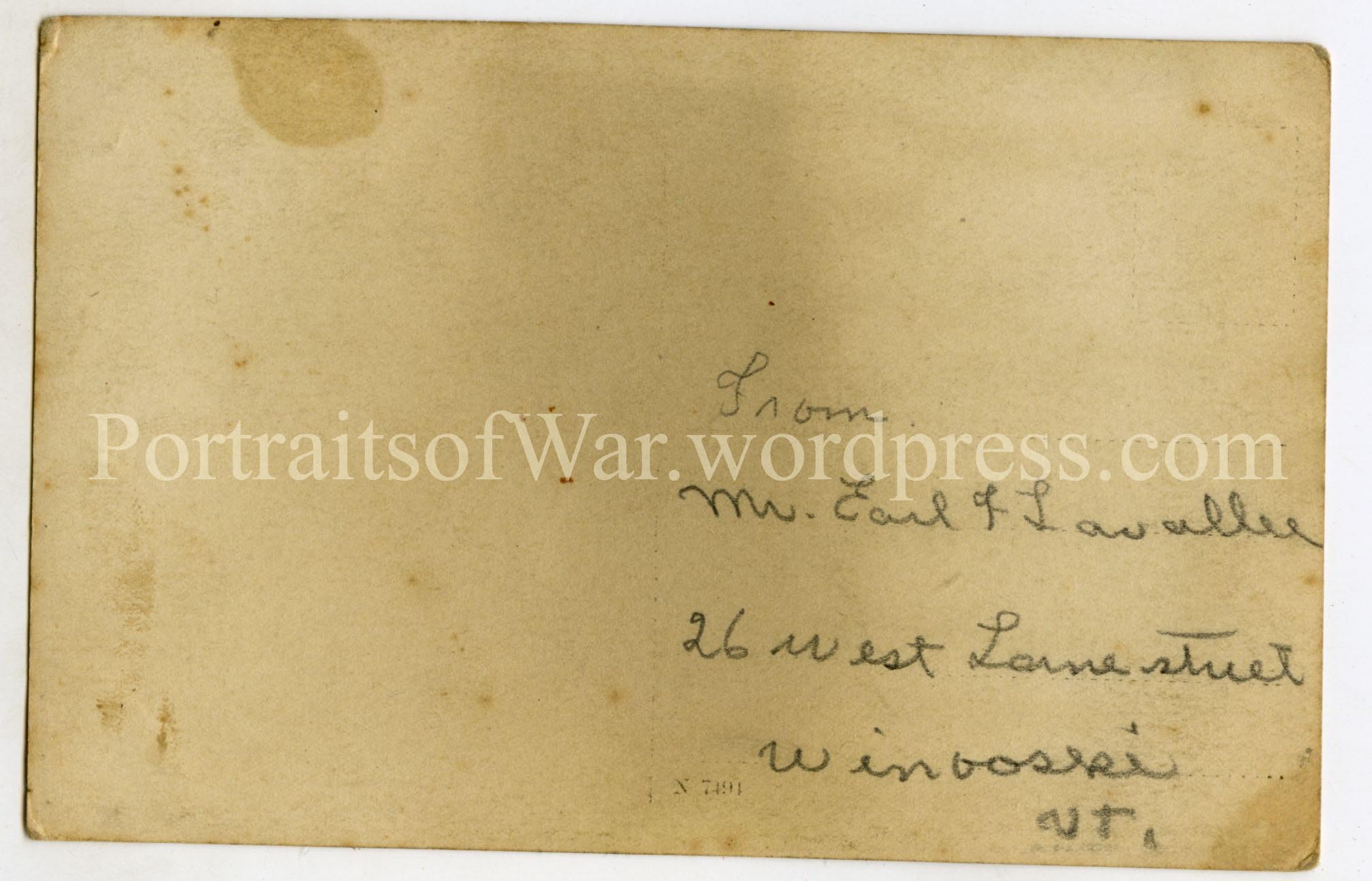
Earl Lavallee Reverse
Earl enlisted on February 11th, 1918 at Camp Green, North Carolina. He served with Company G, 58th Infantry Regiment, 4th Division until August 21st, 1918 when he was transferred to Supply Co, same regiment. He was overseas from May 7th, 1918 to August 1st, 1919.
Earl was wounded in action on September 30th, 1918. This photograph depicts Earl after his wounding evidenced by his right-hand wound stripe. Earl was discharged on August 7th, 1919.
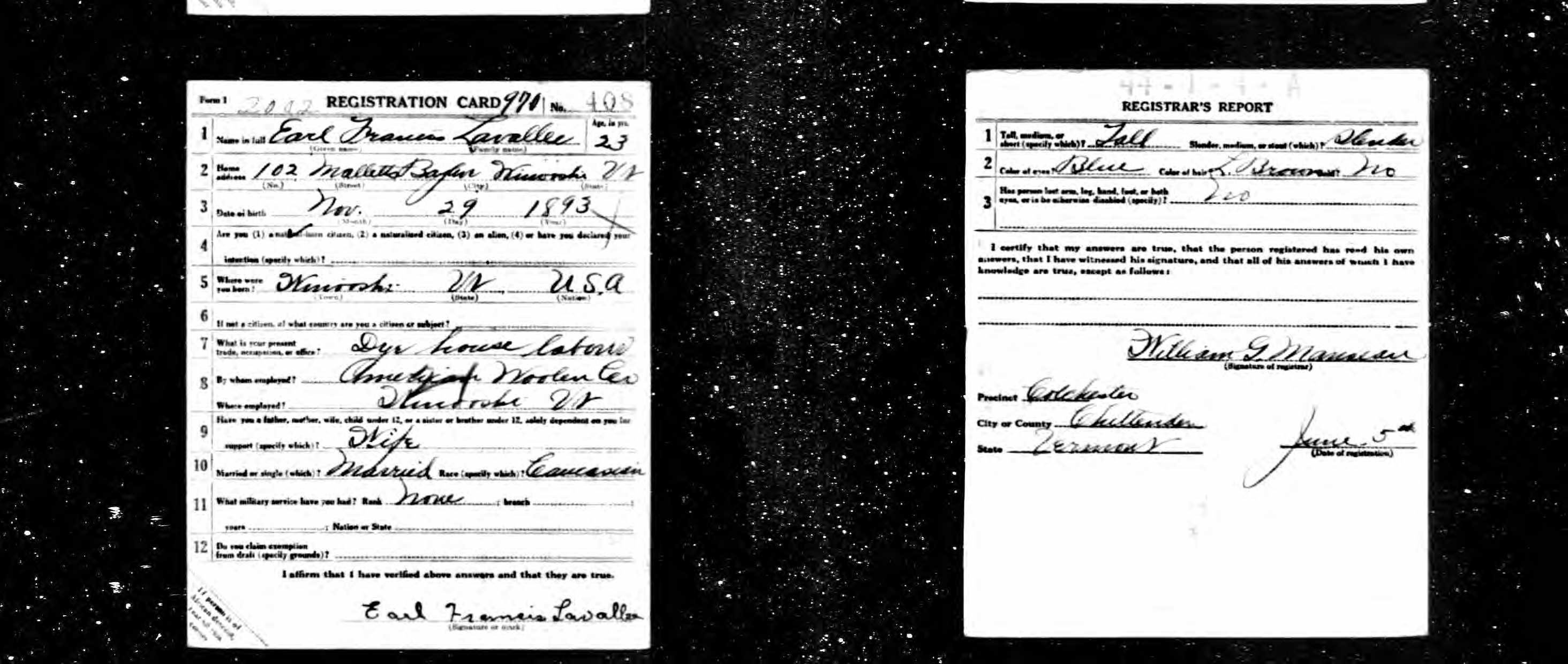
Earl Lavallee Draft Card WWI
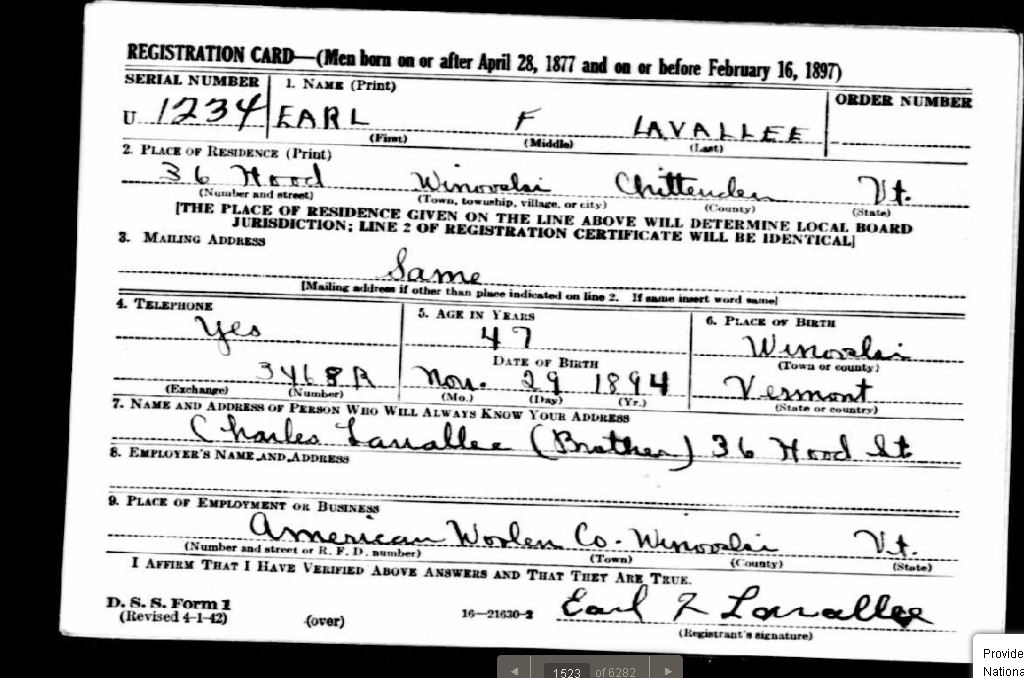
Earl Lavallee WWII Draft Card
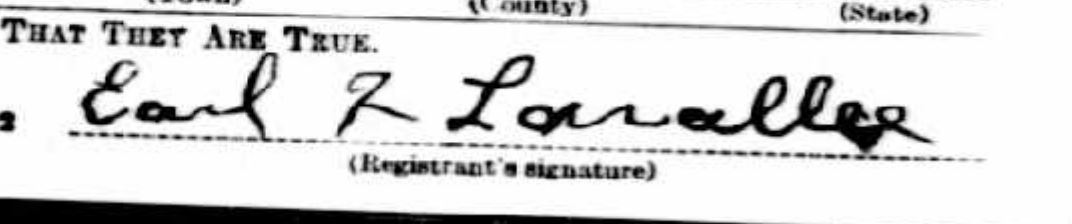
Lavallee Signature
Lavallee Family Story
The 1900 US Census from Colchester, VT shows the Lavallee family as a solid unit with five family members comprised of Earl’s dad Fred Lavallee, his mother Emma, brother Charles, sister Florence and himself (Earl).

1900 Census, Colchester, Vt
Family heirlooms come in many forms, shapes and sizes. It always amazes me what types of material appears on eBay as part of estate liquidation sales. Family scrapbooks, bibles, photo albums and personal diaries. In this case, I was able to purchase a small group of photos and a War Department Identification card from a nurse who served in WWII. Included were a few photos of her in wartime garb, shots of her husband (pre-marriage) and her wartime ID card. As I always say, it’s about the research….

Helen (Boretski) Bronesky’s WWII ID Card

Reverse of Card Showing Fingerprints
It’s sad to thing that a family would sell off relics of their family’s past, but it’s not for me to judge. I’m here to interpret the material at hand and figure out as much as possible with scant information.
I always start off with a quick ancestry.com search to help figure out the background story. We have a name – Helen Boretski and a birthdate of March 31st, 1924. Helen was 5’6″ when the photo was taken and a healthy 142 pounds. Her hair and eyes are listed as brown. Her thumb and right index finger are both present on the back of the ID.
A quick ancestry and google search helped me discover that Helen was dating and eventually married to a Navy man named Paul Bronesky in 1946. A few photos included in the purchase we indeed identified to a Paul, so this helps confirm the identification. In fact, further research into Paul’s WWII service shows that he was a radio man on a Navy aircraft. This is further confirmed through the photo included in the group. He is wearing a rare set of Navy air crew wings with a radioman rate patch on his sleeve.

Paul Bronesky in WWII

Hubba Hubba
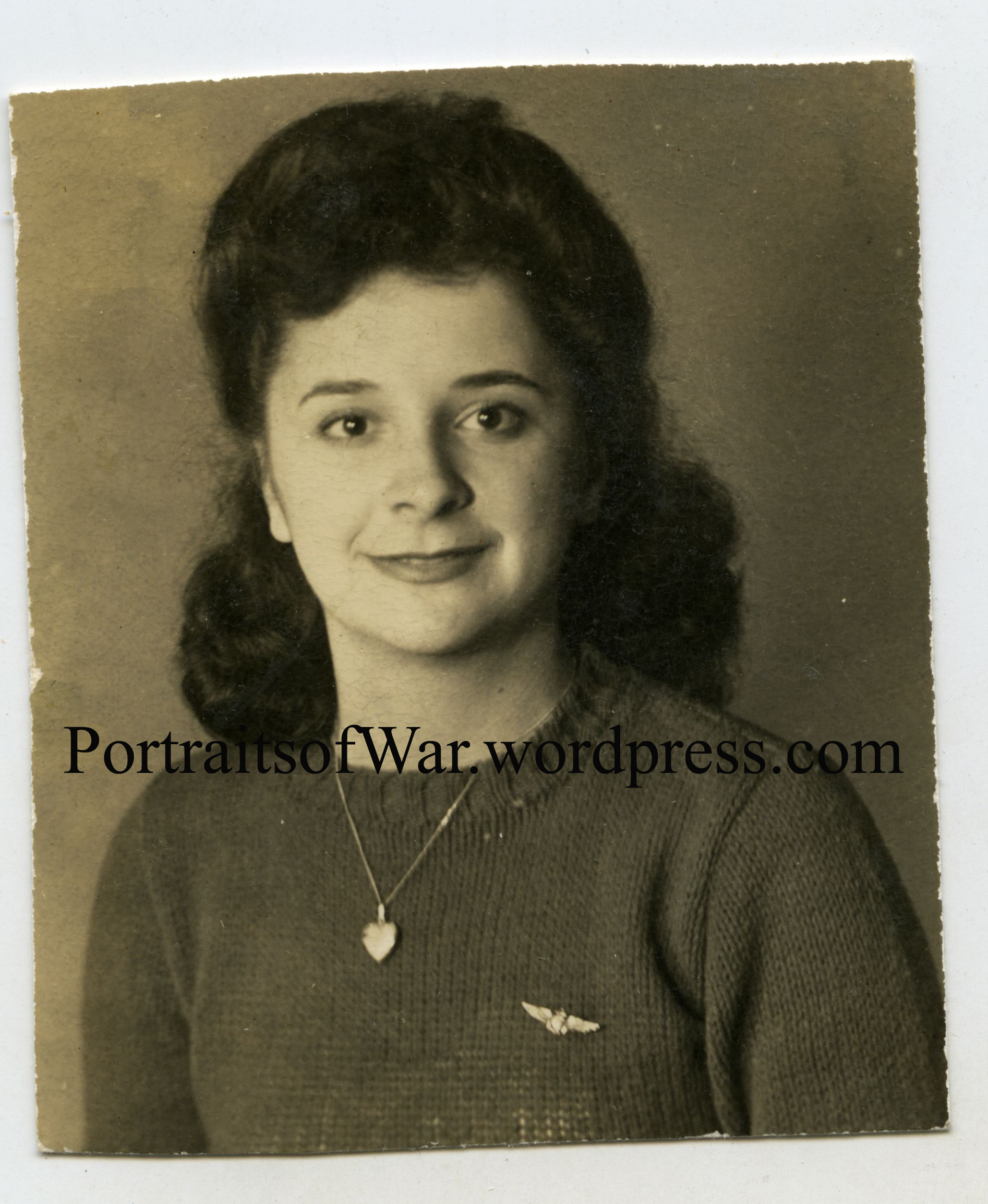
Helen Wearing “Sweetheart” Navy Wings
What makes this grouping of photos interesting is the fact that both the husband and wife (dating in wartime) were both service members. Helen was a nurse and Paul was a Navy radioman. Helen strikes a chord with me. There’s just something about her gaze and smile that make me want to reach out and talk to her. Sadly she passed away in 2008. Please see below for an obituary record from Plymouth, PA:
“Helen (Boretski) Bronesky, 83, formerly of Plymouth, died March 24, 2008, in Mequon, Wis., of a cerebral aneurysm. Mrs. Bronesky was born March 31, 1924, in Plymouth and raised in Lyndwood. She graduated from area schools and RN school and was a veteran of the U.S. Army Nurse Corps in World War II. She was preceded in death by her husband, Paul; parents, Michael and Susan Boretski; her brother, Michael Boretski. She is survived by son, Paul; daughter, Susan; granddaughters, Michelle, Erica and Leslie; sisters, Mary Koliga, Anne Kochevar, Margaret Cowan and Dorothy Bedosky; numerous nieces, nephews and friends.
Interment will be Saturday, July 26, 2008, at 11 a.m. in S.S. Peter and Paul Cemetery, Plymouth Township. Arrangements are by the S.J. Grontkowski Funeral Home, 530 W. Main St., Plymouth.
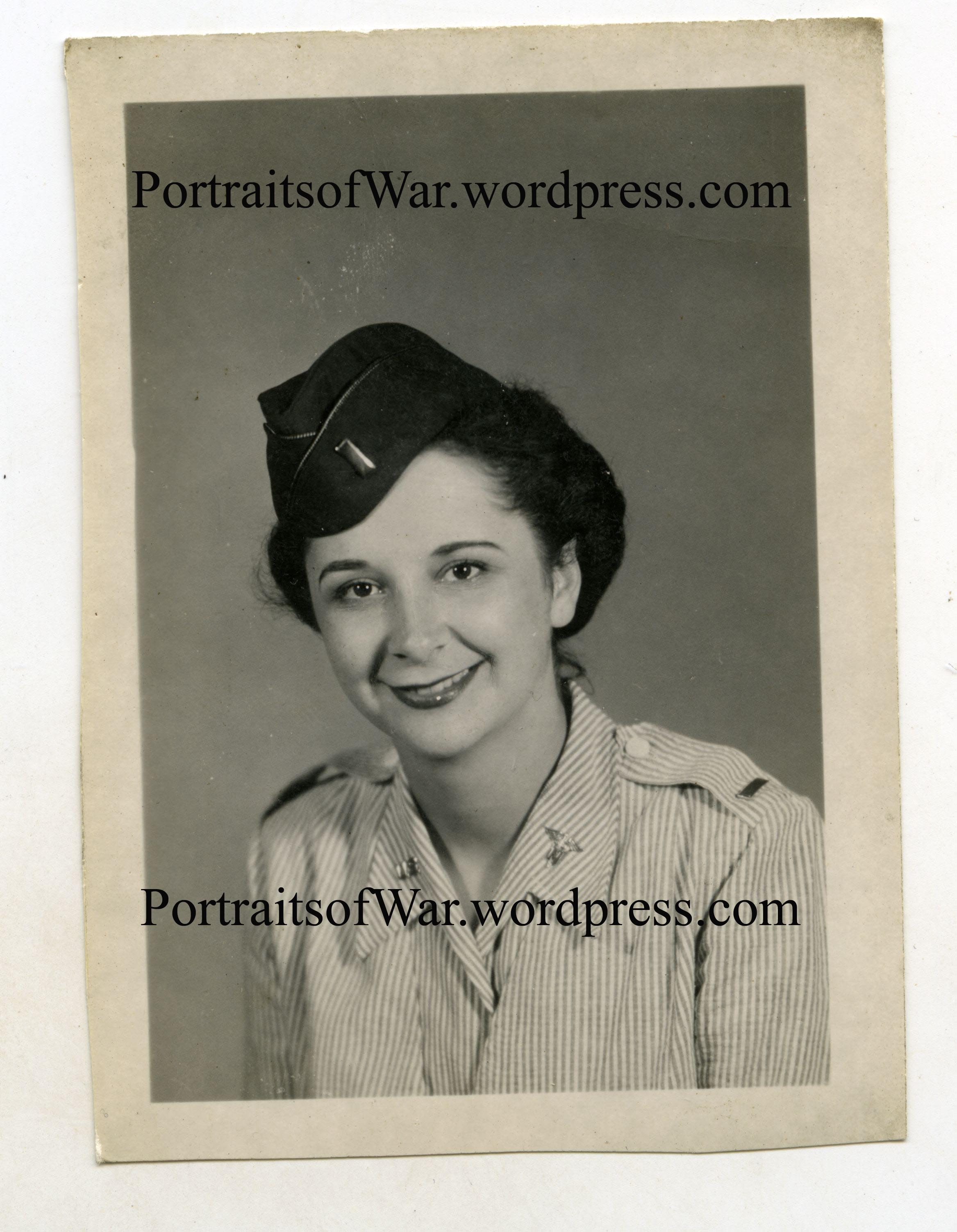
Helen as a Nurse in WWII

Helen and Paul Marriage day 1946

Helen’s Kiss
Generally my WWI photo identifications come with a name, unit, and typically a home state or region. In this case, the only direct ID information to come with the photo was a first name – Harry- and the name of his brother. The rest of the information was hidden in the nuanced details of the photo postcard. See below for the main photo included in the eBay listing.
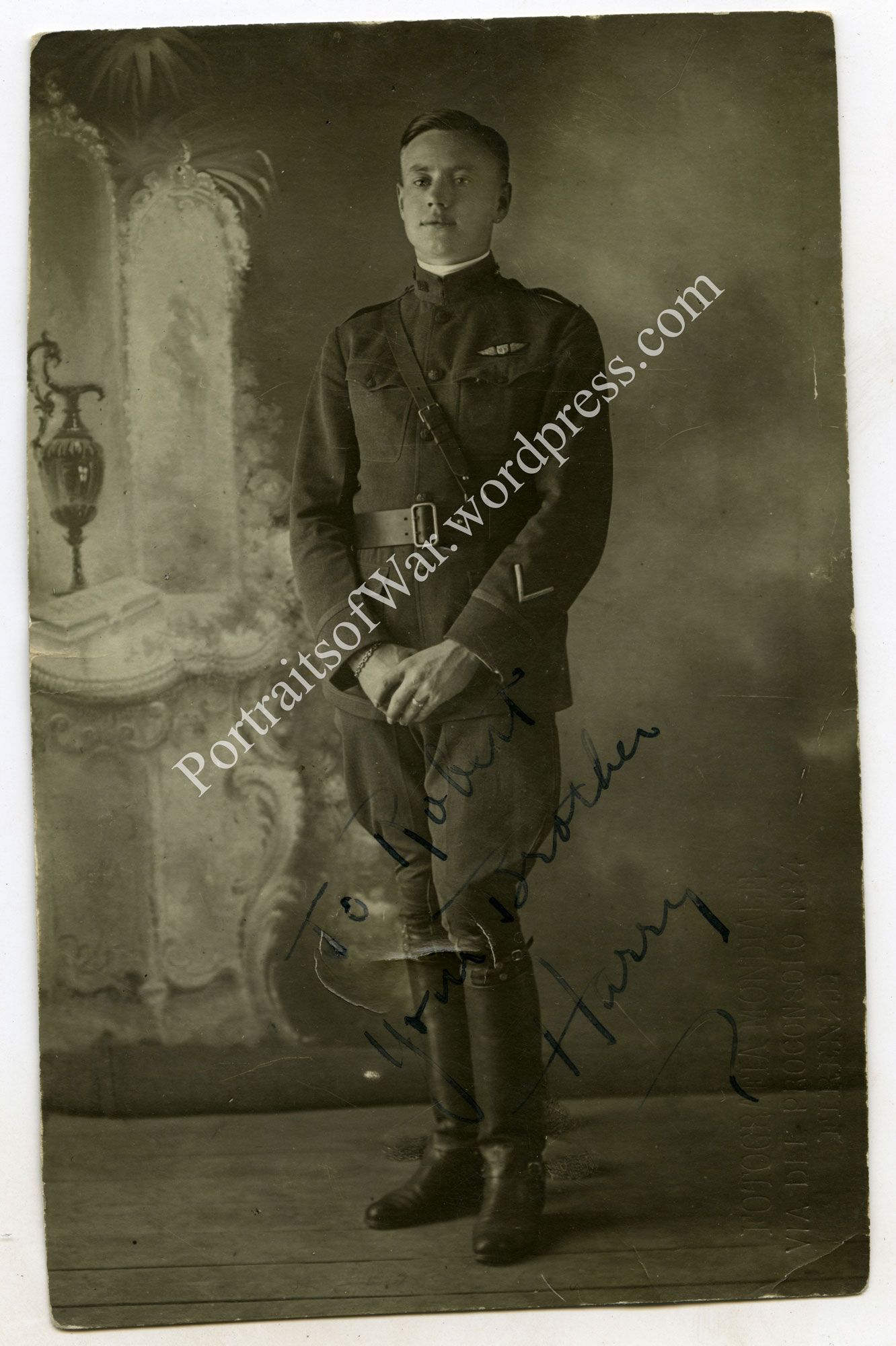
“Harry” in Italy
The eBay listing also made reference to the fact that the studio stamp was an Italian photographer. With this in mind, I bid to win.
After successfully winning the photo I began the laborious process of identifying the photo. Here’s the info I was basing my research on:
1. The photo depicted a US pilot who had served at least 6 months overseas at the time the photo was taken.
2. The pilot was named Harry and had a brother named Robert.
3. The pilot had a distinctive signature and handwriting style with large crossed H’s and a penchant for flourishes.
4. The pilot was in Italy at some point during the war.
I first started my research with a general reference search to find out how many US pilots were in Italy during the war. Lots of websites popped up and generally pointed towards the Fiorello’s Fogiannia, a group of US pilots who trained in Italy on Italian bombers. We’ve all been stuck in LaGuardia airport at some point in our lives, so I instantly recognized the reference to Fiorello LaGuardia. I had no idea he was in WWI! Further research made it clear that only 500 or so US pilots were in Italy during the war.
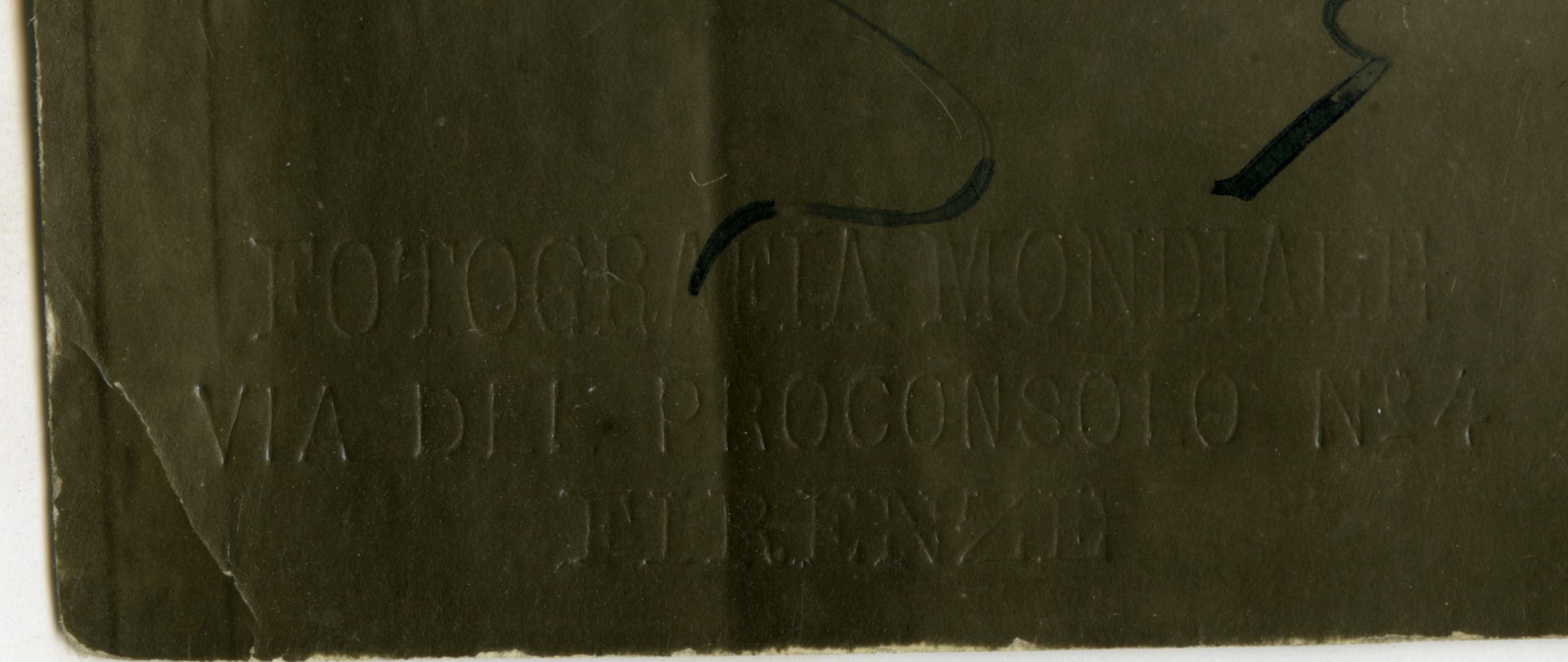
Italian Photo Studio Stamp
I started by tracking down a copy of the roster of the pilots who trained with the “Fogianni” during the war. A good friend, Chuck, was extremely gracious enough to take photos of all the pages and send them to me. I finally had the whole roster to reference. With this in hand, I identified all the Harold’s and Harry’s in the roster. This helped narrow it down to less than 30 candidates! From there I looked at the 1900 and 1910 roster for each of the men in hopes of finding a brother named Robert. A small handful of candidates trickled through.
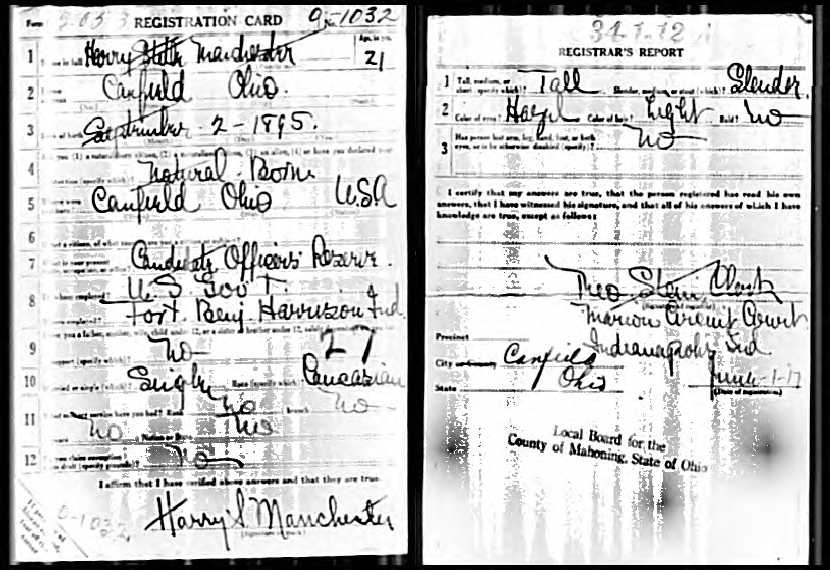
Perfect Match!
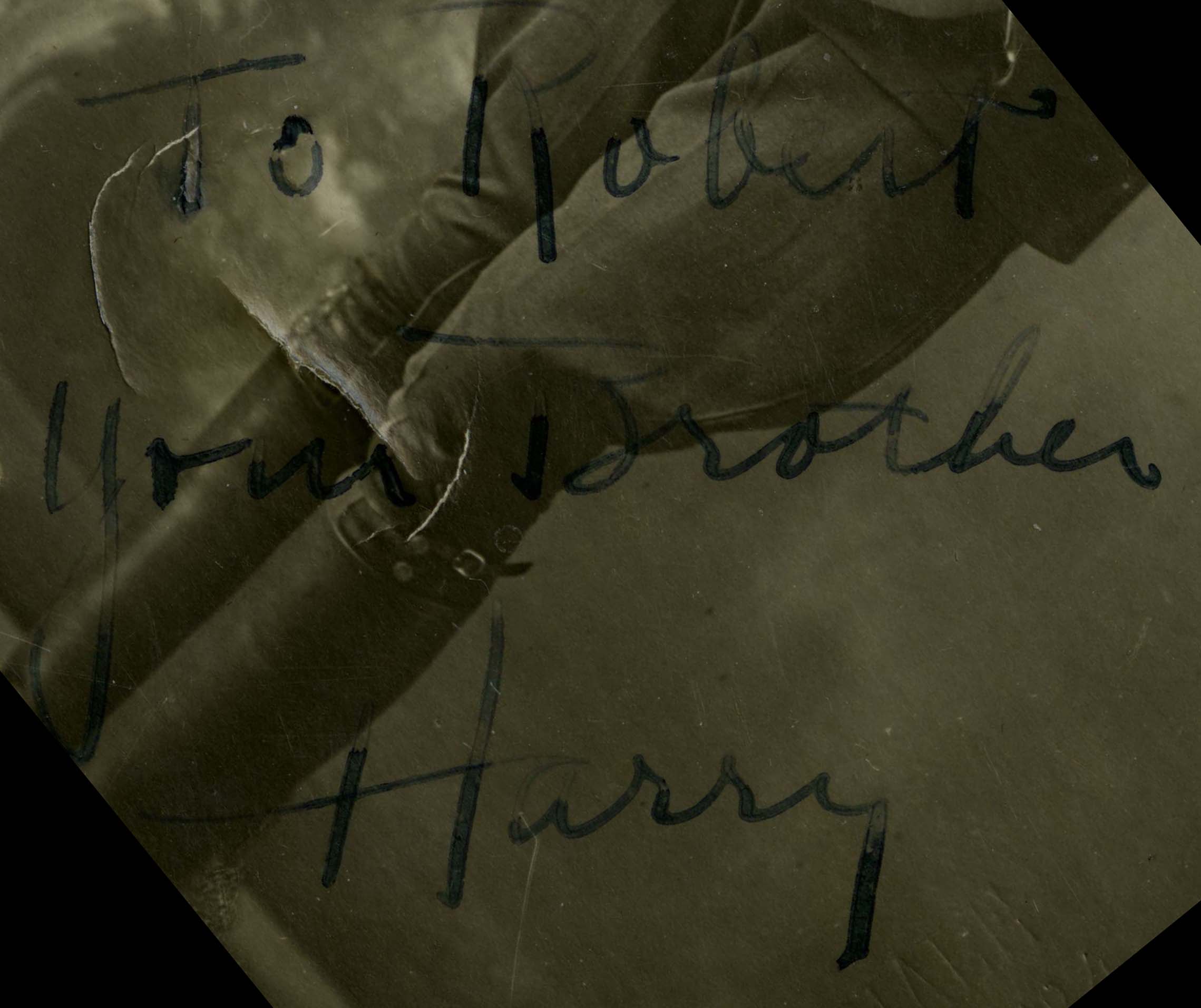
Harry’s Signature
My first cross reference for the Harry’s with brothers named Robert brought me to Harry S. Manchester from Canfield, Ohio. The signature on his WWI draft card almost knocked me over! A perfect match. Note the intense cross on the H and the overly dramatic crosses on his T’s. With further research I was able to find a TON of information on Harry. He was indeed a pilot in Italy during the war and also served in France as a test pilot, testing new US planes as they were unloaded in France. His brother was Robert Manchester Jr. I was able to find Robert’s son (Robert Manchester III) and grandson (Robert Manchester IV) online, both prominent lawyers in the midwest.

Harry’s War Record

Ohio Newspaper Reference
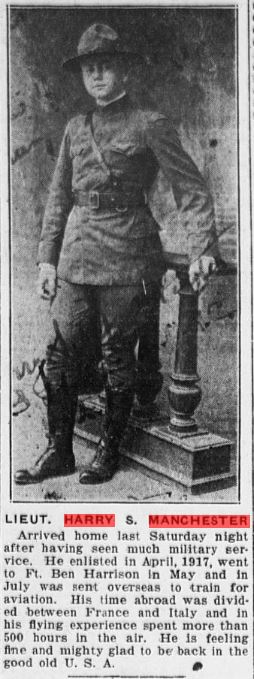
Harry Wearing Italian Wings

Harry Home from Wooster College 1916

Harry in Italy

Harry as Test Pilot
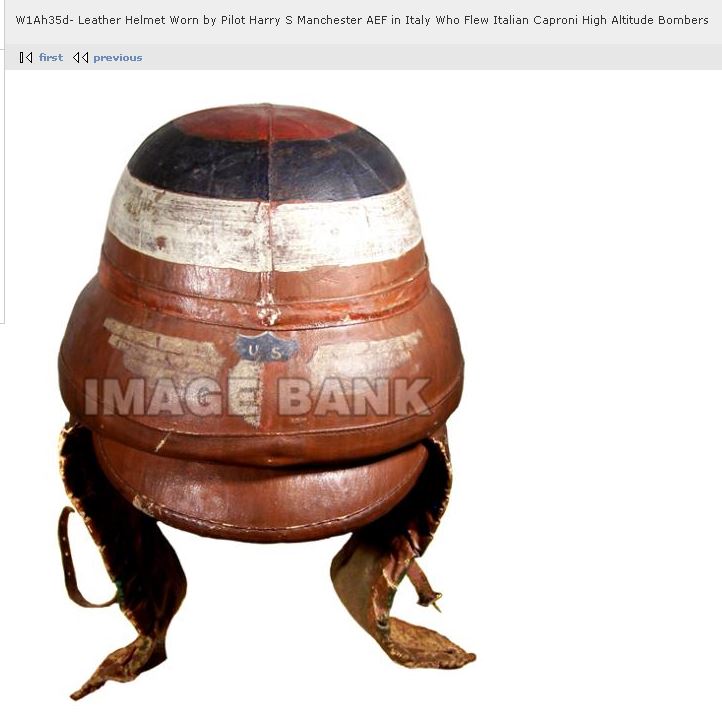
Harry’s WWI Flight Helmet
Also, the National WWI Museum apparently received a donation of a series of photos from the Manchester Estate. Check out these additional portrait shots of Harry from the collection! (Used without permission but with watermark)


The WordPress.com stats helper monkeys prepared a 2013 annual report for this blog.

Here’s an excerpt:
The Louvre Museum has 8.5 million visitors per year. This blog was viewed about 72,000 times in 2013. If it were an exhibit at the Louvre Museum, it would take about 3 days for that many people to see it.
I recently picked a nice WWI dogtag from a medical officer named Liva C. McLain, and found that he likely served as a surgeon with the 7th Evacuation Hospital at Chateau Montanglaust in France, a hospital especially equipped to deal with those wounded with mustard gas.
He is mentioned on page six of the following medical corps pamphlet,
http://jama.ama-assn.org/content/LXIX/25/2121.full.pdf
It looks like Liva served with the hospital during some key battles during the war. His hospital served the wounded at both Chateau Thierry and Belleau Woods. Here’s a good JSTOR article about the unit’s participation at Belleau Woods:
Here is a link to a soldier in the 103rd Infantry Regiment of the 26th Division who spent some time recuperating at the 7th Hospital:

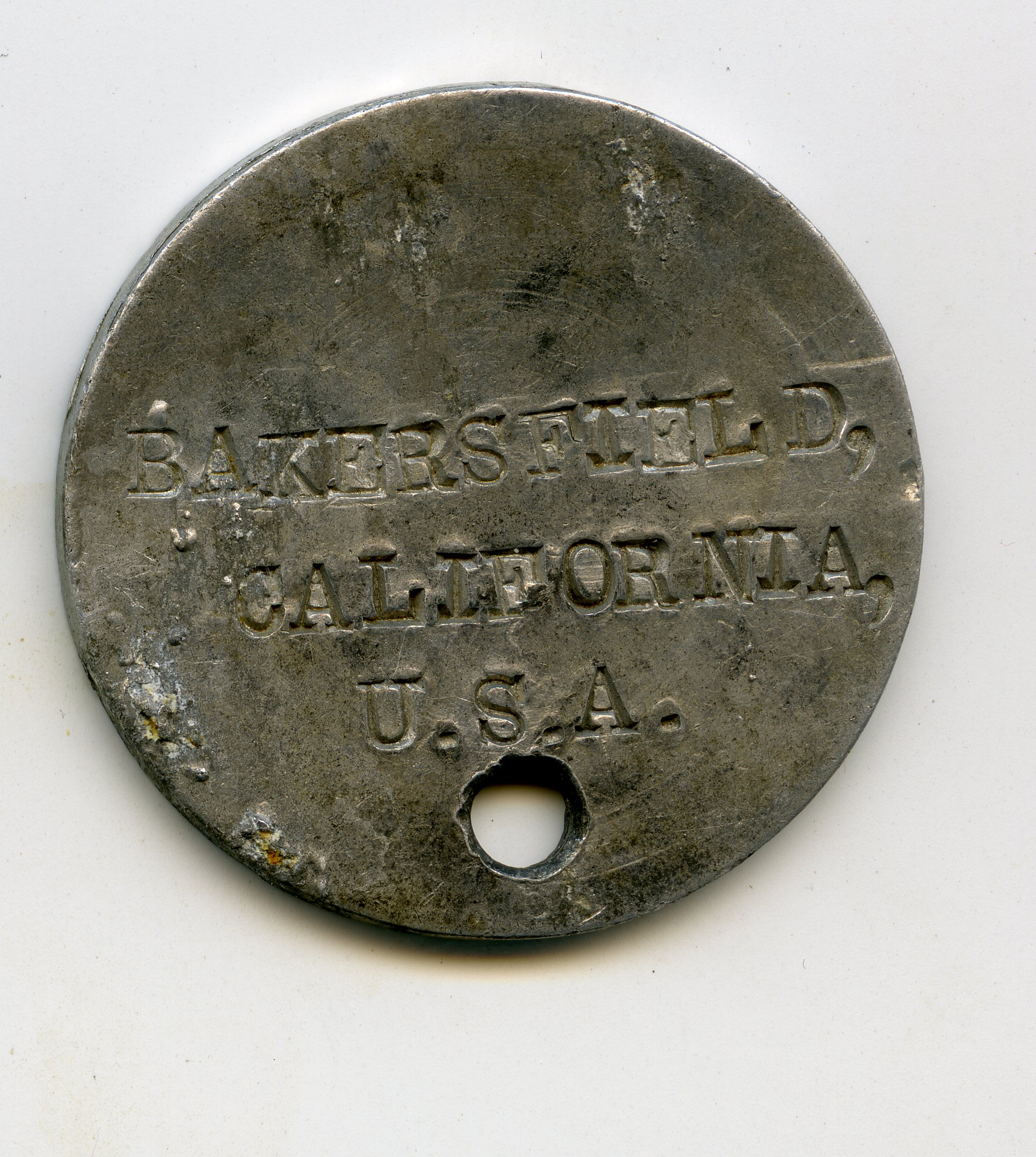
The 7th Evacuation Hospital was organized on 26 November 1917, at Fort Riley, Kansas, as Evacuation Hospital Number 7. The organization participated in WW 1…
View original post 91 more words
World War One Vermonter photos are far and few between, so I always jump on the opportunity to add one to my growing collection. Today’s portrait photo recently arrived in the mail from a fellow collector who discovered it at an estate sale on the West Coast. This crisp and clear 8×10 portrait was sadly damaged during shipping but still retains it’s incredible details depicting the bullion wings and cap insignia.

Walter Monger WWI Portrait
Walter V. Monger was born on December 18th, 1892 and passed away on October 18th, 1975. I’ve tracked down a number of documents on Ancestry.com that can be viewed below:

WWI Draft Registration Card
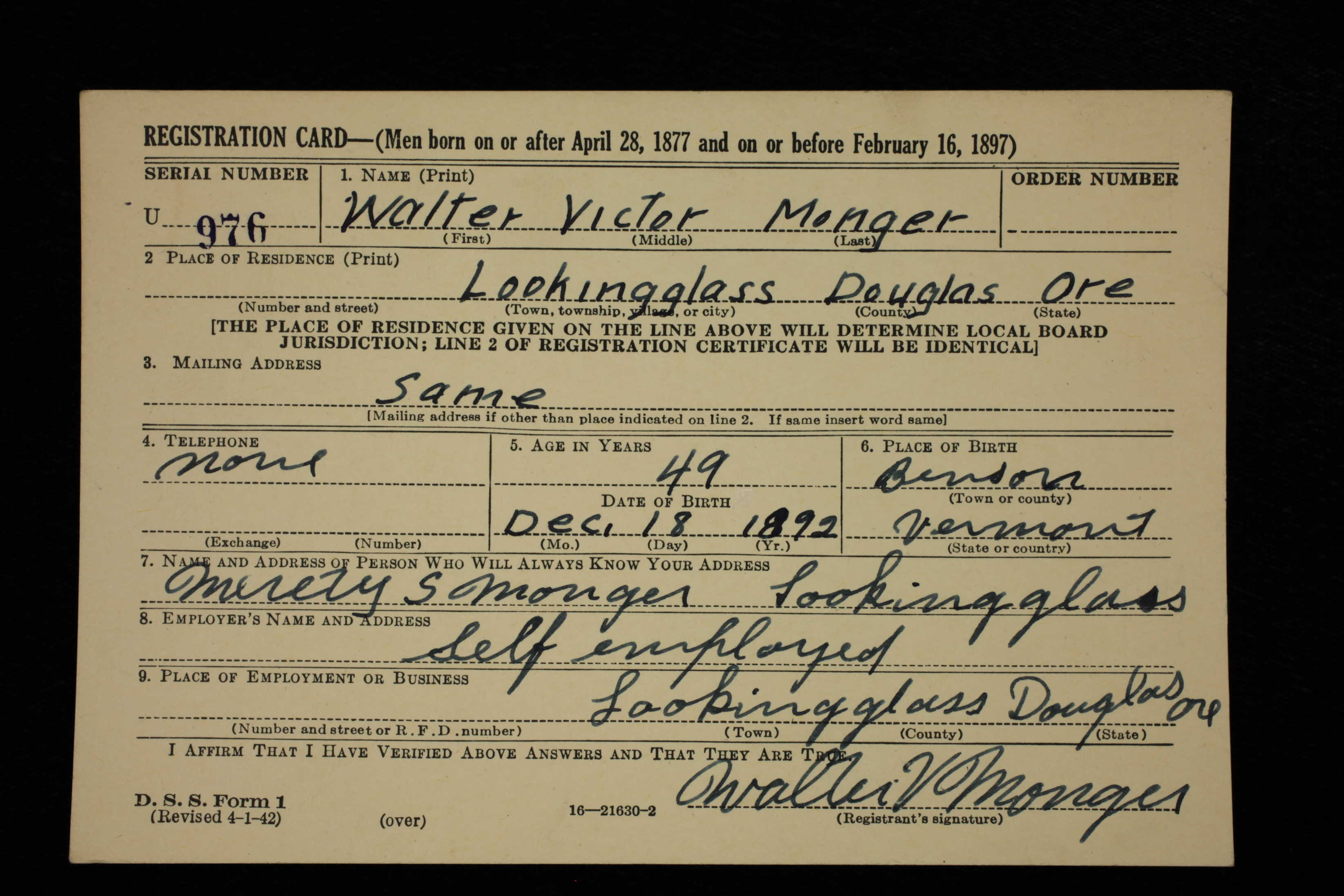
WWII Draft Registration

1919 School Photo
Identified chaplain photos have become incredibly popular in the past few years given the ramp-up effort to prepare for the 100 year anniversary of WWI. I’ve made an effort to scoop up as many interesting chaplain photos as possible to share here on PortraitsofWar to help spread the word about the U.S. involvement in the war. A recent eBay duel landed me with a top-notch portrait of a 37th Division (primarily Ohio based division) chaplain posed with his WWI Victory Medal and uniform. The inscription on the bottom ends with a crude signature. I was able to do my typical google, ancestry.com, Library of Congress and Fold3 search to come up with a 100% positive identification.
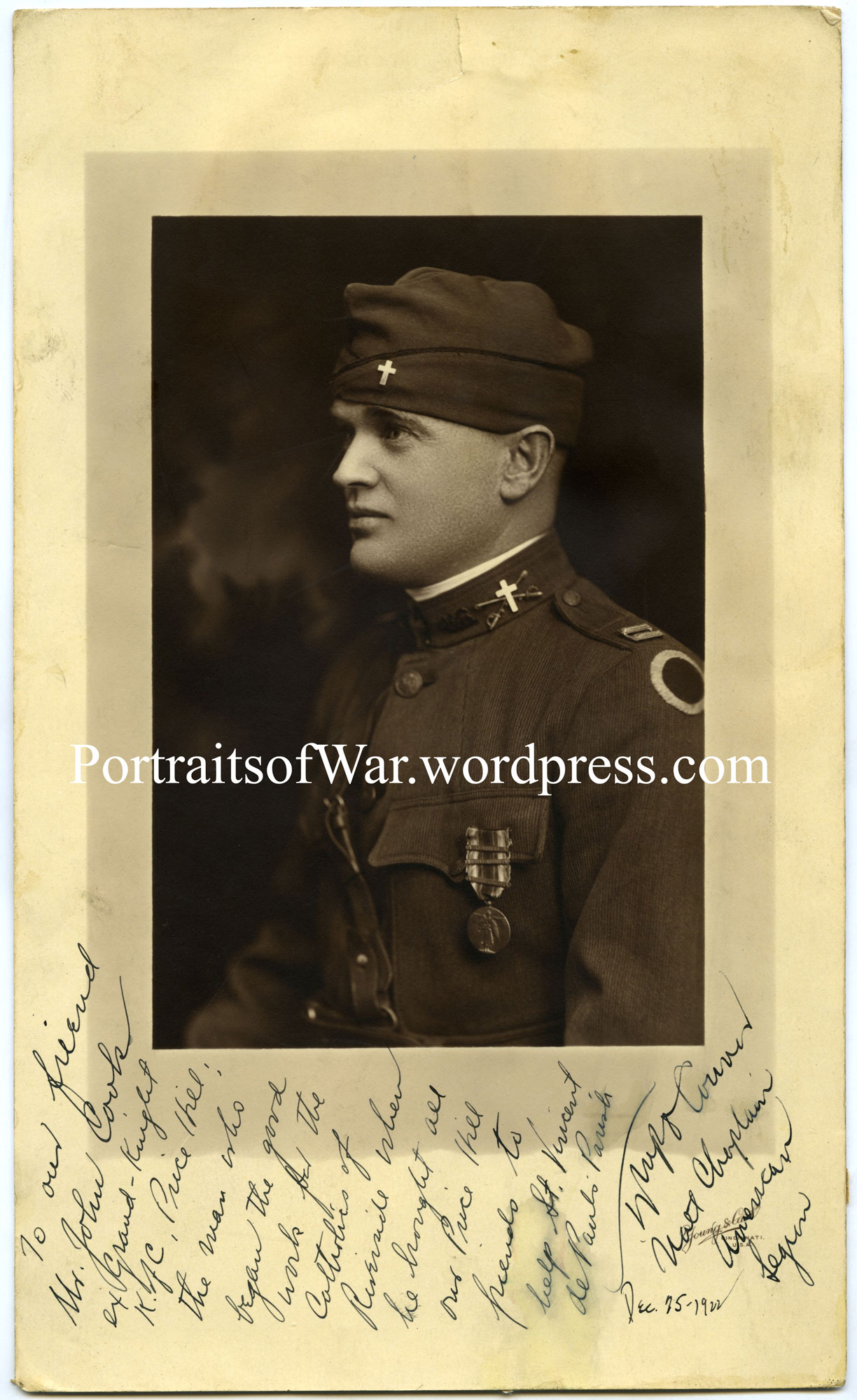
Lt. William O’Connor
William Patrick O’ Connor was born in Dayton, Ohio on October 7th, 1889 to John and Elizabeth (Kenney) O’Connor. He attended the University of Dayton for his B.A. and followed up with seminary school at Mt. St. Mary’s Seminary in Cincinnati. He was ordained in 1913 and served as Curate at Urbana, Ohio, 1913-117; later paston, Church of the Assumption in Cincinnati(Source). William O’Connor has the distinction of being the first Ohio priest to enter the army following the declaration of war in 1917.Father O’Connor served as chaplain with Battery F, 136th Field Artillery as part of the 37th “Buckeye” Division during WWI. At the time of the portrait, he was the chaplain of the 107th Cavalry of the Ohio National Guard. I was lucky enough to track down a 1918 article with a direct quotation from Rev. O’Connor:
“…………… I take this occasion to thank the Knights of Columbus of Cincinnati for their exceeding kindness and consideration to the Chaplain, and to thank all the people of Ohio for their kindness to the soldier boys.
With best wishes, in J.M.J. I am, sincerely yours,
William P. O’Connor,
First Lt. 136th Field Artillery Chaplain”
http://arc.stparchive.com/Archive/ARC/ARC02161918p08.php
Father O’Connor was elected National Chaplain of the American Legion after the third ballot and was in a tight heat with Rev. Ezra Clemmons of Iowa and Rev. Roy Tucker of Baton Rouge, LA. For more info check out the following site: http://arc.stparchive.com/Archive/ARC/ARC11041922p05.php
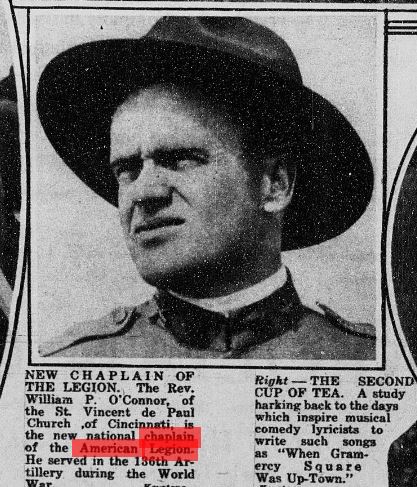
Newspaper Clipping of Father O’Connor, 1922

58 Ringgold St, Dayton Ohio
And where he lived in Dayton, Ohio
My favorite World War One photo in my collection has to be the following real photo postcard shot taken in Paris in December of 1918. The content and context of the photo – three wounded officers posing in a French studio before being sent home – is good enough to grace the “top shelf” of any WWI photo collection. The fact that they are named on the reverse makes it all the more interesting. For the purpose of this post, I will identify one of the officers and track down his service history.

Jacob H. Heckman(L)
Heckman is included in the hall of heroes for American Jewish Military History: http://www.nmajmh.org/exhibitions/catalog-hallOfHeroes/cat41.php
 Here’s a transcription of the above entry:
Second Lieutenant Jacob H. Heckman, USMC
For extraordinary heroism in action in the Bois de Belleau, France, June 25th, 1918. With the assisting three sergeants, he started out to destroy the final stand of enemy in the Bois de Belleau, an impregnable position, where enemy guns were concealed by rocks and heavy shrubbery. Armed with only a pistol, he rushed the nest, which was offering the most violent resistance, and captured one officer and ninety men. Each of his men destroyed a nest and captured two of the enemy at each position. After effecting the complete reduction of the last element, he marched his prisoners in under a severe and harassing fire of the retreating enemy.
And from the following blog: http://boatagainstthecurrent.blogspot.com/2008/06/this-day-in-world-war-i-history-marines.html
Perhaps an even more astonishing example of heroism was provided by First Lieutenant Jacob Harrison Heckman, whose actions on June 25 were just one of many examples of courage up and down the line that day that secured victory. His citation reads as follows:
The Distinguished Service Cross is presented to Jacob Harrison Heckman, First Lieutenant, U.S. Marine Corps, for extraordinary heroism while serving with the 5th Regiment (Marines), 2d Division, A.E.F. in action in the Bois-de-Belleau, France, June 25, 1918 resistance, and captured one officer and ninety men. Each of his men destroyed a nest and captured two of the enemy at each po. With the assistance of three sergeants, Lieutenant Heckman started out to destroy the final stand of the enemy in the Bois-de-Belleau, an impregnable position, where enemy guns were concealed by rocks and heavy shrubbery. Armed with only a pistol, Lieutenant Heckman rushed the nest which was offering the most violent sition. After effecting the complete reduction of the last element, Lieutenant Heckman marched his prisoners in under a severe and harassing fire of the retreating enemy.
I often check eBay listings for groups of assorted black and white photos in the hopes of discovering some exciting WWI material hidden in the mix. In this case, I was lucky enough to recognize the uniforms and insignia of the Norton-Harjes Ambulance Corps amidst the piles of junk photos. An astoundingly cheap $20.00 Buy-it-Now option was on the photos, so I purchased them without haste. What a rare treat! Scroll down for cropped versions of the photo.
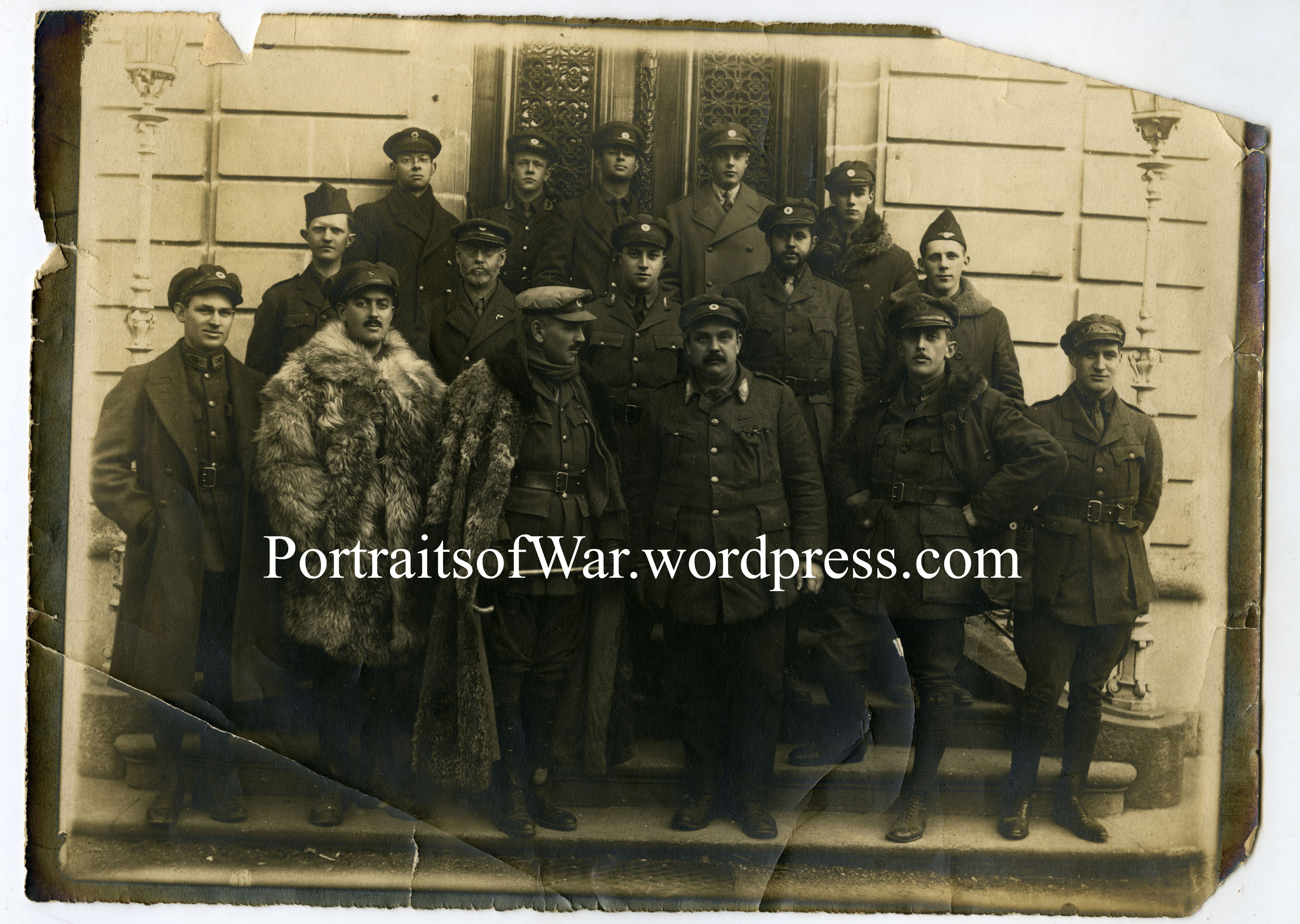
US Ambulance Drivers in France
This is possibly one of the clearest shots of Richard Norton I’ve seen in a digital form on the internet. Norton was the son of an influential Harvard archaeologist named Charles Norton who bankrolled a group of well-to-do American men to travel to France to assist in the movement of wounded soldiers from the battlefields. In this photo we see Norton posed with his fur overcoat, swagger stick and uniform. I’m guessing this photo was taken to depict a certain group of men overseas at the time. My best educated guess is that it was a photo taken of all the Harvard men in the Ambulance Corps at the time. Who knows?

Richard Norton

E.E. Cummings?
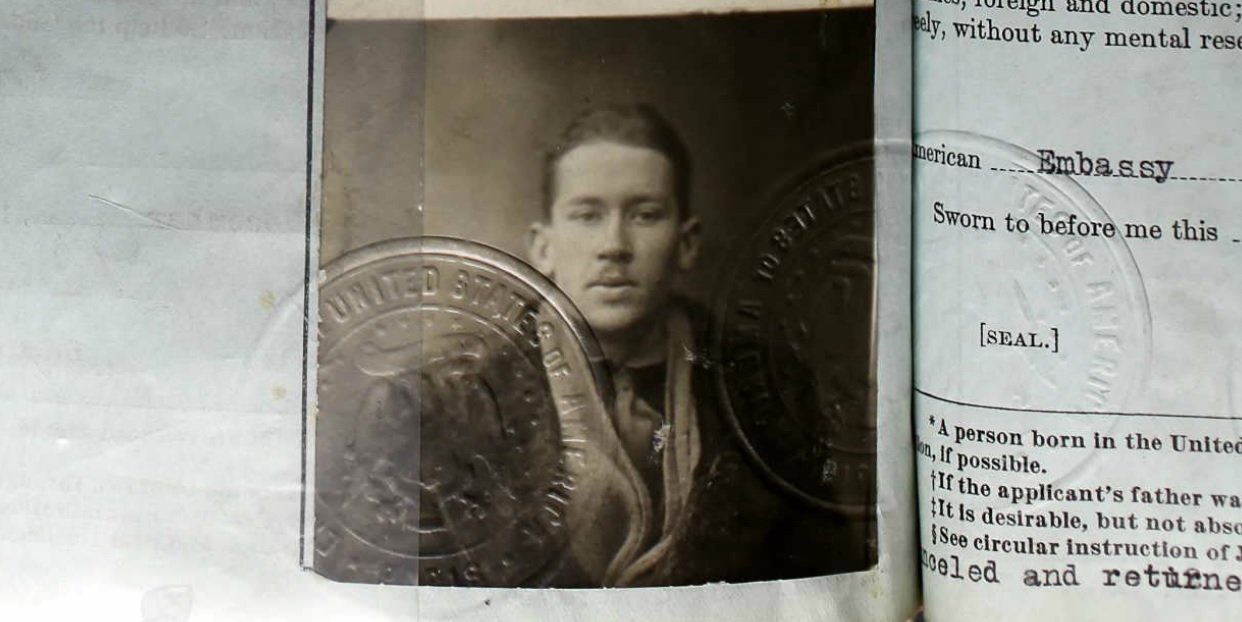
Edward Estlin Cummings
1917 Passport Application for travel to join the Norton-Harjes Ambulance Corps

 Portraits of War