WWII Press Photo – James “Jack” C. Warren Wounded in Normandy, July 1944


From time to time, I like to browse the pages of eBay in search of portrait photographs of identified U.S. soldiers — small windows into the past that I can casually research to uncover the individual’s story and their role in whichever conflict they served. In today’s post, I was drawn to one particular image: a portrait captured by a British photographer. Unlike the widely circulated press photos that often made their way into American newspapers, this photograph was unlikely to have been distributed stateside and equally unlikely to have fallen into the hands of the soldier’s family.

When soldiers were photographed, it was common for them to provide their names, ranks, and often their hometowns. Yet in most cases, there was little chance for photographers or newspapers to follow up and let those soldiers know that their likeness had appeared in print. That disconnect is part of what makes original press photographs so compelling today. Many remain unpublished, and most have never been thoroughly researched. In fact, I’ve noticed a growing trend in 2025: more and more World War II–era press photos are surfacing on the secondary market, offering new opportunities to rediscover stories that might otherwise have been lost.

PFC James “Jack” C. Warren of Kentucky

The photograph above was discovered in August 2025 during one of my routine eBay searches for intriguing portrait shots of World War II servicemen — images that spark my curiosity to uncover the stories behind the faces. This particular shot is especially striking: crisp, tightly framed, and, based on the other photographs sold by the same seller, likely taken in England at a collection point for wounded or ill soldiers. I cleaned up the scan and cropped the edges to make it more visually appealing for digital presentation.

The next question became the most important one: how do we identify him?

Reverse Side From eBay

What do we know?

The photo was taken on July 13, 1944 at a port in the South of England.

The photographer worked for a British newspaper.

The subject of the photo is a PFC J.C. Warren from Kentucky and was wounded.

The photo was approved for publication by US censors a few days later.

Who was J.C. Warren?

Given the information provided in the brief writeup on the reverse side of the photo, we know that the subject is a young male, likely aged 18-24 from Kentucky named J.C. Warren who was wounded or injured at some point after the D-Day landing a month earlier. His “walking wounded” paper tag (Form 52b-MEDICAL DEPARTMENT, U.S.A. (Revised October 25, 1940), 16-15434) seen poking up at the bottom hints that he wasn’t disabled or infectious. With that information in hand, I began narrowing the search. Since the most common first names beginning with “J” at the time were James and John, I started there, turning to an obscure database that tracks U.S. servicemembers admitted to hospitals during World War II.

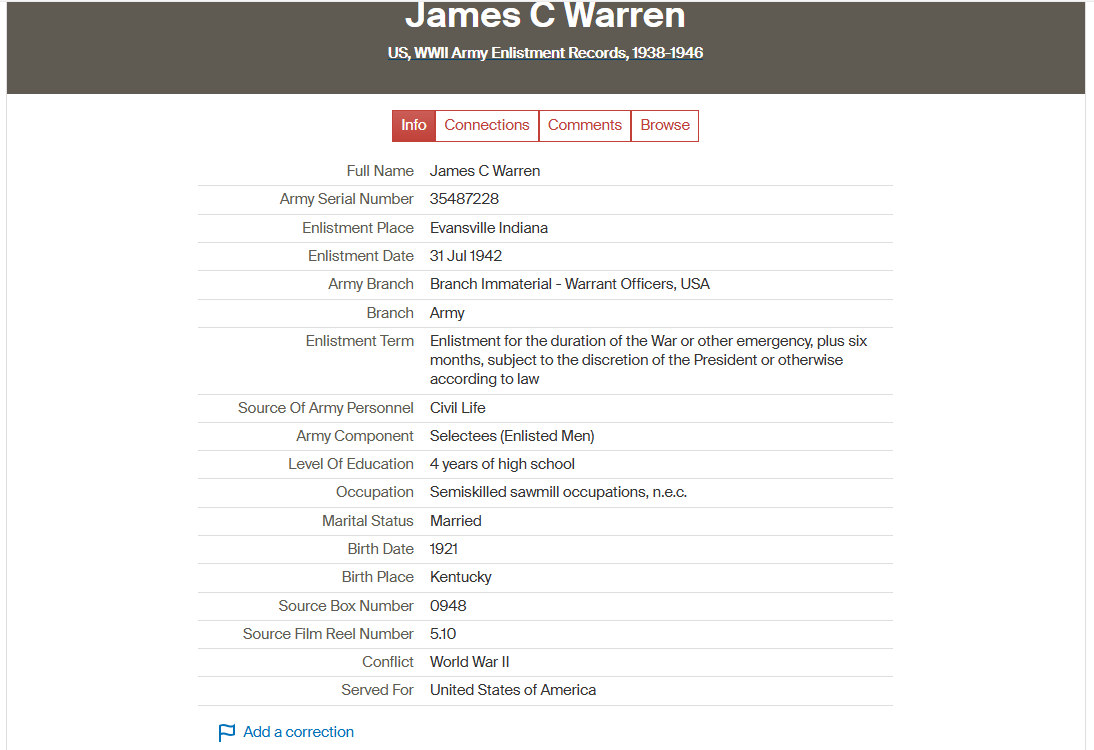
After only a few minutes of typing I found a hit to a James C. Warren with the Army Serial Number(ASN) of 35487228, and the only J C Warren who was from Kentucky that was admitted to a US hospital in July of 1944.
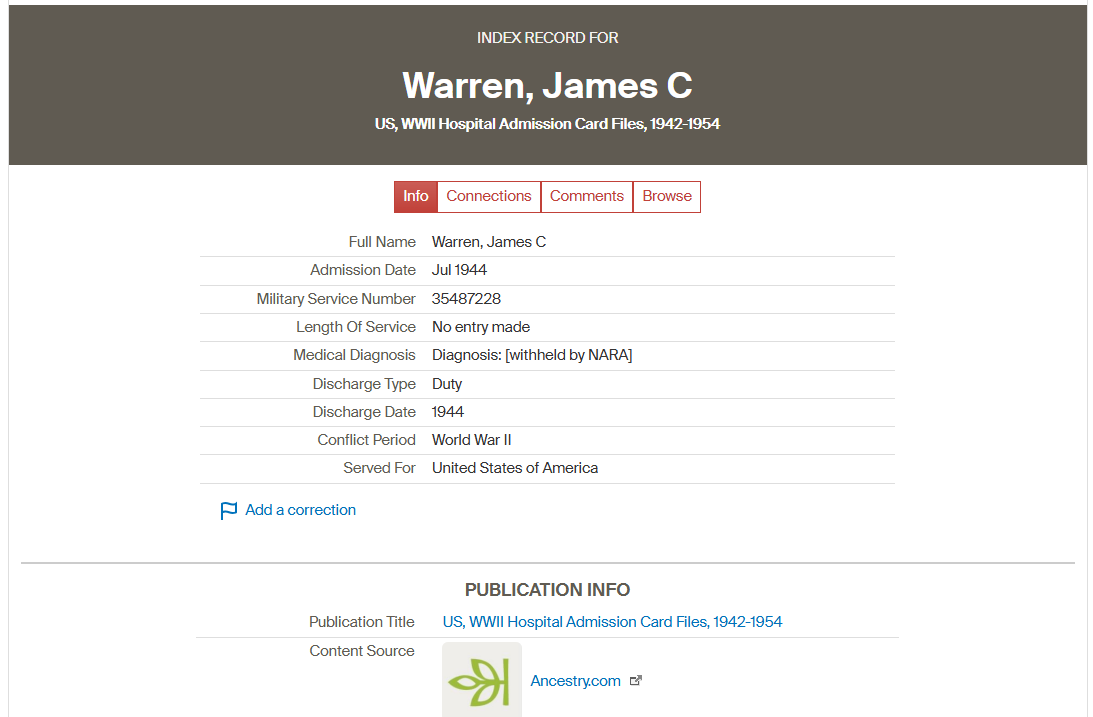
WWII Hospital Admission Card for James Warren

And when looking up his ASN…

WWII Draft Registration Information

With confirmation like this, I decided to dig deeper into PFC Warren’s life story in hopes of pulling out a few more details about his life story. Luckily, Ancestry.com and Fold3.com provide prompts based on confirmed information when researching so I was quickly on my way down the rabbit hole.

Veteran Headstone Application Form

It’s always a bittersweet discovery when I come across one of these documents, which tend to surface most often for veterans who passed away between the 1950s and 1980s. This particular record (which I’ll share below) shows that PFC Warren served with the 816th Ordnance Base Depot Company, a unit stationed in southern England at the time of his hospital admission. Interestingly, there is no mention of a Purple Heart on the form. That leaves me to wonder whether his injury did not meet the criteria for the medal, or whether it simply wasn’t recorded on his discharge papers after the war. Perhaps his family would know the answer.

Veteran Headstone Application

Luckily, the document provides just enough detail to shed light on who James Carmen Warren sadly left behind when he passed away in 1968. Born on April 8, 1921, he died on August 8, 1968, at the age of 47. He was survived by his wife, Mary Emma Green Warren, along with their two sons, Ivan and James C. Warren Jr.

More to come!

Roy H. Oplinger and the 158th Aero Squadron Survive the Sinking of the SS Tuscania


Survivors of the Sinking of the SS Tuscania

The 158th Aero Squadron and the Sinking of the SS Tuscania

On the night of February 5, 1918, the troopship SS Tuscania was steaming off the coast of Islay, Scotland, when it was struck by a torpedo fired from the German submarine UB-77. The liner was carrying over 2,000 American soldiers bound for the Western Front as part of the earliest waves of U.S. troops to join the fight in Europe.

Among those aboard were men of the 158th Aero Squadron, a newly formed Air Service unit. Organized in late 1917, the squadron was composed largely of young Americans who had trained in Texas before embarking overseas. Their mission would be to support the burgeoning U.S. Air Service in France, a much needed element of warfare in the late stages of WWI.

When the torpedo struck, chaos erupted. Lifeboats were launched into rough seas, and the darkness made rescue operations difficult. British destroyers and local fishermen rushed to aid survivors. Despite these efforts, more than 200 soldiers and crewmen were lost, making the Tuscania the first U.S. troopship sunk in World War I.

Footage of the Survivors of the Tuscania Sinking

The men of the 158th Aero Squadron were among the survivors. Shaken but determined, they eventually reached England and continued their training before heading off to France. Looking at this group portrait, it’s striking to think that every face here carries the memory of that night in the frigid waters of the North Channel. For the men of the 158th, their war began not in the skies over France, but in the dark Atlantic, clinging to lifeboats and praying for rescue.

Roy Oplinger and the 158th Aero Squadron

While the group photo provides us with an overall snapshot of the 158th Aero Squadron in the days after their harrowing ordeal, the photograph also highlights the wartime experience of an individual soldier who decided to send this image home to his family.

The reverse side of this English postcard has a few unique elements that help point towards the ID of the soldier who sent the postcard home in 1918. The first and obvious clue is that the photograph is likely related to someone who served with the 158th Aero Squadron. The following clues can be found on the reverse side of the postcard.

Reverse Side of Postcard

The additional clues are pretty obvious given the stamp at the top right-hand corner paired with the writing on the bottom. We know his name is Roy, and that his Army Service Number was 250033. Using the powers of ancestry.com and fold3.com I was able to identify the sender as Corporal Roy Holden Oplinger who served as a mechanic with the 158th Aero Squadron. Born on May 8th, 1896 in Danielsville, PA to Adam and Edna Oplinger, Roy went on to enlist for the draft on June 5th, 1917 with a listed address in Walnutport, PA. What doesn’t jive is that he was a private at the time of the sinking of the SS Tuscania, so it appears that he didn’t actually send this postcard to his family (if ever) until later that year when he was promoted to corporal in October.

Roy’s WWI Draft Registration Card

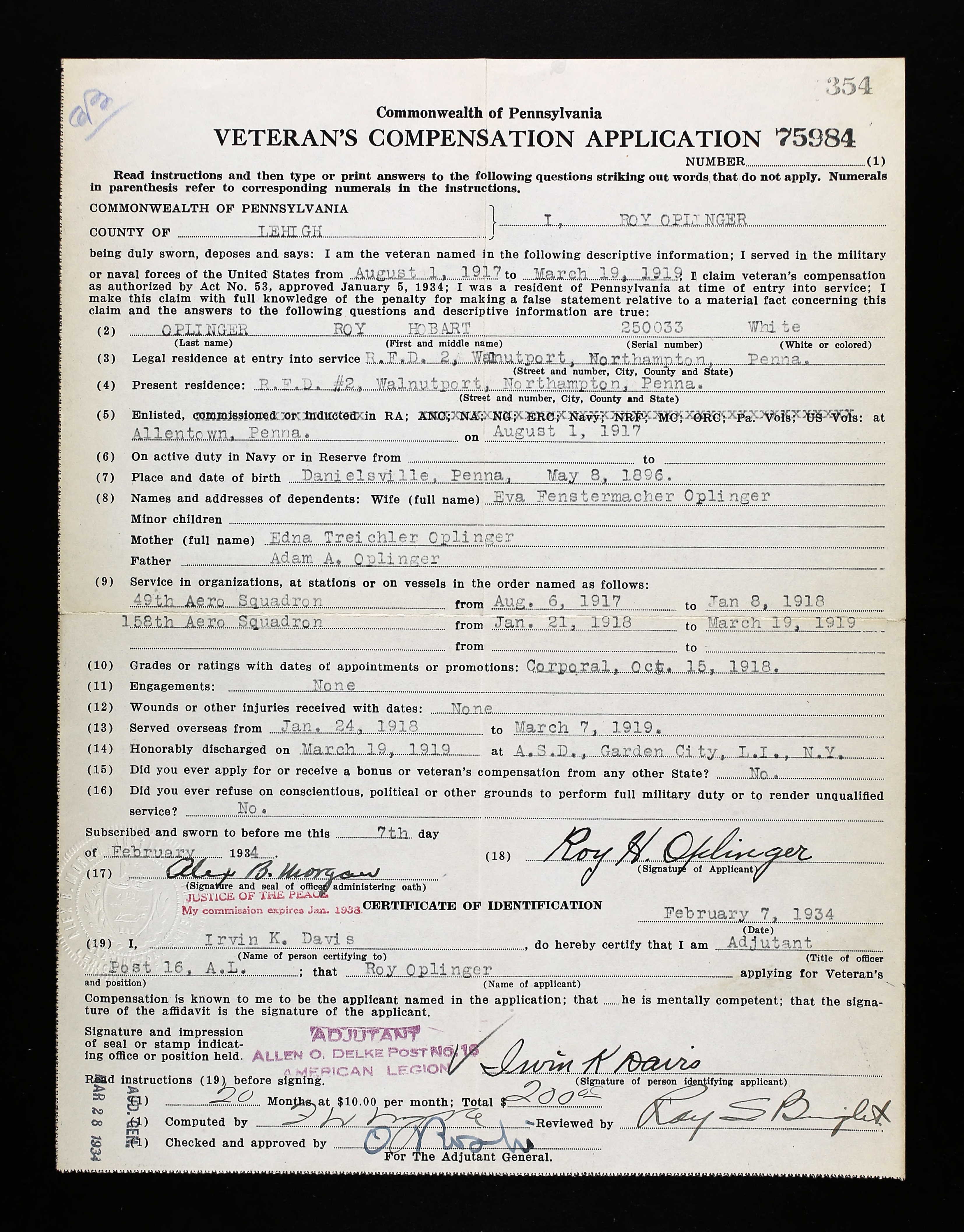
According to Roy’s WWI Pennsylvania Veteran’s Compensation Application, after enlistment he went on to serve with the 49th Aero Squadron (an obscure pursuit squadron) in August of the same year and then on January 8th of 1918 with the 158th Aero Squadron shortly before his departure aboard the SS Tuscania.

WWI Pennsylvania Veteran’s Compensation Application Form

A Letter Home to a Friend

In a rare stroke of luck, I struck photo researcher gold after searching for newspaper articles related to Roy’s WWI service. In this case, it looks like he sent a letter home to a close hometown friend, Samuel W. Danner on February 13th, 1918 only a few days before the group photo was taken. Anecdotes like this offer a rare glimpse into individual moments during the war, and I was lucky to stumble across it. Here’s a link to the The Morning Call, an Allentown, PA newspaper. Please disregard any typos in the OCR transcription of the article.

Roy H. Oplinger Private in 158th Aero Squadron now in France received the following letter: American Rest Camp, Winchester, England.

February 13, 1918. Dear Sir: best of health and hope you are well I will let you know that I am in the same in America. I will let you know that I have experienced the Torpedoing of the S. S. Tuscania.

The very first ship sunk with U. S. Soldiers on board. I had a narrow escape, I was on deck when we were submarined, but was soon floating on the Atlantic waters on a raft, shortly after we were struck about one hour and a half later we were picked up by a British patrol boat.

If the ship would have sunk as quick as the Lusitania, why I think we would have perished. The S. S. Tuscania went down some hours later, she was torpedoed about supper time somewhere on the Irish coast. How many lives were lost I am unable to tell.

Only a few of our squadron The clothing and my personal belongings I had with me are all the articles I have, all the rest of my stuff is at the bottom of the sea with the Tuscania. But my gold watch which mother presented to me as a present some years ago is out of commission as the salt water did not agree with her very well. I do not like the taste of it myself, it does not feel very comfortable to be in the water this time of the year. But I was kept warm as I was the only one on the raft that knew how to handle an oar. So you see what I had to do to get away from that sinking ship.

There is danger in being too near a sinking vessel as the suction will at times suck persons down that are near. I paddled along and when rescued we eight boys on the raft were a few miles from the ship. We were somewhat soaked. But I am dry by the time you received this letter. Ha Ha.

I will never forget that shock of that torpedo which hit us on that night February 5, 1918. The boys were brave and sang national hymns when we let her go down. Every soldier was coal as jar as I know not one was panic stricken, all left that ship in an excellent manner and can tell you from my experience what I have had in seeing a ship sunk. That you can thank God if you never have to witness that kind of a sight on a rough sea. I am sure glad that I am safe.

It was God’s will that only a few lives were lost in the ship wreck. I will sure do my best to do a little harm towards “Kaiser Bill” as he has to account for the lives that were lost on that cold night (you know). I am yours as before.

Address, Priv. Roy H. Oplinger, 158th Aero Squadron. A. E. (via) N. Y.

And Some Insight From a Friend

Fast forward to 2025, here’s some information about the photo from a WWI researcher friend of mine, Charles “Chuck” Thomas. Thanks Chuck!

Chuck’s Take

Here is a special image of the surviving members of the 158th Aero Squadron shortly after arriving at the American rest camp in Winchester, England. This squadron was aboard the Tuscania when it was sunk by a German submarine off the northern coast of Ireland 5 February 1918. When the 158th AS was reassembled at Winchester, it was determined that seventeen men had been lost during the sinking. After the picture was taken, the flying officers were sent to France for training and the enlisted members were broken up into four flights: one flight was sent to Beverly, Yorkshire and the other three went to Lincolnshire, England.

The squadron would later be reunited and sent to Issoudun on 27 September to finish out their service at that aerodrome.

The squadron officers were:

1st Lt. Phil E. Davant

1st Lt. Herbert B. Bartholf

1st Lt. J. W. Blackman (Gorrells has it spelled ‘Blakcman’ – typo?)

1st Lt. Merle H. Howe

1st Lt. Miner C. Markham

2nd Lt. Kenneth S. Hall

2nd Lt. Freeman A. Ballard

2nd Lt. LaRue Smith

2nd Lt. James McFaddan

Of note is the mixture of civilian attire with military uniforms being worn by some of the enlisted men.

I should also point out that the flag seen here was the only one saved during the sinking of the Tuscania by Corp. Guy W. Burnett.

Two Mississippi Doughboys in France, 1918


Finding vintage photography to post to the site that has meaningful background history has been a tough mission the last few years. I was recently inspired to start posting to the blog more often from a group of friends who enjoy seeing great photography mixed in with background research. This site has always been a labor of love and I’ve neglected posting new material (but have updated older posts) since the global pandemic hit. I now introduce you to a new addition to the collection that showcases an underappreciated aspect of the the WWI US service experience.

The process of making these shots web-ready is a bit tedious but it involves the scanning, editing for dust and scratches as well as optimizing size for the web. It’s not a quick task but I like to take time to make these available whenever possible.

Ernie Rayburn and Ollie Stiger Smoking Cigars in France, 1918

This photograph struck me when I first viewed it for a few reasons. The role of African Americans in World War One has been touched upon in books, documentaries and museum exhibits but the photographic history of the common labor war worker has been eclipsed by the “fighting” units that are often depicted. These two men, Erie Rayburn of Coffeeville, MS and Ollie Stiger of Jackson of the same state have likely never been shown online. These postcard style shots were often taken to be sent to friends and family as a way of remembering a time where the normal day-to-day life of the 1910s was upended and normal guys were thrown into abnormal situations.

Ollie and Ernie in France

Both Ollie and Ernie served in the same labor unit – the Depot Service Company No. II based out of Brest, France during the war. I’m unsure of what exact labor duty they would have been assigned to but it likely involved the moving of material onto or off of ships onto trucks or trains. More research will need to be done.

Ollie Stiger (also spelled Steger in later documents) was born on August 6th, 1892 (also listed as 1891?) in Mississippi and died in San Diego, CA in October of 1972. After the war he worked with the Chicago and North Western Railroad as a “coach cleaner”. I’m unaware of any children or family at the point of writing this post.

Corporal Erie Rayburn was also from the same hometown of Ollie of Coffeeville, MS and was born around the same time in 1895 and passed away a few years after Ollie in 1988. I sincerely hope they stayed friends after the war and after they parted ways to seek the true American Dream.

More research to come…

A Mormon Missionary in WWI: Battling Spanish Influenza in American Samoa


lds151websized

Byron Miller in World War One

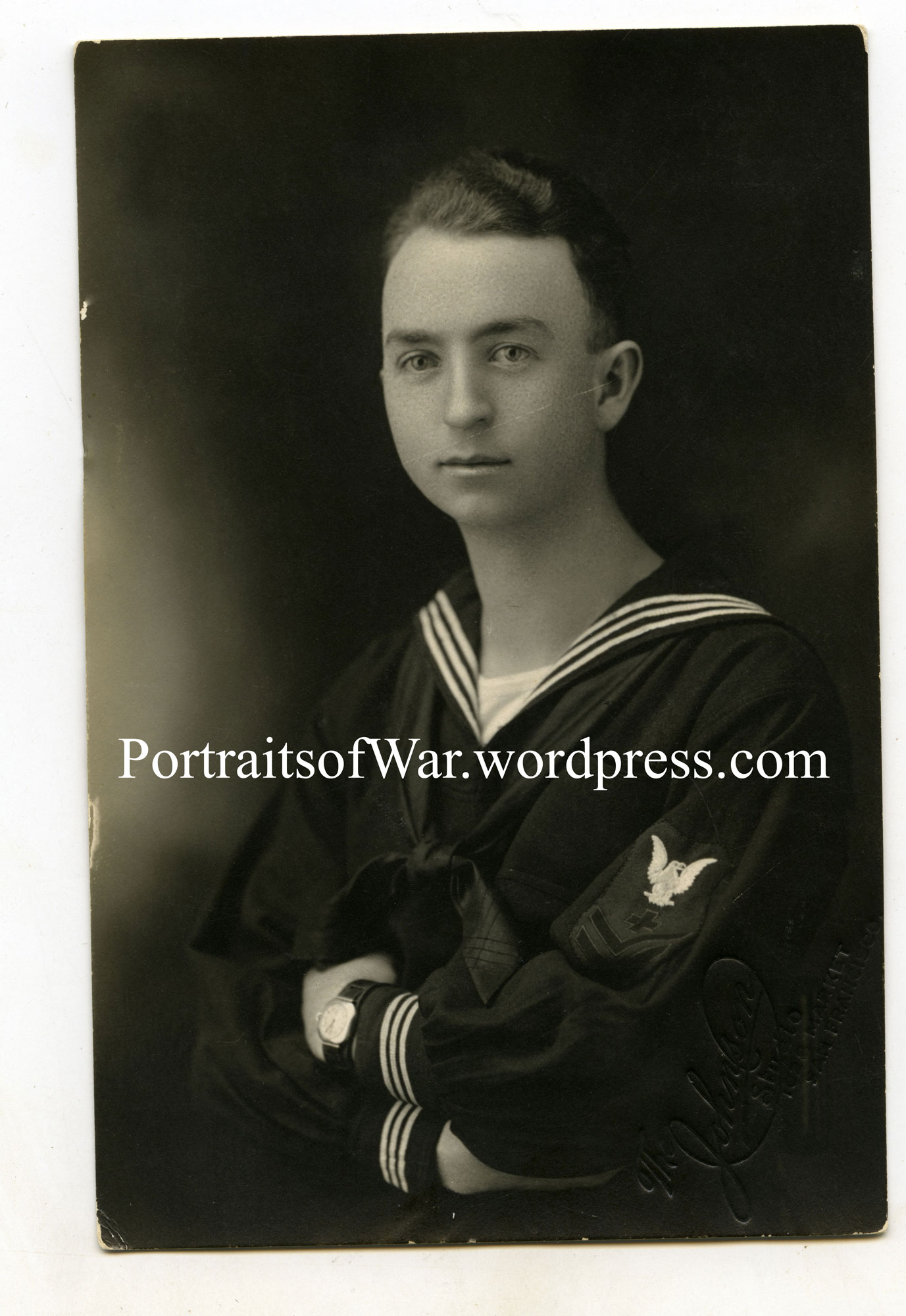
When searching for new portraiture to add to PortraitsofWar I generally tend to look for material with identifiable soldiers, uniforms, medals and other written or visual clues to help shed light on life during wartime. In this post, I will be researching a photograph of a US Navy sailor who caught my eye during a recent eBay search.

lds152

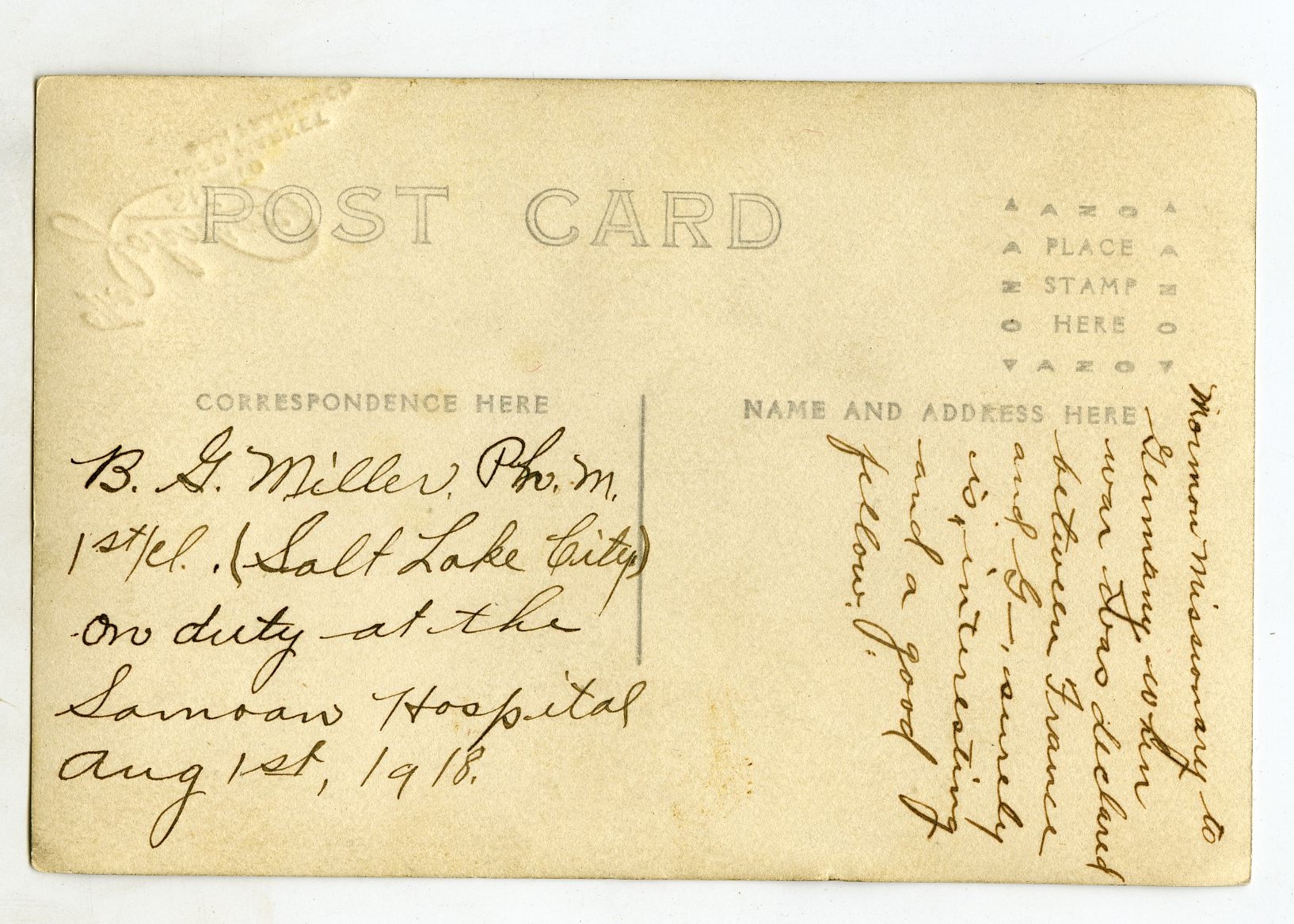
Reverse Side of Postcard

The information written on the back of the postcard shows an identification of the sitter as a B.G. Miller. He is identified as being a Pharmacist’s Mate 1st Class from Salt Lake City, Utah who was on duty at one point at a hospital in Samoa on August 1st, 1918. Additional info added to the photo includes an anecdote about his position as a Mormon missionary in Germany during the breakout of the war between Germany and France.

With a little bit of luck and a lot of research I was able to track down our mysterious B.G. Miller. Byron Gardener Miller was found listed in the Utah World War 1 Military Service Questionnaire on ancestry.com. Please see his card below:

31805_00025033-00051

Byron’s WWI War Service Card

It looks like Byron attended the University of Utah for a year before being shipped off for his overseas missionary work. This is likely the reason for his service as a Pharmacist’s Mate with the US NAVY as can be seen in the details of his uniform.

lds151ratepatch

Navy Pharmacist Rate Patch

The reference to his missionary service in Germany during the outbreak of war in July of 1914 is partially confirmed through my discovery of his listing aboard a ship ledger arriving in Montreal, PQ in September of 1914.

1914

His service in Samoa has also been confirmed through the same series of records.

sssonomoa

Sadly, his arrival back in the US in 1919 wasn’t likely a time of joy for the Miller family; a Utah death certificate shows that he died of the Spanish Influenza only a few months later on February 7th, 1920.  Interestingly enough, my research into the US Hospital in Samoa shows that a MASSIVE flu outbreak in the Samoan Islands lead to the deaths of nearly 25% of the population. With over 8500 deaths, the Spanish Flu was devastating to the island.  In response, the US Navy set up an epidemic commission to deal with the issue.  The results of the intervention in American Samoa were incredible.  Apparently the method of using maritime quarantine lowered mortality rates to nearly 1%.  It’s strange that Byron would die of influenza only a few months later while in the United State…

For the 1919 report please CLICK HERE

1920 Death Certificate

One of the main goals of this website is to help share photos and pertinent military service information with the families of the men and women depicted in the images I collect. In this case, I’m hoping a Miller family representative will discover a rare image of their ancestor who witnessed a formative time in history.

The French 111th Infantry Regiment in the Battle of Verdun


Tonight we have a guest post from a Facebook friend who also enjoys collecting WWI photography. Special thanks to James Taub for providing us with this interesting shot of a French soldier!

A Poliu of the unfortunate 111e régiment d’infanterie. During the Battle of Verdun, on 20 March, 1916 the 111e was in positions in the woods near Malancourt and Avocourt. (Later to be crucial points during the 1918 Meuse-Argonne Offensive.) They suffered under an intense German bombardment before being assaulted by flame throwers. The four German regiments from Bavaria and Wurttemberg infiltrated deep into the 111e’s position. The regimental commander, the colors the JMO (war diary), and 1,200 other officers and men were lost, many taken prisoner. The Germans used the capture of the 111e as propaganda, and the French Army responded by disbanding the regiment and accusing all 13 companies of treason. One French official even stated that “the uninjured prisoners before the end of the war be worked into a court-martial “. It would not be until the late 1920s that it was admitted by General Petain that the regiment was one of the many sacrificed to slow down the German assault. In 1929 the 111e was reformed, and their colors allowed to hang in Les Invalides

Capitaine Jean Nardou of the 111e wrote:

“A 7h00, un bombardement très violent commence (grosses torpilles et engins de tranchées de toutes sortes) sur nos tranchées de première série et petits postes ; obus de gros calibres sur les deuxième séries et boyaux.
Vers 9h00 j’envoie à mon chef de bataillon la communication suivante par un planton : “Les tranchées sont détruites, les abris démolis ou bouchés ; le téléphone, le bureau sont en miettes, la poudrerie a sauté, mes papiers sont détruits, la situation me paraît très critique”. Le bombardement a continué avec une intensité de plus en plus grande et est devenu d’une violence inouïe après 15h00. A partir de ce moment , tout mouvement dans les tranchées et boyaux était impossible, tant le bombardement était grand. Un peu avant 16h00, les Allemands ont lancé des liquides enflammés sur plusieurs petits postes qu’ils ont également fait sauter à la mine et ont profité de la fumée noire et épaisse qui se dégageait pour s’approcher de nos tranchées qu’ils ont attaquées de revers et de face à l’aide de grenades, pendant que leur bombardement continuait.”

“At 7:00 am, a very violent bombardment begins (big mortars bombs and trench machines of all kinds) on our first series trenches and small posts; shells of large caliber on the second series and dugouts.
Around 9:00 am I send the following communication to my battalion commander: “The trenches are destroyed, the shelters demolished or plugged, the telephone, the office are in pieces, the blowing snow has blown up, my papers are destroyed, the situation seems to me very critical “. The bombing continued with increasing intensity and became incredible violence after 15:00. From that moment, any movement in the trenches and dugouts was impossible, so much was the bombing. A little before 4 pm, the Germans fired flamethrowers on several small posts that they also blew up at the mine and took advantage of the thick black smoke that was emerging to approach our trenches they attacked. from behind and from the front with grenades, while their bombardment continued.”

73482662_10221072262697085_5127926471632879616_n

French Poliu of the 111th Infantry Regiment

WWI 1st Division Photo Identification, Robert B. Alexander – Portage, Wisconsin Veteran


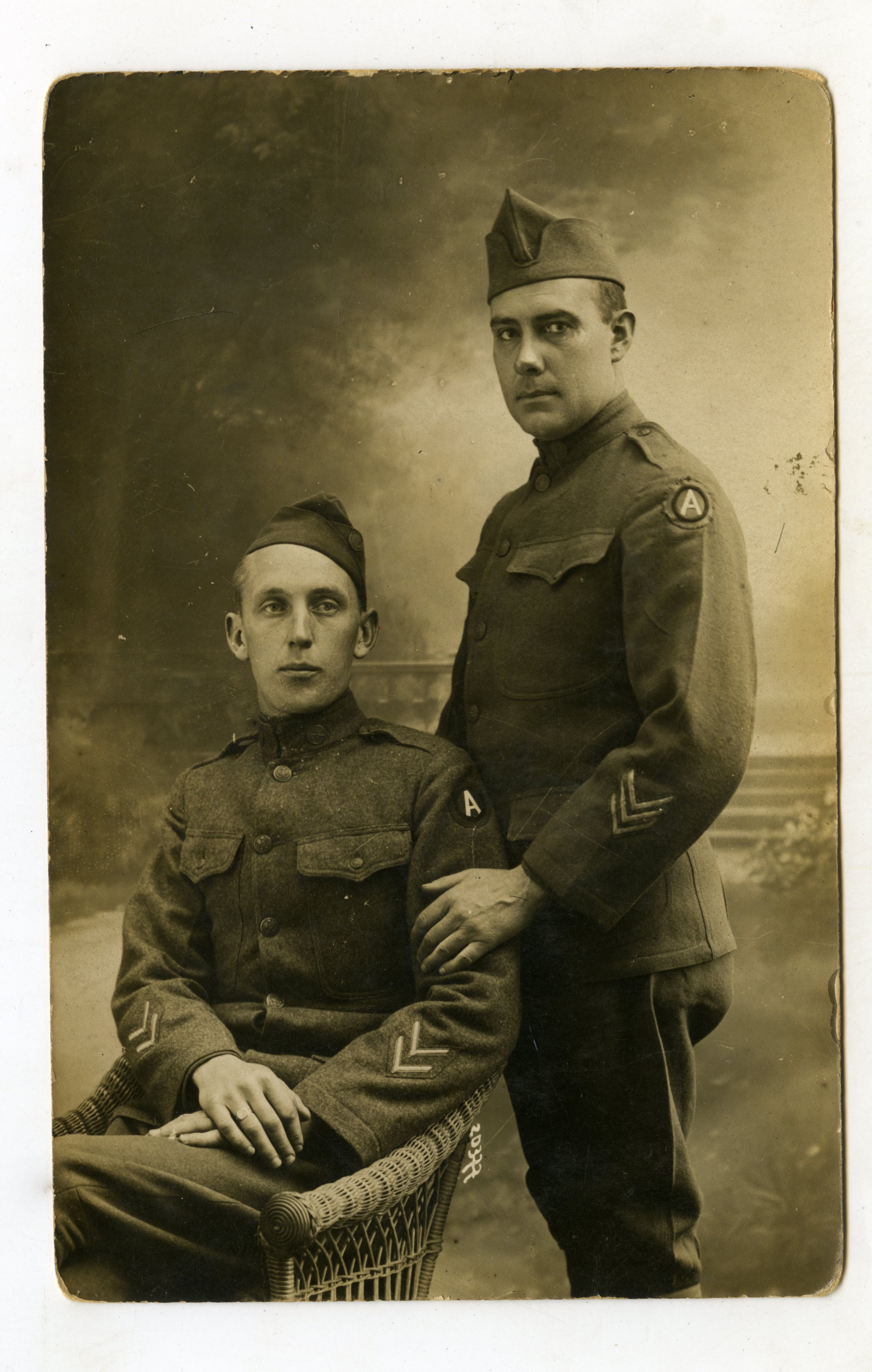
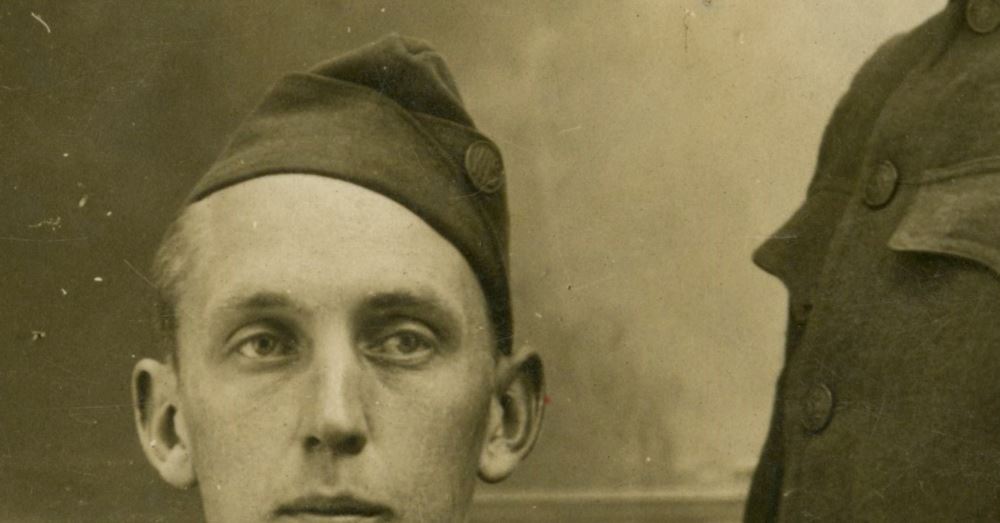
After a long hiatus I’ve decided to come out of obscurity and begin posting to the blog again! A recent Facebook purchase from a WWI collecting colleague has proved to be a classic PortraitsofWar photo for interpretation. The photo depicts two US soldiers posed in a German studio during the postwar occupation of Germany in 1919. The soldier at right is shown with three overseas (OS) stripes on his left cuff denoting 1 1/2 years of overseas service as well as a French-style cap. Both soldiers are wearing 3rd Army patches on their left shoulders, which would have been worn during the postwar occupation period. The seated doughboy is sporting two wound stripes as well as two OS stripes and a Wisconsin collar disc on his cap. The reverse of the photo lists one of the soldiers in the photo as Robert B. Alexander of 914 Adams Street, Portage, WI. Given that the seated soldier is wearing a Wisconsin disc on his cap, it is presumable that the identification on the reverse is leaning towards the sitter at left.

16thInfantry022

Pvt. Robert B. Alexander (seated), Co. F 16th Infantry Regiment, 1st Infantry Division

103rd0711

Reverse Identification of Pvt. Alexander

Some quick research revealed that that Pvt. Alexander was born on April 20th, 1892 in the town of Portage, Wisconsin to Robert M. and Mary Alexander. He lived much of his teen years at 913 and 914 Adams Street in Portage and was listed as working as a switchman with the Chicago, Milwaukee, St. Paul and Pacific Railroad as of 1917 before he enlisted in August of that year.

RR

Railroad Switchman, Ca. 1940

914

914 Adams Street

Attempts to find a photograph of Robert Alexander using traditional research methods failed, but I was able to track down a yearbook photo of Robert’s youngest son. Claire Alexander sat for a yearbook photo in 1944; a side-by-side comparison leaves no doubt in my mind that Claire is a progeny of the seated doughboy.

dudeclose

Pvt. Alexander

sonclaire

Claire L. Alexander in 1944


Wartime Service

Research into Alexander’s wartime service has revealed that Robert was involved in heavy combat in September of 1918 only months before the end of the war on November 11th, 1918. His accolades are laid out in an unlikely document:

silverstar

Veteran Headstone Document

silverstar2

Reverse of Above Document

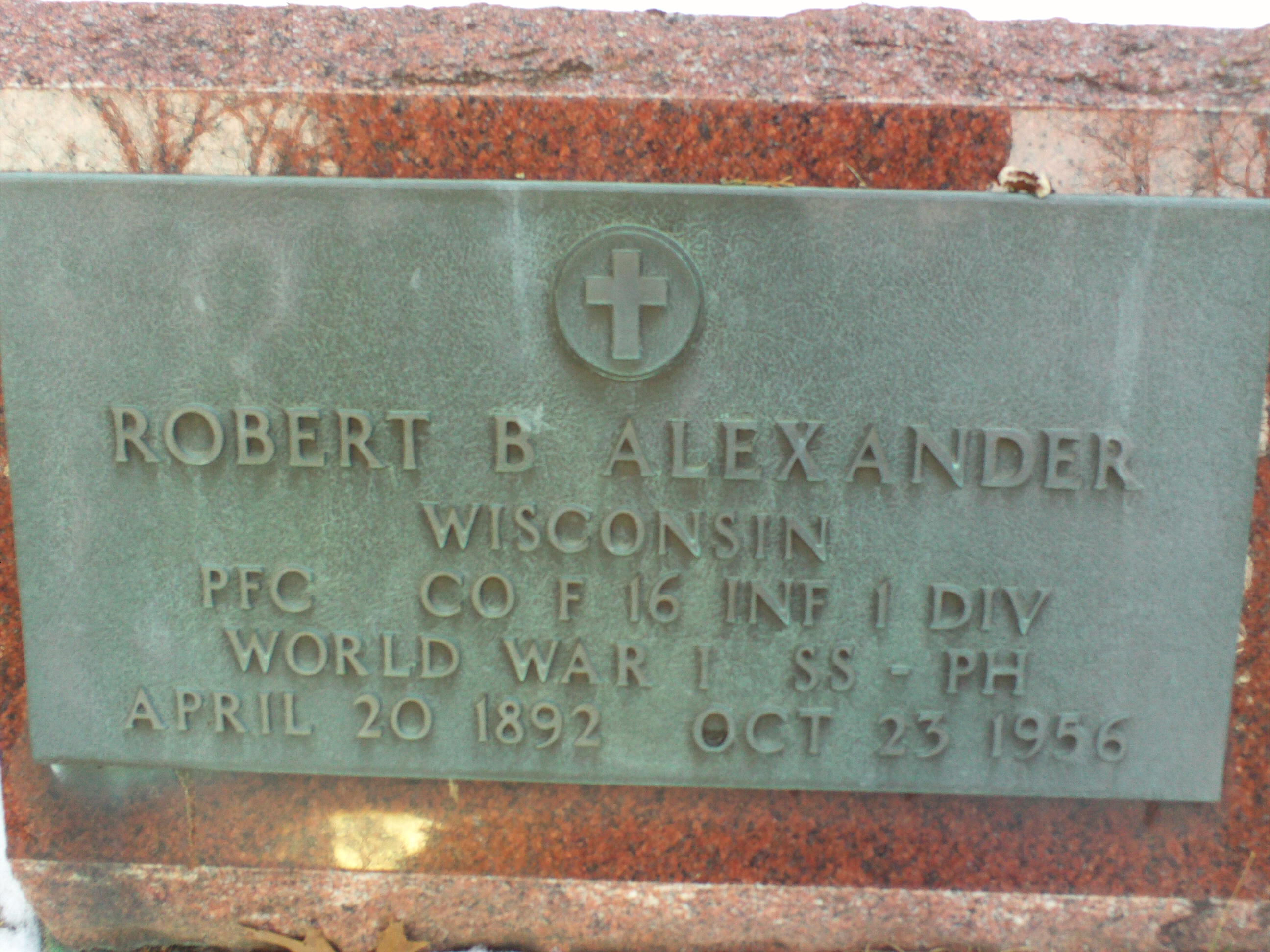
This document confirms that Robert served with Company F of the 16th Infantry Regiment, 1st Division. He was wounded at least once and received the Purple Heart (After 1932) and also the Silver Star. Details about his wounding and SS are still pending… stay tuned.

Private Alexander’s 1956 headstone was made by the Acme Bronze Company of Maple Park, IL and was delivered to the family on November 6th, 1956 following Robert’s death on October 23rd, 1956.

DCIM101MEDIA

Mr. Alexander’s Headstone (Courtesy of Findagrave.com)

Research into living members of the Alexander family have proven fruitful…stay tuned for details related to the reunion of this photo with a great-granddaughter!

Wisconsin

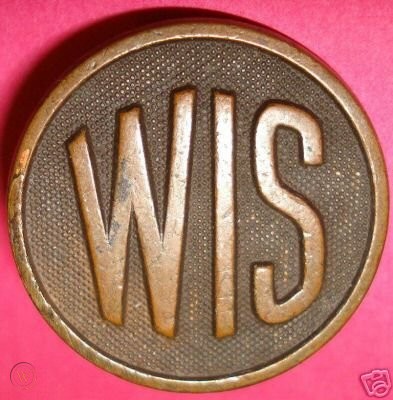
Wisconsin Collar Disc on Cap


wwi-collar-disk-disc-wis-wisconsin-national-guard-wi_1_88787f81f60301c5cdf36ab46f71d0fc

Wisconsin Collar Disc (Worthpoint Photo)


WWI German Trench Life – May of 1917


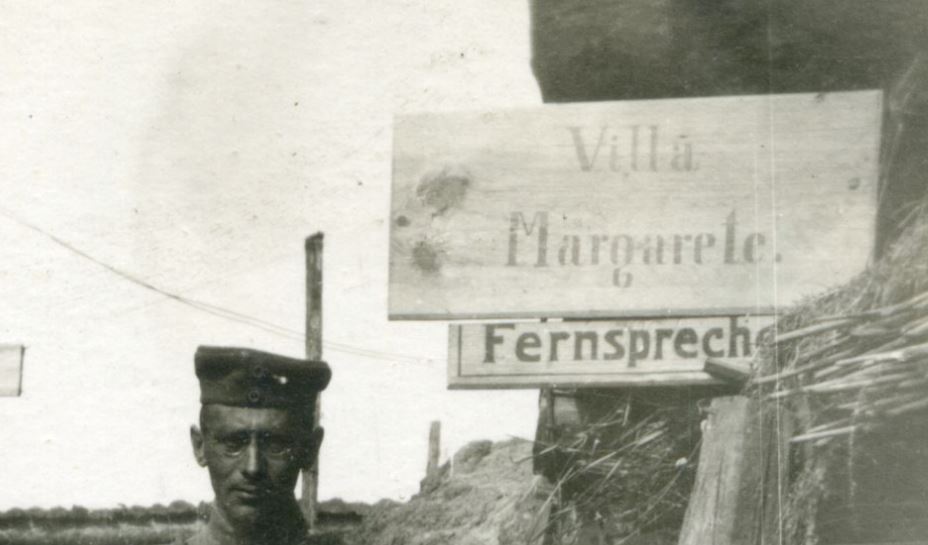
The main focus of this blog is to highlight individual photographs from WWI and WWII veterans whose photos have made their way to the secondary market; eBay and flea markets are a good way to find these photographs, and the typical image comes with little-to-no context. Today’s photograph shows a typical German trench in the spring of 1917 with a pair of handmade signs.

I collect WWI German trench signs and shots like this are a good way to identify the style and construction techniques of a period trench-made sign.

sign.JPG

Villa Margarete – Fernsprechen (Telephone)

German1917018

Translation Below

Thanks to a Reddit user I was able to translate the writing on the reverse side of the postcard:

In the dwelling trench by the phone dugout.

NCO Biernacki, me, NCO Schwabacher, ?? Puppchen of the artillery observers.

May 1917.

The trench signs that are shown in the image are as follows: Villa Margarete and Fernsprechen (Telephone)


WWI Portrait Photo – An AEF Soldier and a French Puppy, a Tribute to Violet


One of my closely held collecting secrets is that I love WWII and WWI photographs of soldiers holding or interacting with their dogs. My recently dearly departed furry companion Violet originally led me to start collecting shots of soldiers with their canine friends nearly eight years ago. Without her I would’ve never thought twice to bid on a dog photograph.

14708141_10102697620239280_8506601569270178893_n

Violet at the Hilton Portland, ME

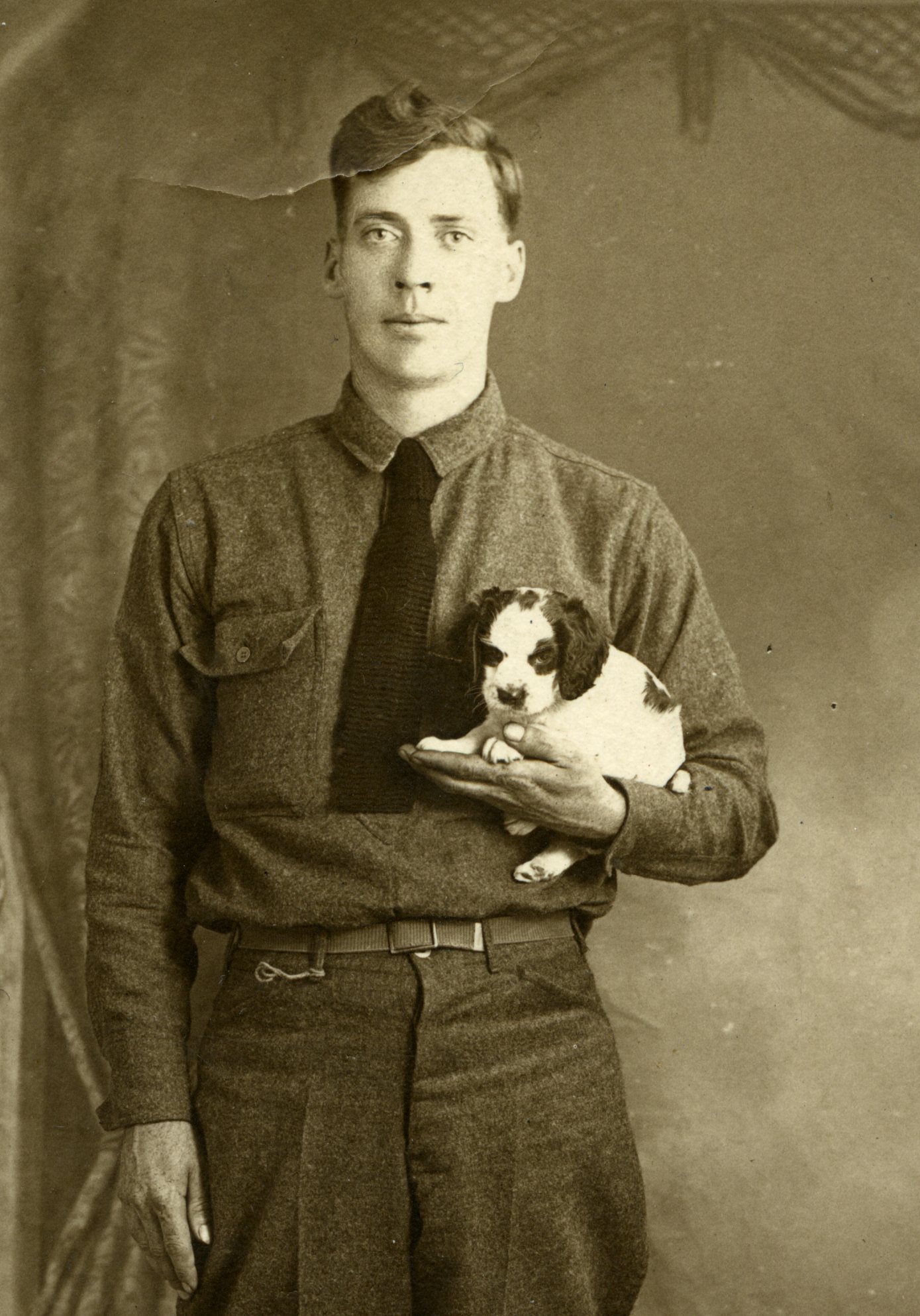
I dedicate this post to her. In this particular case, I bid on and won (eBay) a photograph of a US soldier holding a young puppy during wartime in France. Typically, shots of US soldiers holding dogs or other mascots were taken (at least that I’ve found) in the post-war era following the 11/11/18 Armistice. This studio photograph was taken on September 10th, 1918 and shows Thomas (Tom) Gray Jr. posing in a French studio with a puppy cradled in his left arm while sporting a custom knit necktie.

Dog076

Thomas Gray Jr. and a cute puppy!

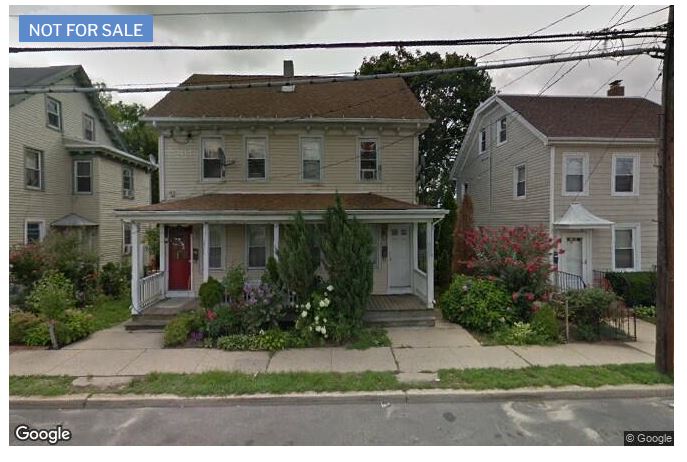
The photo was taken in September of 1918 and the writing on the back (see below) notes that Thomas had been overseas for ten months at this point. Additionally, he addresses the postcard photo to his mother, Mrs. Thomas Gray of 329 North Pearl Street, Bridgeton, NJ. After my normal run of extensive research it appears that his father and brothers worked, at some point, for a local glass factory as glass and bottle blowers. This company was likely the Cumberland Glass Works which was located not far from their duplex home. Additionally, the factory could’ve been the More-Jones factory that appears in a series of Lewis Hine photographs depicting child labor. In fact, Thomas appears in the New Jersey State Census of 1905 and is listed a “Snapper Boy” in the occupation column. So, at age 14 Thomas was working in a glass factory… Could he be one of the young boys captured by Hine?

Hine

Lewis Hine Photograph Taken in Bridgeton, NJ Ca. 1909


Dog078.jpg

Reverse side of the postcard

As far as I can tell, Thomas served with Company B, 501st Engineers and shipped out in November of 1917 and served until mid 1919 when he eventually went home to New Jersey with no mention of a companion. I wish I could learn more about the dog in his hand and about his service in this obscure unit, but I can only do so much research before moving on. I hope that a relative finds this post at some point and can help fill in the gaps. Crazier things have happened on this blog.

pearl

329 North Pearl Street, Bridgeton,NJ in 2018

WWI “Just Got Back” card deciphered – Railway Engineer from Minnesota


One of my favorite pieces of WWI ephemera to research is the pre-printed postcard that was handed out to soldiers intended to be sent to loved ones from the decks/bunks of the multitude of transport ships that brought doughboys back from Europe in the years following the war. In tonight’s case, I purchased this card on eBay without any prior research. The date of 9/11 caught me as particularly interesting given the 2001 connotation, so I made a quick bid and won the postcard. My research process can be followed below:

Step 1: Purchase the card

JewishCard040abcd

Only $9.89+0.99 shipping!

Step 2: Receive the card in the mail

JewishCard039

Front side of the postcard

JewishCard040

Back side of the postcard

Step 3: What the heck is going on?

The first actual step in the interpretation and research of a WWI postcard is to figure out when it was made, when it was sent and who sent it. This one should be pretty easy.

JewishCard040a

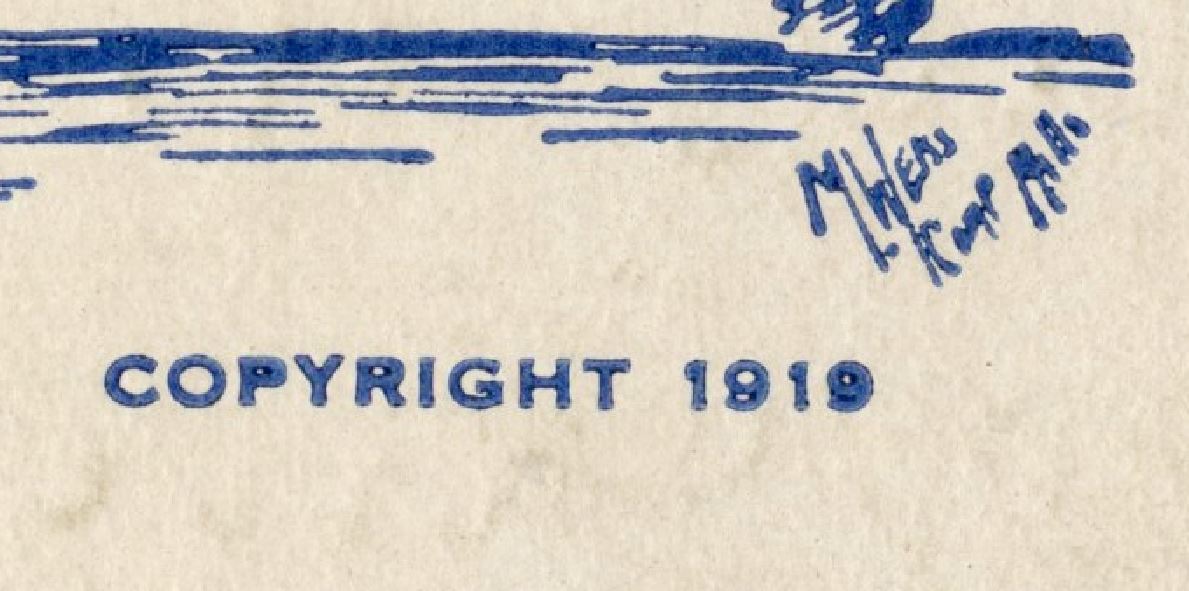
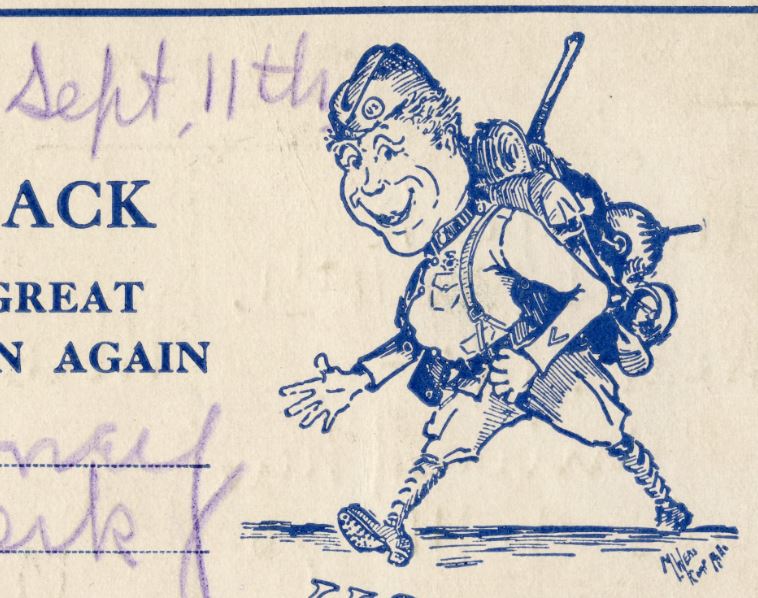
Copyright date of 1919

Most WWI postcards don’t usually come with a Copyright date and/or an artist’s signature. This one comes with both. I don’t have time to delve into the identity of the artist, but I can say that the card was copyrighted in 1919.

So, the written portion is from September 11th, 1919 at the very earliest.

JewishCard040ab

September 11th

Step 4: Who the heck sent this thing?

Whenever I attempt to identify a soldier-sent postcard, I always try to research the recipient first. Normally, we have the name of well established member of a community as well as a normal mailing address and town name intended as the recipient. Assuming most postcards are sent to a mother or father, it doesn’t take much effort to track down the 1910 census record for that family using Ancestry.com. This is exactly what I did in this case. The first Maroney to appear in the Eyota, MN 1910 census was a Patrick C. Maroney… Bingo.

JewishCard040abcde

1910 Census record

From here I researched the children of Patrick and Emma Maroney (the card says “Dear Ma”) and found that they had a son named Charles E. Maroney who was born on September 22nd, 1895 and passed away on September 5th, 1934.

charlesmaroney1

Charles’ September 11th, 1919 return to the USA

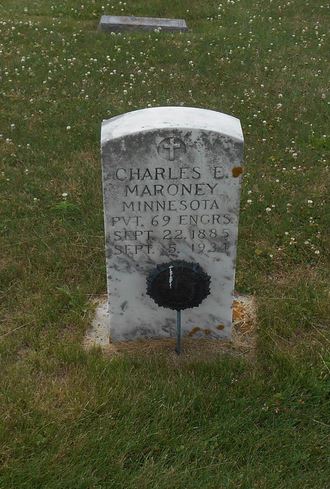
Charles signed in aboard the U.S.S. Montpelier after his time in France on August 28th, 1919 and landed back in the US on September 11th. It was at this time that he was most likely given the above card to fill out and ship to his parents back in Minnesota. His wartime record puts him with an engineering unit that was focused on railway work during the war and this tombstone identifies him as a Private with the 69th Engineers . This doesn’t exactly jive with his US Headstone Application or the US Army Transport records seen above. According to records, his grave should’ve listed him as being with the 144th Transportation Corps. Please note that his mother was also the recipient of his body after he passed away in 1934. 😦

144th

US Headstone Application

charlesmaroney.JPG

Charles E. Maroney’s resting place

WWI Portrait of Pvt. Louis Alterici of the 1st Gas and Flame Regiment in WWI


Pvt. Louis Alterici

I apologize for not posting more frequently, but I’ve been focusing on preparing presentations and talks for local historical societies here in my home state of Vermont. Tonight’s post is the first that focuses around a recently-purchased portrait photo. A dealer from the Philadelphia area has been selling off what appears to be an entire collection of WWI portraits from a Charleroi, Pennsylvania photo studio. Of the several dozen portraits sold by this seller in the past two months, I’ve been lucky enough to pick up two photos. The best of the two is the image photograph presented below:

postlow

Louis Alterici of Charleroi, PA

At first glance, this photograph clearly presents evidence of damage in the hands of an ink-wielding enemy. Who knows how this was damaged, but it didn’t seem to impact the final value of the photograph, which sold for a healthy $68.00. The particularly interesting elements of the photograph are presented here:

headsthot

English Style Cap and Engineer Collar Disc

patch

French Croix de Guerre medal w/ silver star and 1st Army patch variant


After a bit of research into the sitter above, it quickly became clear that he was an engineer with the 1st Gas and Flame Regiment, previously the 30th Engineer Regiment. As a Private with the regiment, he would’ve been involved in the maintenance and mobilization of Livens gas projectors during the last several months of the war.

Born on April 21st of 1897 in Naples Italy, Louis emigrated to the United States on May 26th, 1910 in hopes of linking up with family members in Pennsylvania. He gained his citizenship when he was naturalized in May of 1928 due to his service for the U.S. during the war.

The men of the 1st Gas and Flame would be charged with maintaining, resupplying and moving the Liven’s projectors during the tail end of the war. What did this involve?

LivensProjectorDiagramWWI

Levin’s Projector schematic


Louis is sporting a wound chevron in the portrait photo above – he was gassed on November 1st, 1918 only ten days before the Armistice of November 11th.

wounded

Note wound chevron (stripe) on right hand sleeve


It’s unclear through the records on how he received his gas wounds, but it’s highly probable that his gassing took place during the Meuse-Argonne Offensive, when the 1st Gas Regiment was actively moving forward during the “third-phase” of the offensive. The attack in which Louis was wounded began at 5:30 on the morning of the 1st of November. Sadly, the gas mortars that were projected that morning were done so under less-than-ideal conditions and it appears that shifting wind blew toxic gas back towards the 1st Gas Regiment. All those who were gassed during this event were brought off the line to Sommerance, France where they were treated. All of this information can be found in the unit history of the 1st Gas Regiment, which is hyperlinked here.

gassed1

Louis’ War Record (Note gassing date)

What Louis achieved after the war is unknown to me, but I hope that he lived a full and rewarding life. His war record and portrait will remain a part of my website, but I hope to pass the photo along to a relative one day.