American Civil War Villain: Lewis Powell and the Attempted Assassination of William Seward


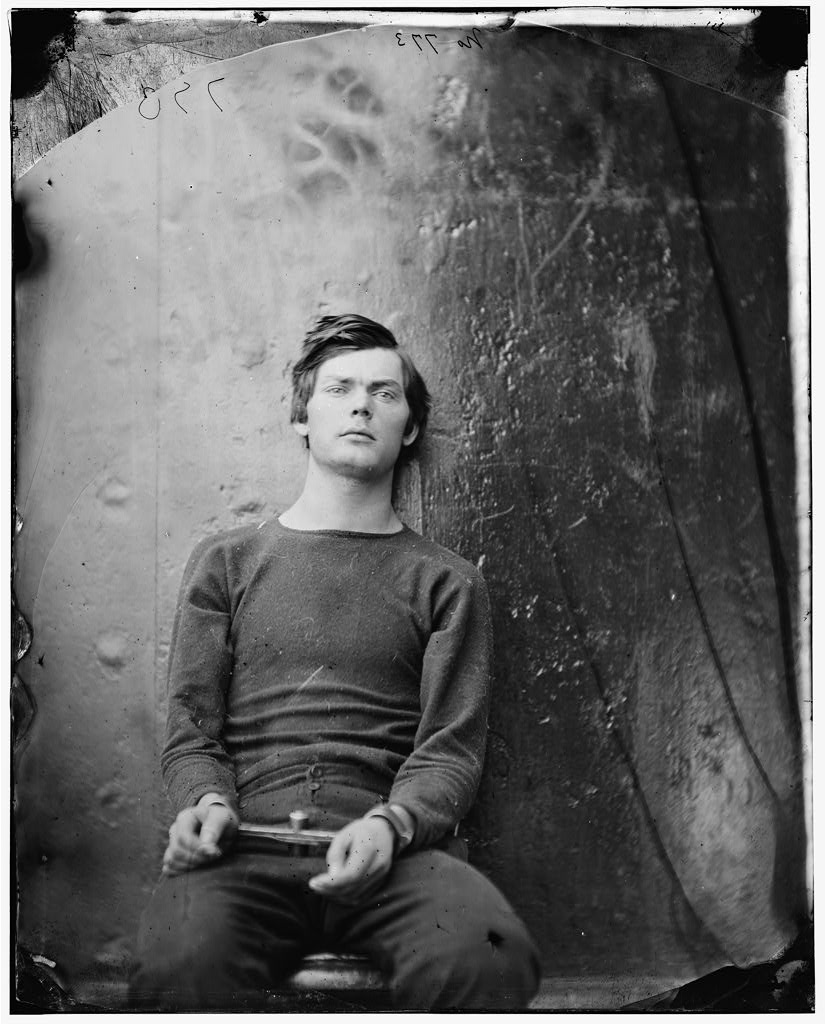
Alexander Gardner, famed Scottish photographer of the American Civil War/Lincoln captured the following image in the wake of the infamous assassination of Abraham Lincoln in April of 1865.   Shot in wet plate, the negative numbers of the images can be scrawled into the top portion of the plates.  See the 777 in the first shot, and the 773 of the second?  These descriptors made it easier for the photographer to identify specific images from a large selection of nearly identical plates.

Lewis Payne in Manacles

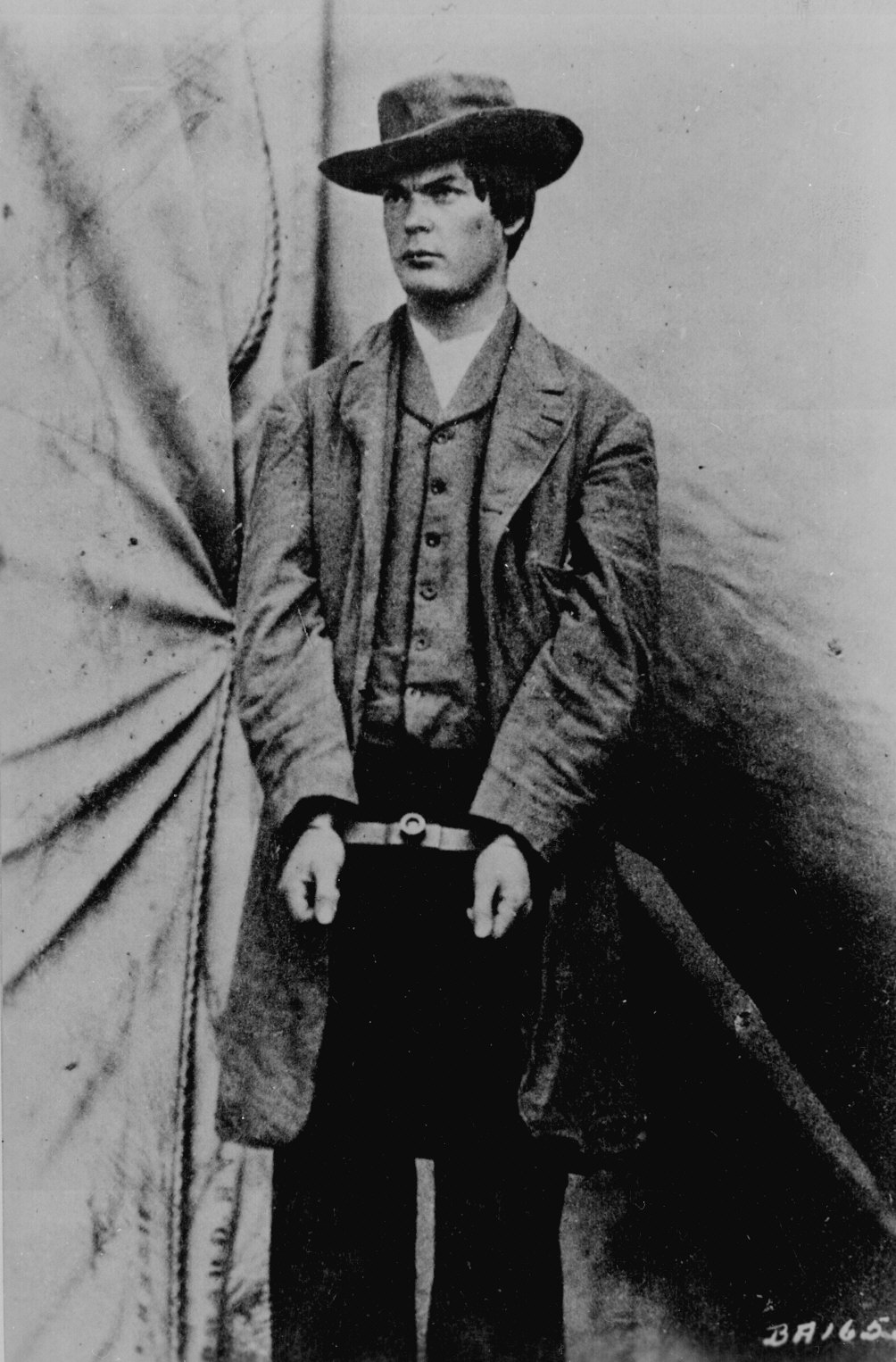
Lewis Powell in Manacles

Lewis Payne in Manacles Front Facing

Lewis Powell in Manacles Front Facing

Powell is infamous for his attempted kidnapping/assassination of Secretary of State William Seward (of Sewards Folly/purchase of Alaska).  Although details surrounding the event are well known, I will attempt to provide a curtailed version of the them in the following paragraphs.

During the American Civil War/War of Northern Aggression, Powell fought alongside famed Confederate badass, Colonel John Mosby.  One of Mosby’s Rangers, Powell fought in many of the major engagements with the Mosby’s Rangers until he deserted from the Confederate Army in January of 1865.

Fast forward a few months and we see Powell (or Payne, as he later associated) linked with the infamous Lincoln conspirator John Suratt.  Although the history is murky, it’s clear that Powell was captured without killing his intended victim, William Seward.

Given the main focus of PortraitsofWar, we’re going to focus on the photography related to the event discussed.  The aforementioned Alexander Gardener was able to acquire exclusive access to the prisoner(s) on April 27th, 1865. His photographs are some of the best and most detailed images of the Lincoln Conspirators:

Payne in Cuffs

Payne in Cuffs

Lewis Paine Recent in Recent Capture

Lewis Paine Recent in Recent Capture

After many hours of searching the internet, it became incredibly yet strangely clear that Lewis Payne/Powell was the most infamously handsome man of the American Civil War era.

Moving backwards in time (date 11/2015):

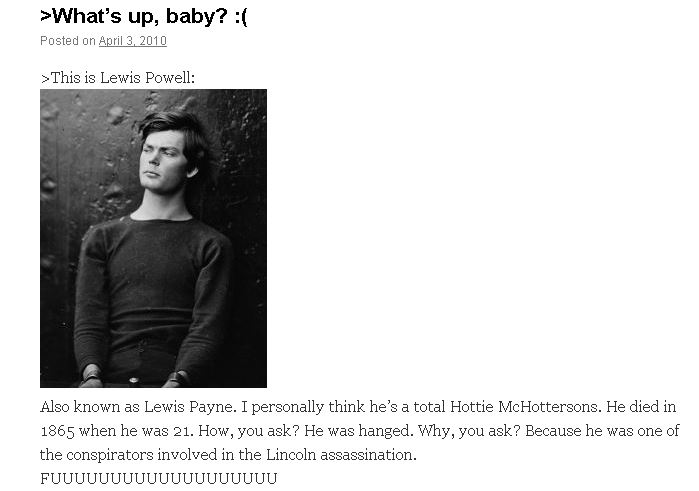
Listed on a “Historical Hotties” Website

Payne as a Hottie

Payne as a Hottie

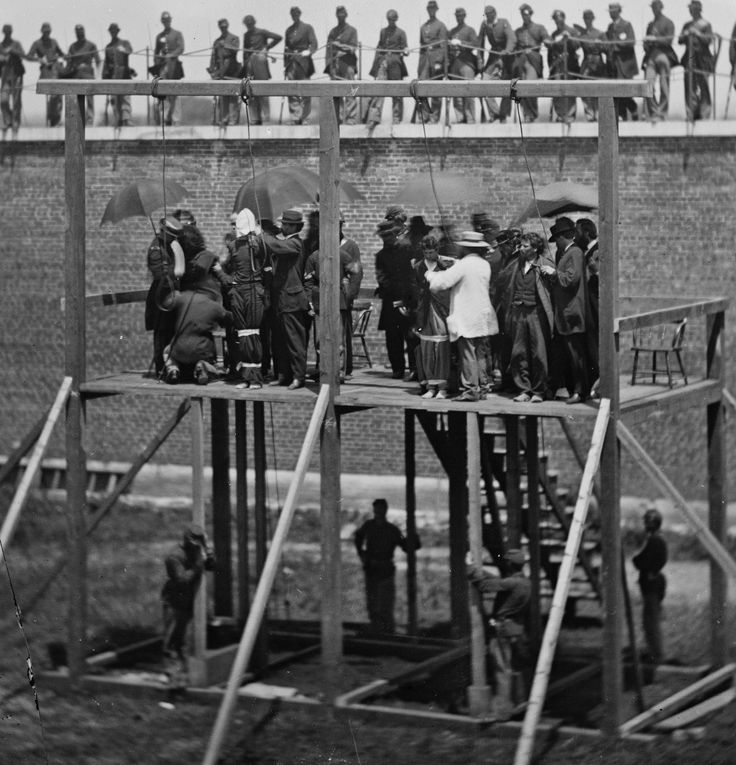
And another reference about Payne from his execution:

Payne Execution Details

Payne Execution Details

And finally, a site dedicated to the feel and expression of the image:

And the final shot of Lewis during his time among the living:

Pre-Hanging

Pre-Hanging

WWI Ohio Soldier Research – Defiance, Ohio Soldiers Identified as Ward Family Veterans


A recent eBay purchase has been incredibly fun to research and has yielded some solid and fulfilling results.  I purchased a group photo of four US soldiers posing in an American studio immediately following the war.  How do we know they are in an American studio?  The veteran at center is wearing a WWI Discharge Chevron, also known as a Discharge Stripe or Honorable Discharge Stripe, which indicates that the soldier has been discharged from his service and can wear his uniform in public with the proviso that he affixes the chevron.  Apparently, it was possible to be arrested for wearing a service uniform without the stripe after three months following discharge.
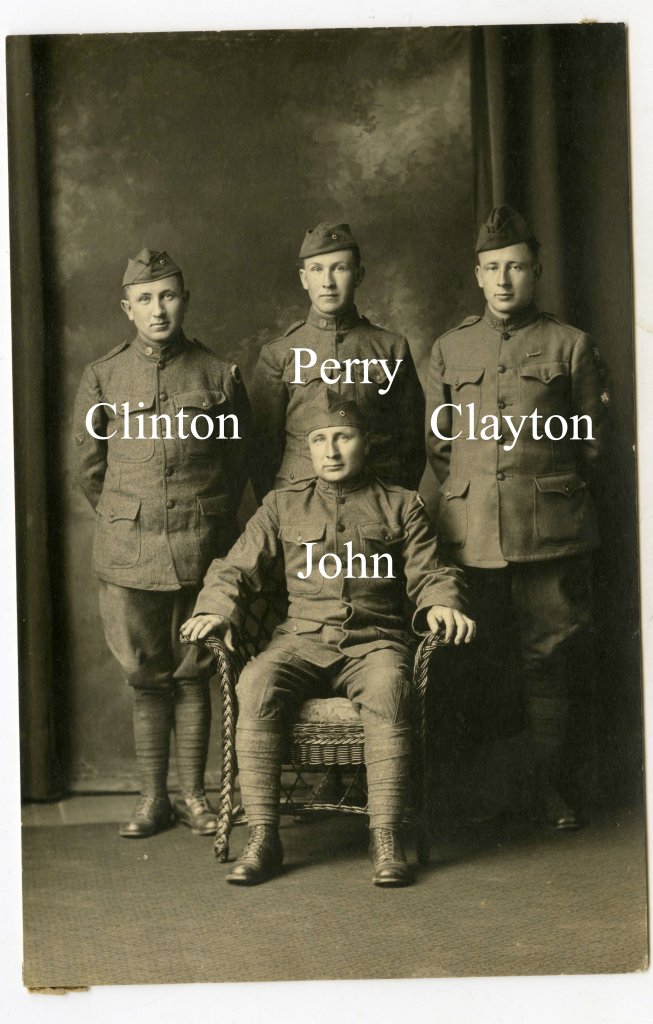
Ward Brothers

Ward Brothers

A fellow WWI researcher (Brian – AKA WWINERD) posted the following information on a popular militaria web forum:

“Thus far, I’ve been unable to locate any specific General Orders either from the War Department or from the U.S. Army concerning the red discharge chevron, which I believe was adopted early in 1919. However, I do know that:

  • Each discharged soldier was issued with three discharge chevrons. Officers had to purchase their own.
  • Upon being discharged from service, the uniform could be worn for a maximum of three months without the red discharge chevron.
  • If the uniform was worn after the three month period had expired, the person wearing it could be charged with the offense of impersonating a soldier.
  • If the uniform was never worn again the discharge chevron did not have to be sewn on.
  • As soon as a soldier received his discharge papers he became a civilian, and he was no longer obligated to salute a superior officer.

These and other facts pertaining to the uniform and discharge chevron were explained in a post war pamphlet handed out to Doughboys before they mustered out of the Army. It partially read as follows:
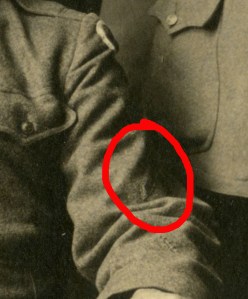
John Ward's Discharge Stripe

John Ward’s Discharge Stripe

The Uniform

If it is your desire to go home in uniform, it is your privilege to do so, under full grant of an act of Congress. You may wear your issue uniform as long as it hangs together if you wish. It is yours. But do not let a minute pass, after being discharged, until you have sewn on, or had sewn on a red chevron, point up, midway between the elbow and the shoulder on the left sleeve.

The wearing of any gold, silver, or metal device indicating service is forbidden. Only regulation service chevrons and collar insignia are authorized by law and regulations. Wound and service chevrons for service in any of the Allied Armies are included in that authorization. Can all camouflage.

Remember in wearing the uniform, that all of its privileges are yours, with none of the restraints. You are a civilian. There is no law or regulation or tradition requiring you to salute an officer. But so long as the O. D. or the Navy blue or the Marine green covers your body, it should be your pride as one with a military training, and as a soldier who participated in the Great War, to be courteous.”

Where Do We Go from Here: This is the Real Dope, 1919, William Brown Meloney, page 21, 22

Ok – so we know the photo was taken stateside at some point after the war, but recent enough to warrant a group shot of all four men in uniform.  The photo trifold mount had “Ward Boys” scribbed on it with no additional identifying information.  The seller was from Ohio, so I started with a basic search for Ohio veterans with the last name of Ward.  Big mistake……. There were nearly a hundred men with the last name of Ward who served in Ohio during the war.  Take a deep breath…..

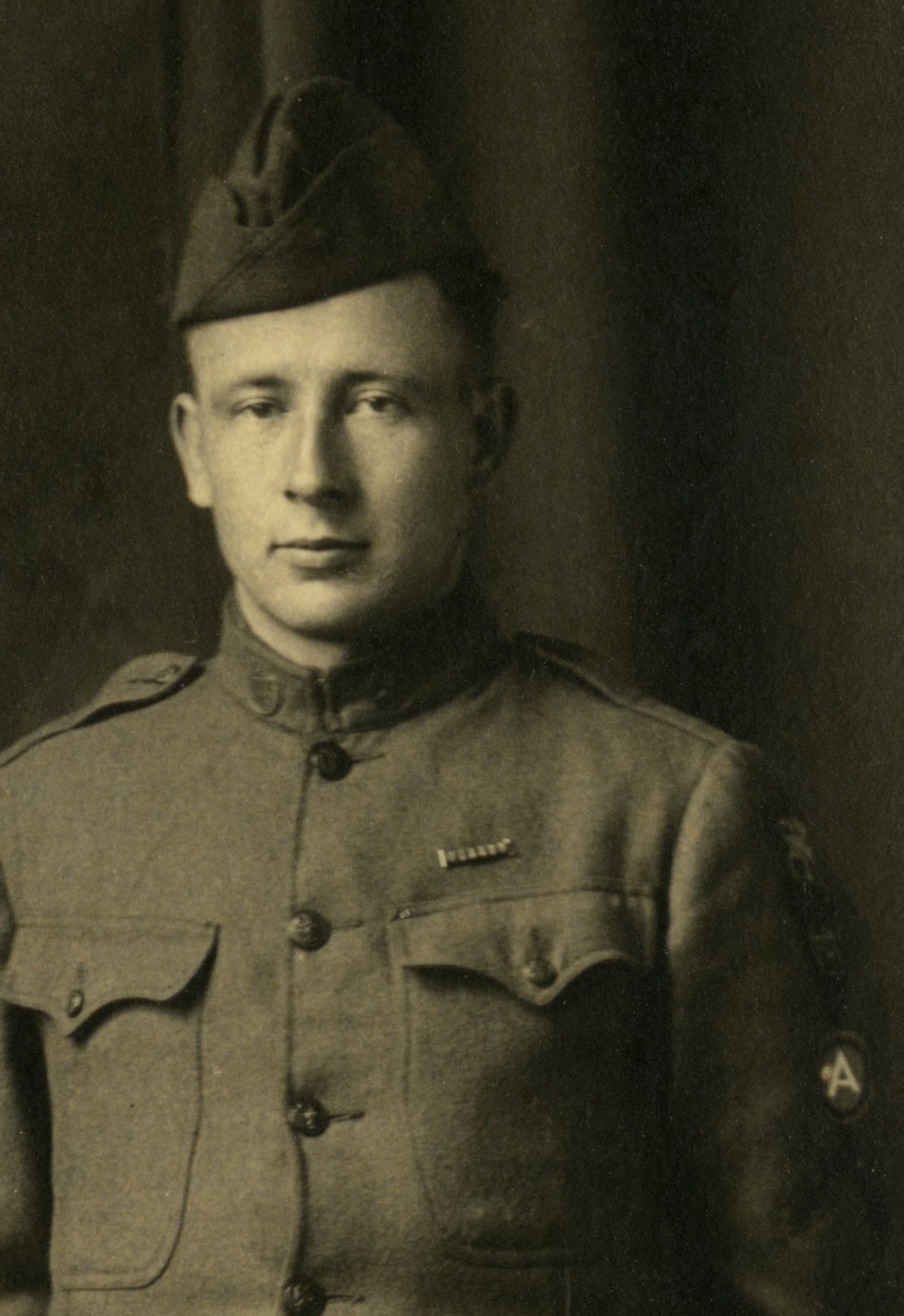
I needed to narrow down the search and the image itself provides a very good way in which to identify one of the soldiers based on his patches.

Clayton Ward

Clayton Ward

See those patches on his left sleeve? They’re from a very famous unit that served in Italy during the war.  In fact, this is an incredibly rare shot that depicts a soldier wearing regimental, divisional and army level patches along with the discharge chevron previously mentioned.  Ok – so we know one of the Ward Boys was in the 332nd Infantry Regiment.  Since the typical US regiment during the war varied between 1000-2000 (roughly), it’s highly unlikely that two men with the last name of Ward were likely to both be from Ohio.  Luckily, my research gamble paid off……

Clayton Ward, H Co. 332nd Infantry Regiment

Clayton Ward, H Co. 332nd Infantry Regiment

Bingo!  After interpreting the abbreviated information in the Ohio WWI book, I was able to determine that Clayton was born in Defiance, Ohio, was 24 years of age, and served with Company H of the 332nd Infantry Regiment.  With the place of birth info, I was able to identify all the additional men in the photo using clues present on each of their uniforms.

A quick search for the 1910 US census record for the Clayton Ward provided me with the names of his brothers:

1910 US Census

1910 US Census

With the census in hand, I was able to make out a few names of brothers who were of-age to serve during WWI.  Clint (short for Clinton) and Perry were easy enough to research.  The same Ohio reference book provided the following:

Clinton Perry

Clinton Ward

Perry Ward

Perry Ward

Based on the information provided in the reference book, Clinton Ward, age 26 1/12 at the time, enlisted with Company G of the 6th Infantry of the Ohio National Guard.  This unit was federalized and became Company G of the 147th Infantry Regiment.  He rose to the rank of Private First Class on May 15th, 1918.  Since I’ve memorized the rank insignia of the AEF, I was able to quick pick him out.
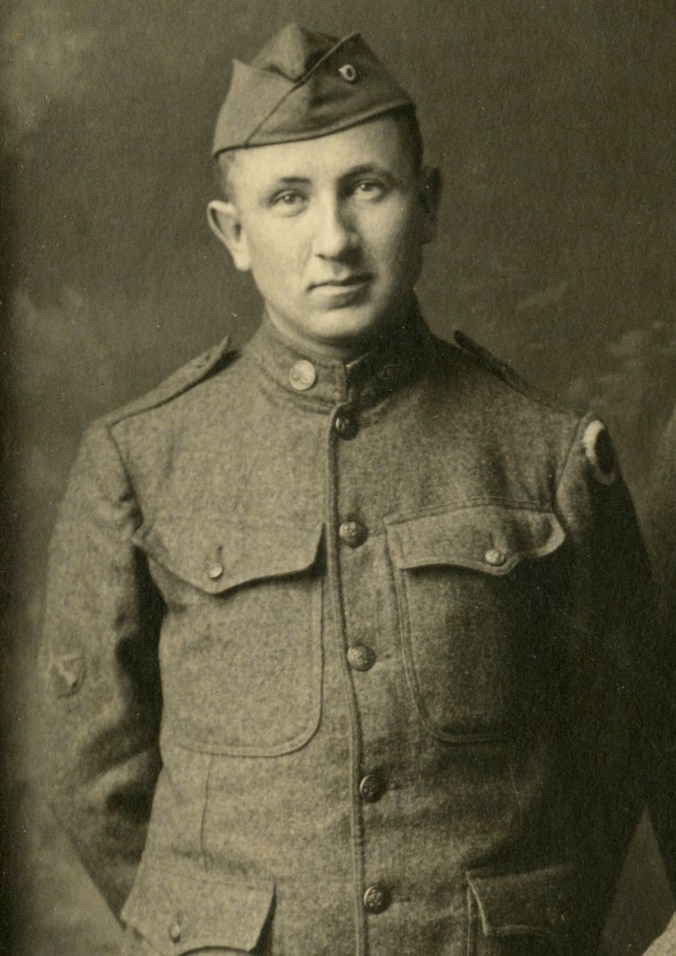
Clinton Ward

Clinton Ward

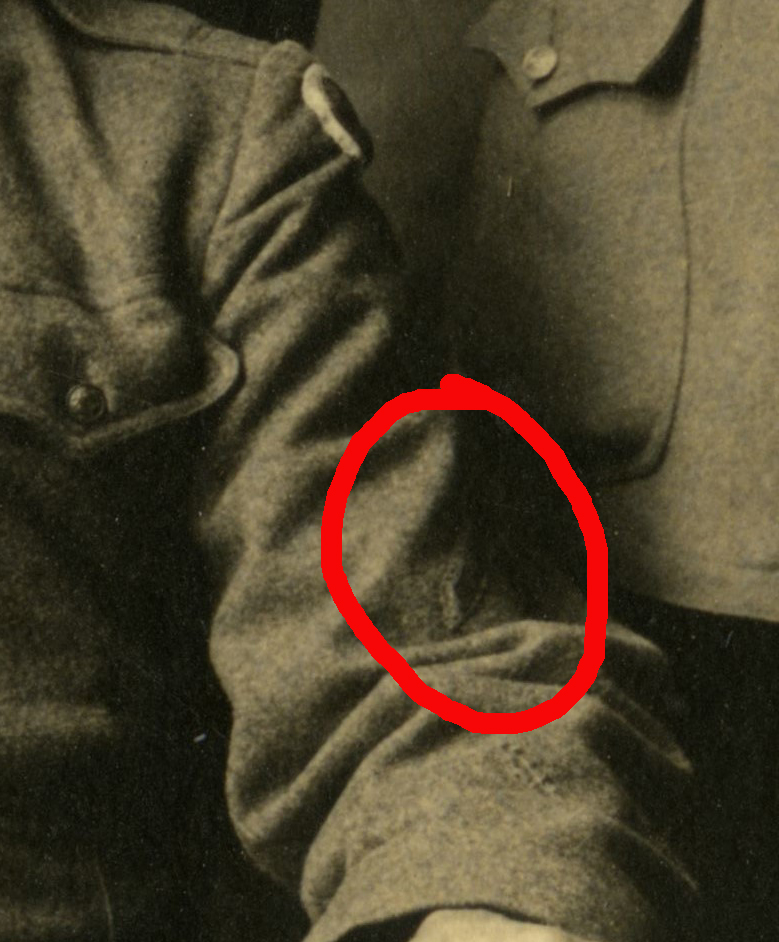
See the round patch on his right arm?  That’s the rank insignia worn by a Private 1st Class during WWI.  I’m including a generic view of the patch below:

Since he’s the only one wearing a Pvt. 1st Class patch in the photo, plus the addition of infantry regiment collar discs, he’s almost certainly Clinton.

Perry Ward

Perry Ward

Although it’s tough to make out in the scan, the soldier is clearly wearing a collar disc that depicts a set of crossed cannon.  This would indicate service in an artillery unit during the war.   Perry’s reference in the aforementioned Ohio WWI book shows that he served with the 52nd Coastal Artillery Company during WWI, which would be supplied with these exact collar discs.

WWI Artillery Collar Disc

WWI Artillery Collar Disc

At this point, I’ve been able to identify three of the four soldiers in the photo based on archival research, visual interpretation and identification of key pieces of military insignia, and a gut feeling.  The last soldier, shown sitting turned out to be a tough nut to crack.

John Ward

John Ward

Ok – so what do we see in the photo?

  • A seated male, appearing to be the oldest based on facial details
  • A 37th Division patch on the left sleeve
  • A discharge chevron and overseas service chevron
  • Corporal rank insignia on the right sleeve
  • Infantry collar disc

In essence, we have an older-looking corporal from the 37th division who served for at least six months (the service chevron) overseas in an infantry regiment.  A detailed search of the Ward’s who served from Ohio in WWI yielded the only possible candidate:

John Ward War Record

John Ward War Record

John Alvin Ward was a brother who separated from the family early in life (no idea why) and eventually rose to the rank of corporal in WWI as part of the 147th Infantry Regiment.  It was tough to parse out the details regarding his upbringing, but the following Social Security information confirms that he was indeed from the Ward family of Defiance, Ohio.

Social Security Records

Social Security Records

At first I was confused about the portion mentioning his father being identified as a William H. Ward, but upon further genealogical research it became clear that his father commonly switched his first and middle names; this is a common practice that becomes terribly difficult for researchers.

So, we have the older brother who left the family and posed with his brothers after returning home from war in 1919.  Sadly, the photograph was discarded at some point and made it’s way into the eBay chain; eventually ending up on the desk of an intrepid WWI researcher (Me!) who was able to bring some context to the photo using easily-accessible internet resources.  I hope I’ve inspired some readers to delve into their own collections of photos in hopes of giving a name to the faces sitting in photo binders and dusty drawers.

Interested in researching Ohio World War One veterans?  Check out the following book:

The Official Roster of Ohio Soldiers, Sailors, and Marines in the World War, 1917-18. Columbus, OH, USA: The F.J. Heer Printing Co., 1926.

Vermont WWI Veteran Post: Rutland County Veterans Return Home – Rare 1919 Celebration Footage


After years of stagnated war, Vermonters were ready to celebrate the return of Rutland County’s men and women in uniform. The Vermont State Fair has been held in the same location every September/October since 1846; nearly 73 years before the film was shot, and exactly 171 years before the date of this blog post.

I purchased this original reel of 1919 footage on the internet from a local Vermont dealer.  The footage was saved midcentury by a famous film preservation specialist, film historian and local Northeast historian named Karl Malkames, who apparently found the footage in disrepair and did his best to conserve the remaining material.

Although the footage was expensive, I was able to find a company to digitize the fragile footage and provide digital files of the film.  The content is spectacular, and MAY represent the first confirmed footage of a plane flying in Vermont………..

The men and women in the film can be clearly seen wearing the WWI Rutland County Service Medal; a commonly sold item on the internet, it’s uncertain how the actual medal was distributed following the war.

WWI medal for wartime service from Rutland County, Vermont

WWI medal for wartime service from Rutland County, Vermont

WWI medal for wartime service from Rutland County, Vermont

WWI medal for wartime service from Rutland County, Vermont

And for those of you who don’t know Rutland…. here’s an aerial view of the Agricultural Fairgrounds where this footage was taken in October of 1919.

Rutland County Fairgrounds

Sgt. Rufus M. Pray of the 3rd Vermont Infantry Regiment: Three Times Wounded Veteran From Woodbury/Calais, VT


civwar916

Rufus Pray ca. 1861

rufus

Little nuggets of historical importance can be found in the strangest of places.  The following photograph was discovered at a local flea market for less than $20.00 US.  The tintype was in terrible condition, with major flaking of the image, oxidation damage and was missing a proper case.  The flea market dealer gave me the family name of the estate the photograph came from and I was content to conduct some research on the image.  At first glance, it appeared to be a standard “armed” shot of a Union Army solider sporting corporal stripes and a pronounced beard.  Colored tint had been added to the cheeks; coloring of images was a common addition by 1860s photographers.

civwar915

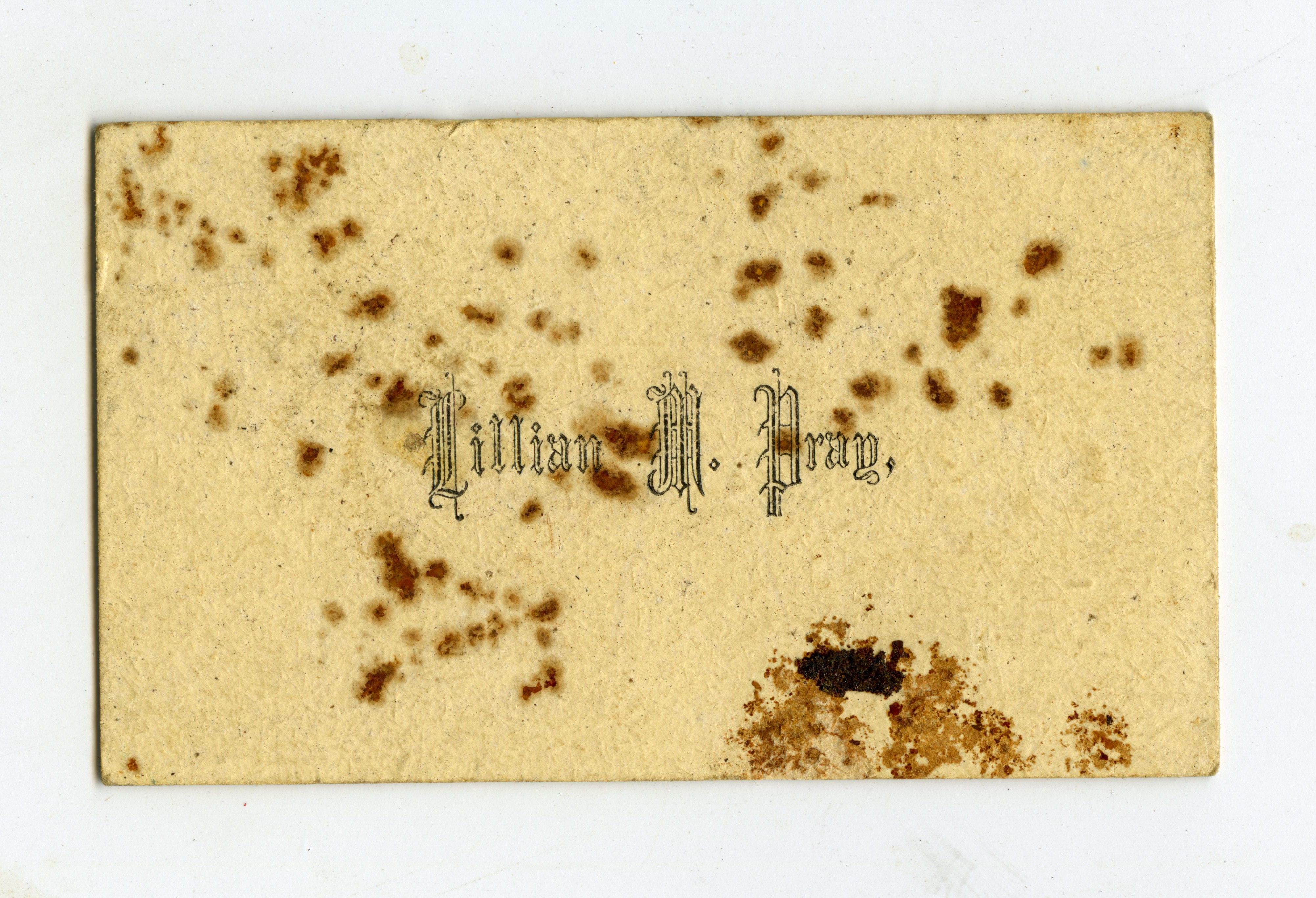
Calling Card of Lillian M. Pray

Upon carefully inspecting the photograph, it became clear that the image depicted the father of a Lillian Pray; her Victorian era calling card was carefully tucked into the back of the tintype.  Using the power of the internet, I was able to find the identity of her father, as well as a wealth of information related to his wartime exploits and his civilian life here in Vermont.

civwar914a16

Rufus Pray after Photoshop

Please enjoy the following information regarding Sgt. Rufus M. Pray.

The following biography can be found on page 326 of:

Men of Vermont: An Illustrated Biographical History of Vermonters and Sons of Vermont

Compiled by: Jacob G. Ullery

“Rufus M. Pray, of South Woodbury, son of Thomas and Polly (King) Pray, was born in Calais, April 8th, 1844.

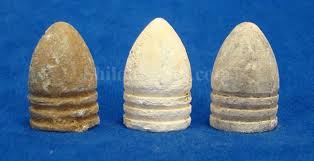
His father’s calling was that of a carpenter and joiner, who was a long time resident of the town, in the schools of which Rufus received his education.  The latter, a mere lad of seventeen, did not resist the patriotic impulse that moved him to enter the rank of the Union army, and enlisted in the 2nd New Hampshire Volunteer Infantry Regiment, which for three months garrisoned at old Fort Constitution on the seacoast of that state.  On his journey homewards, he stopped at St. Johnsbury, where Co. J, of Calais, 3rd Regt. Vt. Volunteers were engaged in their daily drill, and such was the enthusiasm of the young volunteer, that he at once re-enlisted without bidding farewell to the loved ones at home or crossing the paternal threshold.  Mr. Pray share the fortunes of the gallant third in all its numerous engagements from Lewinsville and Lee’s Mills, to the bloody Battle of the Wilderness, where he was wounded in foot and forehead, and was sent to the S.A. Douglas hospital in Washington, from thence transferred to the U.S. General Hospital at Montpelier, from which he boldly returned to active duty before his wounds were wholly healed.  He then experienced the vicissitudes of Sheridan’s Shenandoah campaign, and at Cedar Creek, while on the skirmish line, received a dangerous wound in his hip, which was traversed by a minie-ball.  He was carried twelve miles in an army wagon to Sheridan Hospital, then sent to Frederick, Maryland, and later to Montpelier, where he received an honorable discharge after a gallant service of four years, one month, and twenty-six days, during which time he was not excused from duty a single hour, except when wounded.

US Minie Ball

US Minie Ball

Since his return from the army, though for more than a year a cripple, he has been able to labor a little at his trade of carpentry and joiner, and to cultivate with effort a small farm.

Mr. Pray was married August 8th, 1864 to Nellie A., daughter of David and Sabrina (Chase) Whitham of Woodbury.  One child has been the fruit of this wedlock: Lillian M. (Mrs. Robert B. Tassie of Montpelier).

Mr. Pray is still a member of that party for whose political principles he fought and bled.  He was appointed postmaster at South Woodbury, July 12th, 1889, under President Harrison, and held that position until his resignation on being elected to the Legislature of 1892 by an unusual majority.  He was town treasurer 1891-1892.”

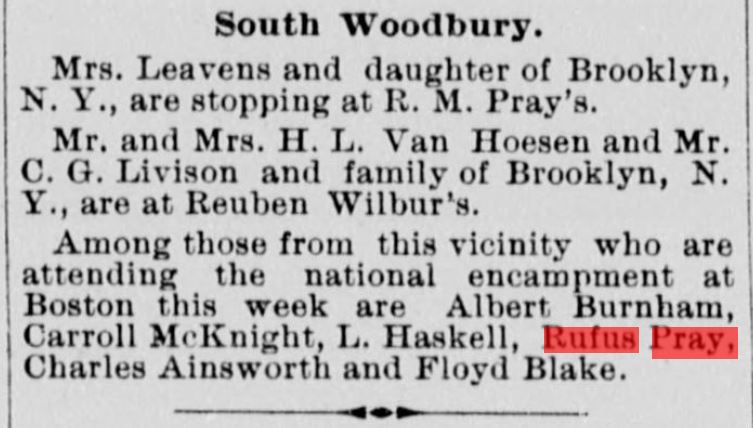
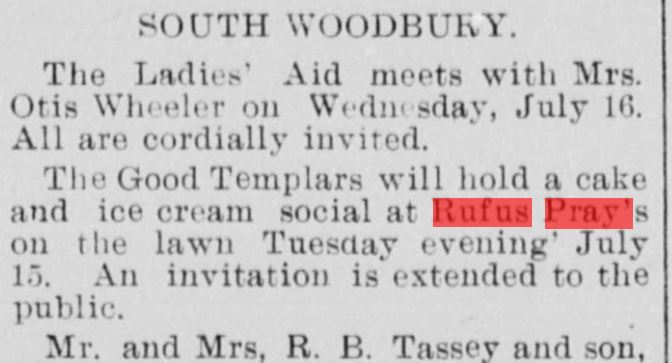
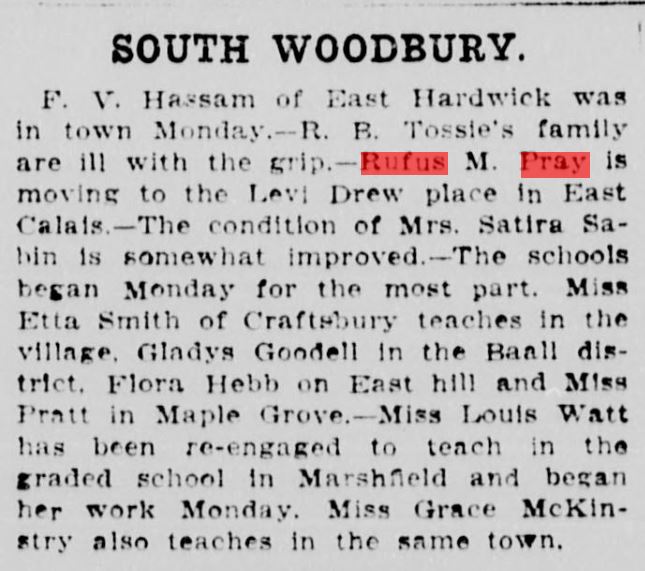
Rufus appears in a number of Vermont newspapers for his civic duty as well as his attendance at national Civil War events. He was quite active in the local unit:

August 1890 GAR Encampment

August 1890 GAR Encampment

The 1890 GAR Encampment was in Boston

The 1890 GAR Encampment was in Boston

Templar Cake and Ice Cream Party at the May House

Templar Cake and Ice Cream Party at the Pray House

Rufus Moves Home to Calais

Rufus Moves Home to Calais

Visualizing Shell Shock in World War One: Footage from the British War Archives


WWI has the dubious distinction of being the first modern war to be fought with the mass of industrial mechanization and production in close support.  To a lesser extent, this distinction is also often shared with the American Civil War.  The mental distress of the soldiers involved in this global war are well known to most schoolchildren enrolled in Social Studies or History classes.  The psychiatric distresses imparted upon these men during the massive artillery bombardments of 1914-1918 are best exemplified in the following video made available by the British War Archives.

Select section 3 in the left hand drop down menu.  Or watch the whole series!

Birth of the American Graphic T-Shirt: The Las Vegas Gunnery School Official WWII Shirt


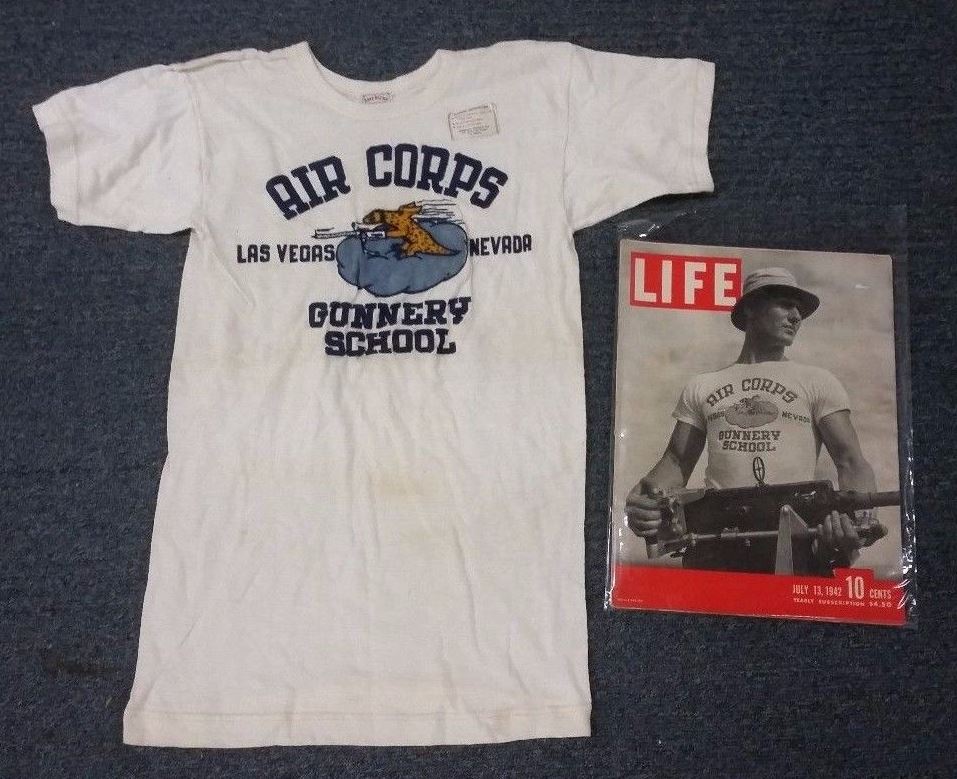
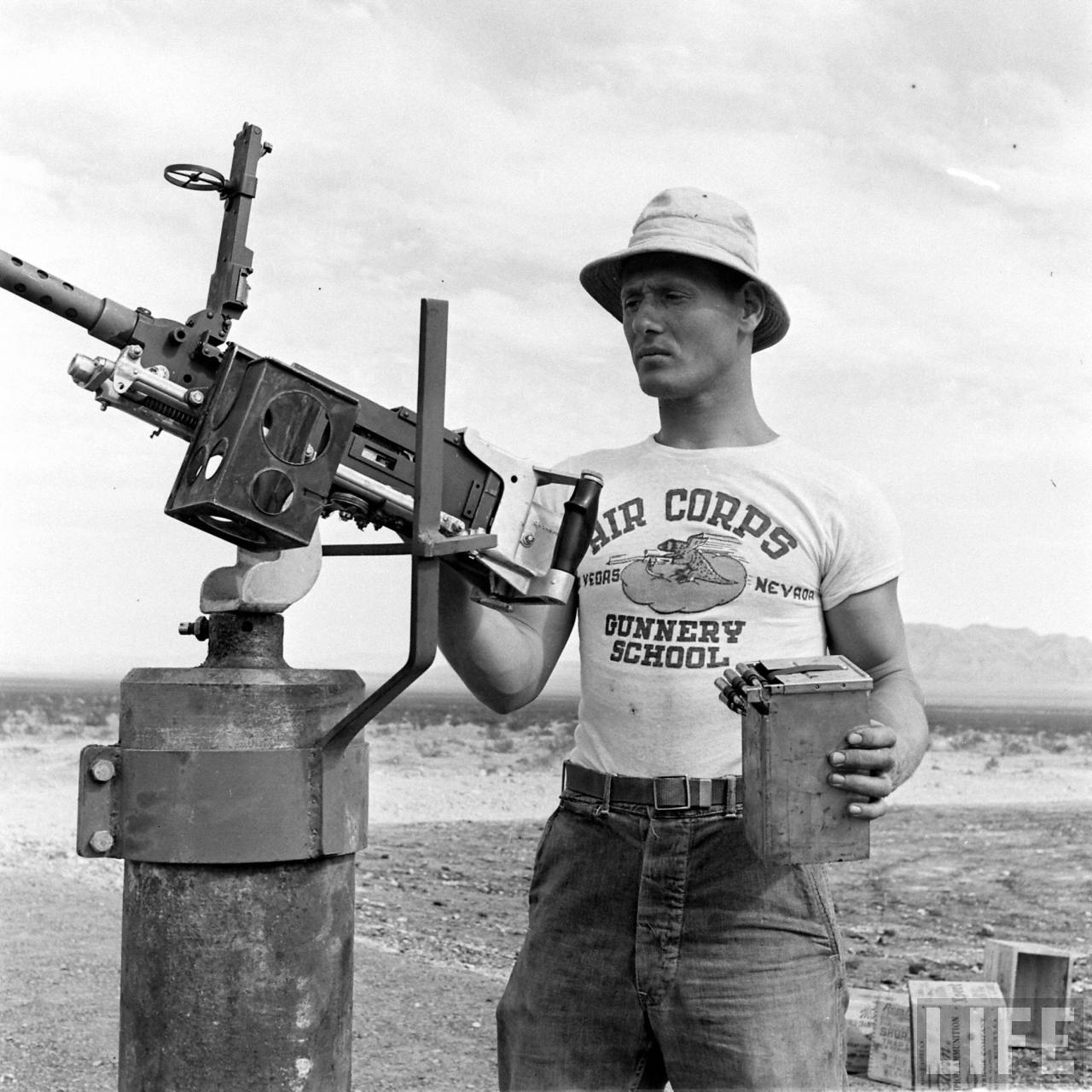
Corporal Alexander Le Gerda in his 1942 LIFE Appearance

Corporal Alexander Le Gerda in his 1942 LIFE Appearance

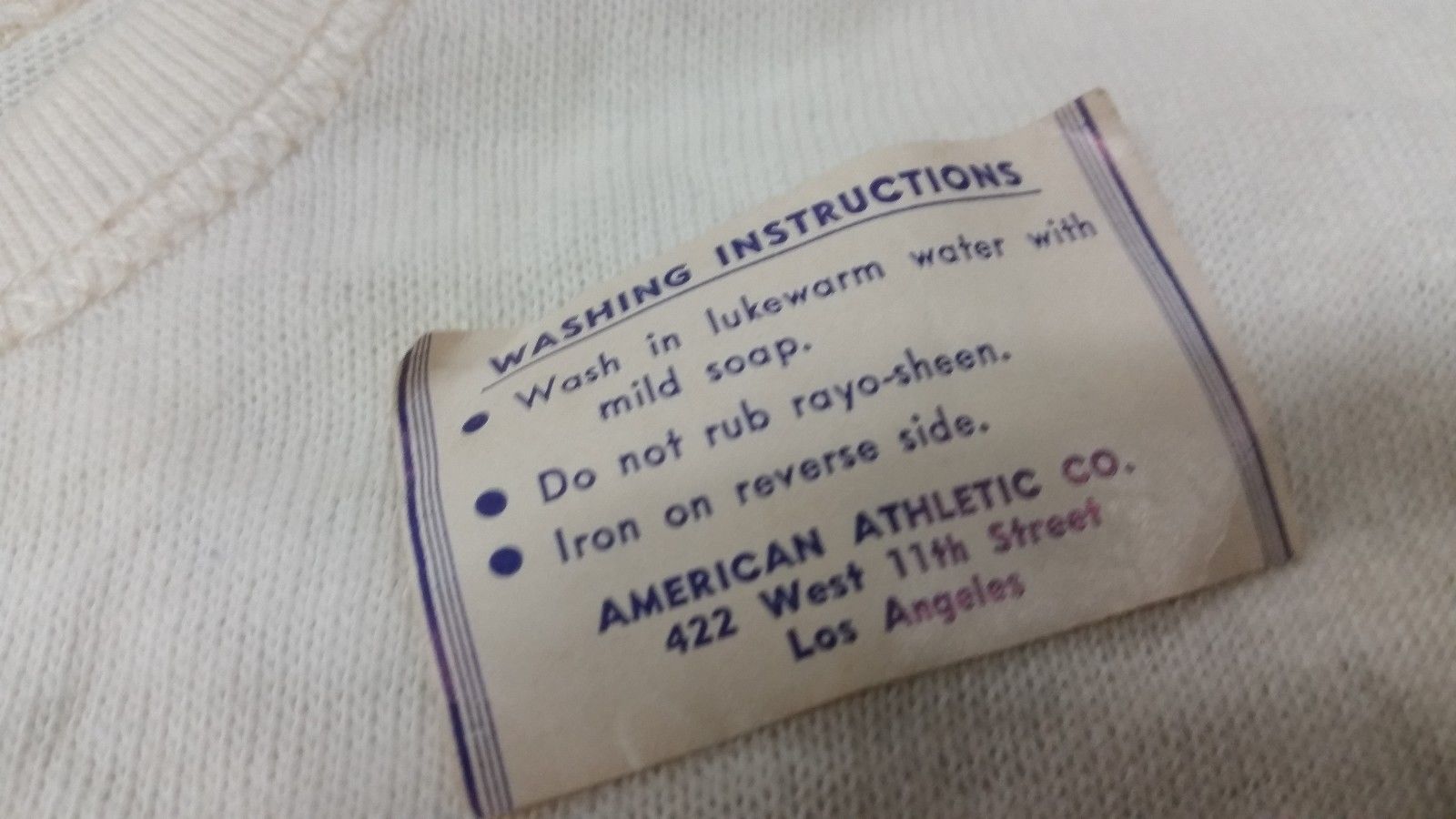
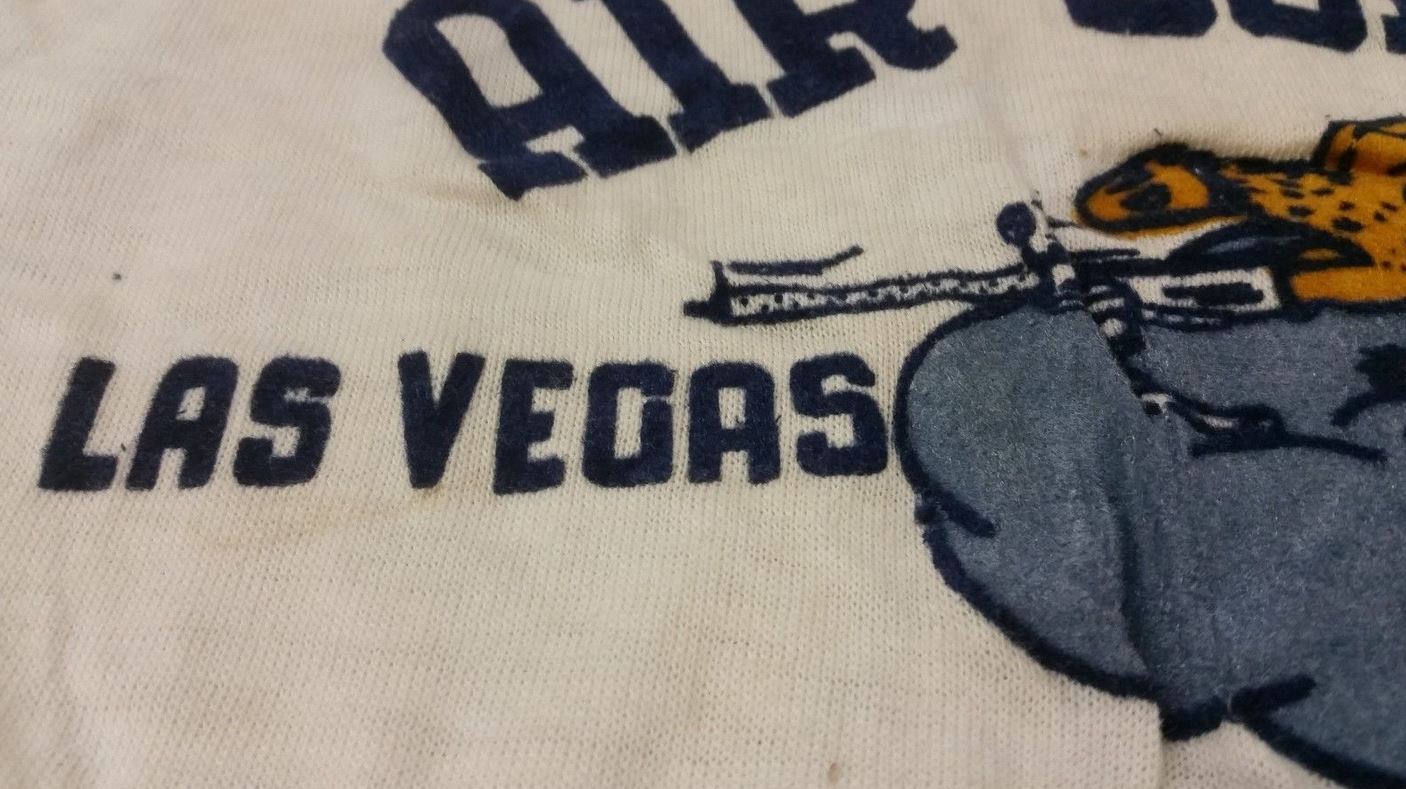
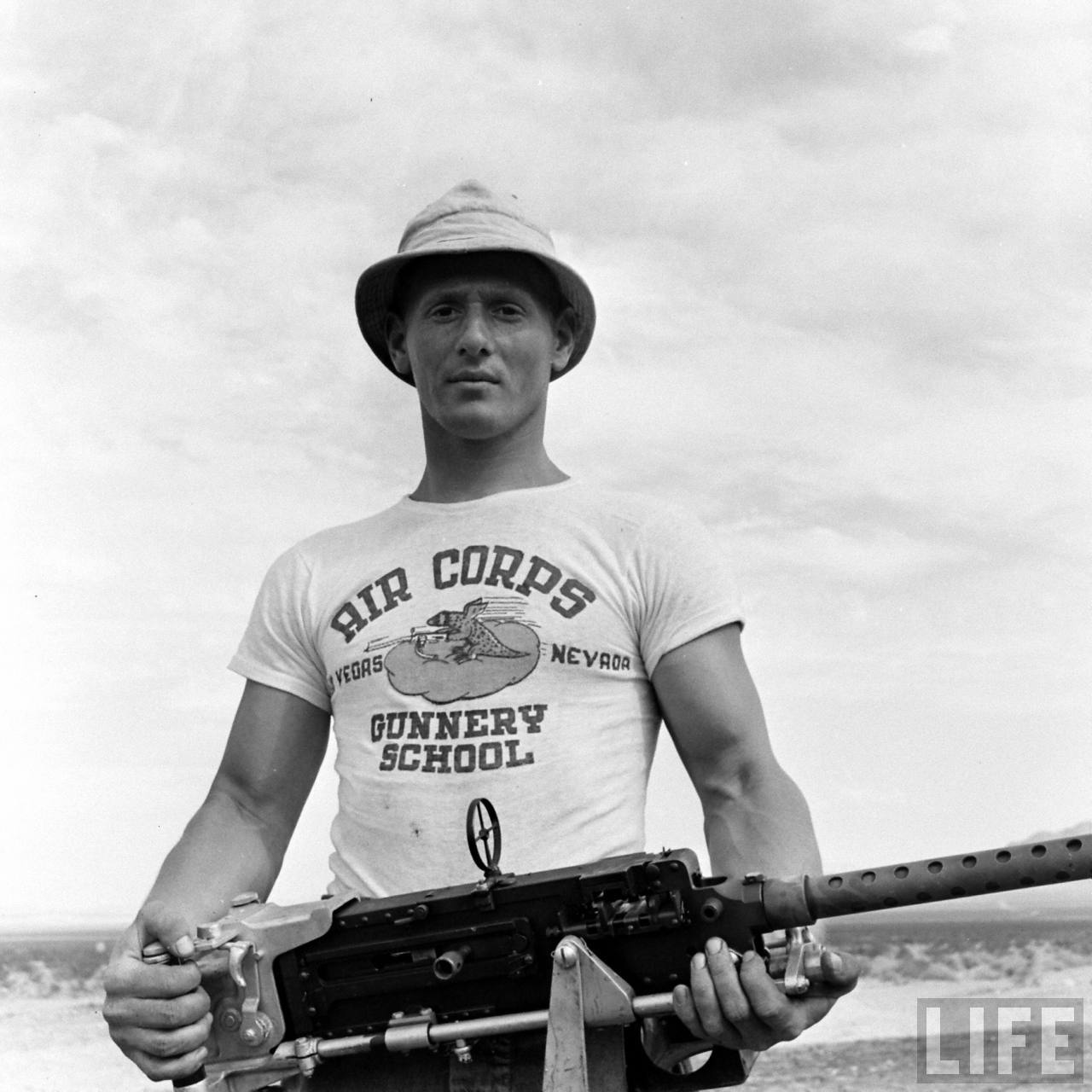
Corporal Alexander Le Gerda is the first person in history to be included in a popular magazine  wearing a  graphic t-shirt.  His photo made the July 13th, 1942 cover of LIFE Magazine cradling a .30 cal. machine gun and sporting a tight fitting athletic tee made by the American Athletic Co. in Los Angeles, CA.  An original version of this shirt recently sold (August, 2015) for over $1,000 USD.   The shirt depicts a winged horned toad shooting a .30 calibur machine gun perched upon a cloud.  The shirt is commonly reprinted but with incorrect colors for the mascot.  The true color is a yellow ocher, when some sites print the shirts with a light blue.   Screengrabs from the completed auction can be found here:

This original 1942 Las Vegas Gunnery School T-Shirt sold for $1,009 on August 23rd, 2015

This original 1942 Las Vegas Gunnery School T-Shirt sold for $1,009 on August 23rd, 2015

Original Laundry Instructions

Original Laundry Instructions

Closeup of Text Applique

Closeup of Text Applique

Winged Armadillo

Winged Horned Toad

American Athletic Co. Tag

American Athletic Co. Tag

Although spelled Le Gerda in the original 1942  LIFE article, Alexander’s surname is correctly spelled as Legerda in official government documents.  Among the multitude of internet sites dedicated to the poster child of the American graphic T-shirt, none delve into the life of Mr. Legerda.  Here at Portraitsofwar, we strive to dig out the details hidden in plain sight.

I first started with a social security death index search for Alexander Le Gerda.  The article mentions that Alexander was 23 at the time of the article, and I based my birth year search at 1919 to be safe.  No hits on ancestry for an Alexander Le Gerda…… but a solid hit for a LeGerda of the same first name.  Eventually rising to the rank of Sgt. with the 94th Bomb Group during WWII, LeGerda was born and raised in the Lehigh Valley area of Pennsylvania.  Lehigh Valley is generally located north of Philadelphia and west of New York City, and encompasses a handful of towns along the NY/PA border.

Alexander was born on April 24th, 1919 and passed away on August 3rd, 1998 at Sacred Heart Hospital in Allentown, where he worked as a maintenance man for 1601 Realty.   His 1998 obit can be found below:

Alexander LeGerda; 79; Allentown; died Monday, Aug. 3, Sacred Heart Hospital; husband of Elizabeth “Shay” (Albert) LeGerda; married 52 years in June; maintenance man, 1601 Realty, Allentown, 14 years, retiring 1992; 1942, became first Lehigh Valley resident to have picture on cover of Life magazine, subject of a feature story about work in Army gunnery school in Las Vegas; born Topton; son of the late Elias and Mary (Krauss) LeGerda; member, St. George Antiochian Orthodox Church, Allentown; Army Air Corps veteran, World War II; sergeant, 94th Bomber Group. Survivors: wife; daughter, Donna Shay LeGerda, wife of Aaron Kotzin, Soldotna, Alaska; sisters, Mary Shahda, New Orleans; Anna Noble, Quakertown; Helen Springer, Rosewood, Calif.; granddaughter. Weber Funeral Home, 502 Ridge Ave., Allentown.
[obituary, The Morning Call, Allentown, PA, Wednesday, August 5 1998, page A-11]

In the coming weeks, I hope to reach out to family members to see if any stories passed down from Alexander in regards to his time as a cover model for the Air Force Gunnery School.  I wonder if he was aware of his singular fame as the first person to wear a custom printed t-shirt in mass media?  These shirts were common during the war, and I have dozens of examples of uniquely printed unit-based and camp-based printed tees during the war, but this is the singular example of a popularization image of the soon-to-be popular graphic t-shirt.

The photos were taken by famed documentary photographer Eliot Elisofon and are available for viewing in the LIFE magazine archives.

Another View of Legerda

Another View of Legerda

Full Frontal

Full Frontal

Dogs of War: A Saint Bernard Mascot – 67th Coastal Artillery Company Veteran “Barney”


It’s been a long time since I’ve posted here to PortraitsofWar, so I’m taking a quick moment to add a recently acquired real photo postcard of a St. Bernard mascot from the 67th Coastal Artillery Company. He’s even sporting his own uniform!  Check out the 1st Army variant patch with the 67 denoting the unit number and a double overseas chevron for a year of service.  Good work Barney!

Mascot photos are one of my favorite avenues of WWI photo collecting. They are relatively hard to come by and are tough to research.  All the better for a unique challenge when trolling through the pages of eBay.


Barney the St. Bernard in WWI

Barney the St. Bernard in WWI

WWI Photo Post – Lincoln Leslie Loper w/ Gas Mask Returns Home From France January 1919


Lincoln Leslie Loper served in France with a military medical unit during the last year of WWI.  Born and raised in Iowa, Loper  eventually worked his way to Washington, living in Seattle as early as 1942.  It’s tough to trace an individual based on scant information, but I’ve been able to deduce that he passed away in 1972 based on his military records.

Lincoln L. Loper in a Gas Mask, 1919

Lincoln L. Loper in a Gas Mask, 1919

LIncoln Loper Postcard Backside

Lincoln Loper Postcard Backside